Bellarmine Jugs: How to Date a Bartmann by Its Mask and Medallions
A Bellarmine jug is a salt-glazed stoneware jug or bottle from the Rhineland with a bearded face moulded onto its neck. Museums now usually call it a Bartmann, German for “bearded man”. They were made in enormous numbers from the early sixteenth century to the end of the seventeenth, and copied in England from the 1670s. Four things date one, and they are worth reading in this order: the medallion, the decoration on the body, the mask, and whether it is German or English. The table near the end puts them together.
Table of Contents
Bartmann or Bellarmine: What You Are Looking At
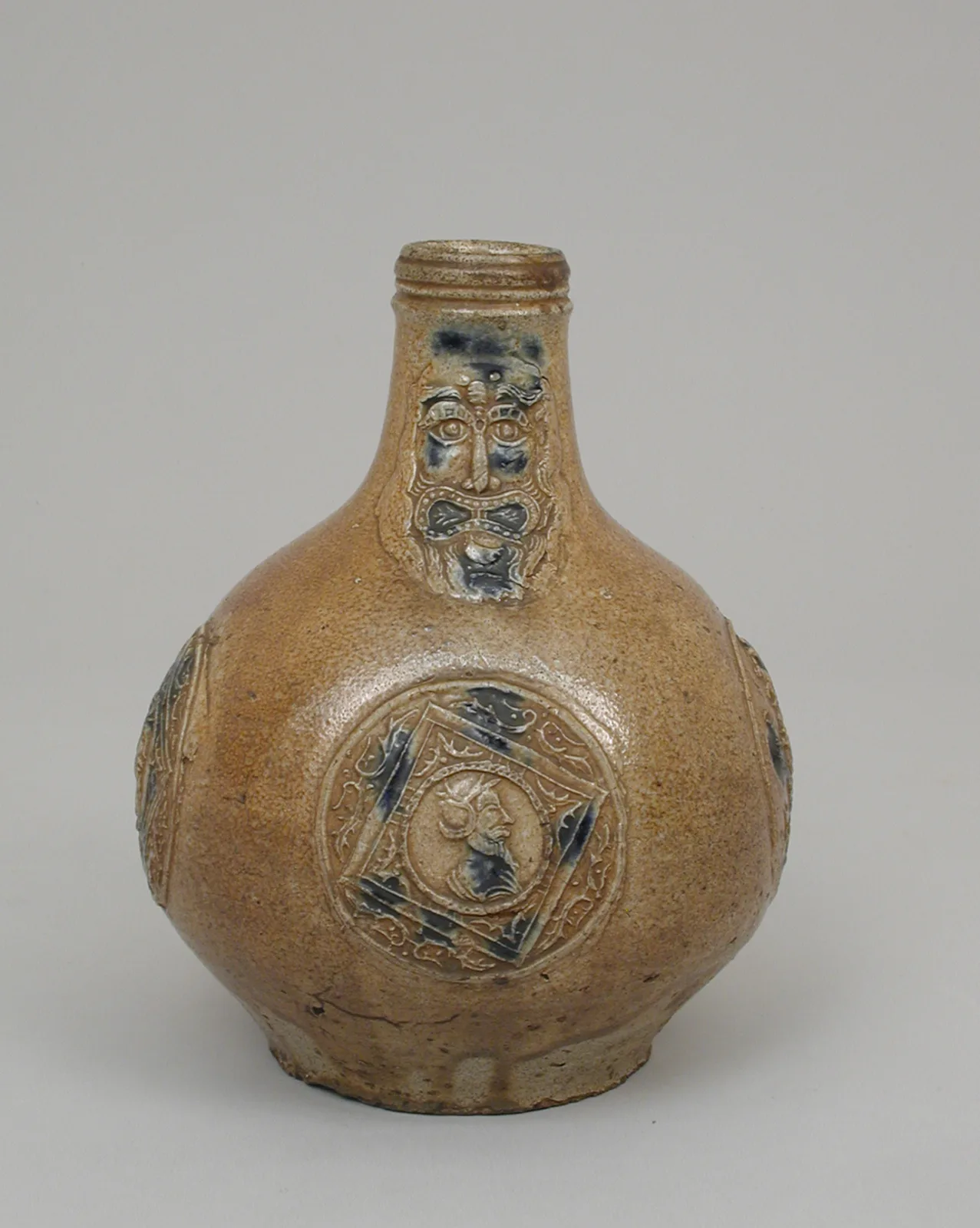
The jug was thrown on the wheel in grey stoneware and fired hot enough for salt thrown into the kiln to form a thin, tight glaze (the V&A; Historic Jamestowne). The face and any medallions were sprig-moulded: pressed in a small mould and stuck onto the pot before firing (the V&A; the Museum of London). The main centres were Cologne and, later, Frechen just outside it (the V&A; Britannica).
The English name comes from Cardinal Robert Bellarmine (1542–1621). The V&A and Britannica both describe the masks being used in Protestant northern Europe to mock him, but the face is older than the joke. The Museum of London's Jacqui Pearce and Wikipedia both connect it instead with the “wild man” of northern European folklore.
Stoneware from the Westerwald, another Rhenish centre, is covered in the beer stein guide, and the salt-glazed crocks and jugs of nineteenth-century America in the stoneware crocks guide. Neither carries a moulded face on the neck.
Before 1550: Cologne, Oak Leaves and a Careful Face
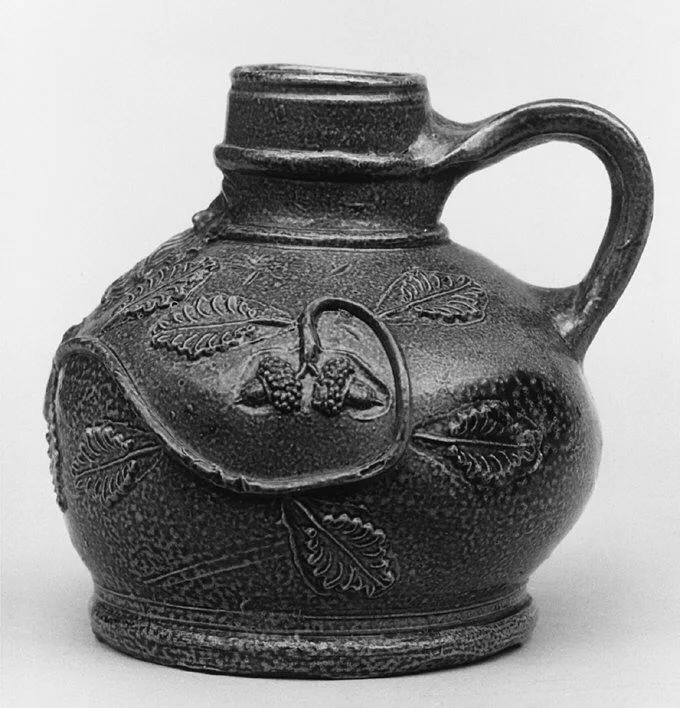
The earliest Bartmann jugs come from Cologne in the second quarter of the sixteenth century. Their bodies are covered in applied oak leaves and acorns: the V&A has a Cologne pitcher of 1525–50 and a jug of about 1540 decorated this way, and Wikipedia gives oak-leaf-and-acorn or floral relief as the sixteenth-century norm. The V&A's jug of about 1540 was recovered near the wreck of the Mary Rose, which sank in 1545, so the type was in use by then.
The early face is modelled with care. Pearce describes a Museum of London jug of about 1500–1550 with “carefully delineated” features and a flowing beard, unlike the stylised, often fierce masks of later Frechen; Wikipedia describes the same decline.
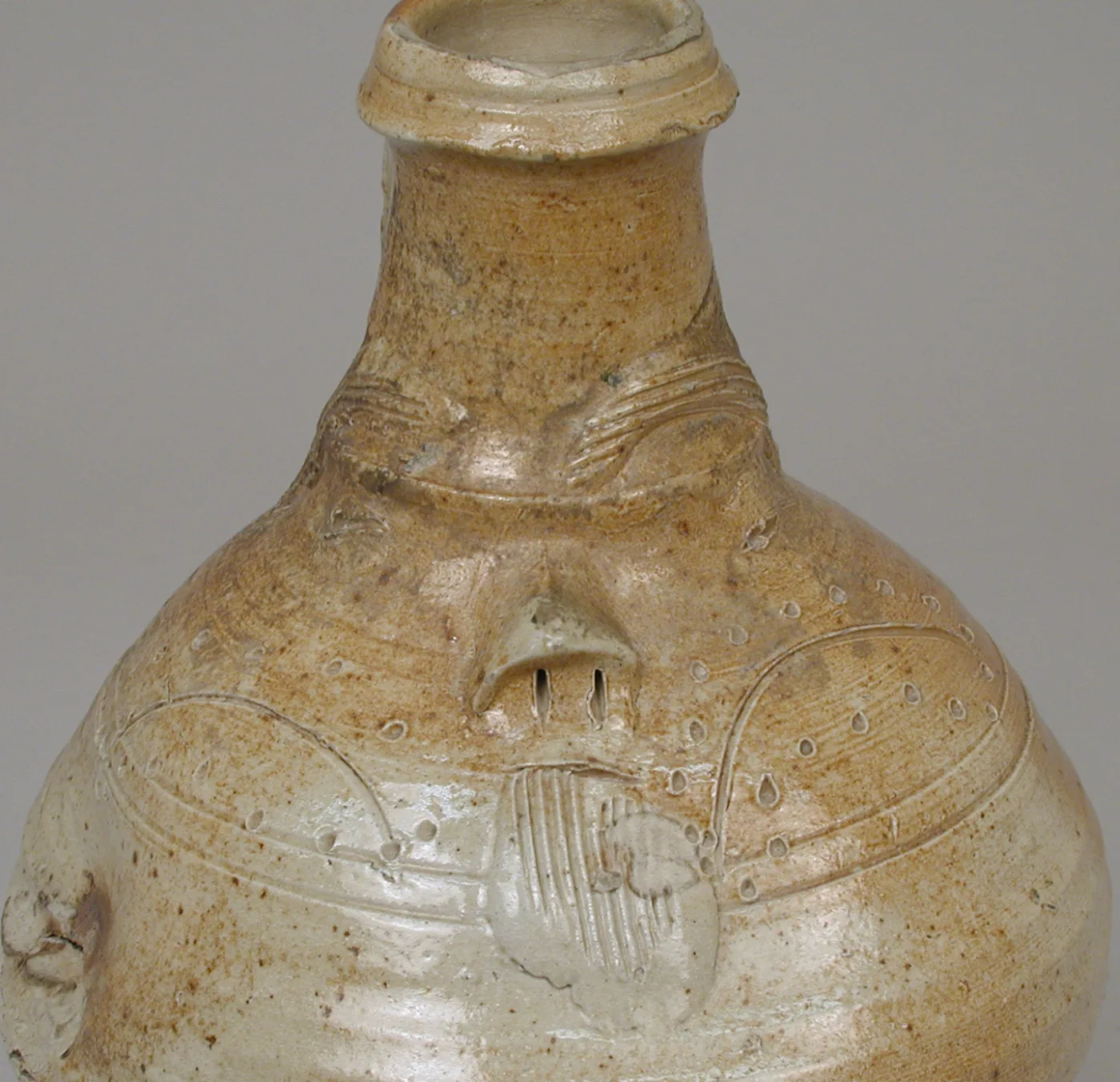
That difference is worth checking on anything offered as “early”. A face drawn into the clay by hand is a different kind of pot; a Bartmann face is a separate, moulded piece, and on the jug at the top of this page you can see its edges where it was pressed onto the neck.
Medallions: The Closest Thing to a Date
By the end of the sixteenth century the body usually carries one to three round or oval medallions instead of all-over leaves. Historic Jamestowne and Wikipedia both list what they show: the arms of cities, duchies, noble families or royalty, portraits, and sometimes a date. Read the medallion before anything else, because it can do three things.
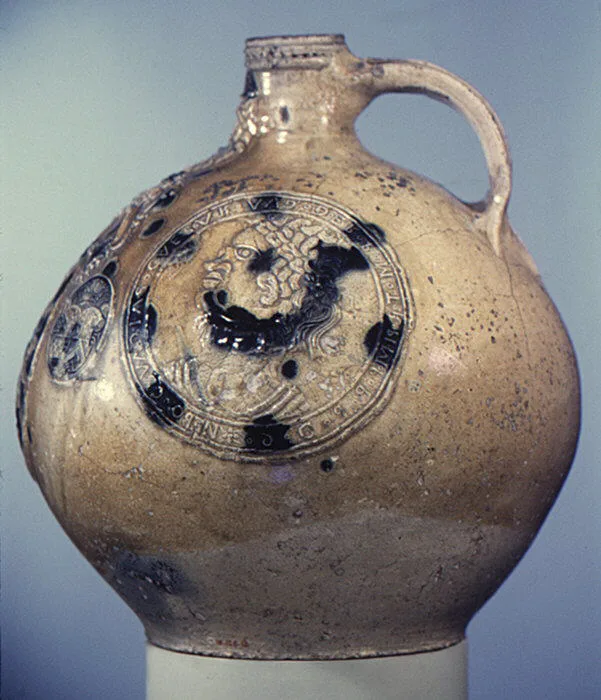
- Give a year. Dated medallions are common enough to look for: the Met's bottle of 1595, a V&A Raeren jug dated 1601, a Frechen jug of 1607 sold at Bonhams.
- Give a window through heraldry. A V&A jug found at Hampton Court bears the royal arms of England as they were borne until Elizabeth I died in 1603, which is why it is dated about 1585–1600. The arms of the Rhineland duchy of Jülich-Kleve-Berg appear on a V&A Frechen bottle of 1600–50 and on the 1607 Bonhams jug.
- Name the merchant. Frechen potters applied the names or marks of the Dutch dealers who shipped their bottles. The V&A has bottles with medallions of Jan Allers (active about 1580–1600), “IODK” for Jan op de Kamp (about 1660–65) and a reversed “PVA” for Pieter van den Anker (about 1665).
That trade, from Cologne through Amsterdam and Dordrecht to England (Historic Jamestowne; the V&A), is why so many survive in Britain and America. The delftware guide covers the tin-glazed earthenware that often comes out of the same ground.

Frechen, 1600–1700: The Face Gets Coarser
By about 1600 the Frechen bottle had settled into a standard form, and the V&A describes it continuing with only minor changes to the profile, and a gradual fall in quality, to the end of the seventeenth century. Three things on the surface are typical:
- A mottled brown skin. The pot was dipped in an iron-rich slip before firing, and the salt glaze turned it glossy and speckled, the surface collectors call “tiger” glaze (Historic Jamestowne; the Keramion museum in Frechen).
- Blue on the mask and medallions. Cobalt was splashed on the applied parts (Historic Jamestowne; the V&A's Jan Allers bottle).
- One to three medallions around the belly, sometimes none (Historic Jamestowne).
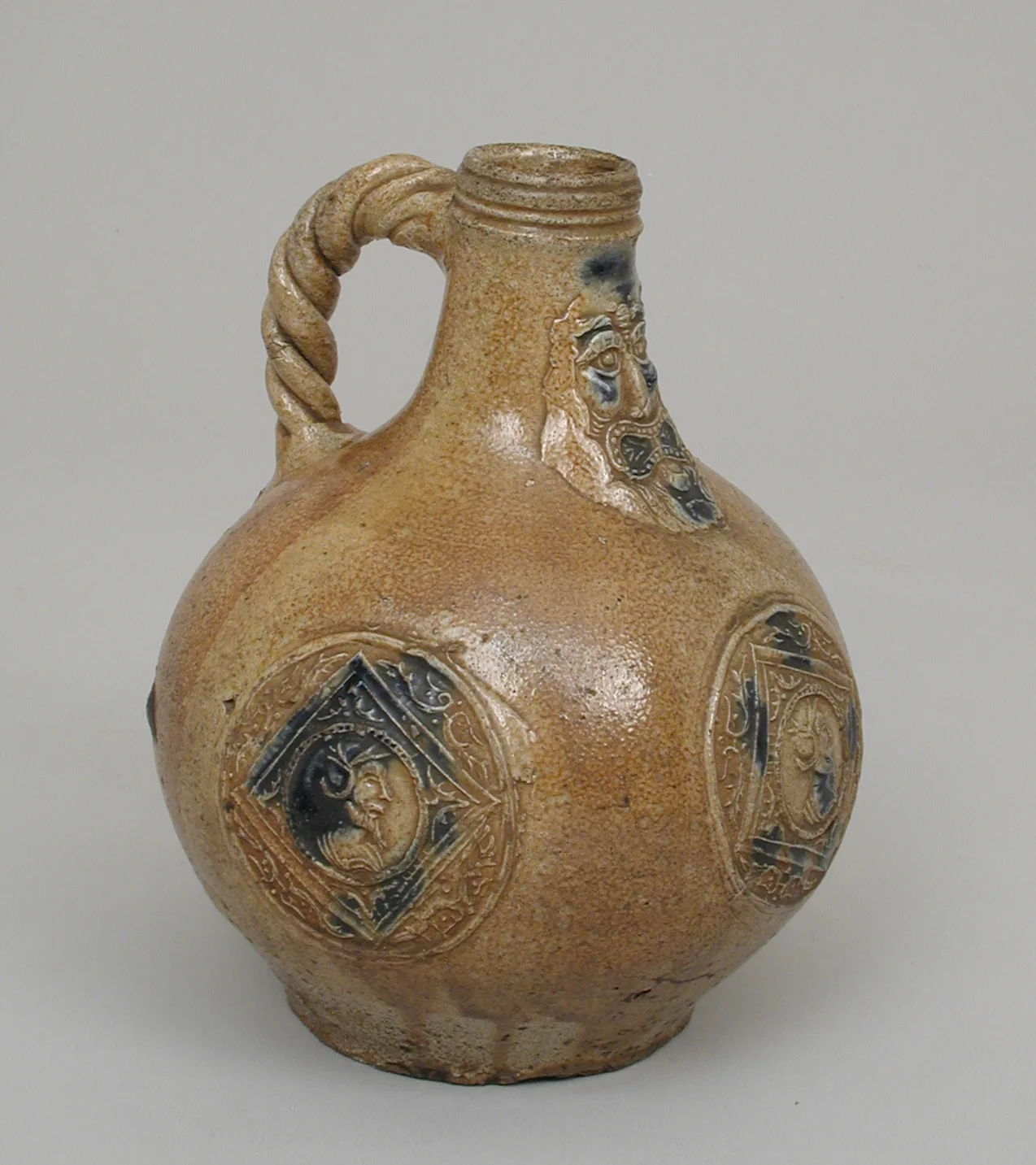
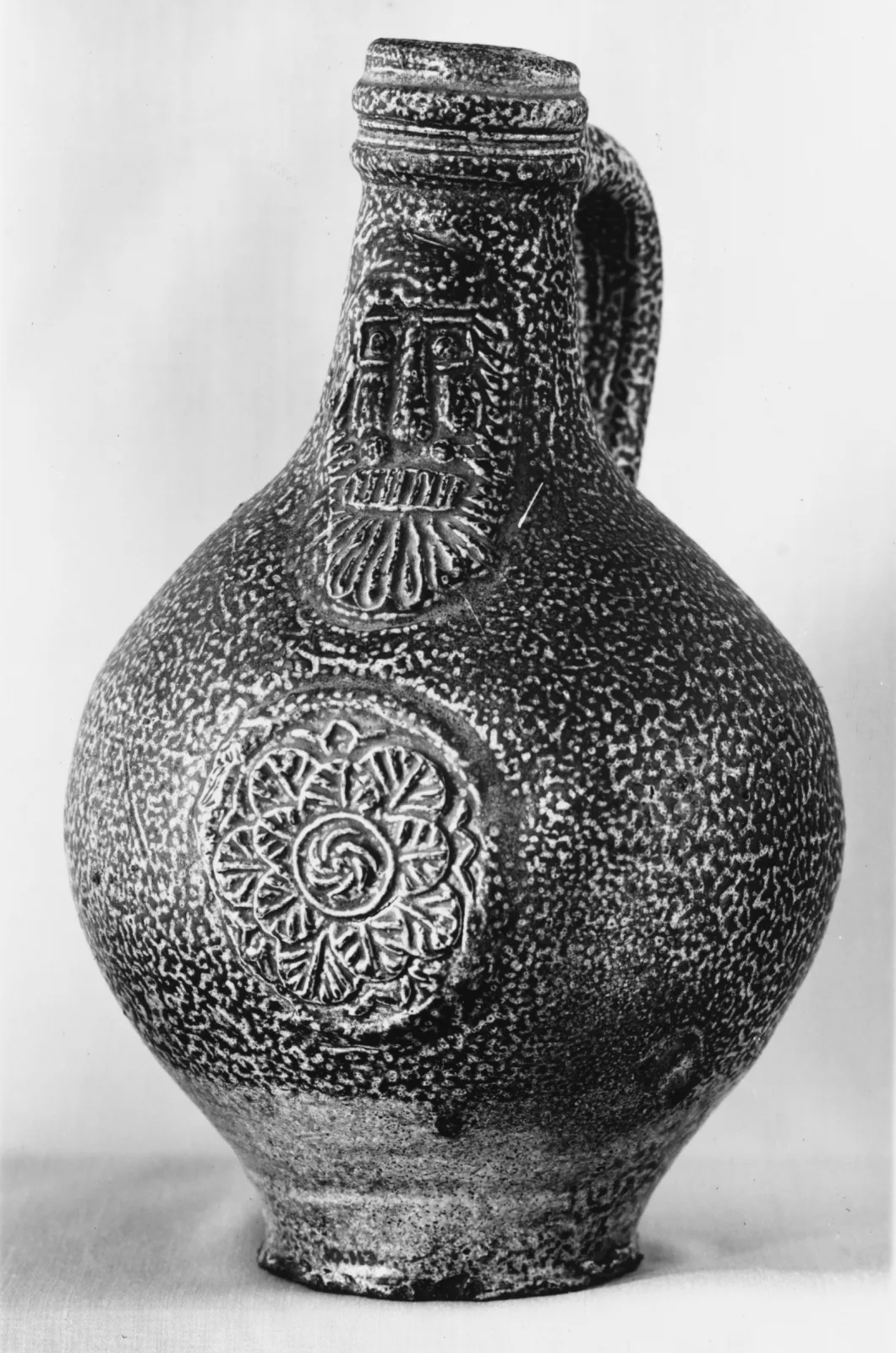
The mask is a trend, not a calendar. At James Fort, Virginia, Historic Jamestowne finds that faces from about 1607–24 are “ordinarily realistic and smiling”; the Met's jug of 1660–80 above shows where many ended up. But good and poor masks overlap in date, and the Royal Albert Memorial Museum in Exeter already calls the face on a Frechen jug of about 1540–80 “grumpy”. Use the face to support a date from the medallion, never to replace it. Production did not stop in 1700 either: the Albany Institute dates a Frechen jug to about 1700, and the Basel Historical Museum says Frechen went on into the eighteenth century.
English Copies After 1672
England relied on Rhineland stoneware until the 1670s: Historic Jamestowne estimates at least 100,000 pieces had come in through Holland by 1600, and the V&A calls Britain entirely dependent on Germany until 1672. John Dwight of Fulham patented stoneware, then called “Cologne ware”, and William Killigrew applied for the same process about two weeks later (the V&A; Grace's Guide). The V&A, the Museum of London and Wikipedia give Dwight's patent as 1672; Britannica and Grace's Guide give 1671. Grace's Guide places both applications in April 1672, so we read the start as 1672. The V&A's Killigrew bottle, made at Southampton, carries a medallion dated 1674.
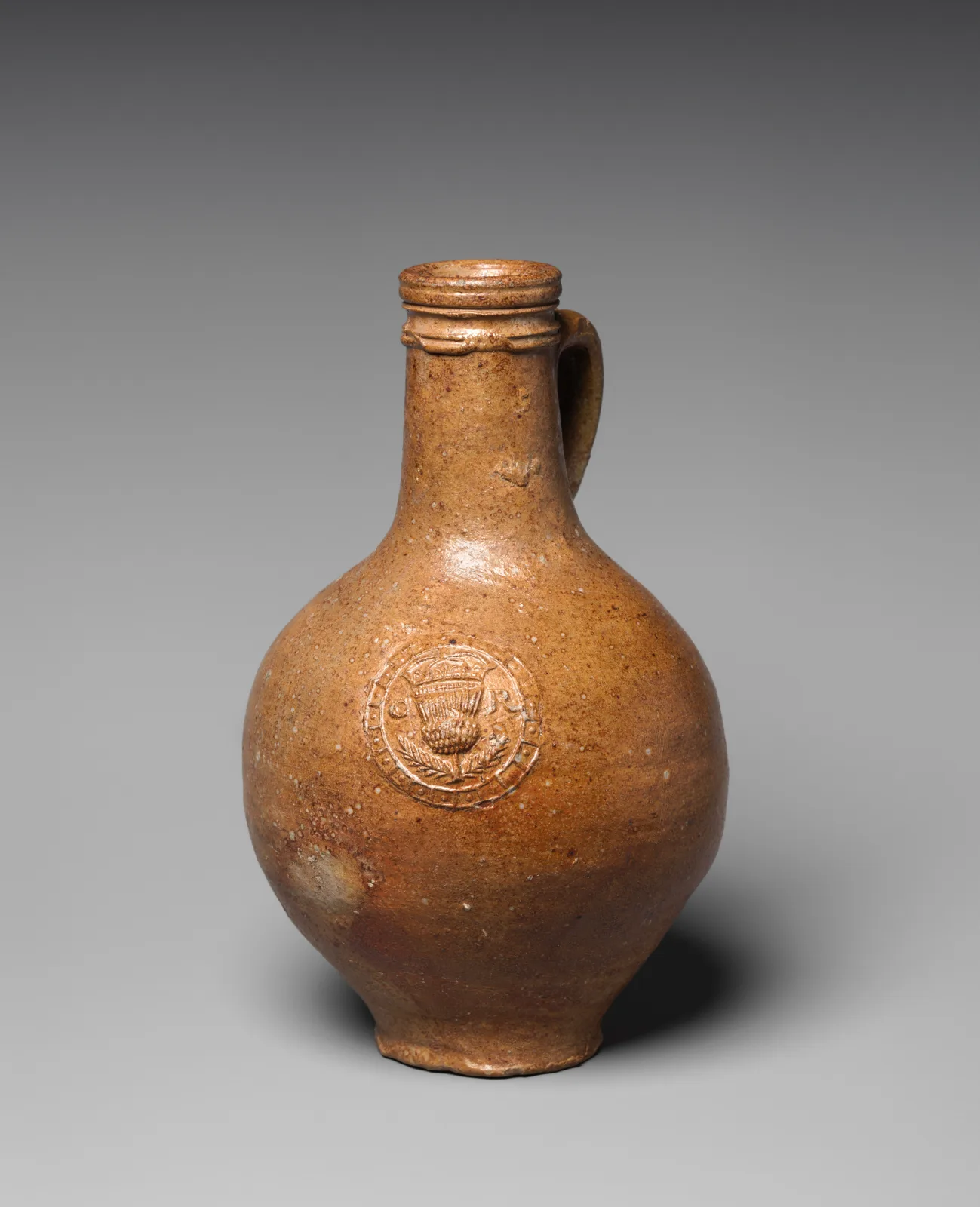
Dwight's bottles copied Rhenish Bartmann bottles (the Met; the V&A), and the giveaway is the medallion. The Met's bottle shows a crowned thistle between C and R; a V&A Fulham bottle of about 1680 has a crown over a fleur-de-lys between the same letters, with a “grotesque bearded mask” on the neck. The V&A reads CR as Carolus Rex. On an English stoneware bottle that can only mean Charles II, so a crowned CR medallion puts it between 1672, when English stoneware began, and 1685, when Charles II died. That window is our reasoning from the two records and the reign, not a museum date.
The ceramics and pottery guide places Dwight's work among the other English bodies, and the bottle guide covers the glass bottles that were made alongside these.
Dating Table: What Each Feature Lets You Say
The dated museum examples from this article, set against the window each feature supports. Stop at the first row your jug matches; lower rows add to it but cannot override it.
| What you see | What it allows | Dated examples behind it |
|---|---|---|
| A date in a medallion | That year at the earliest | Met bottle 1595; V&A Raeren jug 1601; Bonhams Frechen jug 1607; V&A Killigrew bottle 1674 |
| Crown over a thistle or fleur-de-lys between C and R, on a plain brown bottle | English, 1672–1685 | Met Dwight bottle about 1675–76; V&A Fulham bottle about 1680 |
| English royal arms of the Tudor form | Before 1603 | V&A Hampton Court jug, about 1585–1600 |
| A Dutch dealer’s name or mark | The dealer’s working years | Jan Allers, about 1580–1620; Jan op de Kamp, about 1660–65; Pieter van den Anker, about 1665 (all V&A) |
| Oak leaves and acorns over the whole body, carefully modelled face | Cologne, about 1525–1550 | V&A pitcher 1525–50; V&A Mary Rose jug about 1540; Met miniature about 1540 |
| Mottled brown “tiger” surface, one to three medallions, realistic smiling face | Frechen, early seventeenth century | James Fort finds, about 1607–24 (Historic Jamestowne) |
| Same surface, stiff rectangular face, rosette or simple medallion | Frechen, later seventeenth century | Met jug 1660–80 |
| Face scratched and modelled by hand, no moulded mask | Not a Bartmann; a face jug of around 1500 | Met face jug from Aachen or Raeren, about 1500 |
A date in a medallion was cut into the mould, so it says the jug is not earlier than that year, not how long the mould stayed in use. And a find-spot story is not evidence: the V&A bought one bottle “said to have been excavated in London” in 1852. If a jug matches no row, the is-this-an-antique checklist is the place to start, and the pottery marks guide covers the stamped and printed marks that later stoneware carries instead.
Frequently Asked Questions
Why is it called a Bellarmine jug?
It is an English nickname linking the bearded mask to Cardinal Robert Bellarmine (1542–1621), whom Protestants mocked. The mask is older than the joke, and museums now mostly use the German name Bartmann, bearded man.
How old is my Bellarmine jug?
Read the medallion first: a date, arms or a Dutch dealer's name can narrow it to a few decades. Oak leaves all over the body point to Cologne before about 1550; a mottled brown bottle with medallions and a coarser mask to Frechen, about 1600 to 1700; a crowned CR medallion to England, 1672 to 1685.
Were Bellarmine jugs made in England?
Yes, from the 1670s. John Dwight patented stoneware at Fulham in 1672, and William Killigrew applied for the same process weeks later and made it at Southampton; the V&A has a Southampton bottle dated 1674. English bottles copy the German form but carry English medallions, such as a crowned thistle or fleur-de-lys between the letters C and R.
What is a witch bottle?
A seventeenth-century English counter-charm against witchcraft: a stoneware bottle, very often a Bartmann, filled with things such as bent pins, nails, hair and urine and hidden in a house. One found in Greenwich in 2004 still held urine, iron nails, brass pins and hair.
What does the blue on a Bellarmine jug mean?
It is cobalt brushed or splashed onto the mask and medallions before firing. It appears on Cologne pieces of 1525–50 and Frechen bottles of about 1600 alike, so blue alone does not date a jug.
The Short Version
Read the medallion first; it dates a Bartmann better than anything else on it. Without one, the body gives the century: oak leaves for Cologne before 1550, a mottled bottle with medallions for seventeenth-century Frechen, a crowned CR for England after 1672. Use the face last, as a check.