
Antique Queen Anne Furniture Identification Guide: Legs, Feet, and Dating
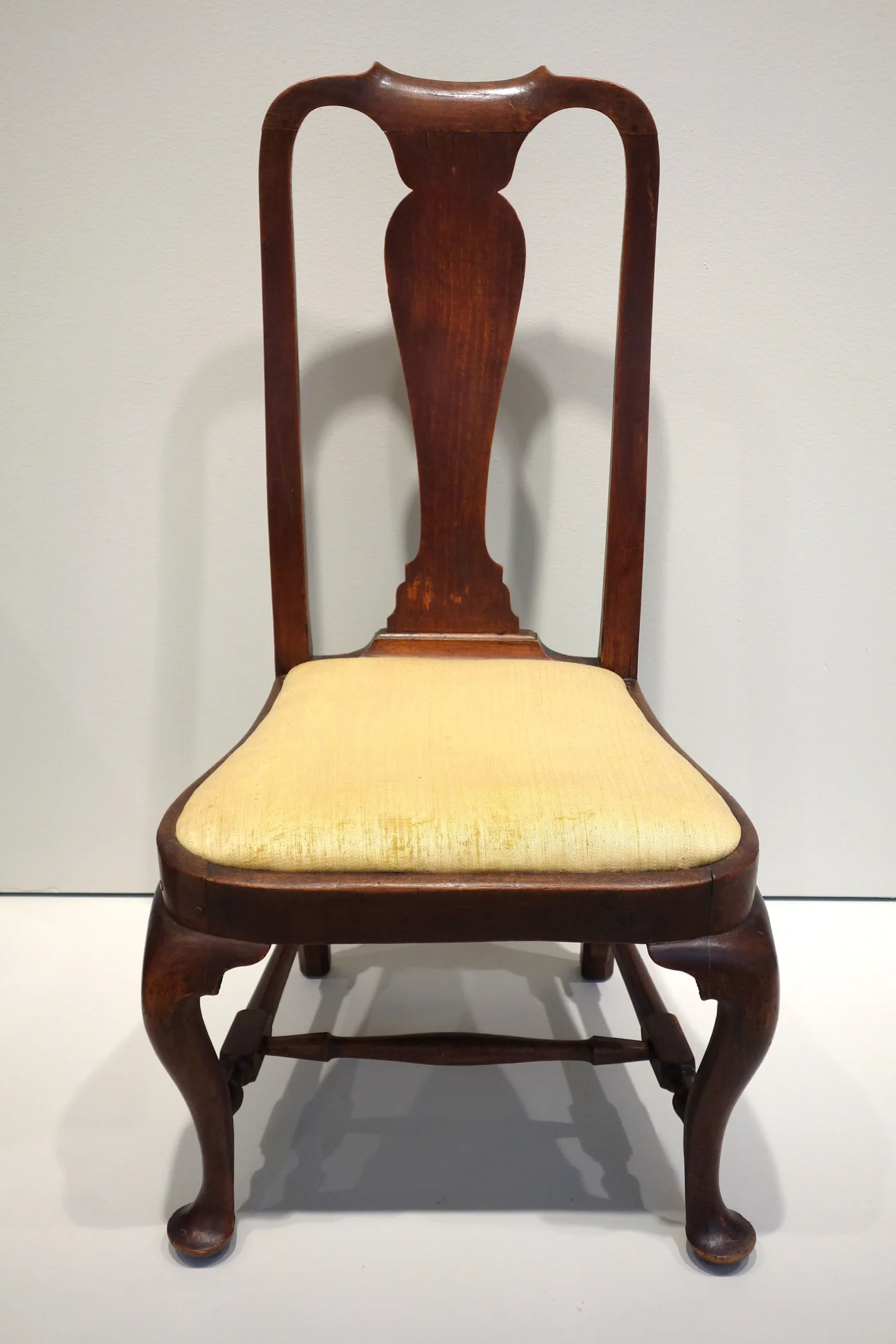
No furniture style is named more often or understood less well than Queen Anne. Estate listings apply it to anything with a curved leg. Auction catalogues use it for objects made two centuries apart. Somewhere in a great many houses sits a walnut side chair or a cherry dressing table that the family has always called "the Queen Anne piece" — and it may be a 1740s New England original worth a serious sum, or a 1930s dining suite worth a few hundred dollars. The two can look surprisingly similar across a room.
Fortunately, the gap closes quickly once you know where to look. Queen Anne furniture has a compact, consistent visual vocabulary — the cabriole leg, the pad foot, the solid vase-shaped splat, the shell on the knee — and it was built with hand tools that leave signatures no factory can quite fake. The style is also unusually regional: a Philadelphia chair and a Boston chair of the same decade are built differently, and those differences are catalogued.
This guide covers what the Queen Anne style actually is and why its dates never line up with the queen's reign, the vocabulary of legs and feet that lets you date a piece in seconds, how to read chairs, highboys, lowboys, and tea tables, the woods and secondary timbers that place a piece geographically, the tool marks and joinery that separate the eighteenth century from the twentieth, the American regional schools, and the Colonial Revival reproductions that outnumber the originals by a wide margin. Whether you are examining an inherited chair or standing in front of a highboy at a country auction, the aim is the same: decide what it is, roughly when it was made, and whether it is what it claims to be.
Table of Contents
- What Queen Anne Style Actually Is
- The Timeline: Why the Dates Never Match the Queen
- The Core Vocabulary of the Style
- Cabriole Legs and Feet: The Fastest Read
- Reading a Queen Anne Chair
- Highboys, Lowboys, and Case Furniture
- Tea Tables, Card Tables, and Occasional Forms
- Woods and What They Tell You
- Construction and Tool-Mark Evidence
- American Regional Schools
- English and Continental Queen Anne
- Surface, Finish, and Patina
- Colonial Revival and Later Reproductions
- Brasses, Labels, and Provenance
- Condition, Restoration, and Marriages
- Value Factors and Price Ranges
- Care and Conservation
- Quick Identification Checklist
What Queen Anne Style Actually Is
Queen Anne is the moment furniture stopped being architecture and started being sculpture. The style that came before it — William and Mary — was built from turned elements: trumpet legs, ball feet, flat serpentine stretchers, surfaces veneered in busy figured walnut. Everything was assembled from parts made on a lathe and joined at right angles. Queen Anne threw the lathe away for the important elements and replaced them with the cyma curve, the double S that William Hogarth would later call the "line of beauty."
The result is a style defined by restraint and flow rather than ornament. A Queen Anne chair has almost no carving; what it has instead is a continuous curve running from the crest rail down the back stile, along the seat, and out into the leg. Surfaces are broad and plain so that the figure of the wood does the decorating. Where ornament appears, it is concentrated in a few places — a carved shell on the knee or crest, a fan on a drawer front, a shaped skirt — and the rest is left alone.
The Style in One Sentence
If a piece has curved cabriole legs ending in simple pad feet, a solid (not pierced) vase-shaped chair splat, minimal carving concentrated at knees and crests, and broad plain surfaces of figured walnut, cherry, or maple, you are looking at Queen Anne or something imitating it. Every other question — period or revival, English or American, Boston or Philadelphia — follows from establishing that first.
What It Is Not
Queen Anne is not Chippendale, though the two overlap and share the cabriole leg. Chippendale adds ball-and-claw feet, pierced and carved splats, and rococo, Gothic, and Chinese ornament. Queen Anne is also not Victorian: the mass-produced Victorian furniture of the nineteenth century revived curved legs but did so with machine-cut components, heavier proportions, and a very different sense of ornament. And it is emphatically not the "Queen Anne" of architecture and interior design, which refers to a late-Victorian revival movement with no connection to eighteenth-century cabinetmaking at all.
The Timeline: Why the Dates Never Match the Queen
Anne reigned from 1702 to 1714. The furniture style bearing her name was barely getting started when she died, and most of what collectors call Queen Anne was made under George I and George II. This is why English dealers frequently prefer the term early Georgian for the same objects. The label is a nineteenth-century convenience that stuck.
England: Roughly 1710 to 1740
In England the style emerged in the last years of Anne's reign and dominated the 1720s and 1730s. Its early phase is the tail end of the "Age of Walnut," with burr and figured walnut veneers laid over oak or pine carcasses. From the 1730s onward mahogany imports increased sharply, and the cabriole leg carried on into what we now call Chippendale. English Queen Anne is over, as a fashion, by about 1740.
America: Roughly 1725 to 1760, and Later in the Country
American cabinetmakers adopted the style roughly a decade behind London and held it far longer. The main period runs from the mid-1720s to about 1760, when Chippendale patterns arrived. In rural New England, Pennsylvania, and the South, however, the Queen Anne idiom persisted well into the 1780s and occasionally beyond — a country cabinetmaker with satisfied customers had no reason to retool.
This lag has a practical consequence. A cabriole-legged chair with a solid splat is not automatically earlier than a ball-and-claw chair; American Boston makers were using ball-and-claw feet by the late 1730s while others were still making pad feet in 1775. Date a piece by the totality of its evidence — construction, wood, hardware, wear — not by style alone.
The Transitional Zone
Expect ambiguity. A large number of surviving American chairs are genuinely transitional: Queen Anne splat and crest with Chippendale ball-and-claw feet, or Chippendale-shaped ears on a Queen Anne back. These are not errors or later alterations. They reflect exactly what happened in workshops during the 1750s and 1760s, when new patterns and old habits coexisted.
The Core Vocabulary of the Style
A handful of terms carry most of the identification work. Learning them is the single highest-return investment in this field, because dealers, catalogues, and appraisers all use them precisely.
The Cyma Curve
The compound S-curve underlying nearly every Queen Anne form. It runs through the cabriole leg, the outline of a chair back, the profile of a shaped skirt, and the bonnet of a highboy. When a piece feels "right" for the style, the cyma curve is usually why.
Vase or Vasiform Splat
The central vertical element of a chair back, cut from a solid board and shaped like a vase, urn, or violin body — hence the common nickname fiddle-back. Critically, it is solid. Once splats are pierced and carved, you have moved into Chippendale territory.
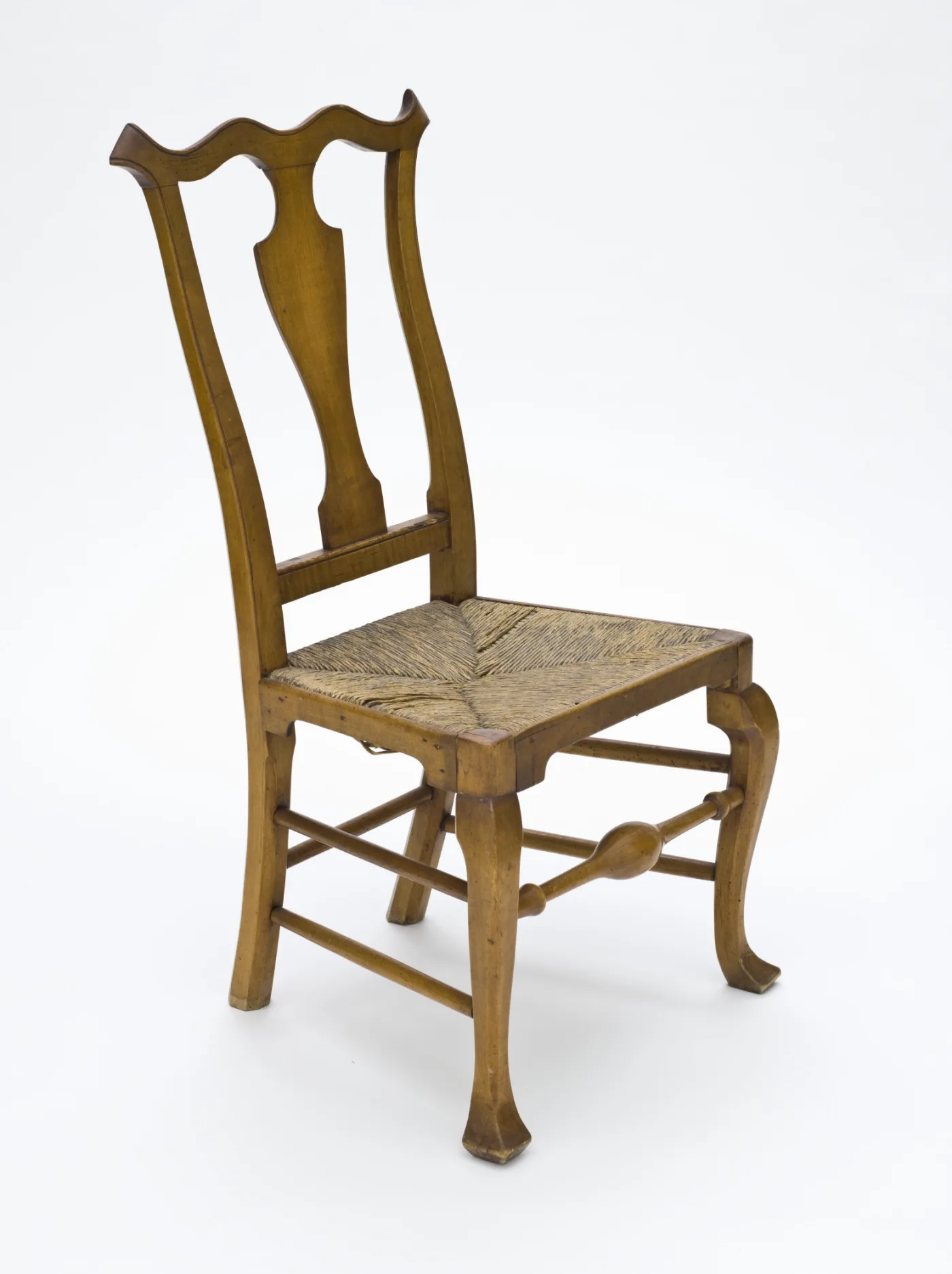
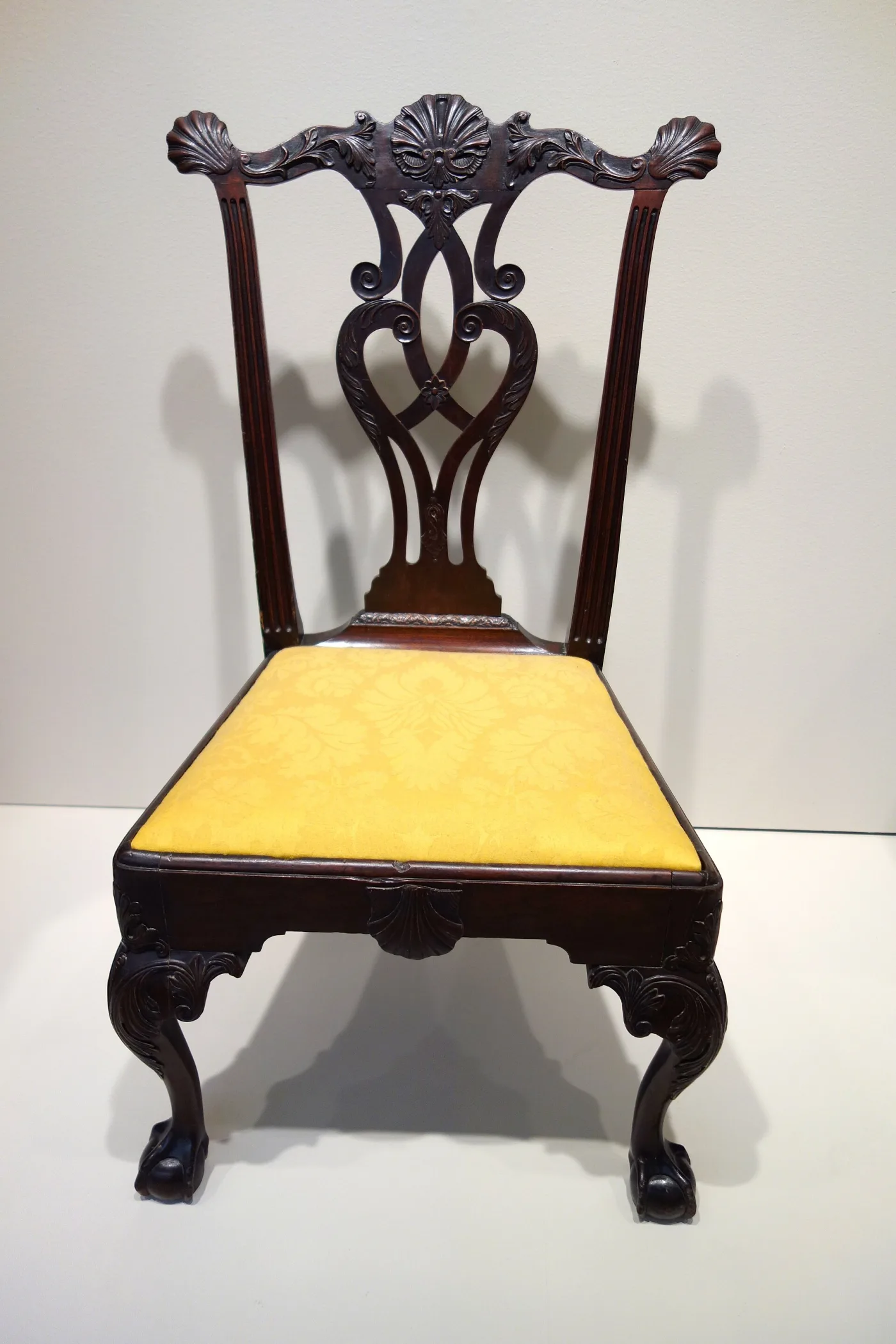
Two chairs from one city about twenty years apart, and the splat settles the argument on its own. A Queen Anne splat is a solid board shaped to a vase or violin outline; once it is pierced into interlacing straps and carved, the chair is Chippendale whatever the catalogue calls it and whatever shape the legs are. Everything else on the later chair moves in step — a crest carved with a shell and leafage instead of a plain yoke, carved acanthus on the knees, ball-and-claw feet instead of pads. Style words are cheap and get applied loosely by sellers; whether the splat has holes in it is a physical fact you can check from a photograph.
Yoke Crest and Hoop Back
The top rail of a chair, shaped like an ox yoke with a gentle central dip, or forming a continuous rounded hoop with the stiles. Both are period-correct; the hoop back tends to be the more sophisticated and the more English.
Compass, Horseshoe, and Balloon Seats
Names for the rounded chair seat that swells at the front and narrows at the back. A true compass seat requires shaped seat rails and more labour than a plain square seat, and it signals a better chair. On plainer country examples the seat is simply square or trapezoidal.
Shell and Fan Carving
The characteristic Queen Anne ornament: a stylised scallop shell carved on the knee of a leg, the centre of a crest rail, or the skirt of a case piece. American versions are often a simpler fan — a carved or inlaid rayed semicircle on a drawer front. Look at how the carving relates to the surrounding surface; on a period piece it is cut into the wood, and the surrounding wear and colour flow over and around it naturally.
Cabriole Legs and Feet: The Fastest Read
If you learn one thing from this guide, make it the feet. Foot form narrows date and region faster than any other single feature, and it is visible from across a room.
How a Cabriole Leg Is Made
A cabriole leg is sawn from a thick block, not turned. The profile is cut on two adjacent faces with a bow saw, then the corners are worked away with drawknife, spokeshave, and rasp until the leg is round in section. On a period leg you will often find faint facets, tool chatter, or slight asymmetry between the left and right sides — evidence of hand shaping. Machine-made revival legs are shaped on a spindle carver or copy lathe and are mechanically identical to one another.
Check the top of the leg too. On period case pieces the cabriole leg is usually a continuation of the corner post, with the knee blocks glued on as separate pieces. On many reproductions the entire leg is a separate turned or carved component bolted or dowelled to the frame.
Pad Foot (Dutch Foot, Club Foot)
The default Queen Anne foot: a simple rounded disc, sometimes raised on a small integral pad or "shoe." Plain, unpretentious, and found everywhere from London to rural Connecticut. Most surviving pad feet show genuine wear — flattening on one side, loss of the crisp lower edge, sometimes old repairs where damp floors rotted the base.
Trifid or Drake Foot
A three-lobed foot with distinct toes, strongly associated with Philadelphia and the Delaware Valley from roughly 1740 to 1770. If you see a trifid foot on an American chair, Philadelphia should be your first hypothesis.
Slipper Foot
An elongated, pointed foot resembling the toe of a shoe. Associated with Newport, Rhode Island and parts of Connecticut. Newport slipper feet on the best pieces are elegantly narrow and often paired with distinctive shell carving.
Spanish or Brush Foot
A scrolled, ribbed foot flaring outward like a brush or a clenched hand. It belongs to the William and Mary vocabulary and survives into early transitional Queen Anne, especially on New England chairs of roughly 1720–1740. A Spanish foot on a cabriole leg is a good early indicator.
Ball-and-Claw Foot
Technically a Chippendale feature, but Boston makers used it on otherwise pure Queen Anne chairs from the late 1730s. A ball-and-claw foot with a Queen Anne solid splat is a legitimate and often desirable transitional form, not a red flag. Look at the talons: period American claws vary regionally — Massachusetts claws are often raked back with a flattened ball, New York claws are square-knuckled and blocky, and Philadelphia claws tend to be tall and rounded.
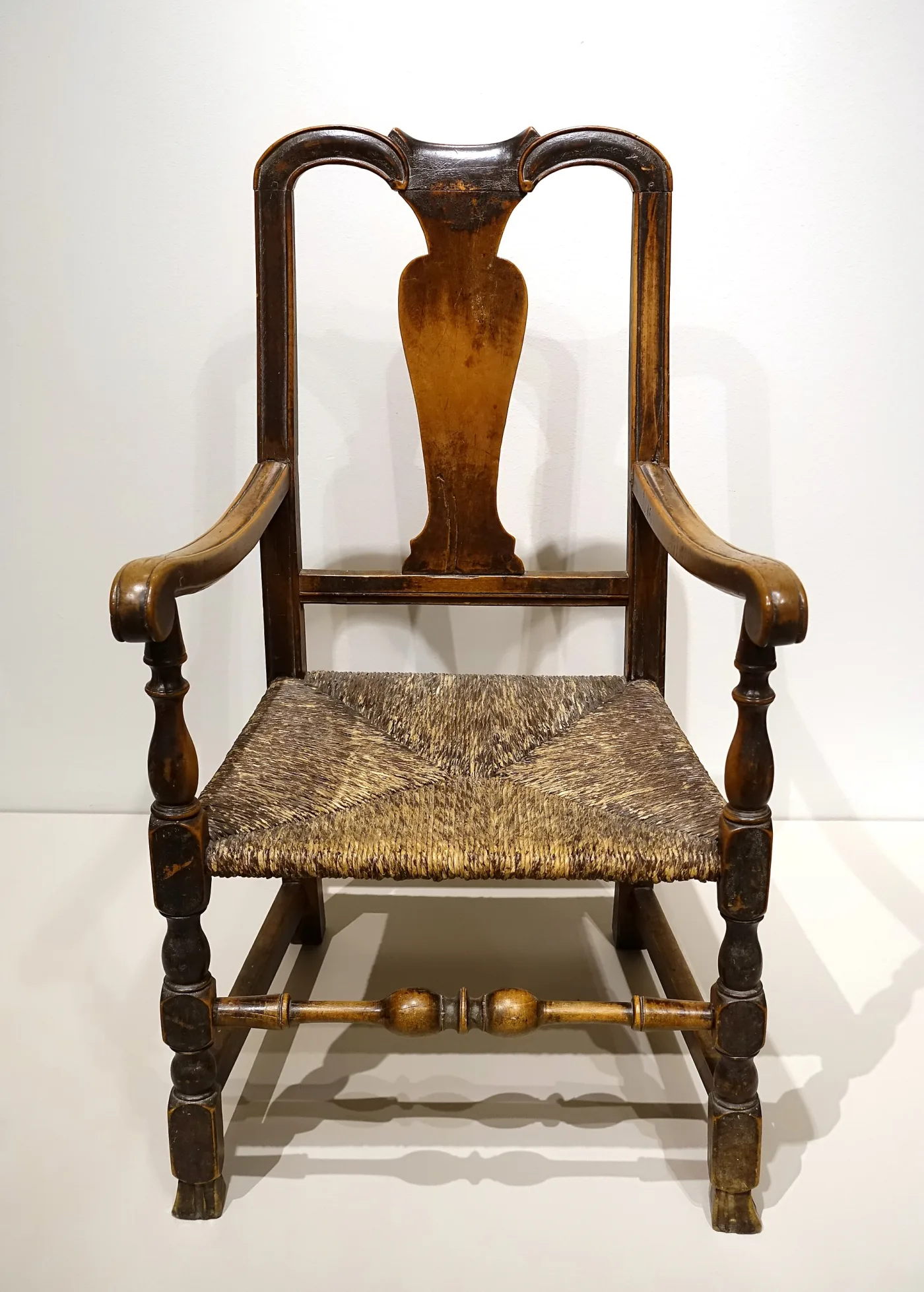
These two mark the outer edges of what turns up on furniture sold as Queen Anne. The Spanish foot is William and Mary vocabulary surviving into the transition, and finding one — particularly on a New England chair that also keeps its stretchers — points early, roughly 1720 to 1740. Ball-and-claw is Chippendale vocabulary arriving from the late 1730s, and it sits on otherwise Queen Anne carcasses all the time; that makes a piece transitional, not wrong. Between the two lie the forms you will actually meet most: the plain pad foot everywhere, the three-lobed trifid foot in Philadelphia and the Delaware Valley, and the elongated slipper foot in Newport and Connecticut. The second photograph also shows a habit worth learning to expect — carved ball-and-claw feet at the front where they are seen, plain pads at the back where they are not. Mixed feet on one piece are normal period economy rather than a sign of replacement, and reading them as a mismatch is a common mistake.
Stretchers or None
English chairs largely abandoned stretchers in the 1720s, trusting the strength of the cabriole leg alone. American makers were more conservative, and many New England Queen Anne chairs retain turned H-stretchers with a block-and-baluster front stretcher throughout the period. The presence of stretchers on an American chair is therefore not evidence of an earlier date — it is more often evidence of a New England origin.
Reading a Queen Anne Chair
Chairs survive in the greatest numbers and are the form most often misattributed, so they repay careful examination. Work from the top down.
The Back
Look at the splat first: solid, vase-shaped, and cut from a single board. Turn the chair and examine the back of the splat. On a period chair the reverse is usually flat or only lightly shaped, showing plane marks or saw texture, and it is noticeably lighter in colour than the front only if the finish has been renewed. The splat should sit in a shaped shoe on the rear seat rail. On the finest Philadelphia chairs the splat runs directly into the rear rail without a separate shoe — a documented regional trait.
Next check the stiles. A good Queen Anne chair back is not flat; the stiles are raked backward and often shaped in three dimensions so the back curves to fit a sitter. Cheap reproductions are almost always flat in plan.
The Seat
Remove the slip seat if there is one. The frame beneath tells you a great deal: hand-cut mortise-and-tenon joints, often pinned with square or irregular wooden pegs whose ends stand slightly proud of the surface because the surrounding wood has shrunk over centuries. You should see saw marks, unfinished surfaces, and old tack holes from successive upholstery campaigns. Numbered or Roman-numeralled chairs from a set often carry matching chisel-cut numerals on the seat frame and slip seat — a strong period indicator.
The Legs and Knee Blocks
Front cabriole legs on chairs are typically extensions of the seat frame's corner blocks, with shaped knee brackets glued on either side. Those brackets are frequent casualties; missing or replaced knee blocks are common and only mildly damaging to value. Rear legs on American Queen Anne chairs are usually plain, raked, and square or chamfered in section — often called stump legs in Philadelphia work. A chair with four fully shaped cabriole legs is more likely English or a later reproduction.
Armchairs and Corner Chairs
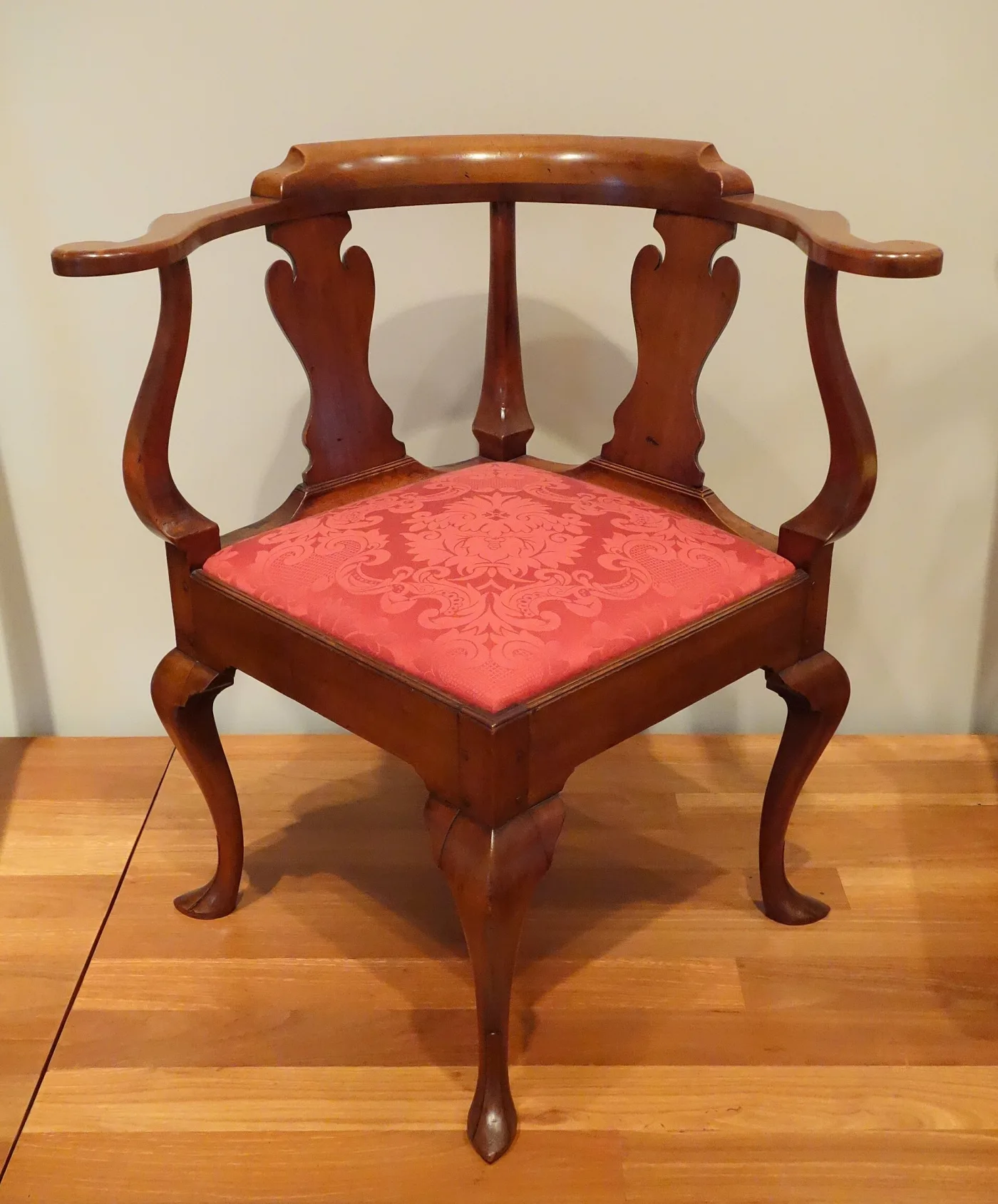
Queen Anne armchairs use shepherd's-crook or scrolled arms supported on curved arm posts that continue the line of the front leg. Corner chairs (roundabout chairs) with cabriole front legs and solid splats are a distinctive and desirable Queen Anne form, often used as desk chairs. Both forms are far scarcer than side chairs and correspondingly more valuable, which also makes them more frequently faked or assembled from parts.
Highboys, Lowboys, and Case Furniture
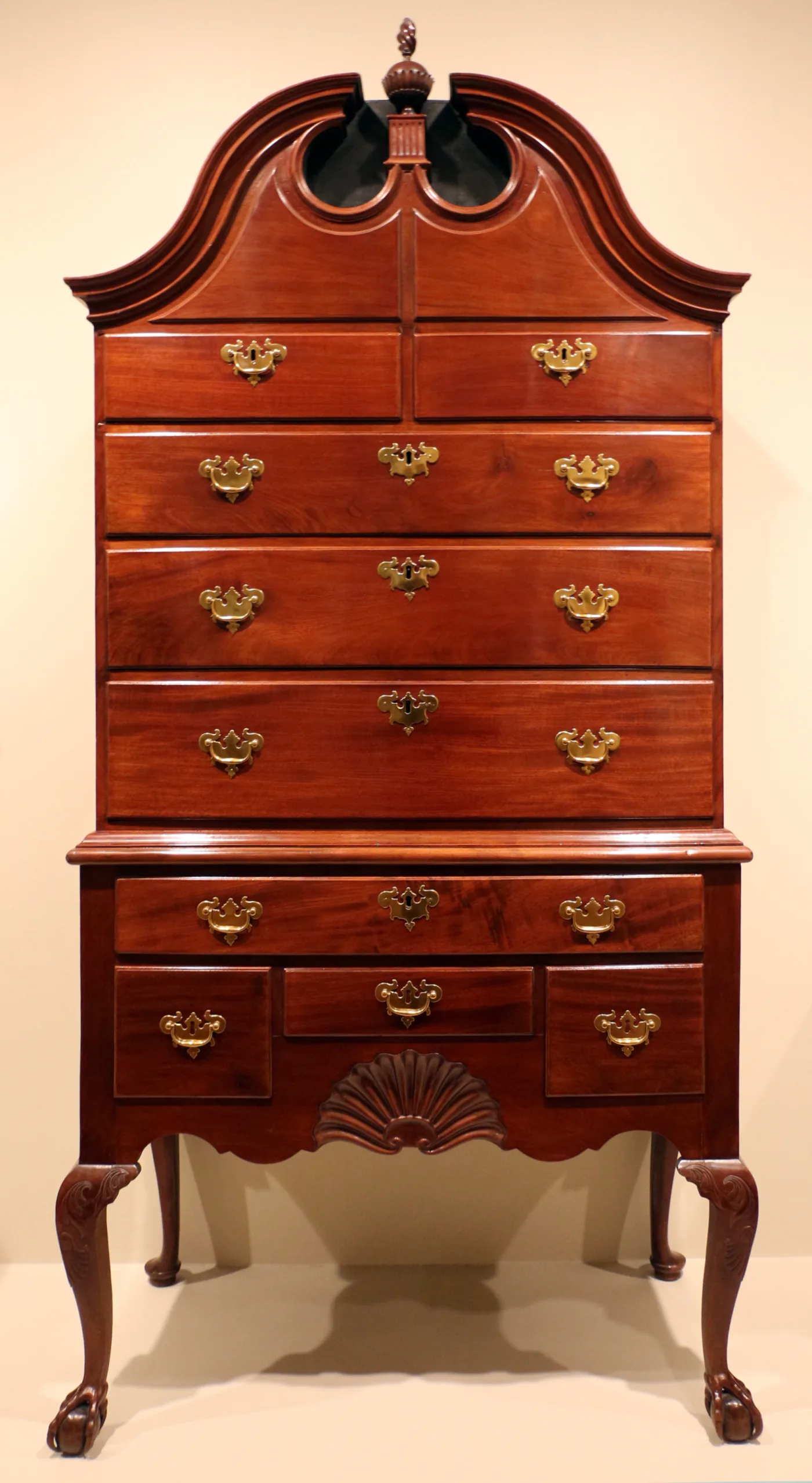
The high chest of drawers on cabriole legs — the American highboy — is the signature Queen Anne case form and one of the great achievements of colonial cabinetmaking. Its companion, the lowboy or dressing table, uses the same base design alone. Note that both terms are American collector usage; in England the equivalents are a chest-on-stand and a dressing table.
Flat Tops, Bonnet Tops, and Pediments
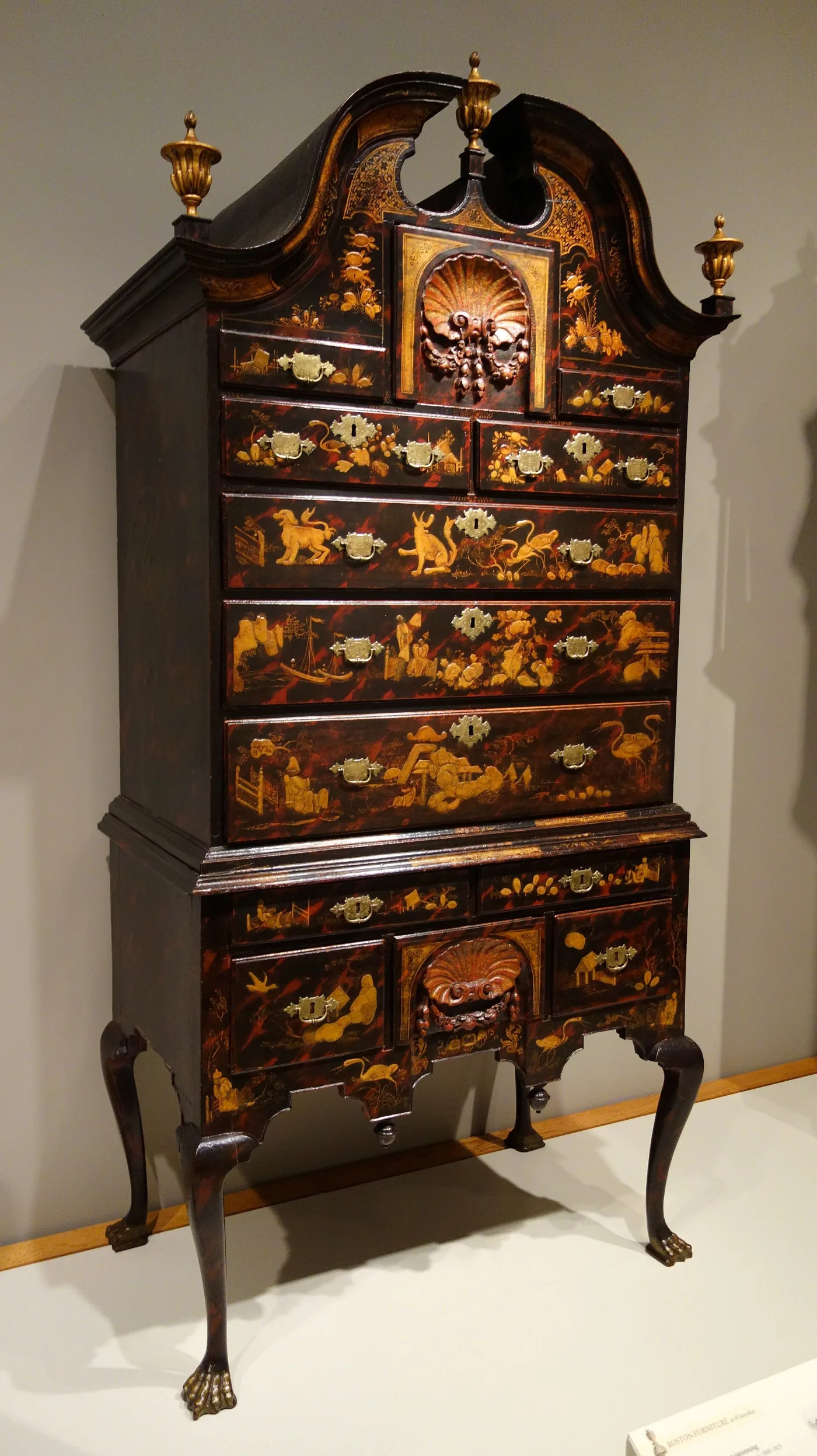
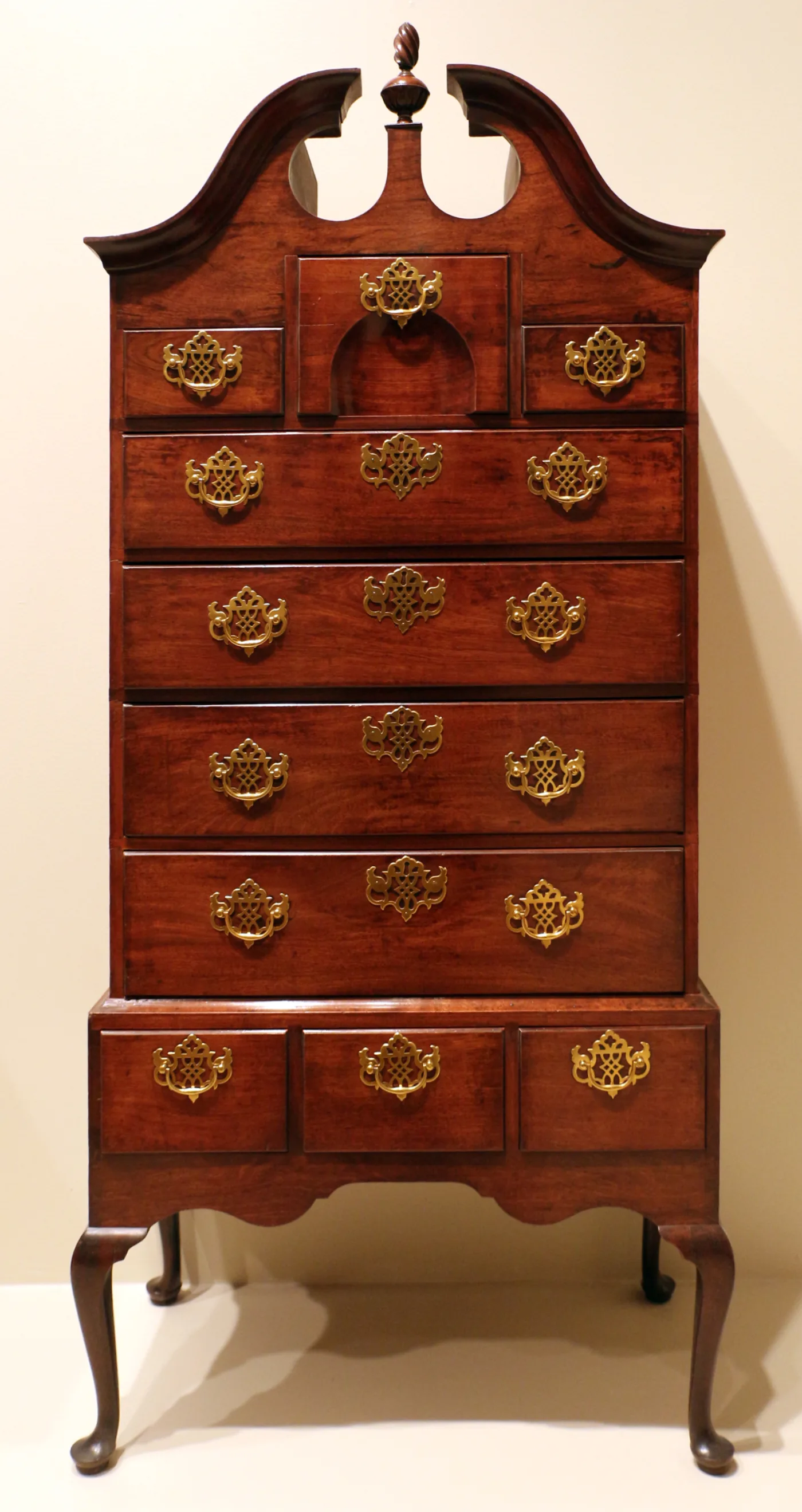
Early Queen Anne highboys have flat tops with a moulded cornice. From roughly the 1740s the bonnet top appears: a broken scroll pediment enclosing a fully finished hood, usually with three finials — corkscrew or flame-shaped — on plinths. A closed bonnet (finished all the way back) indicates a more expensive piece than an open scroll top with a flat board behind it. Missing or replaced finials are extremely common; check that all three match one another in wood, colour, and turning.
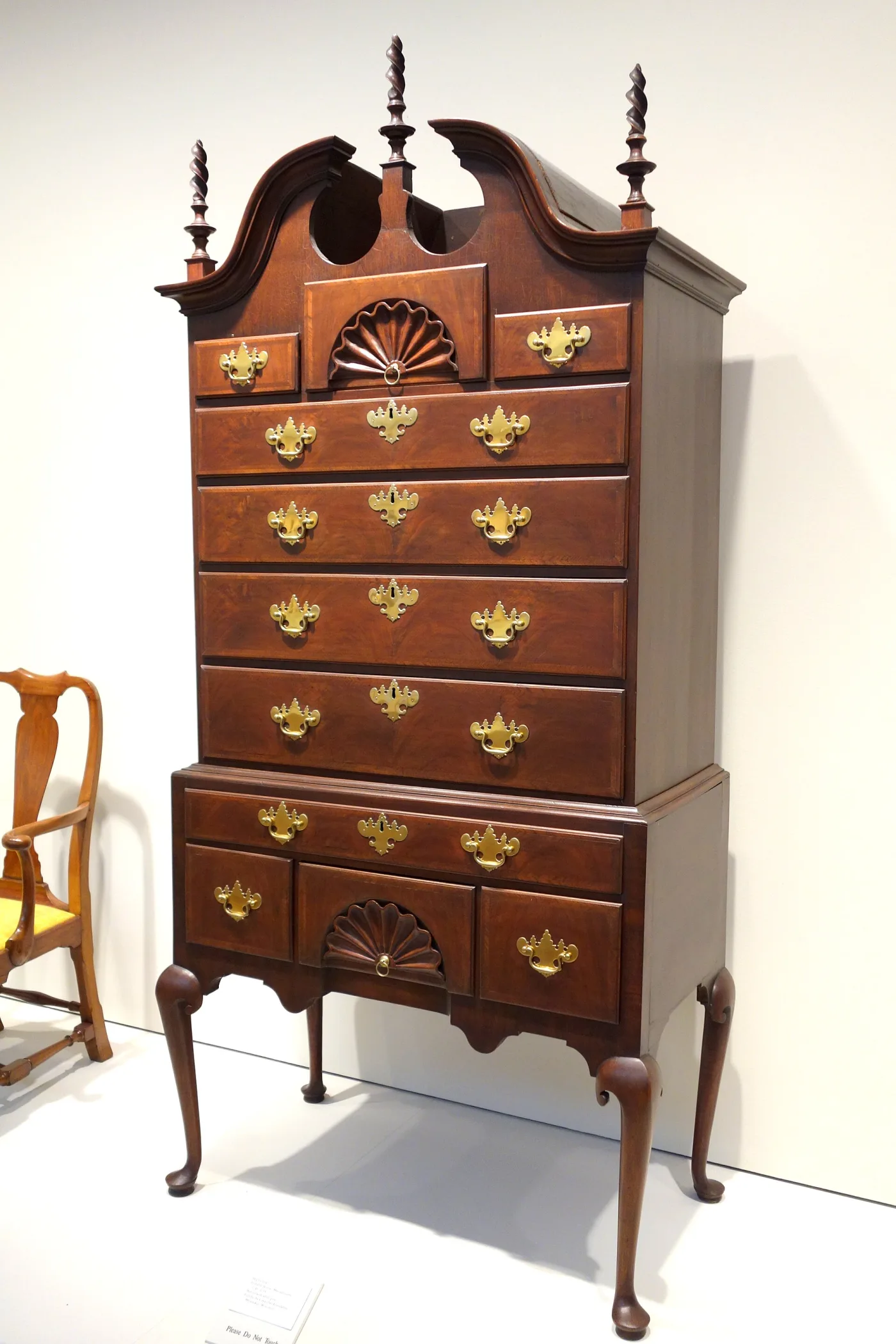
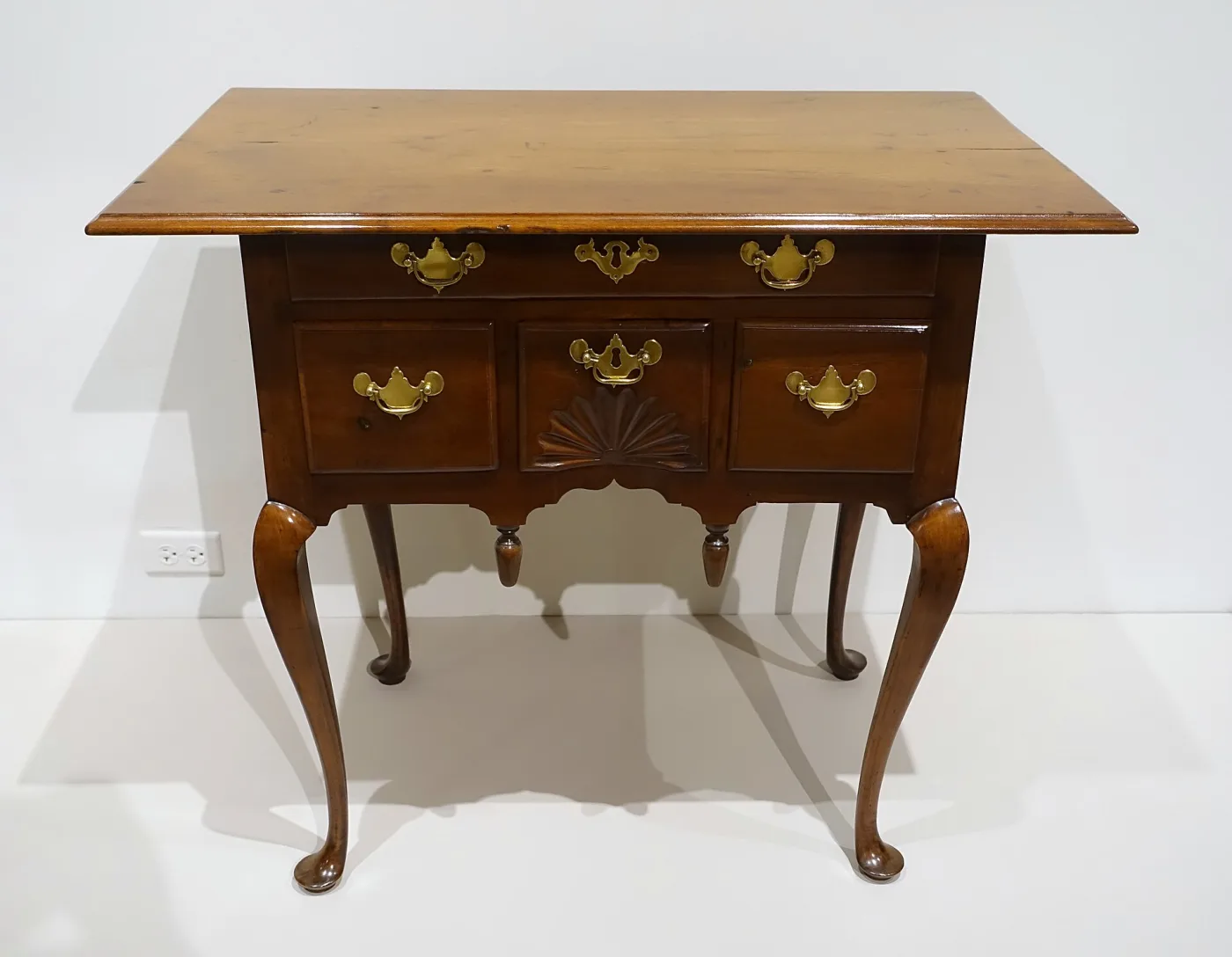
The highboy is a chest-on-stand and it separates in the middle, which is why marriages between unrelated upper and lower cases are the commonest problem in the form. Start with the finials, because they are the most frequently replaced part of the whole object: three that match one another in wood, colour and turning are a good sign, and one that does not is worth pricing in. Then check that the waist moulding closes without a gap, that the dovetails in the upper and lower drawers look like the work of one hand, and that grime and oxidation run continuously across the join instead of stopping at it. One more thing visible in both photographs: the fan carving reads as cut into the solid drawer front rather than applied. On cheaper or later work it is glued on, and the joint shows under raking light.
The Critical Question: Is It Married?
Highboys separate into two pieces for moving, which means upper and lower sections have been getting mixed up for two hundred years. A "married" highboy is worth a fraction of an original. Check every one of these:
Do the woods match? The primary wood should match in species, figure, and colour on both halves, and so should the secondary wood used for drawer sides and backboards.
Do the drawers match? Compare dovetail size, spacing, and angle between top and bottom sections. Two different hands are a strong warning.
Does the moulding fit? The waist moulding should sit correctly with no gaps, and the upper case should sit within it without overhang or shortfall.
Does the wear agree? Oxidation, dust lines, and grime should be continuous across the join. A crisp, clean upper case on a dark, worn base is telling you something.
Drawers and Their Details
Period drawer construction is enormously informative. Look for hand-cut dovetails with narrow pins and wide tails, scribe lines still visible where the cabinetmaker marked the depth, and drawer bottoms of thin riven or hand-planed boards, chamfered at the edges and set into grooves or nailed to rabbets. Drawer bottoms almost always show shrinkage cracks or a gap at one edge. Runners will be worn into grooves — on a genuinely old piece the wear is asymmetric, deeper on the side that took more weight.
Fan or shell carving on the centre drawer of the upper and lower cases is a hallmark of New England Queen Anne highboys. On the best examples the fan is carved into the solid drawer front; on cheaper or later ones it may be applied or inlaid.
Chests, Desks, and Other Cases
The same vocabulary appears on slant-front desks, chest-on-chests, and dressing tables. Queen Anne slant-front desks often sit on bracket feet rather than cabriole legs, with the style expressed instead in the shaped interior — a fan-carved prospect door, valanced pigeonholes, and blocked drawers. Bracket feet are original to many period desks and are not evidence of a later alteration, though replaced feet on case furniture are among the most common restorations you will encounter.
Tea Tables, Card Tables, and Occasional Forms
The Queen Anne period coincided with the arrival of tea and coffee as social rituals in Britain and the colonies, and furniture responded with an entire family of small, specialised tables. These forms are among the most collectable objects in the style.
Tea Tables
Rectangular tea tables with a moulded "tray top" lip to keep cups from sliding off, standing on four cabriole legs, are a classic New England form. The Newport turret-top tea table, with scalloped circular projections at each corner, is one of the rarest and most valuable of all American furniture forms. Tea tables travelled with a whole material culture of tea caddies, silver services, and porcelain, and collectors often assemble the group together.
Tilt-Top Tables and Candlestands
Circular tilt-top tables on a turned pillar and three cabriole legs (a "birdcage" mechanism allows the top to tilt and rotate) span the Queen Anne and Chippendale periods. Check that the top and base belong together: the cleats on the underside should match the birdcage or block precisely, with no filled screw holes or mismatched oxidation. Candlestands follow the same construction at smaller scale.
Card and Games Tables
Folding-top card tables with cabriole legs, often with dished corners for candlesticks and oval wells for counters, appear from the 1730s. The best examples use a swinging rear leg (a "gateleg" action) rather than a hinged fly rail. Original green baize is almost never present; a replaced playing surface is expected and forgiven.
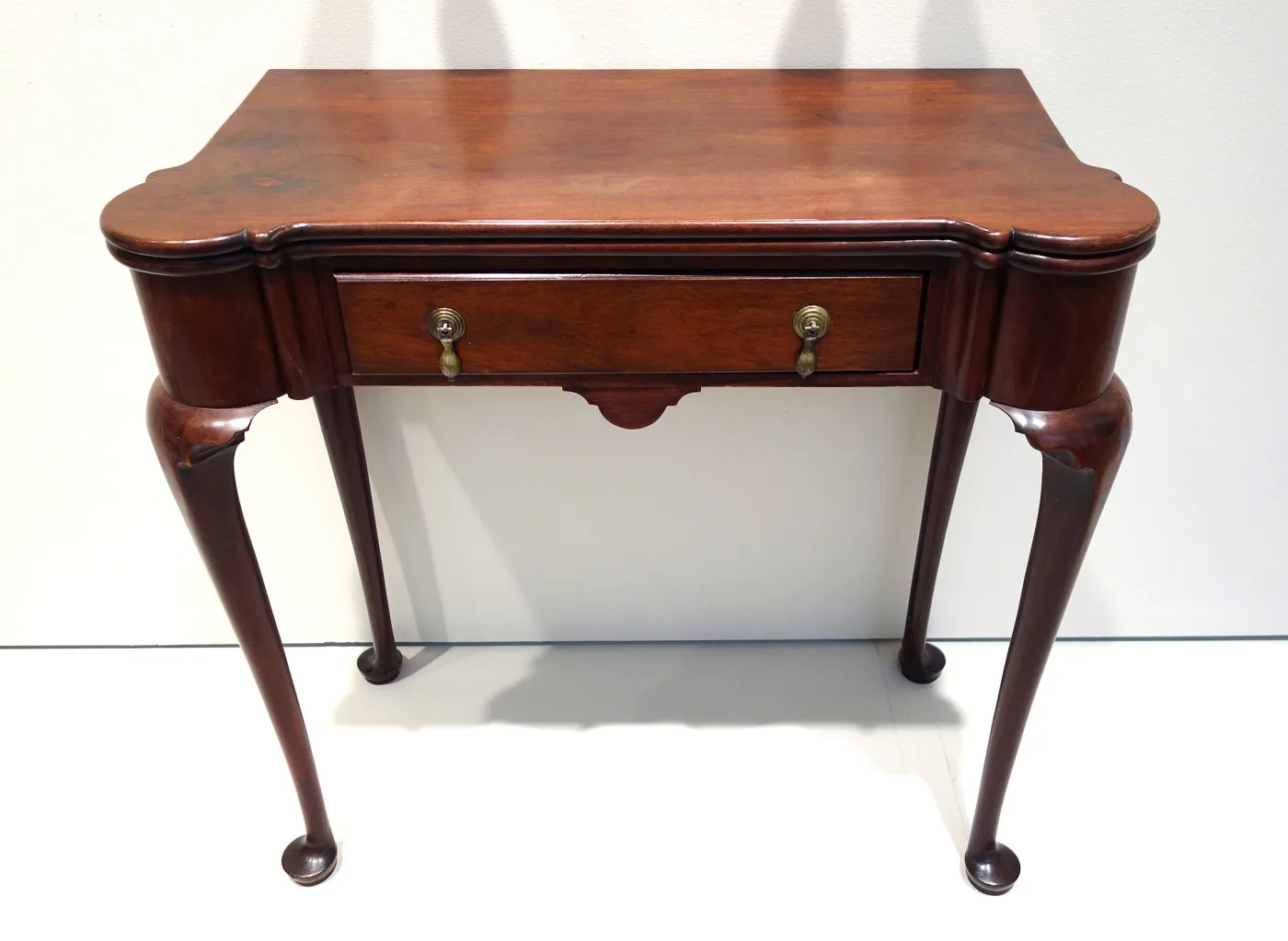
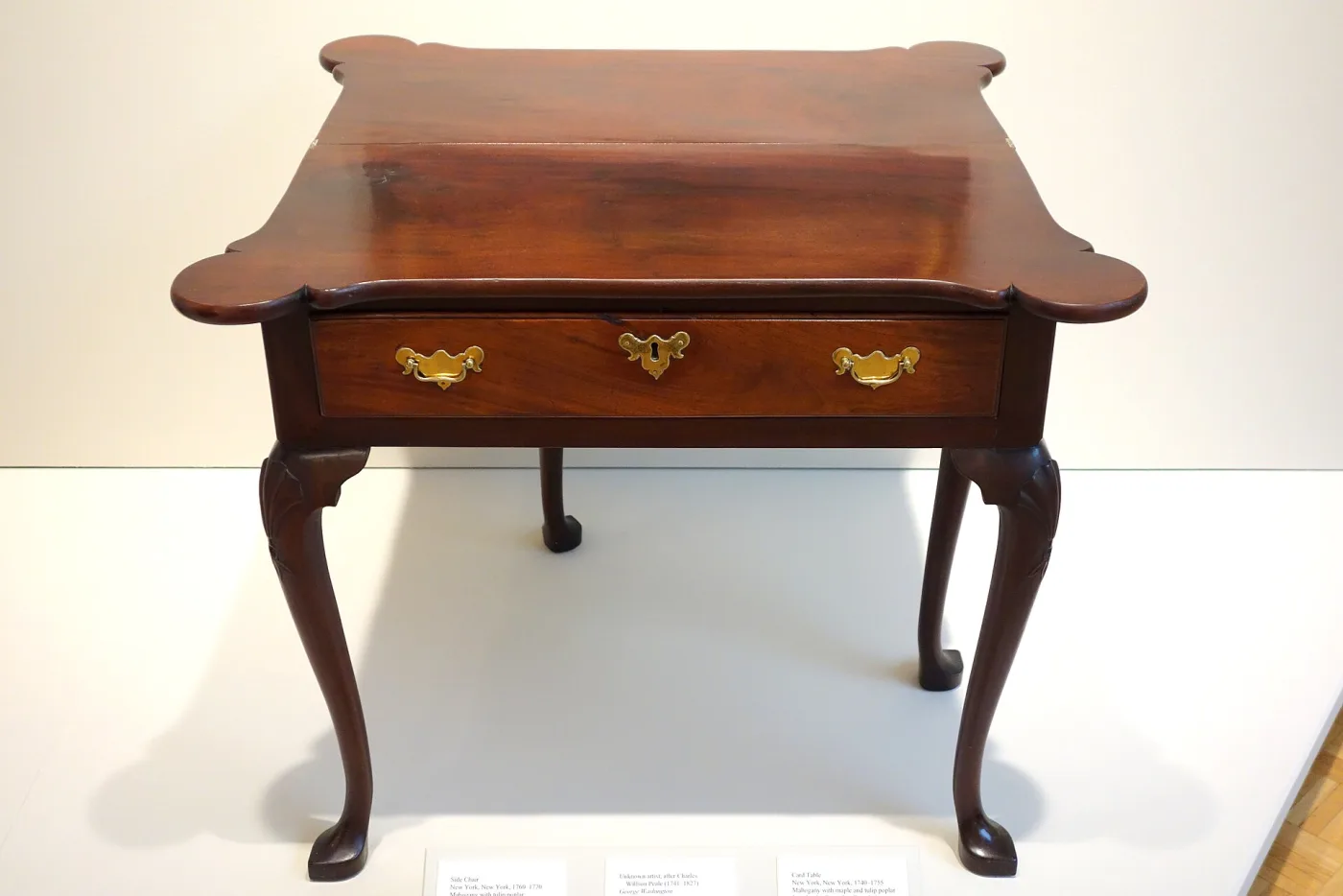
On card tables the mechanism carries the identification, so open one before you look at anything else. The better examples swing out a rear leg — a gateleg action, with the leg travelling under the opening top — instead of dropping a hinged fly rail, and the wooden knuckle joint that lets it swing is beautifully cut on a period table and crudely approximated on a copy. Original green baize almost never survives and a replaced playing surface costs nothing in value; a replaced swing rail costs a great deal. Note too what the second table's recorded secondary woods do on their own: tulip poplar points to New York or the mid-Atlantic, where white pine in the same position would have pointed to New England.
Drop-Leaf and Dining Tables
Oval or rectangular drop-leaf tables on four or six cabriole legs served as dining tables throughout the period. Examine the hinges and the rule joint where leaf meets top: period rule joints are hand-worked and rarely perfect, and the hinges are hand-forged with irregular screw holes. Look underneath for the swing-rail knuckle joint — a beautifully made wooden hinge on good period examples and a crude approximation on cheap copies.

Woods and What They Tell You
Wood identification places a piece geographically and chronologically more reliably than style does, because cabinetmakers used what grew nearby — especially for the parts nobody would see.
Primary Woods
Walnut is the defining Queen Anne timber. English work of the 1710s–1730s uses European walnut, frequently as burr or figured veneer over an oak or pine carcass with feather (herringbone) banding around drawer fronts. American work uses solid black walnut, particularly in Pennsylvania and the mid-Atlantic.
Mahogany arrives in quantity in England from the 1730s and in America from the 1740s onward, dominating the coastal cities. Solid mahogany with dense, straight grain and a deep reddish-brown patina suggests a good urban shop.
Cherry is the great Connecticut River Valley wood, used solid for highboys, chests, and tables throughout the eighteenth century. Maple, especially tiger (curly) and bird's-eye maple, appears widely in New England, sometimes stained to imitate walnut or mahogany.
Secondary Woods: The Regional Fingerprint
Turn a drawer over and identify the wood used for its sides, back, and bottom. This is the closest thing to a passport that antique furniture has:
White pine points to New England. Tulip poplar (yellow poplar) points to Pennsylvania, New York, and the mid-Atlantic. Yellow pine and cypress suggest the American South. Oak and deal point to England. A piece with mahogany drawer fronts and oak drawer linings is almost certainly English; the same fronts with tulip poplar linings say Philadelphia or New York.
Beware of the mismatch that reveals a fake or a heavy restoration: an American-looking highboy with entirely European secondary woods, or an eighteenth-century-styled piece whose drawer linings are twentieth-century plywood or gum.
Veneer and Inlay
Period veneer is hand-sawn and comparatively thick — roughly a sixteenth of an inch or more — with an uneven underside and visible saw texture. Veneer sliced to modern thinness (well under a millimetre) is a nineteenth- or twentieth-century product and settles the question immediately. Look at chipped edges and losses to measure it directly. American Queen Anne uses far less veneer than English work; a heavily veneered "American" piece deserves scepticism.
Construction and Tool-Mark Evidence
Style can be copied; tool marks are much harder to fake convincingly, because faking them means using period tools and taking period time. This is where most identifications are actually settled. General principles that apply across the whole field are covered in our broader guide to antique furniture identification, but a few checks matter especially here.
Saw Marks
Look at unfinished interior surfaces — drawer bottoms, backboards, the underside of tops. Straight, roughly parallel kerf marks come from a pit saw or a water-powered reciprocating mill saw and are consistent with the eighteenth century. Curved, arced saw marks come from a circular saw, which did not enter general furniture use until the 1830s at the earliest. Arced saw marks anywhere on an untouched original surface rule out a period date, full stop.
Planes and Surfaces
Run your hand over a backboard. Period secondary surfaces are undulating, with the scalloped ripple of a scrub or jack plane and occasional tearout. Machine-planed surfaces are dead flat and may show fine, regular chatter marks running across the grain. A period piece will typically have finished, smooth show surfaces and rough, tool-marked hidden ones; a reproduction is often uniformly smooth everywhere, because sanding a whole board is trivial with machinery.
Dovetails
Hand-cut dovetails vary in size and spacing, have narrow pins, show knife or scribe lines marking the shoulder, and often reveal small overcuts where the saw ran past the line. Machine-cut dovetails from the 1870s onward are uniform in size and spacing, and the common round-bottomed router dovetail is a twentieth-century product. Count the dovetails: eighteenth-century cabinetmakers used few and large; factories used many and small.
Fasteners
Hand-forged rosehead nails with irregular tapered shanks are consistent with the eighteenth century. Machine-cut nails with a rectangular shank and a stamped head date from roughly the 1790s to the 1890s. Round wire nails are post-1890 and, in an untouched original location, are decisive. Screws matter too: handmade screws before about 1846 have off-centre, irregular slots, uneven threads, and a blunt tip. A pointed, machine-uniform screw in an original hole is a twentieth-century intervention. A Phillips-head screw anywhere original is post-1936 and ends the discussion.
Shrinkage
Wood loses width across the grain over centuries but not along it. A round period tabletop measures noticeably oval — commonly a quarter to half an inch out of round on a table of two feet or more. A perfectly circular top on a supposedly 250-year-old table is a serious warning. Similarly, panels shrink away from their frames, drawer bottoms open gaps, and pegged joints leave pegs standing proud.
American Regional Schools
American Queen Anne is intensely regional, and attribution to a city can multiply value several times over. These are broad tendencies rather than rules, but they hold up well.
Boston and Eastern Massachusetts
Vertical, attenuated proportions and considerable sophistication. Boston chairs often have raked rear legs, block-and-turned stretchers, and compass seats; the city was also the centre of American japanning, and japanned Queen Anne highboys — painted and gilded in imitation of Asian lacquer — are among the rarest survivals. Boston makers adopted the ball-and-claw foot unusually early.
Newport, Rhode Island
The Goddard and Townsend families produced some of the finest furniture made anywhere in the colonies. Newport Queen Anne is restrained, superbly proportioned, and marked by slipper feet, crisply carved shells, and extremely fine joinery. The blocked-and-shell furniture for which Newport is most famous is largely Chippendale-period, but the Queen Anne foundation is visible in the earlier work.
Philadelphia and the Delaware Valley
Broad, generous proportions, walnut as the favoured wood, trifid feet, stump rear legs, and the through-tenon on chair side rails — a construction detail where the tenon passes completely through the rear stile and shows on the outside. Philadelphia chairs often omit stretchers entirely and rely on massive joinery. Quaker taste favoured plain surfaces of superb material over carving.
New York
Squat, broad, and heavy relative to New England work, with wide seats and thick members. New York Queen Anne is comparatively scarce, and the region is better known for its Chippendale-period output.
Connecticut and the River Valley
The most idiosyncratic of the schools. Cherry is the dominant wood, sometimes with tiger maple. Country cabinetmakers combined elements freely, producing highboys with exuberant scrolled skirts, unusual fan carving, and proportions that no urban shop would have countenanced. These pieces are prized precisely for their individuality, and their construction can look "wrong" while being entirely genuine.
The South
Southern Queen Anne survives in far smaller numbers, with yellow pine and cypress secondary woods and walnut or cherry primaries. Because so little survived war and climate, documented Southern pieces command strong premiums.
English and Continental Queen Anne
English Queen Anne is a different animal from its American cousin, and confusing the two costs money in both directions.
Recognising English Work
English pieces are typically veneered rather than solid, using figured or burr walnut over oak or pine carcasses, with cross-banding and feather banding framing drawer fronts. Oak drawer linings are near-universal. Chairs commonly have no stretchers, drop-in seats, and hoop backs with rounded shoulders. Bachelor's chests with folding tops, bureau bookcases with mirrored doors, and walnut card tables are characteristically English forms with no real American equivalent.
Dutch and Continental Variants
The cabriole leg reached England from the Netherlands, and Dutch furniture of the period uses it lavishly, often with elaborate marquetry of flowers and birds — a decorative approach that runs counter to Queen Anne restraint. A "Queen Anne" walnut bureau covered in floral marquetry is likely Dutch, and a good many were made or re-decorated in the nineteenth century when marquetry was newly fashionable. Later marquetry added to a plain period carcass is a well-documented Victorian practice.
Irish Work
Irish Queen Anne and early Georgian furniture tends toward heavier, more deeply carved knees, sometimes with grotesque masks or bold shells, on mahogany. It is a distinct and increasingly appreciated tradition.
Surface, Finish, and Patina
Surface is where the market makes its sharpest distinctions. An original surface can double the value of an otherwise ordinary piece, and stripping one destroys value permanently.
What Original Finish Looks Like
Eighteenth-century furniture was finished with shellac, oil, or wax — never with the sprayed nitrocellulose lacquer or polyurethane of modern work. Two and a half centuries of that treatment produces a finish that is thin, slightly uneven, warm in tone, crazed in places, and darker in crevices where wax and dirt accumulated. It is not glossy in the modern sense. French polishing — a high-shine shellac technique — is a nineteenth-century development, so a mirror-bright surface on a 1740s chair means it has been refinished at some point.
Wear in the Right Places
Genuine wear is logical. Chair arms are worn where hands rest; seat rails where legs rub; feet where floors and damp attacked them; drawer runners where they slid; the front edges of drawers where fingers pulled. Stretchers show heavy wear on the front one and almost none on the rear, because that is where feet went. Faked wear tends to be evenly distributed, applied with abrasives, and present in places no human body would ever touch. Look inside and underneath: those surfaces should be dirty, oxidised to a warm brown, and untouched, while a faker usually concentrates on what shows.
Colour and Oxidation
Unfinished secondary wood darkens with age and air exposure. Fresh-cut eighteenth-century wood exposed today looks pale; a genuinely old interior surface is uniformly warm brown. Where a piece has had a repair, the new wood is almost always lighter and the difference is visible under a raking light even when it has been stained to match. Deliberate refinishing and restoration decisions are worth thinking through carefully before you act — see our guide to antique restoration and conservation for how far to go.
Colonial Revival and Later Reproductions
Far more "Queen Anne" furniture exists from the twentieth century than from the eighteenth. This is not fraud — most of it was made and sold honestly as reproduction — but the labels fall off, generations pass, and the family story hardens into fact.
The Revival Waves
The 1876 Centennial Exposition triggered the first wave of American colonial revival, producing what dealers still call "Centennial" furniture — often well made, in mahogany, with period-ish detailing and machine construction. A second and much larger wave ran from the 1910s through the 1940s, when firms including Kittinger, Baker, Statton, Henkel Harris, and Wallace Nutting produced Queen Anne reproductions in volume. Cheap "Queen Anne dining suites" were sold by the trainload in the 1930s. Production has continued ever since.
The Tells
Revival pieces betray themselves through machinery and consistency. Watch for: uniform machine-cut dovetails; circular-saw arcs on hidden surfaces; plywood drawer bottoms or backboards; perfect symmetry between left and right legs; sprayed, even finishes with no crazing; gum, birch, or poplar stained to imitate mahogany; identical wear on all four feet; screws with sharp gimlet points; and stapled upholstery. Any one of these is suggestive; two or three together settle it.
Proportion is the subtler tell. Revival makers scaled their pieces for modern rooms and modern bodies, so reproduction highboys are frequently shorter and wider than period examples, and reproduction chairs have higher, deeper seats. Once you have handled a dozen period chairs, revival proportions start looking obviously wrong before you have examined a single joint.
Revival Pieces Worth Owning
Do not dismiss the category. Wallace Nutting's branded or labelled furniture, high-end Kittinger and Baker production, and the best Centennial work are collectable in their own right and can be genuinely well made — often better finished than the country originals they imitate. They simply belong to a different market, typically in the hundreds to low thousands rather than the tens of thousands.
Outright Fakes
Deliberate deception exists at the top of the market, and it usually takes the form of enhancement rather than wholesale manufacture: carving added to a plain period surface, feet replaced with more valuable forms, a period lowboy given a new upper case to become a highboy, or an assembled piece built from genuine old timber. Look for carving that cuts through aged patina and exposes fresh wood in its recesses, and for shells or fans whose style does not match the rest of the piece. For pieces at serious money, documented ownership history matters as much as the object — our guide to authentication and provenance research covers how to build and verify that chain.
Brasses, Labels, and Provenance
Reading the Hardware
Period Queen Anne brasses are cast, not stamped: solid, slightly irregular, with visible file marks and a warm, uneven colour. The common forms are the bat-wing or willow back plate with a bail handle, and simple pierced plates on earlier work. They are attached with threaded posts and nuts on the drawer interior; the earliest use a cotter-pin or "snipe" fastening. Modern reproduction brasses are thin, stamped, mechanically perfect, and usually attached with machine screws.
Replaced brasses are the norm rather than the exception, and are not by themselves a serious problem. What matters is the evidence they leave. Open a drawer and look at the inside of the front: filled holes, extra holes, and shadow outlines where an earlier plate protected the wood tell you exactly how many sets of hardware the piece has worn. If the shadow matches the current brasses precisely, those brasses are likely original — a genuine plus.
Labels, Brands, and Inscriptions
Signed American Queen Anne furniture is rare and valuable. Look for printed paper labels glued inside a drawer or on a backboard, branded names burned into the underside or drawer edges, and chalk or graphite inscriptions from the maker or an early owner. Check drawer bottoms and the backs of case pieces, where labels survived because nobody cleaned there.
Treat any label with appropriate care: labels are removed from damaged pieces and reapplied to better ones. A period label should show paper and ink consistent with its claimed date, adhesion consistent with age, and grime patterns matching the surrounding wood. When a piece is heading toward a formal appraisal or valuation, photograph every mark and inscription before anything is cleaned or moved.
Condition, Restoration, and Marriages
Almost no piece of Queen Anne furniture has reached the present untouched. The question is never whether a piece has been restored but what was done, how well, and how much of the original remains.
The Common Restorations
Replaced feet lead the list. Pad feet sat on damp floors for centuries and rotted; look for a glue line, a change in colour or grain direction, or a foot that is crisper than everything above it. Replaced knee blocks and re-glued joints are near-universal and largely forgiven. Replaced backboards, drawer runners, and drawer bottoms are common and acceptable if well done. Re-carved decoration and replaced tops are much more serious.
Marriages and Made-Up Pieces
Beyond the classic married highboy, watch for: a tea table top married to an unrelated base; a chest converted into a lowboy by adding legs; a set of chairs in which two are period and four are later copies (compare wear, colour, and construction chair by chair, never as a group); and case pieces cut down in height to fit modern ceilings. In every case the test is consistency — of wood, of tool marks, of oxidation, of wear — across the whole object.
What Condition Does to Value
As a rough guide, an original surface is worth a substantial premium; refinishing typically costs thirty to fifty percent of value on a good piece. Replaced feet on a highboy can cost a third or more. A marriage of an upper and lower case that were not made together costs most of the value. Sympathetic old repairs made with period materials are far less damaging than recent, aggressive intervention — and modern epoxy, screws, or filler in a structural joint are penalised heavily.
Value Factors and Price Ranges
Queen Anne is a mature market with an enormous spread between ordinary and exceptional. The figures below are broad guides for pieces in reasonable condition; regional attribution, documentation, and surface can move any of them dramatically.
What Drives the Number
In rough order of importance: attribution and region (a documented Philadelphia or Newport piece is a different market from an anonymous country example); original surface; form (a bonnet-top highboy or turret-top tea table versus a plain side chair); condition and originality of parts; quality of design and carving; and provenance. Sets multiply: a matched set of six or eight period chairs is worth considerably more than six times one chair.
Approximate Ranges
Twentieth-century reproduction chairs generally run tens of dollars each for mass-market examples, rising into the low hundreds for good Kittinger, Baker, or Nutting work. Reproduction highboys and lowboys from quality makers typically fall in the high hundreds to low thousands.
English period walnut side chairs commonly sit in the high hundreds to low thousands each, with exceptional hoop-back examples higher. English walnut bureaux and bachelor's chests of the 1720s–1730s span a wide range from a few thousand upward, heavily dependent on veneer quality and originality.
American period Queen Anne side chairs from New England typically begin in the low thousands and rise steeply with region and quality; Philadelphia compass-seat walnut chairs with fine shells reach five figures and beyond. American highboys range from several thousand for plain country examples to the mid five figures and well past six figures for documented urban masterpieces. Tea tables and lowboys follow similar curves, with rare Newport forms at the extreme top of the market.
Country furniture deserves a note of its own. A cherry Connecticut highboy with idiosyncratic carving and an untouched surface may well outperform a technically superior but refinished urban piece, because the market now prizes originality and character highly. The same premium on honest surfaces applies across collecting fields, from Windsor chairs to painted country furniture.
Care and Conservation
The single most valuable thing you can do for a piece of Queen Anne furniture is very little.
Do Not Strip or Refinish
This bears repeating because the damage is irreversible. If a surface is dull, dirty, or scratched, the correct response is careful cleaning and waxing, not stripping. Consult a conservator before making any decision you cannot undo. A worn original finish is an asset, not a defect.
Environment
Stable humidity between roughly forty-five and fifty-five percent prevents the seasonal swelling and shrinking that opens joints and splits panels. Keep pieces away from radiators, heating vents, fireplaces, and exterior walls. Direct sunlight bleaches walnut and mahogany quickly and unevenly; use blinds or UV-filtering film. Broader principles for climate, light, and handling are covered in our guide to antique storage, care, and preservation.
Cleaning and Waxing
Dust with a soft dry cloth. Apply a good-quality microcrystalline or beeswax paste sparingly once or twice a year, buffing well; wax builds a protective layer without altering the finish. Avoid silicone-based sprays and oil polishes, which can migrate into the finish and make future conservation harder.
Handling and Moving
Lift chairs by the seat rails, never by the crest rail or arms. Carry case pieces from the base, and always separate a highboy into its sections before moving it. Remove drawers first to reduce weight and stress on old joints. Check and re-glue loose joints promptly with reversible hide glue rather than modern adhesives — a wobbling chair destroys its own mortises within a few years of use.
Quick Identification Checklist
Work through these in order. Most pieces declare themselves within the first four or five.
1. Check the feet. Pad, trifid, slipper, Spanish, or ball-and-claw? The form suggests both period and region before you touch anything else.
2. Check the splat. Solid and vase-shaped means Queen Anne; pierced and carved means Chippendale.
3. Look at hidden surfaces. Arced circular-saw marks, plywood, or uniform machine planing anywhere original rules out an eighteenth-century date immediately.
4. Examine the dovetails. Few, large, irregular, with visible scribe lines, or many, small, and mechanically identical?
5. Identify the secondary wood. White pine points to New England, tulip poplar to the mid-Atlantic, oak to England, yellow pine to the South.
6. Measure round elements. A period circular top should be measurably oval from centuries of cross-grain shrinkage.
7. Check the fasteners. Rosehead nails and blunt, off-centre handmade screws are consistent with the period; wire nails, gimlet points, and Phillips heads are not.
8. Read the wear. Is it logical, asymmetric, and concentrated where hands and feet actually go? Or evenly distributed and suspiciously decorative?
9. Open the drawers and read the hardware shadows. Filled holes and outlines record every set of brasses the piece has worn.
10. Test for a marriage. On any two-part piece, compare wood, dovetails, oxidation, and moulding fit across the join.
11. Judge the proportions. Revival pieces are usually broader, shorter, and heavier in the leg than period originals.
12. Assess the surface honestly. Original, old refinish, or recent strip? This decision alone can change the value by half.
Queen Anne rewards patient looking more than almost any other furniture style, precisely because its ornament is so sparse. There is nowhere for a bad copy to hide: everything depends on the quality of a curve, the honesty of a surface, and the evidence left by hand tools. Learn the feet, learn the secondary woods, and learn to trust wear patterns over stories, and you will be reading these pieces confidently within a season. The same habits of looking carry directly into neighbouring fields, whether you move forward into Federal and Duncan Phyfe work or sideways into the wider world of period looking glasses and mirrors that furnished the same rooms.