
American Silver Porringers: Dating by the Handle
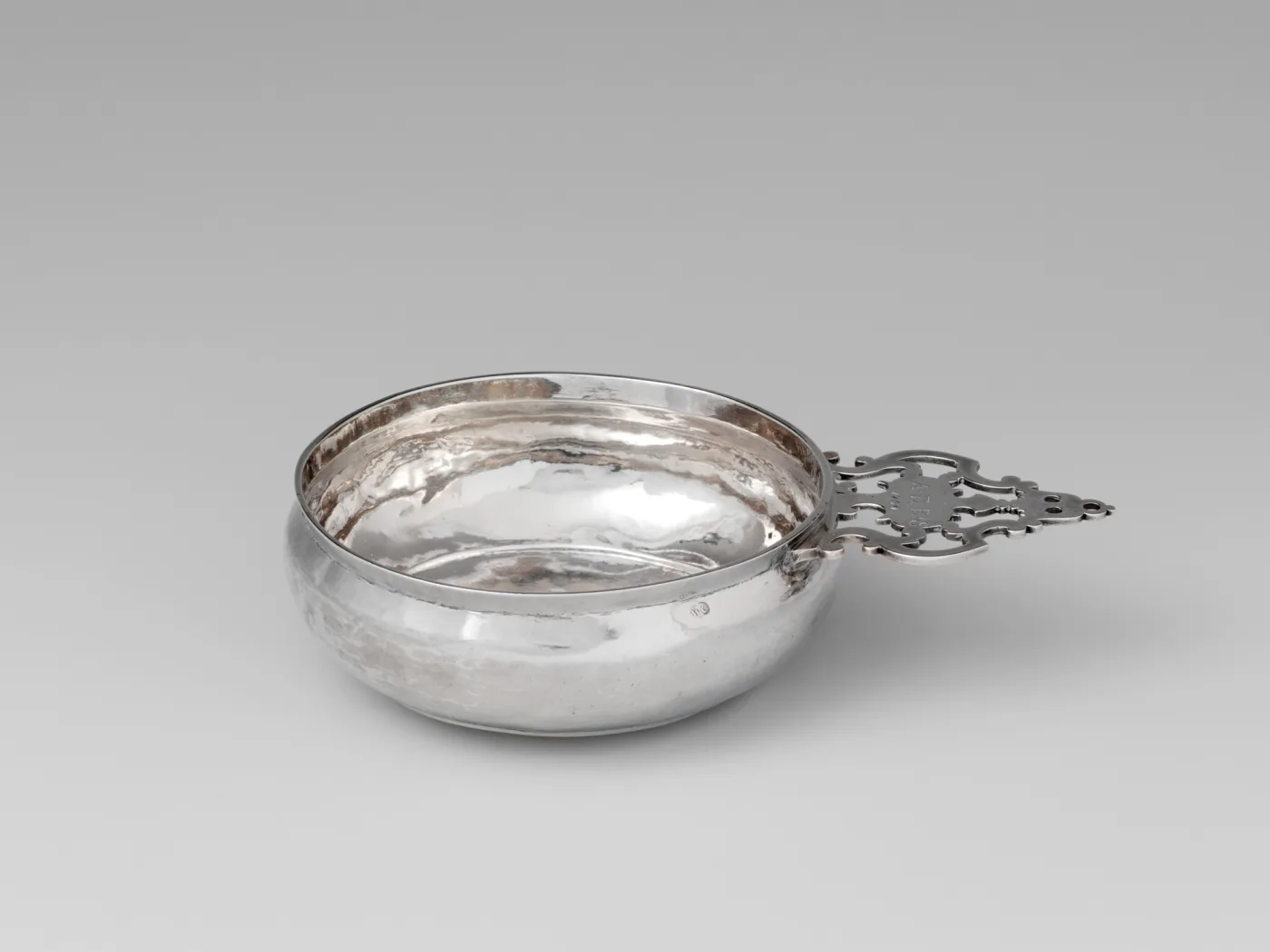
A silver porringer is a shallow bowl about five inches across with one flat handle standing out sideways, and for roughly a hundred and fifty years it barely changed. The bowl is the least informative part: raised from a disc, curved in at the base, near-vertical at the lip, much the same in 1690 as in 1800.
The handle is where the information sits. It was cast in a mould belonging to one shop, in a pattern that shop repeated, then soldered on. That matters more here than for most silver, because colonial American silver was never assayed: no date letter to look up, no town mark to match — one struck punch and a piece of pierced ornament.
Table of Contents
One Handle or Two: the Word Means Two Things
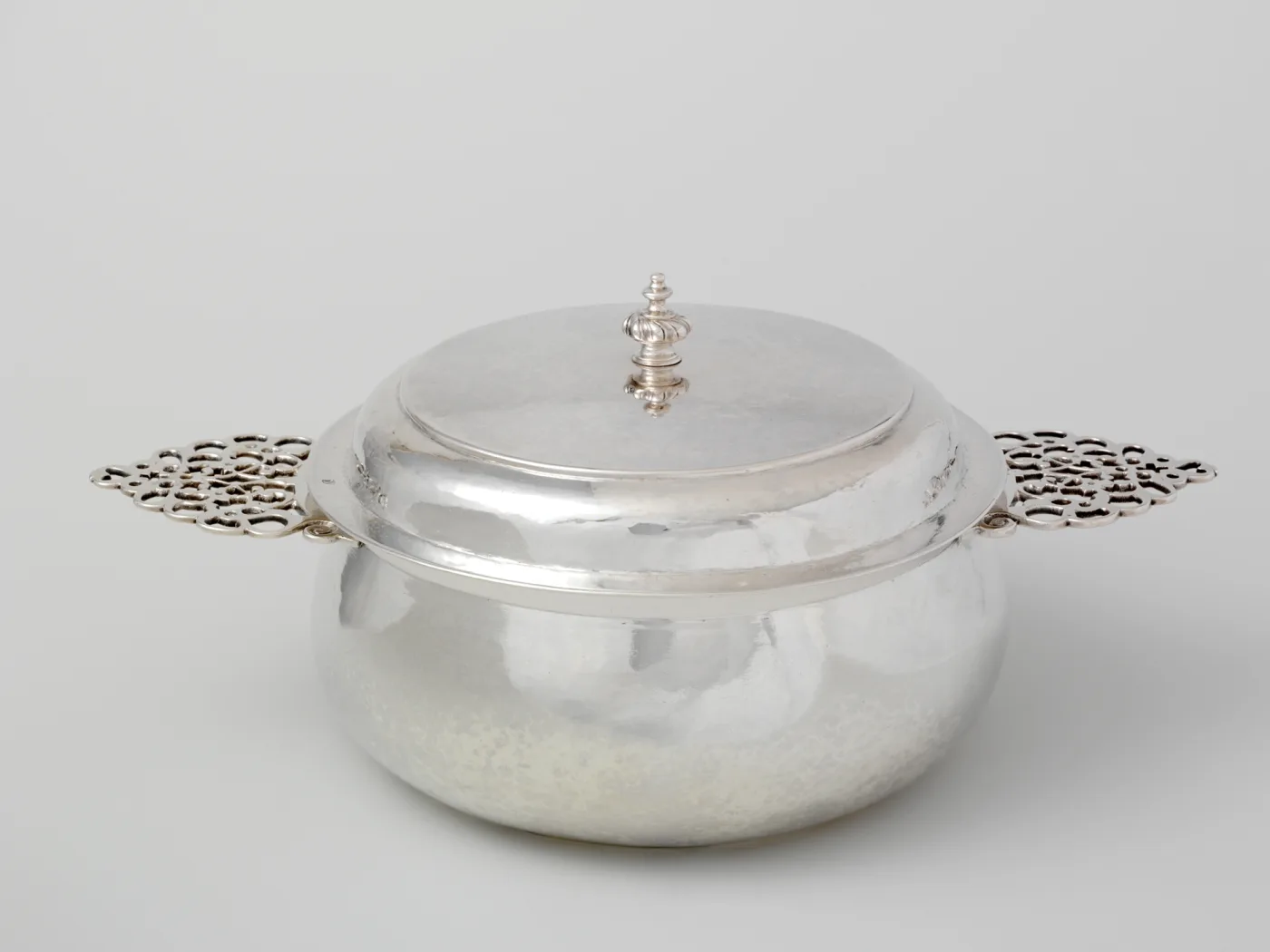
Settle what you are holding first, because the word does two jobs. In American usage a porringer is the single-handled bowl described above. In late seventeenth-century England the same word was attached to a two-handled cup, often covered, also called a caudle cup; its Continental relative is the covered écuelle. Museum catalogues use the word for all of them, which is how the confusion survives.
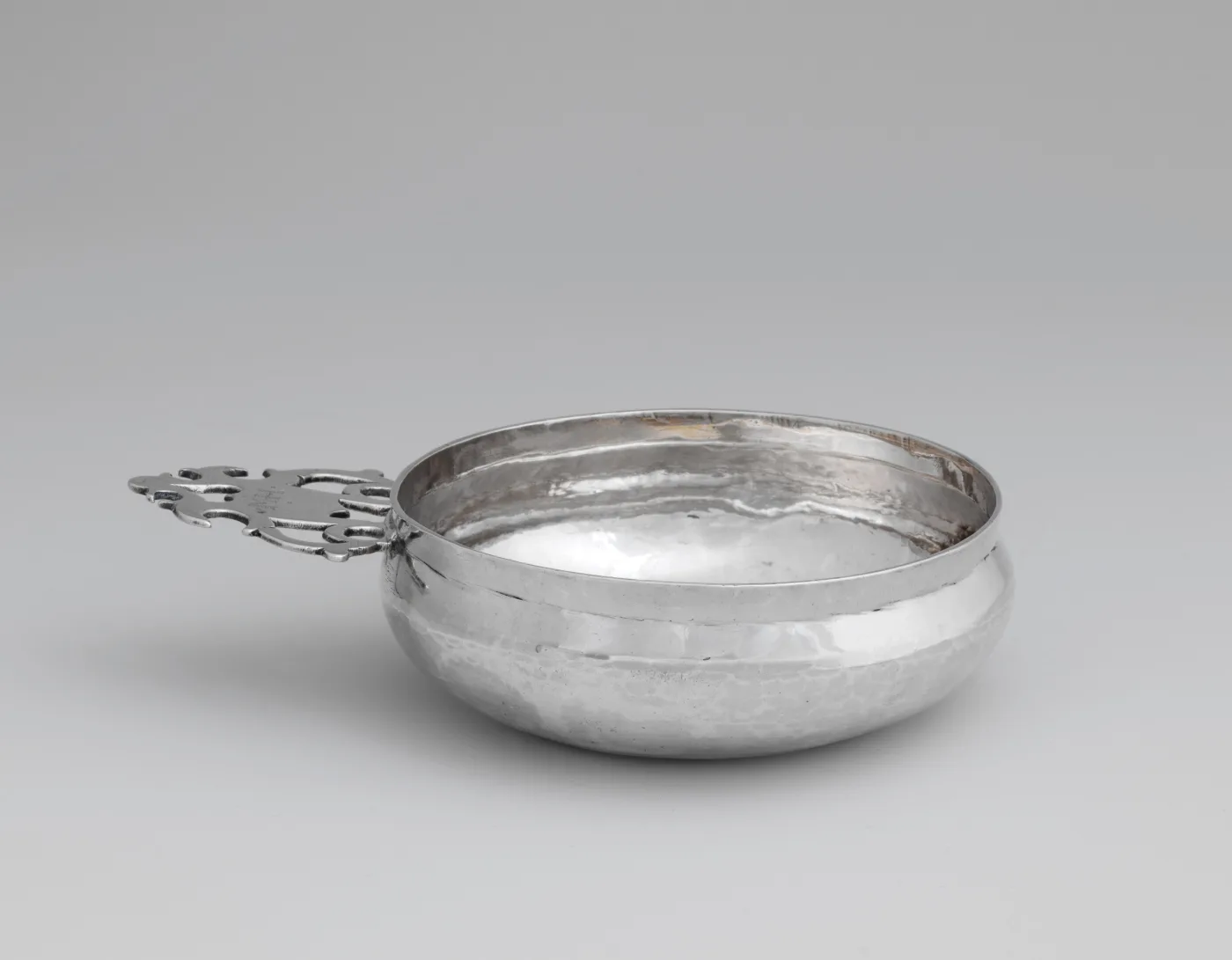
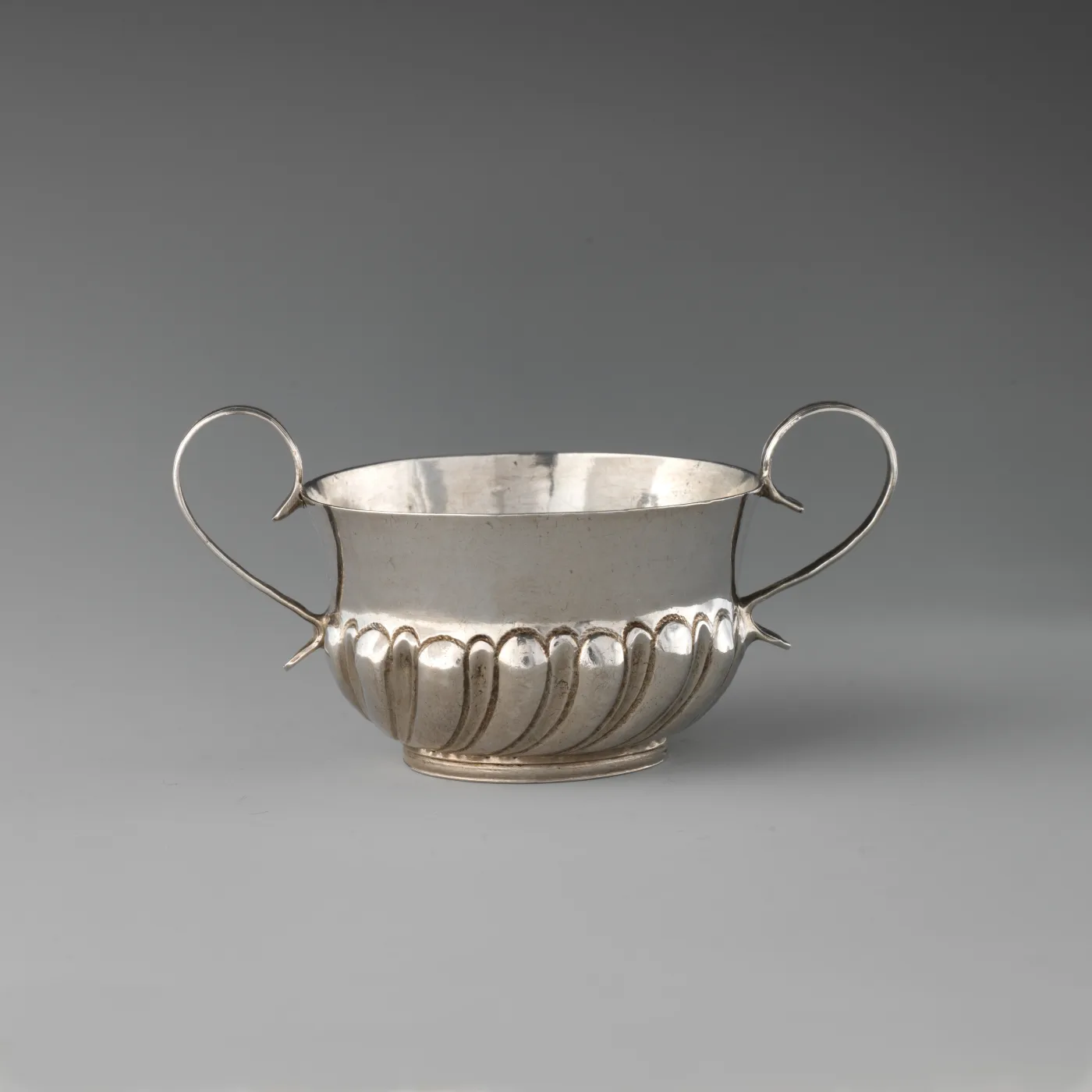
So counting handles narrows the field rather than settling it. The real difference is one of persistence: England largely abandoned the single-handled porringer early in the eighteenth century, while American shops kept making it into the 1820s. A single flat handle therefore points to America, and the later the piece looks the harder it points — but it is not proof.
Read the Marks First
Marks outrank style, so look at them first. There are only three patterns to tell apart.
Four or five small punches in a row means British, Irish or Scottish, and it means a single year can be had: standard mark, town mark, letter for the year, maker's initials. If that is what you have, stop reading style — the order in which British hallmarks are struck and what each one bounds will do the rest.
One punch and nothing else is the colonial American pattern, because no assay office existed in the colonies: a silversmith guaranteed his own work with his own mark and that was the whole of it. Position varies by shop — on the handle, on the bowl near the rim, or inside it — and the punch drifts over the century from initials in a shaped outline towards the surname in a plain rectangle. Treat that drift as a soft indication, not a bound.
A word means the nineteenth century or later: STERLING spelled out, or 925, or COIN, or a firm's name with a pattern number, whatever the handle looks like.
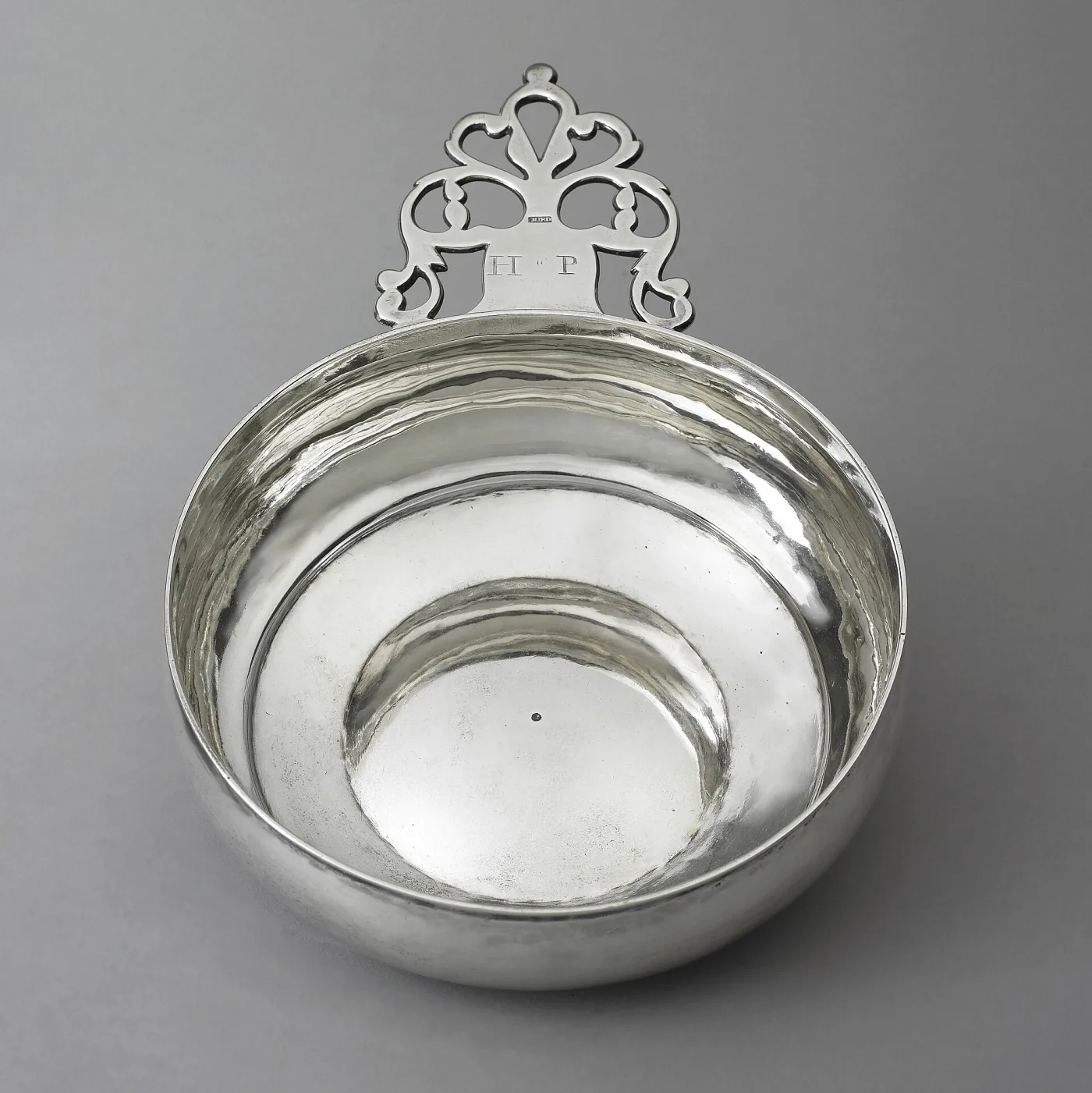
Which raises the trap that catches most people. Engraved letters are not marks. The Cowell porringer at the top of this page is catalogued 1715–30 and engraved 1741, and both are correct: made in one decade, given in another. A struck mark displaces the metal and leaves a raised ghost on the reverse; engraving is cut away and has no reverse. Where the initials point somewhere useful, tracing an owner's initials through wills and inventories is a rewarding exercise in itself.
The Handle Is the Shop's Signature
Handles were cast, not raised, so one mould served many bowls and a pattern belonged to a workshop. Workshops copied their neighbours more readily than their grandfathers, which in practice makes a handle pattern closer to a property of a town. Three families cover most of what survives.
Geometric, around a solid centre. Crescents, circles and trefoils set around an unpierced middle panel, usually where the owner's initials were engraved. The seventeenth-century English pattern and the earliest American one, running to roughly the 1730s.
Dense openwork across the whole plate. A broader handle pierced right across, often with a scalloped or beaded edge. Both New York pieces below are of this kind.
Keyhole. One keyhole-shaped opening at the centre — a round hole above a tapering slot — with symmetrical scrolls either side. New England, common from about the 1730s and still in production about 1800.
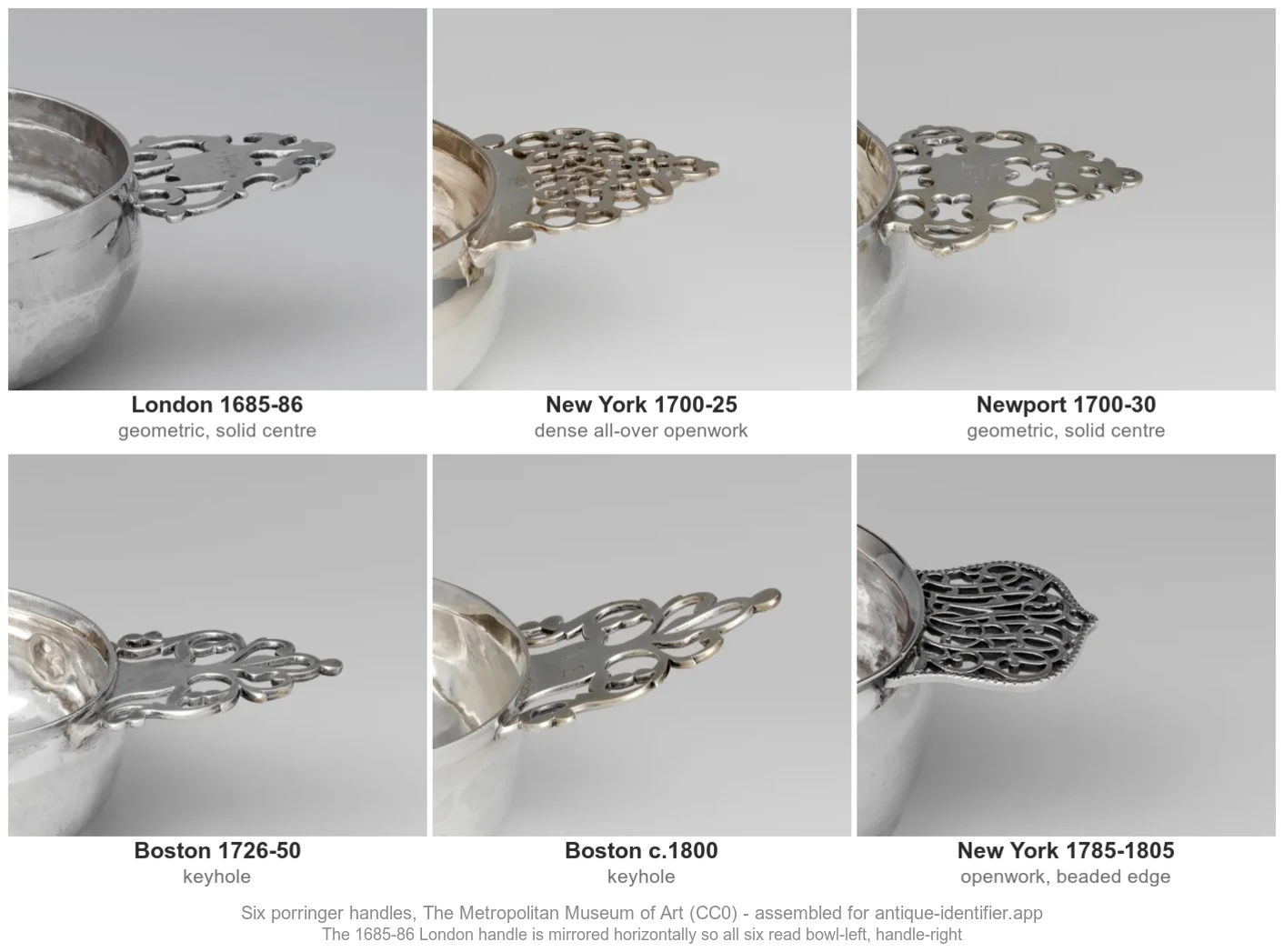
Which is the opposite of how most people use a handle. Do not date it; use it to place the piece, then narrow the date inside that region from the marks, the bowl and the weight. Read the other way round, a handle will mislead you by half a century.
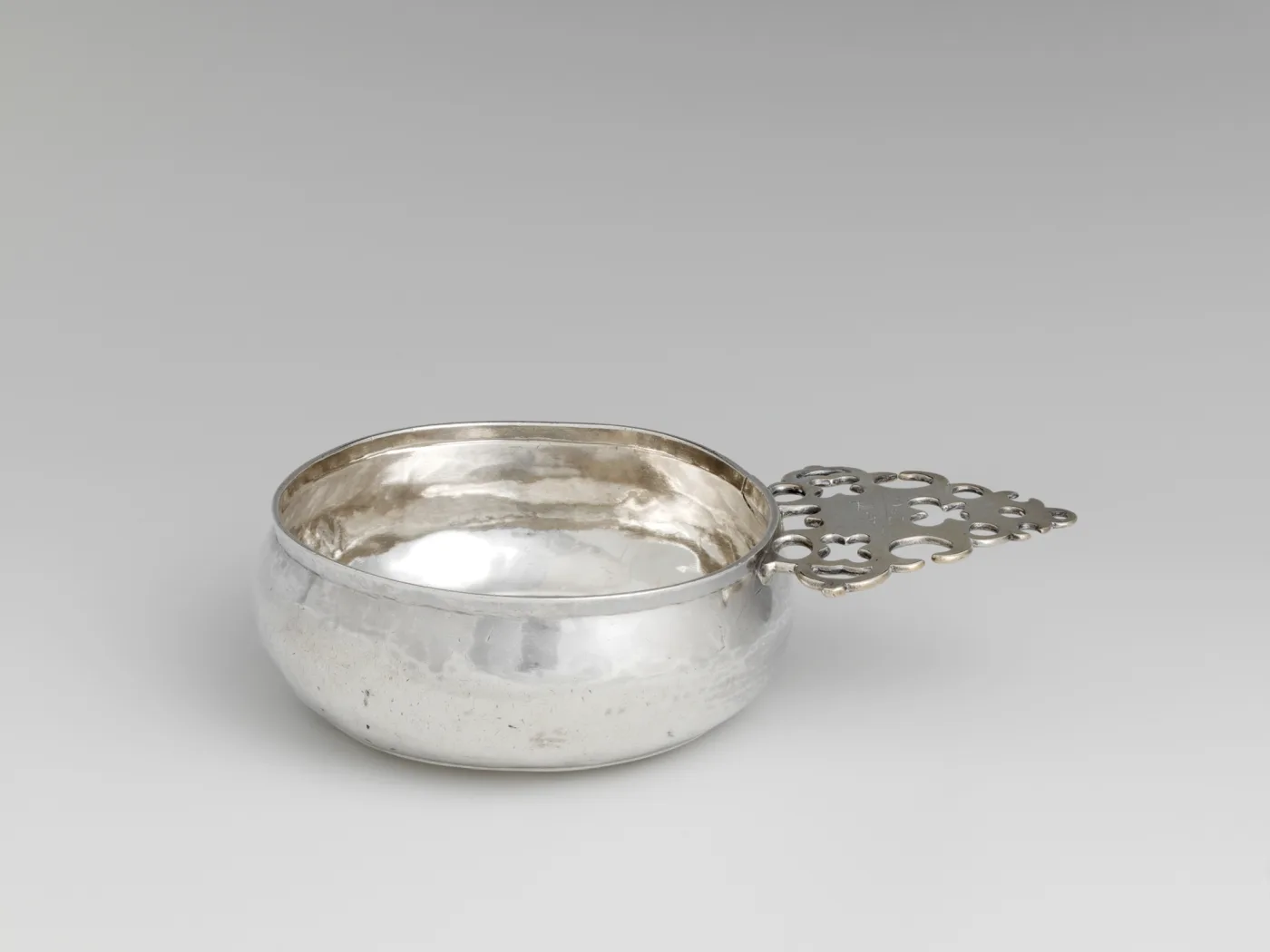
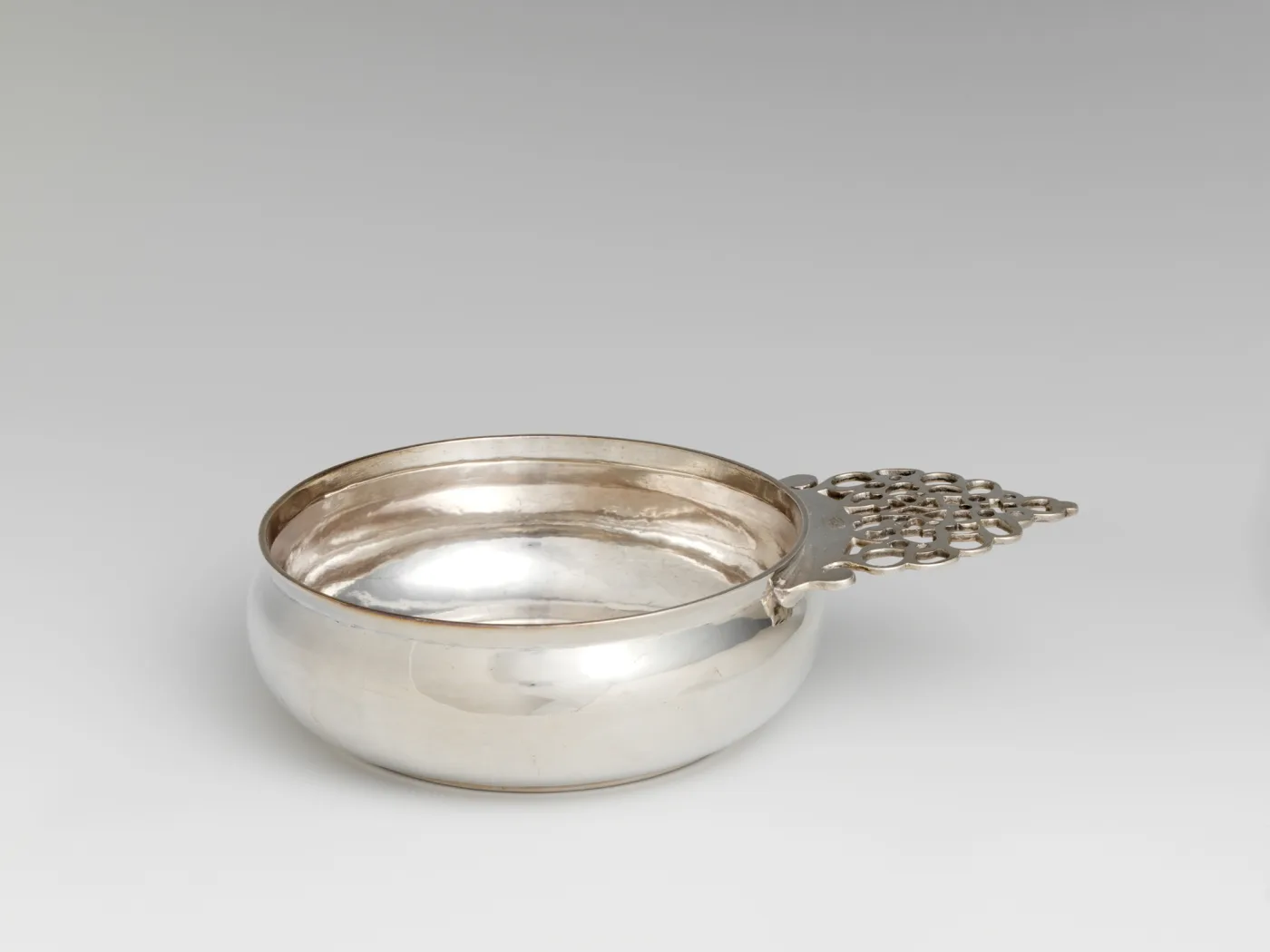
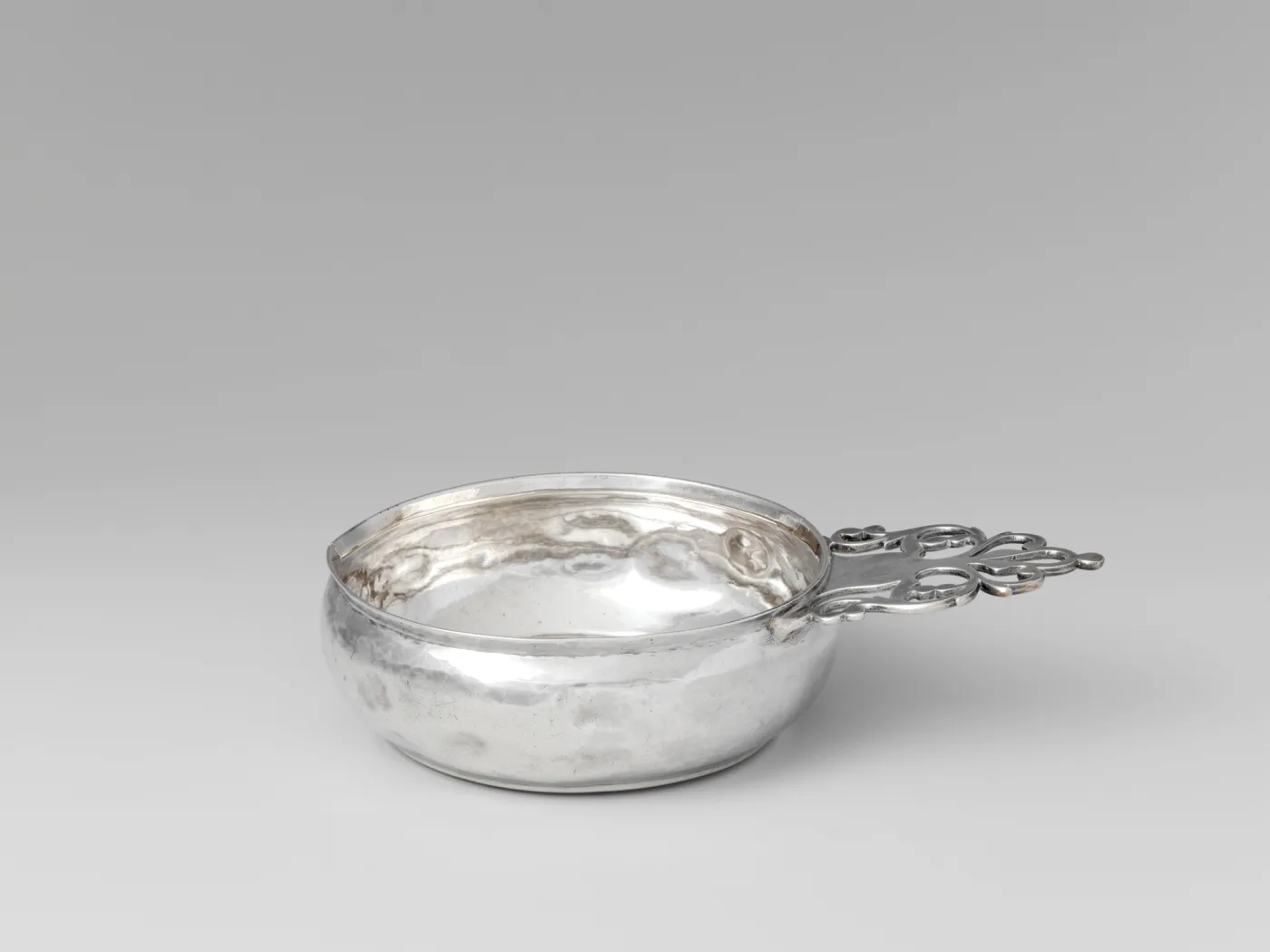
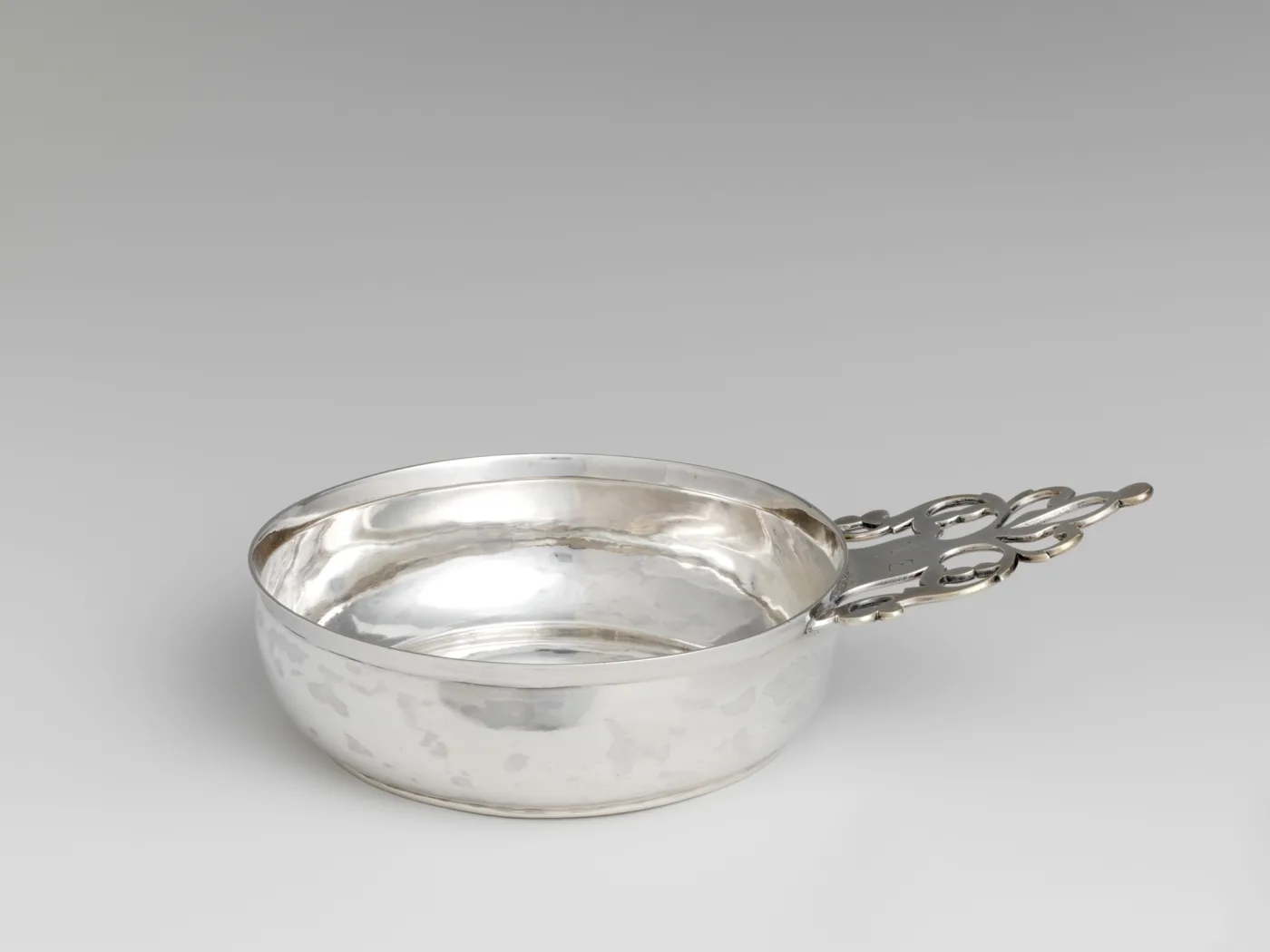
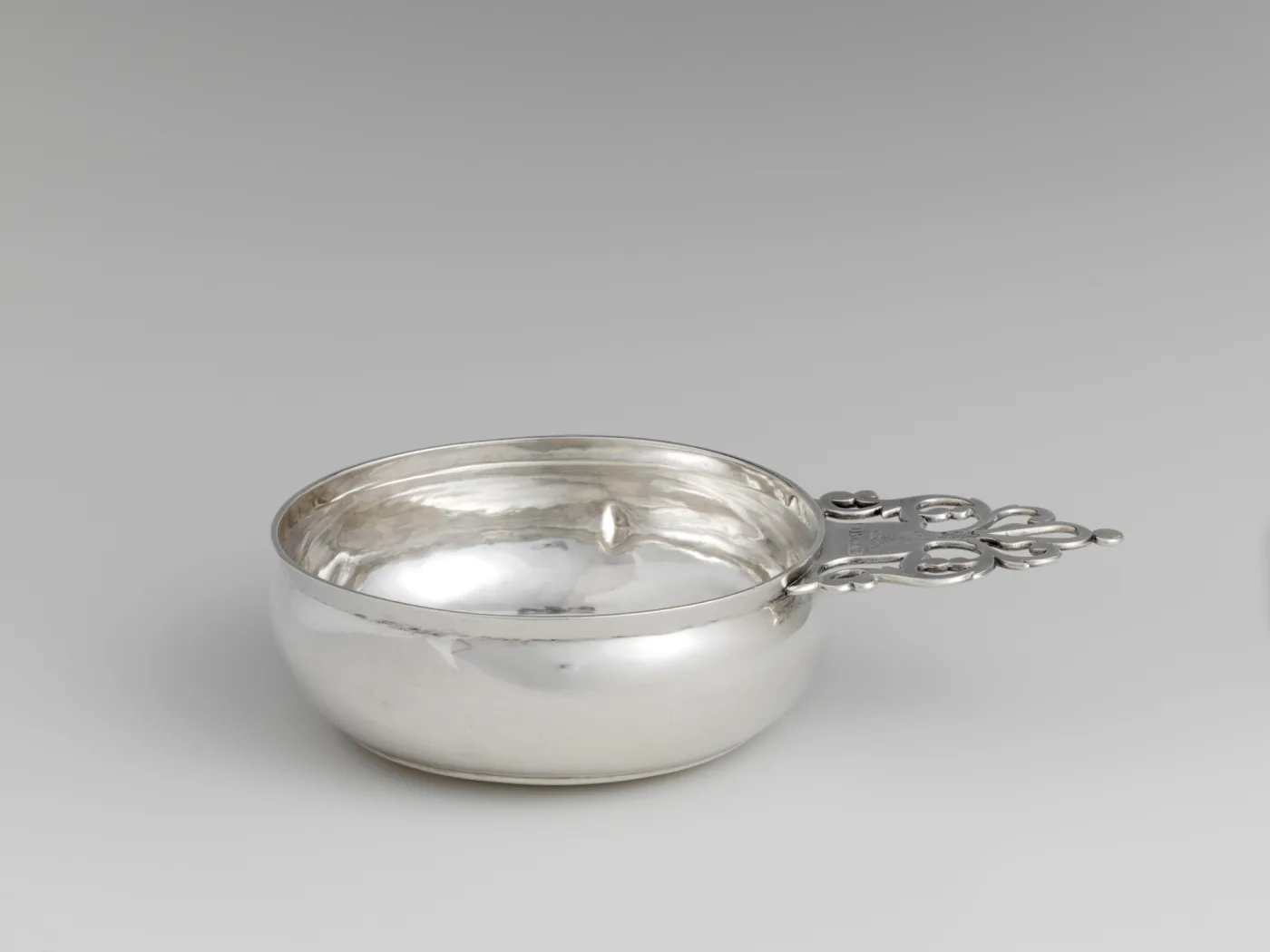
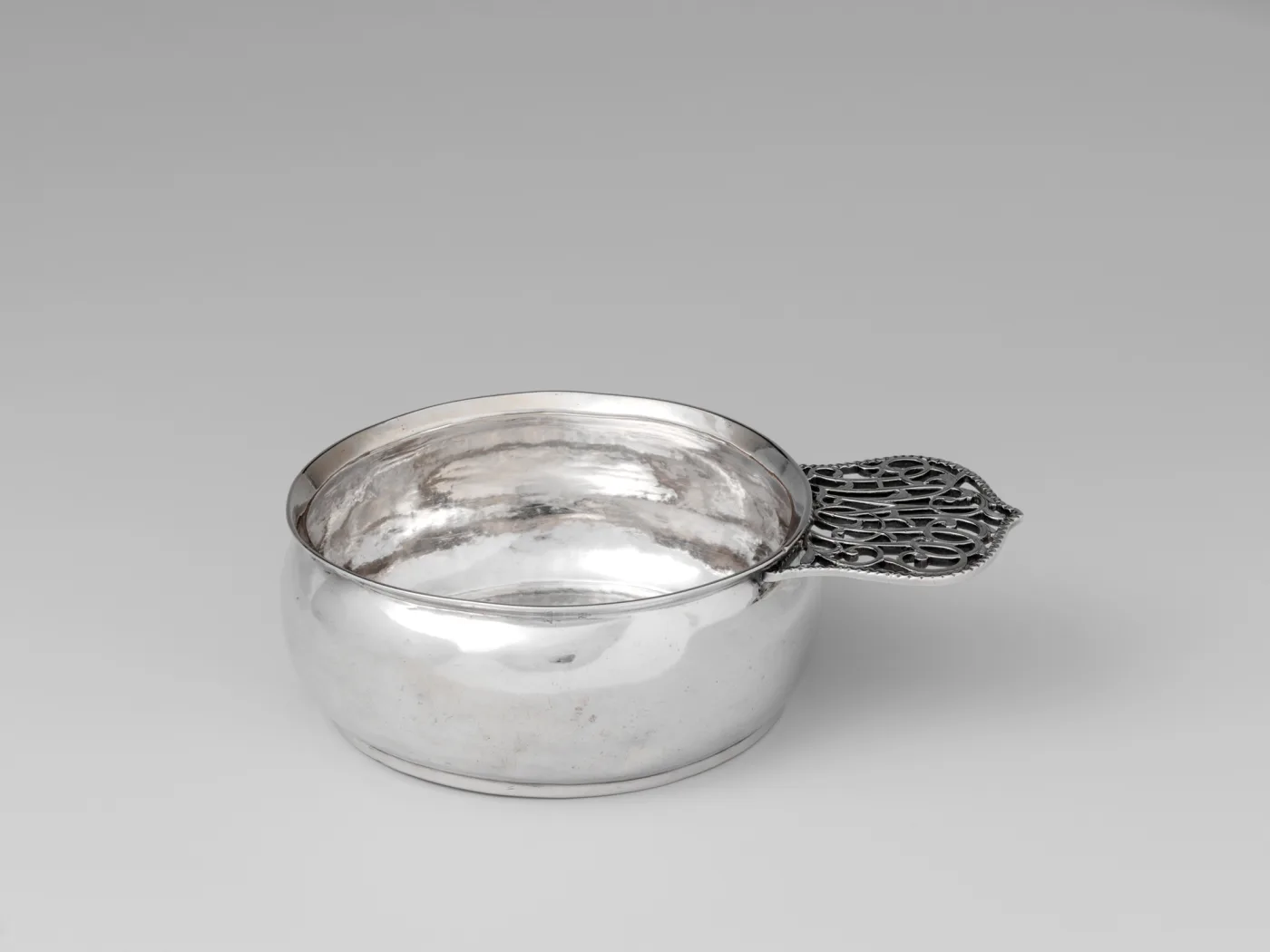
Two caveats. The families are tendencies, not laws: journeymen moved, patterns were copied, and Connecticut and Rhode Island shops worked in either idiom. And there is at least a fourth group — the arched, crown-like openwork of the 1730s and 1740s in the overhead photograph above.

What the Bowl Adds
The bowl will not date a porringer, but it will say whether the object was made by hand or by machine — often the question that actually matters.
A raised bowl was hammered up from a flat disc over a stake. Look inside at a shallow angle to the light for faint concentric rings left by the planishing hammer, and for a small punched dot at the dead centre of the base: the compass point used to scribe the disc before raising. A bowl spun on a lathe shows perfectly even tool lines, uniform thickness, a mirror interior and no centre dot; spinning is a nineteenth-century and later method.
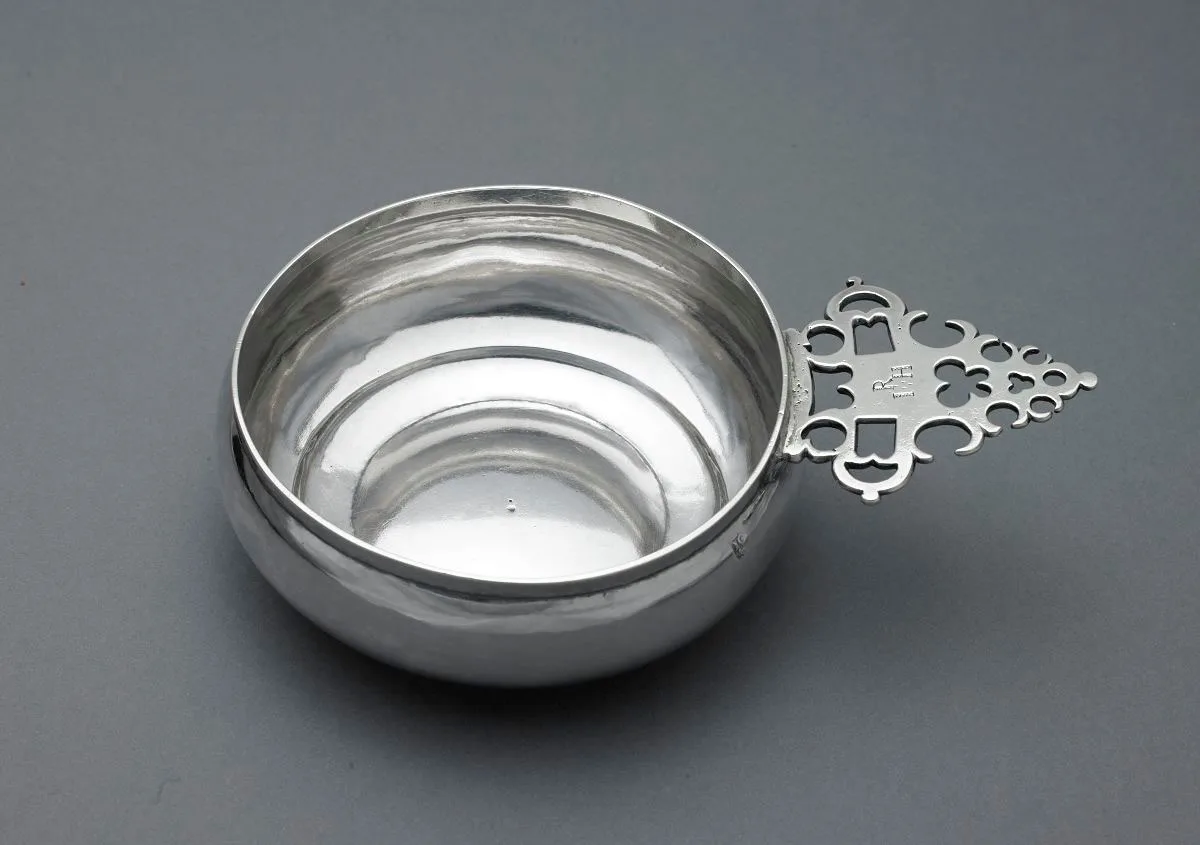
Then put it on the scales. The six single-handled American examples in the table below run 6 3/4 to 8 3/8 inches overall and weigh 7 oz 3 dwt to 9 oz 3 dwt — 223 to 285 grams — across a full century. That steady allowance gives a rough test: much lighter at that size, and the metal has probably been thinned by machine. If the piece proves plated rather than solid, the tells belong with old Sheffield plate and the electroplate that replaced it.
Ten Dated Benchmarks
The fastest way to place an unfamiliar handle is against pieces whose maker, town and date are already settled. The ten below are published museum objects, assembled into one table so pattern, size and weight can be read together; the dates are the museums' own.
| Maker | Working at | Museum date | Handle pattern | Overall width | Weight |
|---|---|---|---|---|---|
| Thomas Cory | London | 1685–86 | Geometric, solid centre | 4 1/2 in. bowl diam. | — |
| P. H. (miniature, two handles) | London | 1690–91 | Looped wire, gadrooned body | 2 in. diam. | — |
| Samuel Vernon | Newport, Rhode Island | 1700–1730 | Geometric, solid centre | 7 5/8 in. (19.4 cm) | 9 oz 3 dwt |
| Peter Van Dyck | New York | 1700–1725 | Dense openwork, rows of circles | 7 15/16 in. (20.2 cm) | 9 oz 3 dwt |
| John Coney | Boston | about 1710 | Geometric with square voids | — | — |
| William Cowell Sr. | Boston | 1715–30 | Scrolled, solid engraved centre | 7 5/8 in. (19.4 cm) | 7 oz 4 dwt |
| Samuel Edwards | Boston | 1726–50 | Keyhole | 7 7/16 in. (18.9 cm) | 7 oz 3 dwt |
| Struck HURD, maker unrecorded | New England | about 1740 | Arched or crown openwork | — | — |
| Benjamin Burt | Boston | 1763 | Keyhole | 8 3/16 in. (20.8 cm) | 7 oz 10 dwt |
| Andrew Billings | Poughkeepsie, New York | 1785–1805 | Dense scrollwork, beaded edge | 6 11/16 in. (17 cm) | 7 oz 16 dwt |
| Ebenezer Moulton | Boston | about 1800 | Keyhole | 8 3/8 in. (21.3 cm) | 7 oz 8 dwt |
Read down the handle column and the grouping is by town, not by decade — the plate's lesson again, in numbers. Read down the weight column and the consistency is the story: whatever the pattern, a table porringer took about seven to nine troy ounces of silver. For how that sits beside other domestic silver, the wider survey of antique silver forms and standards is the place to start, and the same evidence-stacking approach dates flatware, where an English spoon is placed by its stem terminal and the position of its marks.
Where the Sequence Stops: Revival Copies
The porringer had a second life. From the 1890s onward American firms made them again as christening presents, many of them close copies of eighteenth-century Boston keyhole handles. They turn up constantly, they are often offered as colonial, and they are not hard to catch.
STERLING is the fastest tell, and a pattern number or company name settles it. Beyond the marks: an even machine gauge, a mirror interior with no planishing and no centre dot, crisp casting without the file marks a hand would leave, and sometimes a handle matching a published museum piece a shade too exactly. Copies also tend to be lighter than their models, which is where the weight column earns its place.
None of that makes a revival porringer a fake — it is an honestly marked copy of an admired form — but the value gap between it and a marked Boston original of 1750 is very large, so do the check before money changes hands rather than after; the guide to valuing and appraising antiques sets out the framework. Remember too that most surviving porringers were never silver: pewter porringers and tasters were made in far greater numbers, and pewter will not take a mirror polish.
Four Checks, In Order
The order matters, because each step changes what the next one means.
1. Count the handles. Two, with or without a cover, and you are on the other meaning of the word: a caudle cup or an écuelle. One flat handle and you are on the track described here.
2. Read the marks. Four or five punches in a row means British and a year can be had. One punch means colonial American and no year can be had. A word means after about 1860.
3. Match the handle to a family. Geometric around a solid centre for the earliest work either side of the Atlantic; dense openwork for New York and the Hudson Valley; keyhole for New England. A region, not a date.
4. Look inside the bowl. Planishing rings and a centre punch mean hand-raised; even tool lines and a mirror finish mean spun, and therefore modern.
When steps 2 and 3 disagree, believe step 2. Handles are the most vulnerable part of the object and do get replaced, so a keyhole handle on a bowl marked in New York is more likely a repair than a discovery.
Frequently Asked Questions
Is a single-handled silver porringer always American?
No. English silversmiths made them through the second half of the seventeenth century, and the Metropolitan Museum owns a London-marked example of 1685 to 86. England then gave the form up while American shops kept making it for another hundred years, so a single handle points to America without proving it.
What does a keyhole handle tell me?
A keyhole handle, one keyhole-shaped opening at the centre of the plate with matching scrolls either side, is a New England pattern. It runs from about the 1730s to about 1800, so it is worth a region rather than a date. New York plates of the same years are pierced right across instead.
The handle is engraved with three initials and a date. Is that when it was made?
Usually not. A triad of initials records a marriage and an engraved year records that occasion, not the year of manufacture: the Cowell porringer here is catalogued 1715 to 30 and engraved 1741. Struck marks displace the metal, engraving is cut away, so read them separately.
Does the word STERLING mean my porringer is not old?
It means it is not colonial. Spelling the standard out in words is a nineteenth-century habit, so STERLING, 925, or a company name with a pattern number places the piece after about 1860. Many are honest copies of Boston keyhole handles sold as christening presents from the 1890s.
Why is there no date letter on an American porringer?
Because colonial America had no assay office. British silver went to a guild hall to be tested and struck with a town mark, a standard mark and a letter for the year. A colonial silversmith guaranteed his own work with his own punch and nothing else.
What is the small dot in the middle of the bowl?
It is the centre punch, left by the compass point used to scribe the disc before the bowl was raised. With the faint rings of the planishing hammer it is good evidence of hand raising. A spun bowl has even tool lines and no centre dot.
The Short Version
Count the punches. Four or five in a row and it is British, datable to the year. One, and it is colonial American, datable only by argument. A spelled-out word and it is Victorian or later, however convincing the handle.
Then read the handle for place rather than time — geometric for the earliest pieces, dense openwork for New York, keyhole for New England — and look inside the bowl for hammer rings and the compass dot. Handle, mark and surface agreeing is about as close to certainty as an unassayed object gets.