English Silver Spoons: Dating by Stem and Bowl
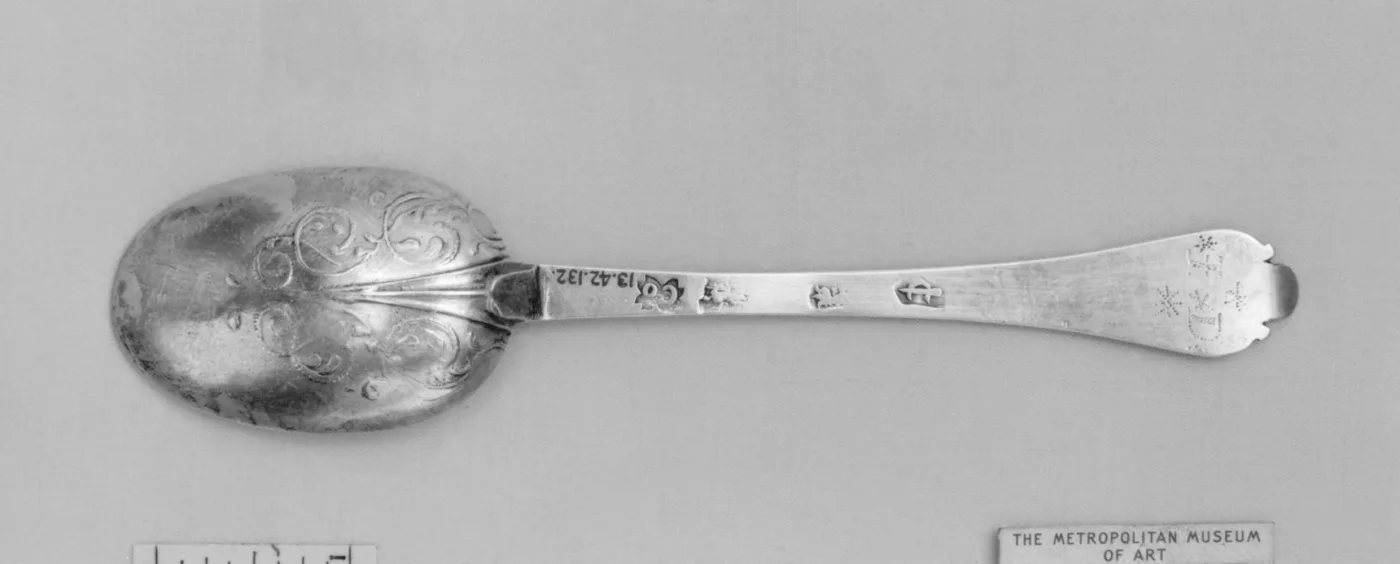
The marks on an old spoon sit exactly where four hundred years of hands have rubbed them, which is why so many spoons arrive unreadable. The shape does not wear off. An English spoon carries its date in three independent places, and two of them survive long after the punches have gone.
This guide reads those three: the shape of the stem end, the reinforcement behind the bowl, and where the marks were struck. Each is a coarse clock. Together they bracket a spoon to a few decades — and, more usefully, they check one another.
Table of Contents
Three Clocks, and Why They Must Agree
Most writing on dating silver starts and ends with the hallmark, and on a spoon that advice fails more often than it works: the punches sit on the thinnest, most handled part of the object, and wear takes them out. So read the object instead. Three features changed on a schedule, independently of one another — which is the whole point. A spoon that is what it claims to be reads the same date three times.
| Stem end | Date range (London) | Expected behind the bowl | Expected mark position |
|---|---|---|---|
| Cast apostle or baluster seal finial; hexagonal stem, fig bowl | to c. 1660 | Nothing — plain junction | Town mark in the bowl, maker's mark on the stem |
| Slip top — stem cut off at an angle, no finial | to c. 1660 | Nothing — plain junction | Town mark in the bowl, maker's mark on the stem |
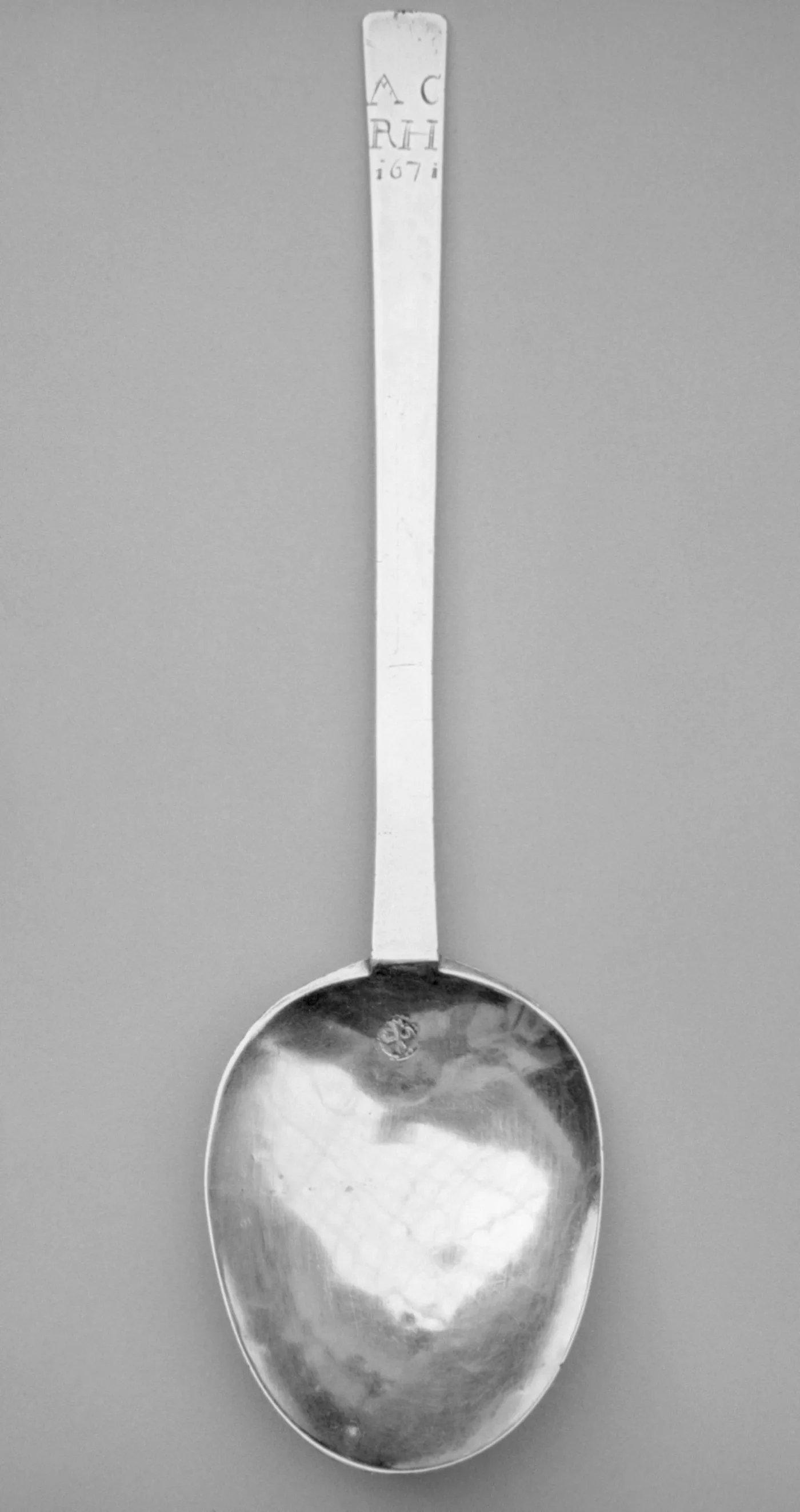
| Puritan — flat stem cut square across, no finial | c. 1650–1665 | Nothing, or a short tongue | In the bowl, or in a line on the stem |
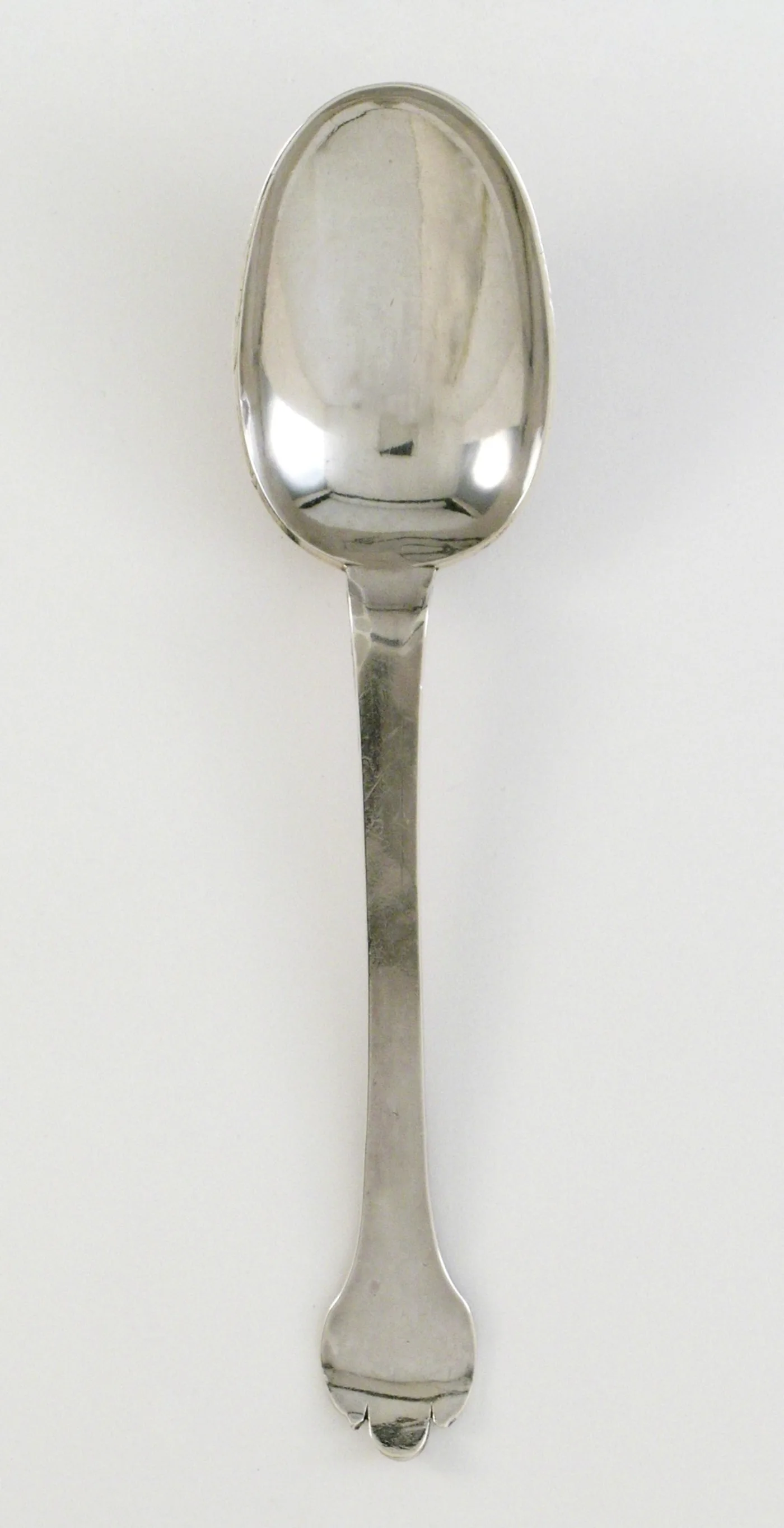
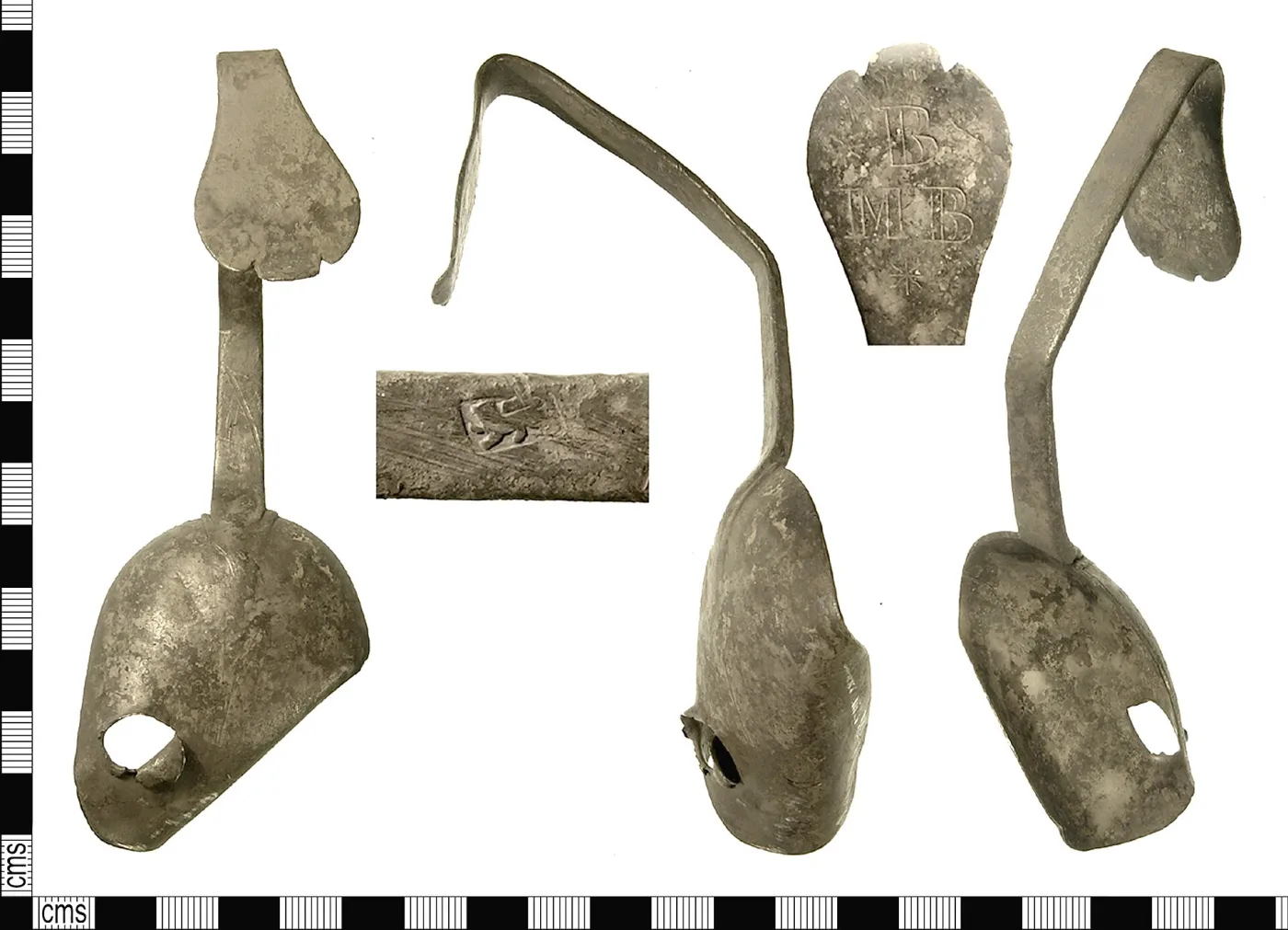
| Trifid — flat terminal with two notches cut into it | c. 1660–1710 | Rat-tail | In a line on the stem, beside the bowl |
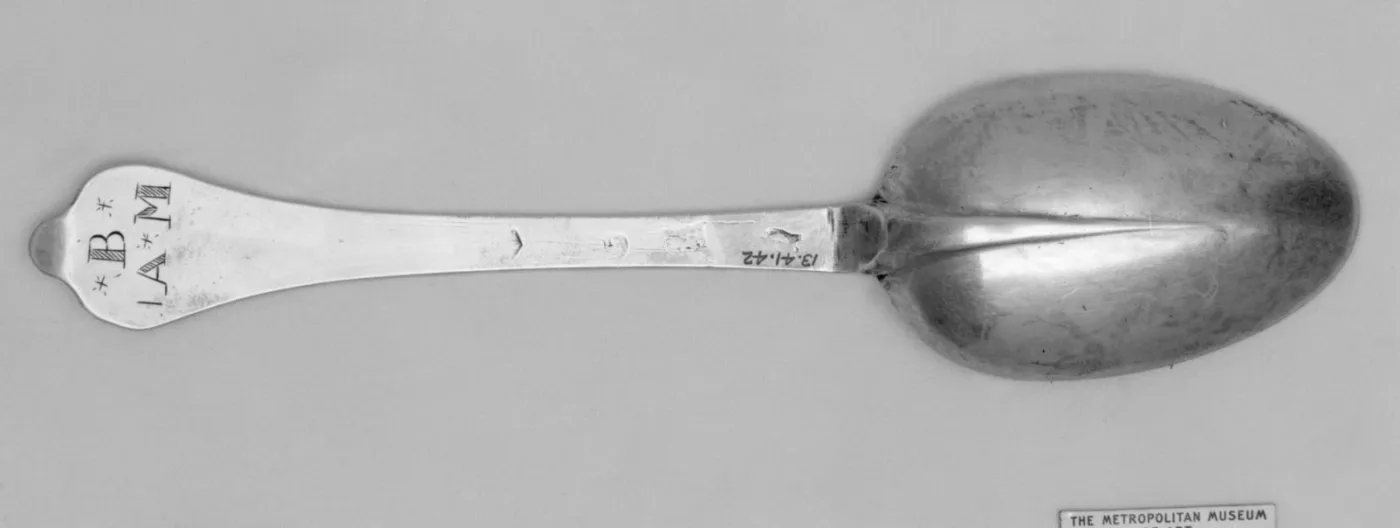
| Dognose or wavy end — single rounded lobe | c. 1700–1715 | Rat-tail | In a line on the stem, beside the bowl |
| Hanoverian — rounded end, ridge down the front, tip turns up | c. 1710–1775 | Rat-tail to c. 1730, then a drop | Beside the bowl |
| Old English — rounded end, no ridge, tip turns down | c. 1760 onward | Drop, often doubled | Beside the bowl to 1780; near the terminal from 1781 |
| Fiddle — shouldered stem widening to a spade end | c. 1800 onward | Drop | Near the terminal |
Read across a row, not down a column. The point is not that a trifid end means the 1680s — plenty of sources say that. It is that a trifid end predicts a rat-tail and marks beside the bowl, and a spoon that fails the prediction is telling you something.
The Stem End, Period by Period
Before the Restoration, English spoons ended in a knop: a cast finial soldered to the top of a slender hexagonal stem, above a deep bowl shaped like a fig, widest towards the tip. The two commonest survivals are the apostle, carrying a figure of a saint, and the seal top, carrying a plain baluster.
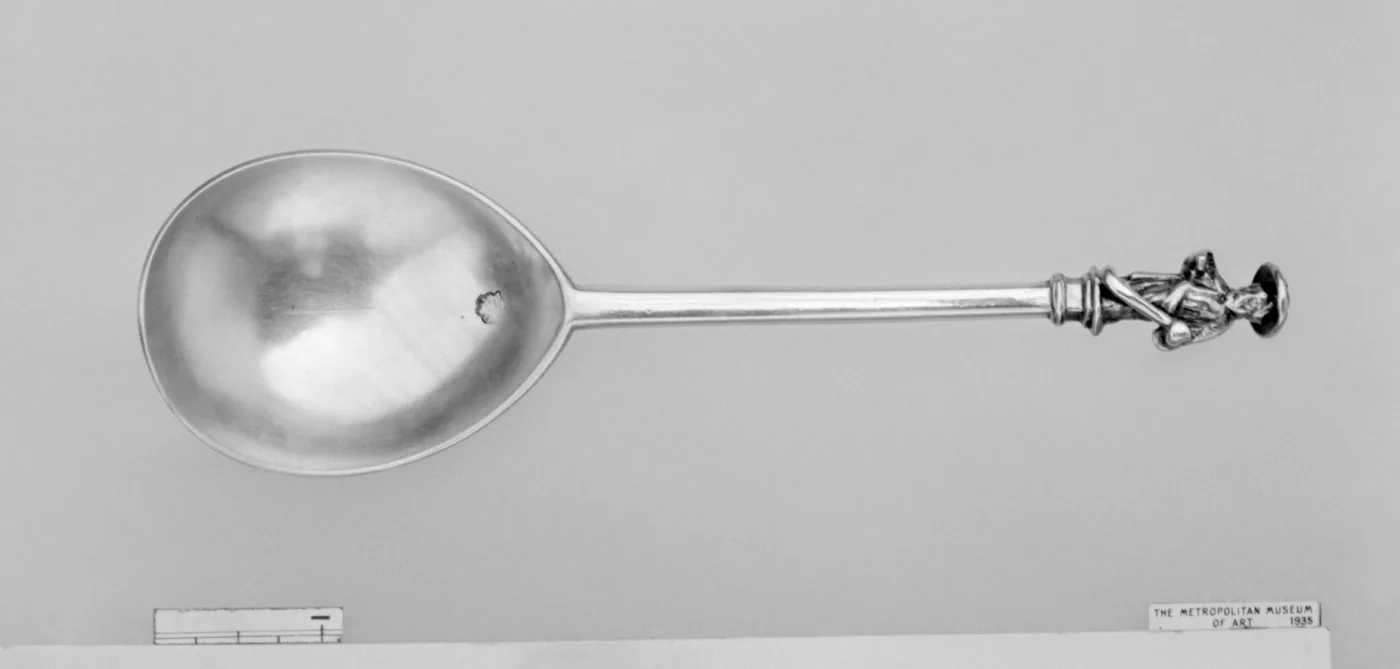
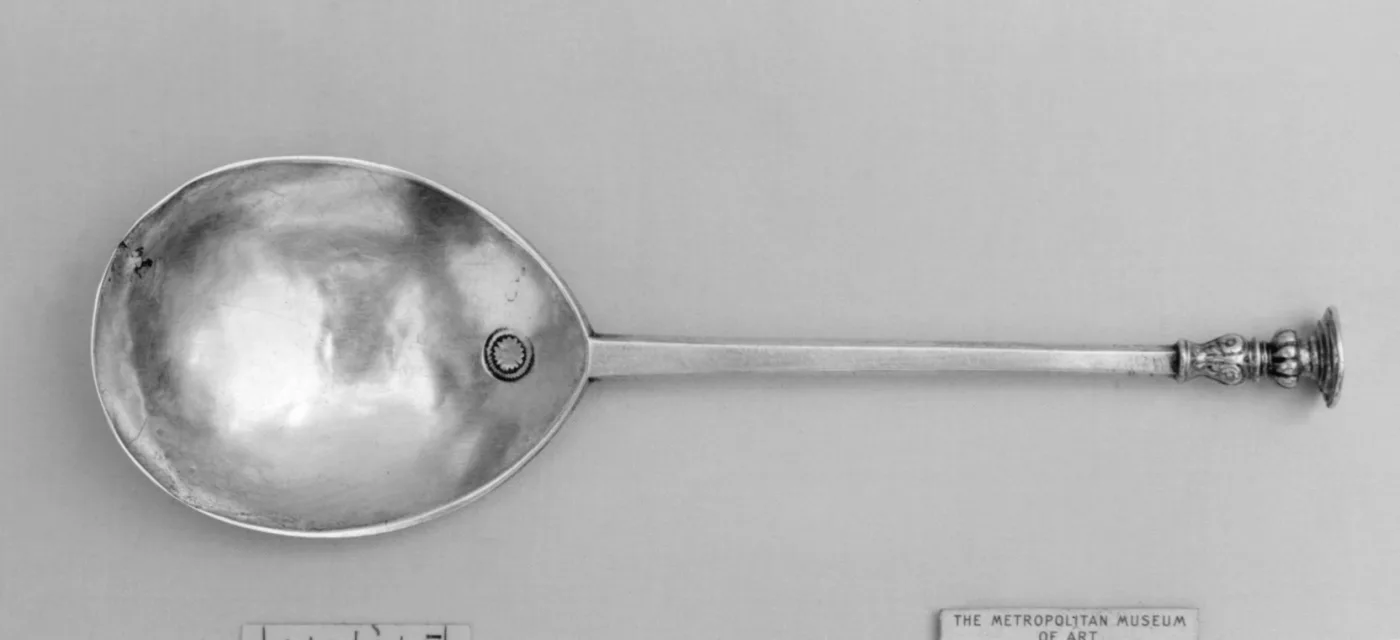
Then the knop disappears. The Puritan spoon of the 1650s is the first English spoon with a flat stem and no finial at all, cut off square at the end — startlingly modern beside an apostle, and the ancestor of every spoon since.
From about 1660 the flat end broadens and two notches are cut into it, making three lobes. This is the trifid, or trefid, and it is the form most people picture when they think of an early English spoon.
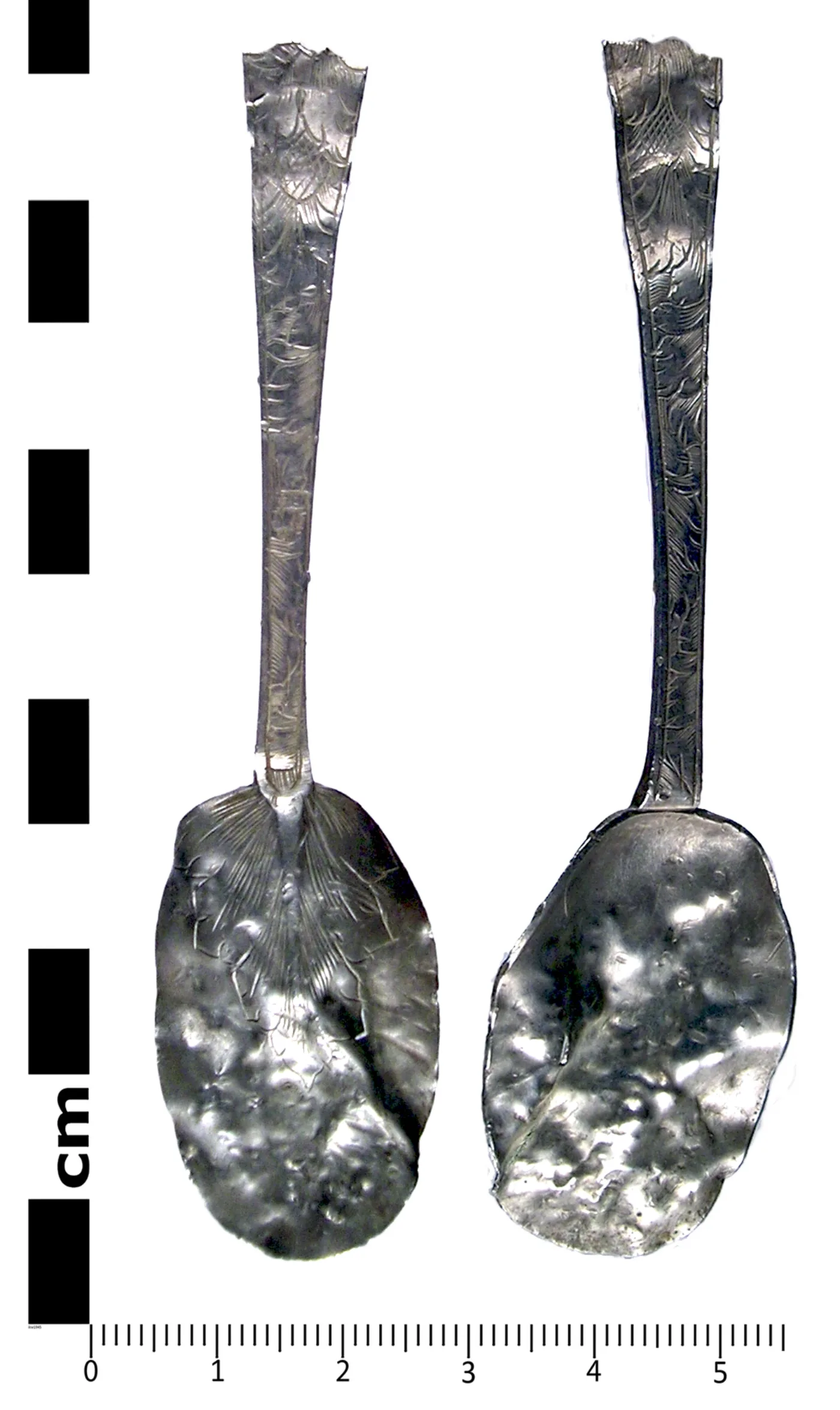
Trifid dates are London dates, and the form travelled slowly. Outside London it stayed in use noticeably longer, which matters if your spoon carries a provincial, Irish or Scottish town mark rather than a leopard's head. Our guide to British silver hallmarks covers identifying the assay office itself.
| Where it was made | Trifid spoons in use |
|---|---|
| London | c. 1660–1710 |
| English provinces | c. 1655–1720 |
| Ireland | c. 1663–1708 |
| Scotland | c. 1665–1715 |
Around 1700 the notches are abandoned and the terminal becomes a single rounded lobe — the dognose, or wavy end. It is a short-lived form, roughly 1700 to 1715, and it is the bridge to everything after.

Hanoverian or Old English: Which Way the Tip Turns
From about 1710 the terminal settles into a plain rounded end that barely changes for a century. Two patterns share it, they are the commonest Georgian spoons you will ever handle, and the only reliable difference between them is which way the very end of the stem bends.
Hanoverian, roughly 1710 to 1775, turns the tip up — the same direction the bowl curves — and usually carries a ridge running down the front of the stem. Old English, from about 1760, turns the tip down, the opposite way, and drops the ridge.
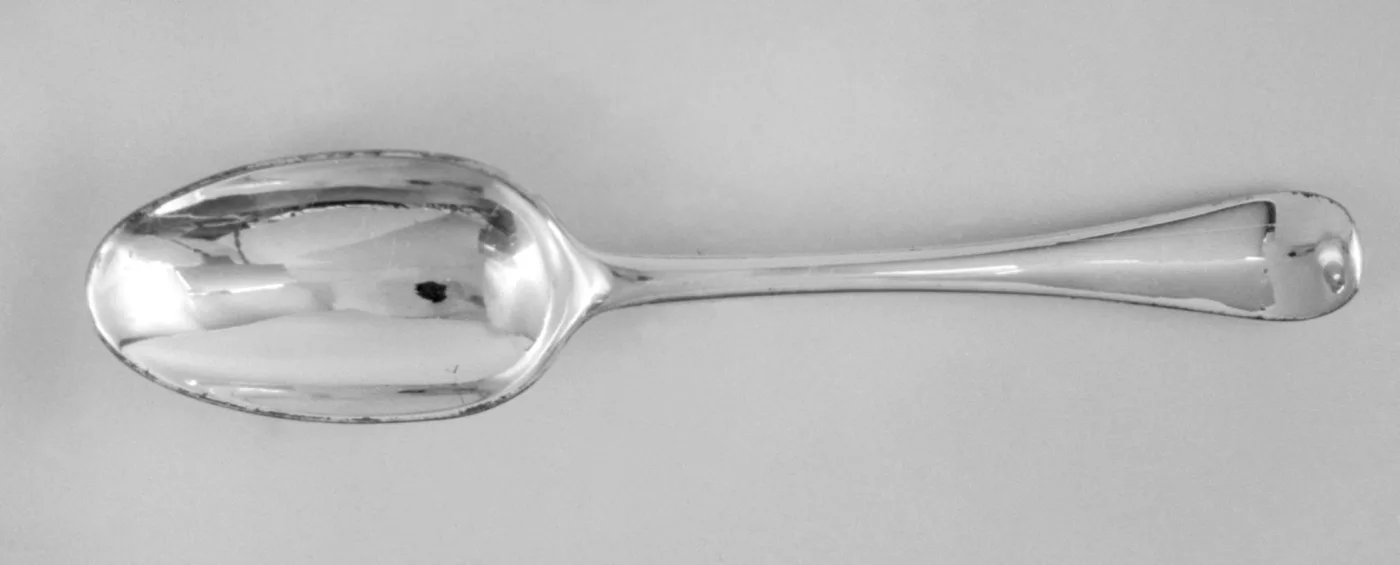
The test takes a second: put the spoon down on a table and let it settle. A Hanoverian rests with the back of its bowl facing up, because the turned-up tip props the handle. An Old English rests bowl up, the way a modern spoon does.
That is not a curiosity, it explains the rest of the object. For most of the eighteenth century the spoon lay on the table back upwards, so the back of the bowl was the side people saw. Which is why engraved crests and owners' initials of that period are on the back of the stem, and why the back of the bowl was worth decorating at all. When Old English flipped the spoon over in the 1760s, the engraving moved to the front and the decorated backs stopped.
The changeover was a fashion, not a rule. Old English was taken up during the 1760s while conservative customers went on ordering Hanoverian into the early 1770s, so a spoon from that decade can honestly be either.
Behind the Bowl: Rat-Tail, Drop, Picture Back
Turn the spoon over. Where the stem meets the bowl there is usually a reinforcement, added because that join is where a spoon breaks, and its shape is the second clock.
From about 1660 it is a rat-tail: a long, tapering rib running well down the back of the bowl. Around 1730 it shortens into a drop, a stubby rounded tongue an inch or less long, and from the 1760s that is often doubled.
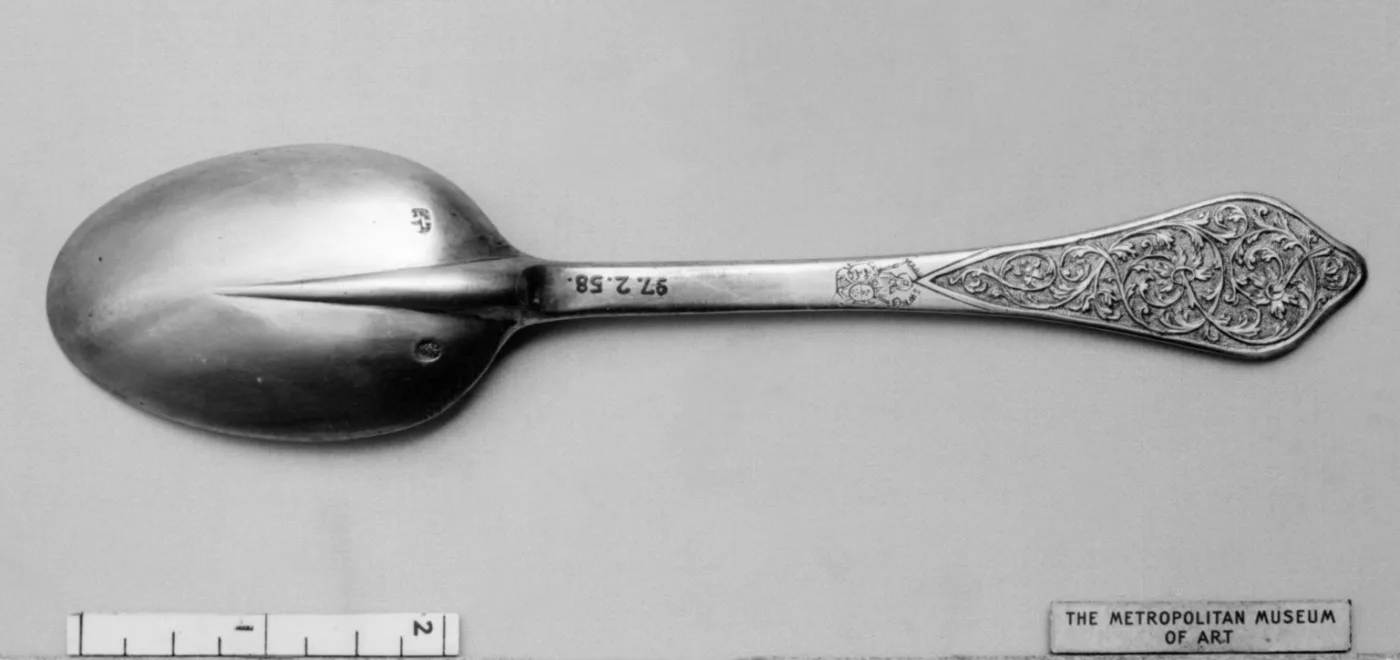
One warning, because it catches people out. Rat Tail was revived as a commercial pattern name in the late nineteenth century and is still made, fully hallmarked with its own date letters. A rat-tail spoon assayed in the 1930s is not a fake; it is a 1930s spoon. The rib alone dates nothing — only the rib agreeing with the terminal and the marks does.
The third thing you may find behind the bowl is a die-struck ornament at the heel — a shell, a basket of flowers, a bird. These are picture backs, and they belong to roughly 1740 to 1780, for the reason given above: that was the face that showed.
Where the Marks Sit, and the 1781 Break
The third clock does not depend on reading the marks at all, only on noticing where somebody put them.
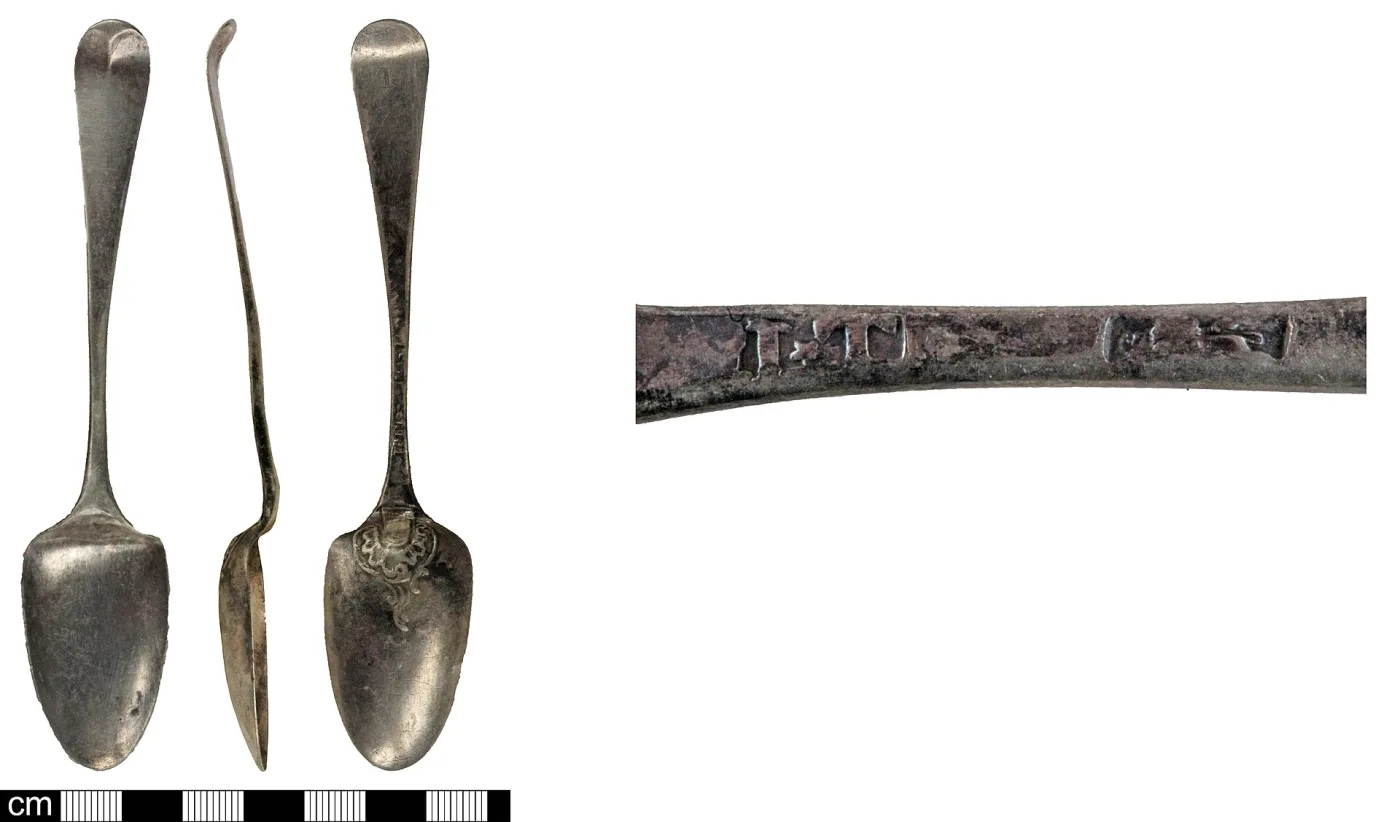
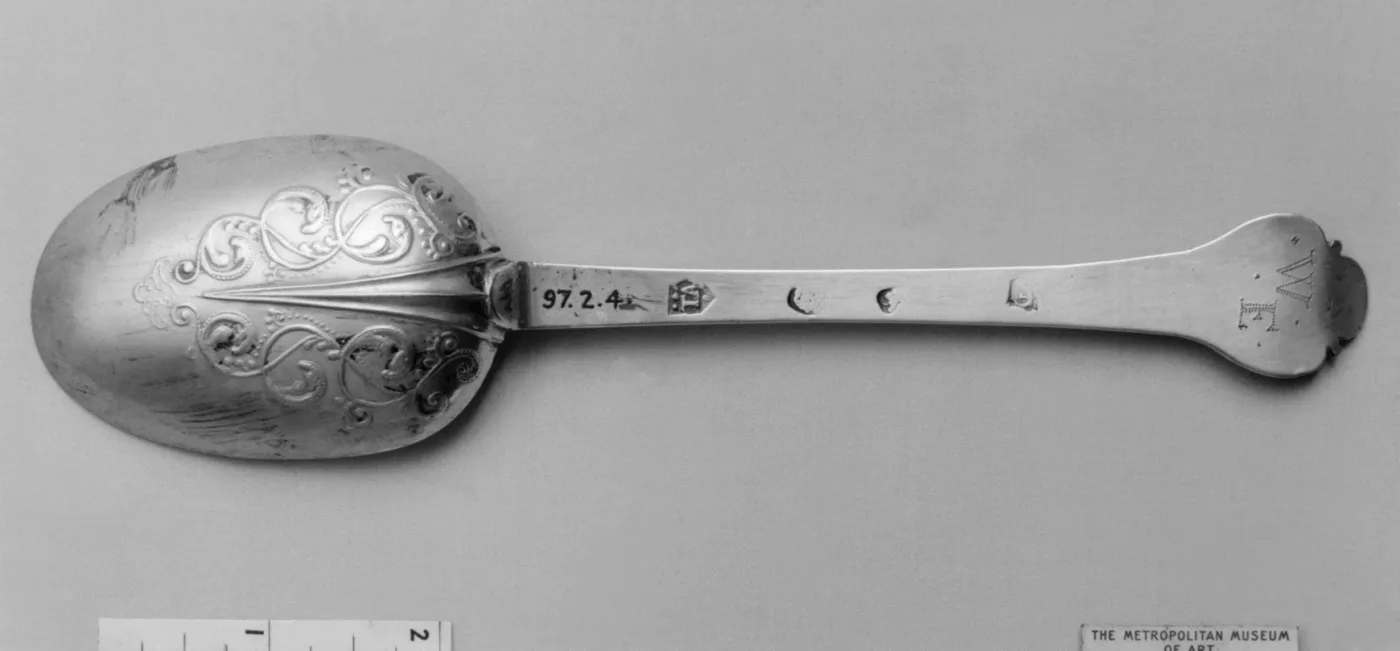
Before about 1660 the town mark went inside the bowl and the maker's mark on the stem — visible on the seal top and the Puritan spoon above. After the Restoration the whole group moves to the back of the stem, struck in a line just above the bowl. This is called bottom marking and it runs to 1780.
In 1781 the marks move to the other end, near the terminal — top marking — and stay there. The reason is mechanical, and it explains a frustration: striking punches into the narrow part of the stem made the metal bulge, so the maker had to hammer it flat again, squashing the marks in the process. Countless bottom-marked spoons are half-legible for that reason, not from wear.
Position alone therefore splits the whole history into three, and you can apply it without identifying a single punch. For what the punches mean once you can see them, and for telling sterling from plate, see our guides to identifying antique silver and to Old Sheffield plate.
When the Three Clocks Disagree
Disagreement is information, and it is the reason to read all three rather than whichever one is easiest.
Trifid end, short drop, marks near the terminal. Not a seventeenth-century spoon. The terminal says 1680, the other two say 1781 or later, and the later evidence wins because nobody moves marks backwards. This is a Victorian or twentieth-century revival copy — honestly made and honestly marked, but not what the shape suggests.
Old English end, marks beside the bowl. Consistent, and tightly dated. Old English begins about 1760 and bottom marking ends in 1780, so the overlap is only those two decades. Two coarse clocks crossing can be sharper than either alone.
An early bowl on a later stem. Look hard at the junction. Spoons were repaired constantly, and a bowl replaced in 1850 leaves a seam, a change in colour, or a rat-tail that does not line up with the stem it grows from.
A bowl that has been re-shaped. Victorian silversmiths bought up plain Georgian spoons and embossed the bowls to sell them as "fancy" pieces. The tell is a bowl that is thin, slightly distorted, and decorated in a style later than everything else on the object. It cuts the value sharply — our valuation and appraisal guide covers how alteration is weighed.
Two last cautions. Not every old spoon is silver — pewter follows a broadly similar sequence of shapes and is far commoner as an excavated find, covered in our pewter identification guide. And this story ends before the souvenir and commemorative trade begins, in our souvenir spoon guide; for sets rather than single spoons, start with the antique silver flatware guide.
Frequently Asked Questions
How can I date a silver spoon if the hallmarks are worn away?
Use the shape. The stem terminal, the reinforcement behind the bowl and the position of whatever mark traces remain are three separate records of the same date, and none of them wears off the way a struck punch does. Between them they will usually bracket an English spoon to a few decades even when not one mark is legible.
Which way does the handle turn on a Hanoverian spoon?
Upwards, the same way the bowl curves. Rest the spoon on a flat surface and a Hanoverian settles with the back of its bowl facing up. Old English, which replaced it from the 1760s, turns the other way and sits bowl up. That single difference is the fastest way to tell two otherwise similar Georgian spoons apart.
What is the rat-tail on the back of a spoon, and what does it date?
It is a long tapering rib running from the stem down the back of the bowl, added to strengthen the join. English spoons carry it from about 1660 to about 1730, after which it shortens into a rounded drop. Be careful with it on its own: rat-tail was revived as a commercial pattern name in the late nineteenth century, so twentieth-century spoons with rat-tails exist and are hallmarked accordingly.
Why are the hallmarks on my spoon near the bowl instead of the handle end?
Because it was made before 1781. English spoons were bottom-marked, with the punches struck in a line down the back of the stem beside the bowl, until the practice changed to top-marking near the terminal. Striking the narrow part of the stem made it bulge, so the maker had to hammer it flat again, which is why so many bottom-marked spoons have squashed and half-legible punches.
Is a spoon with a trifid end always seventeenth century?
No, for two reasons. The form ran to about 1710 in London and later outside it, to roughly 1720 in the English provinces and 1715 in Scotland, so an early eighteenth-century date is entirely normal. It was also copied enthusiastically by Victorian and later silversmiths, and those copies are properly hallmarked with their own date letters, so read the marks before assuming the shape.
The Short Version
Look at the end of the stem first. A cast figure or a knop puts the spoon before 1660. A flat end cut square is the 1650s; two notches in it, roughly 1660 to 1710; one rounded lobe, about 1700 to 1715. After that the end stays plain and you are deciding which way it bends — up for Hanoverian, down for Old English, from about 1760.
Then turn it over. A long tapering rib down the bowl means before about 1730; a short stubby drop, after. A shell or a basket struck into the heel puts it between roughly 1740 and 1780. Then find the marks without reading them: in the bowl, before about 1660; in a line beside the bowl, 1660 to 1780; up near the handle end, 1781 or later.
Three answers. If they land in the same place, you have your date and you never needed a magnifying glass. If they do not, the disagreement is the more interesting finding — it usually means the spoon has been altered, repaired, or made later in an older taste.