Wedgwood Jasperware: Dating by Mark and Body
Most Wedgwood jasperware tells you its own date of manufacture, stamped into the clay on the underside, in a code that has been sitting there unread for a century. Turn the piece over and you may find three capital letters beside the name. The third one is the year.
This guide covers what actually dates a piece of jasper: the wording of the impressed mark, the letter code beside it, and the body itself, which answers a question the mark cannot. For the wider Wedgwood range, including Queen's Ware and the printed bone-china marks, see our general Wedgwood identification guide.
Table of Contents
Jasper, Basalt, and What You Are Holding
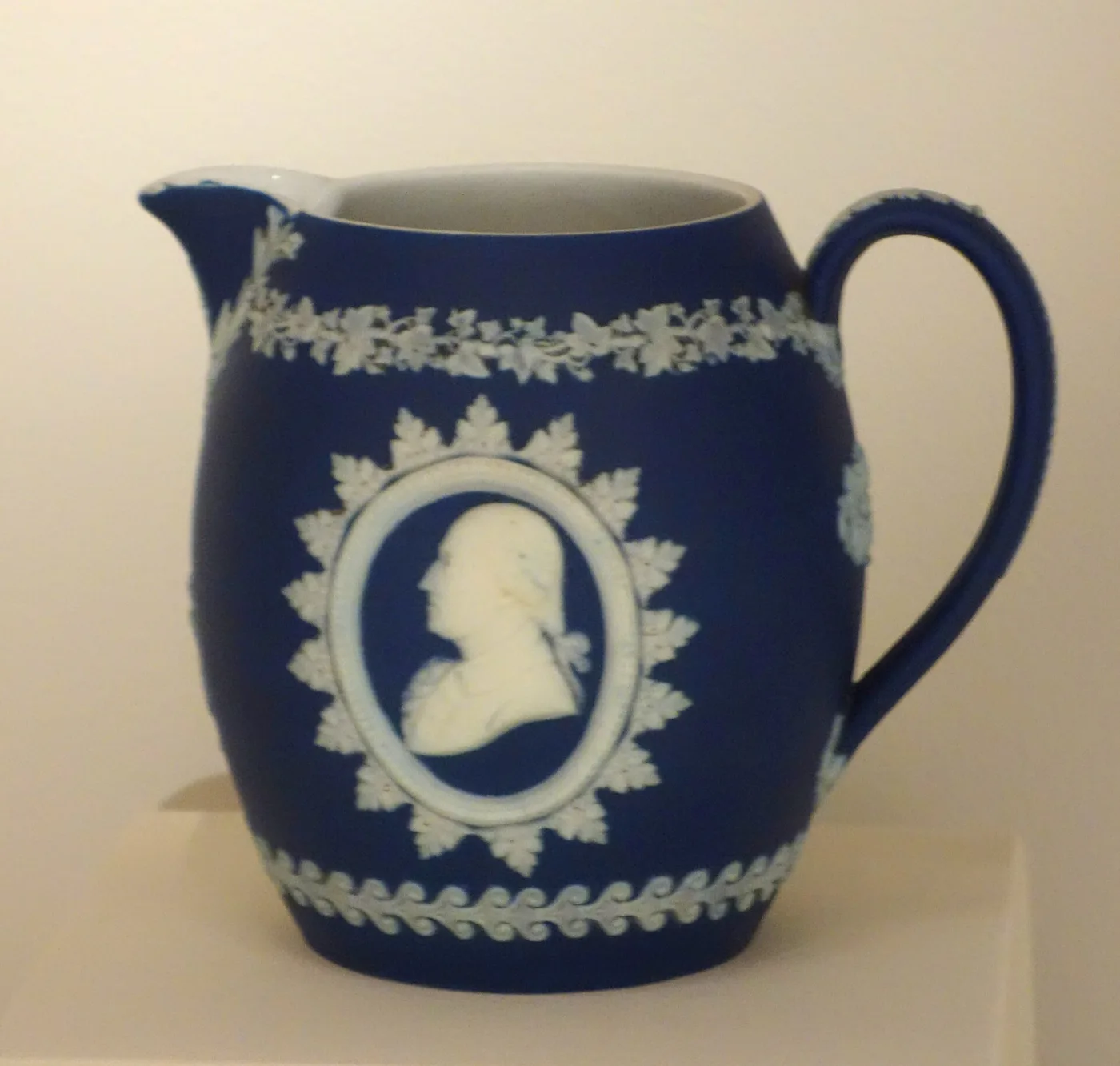
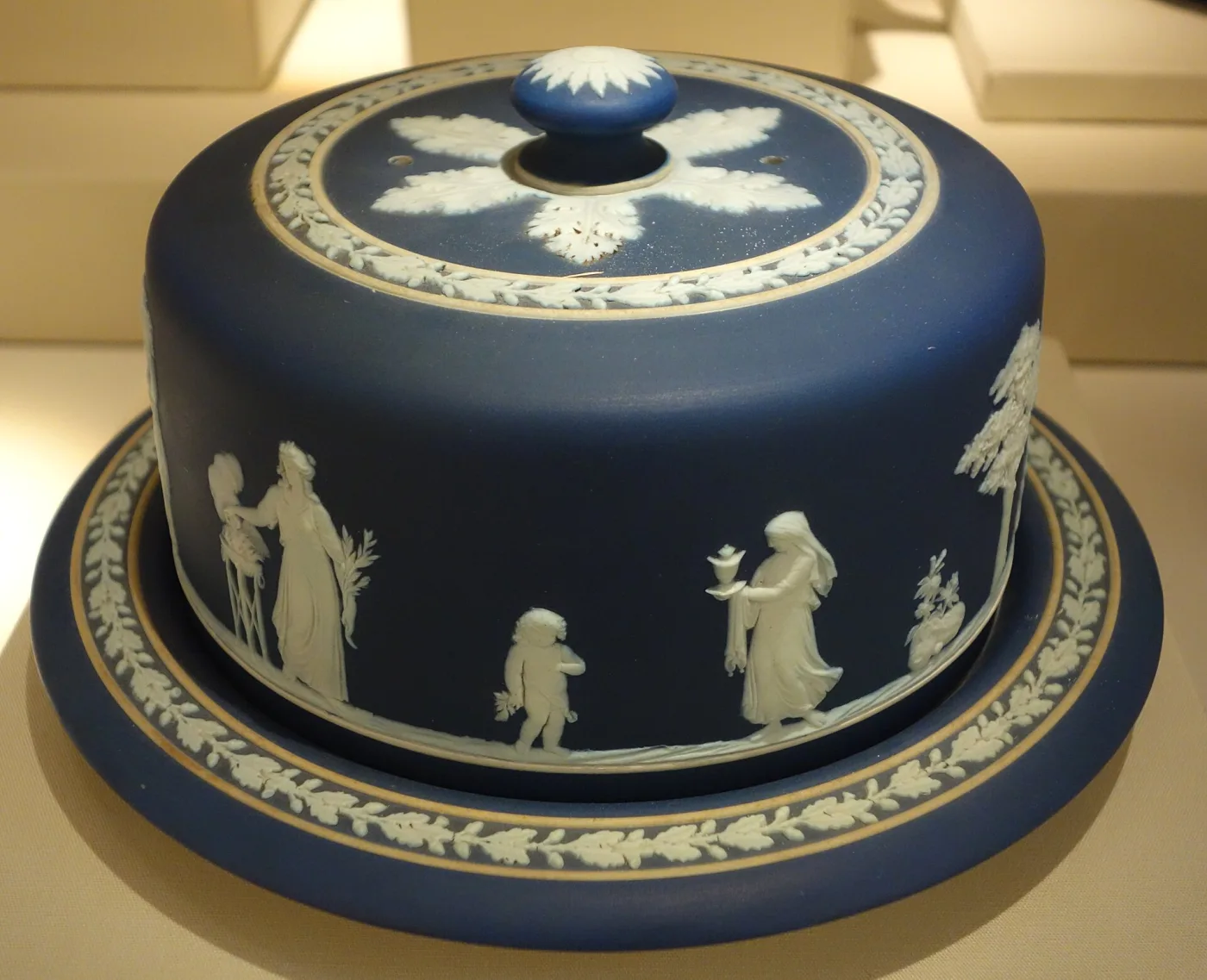
Jasper is Josiah Wedgwood's unglazed fine stoneware, arrived at around 1774 after several thousand recorded trials. It is coloured with metallic oxides and decorated with separately moulded white reliefs, called sprigs, applied to the surface before firing. That white-on-colour contrast is what people picture when they hear the word Wedgwood.
Black basalt is the other famous Wedgwood dry body, and the two get confused constantly, because a black jasper piece and a basalt piece can sit on the same shelf looking related. They are not the same thing, and the difference is visible in a second.
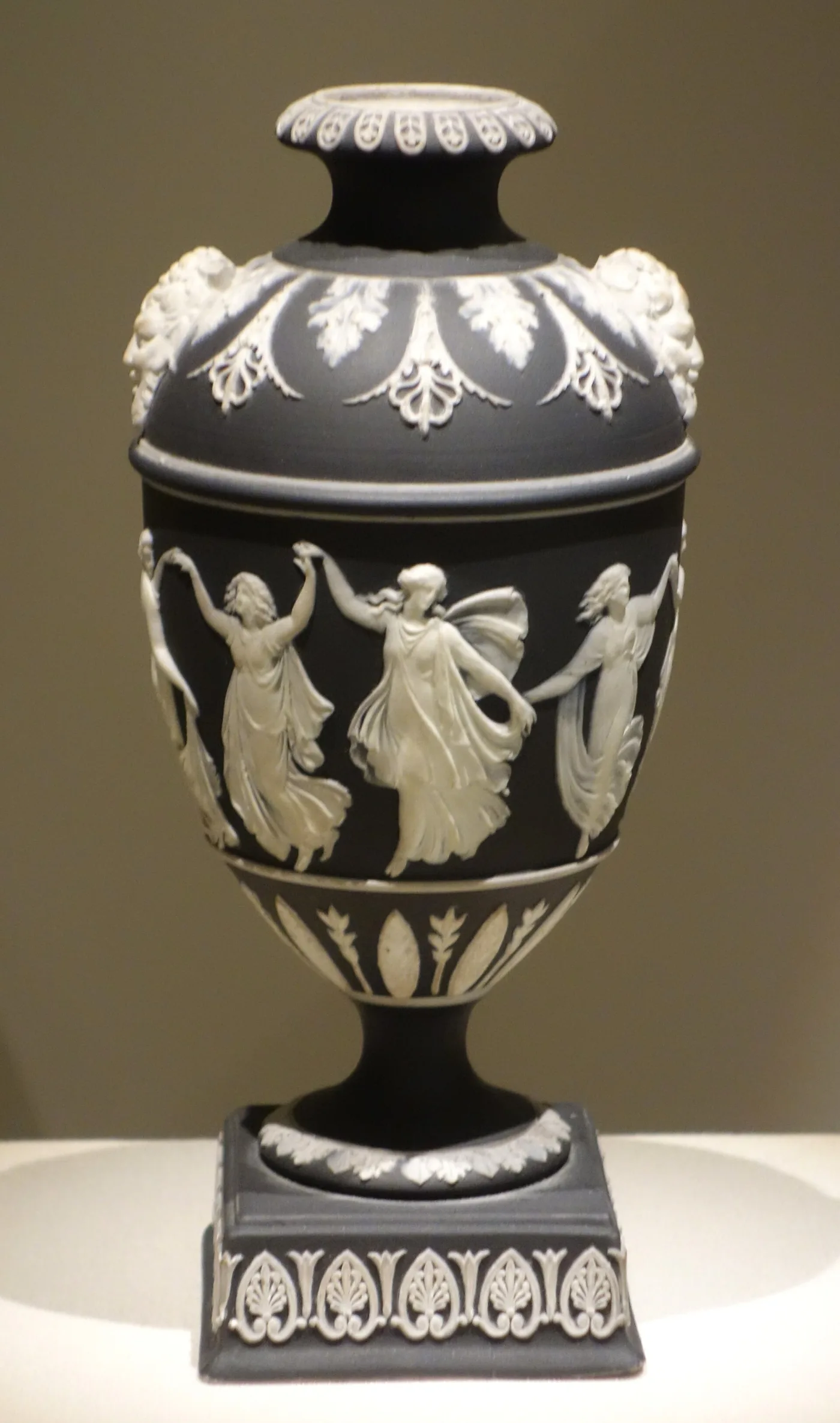
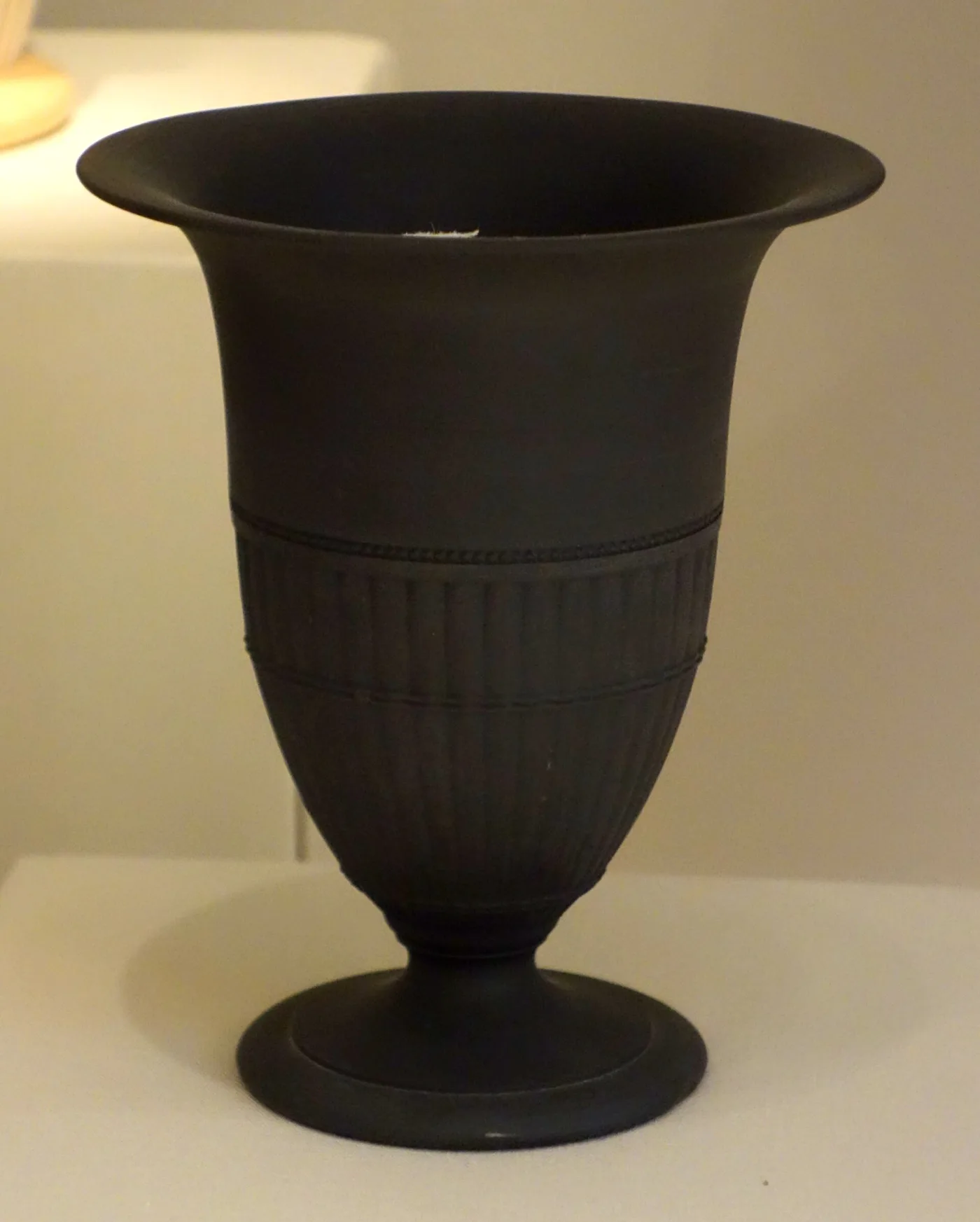
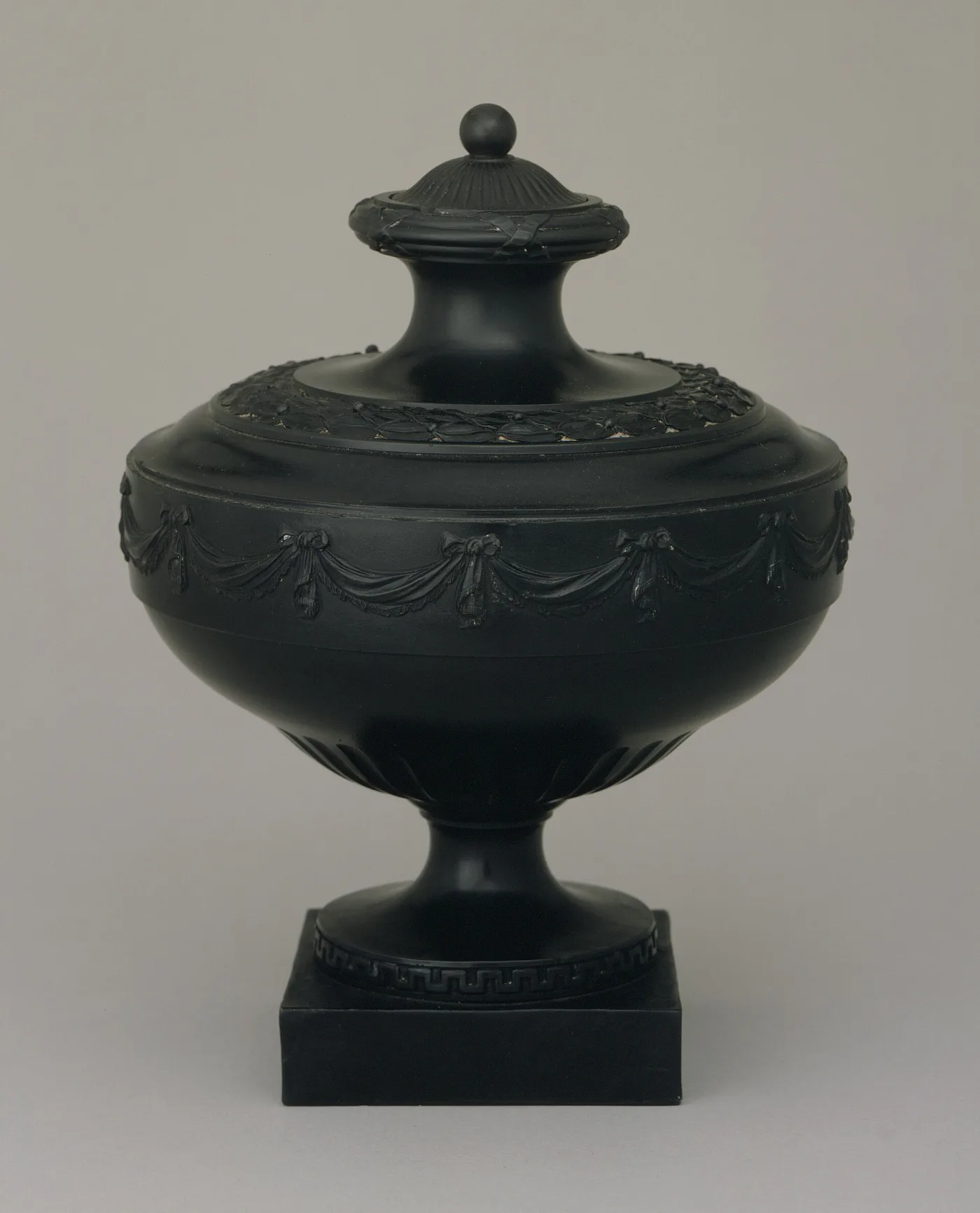
The rule is simple: white applied ornament means jasper. A piece that is uniformly black with its decoration moulded in the same clay is basalt. Both were made across the same long period, so this tells you what you have rather than when it was made, but it decides which of the tests below apply. Neither should be confused with the glazed earthenwares covered in our ceramics and pottery guide.
Solid Jasper or Jasper Dip?
There are two ways to make a blue jasper jug, and collectors pay very different money for them.
Solid jasper has the colouring oxide mixed into the clay body itself, so the colour runs all the way through. Jasper dip is a white jasper body coated on the outside with coloured slip. Wedgwood introduced dipping in 1777, and he was explicit about why: cobalt cost thirty-six shillings a pound, which he judged "too dear to mix with the clay of the whole grounds". Colouring only the surface used a fraction of it.
The test takes two seconds. Find a surface the dipper could not reach.
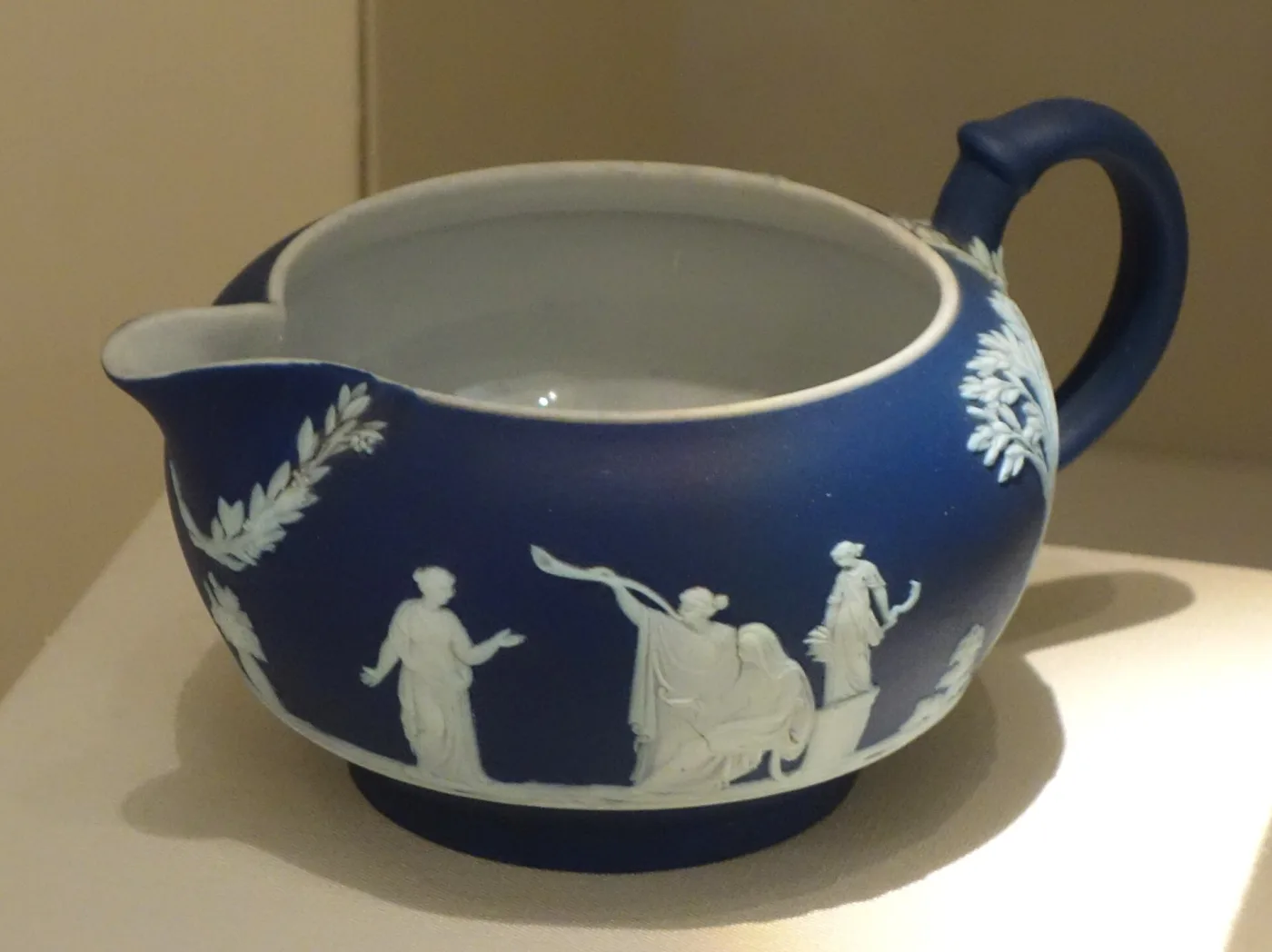
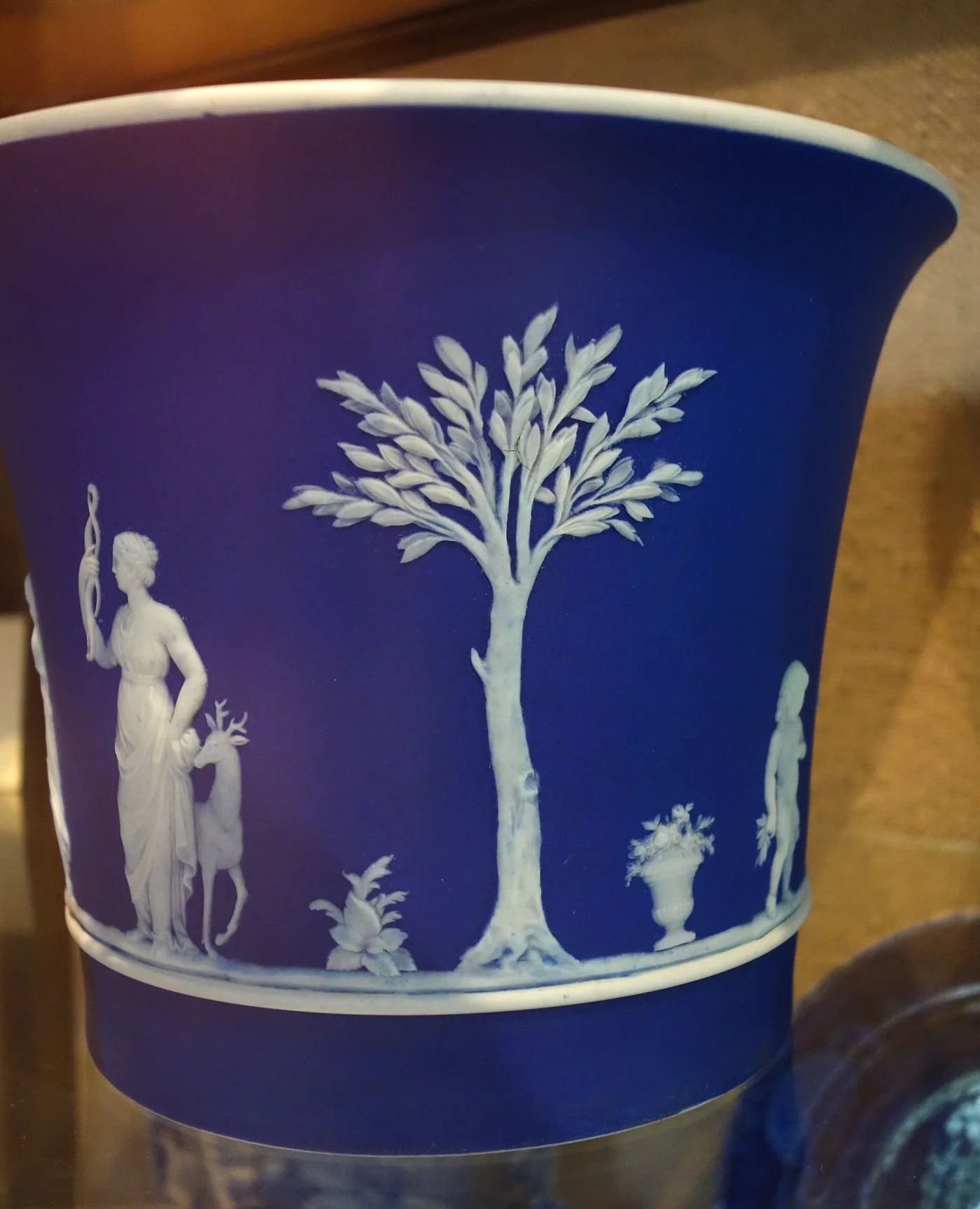
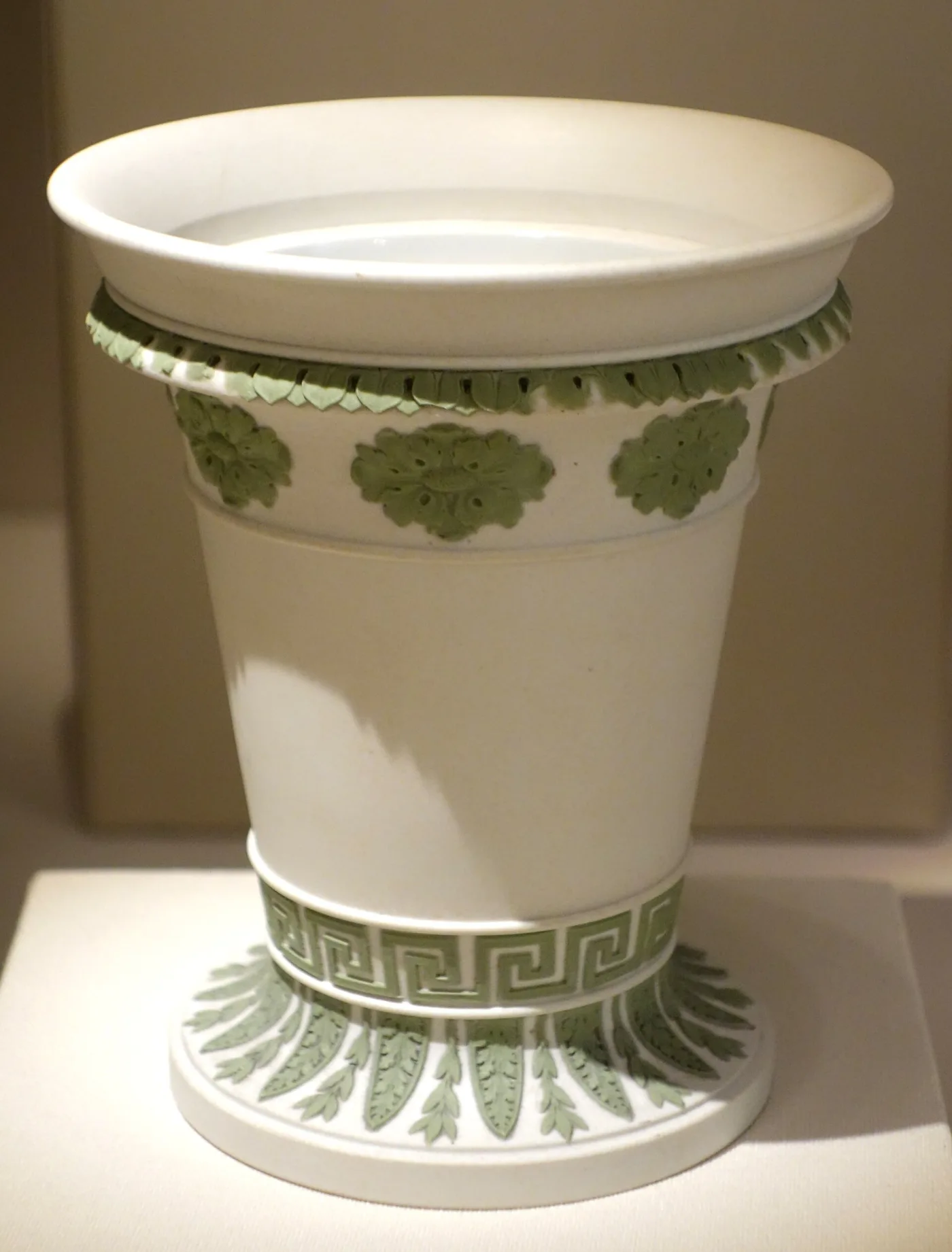
Jugs and teapots give it away through the mouth. Vases give it away down the neck, and the flared rim of a cache-pot shows a clean white line at the lip where the slip stopped:
Solid jasper behaves the opposite way. This goblet, catalogued to about 1780, carries the same red inside the bowl and around the foot as it does outside:
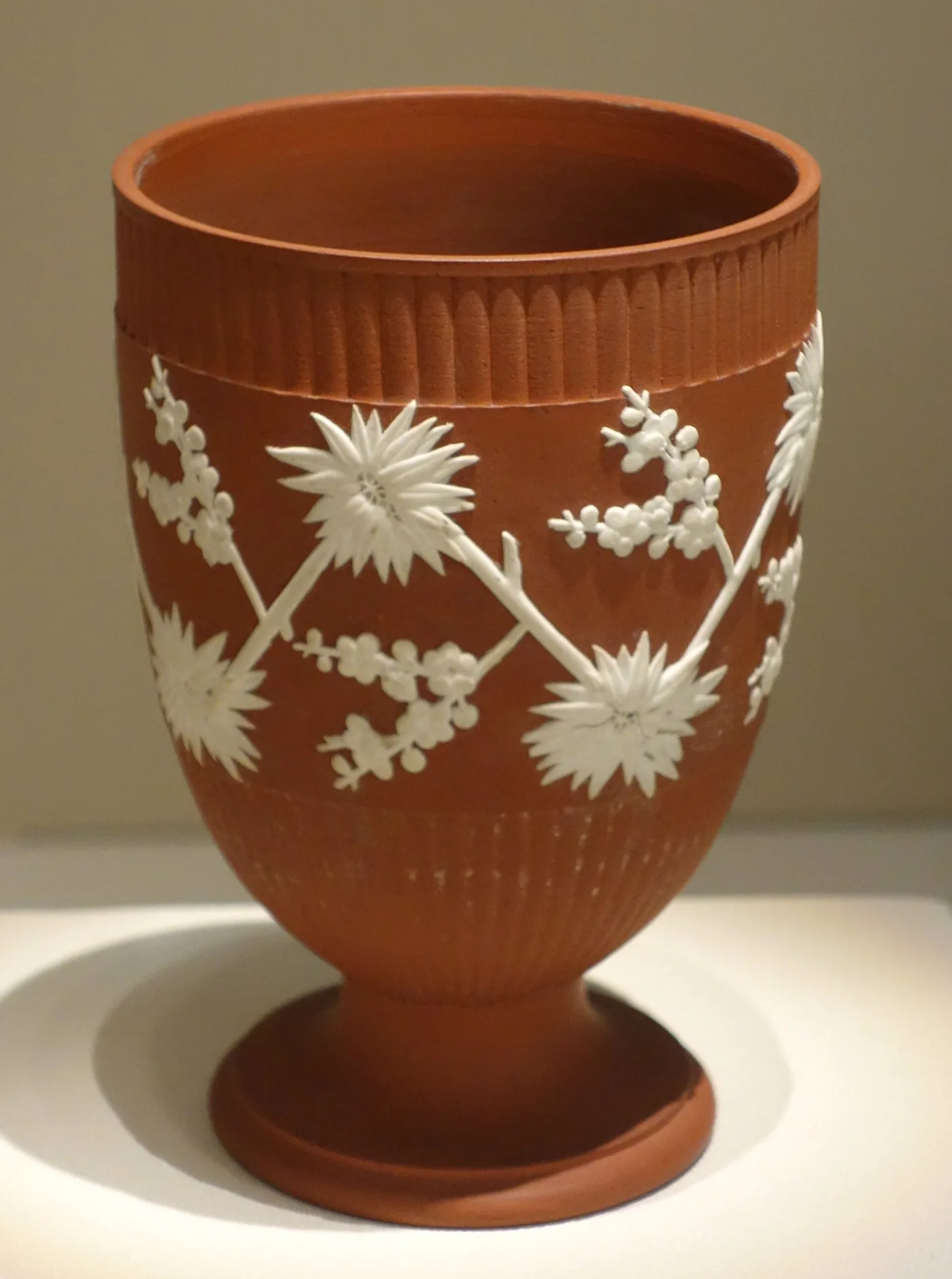
Be careful what you conclude from this. Dip has been in continuous use since 1777, so a white interior does not date a piece on its own — it is as normal on a 2020 vase as on an 1840 one. What it does is tell you which of two quite different objects you are holding, and solid jasper in an early colour is materially scarcer than dip.
What the Wording Alone Tells You
Before you touch the letter code, read the words. Several of them carry hard date bounds on their own.
| Impressed wording | What it bounds |
|---|---|
| WEDGWOOD & BENTLEY, W&B, or the circular Etruria seal | The Bentley partnership, which ended with Thomas Bentley's death in 1780. References differ on the start, usually given between 1769 and 1772. Nothing later than 1780. |
| WEDGWOOD alone, impressed in capitals | The standard mark from 1780 onward. Almost no bound by itself — this is the mark you then date by the letter code. |
| WEDGWOOD with ENGLAND | 1891 or later. The McKinley Tariff Act required imports into the United States to state a country of origin. |
| MADE IN ENGLAND | Roughly 1908 onward, replacing the bare ENGLAND in general use. |
| BARLASTON | After the move from the old Etruria works, so from about 1940. |
| WEDGEWOOD, with an E in the middle | Not Wedgwood at all. See below. |
The last row is worth dwelling on, because it is one of the few genuinely instant answers in ceramics. Josiah Wedgwood's firm never spelled its own name with an E in the middle. The best-known user of the extra E was William Smith & Co of the Stafford Pottery at Stockton-on-Tees, who marked wares WEDGEWOOD and W S & Co's WEDGEWOOD until Wedgwood obtained an injunction against them in 1848. Their output was largely printed earthenware of the sort covered in our transferware guide, not jasper — so an extra E on a blue-and-white plate has a real history behind it, and an extra E on a jasper piece is a modern fake or a fantasy mark.
At the other end of the range, a Wedgwood and Bentley mark is the earliest thing you can find, and it is worth knowing what those years look like:

The Three-Letter Date Code
From 1860, Wedgwood impressed a group of three capital letters alongside the name. They are not initials and they are not a pattern number. Each position means something different:
- First letter — the month the piece was made.
- Second letter — the potter who threw or pressed it. Useful to a factory clerk in 1875; useless to you.
- Third letter — the year. This is the one you want.
The year letters run in cycles. Read the third letter against this list:
1860–1871
- O 1860
- P 1861
- Q 1862
- R 1863
- S 1864
- T 1865
- U 1866
- V 1867
- W 1868
- X 1869
- Y 1870
- Z 1871
1872–1897
- A 1872
- B 1873
- C 1874
- D 1875
- E 1876
- F 1877
- G 1878
- H 1879
- I 1880
- J 1881
- K 1882
- L 1883
- M 1884
- N 1885
- O 1886
- P 1887
- Q 1888
- R 1889
- S 1890
- T 1891
- U 1892
- V 1893
- W 1894
- X 1895
- Y 1896
- Z 1897
1898–1923
- A 1898
- B 1899
- C 1900
- D 1901
- E 1902
- F 1903
- G 1904
- H 1905
- I 1906
- J 1907
- K 1908
- L 1909
- M 1910
- N 1911
- O 1912
- P 1913
- Q 1914
- R 1915
- S 1916
- T 1917
- U 1918
- V 1919
- W 1920
- X 1921
- Y 1922
- Z 1923
1924–1929
- A 1924
- B 1925
- C 1926
- D 1927
- E 1928
- F 1929
Which is where most people give up, because the same letter appears in more than one list. It is resolvable, and the factory itself gave you most of what you need.
When One Letter Means Two Years
Start with the first character of the group, not the third. From 1907 the month letter was dropped and replaced by a numeral marking which cycle the piece belonged to, which separates the later runs cleanly:
| First character of the group | Cycle |
|---|---|
| A letter (the month) | 1860–1906 |
| The figure 3 | 1907–1923 |
| The figure 4 | 1924–1929 |
| Two digits in place of a year letter | About 1929 onward, the last two digits of the year written out |
That leaves only the pre-1907 letters genuinely in doubt, and there the word ENGLAND does most of the remaining work — because it cannot appear before 1891. Running that against the cycles gives the following, which is the part no letter table alone will tell you:
| Third letter | Candidate years | Does ENGLAND settle it? |
|---|---|---|
| A–I | 1872–1880 or 1898–1906 | Yes. ENGLAND present means the later pair; absent means the earlier. |
| J–N | 1881–1885 only | Not needed. These letters are unique in an all-letter code. |
| O–S | 1860–1864 or 1886–1890 | No. Both candidates predate 1891, so ENGLAND is absent either way. |
| T–Z | 1865–1871 or 1891–1897 | Yes. The later candidate falls after 1891, so ENGLAND separates them. |
So a code ending in L is 1883 and nothing else. A code ending in C with ENGLAND is 1900; the same C without it is 1874. But a code ending in Q is either 1862 or 1888, and no amount of staring at the mark will separate them, because neither year carried ENGLAND. That band — O through S, a twenty-six-year fork — is the one case where the mark genuinely runs out, and you fall back on the body, the potting and the sprig quality.
Two practical notes. Marks on jasper are impressed into a dry, hard body and are often shallow, so use raking light from one side rather than overhead light. And pieces made before 1860 have no code at all — their absence is not a fault, it dates them.
Colour and Relief as Corroboration
Colour is a weak dating tool on its own and a useful sanity check alongside the mark. Wedgwood produced jasper in pale and dark blue, sage and olive green, lilac, black, yellow and crimson, and ran several of them concurrently for long stretches.
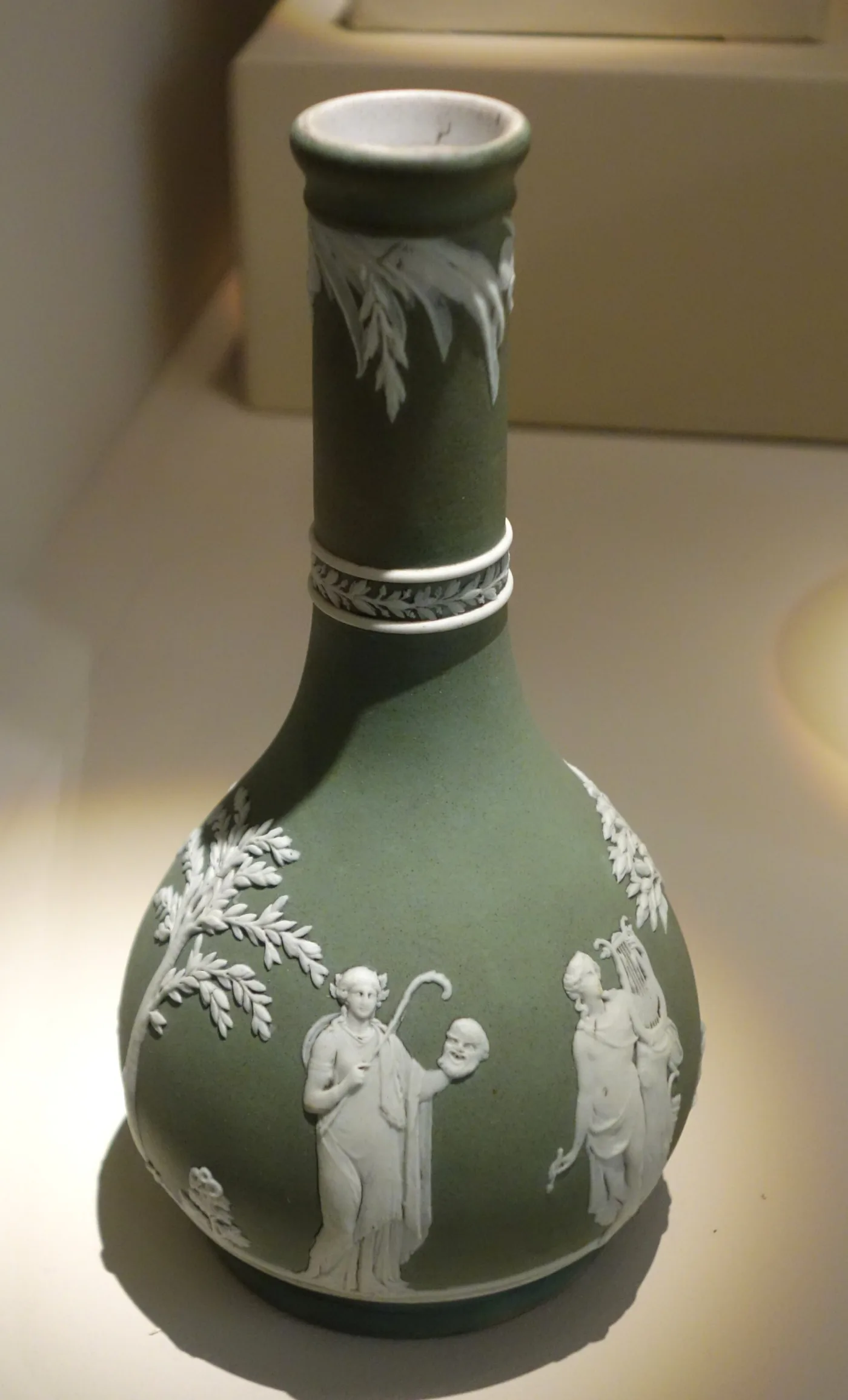
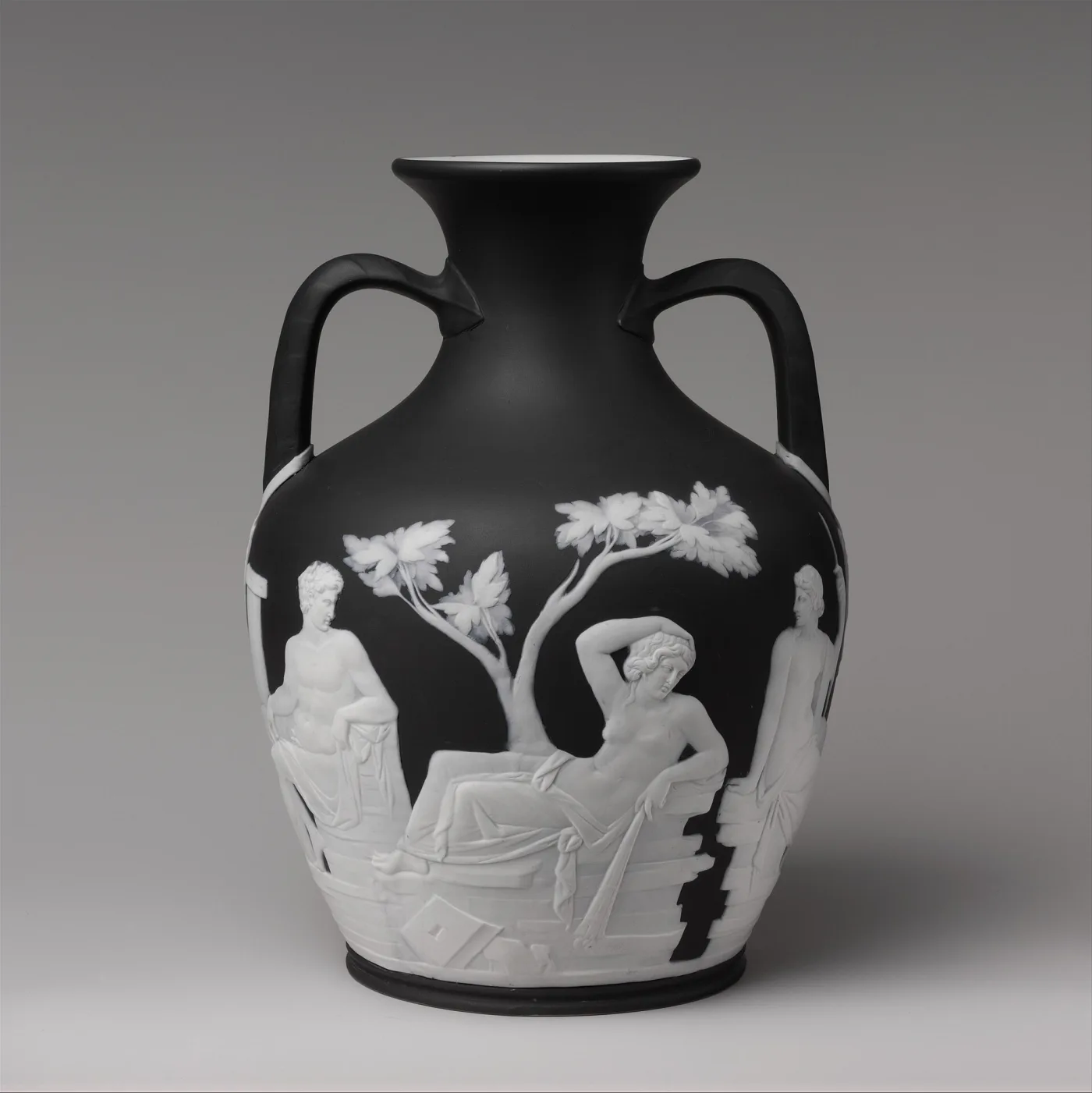
The sprigs themselves are more informative than the colour. On good work the reliefs are crisply undercut, with drapery and foliage finished by hand after moulding, and thin extremities that stand clear of the ground. The Metropolitan Museum's copy of the Portland Vase shows how far that could be pushed:
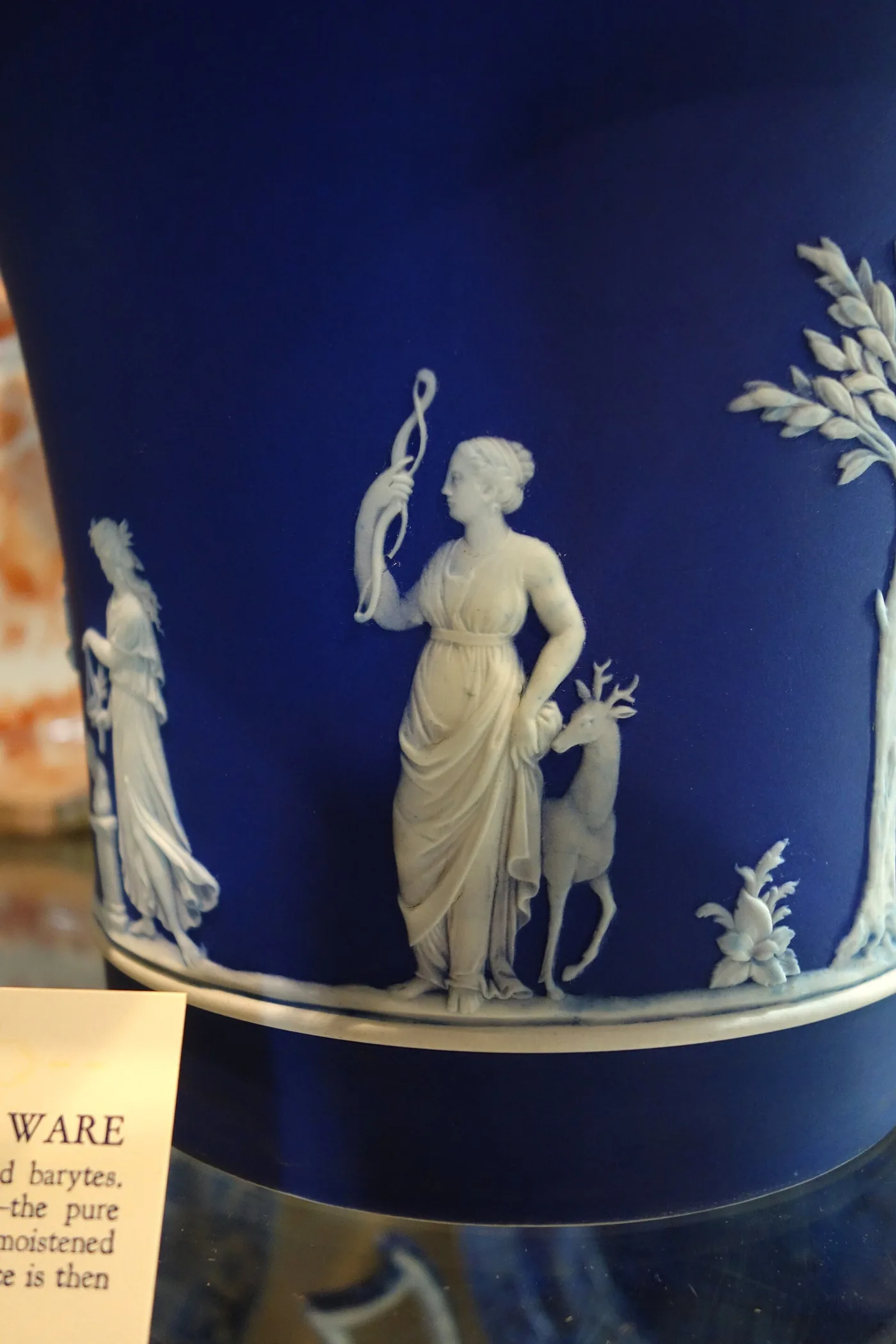
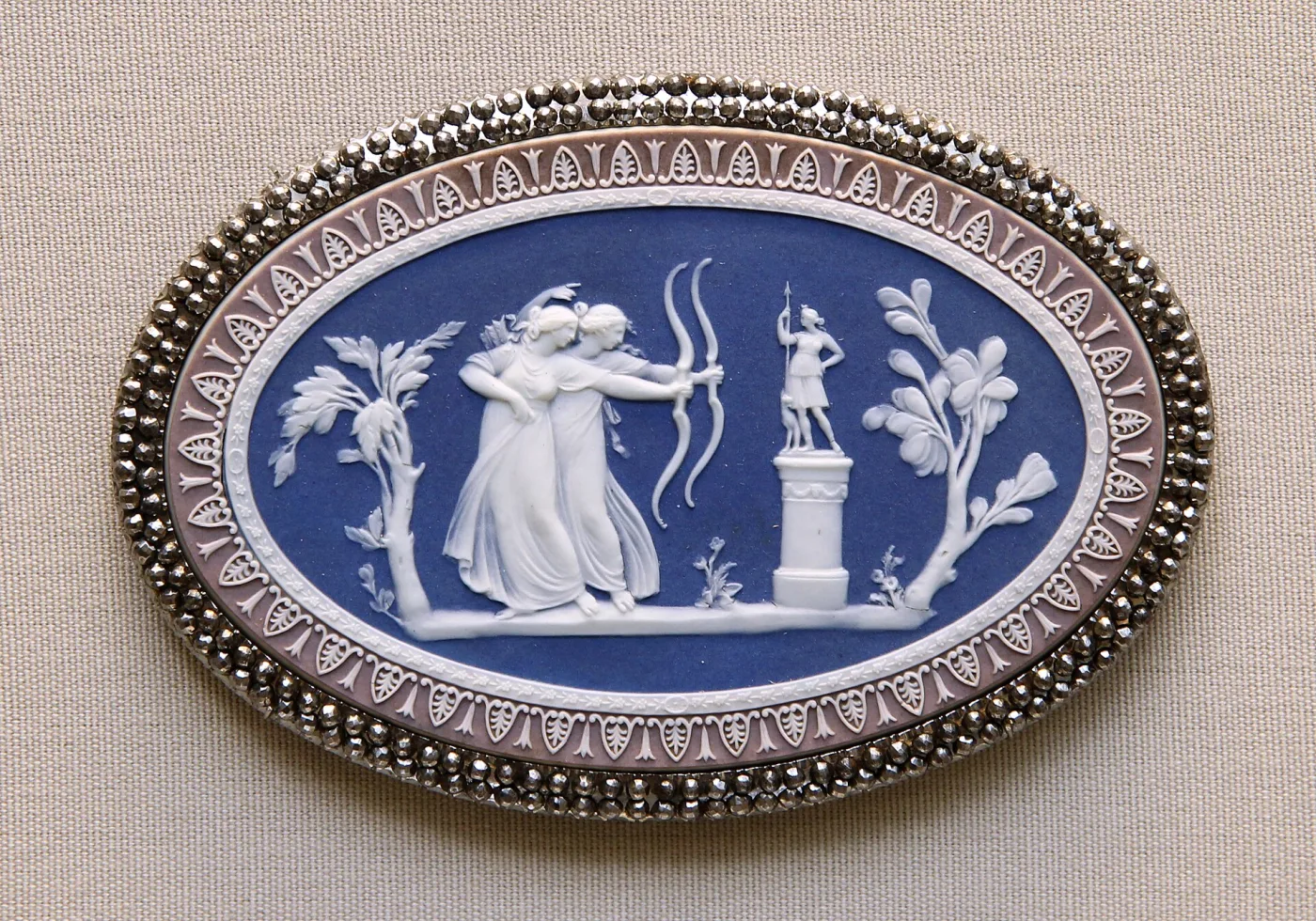
Three-colour work — a coloured ground, a contrasting border and white figures, as on the plaque at the top of this page — was expensive to make and is worth looking at twice. Mounted pieces are another useful cross-check, since the mount can often be dated independently:
Wedgwood was not the only maker using coded date marks in this period — Minton ran a comparable system, and the firm's earlier cream-coloured wares are dated on quite different evidence, covered in our creamware and pearlware guide. Wedgwood's later majolica carries the same impressed name and the same three-letter code, so everything above applies to it unchanged. Once you have a date, our valuation guide covers what it is worth.
Frequently Asked Questions
Where is the date on a piece of Wedgwood jasperware?
On the underside, impressed into the clay rather than printed on top of it. From 1860 Wedgwood added a group of three capital letters beside the WEDGWOOD name. The third of those letters is the year. The first is the month and the second identifies the potter who made the piece, so neither of those helps you date it.
What does ENGLAND mean on a Wedgwood mark?
It means 1891 or later. The McKinley Tariff Act required goods imported into the United States to name their country of origin, and Wedgwood added ENGLAND to the impressed mark from that year. MADE IN ENGLAND came into general use from about 1908, so that wording pushes the piece later still.
How can I tell jasper dip from solid jasper?
Look at a surface the dipper could not reach: the inside of a jug or teapot, the inside of a vase neck, or sometimes the recess under the foot. If the outside is coloured and that hidden surface is white, the piece is jasper dip, which is a white body coated in coloured slip. If the same colour runs through everywhere, it is solid jasper.
My piece is marked WEDGEWOOD with an extra E. Is it genuine?
Not Wedgwood. Josiah Wedgwood's firm never spelled its name with an E in the middle. The best-known user of the extra E was William Smith and Company of the Stafford Pottery at Stockton-on-Tees, who were restrained by injunction in 1848. An extra E is one of the few instant answers in ceramics.
Is black Wedgwood always black basalt?
No. Wedgwood made both black basalt and black jasper. Basalt is black throughout and is usually left plain or moulded in the same black body. Black jasper carries applied white reliefs against the dark ground, exactly like the blue jasper everyone recognises. If there is white ornament, you are looking at jasper.
The Short Version
Turn the piece over and read the words first. Wedgwood and Bentley puts it before 1780. ENGLAND puts it at 1891 or later; MADE IN ENGLAND, about 1908 or later; Barlaston, about 1940 or later. An E in the middle of the name means it is not Wedgwood at all.
Then find the three-character group. If it opens with a 3 or a 4 you already know the cycle. If it opens with a letter you are before 1907, and the third character gives the year — uniquely for J to N, and for the rest once you have checked whether ENGLAND is present. Only O to S leaves you with a real fork.
Finally, look inside. White under a coloured skin means dip; colour all the way through means solid jasper. That one glance will not date the piece, but it separates two objects that look identical on a shelf and are not worth the same money.