
Vintage Halloween Collectibles Identification Guide: Lanterns, Noisemakers, and Candy Containers
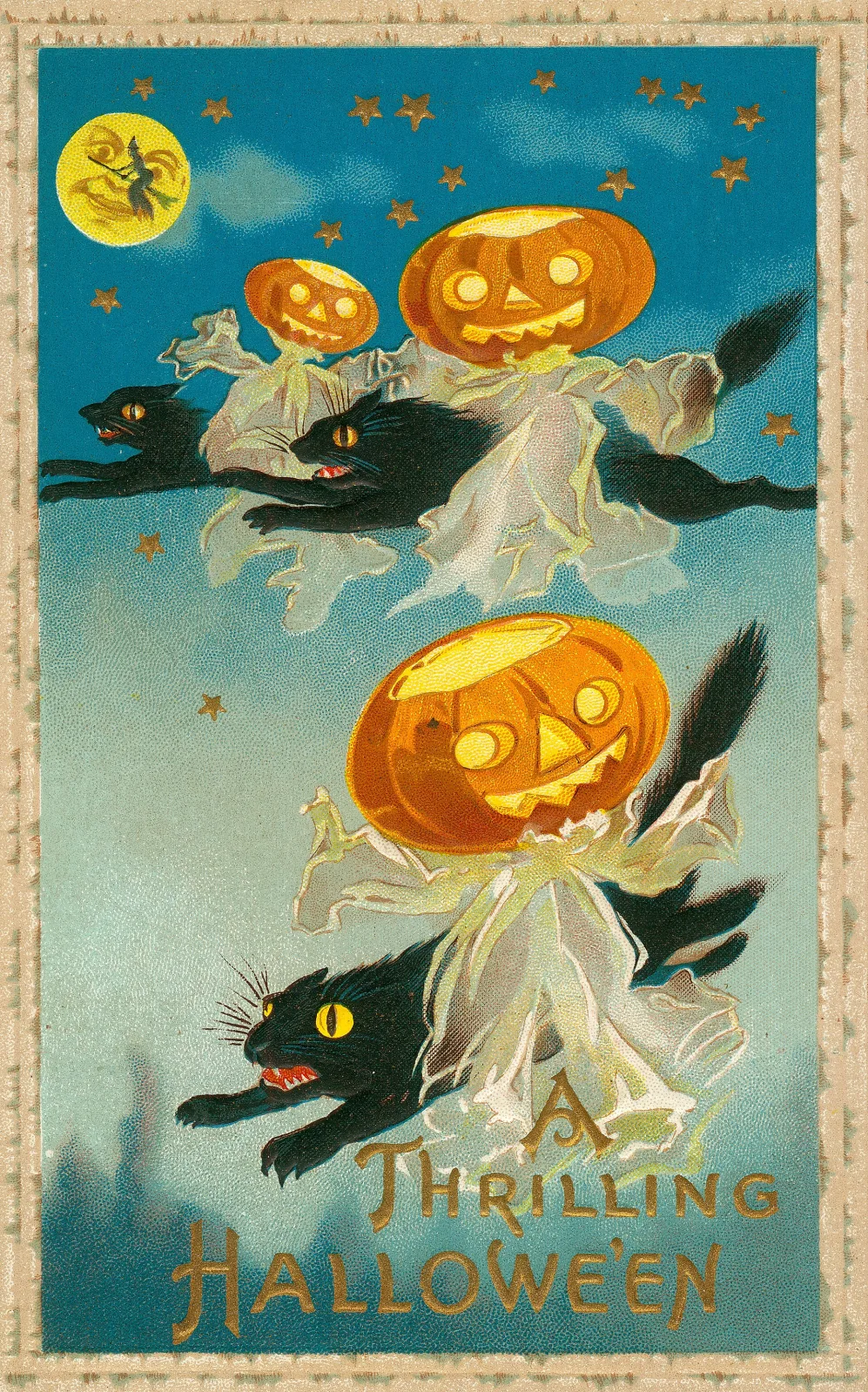
Few collecting fields have climbed as dramatically as vintage Halloween. Objects that were made to survive a single October night—paper lanterns, crepe streamers, molded candy containers, tin horns—were thrown away by the millions, and the survivors have become some of the most eagerly hunted holiday antiques in the market. A German composition witch that sold for pennies in 1925 can now compete with fine folk art at auction, and even humble tin noisemakers have devoted followings.
The field rewards knowledge more than most. Because the objects are simple—pressed paper, molded pulp, lithographed tin, painted plaster—the difference between a common piece, a rarity, and a modern reproduction often comes down to small physical details: the depth of an embossing, the tone of aged paper, the wording of a country-of-origin stamp, the way a candle holder is clipped inside a lantern. Reproductions and fantasy pieces have flooded the market precisely because originals are so valuable, so a collector who can read those details has a real advantage.
This guide walks through the major categories of vintage Halloween—German composition and papier-mâché, jack-o'-lanterns, Dennison and Beistle paper, noisemakers, candy containers, and costumes—then covers dating clues, maker and country marks, reproduction warning signs, value factors, and a practical inspection routine you can apply to any piece.
Table of Contents
- What Counts as Vintage Halloween
- The German Golden Age (1900–1935)
- Jack-O'-Lanterns: Composition, Pulp, and Tin
- Paper Ephemera: Dennison, Beistle, and Party Goods
- Tin Lithograph Noisemakers
- Candy Containers from Composition to Hard Plastic
- Costumes and Masks
- Dating Clues: Materials, Construction, and Printing
- Country-of-Origin and Maker Marks
- Spotting Reproductions and Fantasy Pieces
- What Drives Value
- A Step-by-Step Inspection Routine
- Care, Storage, and Preservation
What Counts as Vintage Halloween
Collectors use the phrase "vintage Halloween" to cover roughly three-quarters of a century of holiday material, from about 1900 to the early 1970s. Strictly speaking, only the earliest German pieces have crossed the hundred-year line that defines a true antique, but the market does not split hairs: a 1912 Dennison invitation, a 1931 composition cat, and a 1955 hard plastic witch all belong to the same collecting field, and dealers, auction houses, and price guides treat them together.
The material sorts naturally into three eras. The first is the German golden age, from around 1900 to the mid-1930s, when cottage workshops in Germany produced composition and papier-mâché figures, lanterns, and candy containers for the American market. The second is the American paper era, overlapping the first, when firms like Dennison and Beistle built the modern Halloween party out of crepe paper, diecuts, and printed games from roughly the 1910s through the 1940s. The third is the postwar boom, from 1945 into the 1970s, when American pulp lanterns, tin noisemakers, hard plastic novelties, and boxed costumes carried the holiday into every suburban household.
Halloween collecting also sits at a busy crossroads. Noisemakers belong to tin toy collecting, diecuts and invitations to ephemera, composition figures to folk art, and postcards to their own enormous specialty. That crossover demand—several collecting communities chasing the same small supply—is a large part of why prices for good vintage Halloween have risen so far above other holiday material.
The German Golden Age (1900–1935)
The most valuable vintage Halloween pieces almost all come from Germany. The same cottage-industry regions of Thuringia and the Erzgebirge that supplied the world with Christmas ornaments turned their skills to the American Halloween trade in the first decades of the twentieth century, producing witches, black cats, devils, skeletons, owls, and grinning vegetable people in composition, papier-mâché, cardboard, and crepe paper.
Composition: The Signature German Material
German "composition" is a moldable paste of pulped paper or sawdust bound with plaster and glue, pressed into molds, dried, and painted by hand. It is light but rigid, with a slightly grainy surface under the paint, and it takes crisp detail—warty pumpkin faces, furrowed witch brows, articulated fingers. Composition pieces were made as figures, candy containers, lanterns, and "nodders" with spring-mounted heads. Age shows as fine crazing in the paint, gentle surface soiling, and occasional chips that reveal the gray-brown material beneath. The material is related to the molded plaster of chalkware, but composition is lighter, tougher, and usually more finely detailed.
Veggie People and Fantasy Figures
The most distinctive German inventions are the anthropomorphic vegetables—pumpkin-headed men in crepe paper suits, cucumber gentlemen, turnip ladies—along with devils, witches riding pigs or motorcycles, and black cats in every posture. Many doubled as candy containers, separating at the neck or base. These figures were expensive novelties even when new, survive in small numbers, and now anchor the top of the market.
How the Era Ended
German production was interrupted by the First World War, resumed strongly in the 1920s—the peak years for quality and invention—and then collapsed in the 1930s as the political situation in Germany choked off the export trade. By the Second World War the supply had ended entirely, and postwar German material is limited and clearly marked differently, as covered in the marks section below. This clean historical cutoff is useful: a genuine German-marked composition piece is almost certainly pre-war.
Jack-O'-Lanterns: Composition, Pulp, and Tin
The jack-o'-lantern is the emblem of the holiday and one of its most collected objects. Three distinct materials dominate, and each has its own era, look, and market.
German Composition and Cardboard Lanterns
Early German lanterns were molded in composition or assembled from embossed cardboard panels, with cut-out eyes and mouths backed by thin translucent paper inserts, a wire bail handle, and a clip or socket inside for a small candle. Faces range from cheerful to genuinely sinister—devil heads, skull lanterns, and black cat lanterns were made alongside pumpkins. The molded detail is sharp, the paint is hand-applied, and bases often show a candle drip or scorch from real use. Cardboard slot-and-tab lanterns, made to fold flat, survive poorly and are rare complete.
American Pulp Lanterns
When German supply ended, American makers filled the gap with molded pulp—the thick, spongy, egg-crate-like papier-mâché familiar from drugstore lanterns of the 1940s and 1950s. Pulp jack-o'-lanterns are usually a single unpainted orange (or black for cats, white for skulls and ghosts), with stapled or glued paper face inserts printed with eyes and grins. They are thicker-walled and softer-edged than German composition, and they were made in enormous quantities, so survival is good. The single most important value factor is the original paper insert: a lantern with its period insert intact can be worth several times one with a replaced or missing face, and reproduction inserts are extremely common—inspect the paper before you pay an insert premium.
Tin and Parade Lanterns
Lithographed tin lanterns—four-sided, round, or pumpkin-form, often with punched vents and wire handles—were made in smaller numbers and cross over into tin toy collecting. Early examples with strong stone-lithographed graphics are scarce and bring strong prices. Later battery-operated plastic lanterns from the 1950s and 1960s begin the transition out of the vintage era and remain affordable entry points.
Paper Ephemera: Dennison, Beistle, and Party Goods
The American Halloween party was largely invented by two paper companies, and their output—cheap, seasonal, and disposable—is now a core collecting field.
Dennison Manufacturing Company
Dennison, of Framingham, Massachusetts, sold the raw materials of the party: orange and black crepe paper, gummed seals, silhouettes, borders, tally cards, and invitations. Its most famous productions are the Bogie Books, the annual party-planning guides issued from 1909 into the 1930s that showed hostesses how to use Dennison goods. Original Bogie Books, with their striking cover art, are heavily collected, and even loose Dennison seals and diecut silhouettes have a ready market. Dennison material is usually identifiable by printed trademarks on borders, packaging, or the items themselves.
The Beistle Company
Beistle, of Shippensburg, Pennsylvania, founded in 1900 and still in business, made the decorations themselves: embossed diecut skeletons with jointed limbs, owls, witches, black cats, honeycomb tissue pumpkins, fortune-telling wheels and games, and table centerpieces. Early Beistle is often unmarked or marked with a small diamond trademark; pieces from the 1940s and 1950s frequently carry the "H. E. Luhrs" mark, the name of the company's then-owner. Beistle has also reissued many of its classic designs in recent decades—legitimately and usually with modern copyright dates—so reading the paper itself matters as much as the design.
German Diecuts
German embossed diecuts from the 1920s and 1930s are the aristocrats of Halloween paper: deeply embossed, richly printed cats, witches, moons, and devils whose relief you can feel with a fingertip. American diecuts of the same era are typically flatter and printed in fewer colors. Depth of embossing, color richness, and aging of the cardboard are the fastest ways to separate the two.
Postcards and Small Ephemera
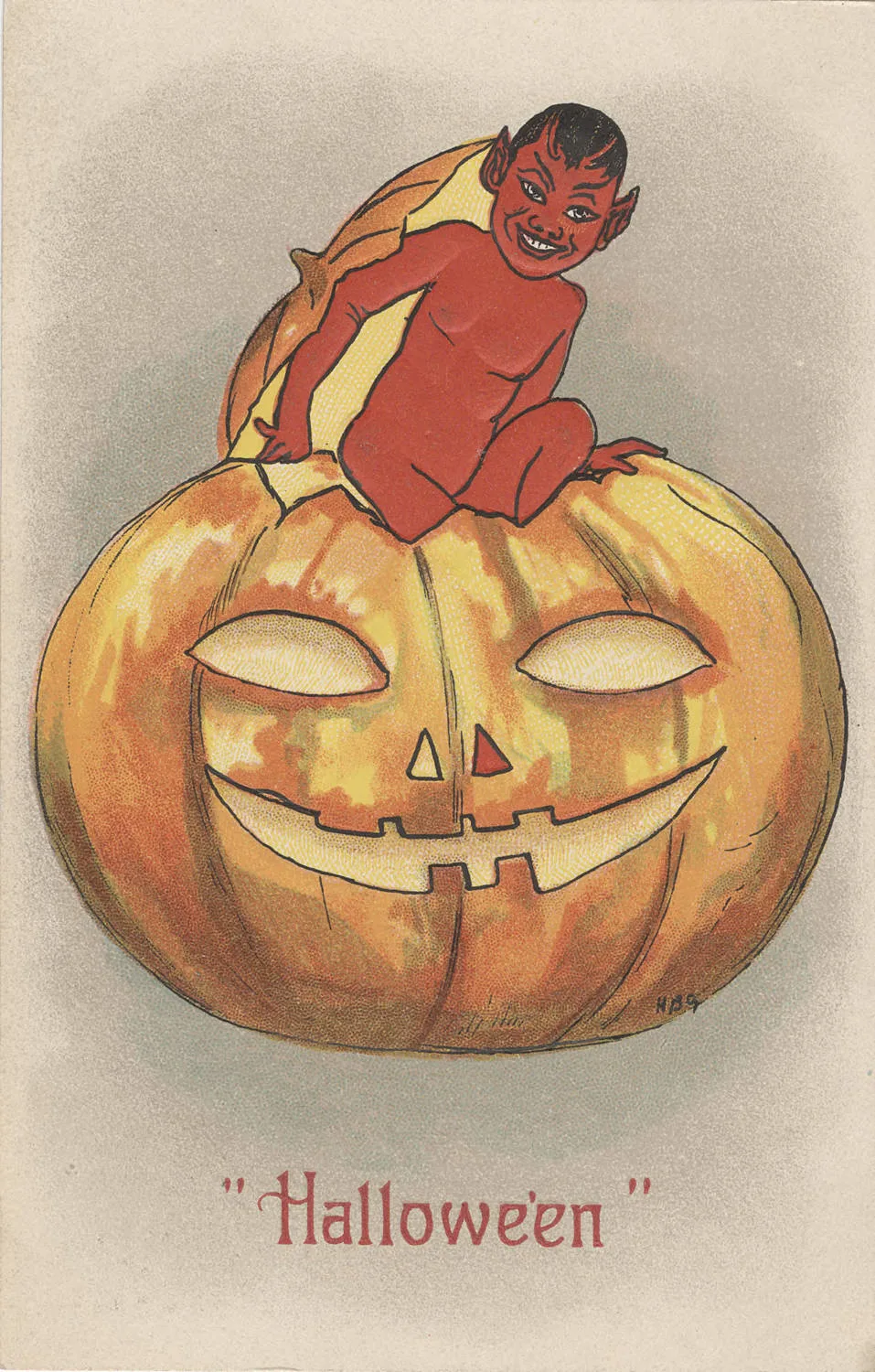
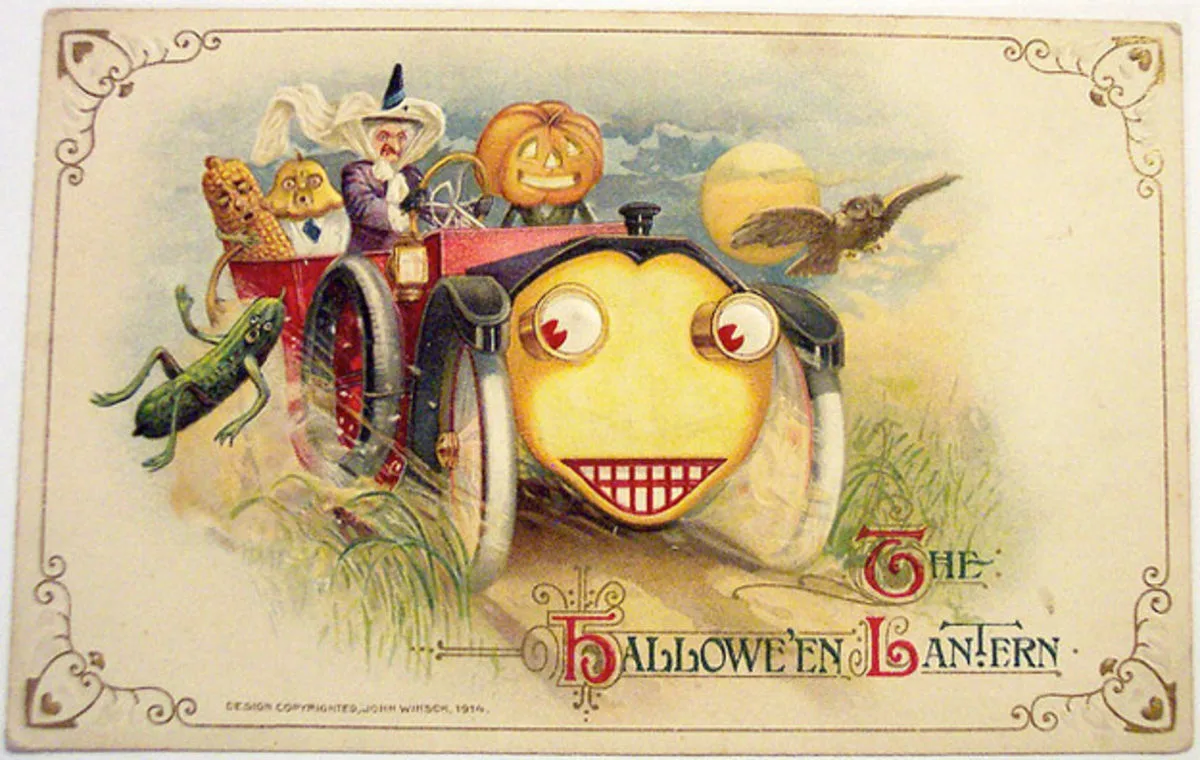
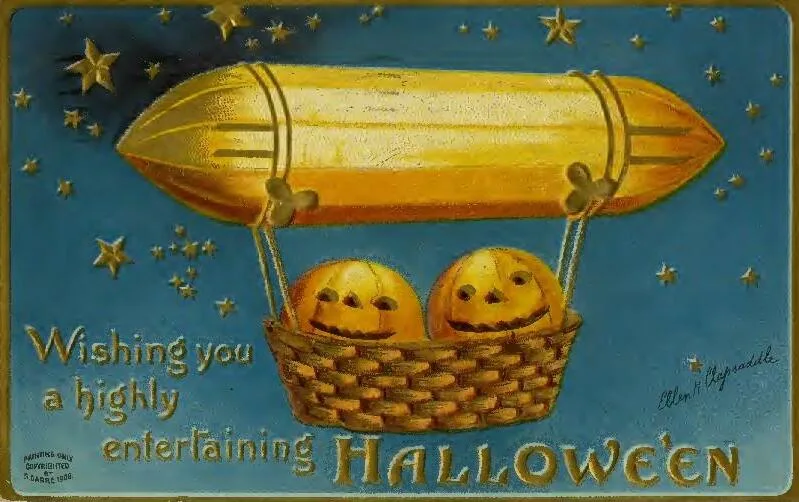
Halloween postcards from the golden age of postcard publishing (roughly 1905–1915) are a major specialty of their own, with artists like Ellen Clapsaddle and publishers like John Winsch commanding premium prices. Invitations, place cards, nut cups, and paper party hats round out the ephemera field—small, affordable, and genuinely scarce in fine condition.
Tin Lithograph Noisemakers
Noise has been part of Halloween since its beginnings—originally to frighten off spirits, later just to fuel the party—and lithographed tin noisemakers are the most accessible corner of vintage Halloween collecting. Most date from the 1920s through the early 1960s.
The Common Forms
Ratchets spin a gear against a flexible tongue; clangers swing a striker against a bell; clickers snap a spring strip; tambourines, shakers, frying-pan rattles, and horns complete the family. Graphics are the point: witches silhouetted against moons, dancing cats, grinning pumpkins, parading children in costume. The liveliest lithography, and the scarcer forms like figural horns, bring the strongest prices.
Makers to Know
Most American noisemakers came from a handful of metal toy firms: Kirchhof of Newark, New Jersey (whose "Life of the Party" slogan appears on many pieces), U.S. Metal Toy Manufacturing, T. Cohn of Brooklyn, and J. Chein, all of whom also made general tin toys. Marks are usually lithographed directly into the design, sometimes small and hidden in the border, so examine the whole surface.
Dating Noisemakers
Handles are the quickest clue: turned wooden handles, often painted red, generally indicate prewar or 1940s production, while plastic handles arrived after the war and dominate the 1950s. Earlier lithography tends toward richer, more painterly imagery; late pieces simplify the graphics and brighten the palette. Rust, dents, and worn litho are common—as with tin toys, honest surface wear is acceptable, but strong color drives the price.

Candy Containers from Composition to Hard Plastic
Candy containers—figures made to hold a few sweets and be kept afterward—run through the entire history of vintage Halloween, and the material tells you the era at a glance.
German Composition Containers
The classic German container is a composition figure that separates at the neck, the base, or a hidden plug: a witch whose head lifts off, a cat sitting on a pumpkin that opens, a vegetable man whose torso conceals the candy cavity. Look for the seam where the piece separates, hand-painted detail, crepe paper costume elements, and honest interior wear where fingers reached for candy. These are the blue-chip pieces of the field, and the best examples—large sizes, unusual subjects, devils, and multi-figure groups—bring four-figure prices at specialist auctions.
Glass and Molded Novelty Containers
American glass candy containers, a field of their own, included Halloween forms—small pressed glass pumpkin heads, witches, and lanterns with slotted tin closures. They were candy-counter novelties of the 1910s–1940s and cross over with bottle and glass collecting. The pressed pumpkin and figural forms parallel the holiday shapes found in pewter ice cream molds of the same era, which turned out pumpkin, witch, and cat desserts for the party table.
Japanese Imports
Between the wars, Japan supplied inexpensive Halloween novelties—crepe paper figures, celluloid toys, small bisque and composition pieces—marked "Japan" or "Made in Japan." Postwar pieces marked "Occupied Japan" date narrowly to 1947–1952, a precise and useful window. Japanese items are generally lighter, simpler, and more cheaply finished than German work, and they remain an affordable way to collect genuine prewar and early postwar material.
American Hard Plastic (1945–1960)
After the war, injection-molded hard plastic took over the candy-counter trade. Rhode Island firms—E. Rosen and its Rosbro molding affiliate chief among them—produced glossy orange-and-black witches, cats on pumpkins, pumpkin-headed figures, and famous novelty forms like the witch riding a rocket. Hard plastic is rigid and thin-walled with visible mold seams, and it has boomed with collectors priced out of German material: common figures remain affordable, while scarce forms and anything with original candy packaging or wheels intact bring real money. Soft blow-molded plastic signals the 1960s and later, outside the prime vintage window.
Costumes and Masks
Costumes complete the picture of vintage Halloween, and they divide cleanly by construction.
Early and Homemade Costumes
Before commercial costumes, disguises were homemade, and the survivors—stitched cheesecloth ghosts, painted buckram and gauze masks, crepe paper clown suits—qualify as folk art. Early stiffened-gauze masks with hand-painted faces have an eerie presence that collectors prize, and photographs of children wearing them are a collecting field in themselves.
Boxed Costumes: Ben Cooper, Collegeville, and Halco
From the 1930s onward, companies like Ben Cooper of Brooklyn and Collegeville of Pennsylvania sold complete boxed costumes—a printed rayon or fabric suit plus a molded mask. After television arrived, licensed characters took over, and the costume becomes datable by its character and copyright line: a 1950s Zorro, a 1960s Barbie, a 1970s superhero. Value concentrates in early examples, popular characters, unusual subjects, and above all complete costumes with their original illustrated boxes, since boxes were the first thing discarded.
Dating Masks
Mask material follows a clear sequence: painted gauze and buckram early, molded and painted linen or paper mache into the 1940s, thin vacuum-formed plastic from the 1950s onward. Elastic straps, staple types, and interior stamps help refine the date, and a mask that matches its boxed costume adds meaningful value to the set.
Dating Clues: Materials, Construction, and Printing
Because so much vintage Halloween is unmarked, dating rests on reading the object itself. Three kinds of evidence do most of the work.
The Material Timeline
Materials are the backbone of Halloween dating. Hand-painted composition, embossed cardboard, and crepe paper point to the German era and the 1920s–1930s. Thick molded pulp signals American production of the late 1930s through the 1950s. Rigid hard plastic means postwar, roughly 1945–1960; soft blow-molded plastic and printed vinyl mean the 1960s and later. Within paper, heavily embossed diecuts lean German and prewar, flat-printed diecuts lean American, and fluorescent inks or bright white board mean modern production.
Construction Details
Look at how the piece is put together. Wire bail handles, candle clips, and slot-and-tab assembly belong to the lantern era before electric lights; staples in paper goods became common in later production, while early inserts were glued. Wooden noisemaker handles precede plastic ones. Crepe paper clothing on figures, spring-mounted nodder heads, and separating candy cavities are prewar German signatures. Mold seams on plastic, and the sprue marks where parts were cut from the molding tree, confirm injection molding and a postwar date.
Printing and Palette
Early lithography lays down rich, solid color with a painterly quality; postwar offset printing shows a regular dot pattern under a loupe, coarser on cheap goods. The classic prewar palette is orange and black with deep greens, purples, and reds; postwar graphics brighten and simplify, and by the 1960s dayglo tones appear. Paper itself ages honestly—period stock tones to cream or tan at the edges and smells faintly of old paper, while modern reproduction stock stays bright white and often glows under ultraviolet light thanks to optical brighteners introduced after the war.
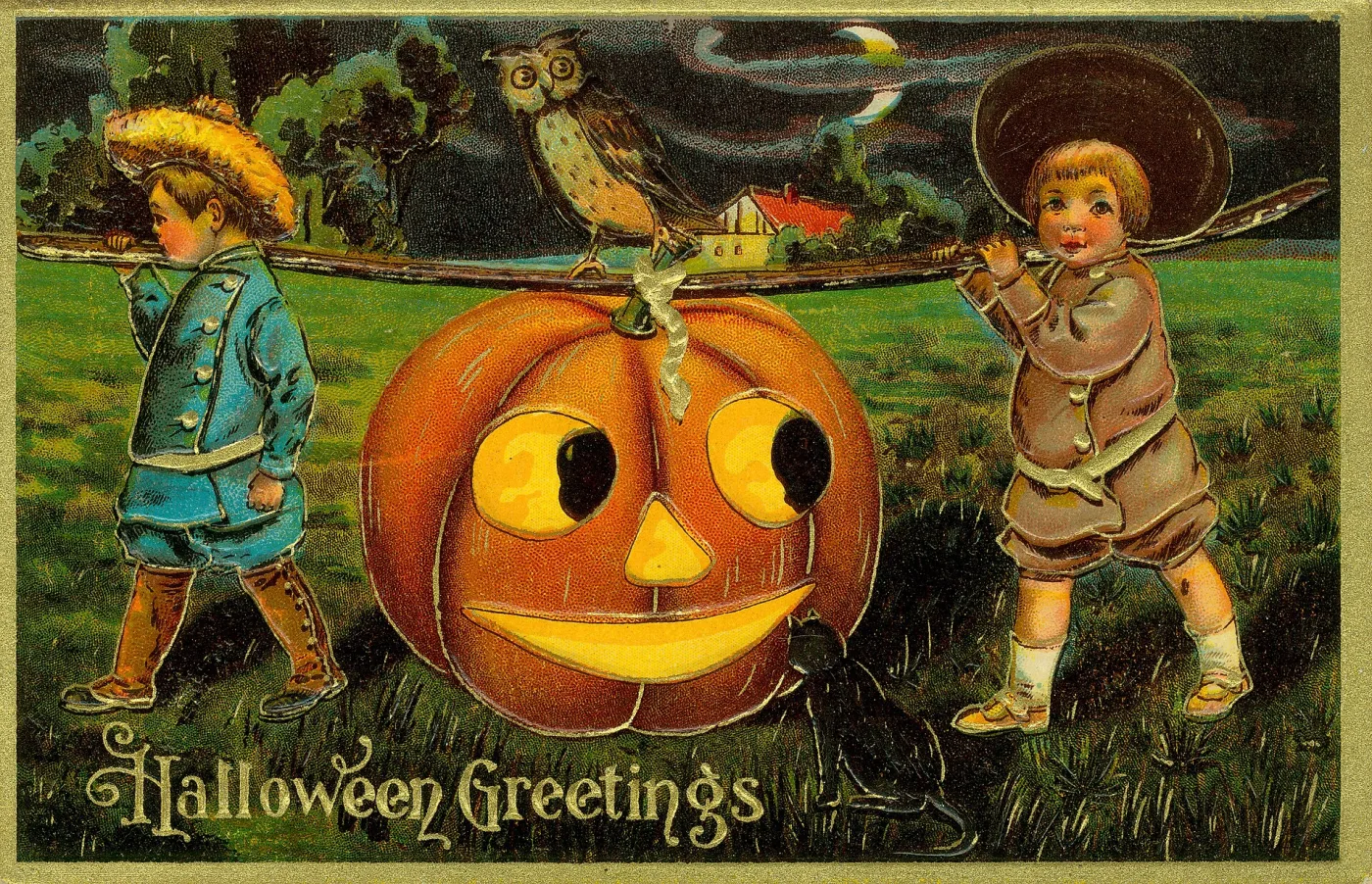
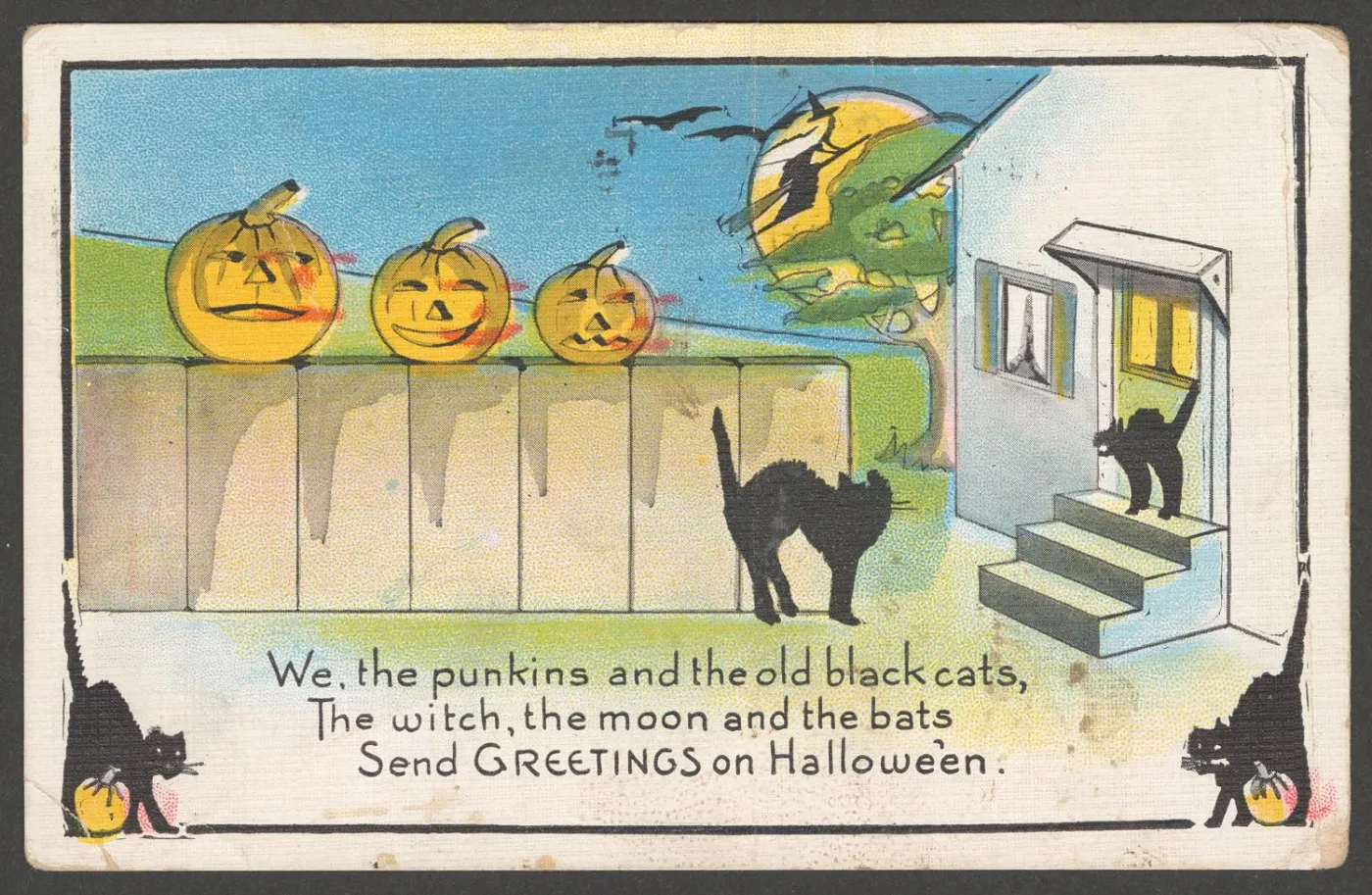
Sixteen years apart, and the printing dates them more reliably than the subject does — both show pumpkins, cats and a moon. Run a finger over the surface first: the earlier card is embossed, so the border and the lettering stand up off the stock, and the highlights are metallic bronze ink applied in an extra pass. Both of those cost money and both disappear from mass-market cards after the First World War. Then look at the colour. The 1910 card is modelled, with graded tones inside each shape; the 1926 card is four flat inks, and along the pumpkins on the right you can see a pink edge where one plate landed a fraction out of register. Neither is a fault to be discounted — loose registration and a thin palette are simply what a cheap card looks like by the mid-1920s, and a "1910" card printed that way is misattributed.
Country-of-Origin and Maker Marks
When a mark is present, it can date a piece within a few years, because import law and postwar politics changed the required wording in well-documented steps.
Reading Country Marks
American tariff law required imported goods to be marked with their country of origin from 1891, which is why German pieces carry a small ink stamp or paper label reading "Germany"—a mark that, on Halloween goods, effectively means pre-World War II. Postwar German items read "US Zone Germany" (about 1945–1949) or "West Germany" (1949–1990). Japanese goods marked "Made in Japan" are generally interwar; "Occupied Japan" dates precisely to 1947–1952. A missing mark is not disqualifying—paper labels fall off, and small pieces were often marked only on their packaging—but a genuine period country mark is strong supporting evidence.
American Maker Marks
Dennison marked packaging and many products with its name and trademarks; Beistle used its diamond mark inconsistently and the "H. E. Luhrs" name in the 1940s–1950s; noisemaker makers lithographed their names into the design; hard plastic often carries molded marks like "Rosbro" or "E. Rosen" on the base, though many pieces are unmarked. Costume boxes carry maker names and character copyright lines that date them closely. Photograph every mark you find—marks are the anchor points around which the rest of your identification is built.
When There Is No Mark
Most vintage Halloween is unmarked, and attribution then rests on documented catalogs and comparison with marked examples. The standard references and auction archives for the field illustrate thousands of authenticated pieces; matching form, size, paint style, and construction to a documented example is the accepted method, and it is exactly the kind of visual matching where a photo identification tool earns its keep.
Spotting Reproductions and Fantasy Pieces
Rising prices brought a wave of reproductions beginning in the 1990s, and they remain the central hazard of the field. They fall into distinct types, each with its own tells.
Reproduction Composition and Pulp
Modern composition figures and lanterns—some cast from original pieces, many invented outright—are widely sold, and some are artificially distressed to pass as old. Warning signs include chalky bright-white plaster showing at chips instead of gray-brown pulp, paint that sits in crisp unworn ridges, uniform "antiquing" wash in every crevice, suspiciously light or heavy weight, and glue or staples of obviously modern type. Genuine wear concentrates where hands actually touched the piece—handles, lids, bases—and real candle use leaves localized scorch and drip, not an all-over toasted tone.
Reproduction Paper
Reprinted diecuts, lantern inserts, and Bogie Books are everywhere. Under a loupe, inkjet and laser reproductions show sprayed dot rosettes or fused toner sheen unlike period lithography; reproduction stock is bright white, uniformly flexible, and often fluoresces under UV. Original paper tones unevenly, feels brittle at the edges, and shows age on the back as well as the front—always turn paper over, since reproductions often have clean, modern-looking reverses. Beistle's own licensed reissues are honestly marked with modern dates; read the fine print in the margin.
Fantasy Pieces and Artist Work
Fantasy pieces are modern inventions in vintage style—forms, sizes, or color schemes that never existed in period production. They are hardest to catch because there is no original to compare against, which is why documentation matters: if a dramatic piece appears in no reference book, no auction archive, and no period catalog, price it as decorative. Separately, contemporary Halloween artists make and sign original composition work in the German tradition; signed artist pieces are collectible in their own right, but they should never be priced or sold as antiques.
What Drives Value
Vintage Halloween prices follow a logic that is easy to learn, and knowing it protects you on both sides of a transaction.
Subject, Form, and Rarity
Subject matter matters enormously. Devils, skeletons, and unusual fantasy figures generally outrank witches and black cats, which outrank plain pumpkins, simply because fewer were made and demand is fierce. Within any subject, candy containers beat plain figures, large sizes beat small, and animated features—nodding heads, jointed limbs, mechanical movement—add a premium. German origin typically multiplies value over American or Japanese equivalents of the same form.
Condition and Completeness
Condition is judged category by category: original paint and intact crepe clothing on composition; original face inserts on lanterns; working mechanisms and strong litho on noisemakers; complete boxes on costumes; clean, untrimmed, untaped paper on ephemera. Because these objects were disposable, collectors tolerate honest wear—but missing inserts, repainting, replaced parts, and moisture damage cut value sharply. An untouched piece with minor wear beats a "restored" one nearly every time.
Market Levels and Timing
As rough orientation: common postwar noisemakers and small hard plastic pieces trade in the tens of dollars; good pulp lanterns with original inserts, prewar diecuts, and better hard plastic novelties run from under a hundred into the low hundreds; German composition figures, lanterns, and candy containers start in the hundreds, with rare forms bringing four figures at specialist auctions. The market is strongly seasonal—prices and selection both peak in September and October—so buyers often do better off-season, and sellers rarely should sell in spring. For significant pieces, a formal appraisal or specialist auction estimate is worth obtaining.
A Step-by-Step Inspection Routine
When a piece is in front of you, work through the same sequence every time. Five minutes of method beats an hour of hopeful staring.
1. Identify the Material and Category
Decide first what you are holding: composition, cardboard, pulp, tin, glass, hard plastic, or paper, and which category it belongs to—lantern, figure, candy container, noisemaker, diecut, costume. Material plus category immediately brackets the likely era and origin, using the timeline in this guide.
2. Search for Marks
Check bases, backs, seams, borders, and interiors for country stamps, paper labels, molded marks, and lithographed names. Photograph anything you find. Remember that wording—"Germany" versus "West Germany," "Made in Japan" versus "Occupied Japan"—carries date information by itself.
3. Read the Construction
Examine how the piece was assembled: glue or staples, wire bails and candle clips, separating candy cavities, handle material, mold seams, embossing depth. Confirm the construction agrees with the material's era—an "1920s German" lantern stapled together with a plastic-coated wire handle is telling you something.
4. Judge Age Honestly
Look for wear where use would put it: fingers on handles, scuffs on bases, candle evidence inside lanterns, toning on paper backs as well as fronts. Use a loupe on printed surfaces to distinguish period lithography from modern dots, and be suspicious of uniform, all-over "aging" that no single object would acquire naturally.
5. Corroborate and Conclude
Finally, compare the piece against documented examples in references or auction archives. If material, marks, construction, wear, and documentation all tell the same story, you can identify, date, and value the piece with confidence. If any element contradicts the others, treat it as a reproduction or fantasy piece until proven otherwise—in this field, skepticism is cheap and mistakes are not.
Care, Storage, and Preservation
Vintage Halloween survives in defiance of its own materials—acidic paper, water-soluble paint, thin tin, brittle plastic—so care is mostly about protecting fragile objects from the environment and from enthusiasm.
Handling and Display
Handle composition and pulp with dry, clean hands and support pieces from the base, never by heads, handles, or crepe clothing. Never burn a candle in a vintage lantern—use a cool LED if you must light it. Display away from direct sunlight, which fades litho and paper with astonishing speed, and away from heat sources that embrittle plastic and dry out composition.
Cleaning With Restraint
Dust with a soft dry brush and stop there. Water lifts hand-applied paint from composition, spot-cleans paper permanently, and rusts tin; solvents are worse. On tin, a barely damp cloth followed by immediate drying is the safe limit. Do not press embossed diecuts flat, tape tears, or "touch up" paint—every such improvement subtracts value.
Storage
Store paper flat in acid-free folders and boxes; wrap figures in acid-free tissue, never newspaper or bubble wrap directly against paint; keep everything in stable, moderate humidity—damp breeds mold on pulp and rust on tin, while dry heat cracks composition. Because so much of this material comes out only in October, good off-season storage is where collections are won or lost; the general principles in our storage and preservation guide apply here in full. Documented, well-stored pieces reward you twice: they survive, and their provenance grows with every year you keep the records.