
How to Date a Vienna Regulator Wall Clock
“Vienna regulator” covers two different clocks. One is the precision wall clock made by hand in Vienna and other towns of the Habsburg empire from about 1800: weight-driven, glazed, built around a long pendulum. The other is the factory clock that German makers built in its image from the middle of the nineteenth century, in far larger numbers.
So dating one is a sequence, not a single test. Decide workshop or factory first; the case then gives a window of a few decades; on a factory clock the movement can narrow it to a few years. Each period below is checked against a museum-dated clock.
Table of Contents
Workshop or Factory: The First Split
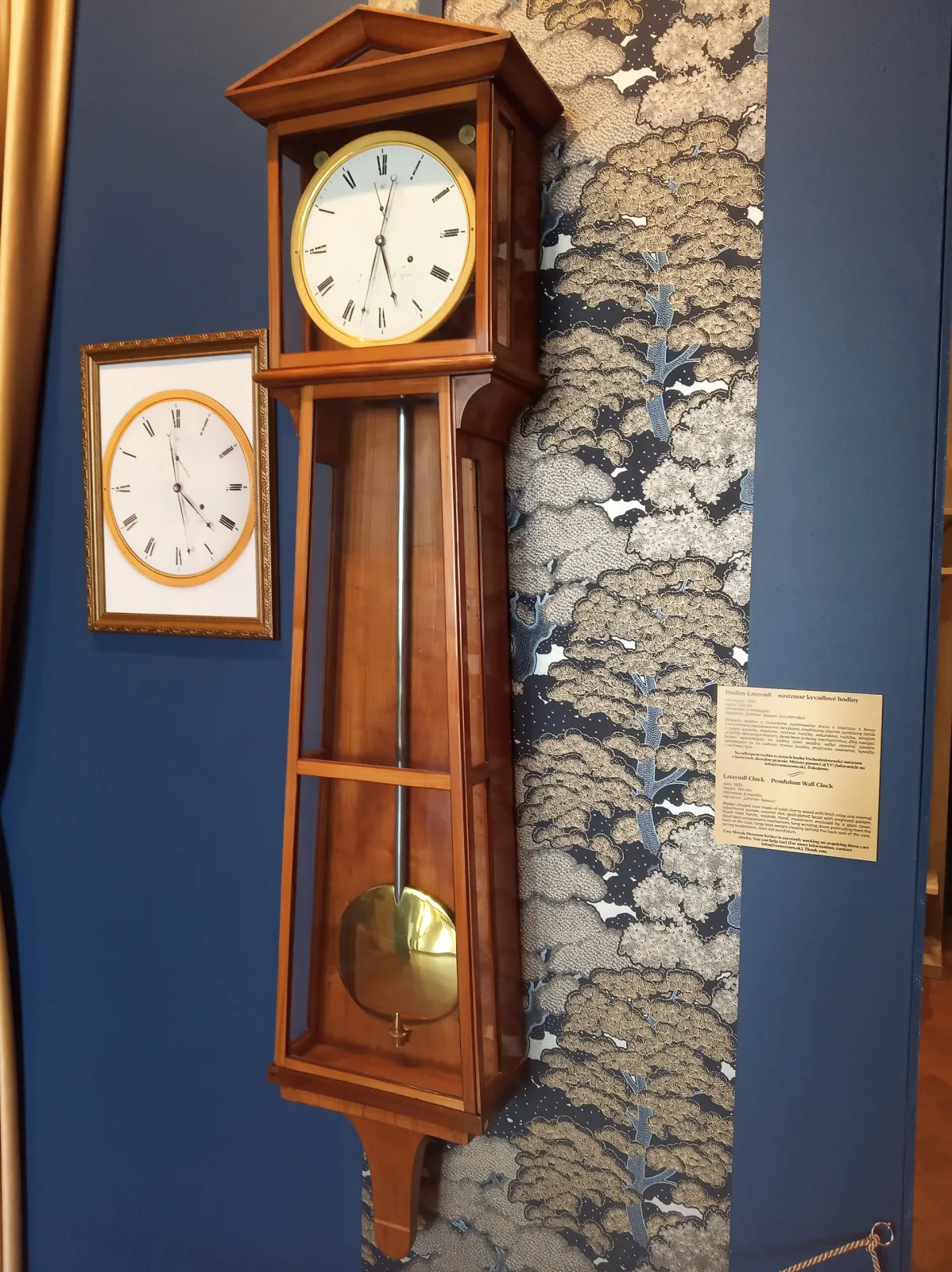
The Viennese wall regulator took its own form around 1800. Stephan Andréewitch's reference page on Laterndluhren dates the style from then, and the dealer Delaney Antique Clocks puts the earliest form at 1800 to about 1820. The classic case, the Laterndluhr or lantern clock, is glazed on three sides and built in three parts: a box for the dial and movement, a long narrow trunk for the pendulum rod and a wider box for the bob. Vienna was the centre but not the only source. Andréewitch names makers in Pest, Buda and Košice, and Lilly's Art lists a month-going regulator by Wilhelm Hübner of Linz. American makers such as E. Howard built wall regulators too; see the banjo clock guide.
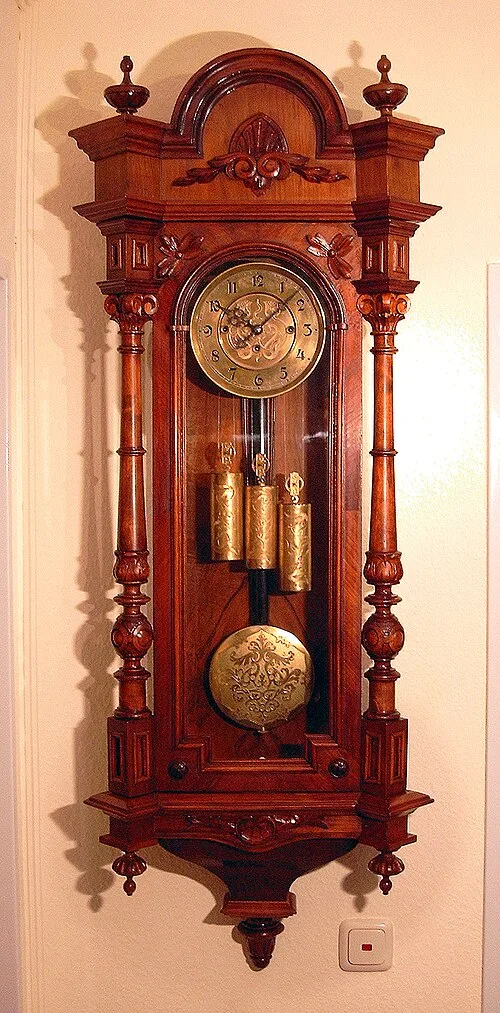
The factory version arrived within half a century. Gustav Becker founded his works at Freiburg in Silesia, now Świebodzice in Poland, in 1847, the year both Wikipedia and the Milan science museum's catalogue give. The Lenzkirch company in the Black Forest, the region the cuckoo clock guide covers, followed in 1851. VintageClockParts describes German production of the style growing “by the mid-1800's”, and Appraisily's guide to German clocks says the factories made many “Vienna-style” clocks, especially between 1870 and 1910.
Three tests separate the two.
- Drive. Horologica, an English repairer, says: “A real Vienna is always weight-driven.” The spring-driven look-alikes, which it calls “Springers”, are German factory clocks, and Delaney and Appraisily both place spring drive in the later part of the century.
- Marks. Factory movements carry a trademark stamped on the back plate, such as Becker's GB on an anchor. Workshop clocks are signed on the dial or not at all: all three Viennese clocks offered by alte-uhren.at are unsigned, as is one of the East Slovak Museum's clocks below, and Abbey Clock notes that most movements carry no name.
- Running time. A month or more on one winding is a workshop feature (see below).
The Case Gives a Window, Not a Year
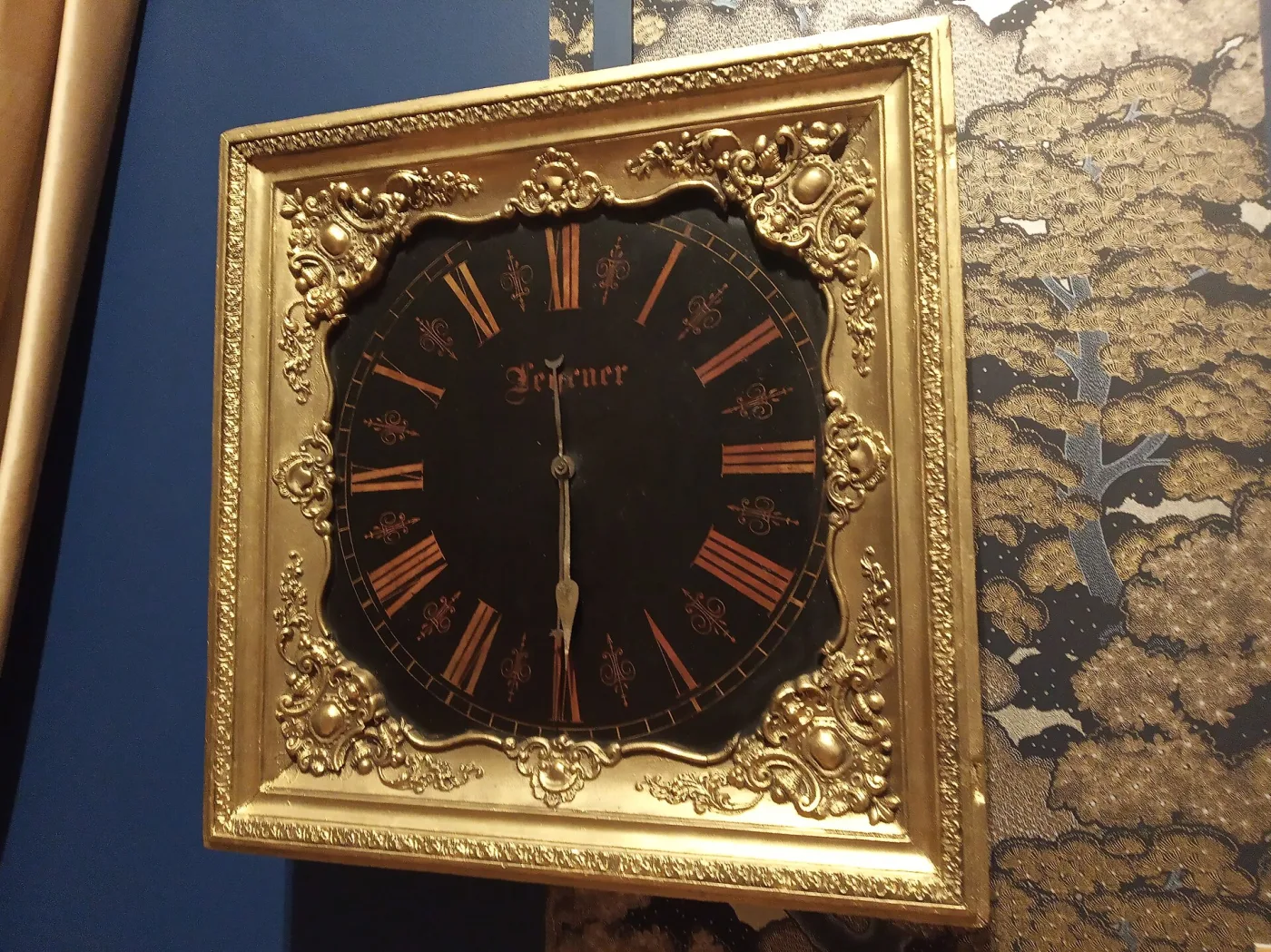
The earliest cases are the plainest. Andréewitch describes early tops as flat and stepped; Delaney describes the form of 1800 to about 1820 as straight wooden frames with inlay and satin banding. A pediment, or “roof”, comes a little later: Andréewitch dates the triangular gable from about 1820, and Vienna-Regulators.com counts the roof-topped Dachluhr among clocks of the Empire and Biedermeier decades.
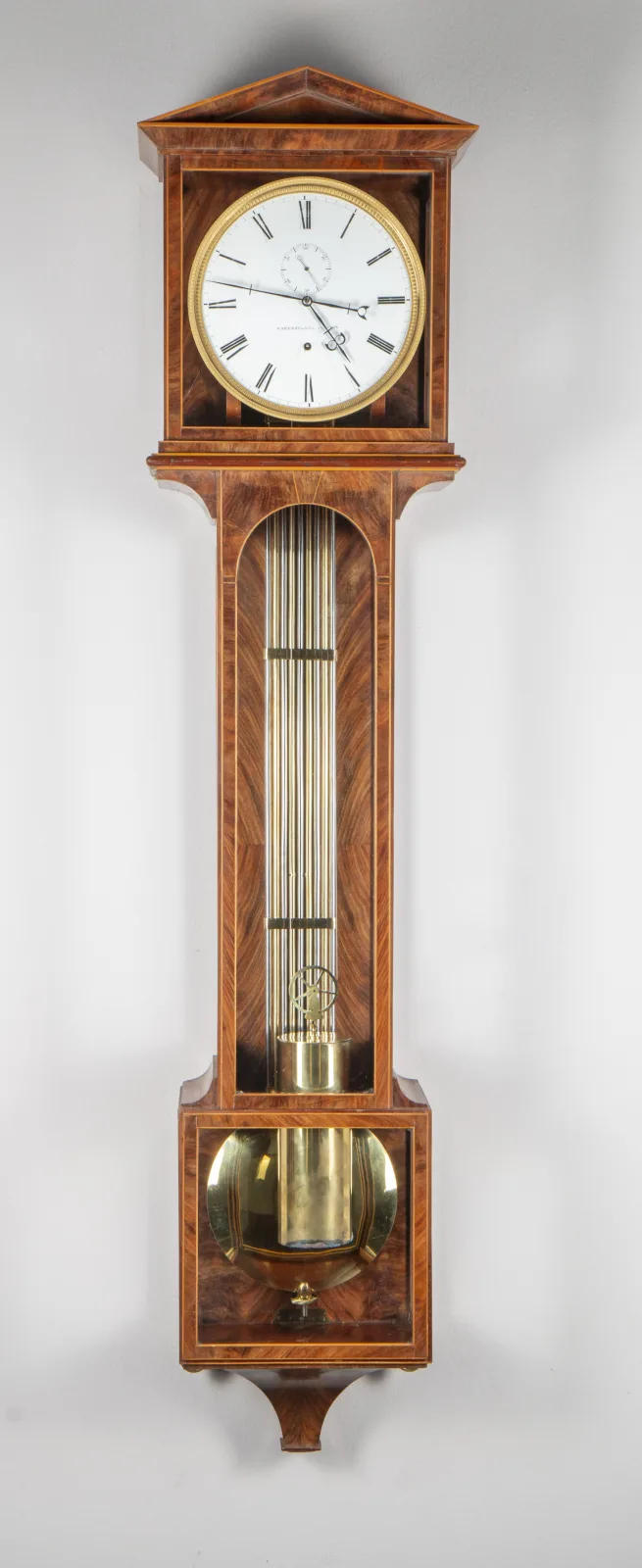
The middle of the sequence is where the sources disagree. Delaney dates the early Biedermeier form from about 1820 into the early 1840s and the late form into the early 1860s; Vienna-Regulators.com gives Biedermeier as 1835 to 1848; Appraisily gives about 1820 to 1840. The museum clocks settle why. Lehrner was still building a Laterndl case in 1835, years after Delaney's earliest form is meant to end, so the styles ran side by side. Read a case as a window of two or three decades, never as a year.
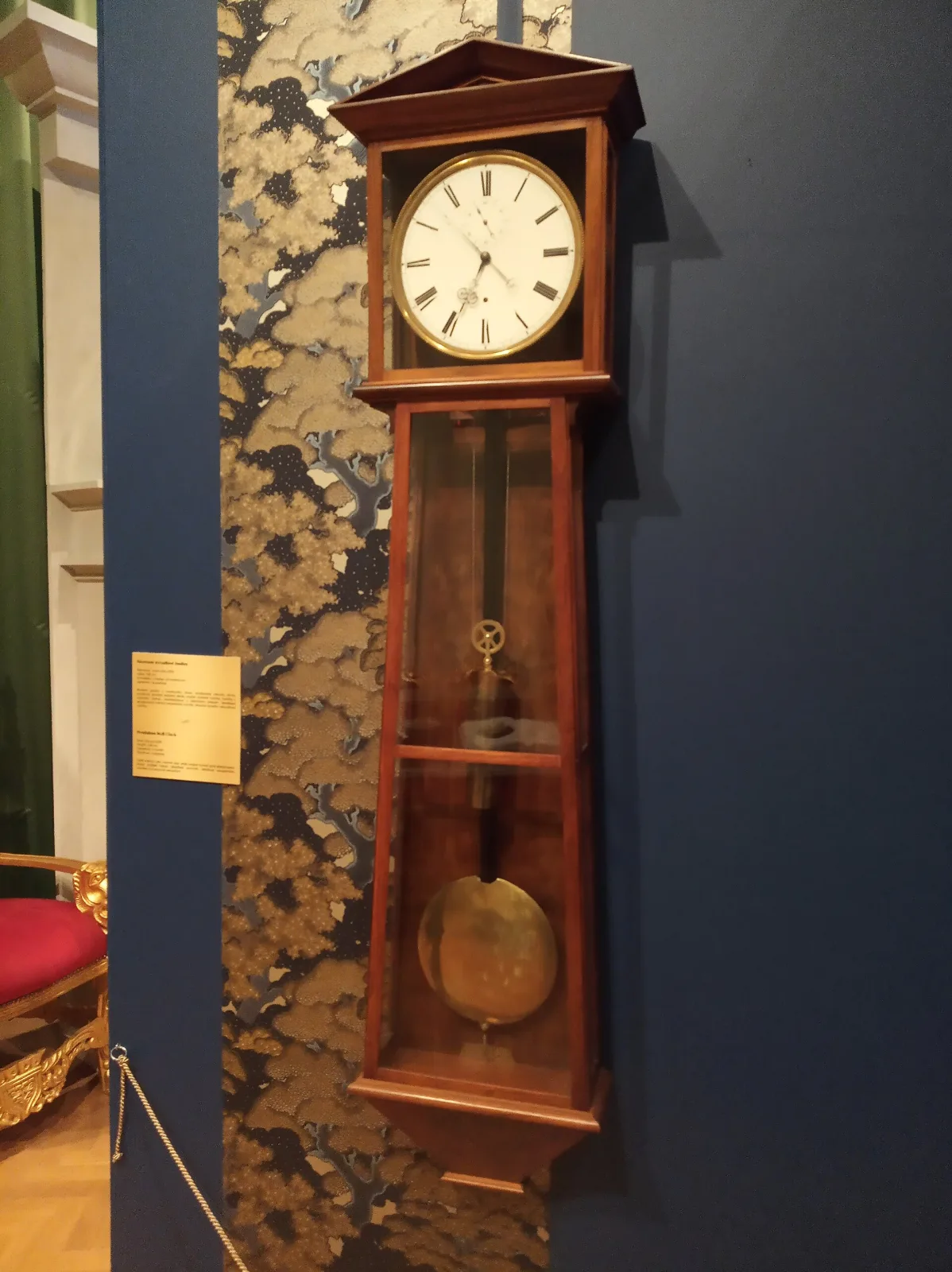
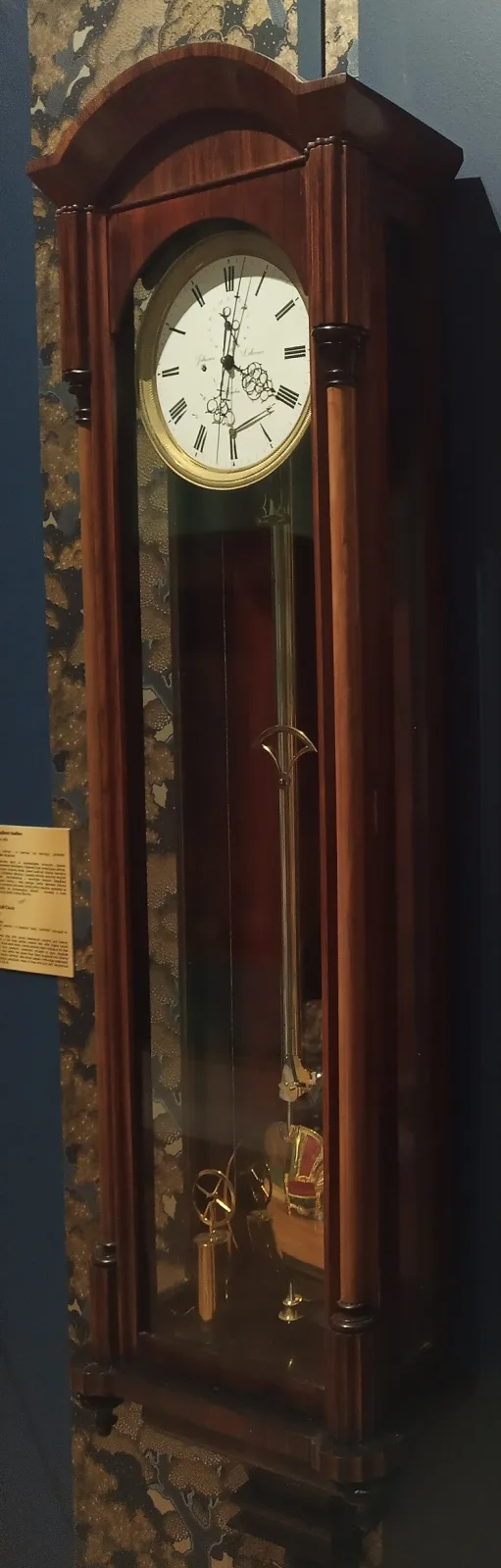
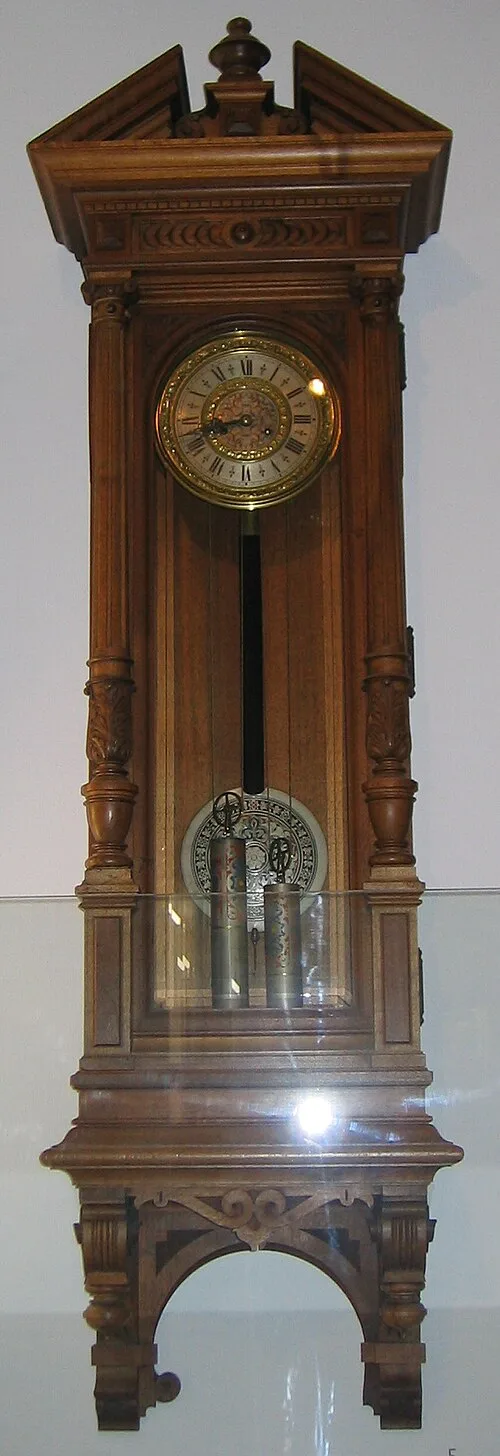
Columns mark the middle of the century. Delaney says late Biedermeier cases “start to incorporate simple columns, light carvings”, and Vienna-Regulators.com dates its Transitional style, with broken or slender columns beside the door, to 1850–1875. The Lehrner of about 1860 fits both. For the factory era, Vienna-Regulators.com dates the Altdeutsch case, with fluted Corinthian columns, crests and finials, to 1870–1895, and Delaney writes that by 1870 almost all cases were ornate. The exception Delaney names is the straight Art Nouveau box, which Vienna-Regulators.com dates to 1890–1920 as its Jugendstil style.

Dial, Pendulum and Running Time
Dials moved from one piece to two. Delaney describes two-piece dials, separated by a brass ring, appearing in the late Biedermeier years and becoming almost universal by 1870; Vienna-Regulators.com lists one- or two-piece dials for Biedermeier clocks and two-piece porcelain dials for the styles of 1850 to 1875. Treat the dial as support, not proof: an unsigned Viennese clock of the first quarter of the century sold by alte-uhren.at already has an enamel ring around a gilt engine-turned centre.
Pendulums grade quality more than they date. Most rods are wood, dried and lacquered fir according to Andréewitch, because wood barely changes length with temperature (Horologica). Precision makers went further. The museum's label for the 1835 Lehrner describes a steel rod; the Lehrner of about 1860 has a compensation pendulum of brass and steel with a temperature scale, a feature Andréewitch also credits to Lehrner. The grandfather clock guide picks out precision regulators among tall clocks the same way.
Running time is the better clue. Andréewitch says most Laterndluhren ran eight days or a month, some far longer, and Lilly's Art lists month-going Viennese regulators. The dated clocks here agree: six months for the 1835 Lehrner, a month for the two clocks of about 1830, 10.5 days for the Lehrner of about 1860. Most “Viennas” run eight days, according to Horologica and VintageClockParts. So a month or more on one winding points to a workshop clock; eight days points nowhere.
What the Weights Tell You
Count the winding holes in the dial rather than the weights, which are easily added or lost: each train has its own weight and its own winding hole, as Horologica explains.
- One weight: a timepiece. It keeps time and does not strike.
- Two weights: time and strike, usually the hours and half hours on a coiled gong (Horologica, Renaissance Antiques, a Tooveys auction lot); a Becker sold by Delaney strikes the hours only.
- Three weights: quarter striking. Abbey Clock describes the quarters sounding on one gong and then the hour on another, so 6:45 is three, then six.
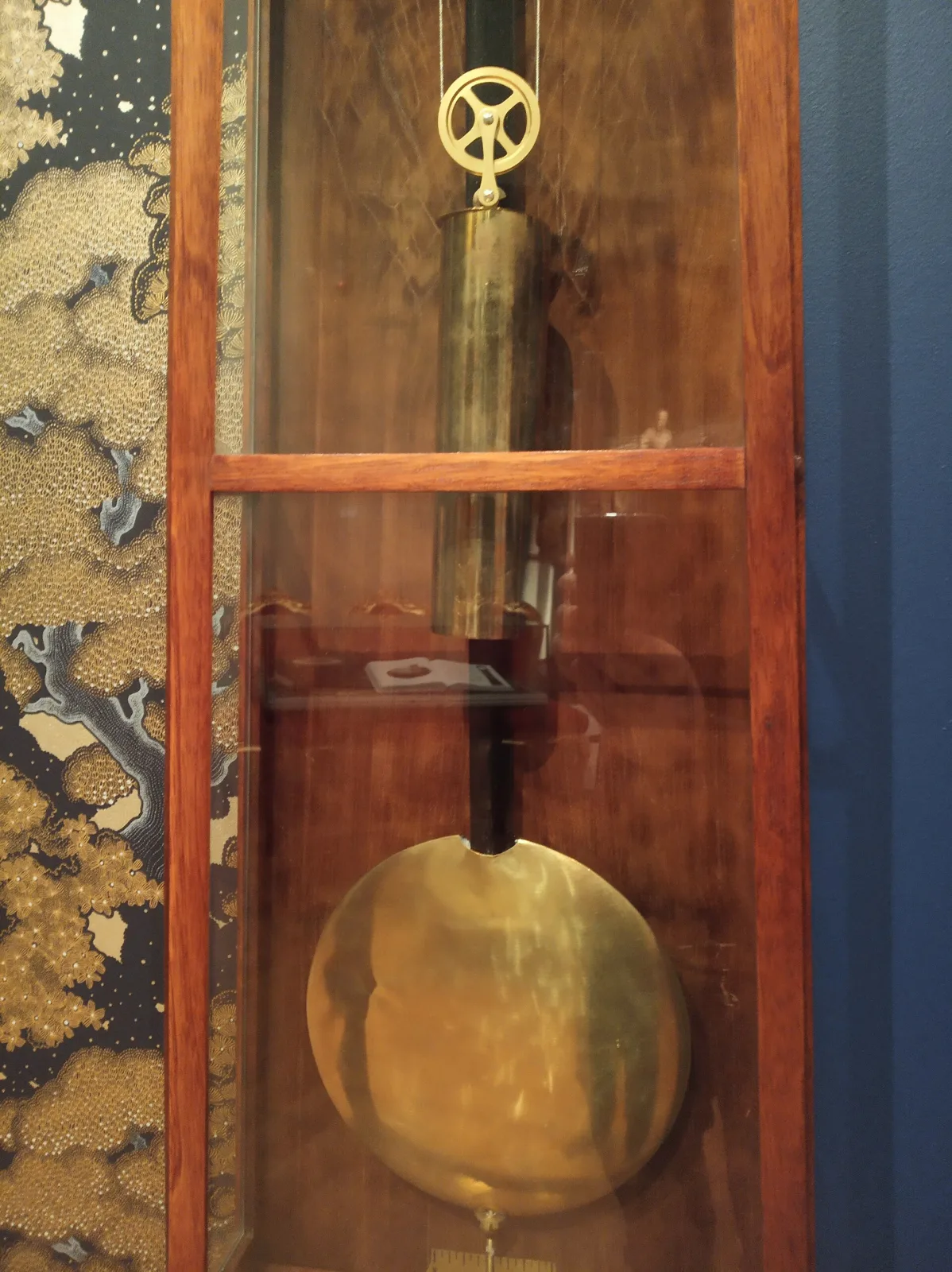
None of this dates the clock. Three weights appear on an unsigned Viennese clock of the first quarter of the nineteenth century (alte-uhren.at), on a Marenzeller Laterndluhr with Viennese grande sonnerie (Lilly's Art) and on Becker factory clocks like the one above. The number of weights tells you what the clock does, not when it was made.
Reading a Factory Movement
A factory movement can carry more datable information than its case. A Becker movement in the Milan science museum (inventory 3890) shows all of it on one back plate.
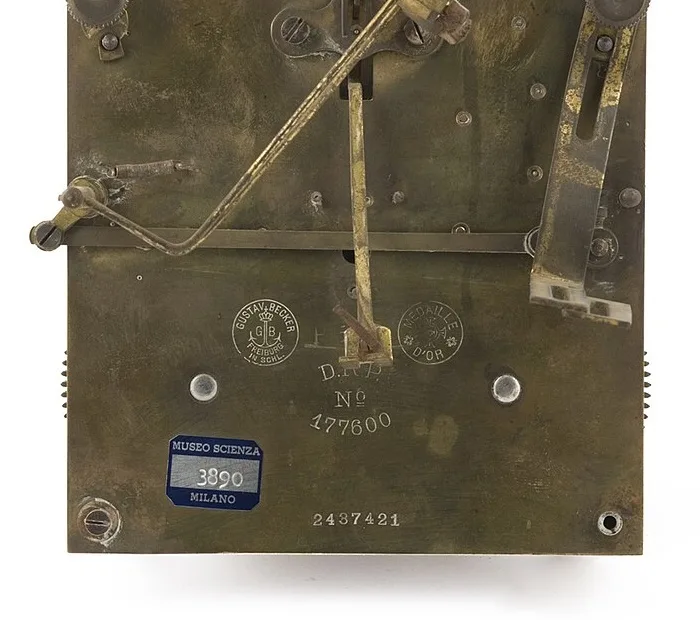
- Trademark. GB on a crowned anchor, ringed by GUSTAV BECKER and FREIBURG IN SCHL. The museum's record and Appraisily describe the same mark.
- Médaille d'Or. The museum says it commemorates the gold medal Becker won in 1852, and Wikipedia also records an 1852 gold medal. It dates the medal, not the movement.
- D.R.P. A German Reich patent (Deutsches Reichspatent), according to both the museum and Appraisily. The movement can be no older than the patent.
- P 54. Pendulum data: the museum says so, and NAWCC forum members read the P number as the pendulum length, probably in centimetres.
The serial number is the strongest clue, with two cautions. A table from the factory's records, which Mervyn Passmore published from figures Karl Kochmann gave him, puts about 100,000 in 1875, 500,000 in 1885, 1,000,000 in 1892 and 1,500,000 in 1900. First, it covers Freiburg only: the Braunau branch, opened around 1888, numbered separately, as both Passmore and NAWCC forum members note. Second, it holds only to 1900. John Hubby, whose chart NAWCC members use, wrote that Kochmann's data “is reasonable up to 1900” but “after 1900 his data is seriously wrong”, and a WatchRepairTalk post says the same of the published lists. Hubby's chart starts 1900 at 1,441,001 and 1901 at 1,530,001, which agrees with the old table at 1900.
The Milan movement shows why that matters. The old table puts 2,244,868 at 1926, and the museum's catalogue note follows it, placing the movement after 1926. But Passmore and the NAWCC forum both record that Becker started a new series of numbers in 1925; the forum says four digits. They disagree on when Junghans took control (1925 in Passmore's account, May 1930 according to Hubby), but not on the renumbering. A seven-digit number therefore dates from 1925 at the latest, which fits the date field of the same museum record: 1900 to 1924. When a table and a numbering change disagree, believe the numbering change.
A country name helps a little. A US tariff law required imports from 1 March 1891 to be marked with their country of origin, and Appraisily dates “Germany” on clocks from 1891. Kovels, though, records the word in some German marks from 1885, so read it as “probably after 1891”, not as proof. Lenzkirch numbered its movements too, but we found no year table that two sources agree on, so this guide does not give one.
Dated Benchmarks and the Dating Ladder
The first table sets the guide's dated clocks side by side, from the museums' own labels and records; the second puts the evidence in the order to use it. The ordering and the rule are our reading of the sources.
| Clock | Date, and who gives it | Case | Runs | Pendulum | Marks |
|---|---|---|---|---|---|
| Johann Lehrner, Košice | 1835 (East Slovak Museum) | Laterndl, wedge-shaped, cherry, pediment | 6 months | Steel rod | “Lehrner Kassán” on the dial |
| Ignaz Marenzeller, Vienna | About 1830 (photograph's description) | Laterndl, pediment, three-part glazed case | — | Multi-rod compensation | — |
| Unsigned | About 1830 (East Slovak Museum) | Plain solid walnut, pediment | 1 month | Wooden rod | None |
| Johann Lehrner, frame clock | About 1830 (East Slovak Museum) | Carved gilt Blondel frame | 1 month | — | LEHRNER on the dial |
| Johann Lehrner, Košice | About 1860 (East Slovak Museum) | Rosewood, arched top, turned columns | 10.5 days | Brass and steel compensation | Signed on the dial; LEHRNER on the movement mount |
| Lenzkirch, Black Forest | 1890 (photograph's description) | Carved architectural case, design by R. Bichweiler | — | — | Factory |
| Gustav Becker movement | 1900–1924 (Milan museum's date field) | Movement only, spring-driven | — | P 54 | GB anchor, Médaille d'Or, D.R.P., 2437421 |
| Step | What you see | What it allows | Sources that agree |
|---|---|---|---|
| 1. Drive | Spring-driven | Factory clock, later nineteenth century or after | Horologica, Delaney, Appraisily |
| 2. Maker's mark | Trademark on the back plate | Factory: no earlier than 1847 for Becker, 1851 for Lenzkirch | Wikipedia, Milan museum, Clockaholic, Appraisily |
| 3. Running time | A month or more on one winding | Workshop clock; eight days allows either | Andréewitch, Lilly's Art, museum labels |
| 4. Case | Flat stepped top, straight frame | The earliest form, from about 1800 | Andréewitch, Delaney |
| Pediment, plain case | About 1820 to 1860; the sources split on Biedermeier | Andréewitch, Delaney, Vienna-Regulators.com | |
| Slender or turned columns | About 1850 to 1875 | Delaney, Vienna-Regulators.com | |
| Corinthian columns, crests, finials | About 1870 to 1895 | Vienna-Regulators.com, Delaney | |
| Plain straight box | About 1890 to 1920 | Vienna-Regulators.com, Delaney | |
| 5. Dial | Two pieces with a brass ring | Usual from mid-century, almost universal by 1870 | Delaney, Vienna-Regulators.com |
| 6. Becker serial | Seven digits up to about 1,500,000 | Kochmann's table, reliable to 1900 | Passmore, Hubby |
| Seven digits above 1,530,000 | 1901 to 1925; use Hubby's chart, not the old table | Hubby, WatchRepairTalk, Passmore | |
| Four digits | 1925 or later | Passmore, NAWCC forum | |
| 7. Country | “Germany” | Probably after 1891 | US tariff law of 1890, Appraisily, Kovels (caveat) |
The rule: the clock is no earlier than the latest date any line allows. The case then says how much later. If the movement and the case give windows that cannot overlap, one of the parts did not start life with the other.
Frequently Asked Questions
How can I tell how old my Vienna regulator is?
Start with the drive and the marks. A spring-driven clock, or a trademark on the back plate of the movement, means a factory clock made from the late 1840s on; a weight-driven clock with no trademark may be a workshop clock of about 1800 to 1860. Then read the case: flat stepped tops are the earliest, carved crests with Corinthian columns about 1870 to 1895, plain boxes about 1890 to 1920. A Gustav Becker serial number can narrow the date further.
What do one, two and three weights mean on a Vienna regulator?
Each weight drives one train, and each train has its own winding hole in the dial. One weight is a timepiece that only keeps time. Two weights add a strike, usually the hours and the half hours on a gong. Three weights add quarter striking: the quarters on one gong, then the hour on another. The number tells you what the clock does, not when it was made.
How do I date a Gustav Becker clock from its serial number?
Find the number on the back plate of the movement. The table from the factory's records puts about 100,000 in 1875, 500,000 in 1885, 1,000,000 in 1892 and 1,500,000 in 1900, and collectors trust it only up to 1900. A seven-digit number belongs to the series that ended in 1925; a four-digit number is later. Movements from Becker's Braunau branch were numbered separately.
Does Germany stamped on the movement date my clock?
Only loosely. The United States required imports to be marked with their country of origin from 1 March 1891, so Germany usually points to a clock made for export after that date. Kovels records the word in some German marks from 1885, so read it as probably after 1891 and confirm with the maker's mark and serial number.
The Short Version
Weights or spring, trademark or none, and the running time settle workshop or factory. The case gives a window of two or three decades; on a Becker movement the serial number dates closely to 1900, and to before or after 1925 later. Other clock types are in the clock identification guide, and the valuation and appraisal guide covers getting a professional opinion.