Banjo Clocks Identification Guide: Willard Patent Timepieces, Girandoles & Presentation Clocks
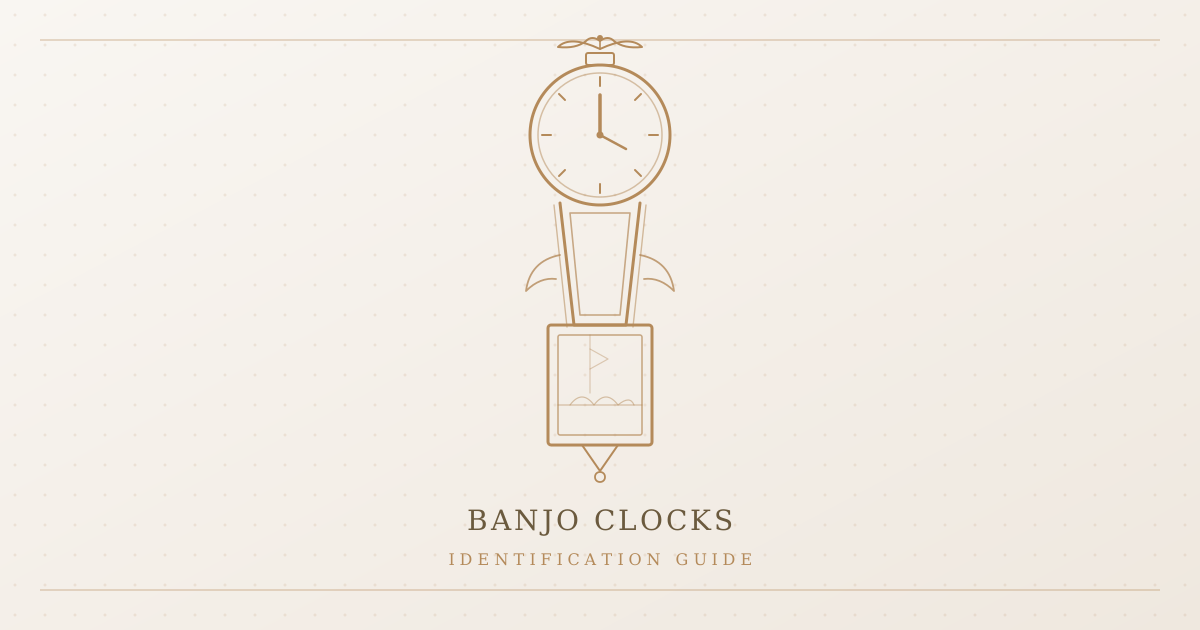
Few objects are as distinctly American as the banjo clock. Its silhouette — a round dial head, a tapering waist, and a rectangular box at the base, crowned by a gilded eagle and flanked by graceful cast side arms — was invented in Massachusetts at the turn of the nineteenth century and copied for the next hundred and fifty years. The nickname "banjo," borrowed from the musical instrument the case resembles, is a twentieth-century collector's term; the men who made these clocks called them simply patent timepieces or improved timepieces.
The form begins with one man and one date. On 8 February 1802, Simon Willard of Roxbury (now part of Boston), Massachusetts, received a United States patent — signed by President Thomas Jefferson — for an "Improved Timepiece": a light, compact, weight-driven wall clock about three feet tall, accurate and dependable, and cheaper to build than the tall case clocks that had dominated American horology. Willard held the patent for fourteen years, until 1816, but the design was so admired that his apprentices, relatives, and competitors produced their own versions from the beginning, and the banjo became the defining wall clock of the American Federal period.
This guide reads the banjo clock the way an experienced appraiser does: from the finial down through the bezel, dial, throat tablet, side arms, lower box tablet, and movement to the maker's signature and case timber. It sits alongside the broader framework of our antique clock identification guide and complements our coverage of related American and European forms such as mantel and shelf clocks, grandfather (tall case) clocks, and carriage clocks. By the end you will be able to distinguish a genuine period Willard-school timepiece from a Colonial Revival factory banjo, date a case within a decade or two, recognise the presentation and girandole variants, read the reverse-painted eglomise tablets, spot married and reproduction cases, and apply realistic value ranges.
Table of Contents
- What Is a Banjo Clock?
- Simon Willard and the 1802 Patent
- Anatomy of a Banjo Clock
- The Willard School and Its Makers
- Presentation Banjo Clocks
- The Girandole and Lyre Variants
- Movements: Weight-Driven and Spring-Driven
- Dials, Bezels, and Hands
- Eglomise Tablets: Throat and Box
- Side Arms, Finials, and Brackets
- Case Construction and Timbers
- Signatures, Labels, and Marks
- Dating a Banjo Clock
- The Colonial Revival and Factory Banjos
- Reproductions, Married Cases, and Fakes
- Authentication Workflow
- Condition and Restoration
- Value Factors and Price Ranges
- Building a Banjo Clock Collection
- Care, Display & Preservation
What Is a Banjo Clock?
A banjo clock is a wall-hung timepiece whose case takes the shape of an upended banjo: a circular head housing the dial, a long tapering neck (the "throat"), and a rectangular box at the bottom. It is almost always a timepiece — a clock that only tells the time, with no striking or chiming train — although a small minority of period examples and many later factory models added a strike.
Timepiece, Not Striking Clock
The absence of a strike is central to the original concept. Willard's genius was economy: by eliminating the strike train, the second weight, and the heavy movement of a tall case clock, he produced a graceful, reliable, affordable wall clock that a middle-class Federal household could own. When you see a genuine early banjo, expect a single weight, a single winding arbor, and a movement no larger than a paperback book.
The Name "Banjo"
Neither Willard nor his contemporaries used the word "banjo." Period documents call the form a "patent timepiece," "improved timepiece," or simply "wall timepiece." "Banjo clock" is an affectionate later description that became universal among twentieth-century collectors because the case profile so obviously echoes the instrument. Using the correct period term ("patent timepiece") in a catalogue description signals expertise and often correlates with better provenance.
An American Form
The banjo is one of very few clock forms that is genuinely, originally American rather than an American version of a British or Continental type. It has no direct European ancestor. This makes fine period banjos important documents of early American decorative arts, and it explains why the best examples reside in museums such as the Smithsonian, the Metropolitan Museum of Art, and the Museum of Fine Arts, Boston.
Simon Willard and the 1802 Patent
The Willards were the pre-eminent clockmaking family of Federal New England. Four brothers — Benjamin, Simon, Ephraim, and Aaron — worked in the trade, but Simon (1753–1848) and Aaron (1757–1844) were the giants. Simon worked at Roxbury; Aaron established a large shop in Boston. Between them and their apprentices they trained most of the makers who carried the banjo form forward.
The Improved Timepiece
Simon Willard patented the "Improved Timepiece" on 8 February 1802. The patent gave him fourteen years' exclusivity, to 1816, and President Thomas Jefferson signed the grant. The design distilled the movement of the Massachusetts shelf clock into an even smaller, lighter form, hung on a wall and driven by a single weight running down inside the case. It kept excellent time, cost far less than a tall clock, and looked elegant on a parlour or hallway wall.
Roxbury and Boston Production
Simon's Roxbury shop and Aaron's Boston shop produced patent timepieces in quantity through the first quarter of the nineteenth century. The two shops' output can sometimes be distinguished by construction details and by the reverse-painted tablets, but both made superb clocks. Because the patent was widely admired and only loosely enforced, apprentices and journeymen — Elnathan Taber, John Sawin, William Grant, Lemuel Curtis, and others — set up on their own and made banjos from the earliest years.
The Willard Legacy
By the time the patent expired in 1816, the banjo was established as the standard American wall timepiece. The form spread from eastern Massachusetts across New England and, by the mid-nineteenth century, into factory production in Connecticut. Its history spans a full century of the weight-driven original followed by spring-driven revivals, making the banjo one of the longest-lived American clock designs. For the wider Federal-period context, our antique clock identification guide places the banjo within the broader American and European clockmaking story.
Anatomy of a Banjo Clock
Learning the vocabulary of the banjo case is the fastest route to confident identification. From top to bottom, the parts are the finial, the bezel and dial (the "head"), the throat, the side arms, the box, and the bottom bracket, with the movement inside the head and the weight travelling down behind the throat and box.
The Finial
Most banjos are crowned by a cast brass or carved-and-gilded finial. The spread-wing eagle is the classic form and the most common; ball, acorn, pineapple, and flame finials also appear. On presentation and girandole clocks the finial is often a large, finely detailed carved eagle. A missing or replaced finial is common and materially affects value.
The Head, Bezel, and Dial
The head contains the movement behind a painted iron or (later) paper dial, protected by a hinged brass bezel and convex or flat glass. Period bezels are cast brass, often with a cove or reeded profile; the dial is typically painted white with black Roman numerals and delicate spade or moon hands.
The Throat
The throat is the tapering neck between head and box. Its front is filled by a glazed reverse-painted panel — the "throat tablet" — usually decorated with geometric, foliate, or patriotic motifs. The throat sides are frequently reeded, gilded, or fitted with applied brass mouldings.
The Box and Bottom Bracket
The rectangular box at the base holds a second, larger reverse-painted panel (the "box tablet" or "lower tablet") behind glass, and encloses the lower travel of the weight and the pendulum bob. Beneath the box a shaped bracket or drop finishes the case; on presentation clocks this may be an elaborately carved and gilded scroll.
Side Arms
Cast brass side arms — decorative brackets shaped like scrolls, cornucopias, or acanthus leaves — flank the throat on most quality banjos. They are purely ornamental, gilded to match the case, and their presence, pattern, and originality are important identification and value points.
The Willard School and Its Makers
The "Willard school" describes the network of Massachusetts makers who learned the banjo form in or around the Willard shops and produced it to a high standard through the first half of the nineteenth century. Recognising these names — and where they worked — is essential to attribution and valuation.
Simon Willard (1753–1848)
The inventor, working at Roxbury. Simon's timepieces are the benchmark: crisp movements, fine reverse-painted tablets, and cases of restrained elegance. Genuine signed Simon Willard banjos are scarce and valuable, and forged "S. Willard" signatures are a perennial problem (see the authentication section).
Aaron Willard (1757–1844) and Aaron Willard Jr.
Aaron ran a large Boston shop; his son Aaron Willard Jr. (1783–1864) continued it. Aaron Willard Jr. banjos frequently carry patriotic box tablets such as "Columbia" and are among the most desirable of the Boston output.
Elnathan Taber (1768–1854)
Simon Willard's most trusted apprentice, working at Roxbury. Taber was so skilled that Simon reportedly allowed him to sign clocks with the Willard name late in his career. Taber's own signed banjos are highly regarded.
Lemuel Curtis (1790–1857)
Working first at Concord, Massachusetts, and later in Vermont, Curtis is famous for elevating the banjo into the girandole (below). His standard banjos are also finely made and command strong prices.
John Sawin, William Grant, and Others
John Sawin (1799–1863), a Boston maker and relation of the Willards, produced excellent banjos, sometimes in partnership as Sawin & Dyar. William Grant, Curtis & Dunning, and numerous other New England shops round out the school. Many fine period banjos are unsigned or bear only a partial label, and are attributed on the basis of construction and tablet style.
Presentation Banjo Clocks
The "presentation" banjo is the deluxe grade of the form: larger, more heavily gilded, with rope-turned or carved case mouldings, elaborate cast side arms, a fine carved eagle finial, and museum-quality reverse-painted tablets. These were the flagship products of the best shops.
What Makes a Banjo a "Presentation"
Presentation clocks are distinguished by scale and ornament rather than by any single mechanical feature. Expect a larger dial (often eight inches), a taller case, cross-banded or rope-turned frames on the throat and box, gilt-gesso decoration, and side arms and finial of exceptional casting. The reverse-painted box tablet is usually a landscape, allegorical, or naval subject of high quality.
Patriotic and Naval Tablets
Federal patriotism runs through presentation tablets: portraits of Washington, "Columbia" figures, Mount Vernon, and above all naval battle scenes celebrating the War of 1812 (the Constitution and Guerrière, the United States and Macedonian). A genuine period naval or portrait tablet in good original paint is a major value driver.
A Caution on "Presentation" Marketing
Because presentation clocks are so valuable, the label is sometimes applied loosely, and plain banjos are occasionally "upgraded" with added tablets, side arms, and finials to imitate presentation grade. Authenticity here depends on the case having been built as a presentation piece from the start — consistent timber, gilding, and construction throughout — rather than assembled from parts. This mirrors the "married clock" problem discussed in the reproductions section.

The Girandole and Lyre Variants
Two important variants grew directly out of the banjo: the girandole, the most beautiful, and the lyre, the most sculptural. Both are prized and both are widely reproduced.
The Girandole (Lemuel Curtis, c. 1816)
Lemuel Curtis patented the girandole in 1816. He replaced the banjo's rectangular box with a round pendulum case fronted by convex glass bearing a reverse-painted classical or allegorical scene, its border set with gilt spherical ornaments ("girandoles") inspired by the round convex girandole mirrors fashionable from about 1810 to 1830. A carved gilt eagle usually surmounts the eight-inch convex dial. The girandole is often called the single most beautiful American clock; genuine period examples are rare and can reach five and six figures at auction, so reproductions vastly outnumber originals.
The Lyre Clock
The lyre clock replaces the banjo's plain throat with a carved lyre-shaped frame — scrolled sides suggesting the arms of a classical lyre, sometimes with carved acanthus and rosettes. Boston makers such as Sawin and the Willard circle produced lyre clocks in both wall and shelf forms during the 1820s and 1830s. The carving quality is the key to grade and value.
Half-Clocks and Miniatures
Smaller "half banjos" and diminutive timepieces exist, made both in the period and during the later revival. Scale alone does not date a clock; assess movement, tablets, and construction as you would on a full-size example.
Movements: Weight-Driven and Spring-Driven
The movement is the single most reliable guide to whether a banjo is an early original or a later revival, because the weight-driven period movement and the spring-driven factory movement are fundamentally different machines.
The Weight-Driven Eight-Day Movement
Period banjos use a small, high-quality, weight-driven eight-day timepiece movement with a recoil (or occasionally dead-beat) escapement and a short pendulum. The weight is cylindrical, usually lead, and travels down inside the throat and box on a cord or gut over a pulley. Plates are brass, hand-finished, and often shaped as a "T-bridge" or "A-frame" to save weight and metal. There is a single winding arbor and no strike.
T-Bridge and A-Frame Plates
Instead of two full rectangular plates, many period movements use skeletonised front plates — a T-shaped or A-shaped bridge carrying the arbors. This is a hallmark of quality Massachusetts work and is difficult to fake convincingly. Examine the plate shape, the hand-cut wheel crossings, and the finishing marks.
Spring-Driven Revival Movements
From the mid-nineteenth century, and overwhelmingly in the Colonial Revival of about 1890–1940, banjos were made with spring-driven movements — often mass-produced Connecticut mechanisms, sometimes with a strike. A spring-driven movement, a keyhole for a mainspring rather than a weight, and stamped rather than hand-finished plates immediately place a banjo in the factory era rather than the Federal period.
Reading the Movement
Turn the clock and look inside: a single lead weight and a skeletonised brass movement point to an early original; a mainspring, a factory stamp, and thin uniform plates point to a revival. This one distinction separates a four- or five-figure period banjo from a two- or three-figure decorative one. The same weight-versus-spring logic applies across many nineteenth-century American clocks, as discussed in our mantel and shelf clock guide.
Dials, Bezels, and Hands
The dial and its surrounding hardware carry both dating evidence and, frequently, the maker's signature.
Painted Iron Dials
Period banjos have painted sheet-iron dials, white or off-white, with black Roman numerals, a minute track, and sometimes delicate corner or centre decoration. The dial is convex on many head styles. Later factory banjos often use paper dials on a metal pan, or printed dials, which look flatter and more mechanical.
Signatures on the Dial
Many makers signed the dial — "S. Willard's Patent," "Aaron Willard, Boston," "L. Curtis," "J. Sawin," and so on — usually beneath the numerals or across the centre. A genuine signature lies under the original varnish, ages with the surface, and matches the clock's construction; a suspiciously fresh or over-crack signature is a warning sign (see authentication).
Bezels and Glass
Period bezels are cast brass with a hinged, latched door and convex glass. The casting quality is high and the profile — cove, ogee, or reeded — is consistent with the case mouldings. Replacement bezels and modern flat glass are common on restored clocks.
Hands
Expect finely pierced steel hands, often blued, in spade, moon, or serpentine patterns. Crude, thick, or mismatched hands usually indicate replacement or a later factory origin.
Eglomise Tablets: Throat and Box
The reverse-painted glass panels — throat tablet above, box tablet below — are the banjo's glory and often its greatest value component. The technique is eglomise (verre eglomise): painting and gilding applied to the back of the glass so the image is viewed through the glass from the front.
What Eglomise Is
The artist paints in reverse order on the back of the glass — details first, background last — and often applies gold or silver leaf for borders and highlights. The result is brilliant, glossy, and, when original, irreplaceable. Genuine period tablets show the characteristic depth and slight crackle of two-century-old reverse painting.
Throat Tablets
Throat tablets are typically geometric or foliate: cross-hatched panels, husk chains, gilt borders, red-and-gold "sandwich glass" patterns. They are smaller and more abstract than the box tablet below.
Box Tablets
The box tablet is the showpiece: landscapes, country houses (Mount Vernon is a favourite), allegorical figures such as Columbia and Liberty, mourning scenes, and — on the finest patriotic clocks — naval battles of the War of 1812. Subject, quality, and originality of the box tablet can account for a large share of a banjo's value.
Original, Restored, or Replaced
Because glass tablets crack and flake, many have been restored or entirely replaced. An original tablet in good condition commands a substantial premium; a well-executed period-style replacement is acceptable and honest when disclosed; a crude modern reproduction or a decal masquerading as reverse painting is a serious detraction. Learn to tell hand reverse-painting from a printed transfer or decal — the latter is flat, dot-patterned under magnification, and lacks the layered depth of true eglomise. The same reverse-glass technique appears on other decorative antiques covered in our antique mirror identification guide.
Side Arms, Finials, and Brackets
The cast metal ornaments — side arms, finial, and bottom bracket — are both decorative and diagnostic. Their pattern, casting quality, gilding, and originality all feed into attribution and value.
Cast Brass Side Arms
Side arms flank the throat as purely ornamental brackets, cast in brass and gilded. Patterns include scrolls, cornucopias, acanthus leaves, and eagle-and-scroll motifs. Fine, crisp casting with mercury or oil gilding indicates quality period work; soft, mushy castings or bright modern lacquer suggest revival or replacement.
Finials
The spread-wing eagle is the classic finial; ball, acorn, pineapple, and flame forms also occur. Presentation and girandole clocks favour large, finely carved-and-gilded eagles. Because finials are fragile and desirable, they are commonly lost, replaced, or "upgraded" — check that the finial's style, patina, and mounting are consistent with the case.
Bottom Brackets
Beneath the box, a shaped wooden bracket or a cast-and-gilded scroll drop finishes the case. On presentation and girandole clocks this can be an elaborately carved gilt element; on plain banjos it is a simple shaped board.
Case Construction and Timbers
The case is built by a cabinetmaker to hold the movement, tablets, and weight, and its timber and joinery are strong period indicators.
Timbers
Period banjo cases are typically mahogany or mahogany-veneered, with pine or other softwood secondary timbers and backboards. Gilt-gesso decoration is applied over a wooden or composition ground. Presentation cases show cross-banding, rope-turning, and fine veneers; plain banjos may be solid mahogany or even painted softwood.
Joinery and Backboards
Examine the backboard, the throat and box joinery, and the internal weight baffle. Hand tool marks, cut nails or wooden pins, oxidised original surfaces, and a settled patina point to period work. Plywood, machine-uniform components, Phillips screws, and bright new timber point to later manufacture or restoration.
Gilding
Original water- or oil-gilding on gesso mellows to a warm, softly worn tone. Bright, even, unworn gilding — especially modern gold paint or bronze powder — is a sign of regilding or reproduction. As with any gilded antique, the character of the gold surface is a key authenticity clue, a theme explored in our antique picture frames guide.
Signatures, Labels, and Marks
A signature or label can transform value — and is therefore the most-faked element of a banjo clock. Treat every signature as a claim to be verified, not a fact.
Where to Look
Look on the dial (beneath the numerals or across the centre), on a paper label inside the case, and occasionally stamped or engraved on the movement. Common forms include "S. Willard's Patent," "Aaron Willard, Boston," "A. Willard Jr.," "L. Curtis," "J. Sawin," and "Curtis & Dunning."
Factory Marks
Revival-era banjos carry manufacturers' paper labels or stamped movements: E. Howard & Co. (Boston), Chelsea Clock Co., New Haven, Waterbury, Sessions, and Seth Thomas. These are legitimate marks of quality factory clocks — but they place the clock firmly in the late nineteenth or twentieth century, not the Federal period.
The E. Howard Distinction
E. Howard & Co. deserves special mention: Edward Howard trained in the Willard tradition and his firm's later banjo and "figure-eight" wall clocks are high-quality regulators, collectible in their own right and quite different from cheap revival banjos. A signed Howard banjo is a serious clock even though it is not a Federal-period Willard.
Dating a Banjo Clock
Dating combines the movement, the tablets, the hardware, the case, and any signature into a coherent estimate. No single feature dates a banjo; the convergence of features does.
The Federal Period (1802–c. 1840)
Weight-driven skeletonised movement, painted iron convex dial, hand reverse-painted eglomise tablets, cast brass side arms and eagle finial, mahogany case with gilt-gesso decoration, and a period signature. This is the golden age of the banjo and the range in which the great makers worked.
Mid-Nineteenth Century (c. 1840–1880)
Continued weight-driven production alongside early spring-driven and factory examples. Transitional features — a slightly heavier case, a printed or transfer tablet, a factory movement in an otherwise traditional case — are common.
The Colonial Revival (c. 1890–1940)
Spring-driven factory movements, paper or printed dials, decal or printed tablets, machine-made cases, and manufacturers' labels (New Haven, Waterbury, Sessions, Seth Thomas, Howard). Enormous numbers were made for a nostalgic market, and most banjos encountered today date from this period.
Modern Reproductions (1950–present)
Battery or modern mechanical movements, printed tablets, and new timber. Decorative and inexpensive, these should never be confused with antiques. The convergence-of-evidence method that dates clocks is the same one applied throughout our antique authentication and provenance research guide.
The Colonial Revival and Factory Banjos
The banjo's second life came with the Colonial Revival, when American consumers sought furnishings that evoked the Federal past. Connecticut and Massachusetts factories met the demand with spring-driven banjos in every grade.
The Connecticut Factories
New Haven, Waterbury, Sessions, and Seth Thomas produced banjos by the tens of thousands. These are honest, attractive, spring-driven wall clocks — often with printed or decal tablets and paper dials — that furnished countless homes, schools, and offices in the early twentieth century. They are collectible as revival pieces, not as Federal antiques.
E. Howard and Chelsea
At the quality end, E. Howard & Co. and the Chelsea Clock Company made fine weight- and spring-driven banjo and regulator wall clocks that continue the Willard tradition at a high standard. Howard's "figure-eight" and "No. 70" banjo regulators are serious horological instruments.
Valuing Revival Banjos
A typical spring-driven revival banjo is worth a modest sum — attractive, usable, decorative. Named quality makers (Howard, Chelsea) command more. None approaches the value of a genuine period Willard-school clock, so correctly separating revival from Federal is the most consequential judgement in banjo collecting.
Reproductions, Married Cases, and Fakes
Because fine period banjos are valuable, the form attracts three kinds of problem: outright reproductions, "married" clocks assembled from mismatched parts, and forged signatures or upgraded tablets.
Outright Reproductions
Twentieth-century and modern reproductions imitate the period form but betray themselves through spring-driven or battery movements, printed tablets, machine-made cases, new timber, and bright modern gilding. Under magnification a printed tablet shows a dot pattern; genuine eglomise does not.
Married Clocks
A "married" banjo combines parts from different clocks — a period movement in a later case, an old case with a replaced movement and new tablets, or a plain banjo dressed up with added side arms and a fancy finial to imitate presentation grade. The tell is inconsistency: timber, gilding, wear, and construction that do not agree from top to bottom. Every element should share the same age and hand.
Forged Signatures
"S. Willard" and other prestige signatures have been added to dials for well over a century. A genuine signature lies under the original varnish, ages with the dial, and is consistent with a genuinely period movement and case. A signature painted over existing cracks, or on a dial that sits above a spring-driven factory movement, is spurious. Never let a signature override the physical evidence of the movement and case.
Upgraded Presentation Clocks
As noted earlier, plain banjos are sometimes elevated to "presentation" grade with added tablets, gilding, side arms, and finials. Judge the case on whether it was built as a presentation piece from the start.
Authentication Workflow
A disciplined, repeatable sequence turns a pile of impressions into a defensible attribution. Work from the movement outward, because the movement is the hardest element to fake and the clearest guide to period.
Step 1: Read the Movement
Open the case. Weight-driven with a single lead weight and a skeletonised brass movement points to a period original; spring-driven with a factory stamp points to a revival. This single step resolves most cases.
Step 2: Examine the Tablets
Are the throat and box tablets genuine hand reverse-painting, or printed/decal? Under magnification, look for dot patterns (printed) versus layered depth and gilding (eglomise). Assess whether they are original, period-restored, or modern replacements.
Step 3: Assess the Case and Gilding
Check timber (mahogany with softwood secondaries), joinery (hand tool marks, cut nails, wooden pins), and gilding (mellow original versus bright modern). Confirm the whole case shares one age and hand — no married inconsistencies.
Step 4: Weigh the Signature
Treat any signature as a claim. Does it lie under original varnish, age with the surface, and agree with a period movement and case? If the physical evidence contradicts the signature, trust the physical evidence.
Step 5: Corroborate and Value
Cross-reference the maker, tablet subject, and construction against published references and auction records. Document everything with photographs. For high-value attributions — a purported Simon Willard, a girandole, a presentation clock — obtain an opinion from a specialist horologist or an auction house, following the disciplined approach in our antique valuation and appraisal guide.
Condition and Restoration
Condition governs value across every grade of banjo, and the market treats different repairs very differently.
Movement Condition
A clean, running, original movement is worth far more than a seized or heavily replaced one. Sympathetic servicing (cleaning, bushing worn pivots) is expected and acceptable; wholesale replacement of the movement destroys much of a period clock's value.
Tablet Condition
Original tablets in good order command a premium. Flaking or cracked originals may be conserved; honest period-style replacements are acceptable when disclosed. Crude modern reproduction tablets or decals significantly reduce value.
Case and Gilding
Original surface and gilding, even if mellowed and lightly worn, is preferred to bright refinishing. Over-restoration — stripping, heavy regilding, replacement mouldings — reduces value and can obscure the evidence needed for attribution.
Replaced Elements
Replaced finials, side arms, bezels, glass, hands, and weights are common. Each replacement should be noted; a clock retaining all its original hardware is markedly more desirable. Reversible, well-documented conservation is always preferable to aggressive restoration, a principle detailed in our antique restoration and conservation guide.
Value Factors and Price Ranges
Banjo values span three orders of magnitude, from a modest revival wall clock to a six-figure girandole. The variables are maker, period, grade, tablet quality, originality, and condition.
The Value Hierarchy
In ascending order: modern reproductions (decorative only); ordinary Colonial Revival factory banjos; named quality revival makers (Howard, Chelsea); unsigned or attributed period banjos; signed period banjos by lesser Willard-school makers; signed Willard, Curtis, Taber, and Sawin banjos; presentation banjos; and girandoles at the summit.
Indicative Ranges
As a broad guide, a modern reproduction banjo brings well under a hundred dollars; a typical spring-driven revival banjo perhaps one to a few hundred; a fine named revival (Howard, Chelsea) several hundred to a few thousand; a genuine period Willard-school banjo commonly low thousands to five figures depending on maker, tablets, and condition; presentation clocks and girandoles reach five and six figures for exceptional, well-provenanced examples. A documented Sawin banjo with original eagle finial and eglomise tablets, for instance, has sold in the low four figures.
What Moves the Needle
A crisp period signature, an original naval or portrait box tablet, complete original hardware (finial, side arms, bezel, weight), an unrestored mellow surface, and solid provenance each add substantially. Replaced tablets, regilding, a swapped movement, and married construction each subtract. For methodology, see our valuation and appraisal guide.
Building a Banjo Clock Collection
The banjo rewards a focused, patient collector. Its long production history offers entry points at every budget and specialisms at every level.
Collecting Strategies
Some collectors pursue the Willard school specifically, seeking signed examples by each maker; others focus on tablet subjects (naval battles, allegorical figures, landscapes); others assemble a survey from Federal original through revival to Howard regulator. A single fine period example often teaches more than a shelf of revival clocks.
Buy the Best You Can
One authentic, well-preserved period banjo with original tablets outperforms several restored or married clocks. Condition and originality compound in value over time, so patience and quality beat quantity.
Where to Buy
Specialist clock dealers, established auction houses, and the National Association of Watch and Clock Collectors (NAWCC) community are the safest sources, especially for high-value pieces. General estate sales and online marketplaces yield finds but carry higher risk of married and reproduction clocks. The disciplines of provenance, condition, and specialisation are explored in our collecting strategies guide.
Care, Display & Preservation
A banjo clock is a wall-hung mechanism with fragile reverse-painted glass and gilded surfaces; a little care preserves both its function and its value.
Hanging and Levelling
Hang the clock securely from a sound fixing into a stud or masonry — a period banjo with weight and movement is heavier than it looks — and level it so the pendulum swings freely and the clock keeps time ("beats" evenly). A clock that is out of beat will stop.
Environment
Keep banjos away from direct sunlight, which fades eglomise tablets and gilding, and away from radiators, damp, and rapid humidity swings, which craze paint and loosen veneers and gesso. A stable interior wall is ideal.
Cleaning and Servicing
Dust the case gently and never wet-clean gilded or reverse-painted surfaces. Have the movement serviced by a qualified clockmaker every several years; do not run a dirty movement, which wears pivots and bushings. Never attempt to clean the back of an original tablet — the paint is on the glass and will lift.
Handling and Transport
When moving a banjo, secure or remove the pendulum and weight, and support the case from below rather than by the fragile finial or side arms. Wrap the glazed tablets carefully. For long-term care principles across antiques, see our storage, care and preservation guide.