
No Cross, No Crown on a Sampler: What the Verse Can and Cannot Date
You have a sampler that reads “No Cross, No Crown” and a stitched date such as 1820, and you want to know whether the words help prove the date. The short answer is that this motto cannot: it was in print by 1669 and is still stitched today. Other verses can, though, sometimes to within a few years, and a verse that is younger than its date is one of the clearest warning signs a sampler can give.
This guide shows which verses date a sampler and which do not, using eight dated samplers in the Metropolitan Museum of Art, and ends with a table you can check your own verse against.
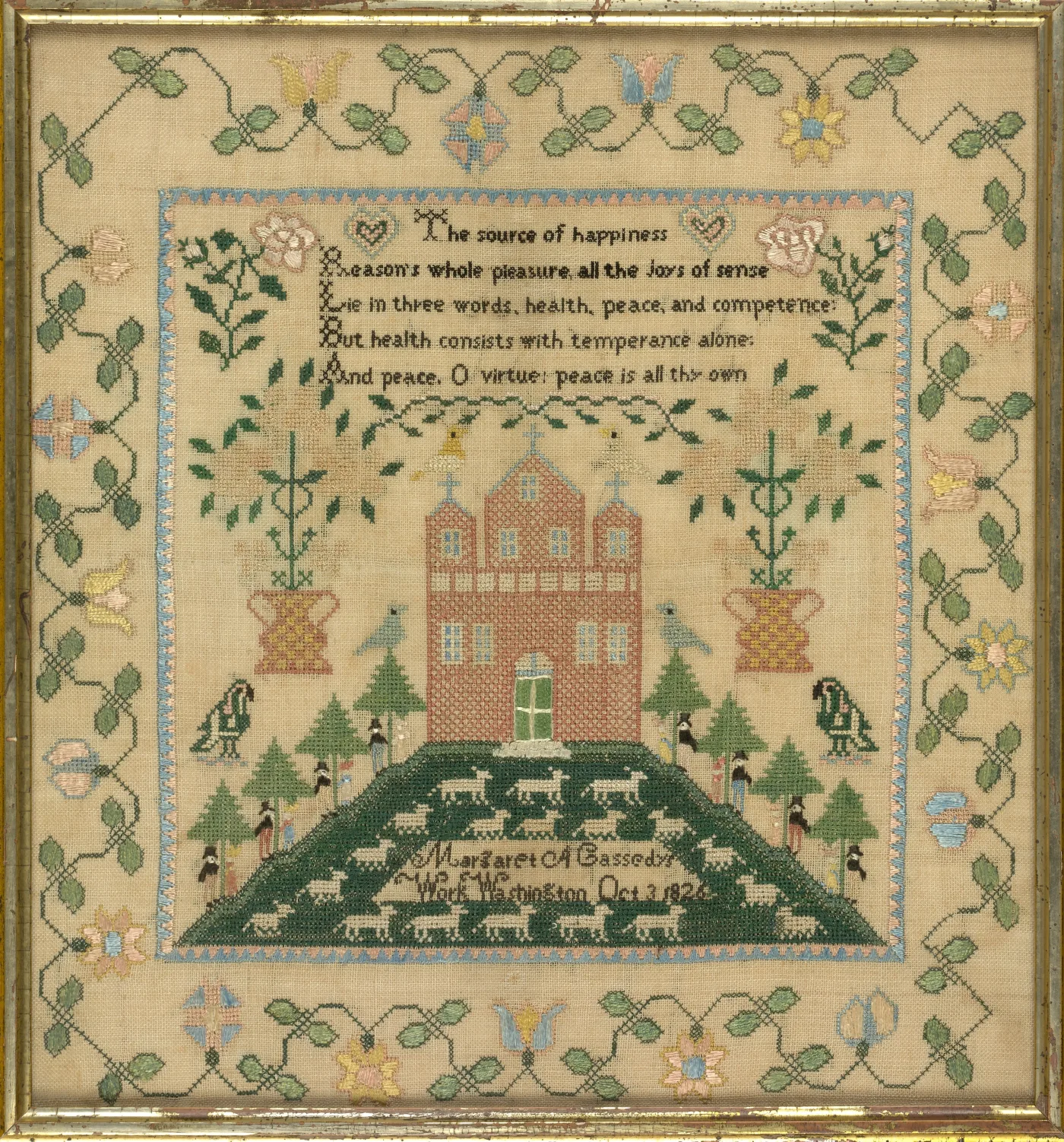
Table of Contents
What “No Cross, No Crown” Means, and Why It Dates Nothing
The motto means there is no reward without hardship: no crown of glory without first carrying the cross. It is the title of William Penn's book No Cross, No Crown, written while he was imprisoned in the Tower of London and first published in 1669. The book is one of the chief texts of Quakerism, so the phrase carries a Quaker association, though a motto alone does not prove the girl who stitched it was a Quaker.
For dating, 1669 is the problem. A verse can only tell you the earliest year a sampler could have been made, and almost no sampler you will meet is older than that. The motto also kept going: a German needlework teacher's examination sample dated 1910 is centred on it, and reproduction charts with this motto are sold to cross-stitchers now. So the words fit 1720, 1820, 1910 and last year equally well. If your sampler reads “No Cross, No Crown”, the date has to come from somewhere else, and the rest of this guide shows where.
The One Rule: A Verse Is a Floor, Never a Date
A girl cannot stitch a poem before it is written. So a verse with a known first printing sets a floor: the sampler cannot be older than that year. It sets no ceiling, because popular verses were copied for a century or more.
That gives three possible results when you compare a verse with the stitched date:
- The floor is far below the date (Penn, the psalms, most hymns). The verse is consistent with the date but says nothing about it.
- The floor is close below the date. The verse narrows the earliest possible year and is good supporting evidence.
- The floor is above the date. Something is wrong: the date was misread, the date or verse was added later, or the piece is not what it claims. Stop and look hard at the linen and thread.
Verse Dating Table
Each row gives a verse found on dated samplers, where the text first appeared in print and the floor that sets. The publication dates come from the sources named in each section. The last column is ours: what each verse can actually prove, given how long it stayed in use.
| Verse (first words) | Source and first printing | Floor | Dated samplers carrying it | What it can prove |
|---|---|---|---|---|
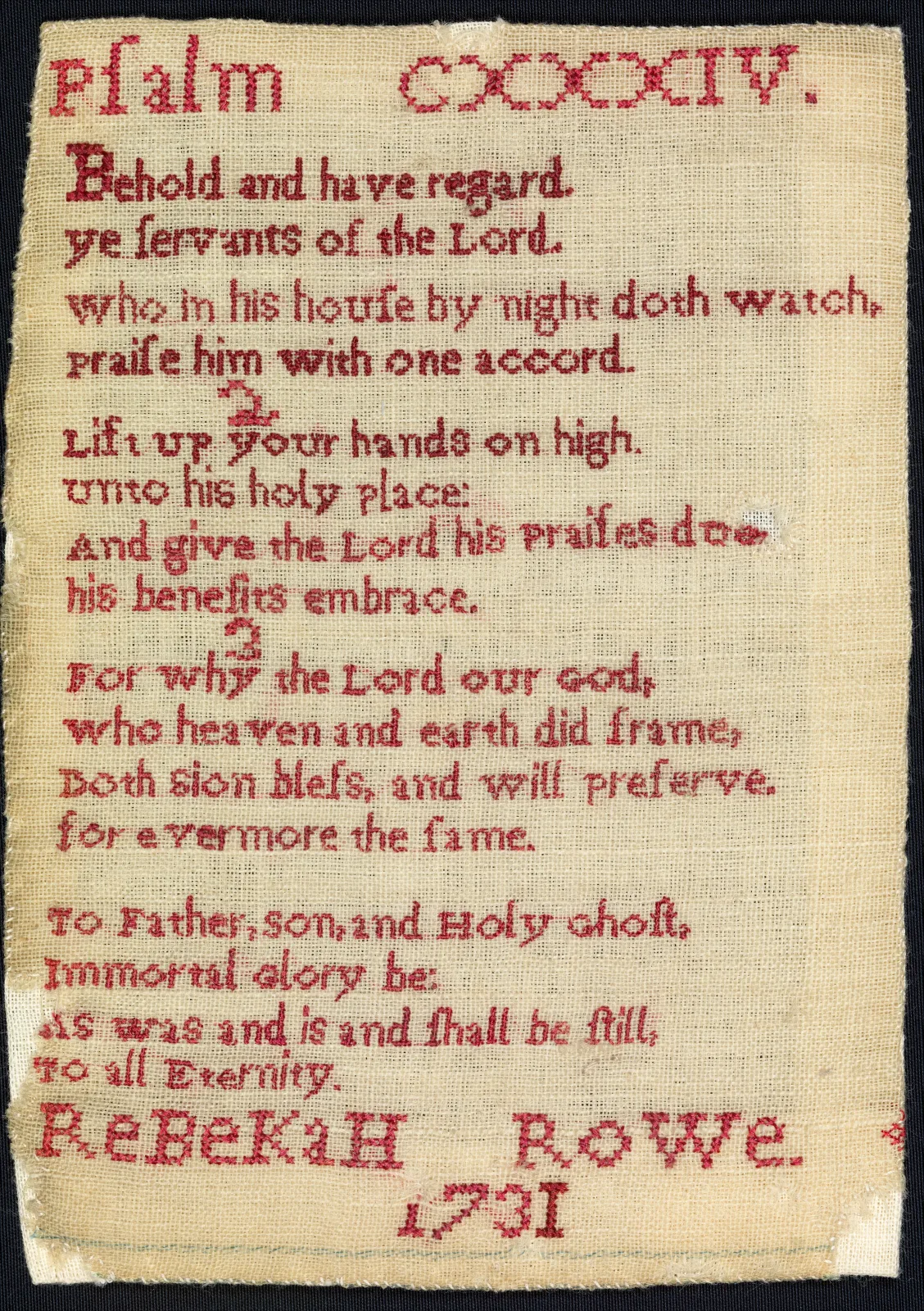
| “Behold and have regard, ye servants of the Lord” (Psalm 134) | William Kethe, Anglo-Genevan psalter, 1561 | 1561 | Rebekah Rowe, 1731 | Nothing. Far older than any sampler you will handle. |
| “No Cross, No Crown” | William Penn, No Cross, No Crown, 1669 | 1669 | German teacher's sample, 1910; modern charts | Nothing. In use from the 17th century to the present. |
| “How doth the little busy bee” | Isaac Watts, Divine Songs, 1715 | 1715 | Mary Brooks, 1792 (Fitzwilliam Museum) | Rules out only a pre-1715 claim. Watts stayed a school text for two centuries. |
| “Reason's whole pleasure, all the joys of sense” | Alexander Pope, An Essay on Man, Epistle IV, 1734 | 1734 | Margaret Cassedy, 1826 | Rules out a pre-1734 date. Useful only on a sampler claimed as early 18th century. |
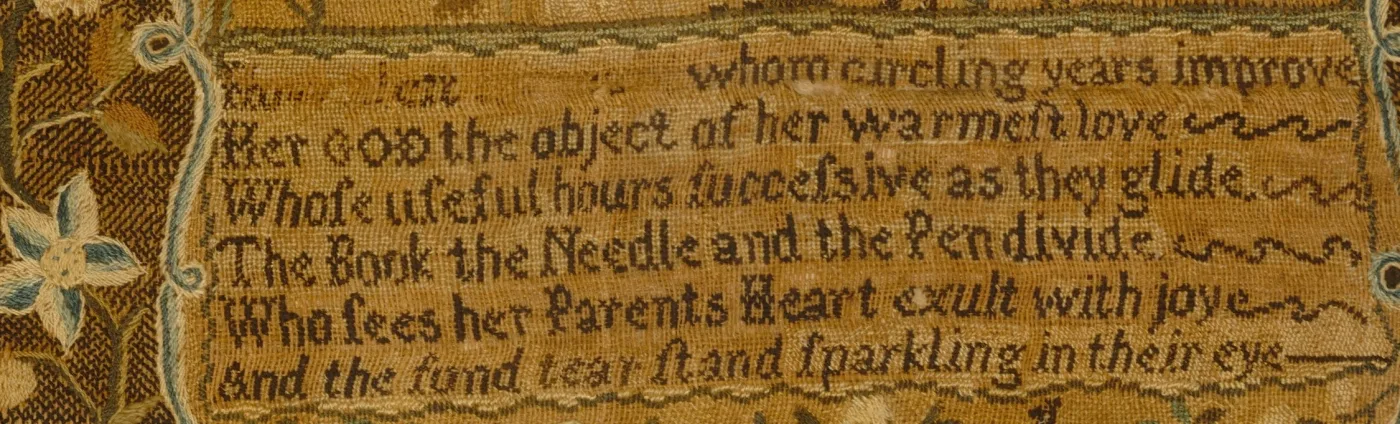
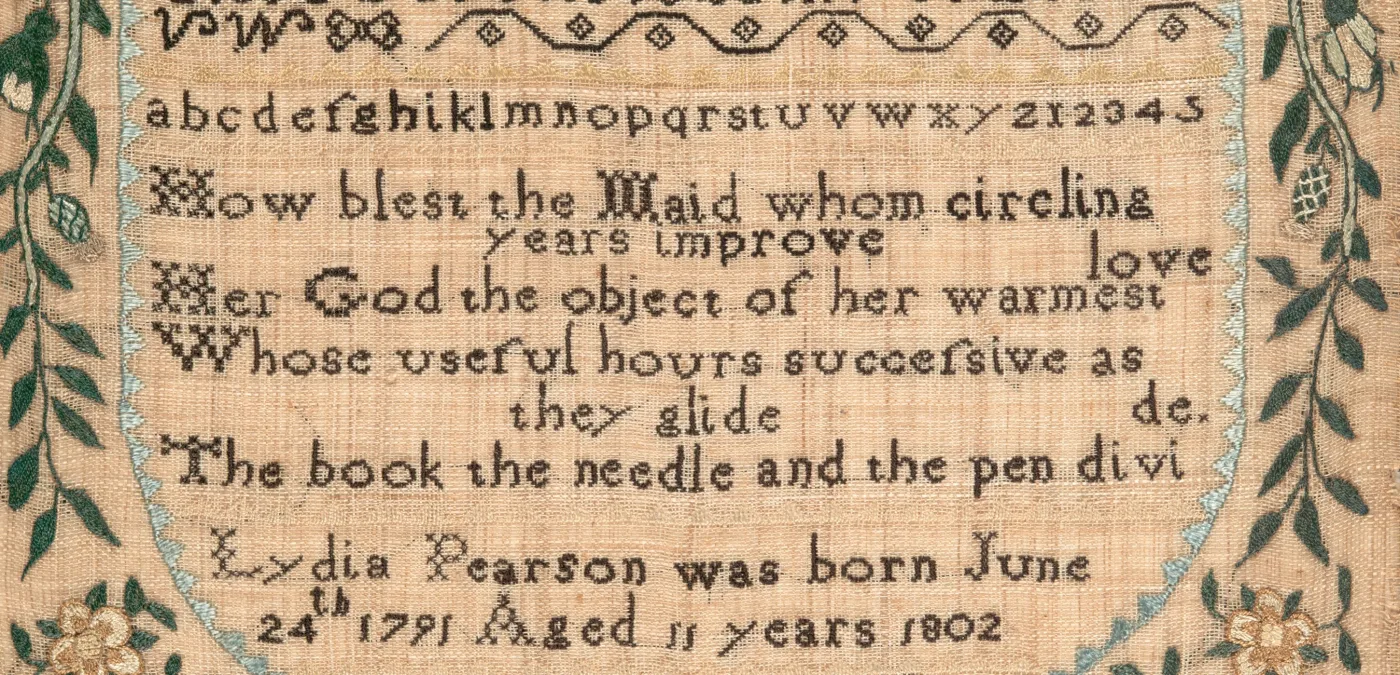
| “How blest the maid whom circling years improve” | No printed source confirmed | none | Rebekah Munro, about 1791; Lydia Pearson, 1802 | Nothing on its own. It moved from sampler to sampler, and the wording changed as it went. |
| “Jesus permit thy gracious name to stand” | Author unproven (credited to John Newton and to Isaac Watts) | none | Catherine Cassady, 1814; Sarah Roberts, 1816 (Fitzwilliam); Eliza Oliver, 1829 | Nothing on its own, but its wording variants can link samplers to the same model. |
| “This work in hand my friends may have” | No printed source confirmed | none | Mary Olorenshaw, 1777 | Nothing. A rhyme passed from hand to hand. |
The pattern is the point. Verses with a printed source give a floor, but the famous ones have floors so early that they rarely do any work. Verses without one give no floor at all. A verse dates a sampler tightly only when it is a recent poem on a sampler that claims to be early, and that is exactly the case where it catches a wrong date.
Copied Verses Travel and Change
Many sampler verses were never taken from a book. A teacher wrote out a model and her pupils copied it, which is why the same lines turn up in different towns, decades apart, with small changes.
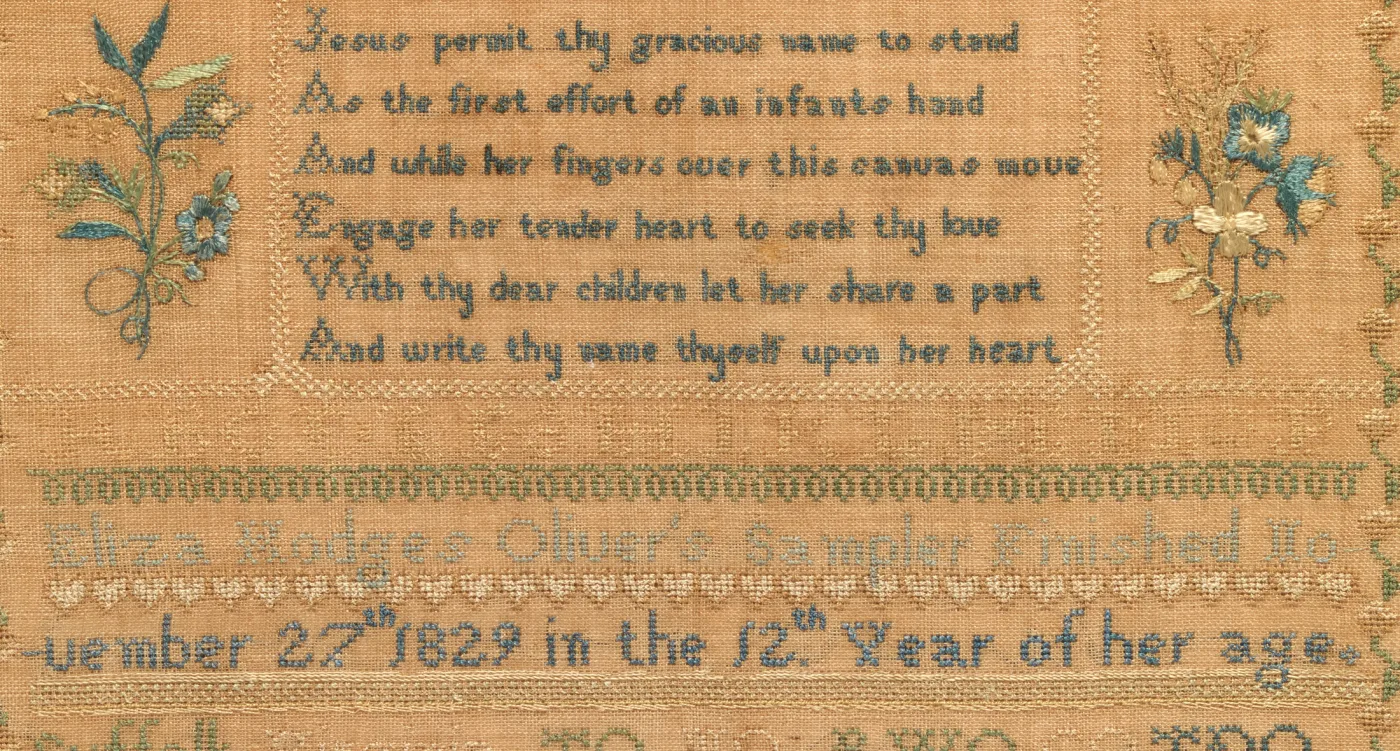
Variants work like fingerprints. Catherine Cassady's 1814 sampler reads “while her fingers over this canvas move” and “with thy dear children let her share a part”. Sarah Roberts's English sampler of 1816 has “on the canvas” and “thy dear Angels may she share”. Eliza Hodges Oliver's sampler, made in Virginia in 1829, has the Cassady wording word for word. Matching variants cannot give you a date, but they can tie an undated sampler to a dated one copied from the same kind of model.

When the Verse Has a Firm Date
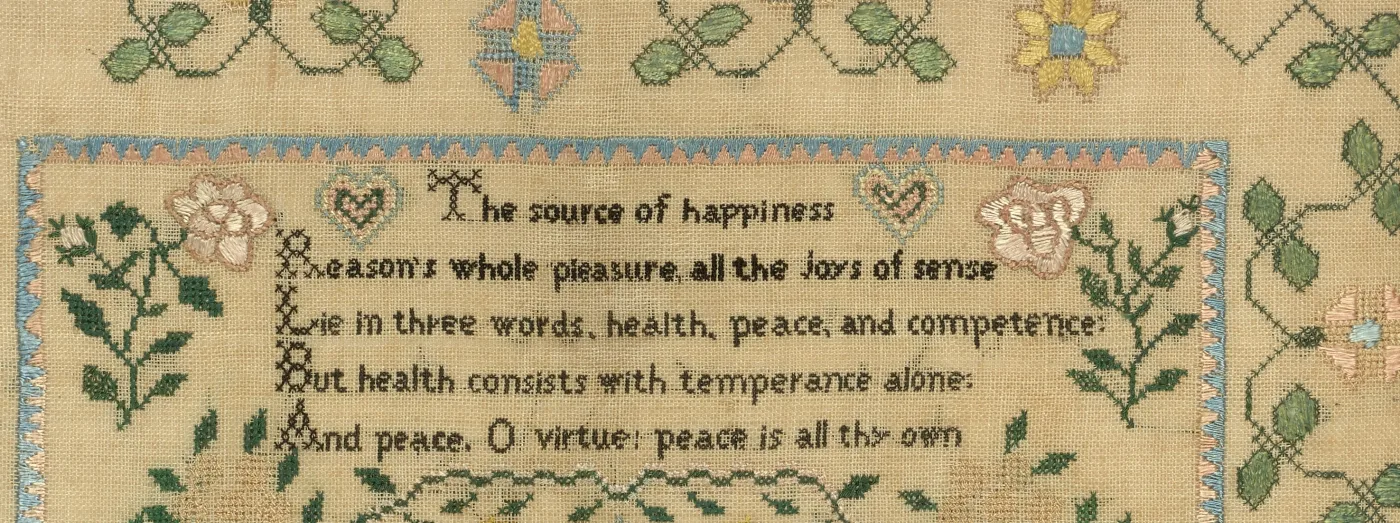
Verses from known poets are the ones worth looking up. Margaret Cassedy's 1826 sampler is headed “The source of happiness” and quotes four lines of Alexander Pope's An Essay on Man, from the fourth epistle, published in 1734. Isaac Watts's Divine Songs appeared in 1715. Mary Brooks stitched its busy bee onto her sampler in 1792, and the book stayed a standard school text for close to two hundred years.
Search the first line of your verse in quotation marks. If a published poet or hymn writer comes back, note the year of first publication and compare it with your date. Hymns and moral poems printed in the 1780s and later are the useful ones, because they set floors close to the dates on most surviving samplers.
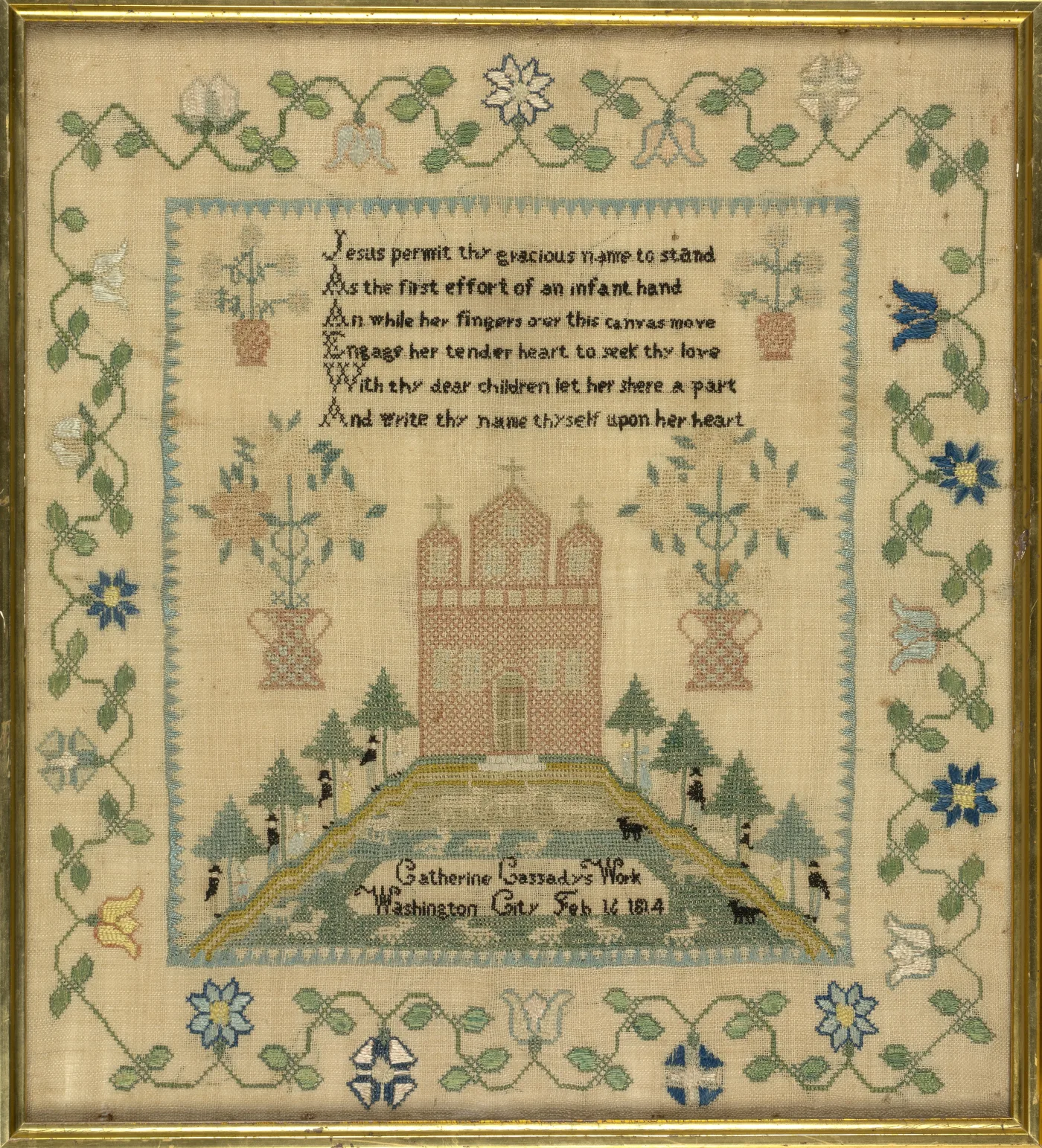
These two samplers were made twelve years apart in the same city, are the same size, and share the same house-on-a-mound design, yet their verses are different: an anonymous prayer in 1814, Pope in 1826. A layout can be copied for years. That is why the verse and the design should be checked separately, then against each other. For the design side, the sampler and needlework identification guide covers the regional styles, motifs and stitches.
The Long s: A Second Clue in the Same Lines
Look at the letters, not just the words. Before about 1800 printers used the long s (ſ, a tall s without the curl at the foot) at the start and middle of words. It rarely appears in good London printing after 1800, and The Times stopped using it in 1803, although some provincial printers kept it into the 1820s.
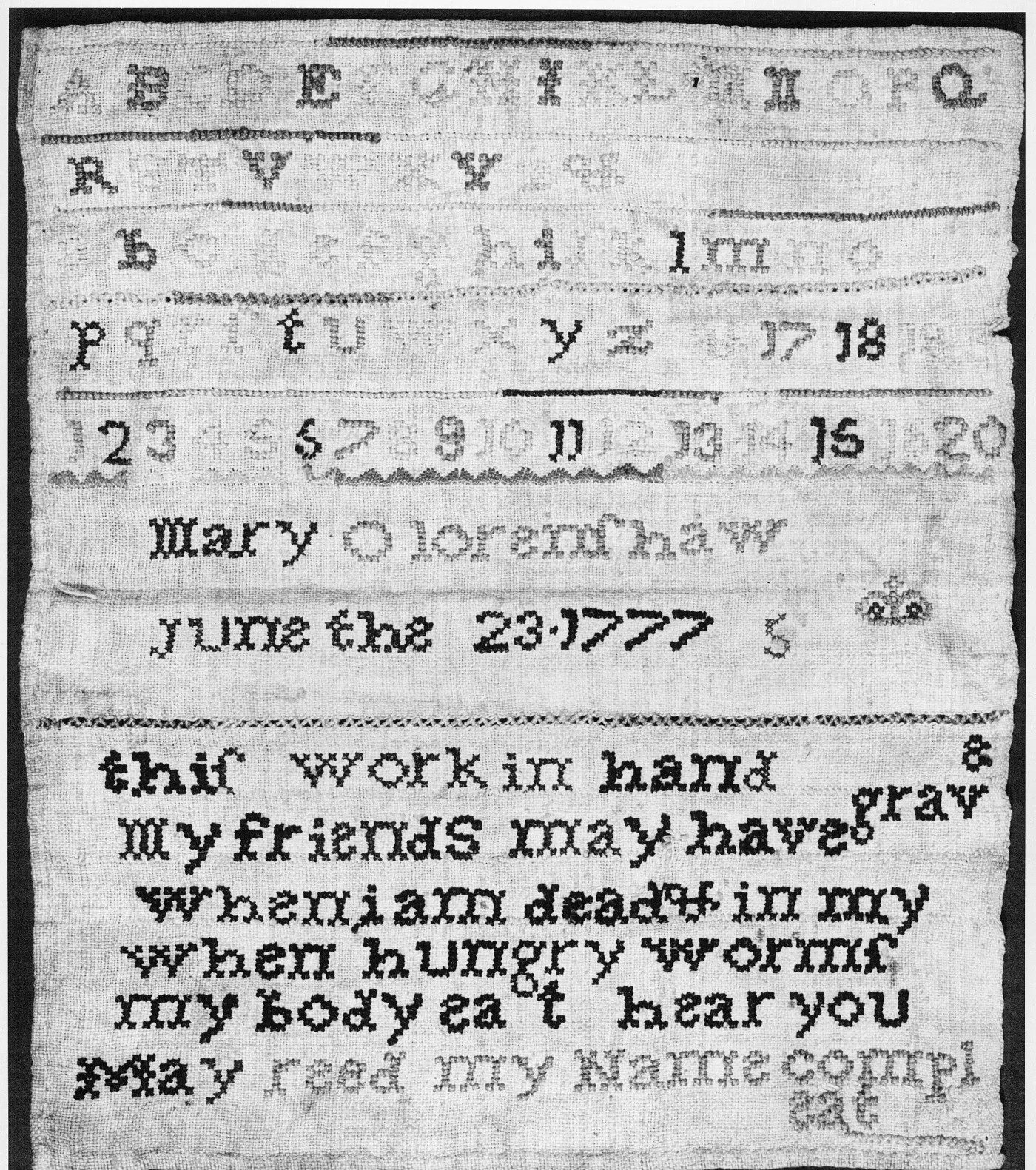
The samplers in this guide follow that pattern. Rowe (1731), Olorenshaw (1777), Munro (about 1791) and Pearson (1802) all use the long s: blefs, thiſ, fparkling, succeſsive. Cassady (1814), Cassedy (1826) and Oliver (1829) do not. Treat it as supporting evidence only. A girl copied her teacher's hand, not a newspaper, so an old-fashioned teacher could pass the long s on for years after printers dropped it. But a long s on a sampler dated 1880 deserves a second look. The same letter matters on antique books and printed documents.
Reproduction Charts Copy the Date Too
Charts made from antique samplers usually reproduce everything on them: alphabets, motifs, verse, and the original girl's name and date. A sampler stitched from such a chart last year can therefore read “1820” and “No Cross, No Crown” truthfully, in the sense that it copies an 1820 piece. The verse and the date are the two features that cannot tell you whether you have the original or a copy.
The materials can. Period samplers were usually worked in silk on linen, and every sampler in this guide is catalogued that way. Old handwoven linen has threads of slightly uneven thickness, and the silk is fine and often faded. A modern copy is usually worked in stranded cotton on a perfectly even modern fabric, often with a fresh, unfaded back. Turn the sampler over if the frame allows. The back shows the original colours and how the thread was carried. The textile identification guide explains how to tell linen from cotton under a glass, and the authentication and provenance guide covers what to ask a seller.
Frequently Asked Questions
What does No Cross, No Crown mean on a sampler?
It means that there is no reward without bearing hardship: no crown of glory without first carrying the cross. The phrase is the title of William Penn's book No Cross, No Crown, written while he was imprisoned in the Tower of London and first published in 1669. It is one of the chief texts of Quakerism, which is why the motto carries a Quaker association.
Does a No Cross, No Crown motto prove a sampler is old?
No. The phrase has been in print since 1669, it was still being stitched on needlework in the twentieth century, and reproduction charts carrying it are sold today. The motto rules out nothing for any sampler you are likely to meet, so the date has to come from the linen, the thread and the way the piece is worked.
Can a sampler verse be later than the date stitched on it?
Not if both are genuine. A girl cannot copy a poem before it exists, so a verse first printed after the stitched date means something is wrong: the date has been misread, altered or added, or the verse is later work. Check the source of the verse before trusting the date.
Why do samplers have spelling mistakes and broken words?
They were stitched by schoolgirls copying a verse line by line (Lydia Pearson was eleven, Eliza Oliver in her twelfth year), and they often ran out of space. Lydia Pearson's 1802 sampler splits divide into divi and de, and Mary Olorenshaw's 1777 sampler carries grave and complete onto the line above or below. These slips are normal in period work.
How can I tell if my sampler is a modern reproduction?
Look at the ground and the thread. Period samplers were usually worked in silk on handwoven linen, whose threads are slightly uneven in thickness. A sampler stitched from a modern chart is usually worked in stranded cotton on a perfectly regular modern evenweave, and the chart copies the original's name and date, so the date on it proves nothing.
The Short Version
Write out your verse, search its first line, and find its first printing. If that year is far below your stitched date, as with “No Cross, No Crown” (1669), the verse says nothing either way. If it is close below, it supports the date. If it is above, the date is wrong. Then check the letters for the long s, and the linen and thread for age, because a reproduction copies the verse and the date with everything else.
For the wider story of samplers and needlework, see the sampler guide. Related needlework includes quilts and textile art and American folk art.