
Antique & Vintage Wristwatch Identification Guide: Movements, Cases, References, and Dating
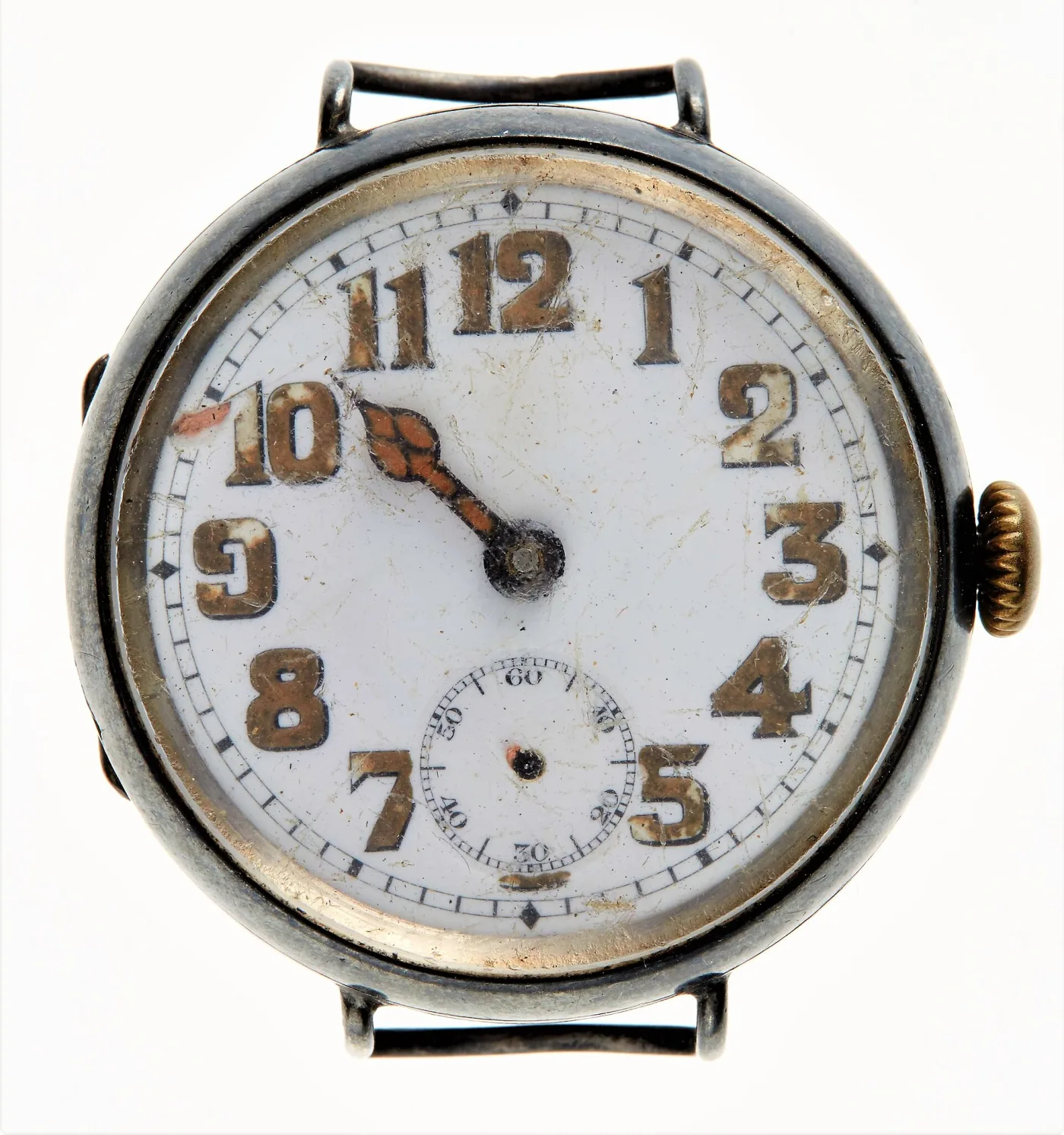
The wristwatch is a twentieth-century object. Where the antique pocket watch was the standard portable timekeeper of the eighteenth and nineteenth centuries, the wristwatch — a small movement mounted in a case with lugs, worn on a strap or bracelet around the wrist — emerged from military necessity around the First World War and displaced the pocket watch almost completely by 1930. In little more than a hundred years it passed through hand-wound movements, the self-winding rotor, the electric and tuning-fork era, the quartz revolution of the 1970s, and the mechanical renaissance that followed. Each of those phases left dating fingerprints in the movement, the case, the dial, and the paperwork.
Identifying a vintage wristwatch means answering a fixed sequence of questions in order. What is the movement — manual wind, automatic, electric, tuning fork, or quartz — and what caliber number is stamped on it? What is the case: material, back type, and the crucial reference number engraved inside or between the lugs? Who made it, and is the name on the dial the manufacturer or a private-label retailer? What do the serial number and reference number date the watch to? And, most important of all in a market awash with altered watches: is the dial original, is the movement correct to the case, and do all the parts belong together?
This guide walks through the whole process. It covers the history of the wristwatch from the early wristlet and trench watch through the quartz crisis; the anatomy and vocabulary you need to read auction catalogs; the movement types and how to read a caliber; case materials, backs, and reference numbers; dials, hands, and luminous material as dating tools; the major manufacturers and their signatures; the private-label and school-watch trap; serial-number dating; the enormous problem of redials, franken watches, and service parts; condition grading; the working valuation framework; and the care of watches you intend to keep or wear. By the end you should be able to open an unknown wristwatch, read its movement and reference, and place it by decade, maker, and grade within a few minutes.
Table of Contents
- A Short History of the Wristwatch
- Anatomy and Vocabulary
- Movement Types
- Reading the Movement and Caliber
- Cases, Backs, and Reference Numbers
- Case Materials and Hallmarks
- Dials, Hands, and Numerals
- Luminous Material as a Dating Tool
- Crystals and Their Dating Clues
- Complications and Watch Types
- Major Makers and Their Signatures
- Private-Label and School Watches
- Dating by Serial and Reference
- Redials, Frankens, and Service Parts
- Authenticity Checks
- Condition Assessment
- What Drives Value
- Care, Service, and Wearing
- Common Beginner Mistakes
- Frequently Asked Questions
A Short History of the Wristwatch
Small watches were occasionally worn on the wrist by women in the nineteenth century — Patek Philippe made a wrist-worn watch for a Hungarian countess in 1868 — but as a functional object the wristwatch is a product of the early twentieth century, and specifically of the military. Officers found that a watch strapped to the wrist could be read in the field without fumbling in a pocket, and by the Boer War and the First World War soldiers were converting small pocket watches (or buying purpose-made "wristlets") by soldering wire lugs to the case and fitting a leather strap.
The Trench Watch (c. 1914–1920)
The classic First World War wristwatch — the "trench watch" — is a small (often 30–35 mm) silver or nickel case with wire lugs, a porcelain-enamel dial with bold luminous Arabic numerals, a subsidiary seconds dial at six o'clock, a hinged or snap back, and frequently a hinged "shrapnel guard" grille over the crystal. The movement is a small pocket-watch caliber. Trench watches are the direct ancestor of every wristwatch that followed and are widely collected; many are related to the broader field of trench art and military souvenirs from the same conflict.
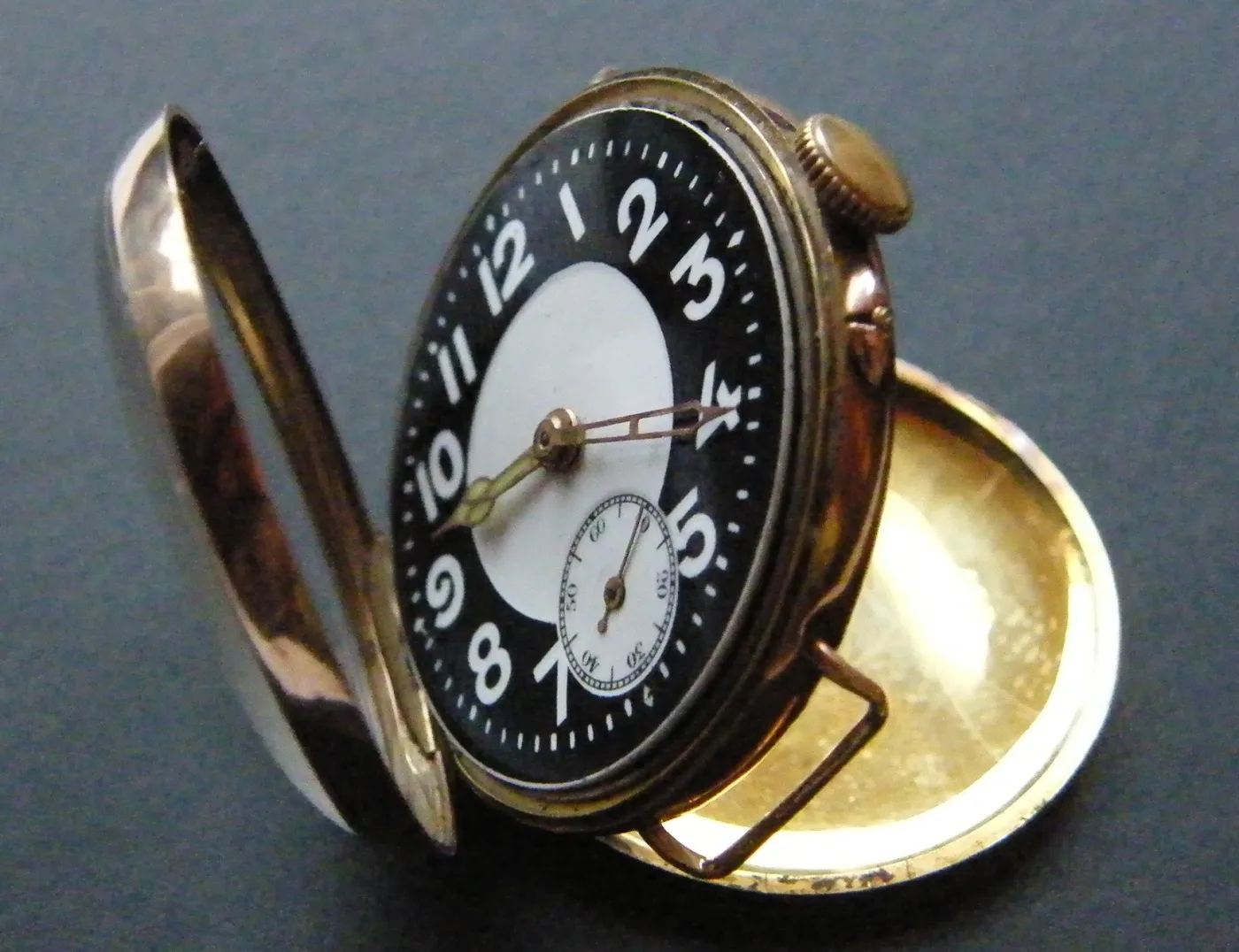
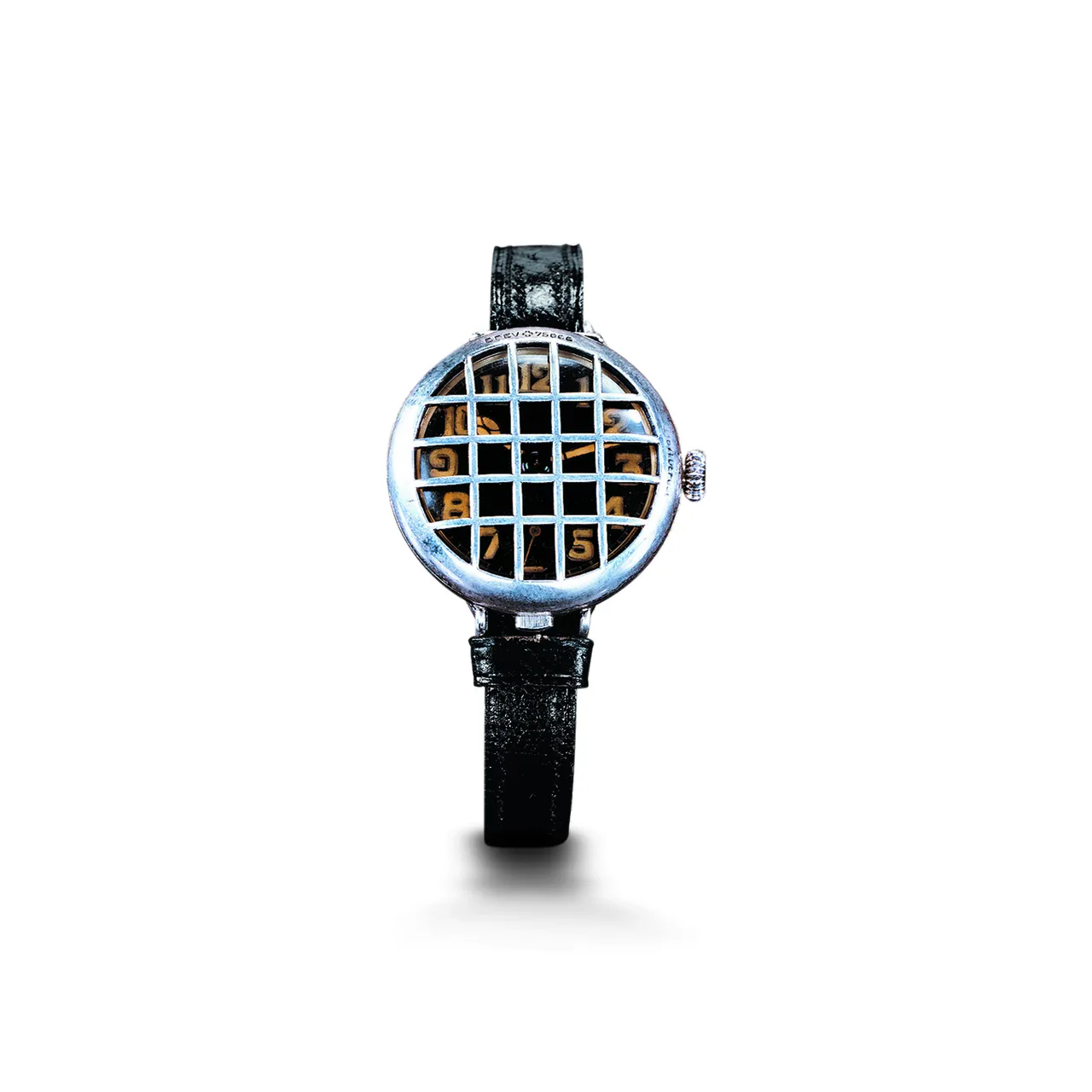
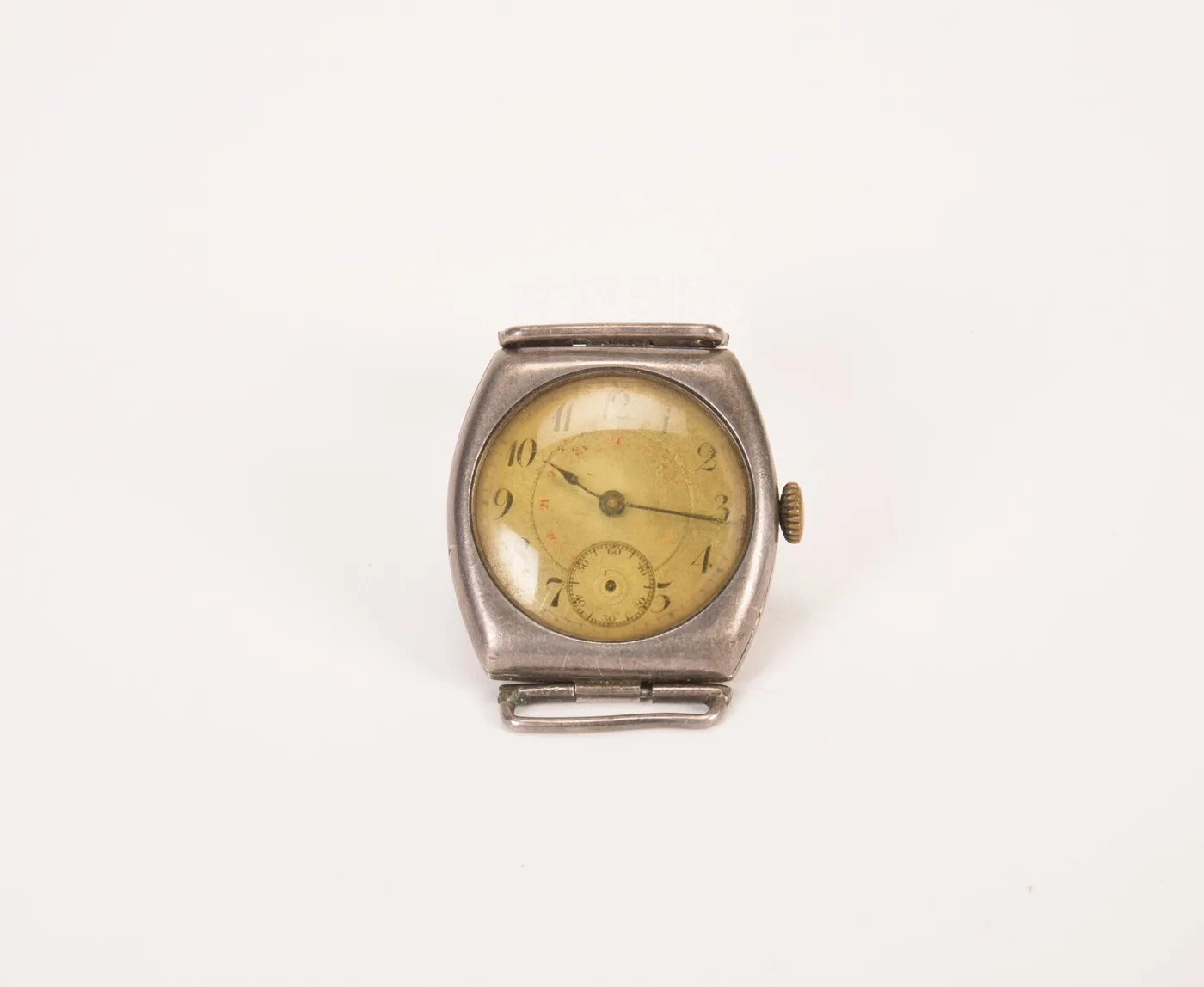
Both of these solve the same problem. A wristwatch crystal in 1916 was glass, the wrist is exactly where a hand gets knocked, and the standard remedy was a metal cover. The full hinged lid is the older solution, inherited from the pocket watch, and it has to be opened before the time can be read; the pierced guard is the purpose-built wristwatch solution and does not. Guards are very often missing today, so look along the bezel for an empty pair of hinge lugs — that tells you a guard was once fitted and lost, which is a completeness question rather than a fault, and it changes what the watch should cost.
The 1920s and 1930s: Establishment and Art Deco
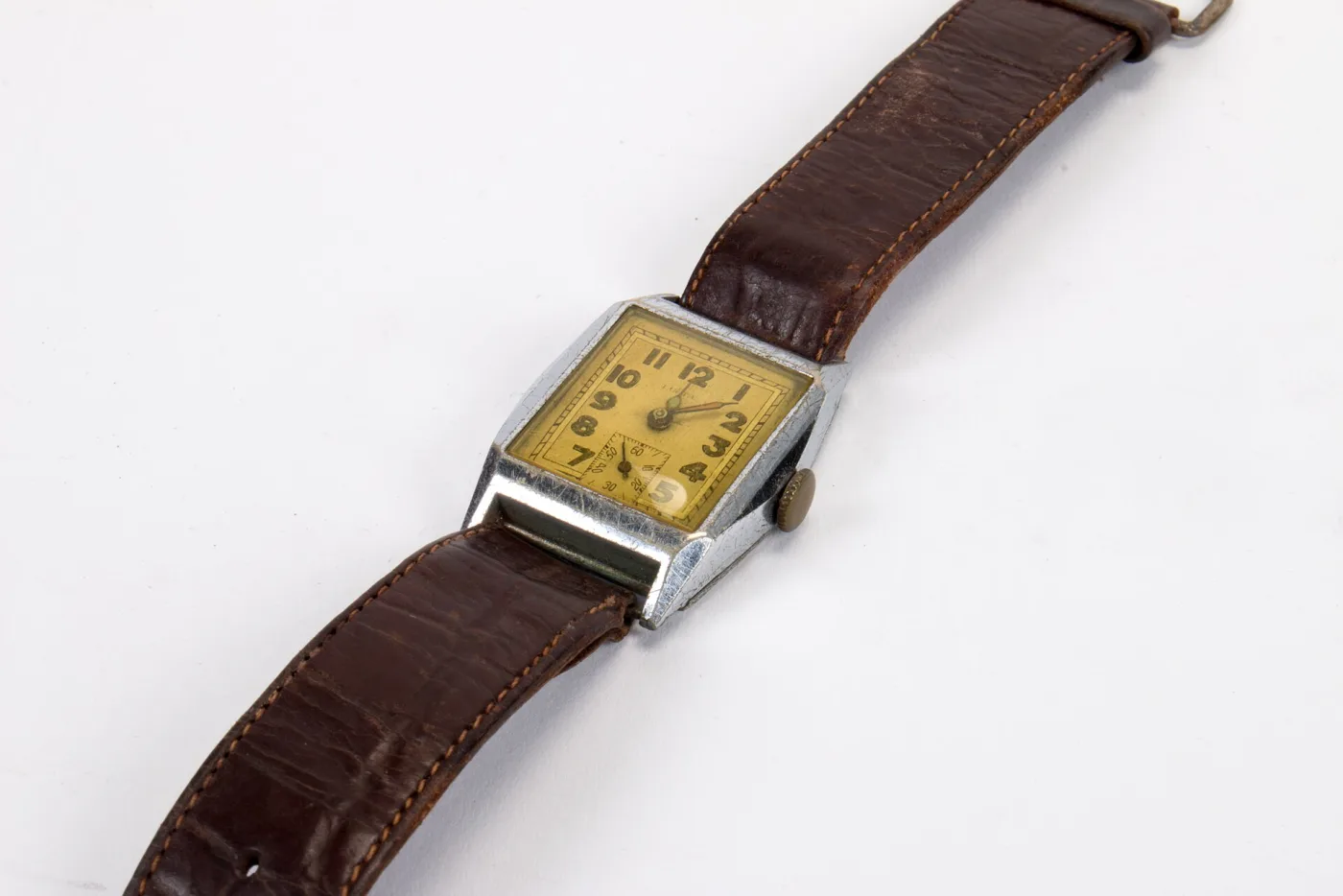
Through the 1920s the wristwatch shed its pocket-watch origins and became a designed object in its own right. Cases grew rectangular, tonneau (barrel-shaped), and cushion-shaped as often as round; the Cartier Tank of 1917 and the Art Deco taste for geometry produced some of the most collectible dress watches ever made. This is the great age of the Art Deco wristwatch, with stepped cases, enamel bezels, and elegant fired-porcelain or silvered dials.
Automatics and the Post-War Boom (1930s–1960s)
John Harwood patented a practical self-winding wristwatch in 1923–24, and Rolex's Oyster (1926, waterproof case) and Perpetual (1931, full-rotor automatic) made the robust, water-resistant, self-winding wristwatch the standard. The post-war decades were the golden age of the mechanical wristwatch: tool watches (divers, pilots, chronographs), elegant dress watches, and the enormous mid-market of gold-filled American and Swiss watches that fill estate sales today.
The Quartz Crisis (1969–1980s)
The Seiko Astron of 1969 was the first commercial quartz wristwatch, accurate to a fraction of the best mechanical watches at a fraction of the cost. Quartz movements nearly destroyed the Swiss mechanical industry through the 1970s. For the collector this is a hard dividing line: pre-quartz mechanical watches and high-end mechanical survivors are collectible; the vast majority of mass quartz watches from the 1970s onward are not, with important exceptions (early quartz, tuning-fork Accutrons, and certain design-icon quartz pieces).
The Mechanical Renaissance (1990s–present)
From the 1990s the mechanical wristwatch returned as a luxury and enthusiast object, and the vintage market matured into one of the largest and most sophisticated in all of collecting — with reference-level scholarship, dedicated auctions, and prices for the best pieces reaching into the millions. That maturity is exactly why identification discipline matters: the more a reference is worth, the more incentive there is to alter lesser watches to resemble it.
Anatomy and Vocabulary
Wristwatch terminology is precise, and knowing the words makes catalog and forum reading immediate.
Case
The metal shell holding the movement. Composed of a middle (the band carrying the lugs), a bezel (the ring around the crystal), and a back (removable or hinged). Case shape — round, cushion, tonneau, rectangular, tank, oval — is a strong period clue.
Lugs
The projections at twelve and six o'clock that hold the spring bars and strap. Early watches have soldered wire lugs; later watches have integral machined lugs. Lug width (the distance between them, in millimeters) is a key spec for strap fitting.
Crown
The winding and setting knob on the case side (usually at three o'clock). A screw-down crown (which threads into the case for water resistance) is a Rolex Oyster innovation and a dating and model clue.
Movement / Caliber
The mechanism. The caliber is the specific movement model, identified by a number stamped on the movement (e.g., Omega 30T2, Rolex 1570, ETA 2824). Reading the caliber is central to identification.
Reference Number
The manufacturer's model number for the case/watch, engraved inside the case back or between the lugs. The reference identifies the exact model and is the single most important number for high-grade watches.
Serial Number
A production number, on the movement (most makers) and sometimes between the lugs on the case. Used to date the watch.
Dial
The face. Signed with the maker (and sometimes a retailer). Dial originality is the largest single value factor in vintage watches.
Subsidiary Seconds vs. Center Seconds
Older watches show a small seconds dial (usually at six o'clock); later watches show a center (sweep) seconds hand from the middle. The transition is a rough dating clue — center seconds became common from the 1940s.
Bracelet vs. Strap
Watches came on leather straps or metal bracelets. Original signed bracelets (Rolex Oyster, Jubilee; Gay Frères for many brands) add substantial value and are frequently replaced.
Movement Types
The movement type is the first great division and an immediate rough dating tool.
Manual Wind (Hand Wind)
The oldest and simplest type: the mainspring is wound by turning the crown. All watches before the 1930s and the great majority of dress watches through the 1960s are manual wind. A manual movement has no rotor visible through the back.
Automatic (Self-Winding)
A weighted rotor winds the mainspring from wrist motion. Full-rotor automatics (a semicircular weight sweeping 360 degrees) are standard from Rolex's 1931 Perpetual onward; "bumper" automatics (a weight that swings between two spring buffers over a limited arc, giving a characteristic soft bump on the wrist) are a 1940s–1950s transitional type and a nice dating clue. A rotor visible through a display back or under the case back indicates an automatic.
Electric and Tuning Fork (1950s–1970s)
The Hamilton Electric (1957) used a battery and electromagnet to drive a balance; the Bulova Accutron (1960) used a tuning fork vibrating at 360 Hz, producing a distinctive hum instead of a tick and a smoothly sweeping seconds hand. These electromechanical movements are a specific, collectible mid-century category — the Accutron "Spaceview" with its exposed movement is iconic.
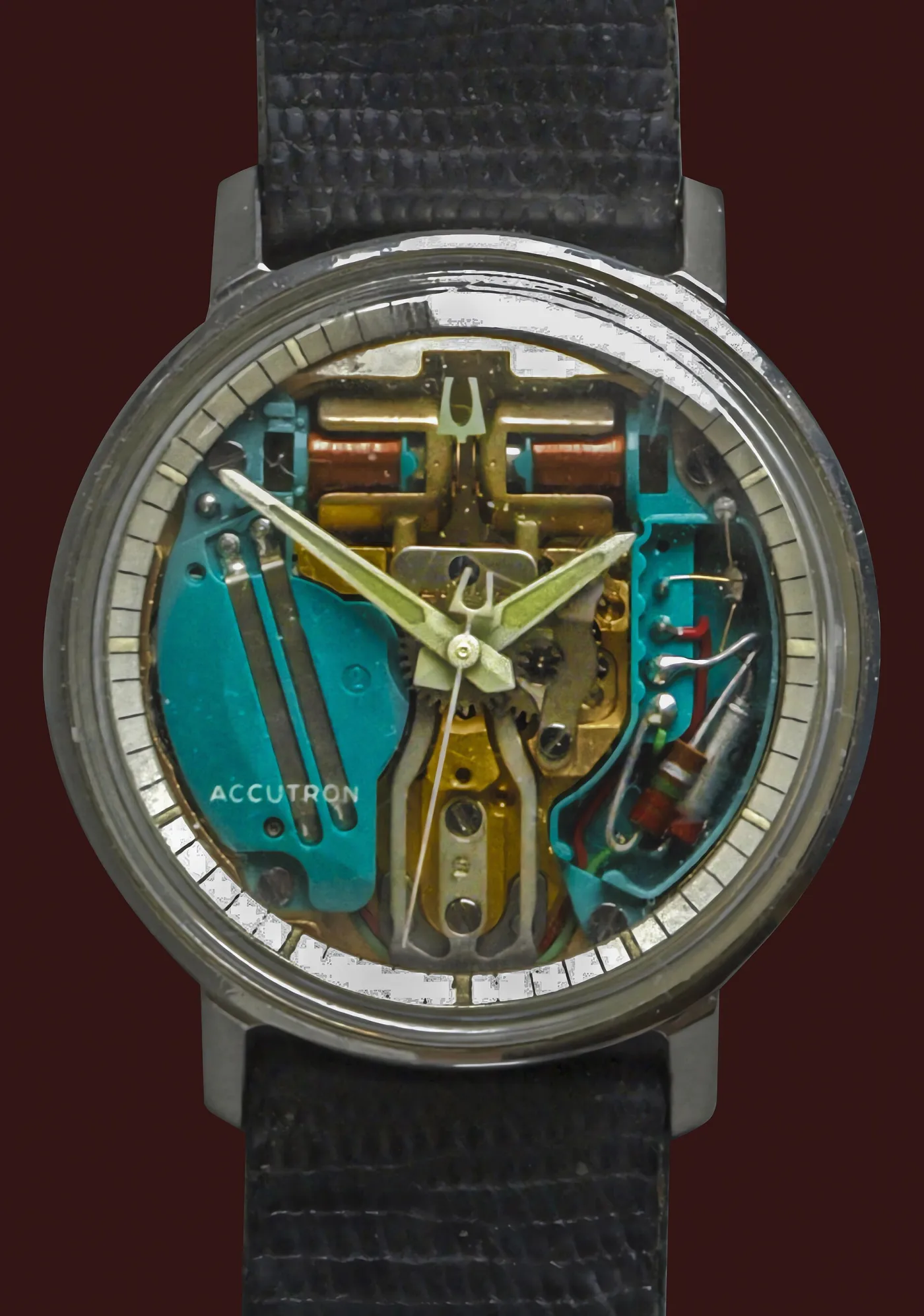
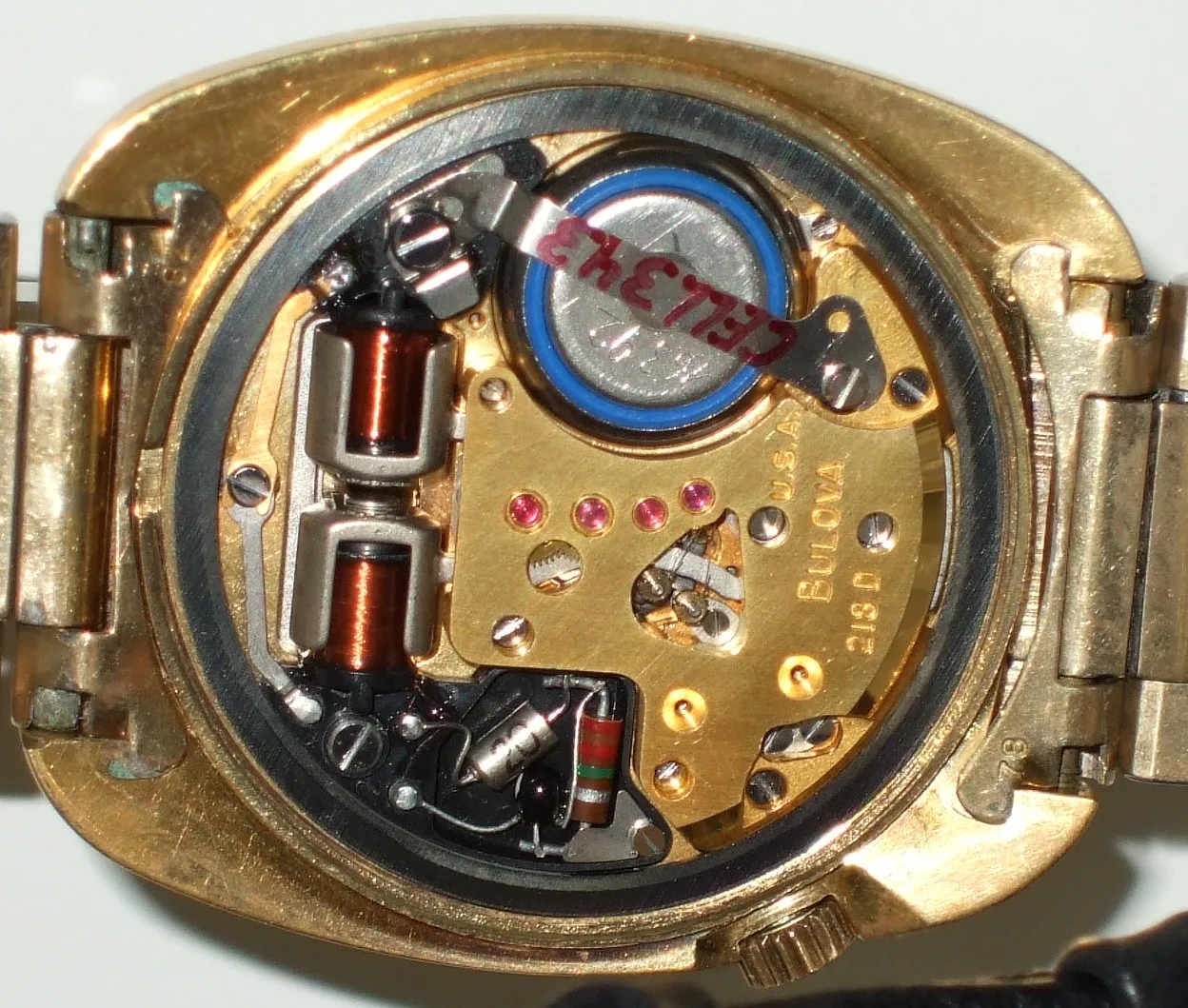
These are the quickest identification in vintage watchmaking, because nothing else looks like them: two copper coils flanking a metal fork, a battery, and neither a balance wheel nor a rotor anywhere. In use they hum rather than tick, and the seconds hand glides instead of stepping. The number stamped on the plate is the thing to record — Bulova's 214, 218 and 2181 are different movements with different service parts, different setting arrangements and different values, and once the back is on there is no other reliable way to tell them apart. Treat an exposed movement with caution, though: many "Spaceview" watches are later conversions made by removing an ordinary dial, so a visible tuning fork does not by itself make a watch a factory Spaceview.
Quartz (1969–present)
A battery powers a quartz oscillator; the seconds hand usually ticks once per second. Most quartz watches are not collectible, but early quartz (Seiko Astron, Omega Beta 21) and certain design pieces are. A quartz watch has a battery, a circuit board, and typically a once-per-second tick.
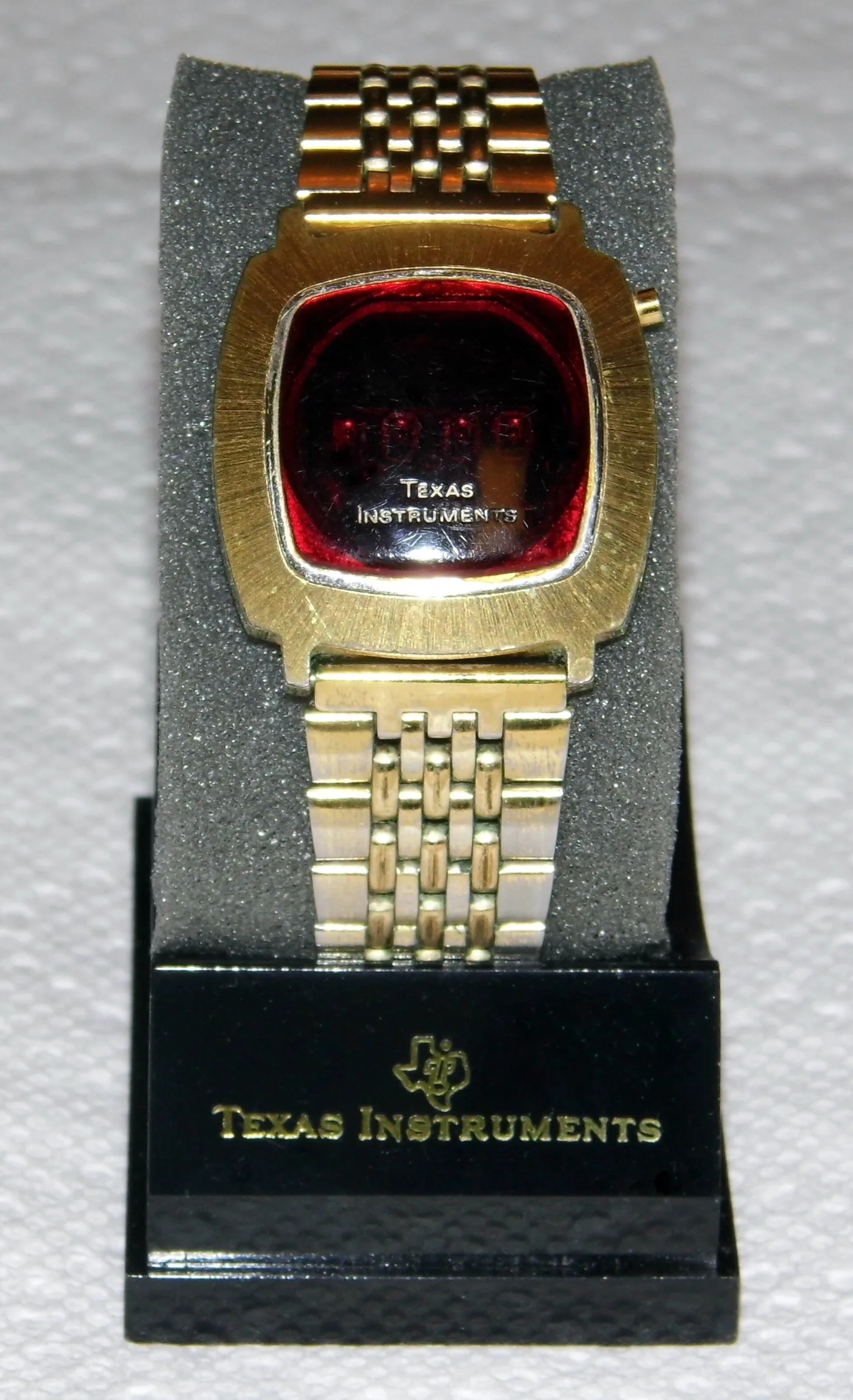
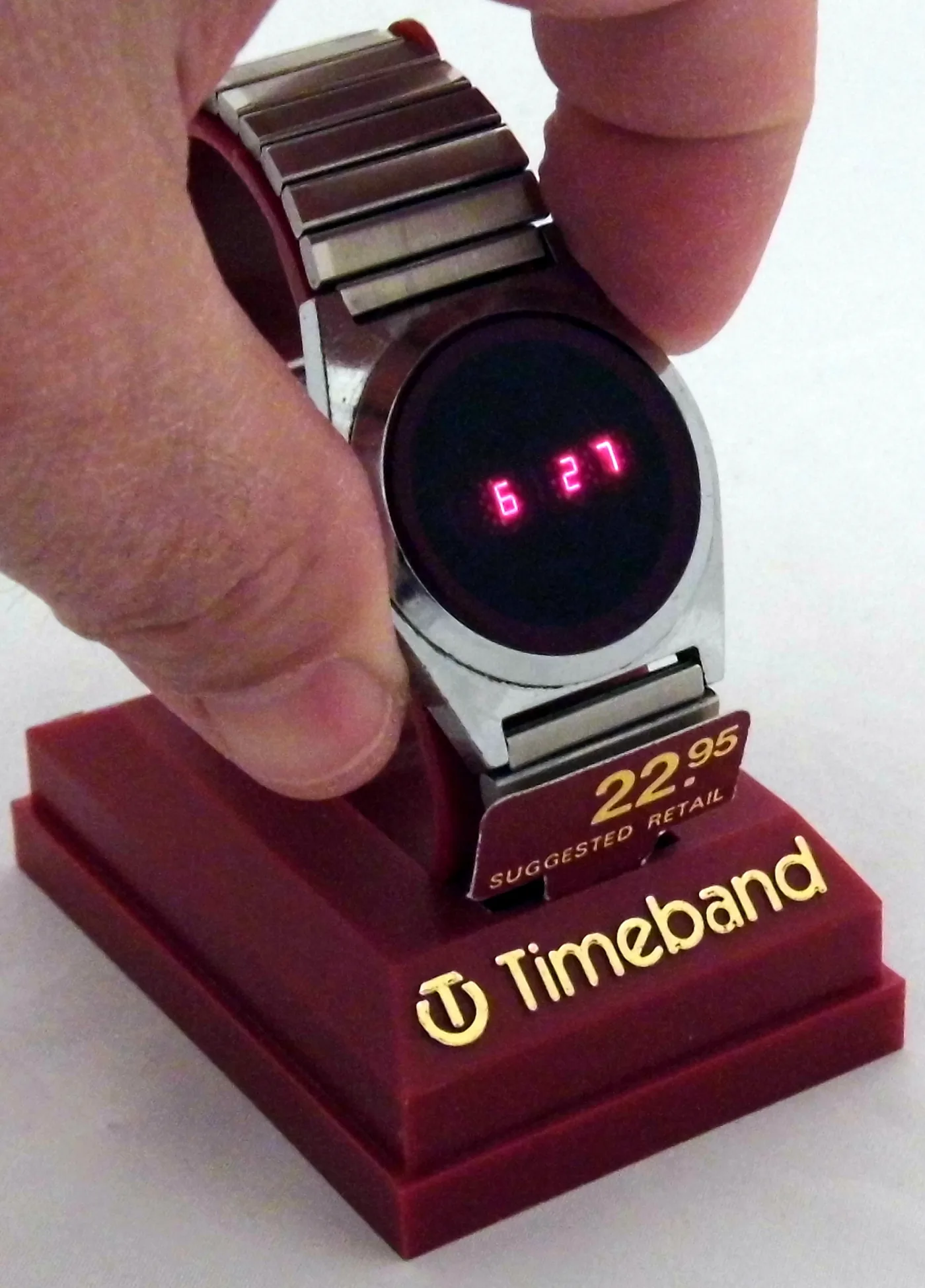
This is what the quartz crisis looked like on the shop counter. Both watches were made by American chip companies with no watchmaking history whatever, and the figure on the display card carries the argument — no Swiss mechanical watch could be built and sold anywhere near that price. Three things identify the type: a dark red filter crystal, because an LED display is invisible until it is lit and is read by pressing a button (which is why so many are found apparently dead rather than broken); an integrated bracelet with no conventional lugs; and a back that opens to a battery and a board rather than to a movement. Most 1970s digital watches are worth very little, but early examples and oddly-badged ones like these are a real collecting niche.
How to Tell Them Apart Quickly
Listen and look: a smooth high-frequency tick and a rotor = mechanical automatic; a tick with no rotor = manual; a hum and gliding seconds = tuning fork; a once-per-second tick with a battery = quartz. This four-way triage places most watches in seconds.
Reading the Movement and Caliber
Opening the case back to read the movement is the single most informative identification step for a vintage watch — more decisive than the dial, which can be swapped. Use a proper case-back tool (a case knife for snap backs, a friction-fit ball or a case wrench for screw backs) and work on a soft surface; never pry with a kitchen knife.
The Caliber Number
Stamped on the movement (often on the bridge or main plate). The caliber identifies the exact movement and, through published references, its production period and the manufacturer. High-end makers made their own calibers (Rolex 1030/1520/1570, Omega 30T2/55x/56x, Patek's 12-ligne series); many mid-market brands used bought-in ébauches.
Ébauche Movements and Who Really Made It
An ébauche is a movement blank supplied by a specialist maker (A. Schild, FHF, ETA, Valjoux, Peseux, Landeron, and later the ETA/Unitas consolidations) and finished under a brand name. A great many "brand" watches run bought-in ébauches; identifying the ébauche caliber (via the movement's bridge layout and any maker's mark or caliber number) tells you what the watch actually is regardless of the dial name. This is essential for valuing mid-market vintage watches correctly.
Jewel Count and Adjustments
As with pocket watches, jewel count (15, 17, 21, 25+) and adjustment markings ("adjusted to temperature and 5 positions," "chronometer") indicate grade. Higher jewel counts and chronometer certification grade the movement up.
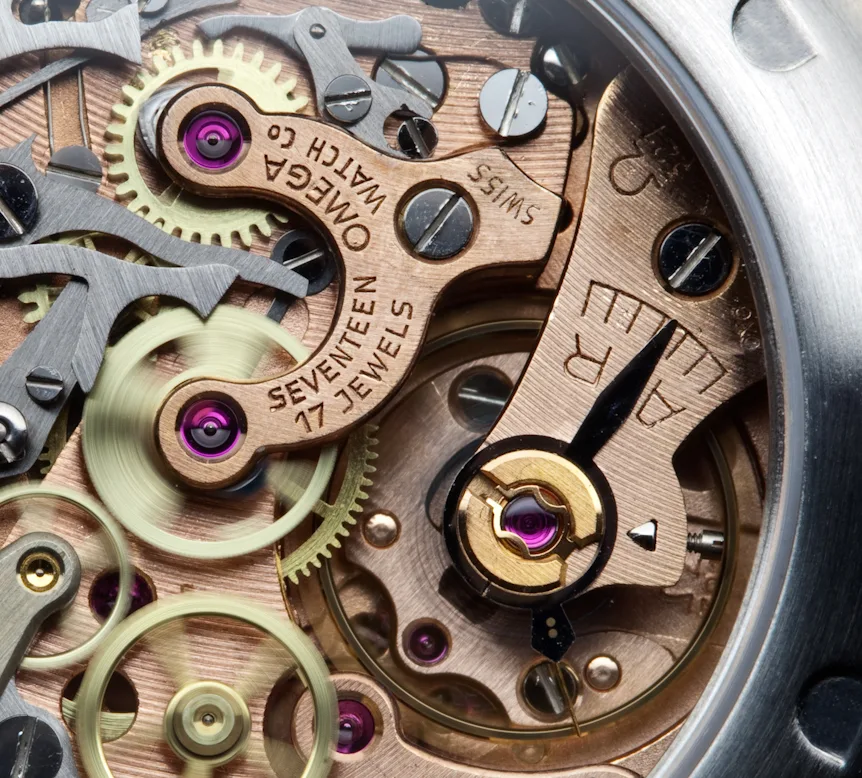
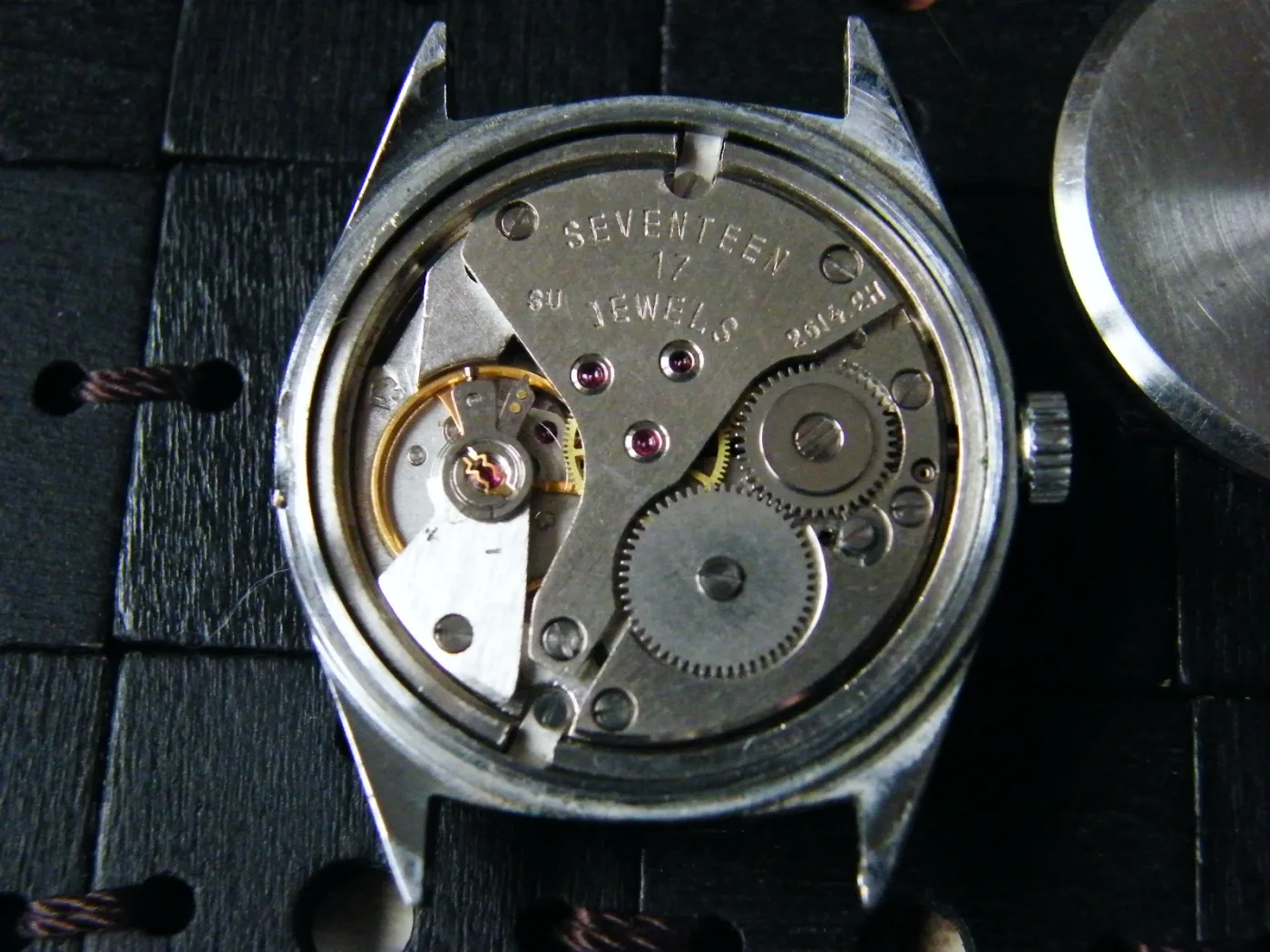
Almost everything needed to identify a movement is engraved on it, and it sits in the same three places on watches separated by decades and continents: the maker's name, the jewel count, and the caliber number, spread across the bridges. Copy all three exactly, suffix letters included — 2614.2H is a different movement from 2614, and Omega's 321 and 861 sit behind dials that look identical. One warning about the middle number: jewel count grades a movement but barely dates it. Seventeen jewels was the standard mid-market specification for roughly half a century, which is why both of these carry it despite having almost nothing else in common.
Movement Finishing
Côtes de Genève (striping), perlage (circular graining), blued screws, gold-filled engraving, and a decorated rotor indicate a higher grade; a plain nickel movement is a workhorse. Finishing quality is one way experts sort a fine caliber from a plain one.
Import and Case Marks
Movements and cases carry import marks (for the destination market), case-maker marks, and (on precious metal) assay hallmarks. British import hallmarks in particular carry a date letter that dates the case precisely — a powerful cross-check on movement dating.

Cases, Backs, and Reference Numbers
After the movement, the case is the second identification target — and the reference number engraved inside it is, for high-grade watches, the most important single fact about the watch.
Back Types
- Hinged back: earliest type; the back swings open on a hinge. Common on trench watches and 1920s–1930s cases.
- Snap back: a press-fit back removed with a case knife in a lug notch. The dominant mid-century type for dress watches.
- Screw back: threads into the case for water resistance; requires a case wrench. Standard on tool and water-resistant watches (Rolex Oyster and its imitators).
- Display back: a glass or crystal back showing the movement; almost always modern or luxury.
The Reference Number
Engraved inside the case back or (Rolex, Patek) between the lugs at twelve o'clock, under the bracelet. The reference identifies the exact model — case shape, material, dial configuration — and is how collectors and catalogs name a watch (e.g., Rolex 1675, Omega 2998, Patek 570). Two watches with the same movement but different references are different models with potentially very different values.
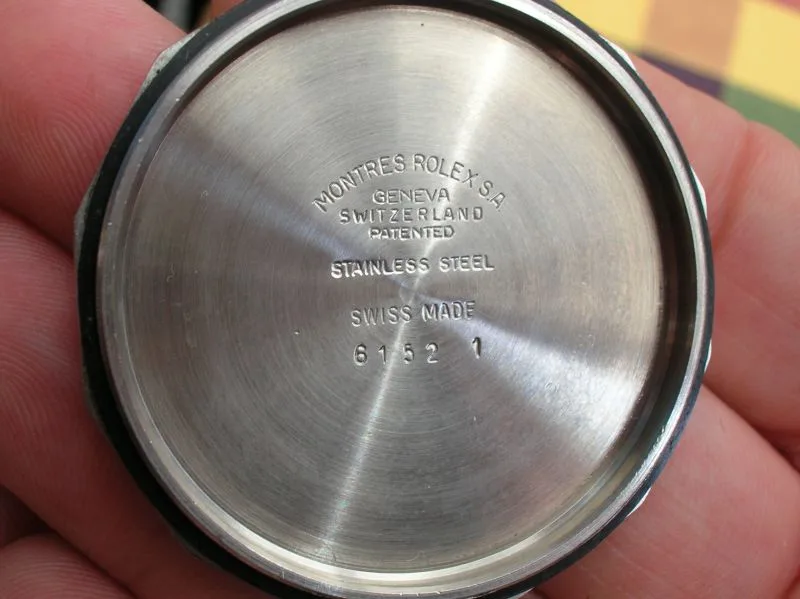
Case-Maker Marks
Many cases were made by specialist case firms (for the American market, companies like the Star, Keystone, and Wadsworth firms; in Switzerland, numerous case-makers) and carry the case-maker's mark rather than the watch brand's. As with pocket watches, the case maker and the movement maker are often different companies.
Between-the-Lugs Engravings
On Rolex and some other makers, the reference number is engraved on the twelve-o'clock side between the lugs and the serial on the six-o'clock side. Removing the bracelet or strap to read these is a standard authentication step; worn-away or re-engraved numbers are a serious warning sign.
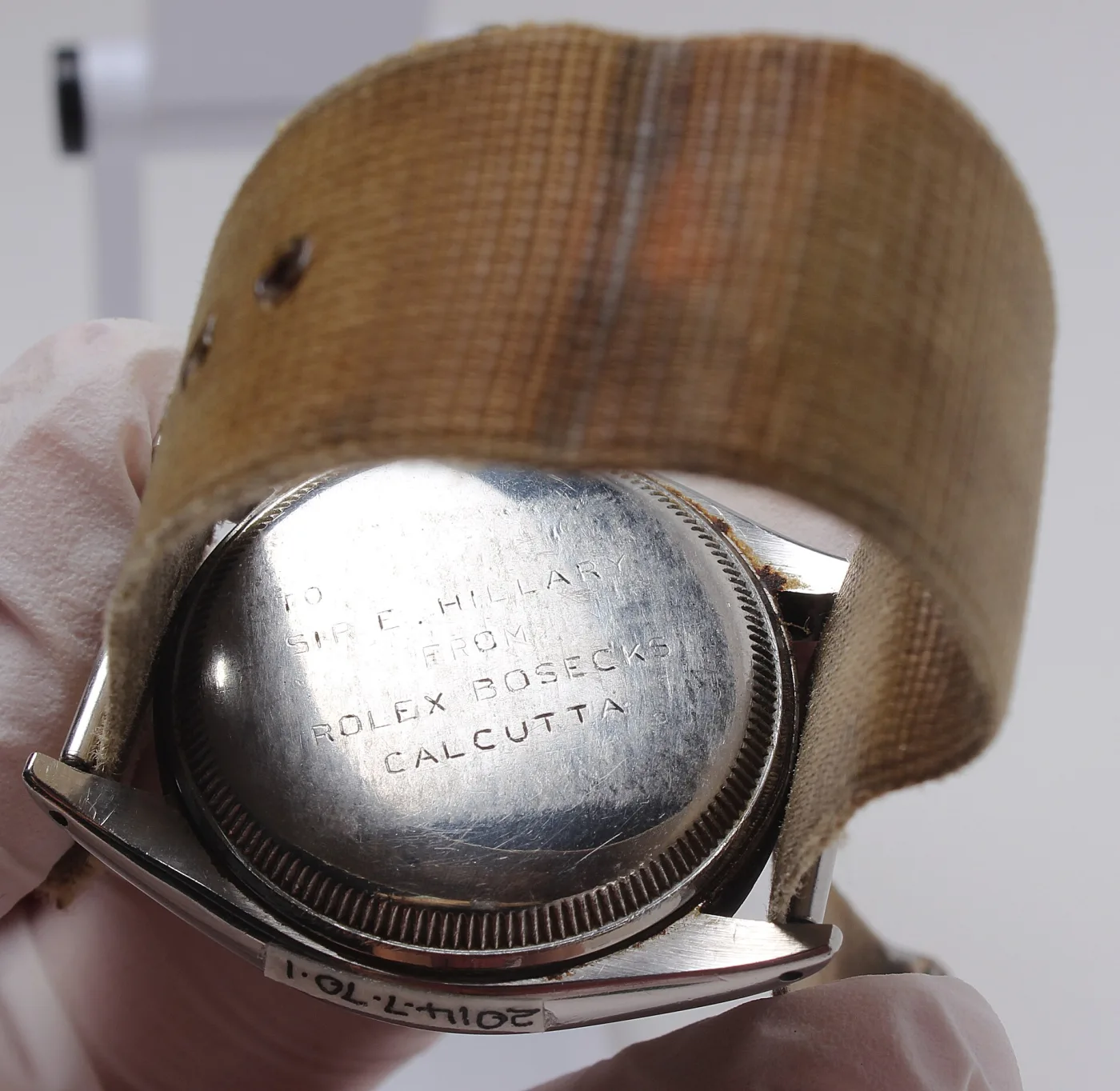
Case Materials and Hallmarks
Case material is both a value driver and a dating clue, and precious-metal hallmarks can date a case to the exact year.
Solid Gold and Silver
Solid gold cases (9k, 14k, 18k) carry karat marks and, for British and Continental cases, full assay hallmarks including a date letter. The techniques for reading these marks are the same as for antique silver hallmarks and precious-metal jewelry — the assay office, standard mark, and date letter together date and place the case. Early silver trench-watch cases are hallmarked the same way.
Gold-Filled and Rolled Gold Plate
The workhorse material of the mid-century American and Swiss market: a thick layer of gold bonded to a base metal, marked "10k/14k GF," "RGP" (rolled gold plate), or with a guaranteed-years mark ("Guaranteed 20 Years"). Wear through at the case edges and lug tips reveals the brass or nickel base — the classic sign of a well-worn gold-filled watch. Gold-filled watches are collectible but worth a fraction of solid gold.
Stainless Steel
Became common from the 1930s and is the material of most tool watches. Counterintuitively, for many iconic sports references a steel case is more sought-after (and sometimes more valuable) than the same reference in gold, because steel tool watches were made to be used and survive in smaller numbers in fine condition.
Chrome and Nickel
Inexpensive chrome-plated and nickel cases (often with a stainless back) were used for budget watches through the 1950s. Chrome wear and base-metal pitting are common. These are low-value cases regardless of the movement inside.
Reading Hallmarks as a Date Check
Where a precious-metal case carries a full hallmark with a date letter, that letter dates the case independently of the movement serial. When movement dating and hallmark dating disagree by more than a year or two, the case and movement may not be original to each other — a marriage. For the broader methodology see our authentication and provenance research guide.
Dials, Hands, and Numerals
The dial is where collectors focus their attention and where the money is made or lost, because an original dial in honest condition is worth a large multiple of a refinished one.
Dial Construction
- Fired enamel / porcelain (pre-1930s): glossy, glass-like, with printed or applied numerals. Chips and hairlines are common. Characteristic of trench and early watches.
- Metal (silvered, matte, sunburst): the standard from the 1930s. Printed markers, applied metal indices, or luminous plots.
- Applied vs. printed markers: applied metal indices (screwed or riveted) indicate a higher grade than printed markers.
Signatures and Codes
The dial carries the maker's name and often a retailer's name below it. The reverse of the dial may carry a dial-maker's stamp and a code (Stern Frères made dials for many top brands). Reading the dial signature and any reverse stamps is part of authentication.
Hands
Hand style (leaf, dauphine, baton, sword, syringe, Mercedes, cathedral) is period- and model-specific and should match the reference. Blued steel hands are common on early and dress watches; luminous hands should match the dial's luminous material and aging. Mismatched or wrong-style hands are a common sign of a service-parts watch.
Patina and Honest Aging
Collectors prize honest patina: even, gentle discoloration of the dial and lume that is consistent across the dial and hands. Uneven staining, a too-clean dial on an otherwise worn watch, or lume in the hands that differs in color and age from the dial plots all point to intervention.
Luminous Material as a Dating Tool
The luminous compound on the dial and hands changed over the twentieth century, and each type brackets a watch to a date range — one of the most reliable quick-dating tools available.
Radium (c. 1910–1960s)
The earliest luminous compound: radium salts mixed with zinc sulphide, self-glowing (radioactive) and used from the trench-watch era until it was phased out for safety in the early 1960s. Aged radium lume is typically cream to dark tan and no longer glows. A watch with radium lume is pre-1960s. (Radium is mildly radioactive; intact dials are low-risk, but never sand or disturb an old luminous dial.)
Tritium (c. 1960s–1998)
Replaced radium; less radioactive and marked on the dial as "T," "T SWISS T," "T<25" (tritium under 25 millicuries), or "SWISS – T <25 –." A tritium dial dates a watch to roughly 1960s–late 1990s, and the specific dial designation narrows it further. Tritium ages to a warm cream or amber ("tropical" tones) that collectors prize.
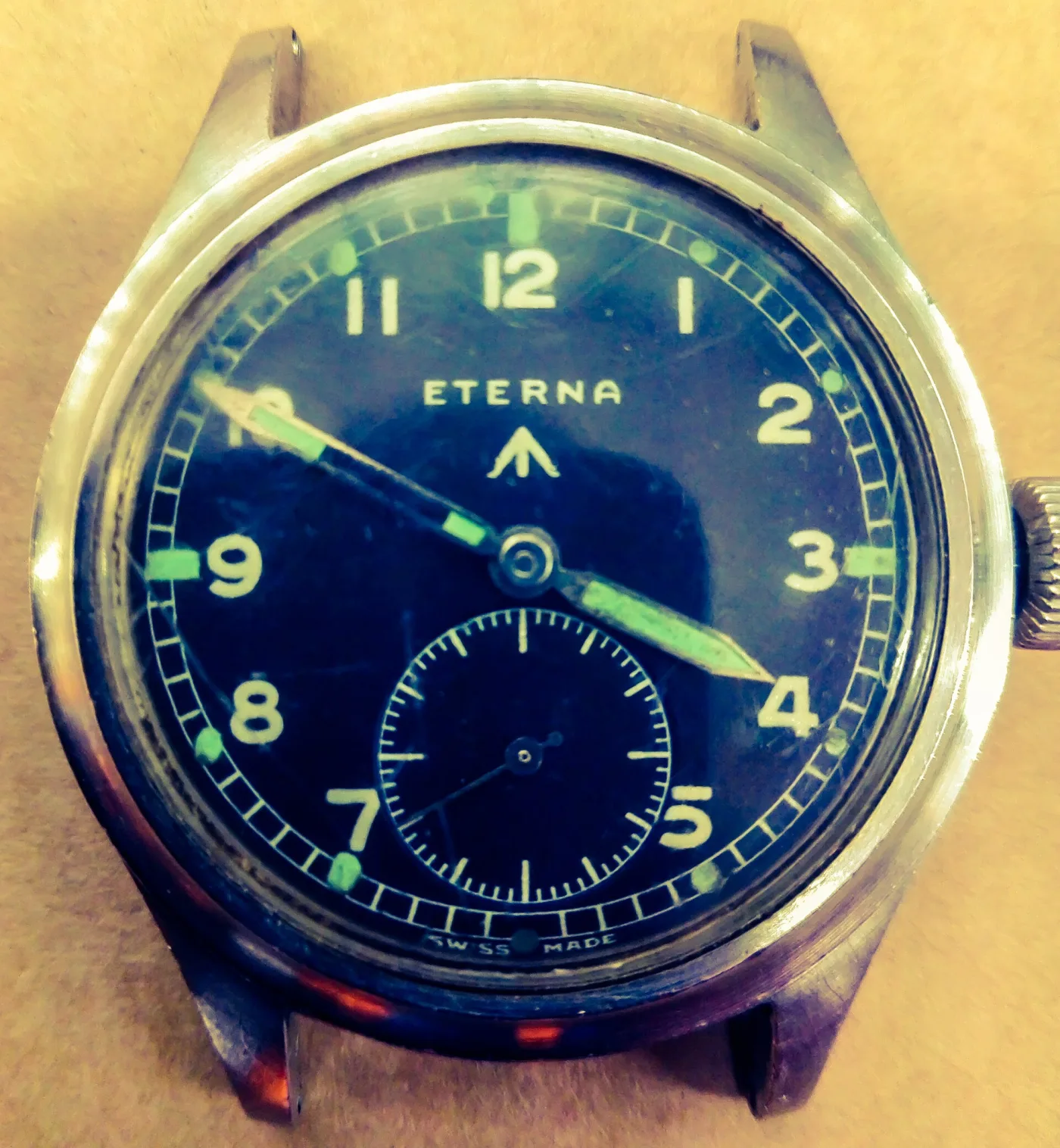
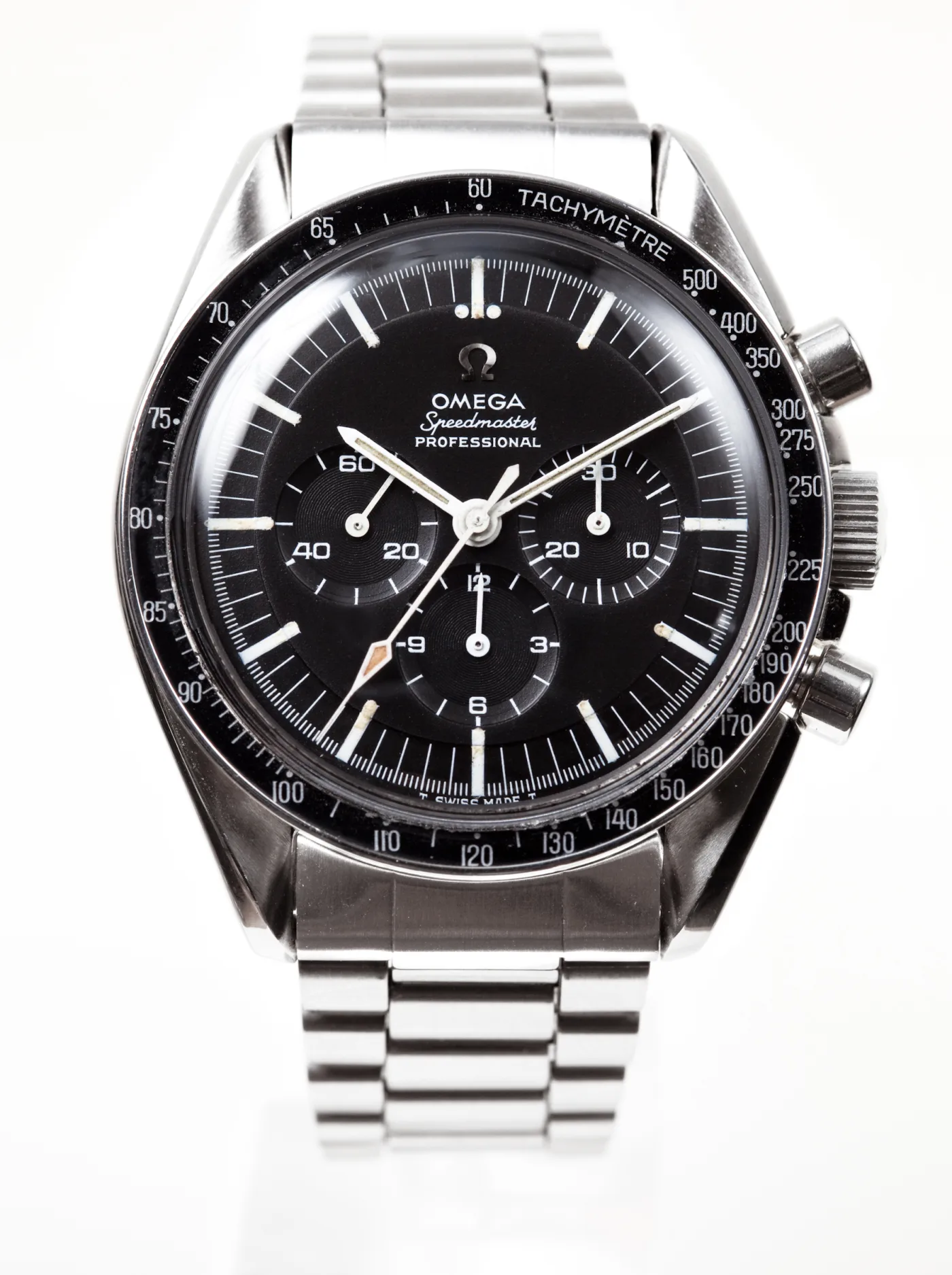
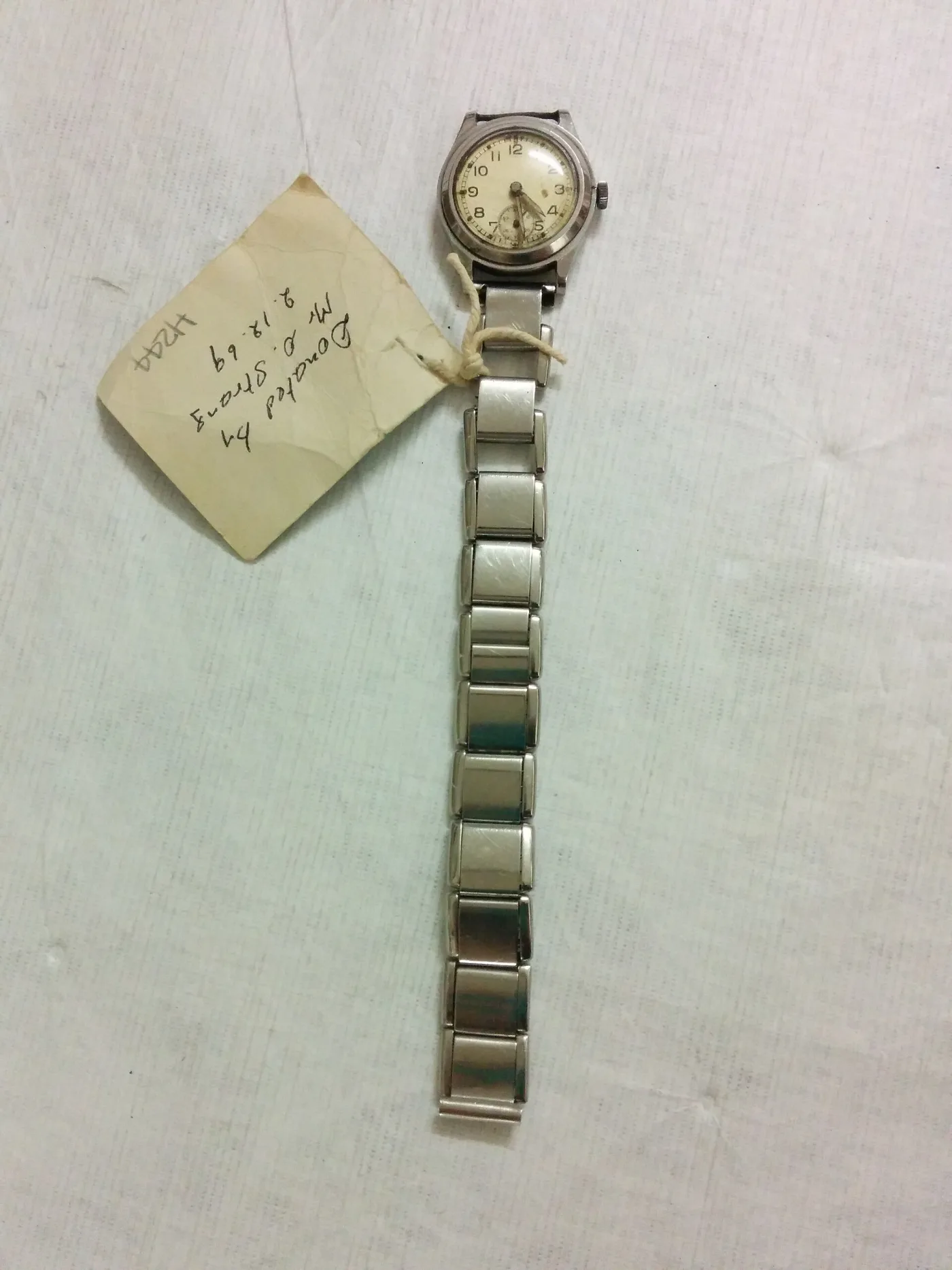
Read the small print at the very bottom of the dial before you read anything else on it. The military dial carries no lume designation at all, which is normal for radium-era dials and consistent with the dull, aged compound sitting in its numerals; the chronograph carries "T SWISS MADE T", which brackets it to roughly the 1960s through the late 1990s and rules out anything earlier. This is the cheapest dating check in the hobby, and it is the one that most often exposes a redial — bright white lume that still glows strongly under a phone torch, sitting on a dial whose printed designation predates that compound entirely, is a dial that has been repainted.
Luminova and Super-LumiNova (1990s–present)
Non-radioactive photoluminescent compound; dials marked "SWISS MADE" alone (no T), or "LUMINOVA"/"SUPER-LUMINOVA." Indicates a watch from the mid-1990s onward. A bright white, still-glowing lume on a watch otherwise presented as "vintage 1960s" is an immediate red flag for a redial.
Using the Dial Designation to Date
The small print at the bottom of the dial ("SWISS," "SWISS MADE," "T SWISS T," "T<25") is a precise dating and authenticity tool. When the lume designation on the dial does not match the watch's claimed date or the lume's actual color and glow, the dial is wrong for the watch.
Crystals and Their Dating Clues
The crystal is a replaceable part, but its material and shape still carry information.
Acrylic (Plexiglass / Hesalite)
Domed plastic crystals are standard on vintage watches from the 1930s through the 1970s. They scratch easily but polish out. A high-domed acrylic crystal is period-correct on most mid-century watches; some iconic references (early Omega Speedmaster) are defined in part by their acrylic crystals.
Mineral Glass and Sapphire
Flat mineral glass appears on some watches; scratch-resistant synthetic sapphire became common on luxury watches from the 1980s onward. A sapphire crystal on a watch claimed to be from the 1950s is anachronistic (though crystals are legitimately replaced, so this alone is not damning).
Faceted and Shaped Crystals
Art Deco and dress watches often used faceted, beveled, or shaped crystals matching non-round cases. A correct-shape crystal for a tonneau or tank case is a small but real originality point; a generic round replacement on a shaped case is a service compromise.
Complications and Watch Types
The functions beyond time-telling, and the watch's design category, are the second major value axis after maker.
Time-Only Dress Watch
The simplest and most common type: a thin, elegant round or shaped case, manual or automatic, subsidiary or center seconds. The bulk of vintage watches. Value rests on maker, material, dial, and design.
Chronograph
A stopwatch complication with pushers (usually at two and four o'clock) and subdials. Vintage chronographs — driven by column-wheel calibers such as the Valjoux 72, Landeron, and Venus movements, or in-house calibers — are among the most collectible watches. The Rolex Daytona, Omega Speedmaster, and Heuer Carrera and Monaco are icons of the category.
Dive Watch
A water-resistant tool watch with a rotating (usually unidirectional) elapsed-time bezel, luminous dial, and screw-down crown. The Rolex Submariner, Blancpain Fifty Fathoms, and Omega Seamaster 300 define the type. Bezel condition and originality are critical.
Pilot and Field Watch
Legible, luminous, robust watches derived from military specification (the "Dirty Dozen" WWII British-issue watches; American A-11 and later specs). Military-issue watches carry issue markings (broad arrow, NATO stock numbers, service engravings) on the case back that both authenticate and date them.
Calendar and Moonphase
Date, day-date, triple-calendar (day, date, month), and moonphase complications appear across the range. A vintage triple-calendar moonphase by a good maker is a serious collector piece. As with all complications, more function plus a good maker equals more value.
Higher Complications
Perpetual calendars, minute repeaters, and split-seconds chronographs on the wrist are the rarest and most valuable category, the province of Patek Philippe, Vacheron, Audemars Piguet, and a handful of others. These are five-, six-, and seven-figure watches where professional authentication is mandatory.
Major Makers and Their Signatures
Attribution to the correct maker — and understanding where a maker sits in the market — is central to valuation. A representative (not exhaustive) map:
The Swiss Top Tier
Patek Philippe, Vacheron Constantin, Audemars Piguet — the "holy trinity" of haute horlogerie; in-house calibers, superb finishing, and the highest vintage values. Rolex — the dominant collector brand, defined by reference numbers, robust in-house automatics, and the Oyster case; the most faked and most scrutinized. Jaeger-LeCoultre — maker of superb calibers (including movements for other top brands) and the Reverso.
The Swiss Broad Market
Omega — enormous, well-documented output (Speedmaster, Seamaster, Constellation, and the fine 30 mm hand-wound calibers); Omega's extract-from-the-archives service makes dating relatively easy. Longines — historically a chronometer powerhouse with a complete archive that will date any watch by serial. IWC, Zenith, Heuer, Universal Genève, Movado, Eterna, Girard-Perregaux — all significant collector names with distinct followings.
The American Makers
Hamilton — the strongest American name, maker of fine hand-wound and the pioneering Electric; military and railroad-grade heritage. Elgin, Waltham, Illinois, Gruen, Bulova — huge producers of the American mid-market, many in gold-filled cases; the Bulova Accutron is a standout. American serial-number databases (especially for Elgin, Waltham, Hamilton, and Illinois) allow precise movement dating in the same way as for American pocket watches.
How Signatures Are Placed
The maker's name appears on the dial, on the movement, and (for many) inside the case back and on the crown, bracelet clasp, and buckle. A genuine watch is signed consistently across components; a dial signature with no corresponding movement signature (or a different one) demands explanation.
Private-Label and School Watches
Two categories confuse beginners constantly and deserve their own treatment.
Private-Label (Retailer-Signed) Watches
Many watches carry a jeweler's or retailer's name on the dial instead of, or alongside, the manufacturer — Tiffany & Co., Cartier (for pieces cased by others), Gübelin, and countless local jewelers. A Tiffany-signed dial on a genuine Patek or Rolex adds value; a retailer signature on an unbranded Swiss movement is a plain private-label watch worth what the movement is worth. Reading the movement caliber tells you which situation you are in.
"School" and Unbranded Swiss Watches
Vast numbers of mid-century watches carry brand names that were essentially labels applied to bought-in ébauche movements, sold through catalogs and department stores. These "brands" have little independent value; the watch is worth what its ébauche caliber, case material, and condition dictate. Do not assume an unfamiliar Swiss name is a discovery — nine times out of ten it is a private-label or catalog brand running an A. Schild or FHF movement.
The Practical Rule
The dial name is a marketing label; the movement is the watch. Always identify the caliber before forming a value opinion, and treat an unfamiliar dial brand as neutral until the movement is identified.
Dating by Serial and Reference
Dating a vintage wristwatch triangulates several independent clues; no single number is sufficient by itself.
Movement Serial Number
For most makers the movement serial is the primary dating key. Omega, Longines, and the major American makers publish (or provide, via archive services) serial-to-year tables. Match the serial to the maker's ranges to get the production year. Note that the case and dial may be later than the movement if the watch has been serviced with replacement parts.
Reference Number
The reference brackets the model to its production run. Combined with the serial, it usually pins the watch to a year or two. Reference-and-serial cross-checking is the standard method for Rolex and Patek in particular.
Hallmark Date Letters
On precious-metal cases with full hallmarks, the assay date letter dates the case exactly. This is an independent check on movement dating and is decisive for British-cased watches.
Dial Designations and Lume
The lume type (radium / tritium / Luminova) and the dial's small print ("SWISS," "T SWISS T," "T<25," "SWISS MADE") bracket the dial's date, which should agree with the movement and case. A mismatch dates the dial and flags a possible redial or replacement.
Design and Feature Cues
Subsidiary vs. center seconds, bumper vs. full-rotor automatic, acrylic vs. sapphire crystal, lug and case shape, and crown type all give rough decade-level dating that should corroborate the numbers. When feature-dating and serial-dating disagree sharply, investigate before concluding.
Redials, Frankens, and Service Parts
The single biggest trap in vintage wristwatches is not outright counterfeits (though those exist) but altered genuine watches — and the largest sub-problem is the redial.
Redials
A redial is a genuine dial that has been repainted/refinished, or a reproduction dial fitted to a genuine watch. Redialing is common because dials deteriorate and refinishers were widespread. Signs: printing that is too crisp or too thick, fonts slightly wrong for the reference, minute-track dots that run into the printing, "SWISS" designations that do not match the lume, a suspiciously clean dial on a worn watch, and lume plots that do not match the hands. A redial can cut a watch's value by half or more. Learning to spot redials is the most valuable single skill in this field.
Franken Watches
A "franken" is a watch assembled from parts of several watches — a correct case with a wrong-generation dial, a service movement, replacement hands, and a reproduction bezel — presented as an original example of a valuable reference. Frankens are built precisely because the assembled reference is worth more than the sum of the donor parts. Defense is component-by-component correctness: every part must be correct for the reference and consistent in age and wear.
Service Dials and Service Parts
Manufacturers legitimately replaced dials, hands, bezels, and crowns during service, often with later-specification parts. A "service dial" is genuine factory work but is not the original dial and is worth less to collectors than an original. Distinguishing an original dial, a period service dial, and a modern redial is a core competence and often requires reference literature or an expert.
Marriages
A "marriage" pairs a movement and case that never left the factory together — often a good movement recased, or a case fitted with a later movement. Serial/reference cross-checks and hallmark dating expose most marriages. A married watch is worth substantially less than an all-original example.
Outright Fakes
Modern counterfeits of high-value references (Rolex, Patek, Omega) are sophisticated and improving. For any watch of significant value, movement inspection by a specialist and (where available) an extract from the manufacturer's archives are the reliable defenses. If a "vintage Rolex" is offered far below market, assume a fake or a franken until proven otherwise.
Authenticity Checks
A systematic authenticity pass, component by component:
Open the Back
Read the caliber and movement serial. Confirm the caliber is correct for the reference and brand. A wrong or "generic" movement in a branded case is decisive evidence of a franken or fake.
Read the Reference and Case Serial
Between the lugs (Rolex/Patek) or inside the back. Confirm the reference matches the watch's configuration and that engravings are sharp and unaltered. Re-engraved or polished-away numbers are a serious warning.
Scrutinize the Dial
Compare printing, fonts, lume plots, and "SWISS" designation against verified reference images. Confirm the lume color/glow matches the claimed era and that dial and hand lume match each other. This is where most bad watches are caught.
Check Consistency of Wear
Case, bracelet, crown, and crystal should show consistent age and wear. A pristine bracelet on a heavily worn case, or fresh lume on a battered watch, indicates mixed parts.
Get an Archive Extract
For makers that offer it (Omega, Longines, Patek, Vacheron, and others), an extract from the archives confirms the original configuration and date for that serial. For high-value watches this is close to mandatory.
Condition Assessment
Condition, for wristwatches, weighs originality far more heavily than mere function.
Dial
Original untouched > original with honest aging > period service dial > modern redial. The dial is the largest single condition factor. A superb original dial can be worth more than the rest of the watch combined.
Case
Sharp, unpolished cases with crisp hallmarks and reference engravings are prized; over-polishing that rounds the lugs and softens the case lines destroys value. Original factory finish (brushed/polished as made) matters. On gold-filled cases, wear-through to base metal caps value.
Movement
Running and recently serviced > running > non-running but complete > non-running with damage or missing parts. A correct, clean, running movement matters, but originality of dial and case usually outweighs a service.
Originality of Parts
Original hands, crown, crystal (where shaped), bezel, and bracelet each add value; each replacement subtracts. Full originality across all components is what separates a collector-grade watch from a "wearer."
Completeness
Original box, papers, warranty booklet, hang tags, and matching serial documentation (the "full set") can add a large premium, especially for luxury references.
What Drives Value
Vintage wristwatch value is a product of several factors that multiply rather than add.
Maker and Reference
The single largest factor. A specific desirable reference by a top maker can be worth orders of magnitude more than a plain watch with a similar movement. Learn the reference, not just the brand.
Originality
An all-original example with an untouched dial and unpolished case can be worth several times an otherwise identical watch that has been redialed, over-polished, or assembled from parts. Originality is the great multiplier.
Condition
Within an original watch, sharper case, better dial, and running-and-serviced condition command premiums. Service cost (often $150–$800 for a standard mechanical, far more for a complicated or vintage chronograph) is deducted from a non-running watch.
Material and Complication
Solid gold and platinum, and each added complication (chronograph, calendar, moonphase, repeater), raise value — though for sports references, steel can outperform gold. For the full appraisal methodology see our antique valuation and appraisal guide.
Provenance and Full Set
Documented ownership, military issue with matching records, and the original box and papers add substantial premiums for the better watches. A "full set" original-owner watch is the top of the market for a given reference.
Care, Service, and Wearing
Vintage wristwatches reward gentle, informed care and punish neglect and over-restoration alike.
Service Interval
A mechanical watch worn regularly should be serviced every 4–7 years; dried oils cause pivot and gear wear. Service includes disassembly, cleaning, lubrication, regulation, and worn-part replacement. Use a watchmaker experienced with vintage — modern "swap the movement" shortcuts can destroy a collectible watch's originality.
Do Not Over-Restore
Never let a jeweler polish a collectible case (it rounds the lugs and erases the factory finish), refinish the dial (a redial can halve value), or replace an original crystal, crown, or bezel unnecessarily. The market pays for honest originality, not a "like new" appearance. This is the opposite of the instinct that serves well for some other antiques.
Water Resistance
Assume every vintage watch is not water resistant. Old gaskets are perished; screw-down crowns no longer seal. Keep vintage watches away from water entirely unless freshly serviced and pressure-tested — moisture ingress destroys dials and movements.
Winding and Setting
Wind a manual watch gently to a firm stop; do not force it. Set the time by advancing the hands; on watches with a date, avoid changing the date in the "danger zone" (roughly 9 p.m. to 3 a.m.) when the date mechanism is engaged, to prevent damage.
Storage
Store in a dry place away from magnets (which can magnetize a movement and make it run fast) and temperature extremes. Keep the original box and papers with the watch. For long-term storage of a collection, apply the same climate principles as our antique storage, care, and preservation guide recommends. Straps and dials both degrade in heat and humidity.
Handling Old Luminous Dials
Never sand, scrape, or attempt to "re-lume" an original radium or tritium dial yourself. Radium dials are mildly radioactive; leave them intact and let a professional handle any dial work. Re-luming an original dial also destroys collector value.
Common Beginner Mistakes
Trusting the Dial Name
The dial name is a label, not the identity of the watch. An unfamiliar Swiss brand is usually a private-label or catalog watch running a bought-in movement. Identify the caliber before forming any value opinion.
Ignoring the Reference Number
For high-grade watches the reference number (between the lugs or inside the back) matters more than the brand. Two watches with the same movement but different references can differ enormously in value.
Missing a Redial
A refinished or reproduction dial can halve a watch's value, and redials are extremely common. Learning to read printing quality, fonts, lume plots, and "SWISS" designations against reference images is the most valuable skill in the field.
Over-Polishing the Case
Polishing a collectible case rounds the lugs and erases the factory finish. Collectors pay for sharp, unpolished cases with honest wear — not a mirror shine.
Refinishing an Original Dial
Sending an original dial out to be "restored" turns a valuable original into a low-value redial. Honest aging beats a repaint every time.
Assuming Vintage Watches Are Water Resistant
Old seals are perished. Every vintage watch should be treated as not water resistant until serviced and pressure-tested. Water ingress is a common way collectible watches are ruined.
Buying a "Bargain" Rolex or Patek
A high-value reference offered far below market is a fake or a franken until proven otherwise. For any significant watch, insist on movement inspection and, where available, an archive extract.
Confusing a Marriage for an Original
A recased movement or a case fitted with a later movement is worth far less than an all-original watch. Cross-check the reference, serial, and any hallmark date letter to catch marriages.
Prying the Case Back with a Knife
Use proper tools (case knife for snap backs, wrench for screw backs). Slipping with a kitchen knife scratches the case, damages the movement, and can injure you.
Neglecting Magnetism
A watch running consistently fast is often magnetized (from phones, speakers, or clasps). Demagnetizing is a quick, cheap fix — do not assume a fast-running watch needs a full service before checking for magnetism.
Frequently Asked Questions
When was the wristwatch invented?
Wrist-worn watches for women existed in the nineteenth century, but the functional men's wristwatch emerged from military use around the First World War (c. 1914–1918). The "trench watch" — a small case with wire lugs and a luminous enamel dial — is the direct ancestor of the modern wristwatch, which displaced the pocket watch almost entirely by 1930.
How do I find out who made my watch and when?
Open the case back and read the movement caliber and serial number, and read the reference number inside the back or between the lugs. Match the serial to the maker's dating tables (Omega, Longines, Elgin, Waltham, Hamilton, and others publish or provide these). The dial name may be only a retailer or private label, so the movement is the reliable identifier.
What is a reference number and where is it?
The reference number is the manufacturer's model number for the watch. It is engraved inside the case back or, on Rolex and Patek, between the lugs at twelve o'clock under the bracelet. For high-grade watches it identifies the exact model and is the most important single number.
What is a redial and why does it matter?
A redial is a dial that has been repainted or replaced with a reproduction. Redials are very common and can reduce a watch's value by half or more. Signs include over-crisp or slightly wrong printing, minute-track dots running into the text, "SWISS" designations that do not match the lume, and lume plots that do not match the hands.
How can I tell if a watch is mechanical or quartz?
Look and listen. A smoothly sweeping seconds hand with a high-frequency tick and a rotor visible through the back is a mechanical automatic; a tick with no rotor is a manual mechanical; a once-per-second tick with a battery is quartz; a humming movement with a gliding seconds hand is a tuning-fork electric (Accutron).
What does the "T" or "T SWISS T" on the dial mean?
It indicates tritium luminous material, used from roughly the 1960s to the late 1990s. "T<25" means tritium under 25 millicuries. Earlier watches used radium (no "T"); watches from the mid-1990s onward use non-radioactive Luminova and are marked "SWISS MADE" without a "T." The designation is a precise dating and authenticity clue.
Are old radium dials dangerous?
Intact radium dials emit low levels of radiation and are generally considered low-risk to handle briefly and wear occasionally. The real hazard is disturbing the compound — never sand, scrape, or re-lume a radium dial, and leave any dial work to a professional. Wash your hands after handling a bare old dial.
Should I have my vintage watch serviced or restored?
Service (clean, oil, regulate) a watch you intend to wear, using a watchmaker experienced with vintage. Do not "restore" it cosmetically — polishing the case and refinishing the dial destroy the originality that collectors pay for. Honest wear is worth more than a like-new appearance.
Is a steel sports watch worth less than a gold one?
Not necessarily. For iconic sports references (divers, chronographs), a steel case is often as valuable as or more valuable than the same reference in gold, because steel tool watches were used hard and survive in fine condition in smaller numbers. For dress watches, solid gold generally commands a premium.
How much is my vintage wristwatch worth?
It depends overwhelmingly on maker, reference, and originality. A plain gold-filled American or Swiss dress watch is often $50–$300; a fine hand-wound gold dress watch by a good maker is several hundred to a few thousand; desirable sports and chronograph references by top makers run into the tens of thousands and beyond. An original untouched dial and unpolished case can multiply the value of any given reference. Identify the caliber and reference first, then compare to sold examples of the same reference in the same condition.