Antique Spatterware Identification Guide: Patterns, Colors & Value
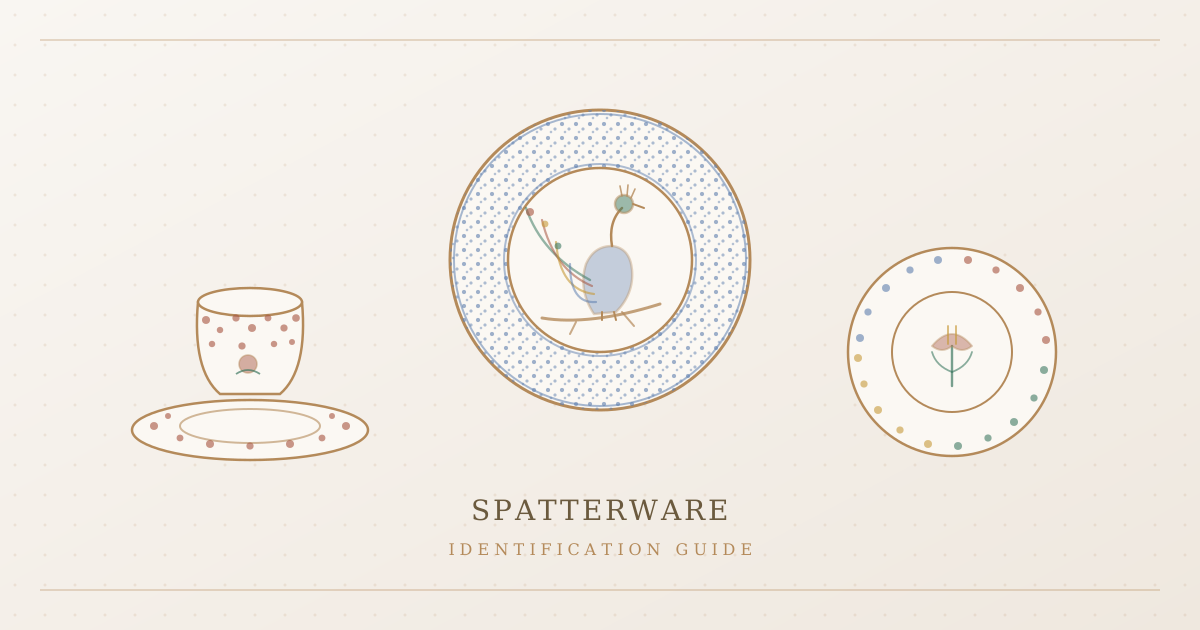
Turn over a small earthenware plate and set it flat on a table, and the whole logic of spatterware announces itself in a second: a broad band of dense, stippled color runs around the rim—blue, red, purple, green, or a rainbow of several at once—and inside that soft, cloudy frame sits a single bright hand-painted motif, a peafowl on a branch, a red rose, a tulip, a little schoolhouse. This deliberately simple grammar of "spattered border plus painted center" is what collectors have called spatterware for the better part of two centuries, and for the Pennsylvania German families who filled their dressers with it in the 1820s through the 1860s it was the everyday china of a whole culture.
Spatterware is one of the most beloved and most confused corners of early ceramics. It is beloved because at its best it is folk art on a plate—naive, cheerful, and instantly recognizable—and because the rare patterns command prices that startle newcomers, with a fine period peafowl or a schoolhouse plate reaching well into four figures. It is confused because the word "spatterware" gets stretched to cover several different decorating techniques, because it overlaps with sponged wares, "stick spatter," and the related Gaudy Dutch family, and because the market is thick with later revival china and outright reproductions wearing the same borders and motifs.
This guide sorts it out. It explains what spatterware actually is and how the sponged and stick-spatter techniques differ; walks through the border colors and the all-important central motifs, from the common four-petal "design spatter" up to the peafowl, rose, tulip, schoolhouse, fort, thistle, and rainbow patterns collectors prize; identifies the bodies, forms, and the mostly-unmarked English Staffordshire origin of classic Pennsylvania German spatter; places spatterware among its cousins—spongeware, stick spatter, Gaudy Dutch, and Gaudy Welsh; and then confronts the reproductions and the pricing so you can tell a $30 chipped saucer from a $3,000 peafowl. By the end you should be able to lay a spatter plate on the table and read its border, its motif, its body, and its condition the way a specialist does.
Table of Contents
- What Spatterware Actually Is
- Sponged Spatter versus Stick Spatter
- A Short History: Staffordshire Made It, Pennsylvania Loved It
- Reading the Border: Colors and How They Were Applied
- The Central Motifs and Named Patterns
- Rainbow Spatter and the Rarity Ladder
- Bodies, Glaze, and Dating Clues
- Forms: Plates, Cups, Teawares, and Rarities
- Marks, or the Lack of Them
- Spatterware versus Its Cousins
- Gaudy Dutch, Gaudy Welsh, and Adams Rose
- Reproductions, Revivals, and Fakes
- Condition and Value
- Field Checklist Before You Buy
What Spatterware Actually Is
Spatterware, in the classic sense collectors mean, is hand-decorated earthenware in which a band of stippled or "spattered" color frames a hand-painted central motif. It is not printed, and it is not a single all-over pattern; it is a two-part composition—a soft, textured color field around the edge and a crisp, naive picture in the middle—applied by hand to cheap, sturdy tableware. The result reads as folk art precisely because the two parts sit in such deliberate contrast: the loose, cloudy border and the tight, cartoon-like motif.
The "spatter" itself is the border texture, and it can be produced in more than one way—dabbed with a sponge, blown or flicked from a stick or brush, or stippled through a stencil—which is the root of much of the confusion in the field. What unites true spatterware is the combination: a spattered ground and a separately painted center. A plate that is spattered all over with no central motif drifts toward plain spongeware; a plate with a transfer-printed center and a spattered rim is a related export ware; but the archetypal spatter plate is a colored border wrapped around a peafowl, a rose, or a tulip.
Where Spatterware Fits Among Earthenwares
Spatterware belongs to the broad family of early nineteenth-century refined earthenwares—the pearlware and whiteware bodies that dominated affordable tableware after about 1800—rather than to porcelain or stoneware. It sits alongside sponged ware, mocha, shell-edge, and the transfer-printed wares as one of the decorative modes that Staffordshire and other potteries used to dress up an otherwise plain plate. For the wider context of bodies, glazes, and decoration that frames everything discussed here, our antique ceramics and pottery identification guide lays out the vocabulary, and this guide assumes that broad map while zooming in on the spattered-border-plus-motif tradition specifically.
Sponged Spatter versus Stick Spatter
The single most useful technical distinction in the whole subject is how the border was applied, because it separates the classic Pennsylvania German spatterware from the later export "stick spatter," and the two look and feel different once you know what to watch for. Both create a broken, textured field of color, but by different means and with different results.
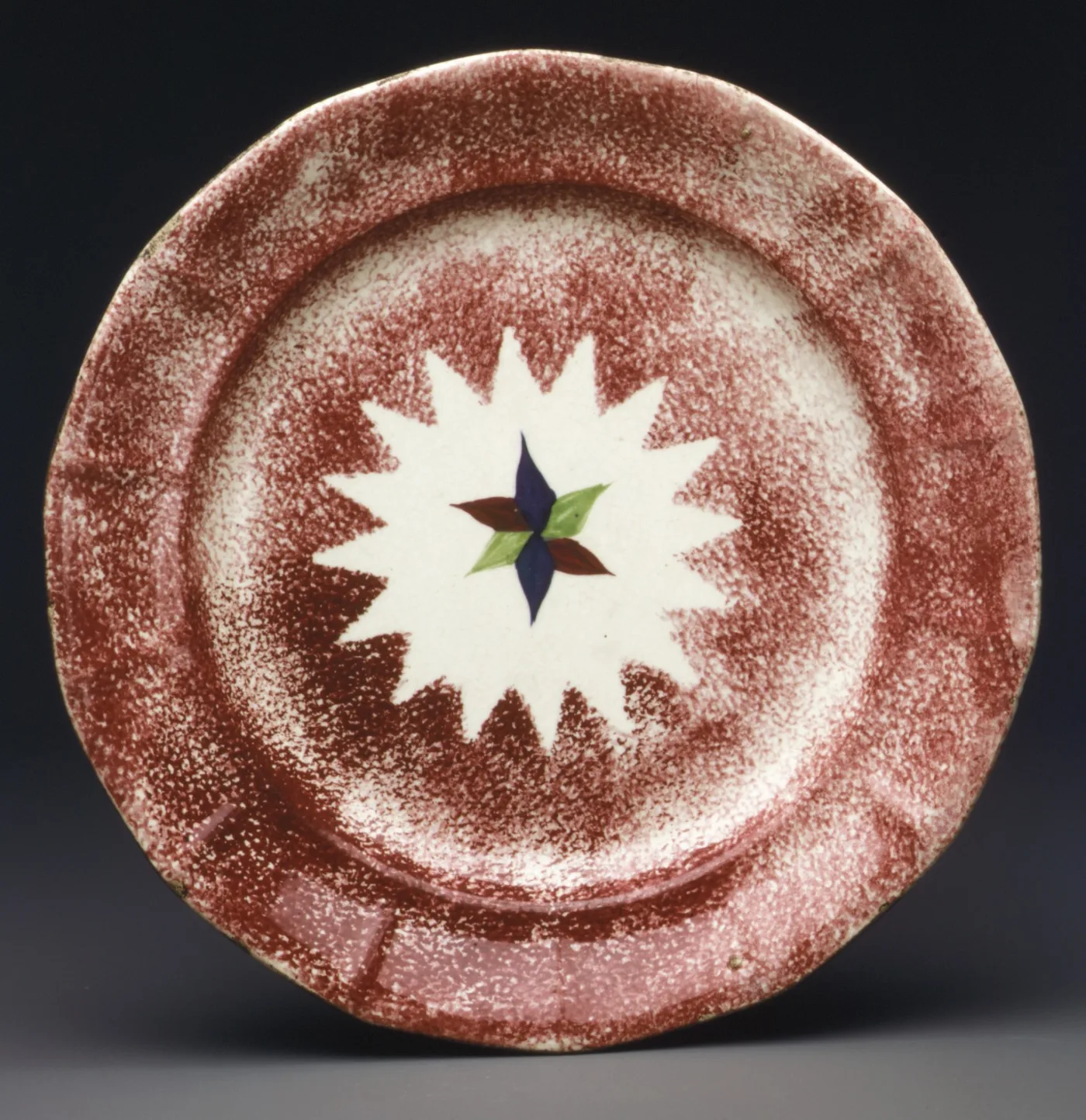
Sponged (or stippled) spatter—the technique of the classic period pieces—was made by dabbing color onto the border with a sponge or a stippling tool, or by stippling through a stencil that masked the center and any reserve. The result is a dense, even, softly granular band of color: close-packed dots that read almost as a solid, cloudy field from arm's length but resolve into countless small marks up close. The color is concentrated and saturated, and the edge where the border meets the reserved center is usually clean, because a stencil or resist protected the motif area while the border was stippled.
The Look of Stick Spatter
Stick spatter (sometimes "spattered" in the looser trade sense) was made by loading color onto a stick or stiff brush and flicking or tapping it to throw a spray of droplets onto the ware. The result is looser, coarser, and more random—larger, more widely spaced spots with visible spatter "throw," rather than the dense, even stipple of the sponged borders. Stick spatter is the technique of the vast Staffordshire export trade to Latin America and other markets from the 1840s onward, and it very often frames a transfer-printed or cut-sponge center rather than a hand-painted one. As a rule of thumb, a tight, dense, even border around a hand-painted peafowl or rose points to classic period spatterware; a loose, sprayed, coarser border—especially around a printed center or a cut-sponge motif—points to later stick-spatter export ware. Neither rule is absolute, and the two traditions shade into each other, but the character of the border texture is the first thing a practiced eye reads.
A Short History: Staffordshire Made It, Pennsylvania Loved It
One fact surprises almost every new collector: the classic spatterware so tied to Pennsylvania German households was overwhelmingly made in England, not America. From roughly the 1820s through the 1860s, Staffordshire potteries produced spattered-border earthenware specifically for export to the United States, where it found its most devoted market among the Pennsylvania German ("Pennsylvania Dutch") communities of the mid-Atlantic. The bright, bold, folk-art decoration suited their taste, and spatterware became the characteristic dresser china of that culture—which is why so much of it survives in Pennsylvania, Ohio, and the Shenandoah Valley, and why it is so bound up with American folk collecting despite its English origin.
The peak period runs from about 1830 to 1860, tapering off after the Civil War as tastes shifted and as printed and later decorative wares displaced the hand-painted tradition. The great collector interest, and the great prices, attach above all to this period production: the hand-painted peafowl, rose, tulip, and schoolhouse plates and teawares that came out of Staffordshire and onto Pennsylvania dressers. A parallel and slightly different story belongs to the stick-spatter export trade, which continued later and reached other markets, and to American potteries that made their own sponged wares—but the heart of "spatterware" as collectors use the word is that 1830–1860 Anglo-Pennsylvania phenomenon.
Why the English Origin Matters
The Staffordshire origin explains several things at once. It explains why classic spatter is usually unmarked—export earthenware for a foreign market rarely carried a factory mark—and why the occasional marks that do appear are English maker or pattern marks. It explains the pearlware and whiteware bodies, which are standard Staffordshire earthenwares of the period. And it connects spatterware to the whole world of nineteenth-century Staffordshire decorative pottery, from figures to transferware, that shared the same factories and the same export logic; that broader Staffordshire context is sketched in our Staffordshire figurines identification guide, and spatterware is best understood as one branch of that prolific, market-driven industry.
Reading the Border: Colors and How They Were Applied
The border is the first thing to read, and it carries information about both desirability and, sometimes, date. Classic spatterware borders come in a range of colors, and the color of the spatter is one of the main drivers of value, quite apart from the central motif. The common ground colors are blue and red, which are the most frequently seen and therefore the most affordable. Purple is scarcer and more desirable; green, yellow, brown, and black are progressively rarer and command real premiums; and combinations of several colors in one border—the celebrated rainbow spatter—sit at the top of the ladder.
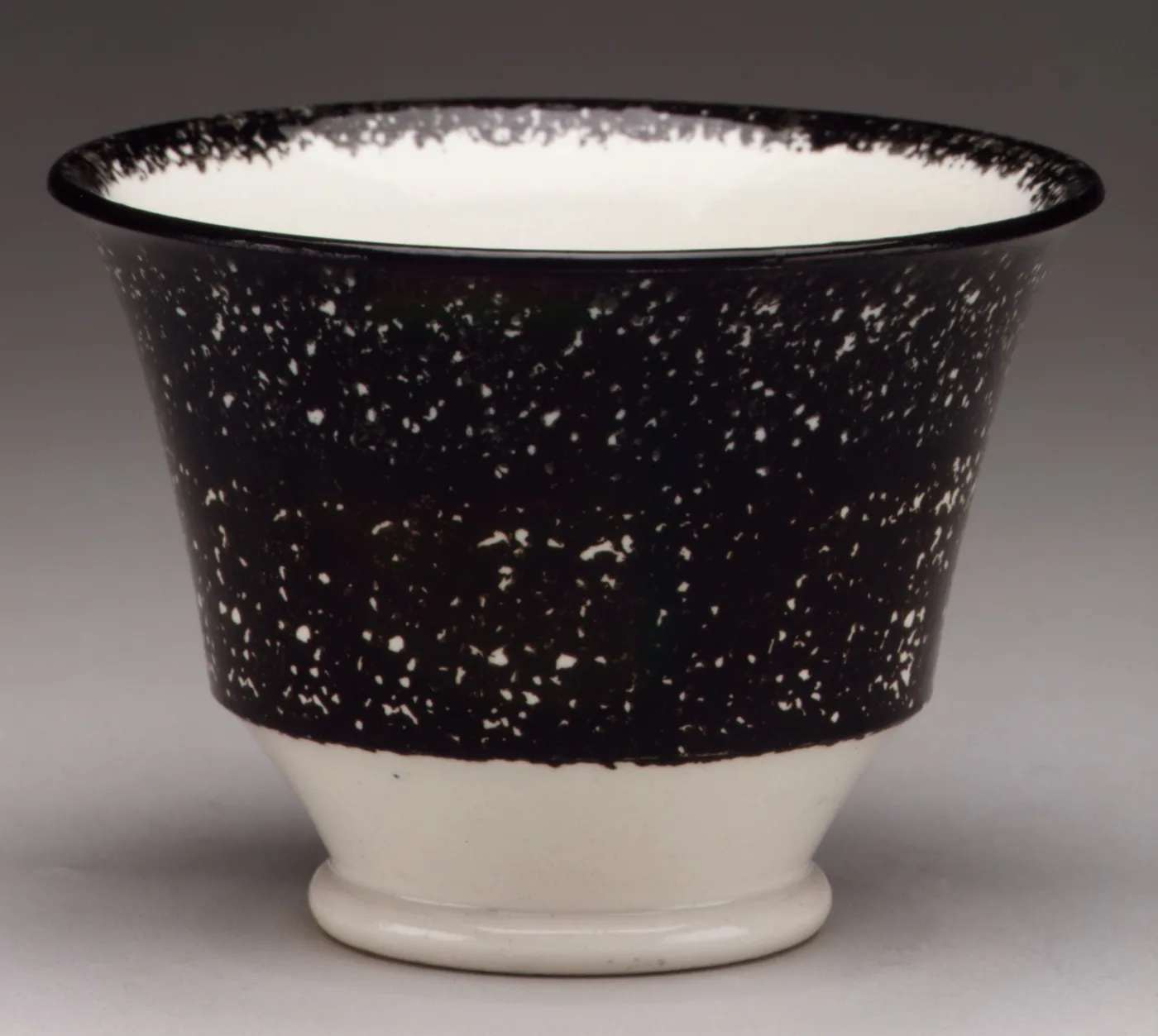
The border also varies in how the color is arranged. Most common is a plain, even band of a single spattered color running around the rim. But borders can be built into patterns: bands of two or more colors, spatter arranged in vertical stripes or "rainbow" sections, spatter in bull's-eye or thumbprint arrangements, or borders that reserve white areas in geometric shapes. The more complex and controlled the border—and the more colors it combines—the rarer and more valuable the piece tends to be, because more colors and more elaborate arrangement meant more work and more skill.
What the Border Texture Tells You
Beyond color, the texture and quality of the spatter is diagnostic. On good period pieces the sponged border is dense, evenly distributed, and saturated, with the color strong and the stippling consistent; the reserved center is clean-edged where a stencil protected it. Weak, thin, patchy, or unevenly applied spatter is a sign of either a lesser piece or a modern imitation. Look, too, at how the border sits under the glaze: period spatter is applied under the glaze and covered by it, so the color lies beneath a glassy surface rather than sitting on top. A border that looks like it is painted or printed onto the surface, that is too uniform and mechanical, or that has an obviously modern crispness is a warning that the piece may be a reproduction rather than period ware.
The Central Motifs and Named Patterns
If the border sets the price floor, the central motif sets the ceiling. The hand-painted picture reserved in the middle of a spatter plate or the side of a spatter cup is what collectors chase, and the motifs form a recognized hierarchy of names and rarities. Knowing the repertoire is essential both to identify a piece and to grasp its value.
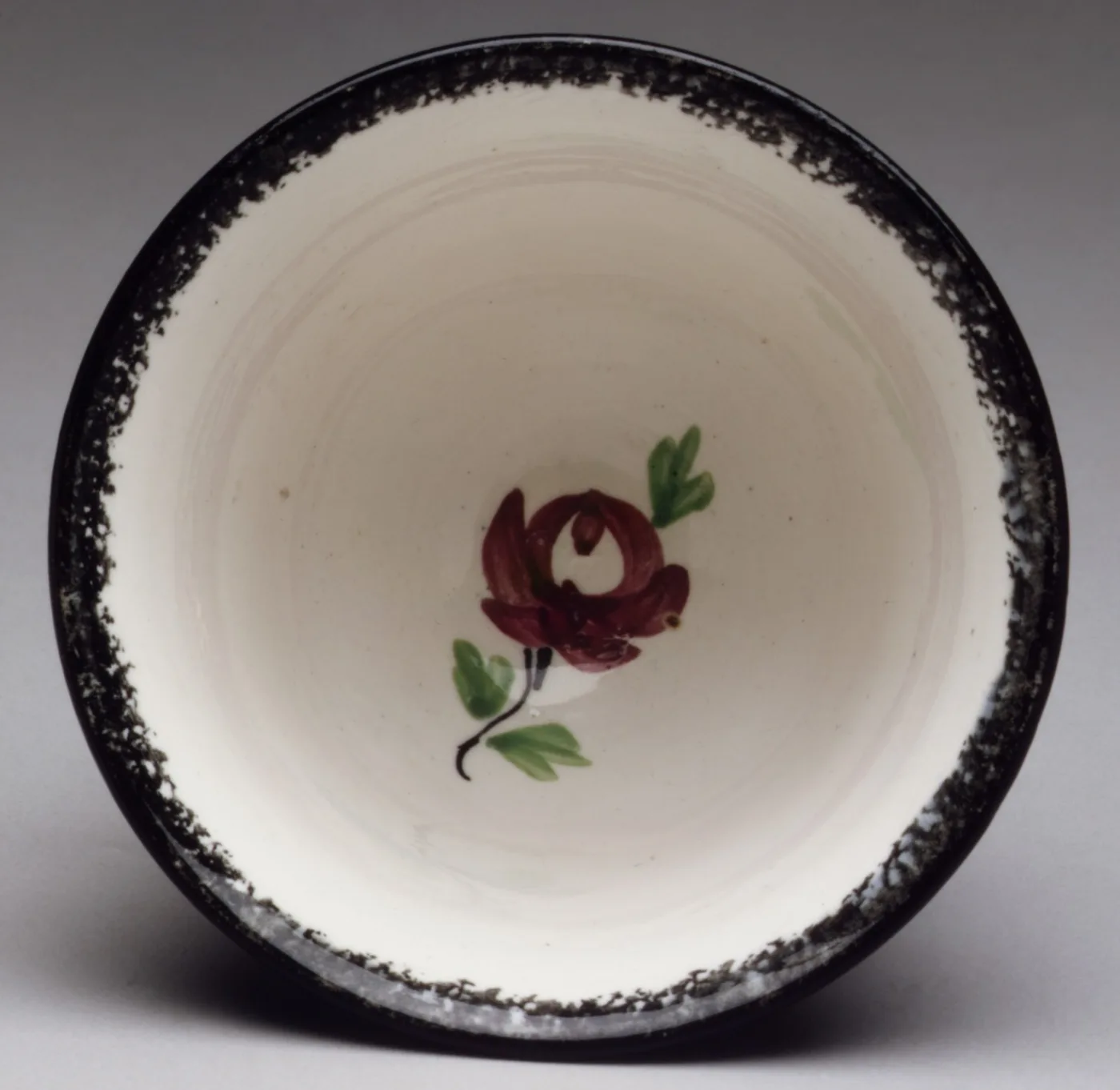
At the common end is what is often called "design spatter"—simple painted devices such as a four-petal flower, a star, a tulip in a very basic form, a cluster of dots, or a plain geometric reserve. These are the everyday spatter patterns, attractive but not scarce. Above them sit the named pictorial patterns that define the field: the Peafowl (a stylized peacock perched on a branch, in bold blue, red, green, and yellow, and the single most iconic spatter motif); the Rose (a full red cabbage-rose bloom); the Tulip (an upright stylized tulip, straight out of the Pennsylvania German decorative vocabulary); and the Cockscomb and other flowers.
The Rarer Named Patterns
Rarer and more valuable still are the architectural and object motifs: the Schoolhouse (a little building, one of the most sought-after of all spatter patterns), the Fort, and other buildings; the Thistle; the Bull's Eye and other geometric centers; and various birds beyond the peafowl. Pieces combining a rare central motif with a rare border color—a schoolhouse on a rainbow border, say, or a peafowl on a green ground—are the trophies of the field. The motifs were painted freehand in bright, opaque colors and reflect the same folk-art sensibility that runs through Pennsylvania German painted furniture, fraktur, and textiles; anyone drawn to that vernacular tradition will recognize the peafowl and tulip immediately, and our antique folk art identification guide places these motifs in their broader American folk context. The naive, confident hand that painted these centers is part of what makes spatterware so appealing, and a genuinely period motif has a spontaneity and slight irregularity that later, more careful copies often miss.
Rainbow Spatter and the Rarity Ladder
No category of spatterware excites collectors more than rainbow spatter, and it deserves its own explanation because it sits at the top of the market and is heavily reproduced. Rainbow spatter uses two or more spatter colors in a single design—arranged as concentric bands, as alternating vertical stripes radiating from the center, as a multi-color border, or as a whole surface built from several spattered colors blending into one another. The effect is bold and striking, and because it required more colors and more careful control, genuine period rainbow spatter is scarce and expensive.
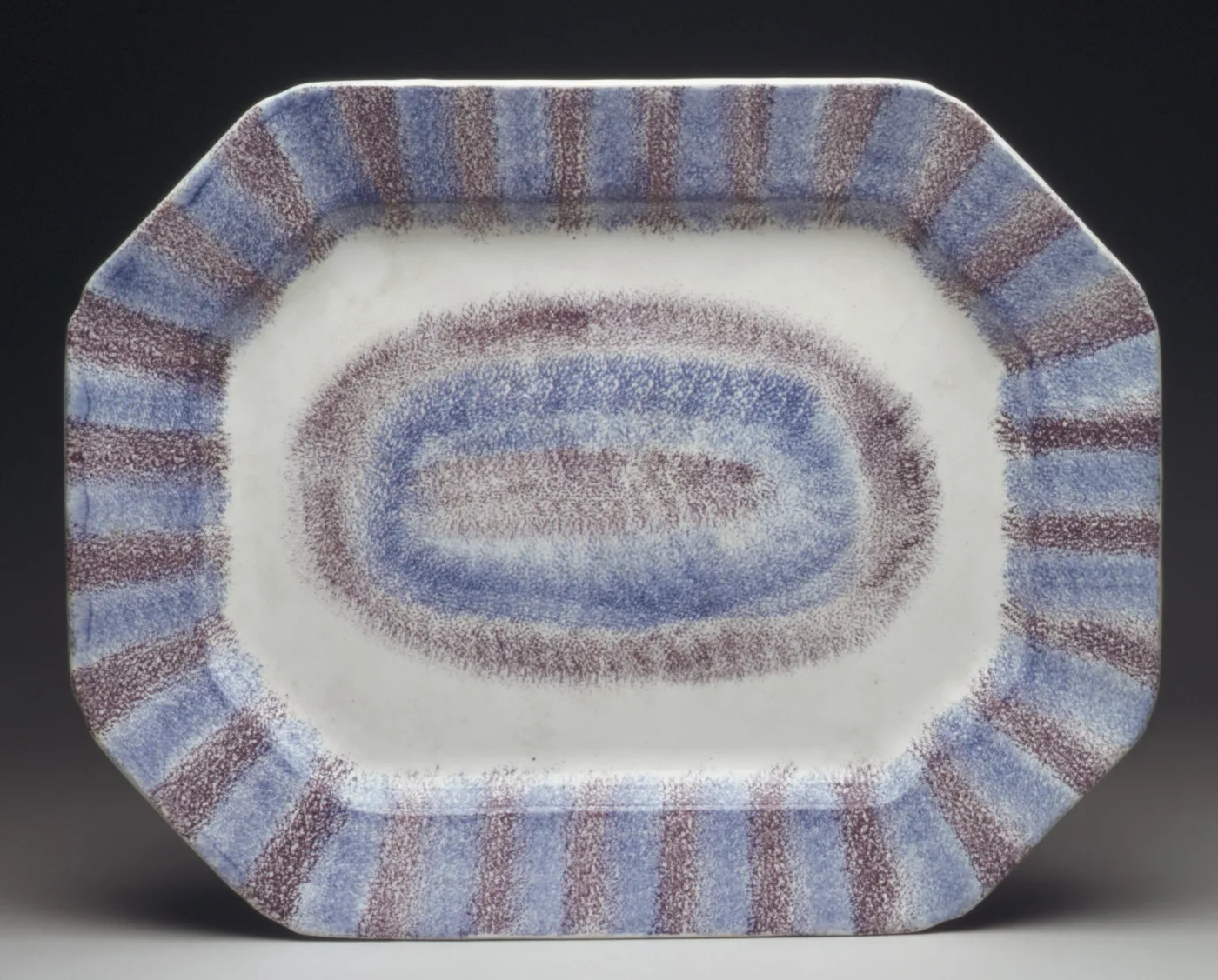
Rainbow arrangements come in several recognized forms. There are bands of different colors circling the rim; vertical stripe or "ribbon" rainbow, where wedges of color radiate outward; and pieces where the spatter covers most of the surface in a multi-color field. The most desirable rainbow pieces combine several strong colors—red, blue, green, purple, yellow—in a clean, well-controlled arrangement, and when a rainbow border surrounds a rare central motif the value climbs sharply. Rainbow spatter with a peafowl or a schoolhouse center is about as good as spatterware gets.
Putting the Ladder Together
The overall rarity ladder in spatterware is a product of three variables multiplied together: border color, border arrangement, and central motif. A blue or red plain border with a simple design center is common and affordable. A purple, green, yellow, brown, or black border raises the piece. A rainbow arrangement raises it further. A rare pictorial motif—peafowl, rose, tulip, and above all schoolhouse or fort—raises it again. And the combinations multiply: a rare motif on a rare-color or rainbow ground is exponentially scarcer and more valuable than either feature alone. Reading a piece therefore means reading all three variables at once and understanding that they compound. This same logic of stacking rarity factors runs through the wider market, and our antique valuation and appraisal guide sets out how to weigh rarity, condition, and demand together in a disciplined way.
Bodies, Glaze, and Dating Clues
Turning a piece over and reading the body is one of the most reliable ways to place spatterware in time and to separate period ware from later copies. Classic spatterware was made on the refined earthenware bodies standard in Staffordshire in the second quarter of the nineteenth century: early pieces tend toward pearlware, with its characteristic slightly bluish, glassy glaze that pools blue in the crevices, while later pieces move to whiteware and heavier ironstone-type bodies as the century progressed and glazes whitened. The body is a soft, porous earthenware, not the vitrified, ringing body of porcelain or stoneware.
The glaze and its aging give further clues. Period spatterware usually shows a soft, slightly irregular glaze that may have fine crazing (a network of tiny surface cracks) developed over generations, honest wear on the base and the high points, and the subtle imperfections of hand production—pinholes, glaze pooling, slight warping, kiln grit on the foot. The pearlware glaze's faint blue tint where it pools is a genuinely useful early indicator, and the shift from that bluish pearlware to a colder, whiter whiteware and ironstone helps bracket a piece within the period. For a fuller account of how to read these early bodies and glazes, and how pearlware differs from the creamware before it and the whiteware after, see our creamware and pearlware identification guide, which covers exactly the bodies that carry most classic spatter.
What the Body Reveals About Fakes
The body is often where reproductions betray themselves. Modern copies frequently use a body that is too white, too heavy, too uniform, or too clean, with a glaze that is glassy and flawless in a way period earthenware rarely is, and with artificial "crazing" or "aging" that looks stained rather than naturally developed. Genuine wear is soft, directional, and concentrated where a piece was actually handled and stacked; fake wear is often uniform, scratchy, or oddly placed. A body that has none of the porosity, imperfection, and honest aging of early earthenware—or that has aging that looks applied rather than earned—should raise immediate suspicion, however convincing the border and motif appear.

Forms: Plates, Cups, Teawares, and Rarities
Spatterware was made as functional tableware, and the form of a piece bears on its rarity and value almost as much as its decoration. The commonest survivors are plates in a range of sizes, from small toddy and cup plates up to dinner plates, and cups and saucers. The cups are worth a special note: period spatter cups are frequently handleless—the small "handleless cup" or tea bowl typical of early nineteenth-century tea drinking—and a spatter cup and saucer is one of the classic collectible units, priced as a pair.
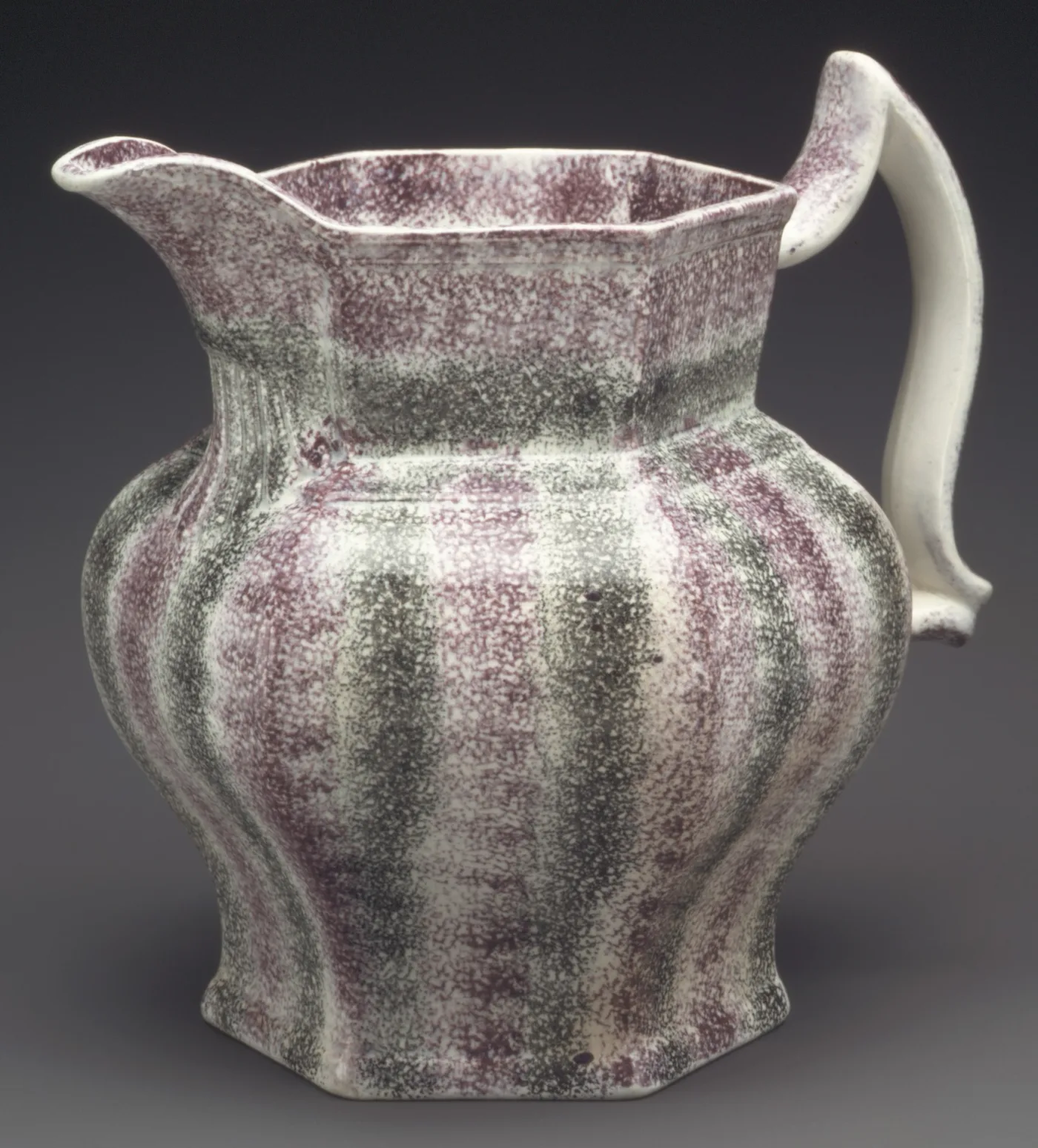
Beyond plates and teacups, spatterware was made in the full range of table and tea forms: teapots, coffeepots, creamers, sugar bowls, waste bowls, cup plates, platters, and serving dishes. The hollowware forms—teapots, sugar bowls, creamers—are scarcer than flat plates because fewer survive intact, and a spatter teapot in good condition with a desirable pattern is a significant piece. Rarer forms still—large platters, unusual serving pieces, miniatures and children's wares—command premiums simply because they are seldom seen.
How Form Interacts with Pattern
Form and decoration multiply in value just as the border and motif variables do. A common plate with a plain border and a design center is entry-level; a rare hollowware form—say a teapot or covered sugar—with a rare motif and a rare-color or rainbow border is a top-tier piece. When assessing a form, consider both its intrinsic scarcity (hollowware over flatware, large over small, complete sets and pairs over singles) and how it carries the decoration (a teapot offers more surface for an ambitious rainbow or a fine peafowl). Matched groups—a set of plates, a complete tea service, a cup-and-saucer pair—are worth more together than the sum of the parts, so original assembled sets should be recognized and kept together where possible.
Marks, or the Lack of Them
Collectors used to porcelain backstamps are often surprised that most classic spatterware is unmarked, and this is normal, not a red flag. As inexpensive Staffordshire earthenware made for export, spatter rarely carried a factory mark; the great majority of genuine period pieces have plain, unmarked bases. The absence of a mark is therefore expected, and attribution rests on the body, glaze, decoration, and form rather than on a backstamp.
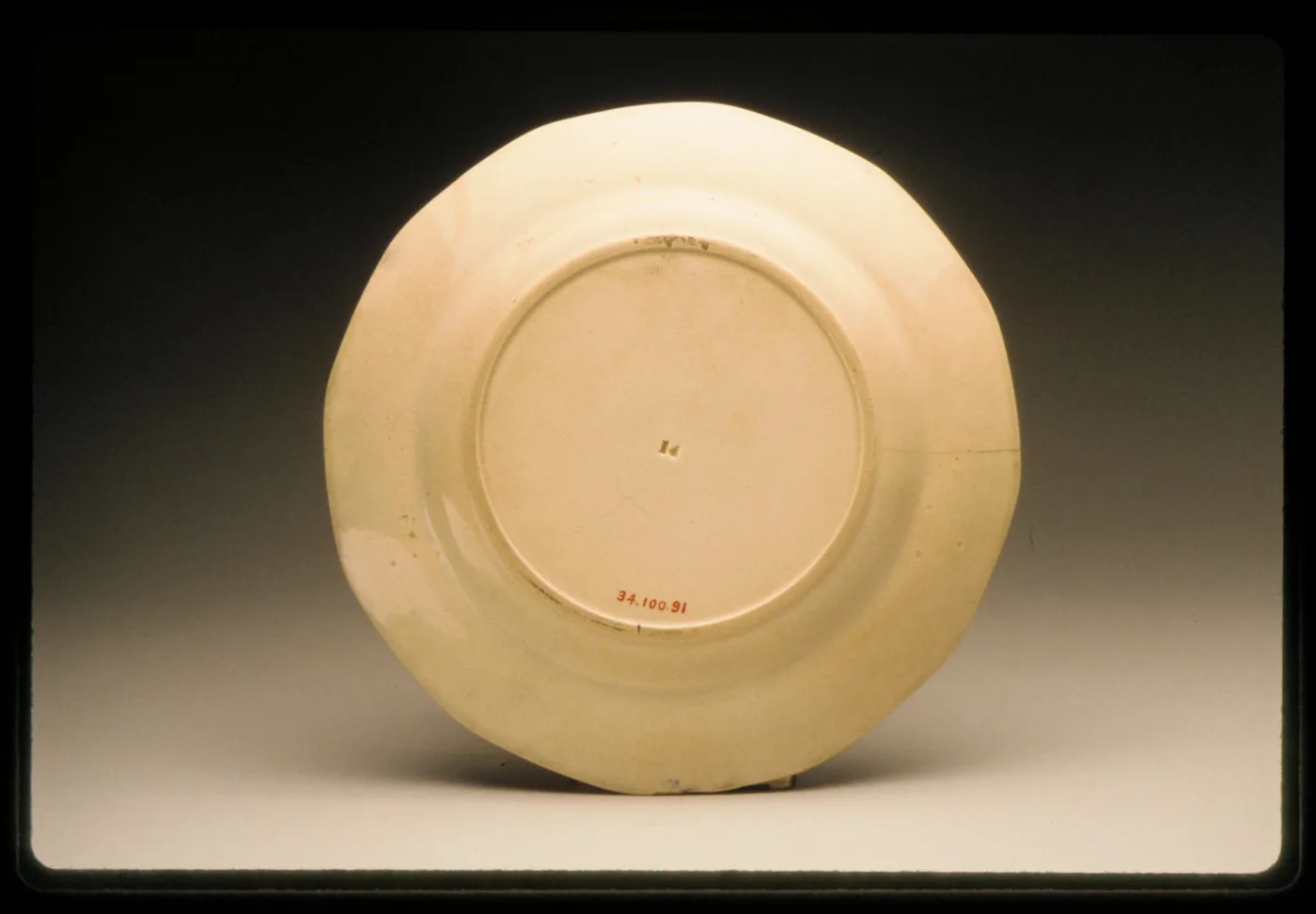
34.100.91, painted on in red. The attribution comes from scholarship — shape, body, palette, documented shards — and not from anything stamped on the object. Most spatterware is unmarked, so a confident maker’s name on a piece offered to you is a claim to check rather than a reassurance, and a painted number like this one records a collection’s history, not a factory’s.
The Metropolitan Museum of Art, CC0
When marks do appear, they are English. Impressed or printed maker's marks of known Staffordshire firms occasionally turn up, as do English registration marks and pattern numbers on some later or better pieces. These are helpful when present, but they are the exception. Later stick-spatter export wares are somewhat more likely to carry marks—including country-of-origin marks such as "ENGLAND" (from 1891) or "MADE IN ENGLAND" (from the 1920s) required for the American market—so a piece marked with a modern country-of-origin statement is by definition later than the classic period, a useful negative dating clue.
Reading Marks Critically
Because the field is unmarked by default, a mark must be read against the object, not trusted on its own. A modern-looking printed mark, a mark that names a maker known for reproductions, or a country-of-origin mark that postdates the classic period all place a piece outside genuine early spatter, whatever its decoration. Conversely, a plausible impressed English maker's mark or period registration mark, consistent with the body and decoration, is a supporting point in favor of authenticity. The general discipline of weighing a mark against the physical evidence—rather than letting a stamp override what the object itself is telling you—is the same approach our authentication and provenance research guide lays out, and it matters especially in a field where the honest default is no mark at all.
Spatterware versus Its Cousins
Spatterware sits inside a cluster of closely related sponged and spattered wares that are constantly confused with one another, and telling them apart is central to identifying and valuing any given piece. The confusion is old and understandable, because the techniques overlap and the trade names have always been used loosely, but the distinctions are real.
Spongeware proper is decorated by dabbing color with a cut or natural sponge, typically as an all-over or bordering pattern, and usually without the reserved hand-painted central motif that defines classic spatterware. Much Scottish and American spongeware is utilitarian dairy and kitchen ware—bowls, crocks, pitchers—decorated with cut-sponge stamps or free-hand sponging rather than the stippled-border-plus-peafowl formula. The two categories shade into each other (a sponged border around a painted center is a genuine gray area), and the same pieces are often mislabeled in both directions, but as a working rule, a reserved hand-painted pictorial center points to spatterware, while an all-over sponged pattern without such a center points to spongeware. Our dedicated spongeware identification guide works through the sponging techniques and the Scottish, Welsh, and American production centers in detail, and it is the natural companion to this article.
Stick Spatter and Transfer Centers
Stick spatter, discussed earlier, is the looser, sprayed border technique of the later Staffordshire export trade, very often framing a transfer-printed or cut-sponge center rather than a freehand painted one. A plate with a coarse, sprayed border around a printed scene is stick-spatter export ware, not classic Pennsylvania German spatter, and it typically trades at much lower prices. Where a spattered border meets a printed center, you are on the boundary between the spatter and transferware traditions, and reading which technique made the center—hand-painted versus transfer-printed—is the key to placing the piece and pricing it correctly.
Gaudy Dutch, Gaudy Welsh, and Adams Rose
Around spatterware sits a family of brightly decorated Staffordshire earthenwares that collectors group together and that are worth distinguishing, because they are often shelved and sold alongside spatter and share its bold, folk-art appeal. Gaudy Dutch is the closest relative: an early (roughly 1810s–1830s) Staffordshire earthenware, also made for the Pennsylvania German market, decorated in bold underglaze blue with bright overglaze enamels in red, green, yellow, and pink, in stylized floral patterns with names like Dahlia, Sunflower, War Bonnet, and Single Rose. Gaudy Dutch is generally earlier, more richly enameled, and rarer than spatterware, and it is a distinct and highly prized category in its own right, though the two are natural companions on a Pennsylvania German dresser.
Gaudy Welsh is a later and more affordable cousin—Welsh and Staffordshire earthenware and porcelain from about the 1830s onward, decorated in underglaze blue with copper luster and bright enamels, in busy floral and "Oyster," "Tulip," and "Grape" patterns. It is more common and less valuable than either Gaudy Dutch or fine spatter. Adams Rose and related "rose" wares—bold red cabbage roses with green leaves on white earthenware, made by Adams and others—overlap with the rose motifs seen in spatter and are frequently found in the same collections.
Keeping the Family Straight
The practical point is to call each ware what it is rather than lumping them under "spatterware" because they share a look and a market. Gaudy Dutch (bold underglaze blue plus bright enamels, early, no spattered border), Gaudy Welsh (blue plus copper luster and enamels, later, common), Adams Rose (bold roses, no spatter), and true spatterware (stippled border plus painted center) are distinct categories with distinct values, even though they were made in the same region for overlapping markets and often live together in collections. Recognizing the differences protects you from paying spatterware money for Gaudy Welsh, or missing a rare Gaudy Dutch piece hiding among the spatter—and it reflects the same folk-art tradition of bold, cheerful Pennsylvania German taste that also shaped the painted furniture, fraktur, and textiles of the same communities.
Reproductions, Revivals, and Fakes
No part of spatter collecting matters more than understanding the reproductions, because the bold, simple, high-value patterns have been copied for well over a century and the market is thick with later ware. The copies fall into a few categories, and they call for different responses.
First are the honest revivals and decorative reproductions. Spatter-style tableware has been made continuously by studio potters, decorative-ware companies, and gift lines throughout the twentieth century and into the twenty-first—Williamsburg-style reproductions, contemporary folk-pottery spatter, and countless decorative "country" pieces. These were made and sold openly as new decorative ware, not as antiques, and there is nothing wrong with them as such; the problem arises only when they are later passed off—through ignorance or intent—as period spatter. Their tells are usually in the body and glaze (too white, too heavy, too flawless, artificially aged) and in the decoration (too crisp, too regular, too carefully painted, with colors that are slightly off the period palette).
Deliberate Fakes and How to Resist Them
Second are deliberate fakes—modern pieces made and aged specifically to deceive, or genuine plain old earthenware later "improved" with added spatter and a painted motif to raise its value. These are less common than honest revivals but more dangerous, and they cluster where the money is: peafowl, schoolhouse, rose, and rainbow pieces. Resisting them means reading the object as a whole rather than being seduced by a desirable motif. Check the body for genuine early earthenware character and honest, directional wear; check the glaze for period softness and natural (not stained-in) crazing; check the spatter for dense, saturated, under-glaze application rather than a surface-painted or too-uniform border; and check the motif for the spontaneous, slightly irregular freehand quality of period painting rather than a careful, mechanical copy. Where serious money is involved, verify the decoration is under the glaze (not painted over it), examine under UV for later overpainting and restoration, and lean on specialist folk-pottery and Pennsylvania German auction houses whose comparables and expertise are the collector's best protection. As with all high-value antiques, a documented history and an object that survives close physical scrutiny together are worth far more than a striking pattern alone.
Condition and Value
Condition governs spatterware value sharply, because these were soft earthenwares in daily use and damage is common. Inspect the whole piece under strong light: look for chips and flakes on the rim and foot, hairline cracks, glaze loss and flaking, stains, and wear that has rubbed the border or motif thin. Because the decoration is under the glaze, surface wear that has dulled or removed the painted motif is a serious fault, and rim chips on plates and spouts and handles on hollowware are the commonest damage. Restoration—overpainting, filled chips, riveted or glued repairs—must be identified, because it materially affects value; the old staple or rivet repairs sometimes found on prized pieces tell you the object was valued enough to mend, but they are still condition faults.
On value, the hierarchy follows the variables set out through this guide, multiplied together: central motif, border color, border arrangement, form, body/period, and condition. Common blue and red plain-border plates with simple design centers occupy an accessible entry range; rarer colors (purple, green, yellow, brown, black), rainbow arrangements, and named pictorial motifs (peafowl, rose, tulip) climb steadily; and the trophy pieces—schoolhouse, fort, and other rare motifs, especially on rare-color or rainbow grounds and in scarce forms—reach well into four figures and beyond at specialist auction. Damage discounts sharply, and a mislabel (spatter confused with spongeware or stick spatter, or a revival taken for period) can mean a tenfold error in either direction. For a structured way to weigh rarity, condition, form, and market demand together, our antique valuation and appraisal guide gives the framework, and it applies directly to a field where a handful of variables compound so dramatically.
Care and Display
Care is gentle and conservative. Spatterware is soft, porous earthenware with under-glaze decoration and often old crazing, so hand-wash only in lukewarm water with the mildest soap, never in a dishwasher and never with abrasives, which can abrade the glaze and dull the decoration; avoid soaking, which can carry staining into a crazed body. Support plates and hollowware fully when handling, cushion pieces on display so rims cannot chip against one another, and use plate stands and shelf liners to prevent knocks. Keep pieces out of harsh direct sunlight and away from sudden temperature swings, which stress old glazes. Treated this way, a spatter plate keeps both its folk-art charm and its value, and the bright peafowl or rose that a Pennsylvania German family set on their dresser two centuries ago stays legible for the next collector.
Field Checklist Before You Buy
When a spatter piece is in front of you, work this sequence before you think about price.
First, confirm it is actually spatterware: is there a stippled or spattered border framing a reserved center, and is that center hand-painted (spatterware) rather than transfer-printed (stick-spatter export ware) or absent (spongeware)? Read the border technique—dense, even, saturated sponged/stippled color (classic period) versus loose, coarse, sprayed stick spatter (later export)—and note the border color and arrangement: common blue or red, scarcer purple, rare green/yellow/brown/black, or a top-tier rainbow.
Second, read the central motif against the rarity ladder: common design spatter (four-petal, star, simple devices) versus named pictorial patterns (peafowl, rose, tulip, cockscomb) versus the rare trophies (schoolhouse, fort, thistle, bull's eye), and judge the freehand quality—spontaneous and slightly irregular (period) versus careful and mechanical (copy). Third, turn it over and read the body and glaze: soft, porous earthenware with a pearlware-bluish or period-white glaze, fine natural crazing, and honest directional wear (period) versus a too-white, too-heavy, too-flawless body with stained-in or applied "aging" (reproduction).
Fourth, read the form and how it carries the decoration: common plate or handleless cup-and-saucer versus scarcer hollowware (teapot, sugar, creamer), large platter, or miniature, and whether pairs and sets are intact. Fifth, run the marks test remembering the honest default is unmarked: no mark is normal and fine, a plausible impressed English maker or registration mark supports authenticity, and a modern printed mark or a post-1891 country-of-origin mark places the piece outside the classic period. Sixth, assess condition honestly—rim and foot chips, hairlines, glaze flaking, rubbed decoration, restoration and old repairs—and remember it discounts value sharply.
A piece that shows a genuine stippled border in a readable color and arrangement, a spontaneous hand-painted motif of known type, a soft early-earthenware body with honest wear and natural crazing, a form consistent with period spatter, an appropriately unmarked (or plausibly English-marked) base, and sound condition is very likely the real thing—and if a rare motif meets a rare-color or rainbow ground on a scarce form, you may be holding a trophy. Practiced as a routine, this sequence turns spatterware from one of the most mislabeled corners of the ceramics market into one of its most rewarding: the patterns are bold and legible, the rarity factors compound in ways a careful eye can read, and the collector who can separate a dense period peafowl on pearlware from a bright modern revival has a real and lasting advantage at every country auction, estate sale, and dealer's shelf.