Antique Staffordshire Figurines: Complete Identification & Value Guide
Staffordshire figurines represent one of the most enduring and beloved traditions in English ceramic history. Produced in the potteries of Staffordshire, England, from the early 18th century through the Edwardian era and beyond, these charming figures decorated the mantelpieces, shelves, and cabinets of homes across Britain and the wider world. From humble cottage ornaments to finely modeled portrait figures, Staffordshire pottery figures chronicle the tastes, heroes, and everyday life of generations past.
Whether you have inherited a pair of Staffordshire spaniels, discovered a flatback figure at a flea market, or are building a serious collection, understanding how to identify, date, and assess the value of these figurines is essential. The market for Staffordshire figures remains strong, with rare early examples commanding thousands at auction, while even common Victorian flatbacks hold steady appeal among collectors and decorators alike.
This guide covers everything you need to know about Staffordshire figurines, including the major types and forms, key makers and their marks, dating techniques, how to spot reproductions, condition and value factors, and practical advice for building and caring for a collection. With an estimated reading time of 22 minutes, this is your definitive resource for navigating the rich world of Staffordshire pottery figures.
Table of Contents
- History of Staffordshire Pottery Figures
- Types of Staffordshire Figurines
- Staffordshire Dogs - The Most Popular Collectible
- Dating Staffordshire Figurines
- Identifying Genuine Staffordshire Marks & Makers
- Construction & Decoration Techniques
- Portrait Figures & Historical Characters
- Flatback Figurines - The Victorian Mantelpiece Staple
- Pearlware vs Earthenware Staffordshire Figures
- Reproductions & Fakes - How to Spot Them
- Condition Assessment & Value Factors
- Building a Staffordshire Figurine Collection
- Care & Display of Staffordshire Figurines
- Resources for Staffordshire Collectors
History of Staffordshire Pottery Figures
The Staffordshire Potteries, a cluster of six towns in the English Midlands now collectively known as Stoke-on-Trent, became the center of English ceramic production for a combination of geographical and economic reasons. Rich deposits of local clay, abundant coal for firing kilns, and excellent canal and later railway connections made the region ideal for pottery manufacture on an industrial scale. By the mid-18th century, hundreds of small workshops and larger factories were producing a vast range of ceramic goods, from utilitarian tableware to the decorative figurines that are the subject of this guide.
Early Origins: 17th and Early 18th Century
The earliest Staffordshire figures date to the late 17th century, when potters began producing simple slip-decorated earthenware figures. These primitive pieces, often depicting horsemen, musicians, or animals, were modeled by hand and decorated with colored slips (liquid clays) in the manner of slipware dishes. By the 1720s and 1730s, potters such as Thomas Astbury and John Astbury were creating more refined figures using agate ware (mixed colored clays) and salt-glazed stoneware. These early figures are exceptionally rare and valuable today, representing the dawn of an industry that would last for centuries. For broader context on how Staffordshire fits within the wider ceramic tradition, see our guide to identifying antique ceramics and pottery.
The Georgian Golden Age: 1740-1800
The mid-18th century saw a dramatic leap in quality and sophistication. The introduction of refined earthenware bodies, including creamware and pearlware, provided a smooth, pale canvas for detailed modeling and decoration. The Ralph Wood family (father and son, both named Ralph) became the most celebrated figure makers of this era, producing superbly modeled pieces decorated with translucent colored glazes in muted tones of green, brown, blue, and ochre, and originating the form now known as the Toby jug. Their figures, often depicting classical or allegorical subjects, are among the most sought-after of all Staffordshire figures. Other notable Georgian-era makers include Enoch Wood, who produced large, finely detailed figures, and Obadiah Sherratt, known for his elaborate, sometimes grotesque, figural groups that are favorites with collectors today.
The Victorian Era: 1840-1900
The Victorian period brought the greatest proliferation of Staffordshire figures. The invention of press-molding and the development of the flatback form allowed figures to be mass-produced cheaply and efficiently. These brightly painted mantelpiece ornaments depicted an enormous range of subjects, from Queen Victoria and Prince Albert to military heroes, theatrical performers, animals, pastoral scenes, and even notorious criminals. Factories such as those of Sampson Smith, Thomas Parr, and the Alpha Factory turned out figures by the tens of thousands, creating the vast body of Staffordshire figures that collectors encounter today. The figures served as the popular art of their day, bringing images of famous people and events into ordinary homes long before the age of photography and mass media. Households that could not afford pottery figures often bought hand-painted plaster chalkware versions of the same animals and subjects as an even cheaper mantel ornament. The Victorian era produced distinctive decorative styles that influenced all forms of household art, including these cherished figurines.
Edwardian Decline and Later Production
By the early 1900s, changing tastes and competition from cheaper imported goods led to a sharp decline in the quality and variety of Staffordshire figures. Production continued on a reduced scale through the 20th century, with some factories producing reproductions of Victorian designs, even as Continental rivals such as the German Hummel figurines, the flower-encrusted Italian Capodimonte porcelain figures, and later the slender, pastel Lladró porcelain figurines from Spain began capturing the mass-market figural ceramic audience from the 1930s onward. Understanding this timeline is crucial for dating and valuing figures accurately.
Types of Staffordshire Figurines
Staffordshire figures encompass a remarkable variety of forms, each with distinctive characteristics that aid identification and dating. Understanding these categories is the first step to becoming a knowledgeable collector.
Flatback Figurines
The most common type of Staffordshire figure, flatbacks are so named because their reverse side is flat and undecorated, as they were designed to stand on a mantelpiece against a wall. Produced primarily from the 1840s onward, flatbacks were press-molded in two-piece molds and are typically decorated with bright overglaze enamel colors. Subjects range from royal portraits and military figures to pastoral scenes, animals, and theatrical characters. The flat, unfinished back is the single most reliable indicator of a Victorian Staffordshire figure.
Portrait Figures
Portrait figures depict identifiable real people, most commonly royalty, military heroes, politicians, and theatrical performers. These are among the most collected Staffordshire figures because they can often be dated precisely based on the historical figure depicted and the event commemorated. A figure of a Crimean War general, for example, can be dated to the mid-1850s. Portrait figures provide a fascinating visual record of popular heroes and public events in 19th-century Britain.
Animal Figures
Animals were among the most popular subjects throughout the entire history of Staffordshire figure production. Dogs (especially spaniels), cats, horses, cows, sheep, deer, lions, elephants, and exotic animals all appear. Early Georgian animal figures tend to be realistically modeled, while Victorian examples are often more stylized and decorative. Staffordshire dogs deserve their own section below, as they are by far the most popular animal form among collectors.
Bocage Groups
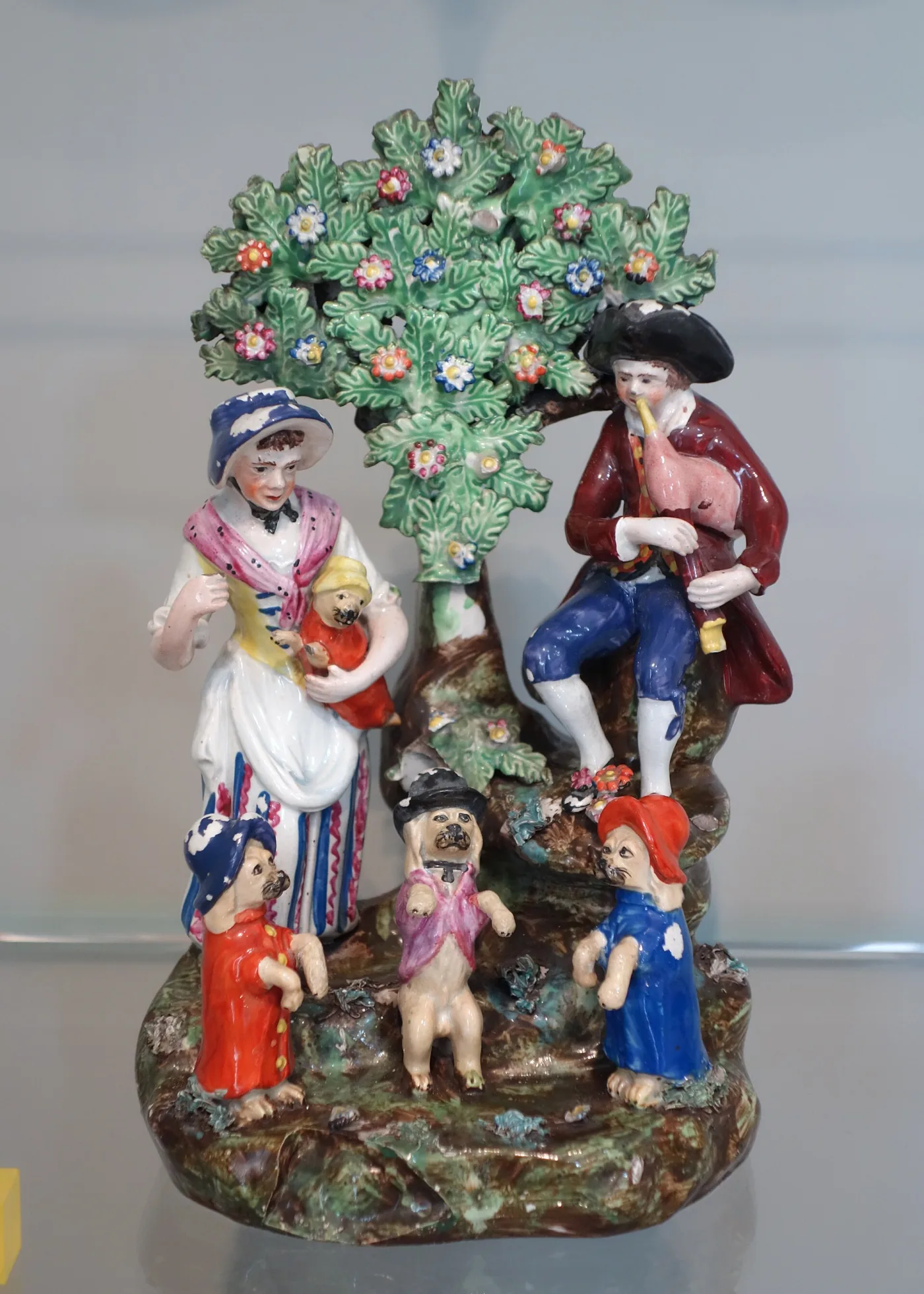
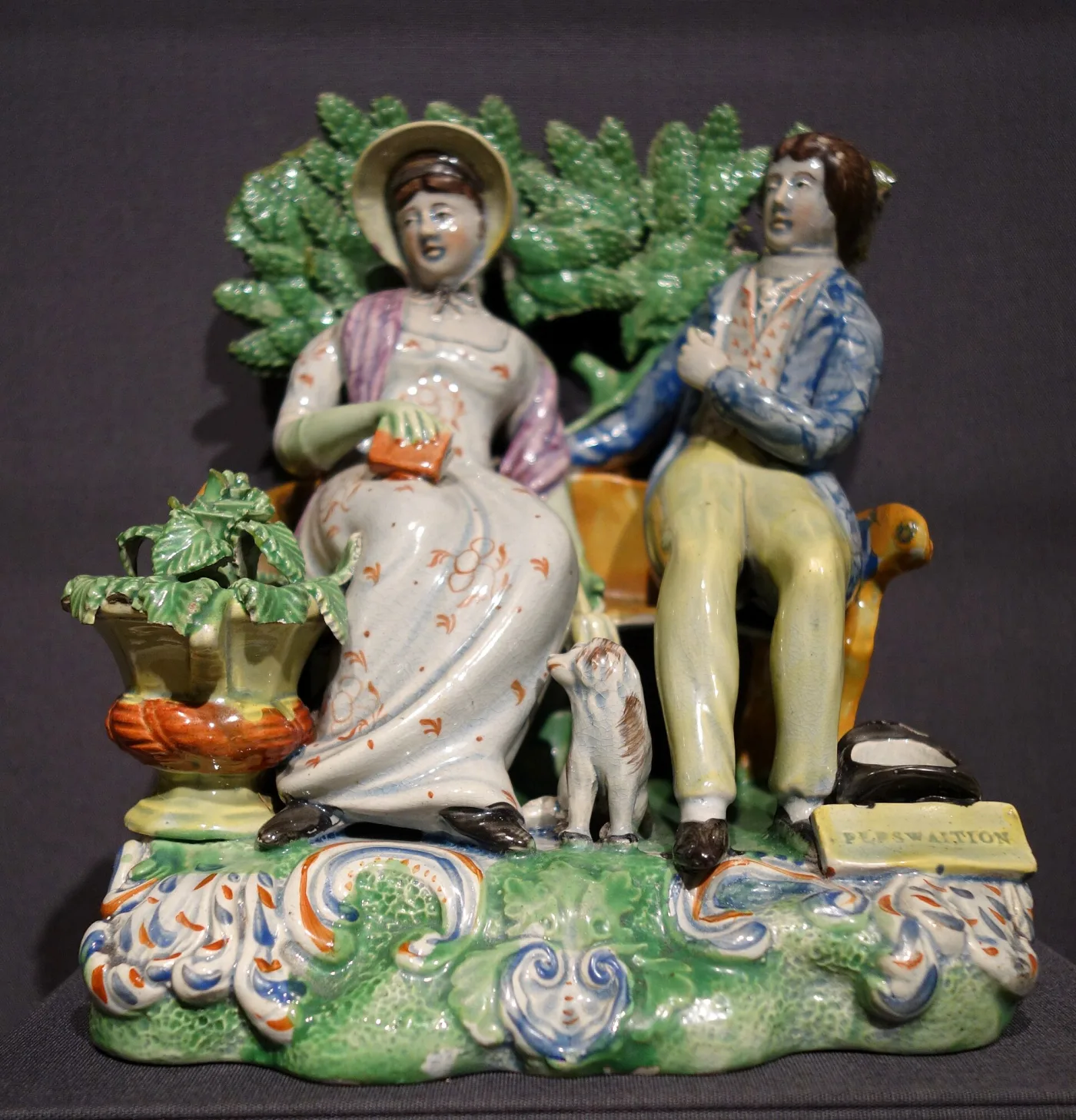
Bocage (from the French word for woodland) refers to the decorative arbors of leaves, flowers, and branches that form a backdrop to many early Staffordshire figures. Common from the 1780s through the 1830s, bocage groups often depict pastoral or romantic subjects set within elaborate floral canopies. The bocage technique was influenced by continental European porcelain traditions, and early Staffordshire bocage figures can rival the quality of fine porcelain figurines. The presence and style of bocage is an important dating clue: early examples have finely modeled, naturalistic leaves, while later versions become increasingly stylized and coarse.
Spill Vases
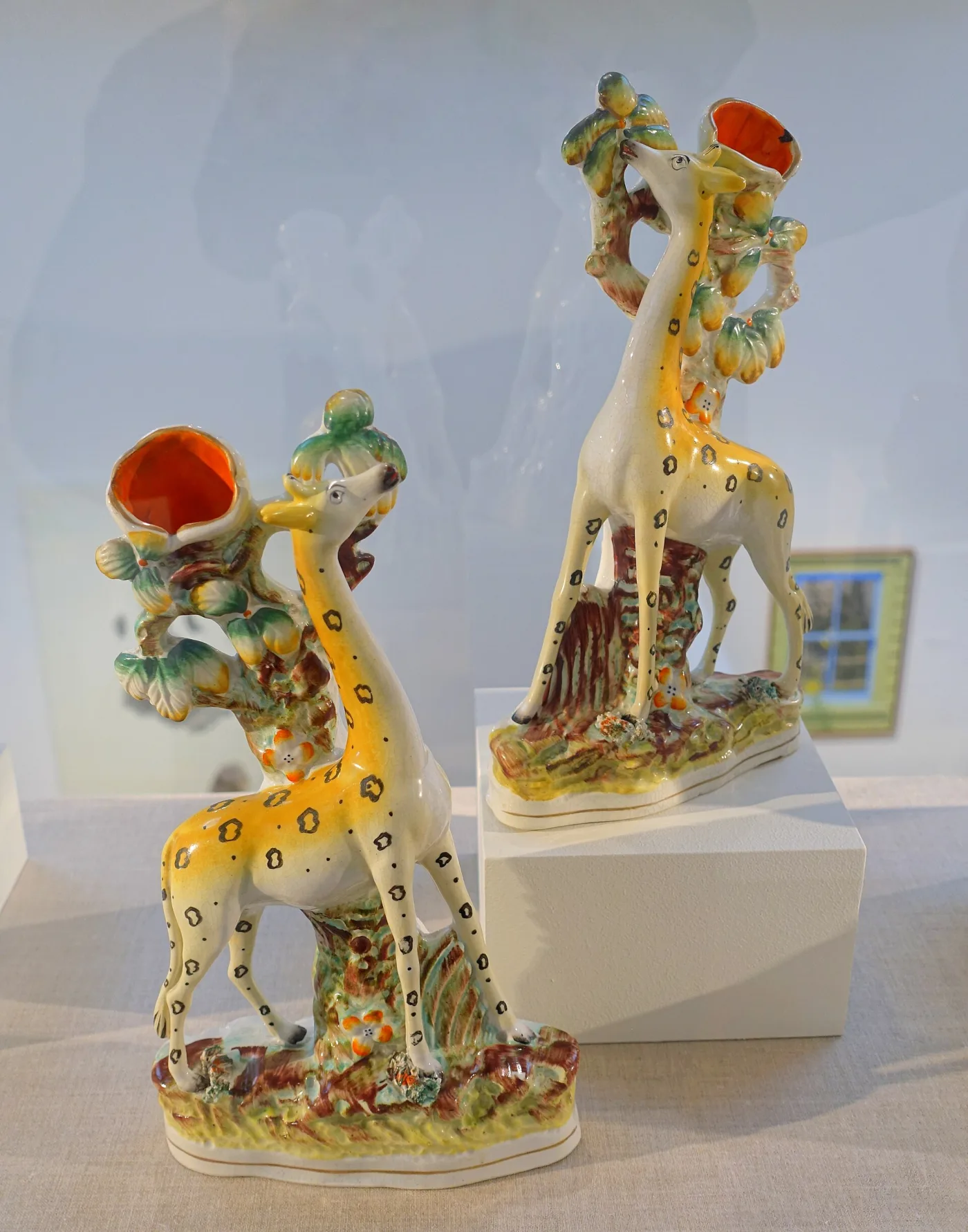
Spill vases are figural groups incorporating a cylindrical vase or holder, originally used to hold spills (thin wooden or paper tapers used to transfer flame from a fire to light candles or pipes). Spill vases were enormously popular from the 1830s through the 1870s, and their subjects mirror those of other Staffordshire figures: animals, people, castles, and rural scenes. The presence of the spill holder distinguishes these pieces from purely decorative figurines and indicates a specific date range.
Equestrian Figures
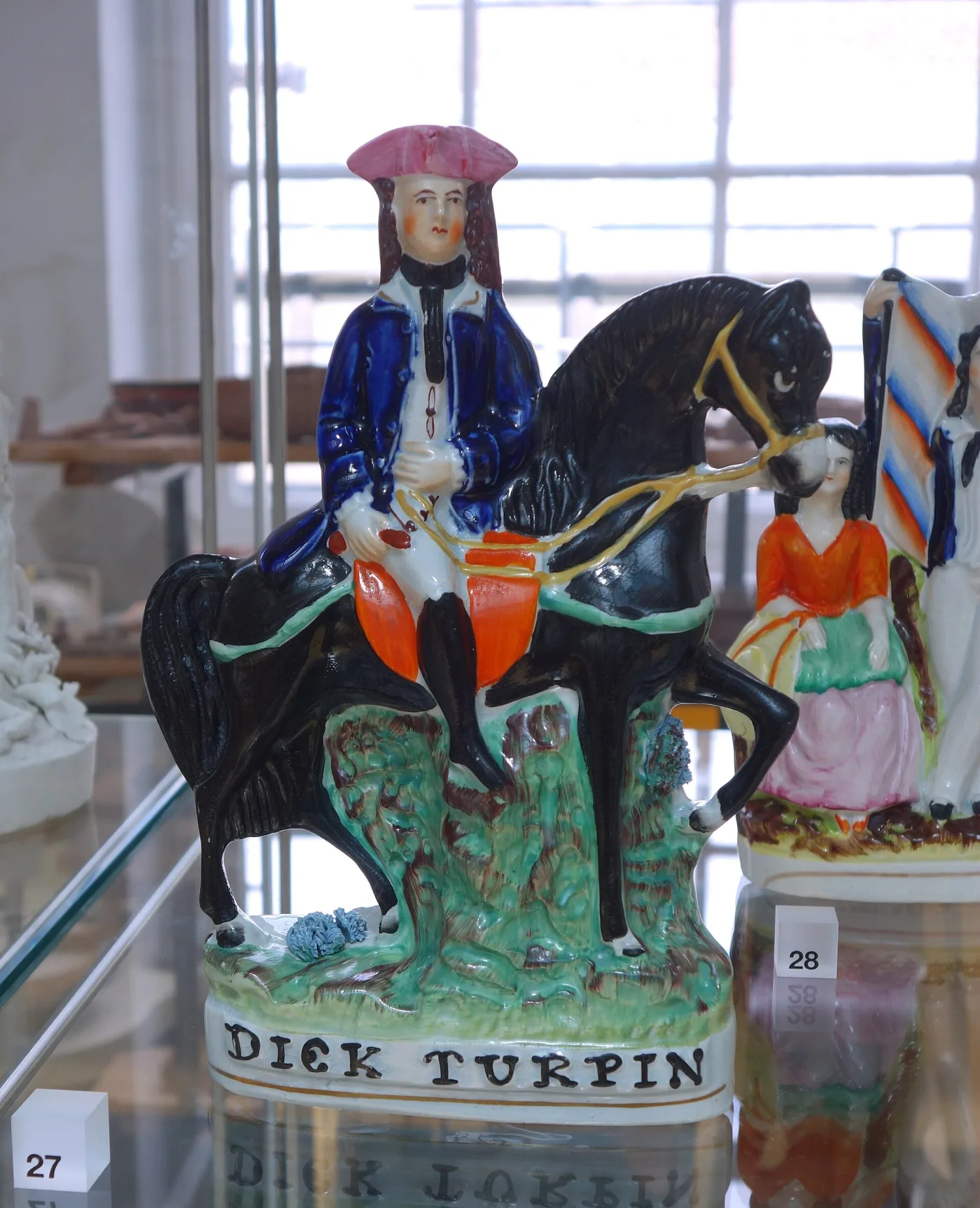
Figures of riders on horseback form a distinct and popular category. Subjects include military heroes (particularly Crimean War and Boer War figures), royalty, highwaymen such as Dick Turpin and Tom King, and huntsmen. Equestrian figures range from small, simple pieces to large, elaborate groups. The quality of the horse modeling and the accuracy of military details can help with both dating and attribution.
Pastoral and Romantic Figures
Pastoral figures, depicting shepherds, shepherdesses, farmers, and rural workers, were popular throughout the Georgian and Victorian periods. These figures draw on a long European tradition of idealized rustic imagery. Romantic figure pairs, sometimes called courting couples, show men and women in affectionate poses, often beneath bocage canopies or beside a clock or fountain. These figures frequently appear as mantelpiece sets of three (a pair flanking a central ornament).
Staffordshire Dogs - The Most Popular Collectible
No discussion of Staffordshire figures would be complete without a dedicated section on Staffordshire dogs, which are arguably the single most recognizable and widely collected form of English pottery figure. The iconic Staffordshire spaniel, seated upright with a golden chain around its neck, is a universally recognized symbol of English domestic life and remains one of the most enduringly popular antique collectibles.
Spaniels: The Classic Staffordshire Dog
The King Charles spaniel is the quintessential Staffordshire dog form. Almost always produced in pairs (one facing left, the other right, for symmetrical mantelpiece display), these seated spaniels feature large, doleful eyes, curly coats rendered in copper luster or russet and white enamel, and a gold-painted chain and padlock collar. The earliest examples, from the 1840s, tend to be smaller and more finely painted, while later Victorian spaniels grew progressively larger and less carefully decorated. Staffordshire spaniels range in size from just a few inches to over 16 inches tall, with the largest pairs being particularly desirable.
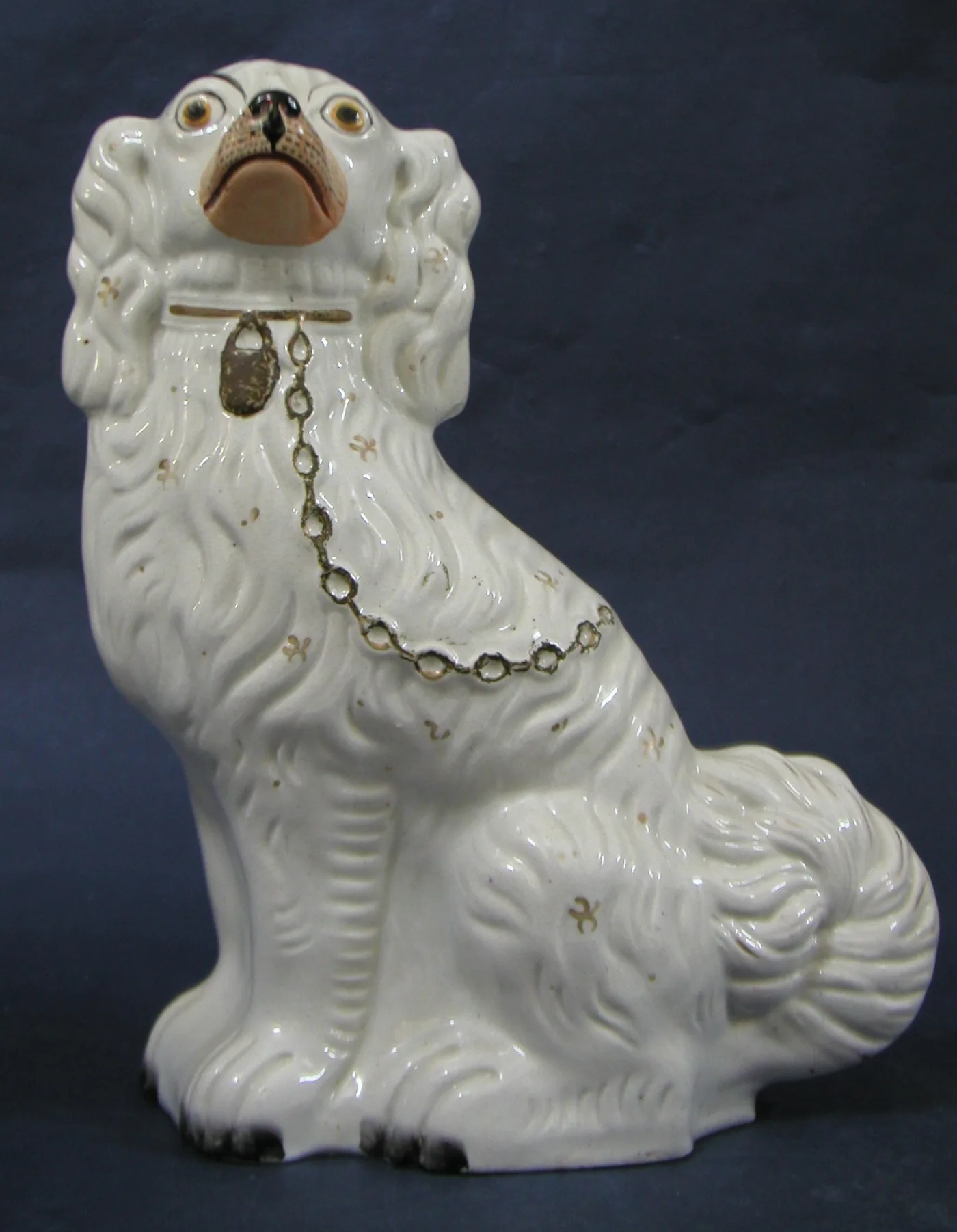
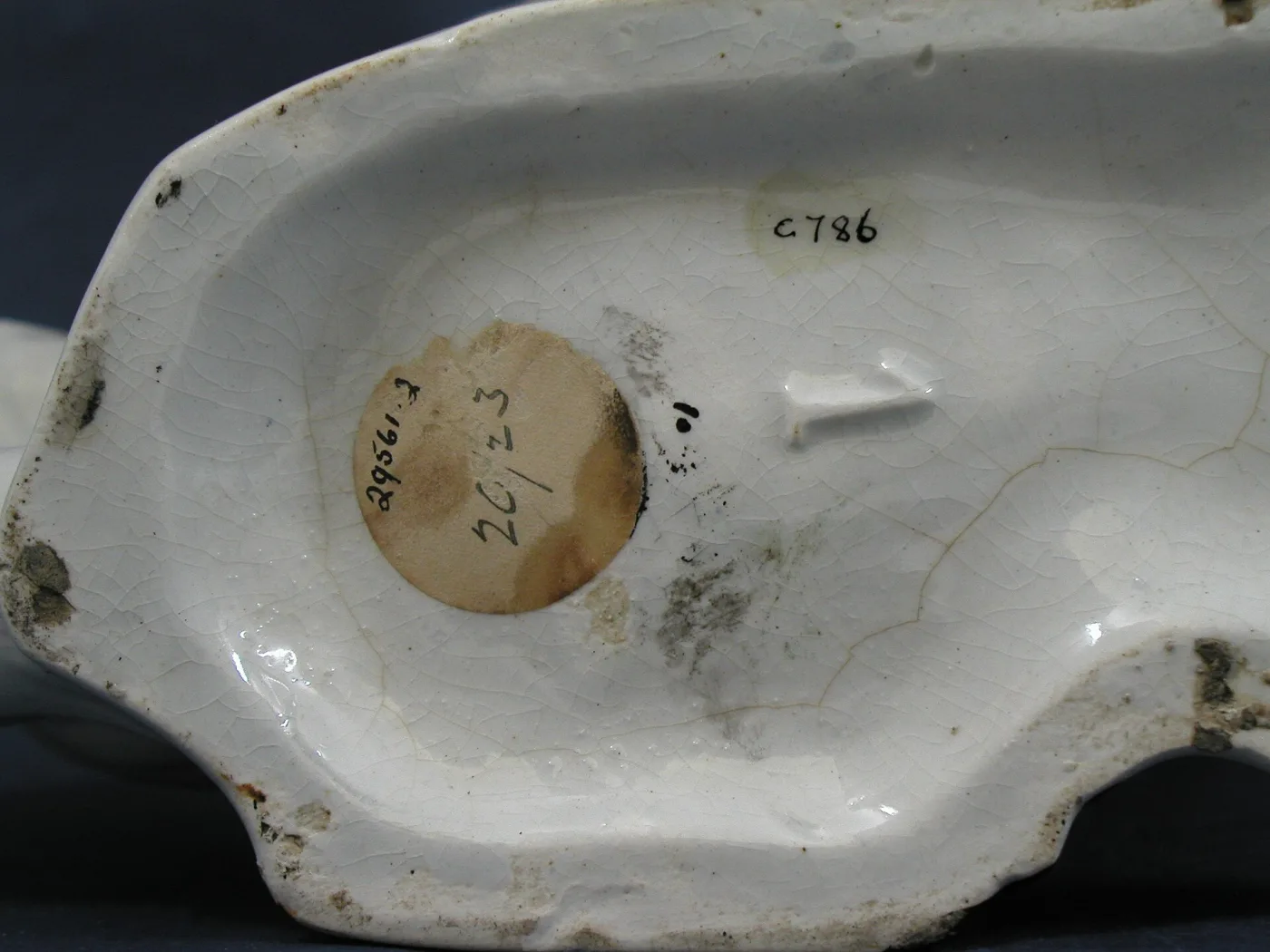
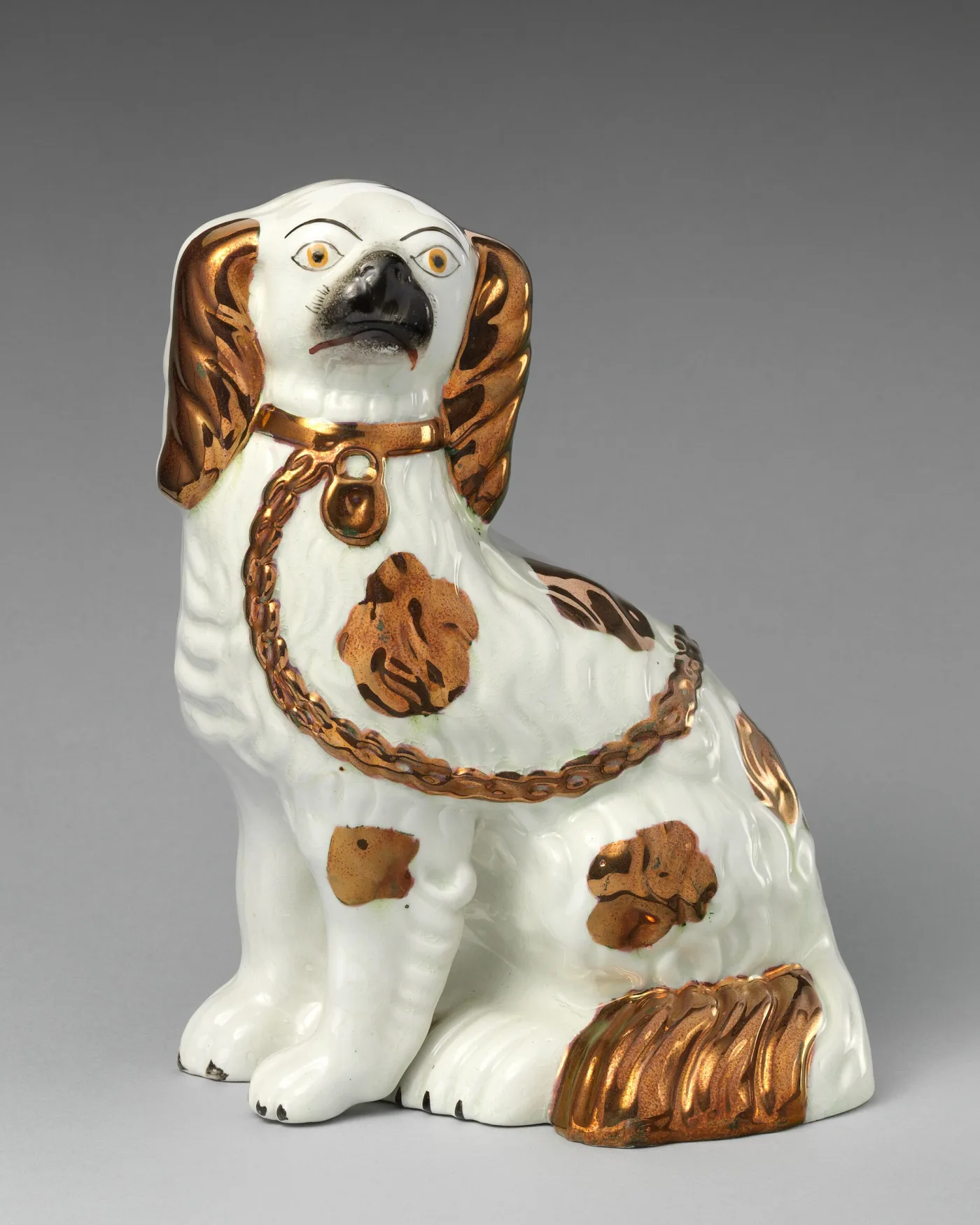
Turn every spaniel over before you buy it, and compare what you see with the second photograph. A press-moulded Victorian dog is a shell: the interior is deeply hollow, follows the outside contours, and carries the same glaze and the same crazing as the visible surface. Dirt sits in the low points and around the foot rim because it was pressed there by a century of mantelpieces, not brushed on evenly. The ink numbers here are museum accession marks, not factory marks — Staffordshire dogs are almost never marked by their makers. Then look back at the front: worn gilding rubs away first on the high points a hand touches, leaving a faint brown residue in the recesses. Gilding that is uniformly bright, or uniformly dull, on a dog whose glaze is otherwise worn has usually been renewed.
Poodles
Poodles were the second most popular dog breed depicted in Staffordshire pottery. They typically stand with one paw resting on a basket of fruit or flowers, and their coats are rendered with small shredded-clay curls that give a distinctive textured appearance. Poodles with separately modeled baskets of shredded-clay flowers are sometimes called "poodles with confetti" and are particularly sought after. White poodles with colored spots are the most common, but all-white and colored examples also exist.
Greyhounds
Greyhounds appear in several standard poses: standing, lying down, or with a captured hare at their feet. These sleek, elegant figures were popular from the 1840s through the 1880s and are often found in pairs. The greyhound with hare form is particularly associated with Staffordshire and remains a strong collectible. Color variations include white with copper luster markings, all-white, and occasionally black or grey.
Dalmatians and Other Breeds
Dalmatians, pugs, whippets, and various terrier-type dogs were also produced, though in smaller numbers than spaniels and poodles. Dalmatians are easily recognized by their black-spotted white coats and are relatively scarce. Unusual breeds and rare color variations command premium prices among specialist dog-figure collectors.
Variations and Novelty Dog Figures
Beyond standard breed depictions, Staffordshire potters produced dog figures with pen holders, watch stands, and inkwells incorporated into their designs. Dogs sitting on cushions, dogs with puppies, and dogs wearing hats or carrying baskets add variety and whimsy to this popular category. Pairs of dogs flanking a clock face or a barometer are particularly decorative and sought after.
Dating Staffordshire Figurines
Accurately dating a Staffordshire figure requires careful examination of multiple characteristics, including body type, glaze, decoration method, subject matter, and construction technique. While precise dating is often impossible without documented provenance, figures can generally be placed within broad date ranges based on their physical characteristics.
Early Period: 1740-1780
Figures from this period are typically made from refined creamware or salt-glazed stoneware. They are fully modeled in the round (decorated on all sides, not flat-backed). Decoration relies on colored glazes rather than enamel paints, producing soft, translucent colors. Figures tend to be relatively small (typically under 10 inches) and are mounted on simple, often irregular bases. The modeling quality is generally high, with careful attention to facial features and anatomical detail. Mold seams may be visible but are usually carefully trimmed. These early figures are rare and command the highest prices.
Late Georgian Period: 1780-1840
This transitional era saw the introduction of pearlware bodies (identifiable by a bluish tinge in the glaze) and the increasing use of overglaze enamel decoration alongside or replacing colored glazes. Bocage groups flourished during this period. Figures became somewhat larger, and bases grew more elaborate, often featuring titled plaques. The work of named makers such as John Walton (who typically marked his pieces with a scroll on the reverse) and Obadiah Sherratt is associated with this period. Construction remains fully in-the-round, but simpler press-molded techniques begin to appear alongside traditional hand-modeling.
Victorian Golden Age: 1840-1900
The introduction of the flatback form in the 1840s marks the beginning of the Victorian golden age of Staffordshire figures. These press-molded, front-only figures were produced in enormous quantities and are the most commonly encountered type today. Victorian figures are decorated with bright overglaze enamels (typically red, blue, green, black, and flesh tones) and often feature gilding. Bases tend to be oval or rectangular with painted or gilded borders. Subjects overwhelmingly reflect contemporary events, personalities, and popular culture. Body composition is typically a coarse, buff-colored earthenware. Many Victorian figures bear no marks whatsoever, making attribution to specific factories difficult. The related tradition of transfer-printed Staffordshire pottery shares many of the same makers and techniques.
Edwardian Decline: 1900-1920s
Late-period Staffordshire figures show a noticeable decline in quality. Colors become cruder, modeling is less detailed, and the range of subjects narrows. Many Edwardian figures are simplified reproductions of popular Victorian designs. The earthenware body may appear more yellow or grey than the warm buff of earlier Victorian pieces. These late figures have lower collector value but can still be decorative and interesting.
Identifying Genuine Staffordshire Marks & Makers
One of the greatest challenges in Staffordshire figure collecting is attribution, because the vast majority of pieces, particularly Victorian flatbacks, bear no maker's mark at all. However, some important makers did mark their work, and certain stylistic characteristics can help attribute unmarked pieces to specific factories or workshops.
Ralph Wood (Father & Son, c.1748-1801)
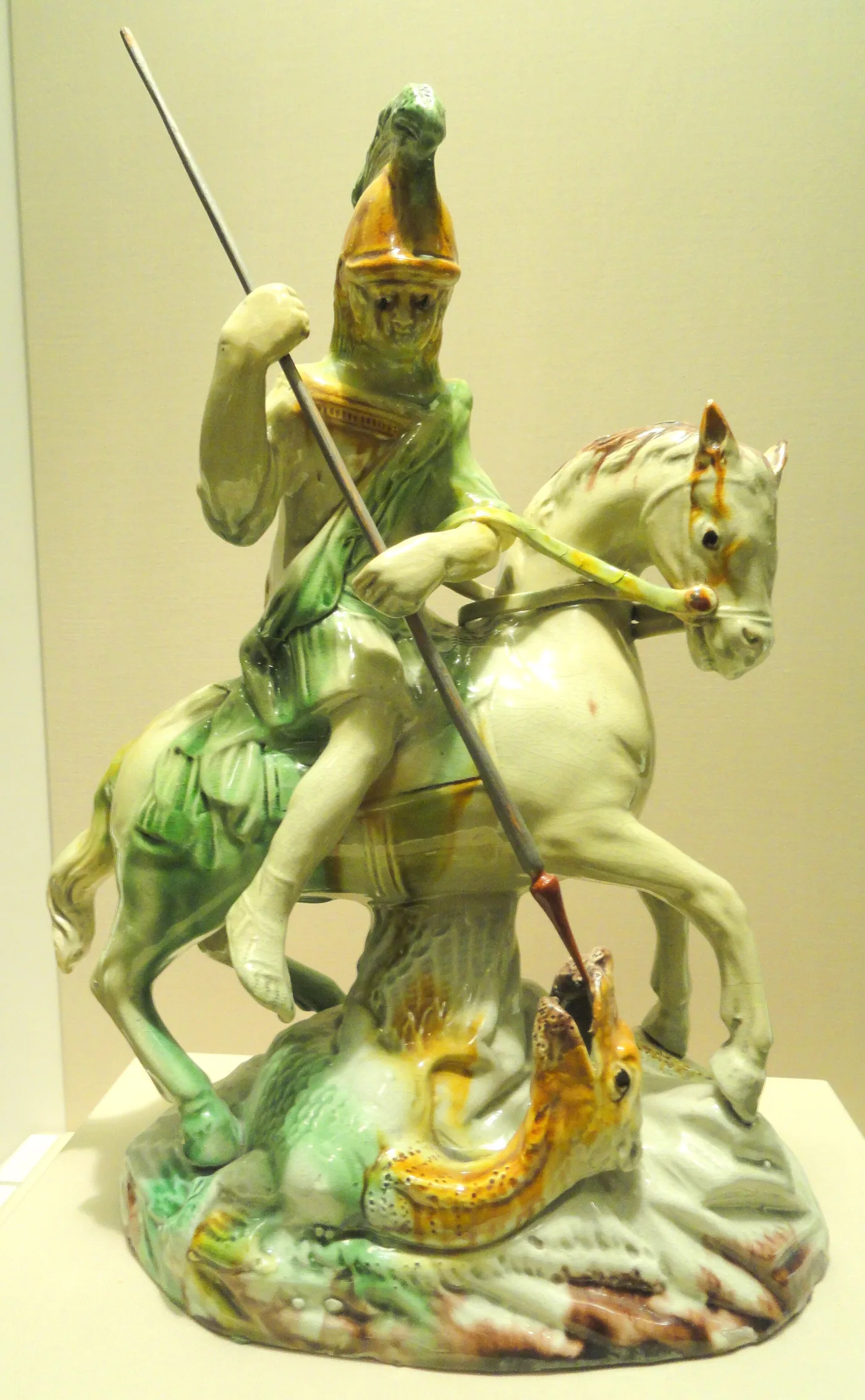
The Ralph Wood workshop produced some of the finest Staffordshire figures ever made. Their pieces are characterized by superb modeling and decoration with translucent colored glazes in controlled, naturalistic palettes. Ralph Wood figures occasionally bear impressed mold numbers on the base, and a few rare examples carry the impressed name "Ra. Wood" or "R. Wood." The quality of glazework and modeling is the primary means of attribution. Ralph Wood figures are among the most valuable Staffordshire figures, with important examples selling for five-figure sums at auction.
Enoch Wood (1759-1840)
Enoch Wood, sometimes called "the father of the Potteries," operated one of the largest Staffordshire factories. He produced large, finely detailed figures that sometimes bear the impressed mark "ENOCH WOOD" or "E. WOOD." His busts of prominent figures, including John Wesley, are particularly celebrated. Enoch Wood figures bridge the gap between the refined Georgian tradition and the mass-produced Victorian era.
John Walton (active c.1810-1835)
John Walton is one of the most readily identifiable Staffordshire makers because he consistently marked his work with a raised scroll on the back bearing the impressed name "WALTON." His figures are characterized by elaborate bocage backdrops and bright overglaze enamel decoration. Common subjects include pastoral groups, religious figures, and animals. The presence of the Walton scroll is one of the few reliable marks in Staffordshire figure collecting.
Obadiah Sherratt (active c.1815-1846)
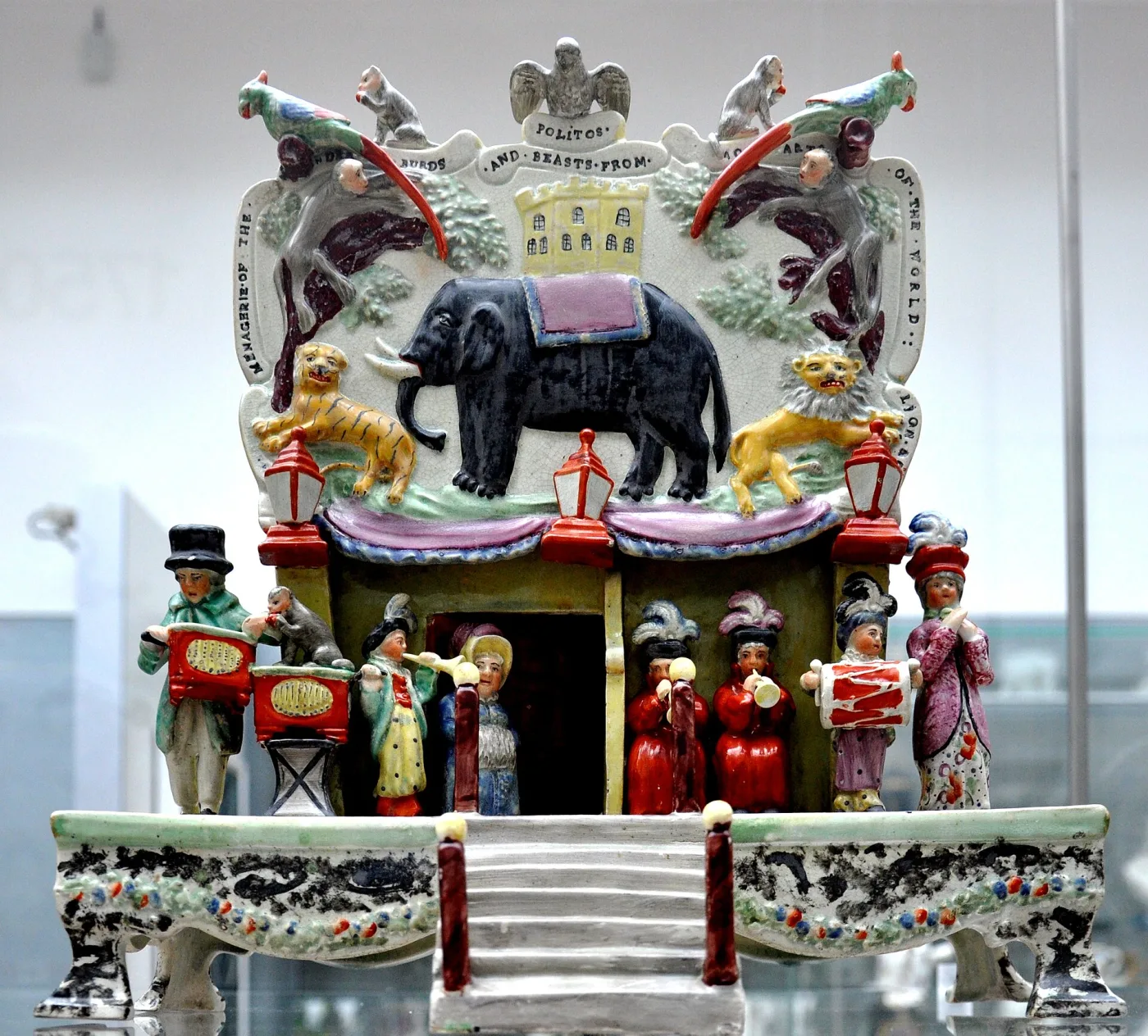
Obadiah Sherratt never marked his pieces, but his work is identifiable through distinctive stylistic features: elaborate, often humorous or dramatic figural groups mounted on table bases with scroll-footed legs. His famous bull-baiting groups, "Politos Menagerie," and "Teetotal" temperance groups are among the most prized Staffordshire figures. Sherratt's attribution relies entirely on style and construction analysis, and some attributions remain debated among scholars.
Sampson Smith (1846-1963)
Sampson Smith's factory in Longton was one of the largest producers of Victorian flatback figures. The firm's mold records survived, allowing many common Victorian figures to be attributed to this maker. Sampson Smith figures are rarely marked but can sometimes be identified through comparison with known molds. The factory continued producing figures into the 20th century, and some of their original molds were later used by other firms, complicating attribution.
Alpha Factory and Thomas Parr
The Alpha Factory (William Kent) and Thomas Parr were other significant Victorian producers. Thomas Parr figures are occasionally found with impressed or painted marks. The Alpha Factory specialized in dog figures, particularly spaniels, and their products are identifiable through consistent modeling characteristics. Both makers produced work in the typical Victorian flatback style, and many attributions are based on stylistic comparison rather than marks.
Understanding Unmarked Pieces
Since most Staffordshire figures are unmarked, collectors must rely on a combination of body type, glaze characteristics, decoration style, modeling quality, and base construction for identification. Reference books with photographs of documented examples are invaluable tools, as is hands-on experience examining pieces at museums, auction previews, and antique fairs. For a broader understanding of how potter's marks function across different traditions, consult our guide to identifying Delftware marks and makers.

Construction & Decoration Techniques
Understanding how Staffordshire figures were made is essential for authentication and dating. Construction and decoration techniques evolved significantly over the 200-year production history, and recognizing these differences is one of the most reliable methods for placing a figure in its correct era.
Press-Molding
Press-molding was the dominant technique for producing Staffordshire figures, particularly from the Victorian era onward. Thin sheets of clay were pressed into plaster molds (typically two-piece molds for flatbacks, multi-piece molds for fully modeled figures), and the pieces were then joined with liquid slip before firing. Evidence of press-molding includes visible mold seams (though these were often smoothed), a hollow interior, and consistent wall thickness. Earlier figures were press-molded from finer clay and show more careful finishing, while later mass-produced pieces may show rough, unfinished interiors.
Slip-Casting
Slip-casting, where liquid clay is poured into a plaster mold and allowed to set, was used for some Staffordshire figures, particularly more complex forms. Slip-cast pieces tend to have very thin, even walls and a slightly different texture from press-molded pieces. This technique became more common in the later 19th and early 20th centuries.
Overglaze Enamel Decoration
Overglaze enamels, applied on top of the fired glaze and then refired at a lower temperature, are the primary decoration method for Victorian Staffordshire figures. Typical enamel colors include iron red, cobalt blue, chrome green, black, and various flesh tones. Overglaze enamels sit on the surface of the glaze and can be felt as a slight raised texture. They are susceptible to wear and flaking, and the condition of enamel decoration significantly affects value.
Underglaze Colors
Earlier Staffordshire figures, particularly those from the Georgian period, were often decorated with underglaze colors applied before the final glaze firing. These colors are fused into the glaze and are therefore more durable than overglaze enamels. The palette of underglaze colors is more limited than overglaze enamels, consisting primarily of cobalt blue (the same pigment used to create flow blue china), manganese brown, copper green, and antimony yellow. Underglaze decoration is a strong indicator of an earlier date, generally pre-1840.
Colored Glazes
The earliest refined Staffordshire figures, particularly those by the Ralph Wood workshop, were decorated with translucent colored glazes that allow the detail of the modeling to show through. This technique produces soft, subtle colors quite different from the bright enamels of later figures. Colored glazes were applied over the unfired piece and fused during a single firing. The controlled, painterly use of colored glazes is a hallmark of the finest Georgian-era Staffordshire figures.
Gilding
Gold decoration was applied to many Victorian Staffordshire figures, typically on bases, costume details, and accessories. Most Staffordshire gilding is not true gold leaf but a cheaper gold-colored paint that can appear brassy or dull. Genuine gold leaf, found on finer pieces, produces a softer, more lustrous finish. Gilding condition varies widely, as gold paint is particularly susceptible to wear and rubbing.
Bocage Construction
Bocage canopies were constructed by building up individual leaves, flowers, and branches from small pieces of clay, which were then attached to a framework behind the main figure. The quality and naturalism of bocage work declined steadily over time: early examples (1780s-1810s) feature finely modeled, individually shaped leaves, while later versions (1820s-1840s) use increasingly simple, repetitive leaf forms. The transition from naturalistic to stylized bocage is a useful dating tool.
Portrait Figures & Historical Characters
Portrait figures are among the most fascinating and historically significant categories of Staffordshire pottery. They provide a unique visual record of the public figures, events, and cultural preoccupations of Georgian and Victorian Britain, and their identifiable subjects make them particularly useful for precise dating.
Royalty
British monarchs and their families were perennial favorites. Queen Victoria and Prince Albert appear in numerous versions throughout the Victorian period, from their wedding in 1840 to the Queen's Diamond Jubilee in 1897. Earlier royal figures depict George III, George IV, and William IV. The style and quality of royal figures evolved significantly over time, and comparing different versions of the same subject provides an excellent lesson in dating Staffordshire figures.
Military Heroes
Military figures constitute one of the largest categories of Staffordshire portraits. The Crimean War (1853-1856) produced a surge of patriotic figure-making, with depictions of commanders including Lord Raglan, Sir Colin Campbell, and Omar Pasha. The Boer War (1899-1902) inspired another wave of military figures, including numerous versions of Baden-Powell, Lord Roberts, and Lord Kitchener. Naval heroes, particularly Nelson, remained popular throughout the period.
Political Figures
Politicians, reformers, and public figures were frequently depicted, particularly those involved in causes that resonated with the working-class audience for Staffordshire figures. Benjamin Franklin, George Washington, Napoleon, Garibaldi, and various British prime ministers all appear. Political figures can often be dated by reference to specific events or elections.
Theatrical and Entertainment Figures
Actors, singers, dancers, and circus performers were enormously popular subjects. Jenny Lind, the "Swedish Nightingale," was one of the most frequently depicted individuals in Staffordshire pottery. Actors in specific roles, such as Mr. T.P. Cooke as "Ben Backstay" or various performers in Shakespeare's plays, provide valuable dating evidence and reflect the popular entertainment culture of the era.
Religious Figures
John Wesley, the founder of Methodism, was probably the single most frequently produced portrait figure in Staffordshire pottery. Other religious figures include Charles Spurgeon, Dwight Moody, and various missionaries. Religious figures often appear in sober, simple designs befitting their subjects.
Literary Characters and Criminals
Fictional characters from popular literature, including characters from novels by Dickens and Scott, appear alongside figures of notorious criminals such as Dick Turpin, the murderers Rush and Manning, and the body-snatchers Burke and Hare. The depiction of criminals was a distinctive feature of Staffordshire figure production, reflecting the Victorian fascination with sensational crime.
Flatback Figurines - The Victorian Mantelpiece Staple
Flatback figurines deserve special attention because they represent the vast majority of Staffordshire figures encountered by collectors today. Understanding the specific characteristics of flatbacks is essential for anyone interested in Victorian decorative arts.
What Makes a Flatback
The defining characteristic of a flatback is, as the name suggests, a flat, undecorated reverse. The figure is designed to be viewed only from the front and sides, making it essentially a three-dimensional relief rather than a fully modeled sculpture. The flat back was a practical innovation: it made production faster and cheaper (requiring only a two-piece mold), used less clay, and was perfectly suited to its intended display position on a mantelpiece shelf against a wall.
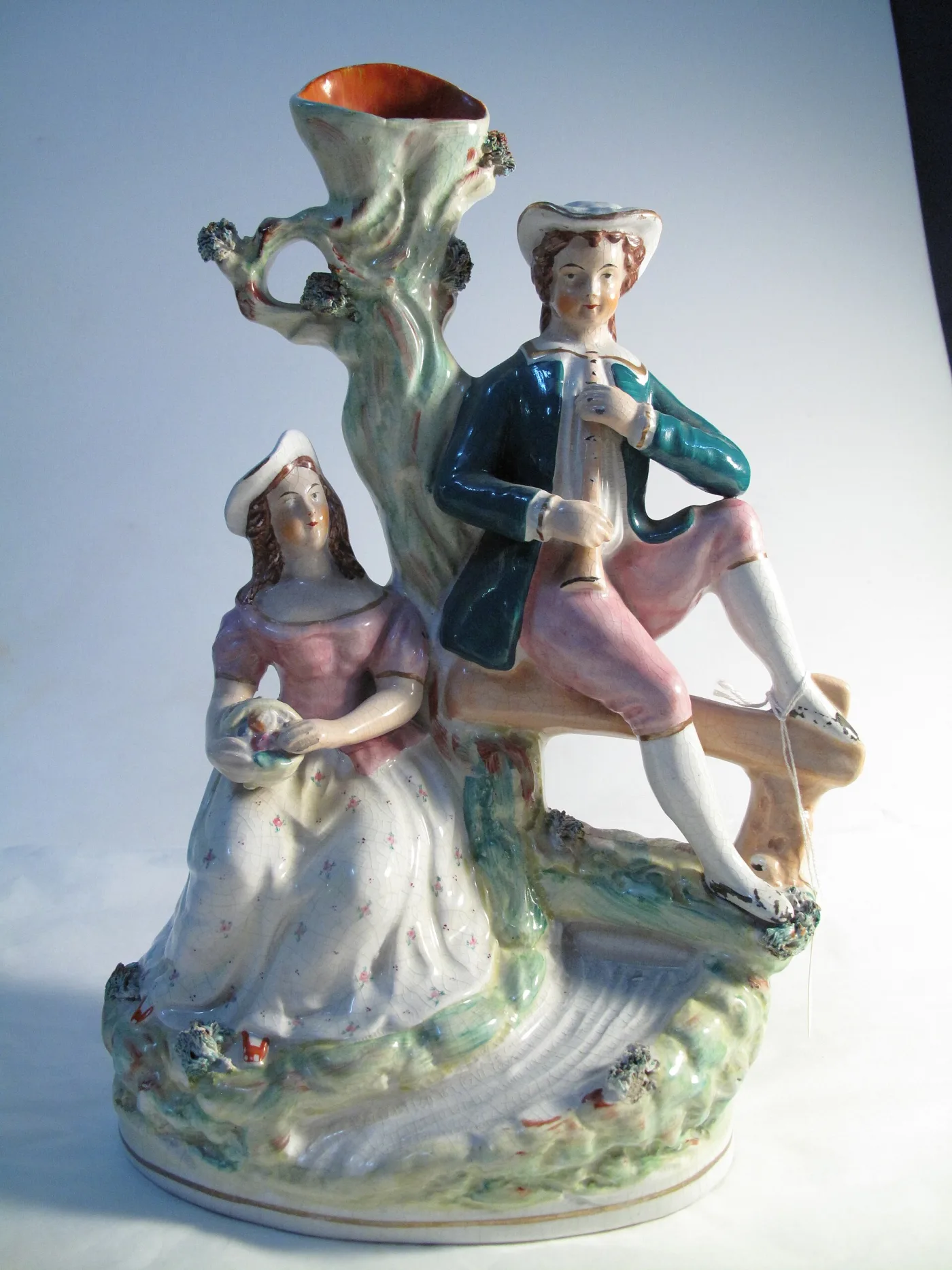
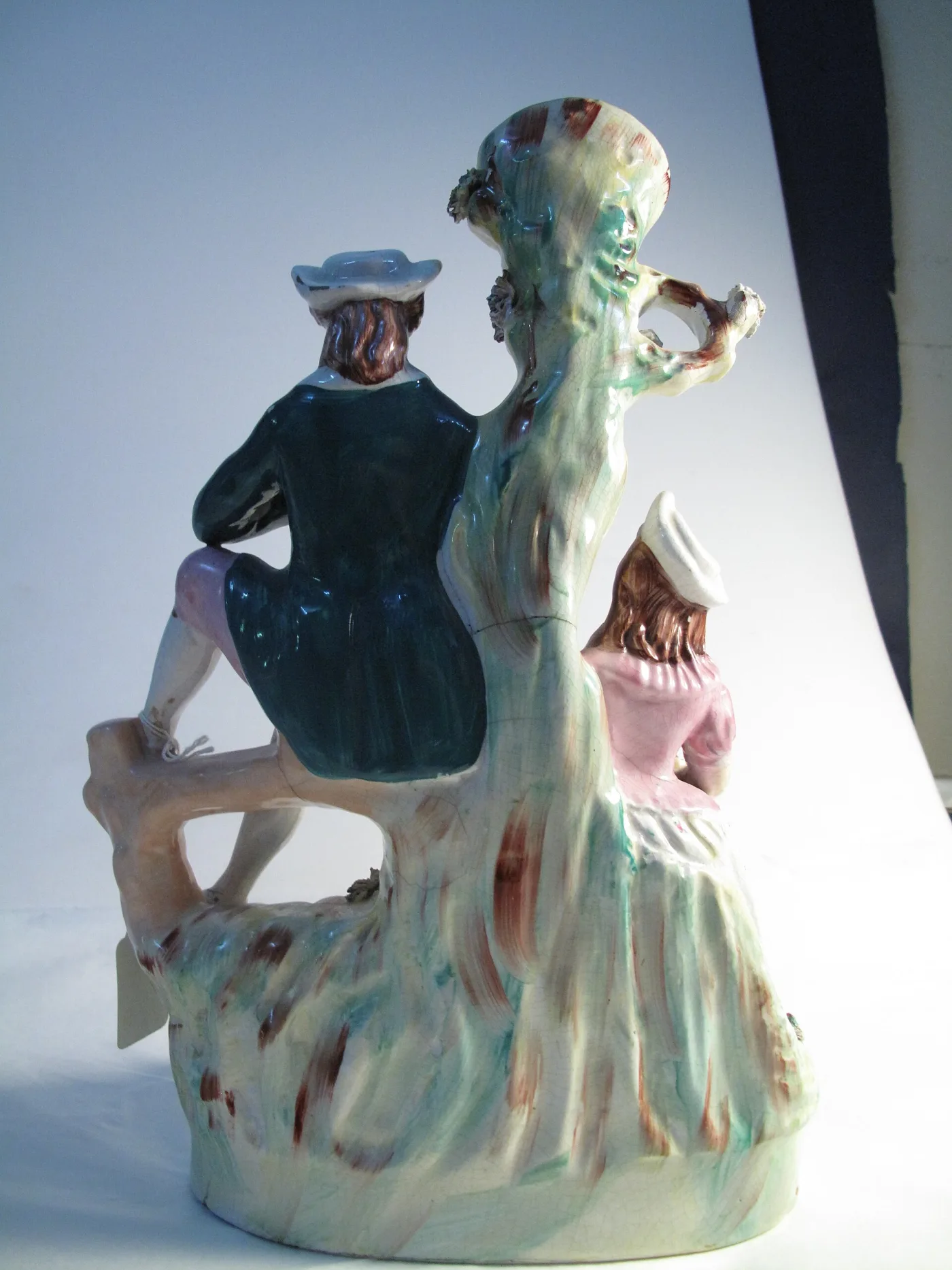
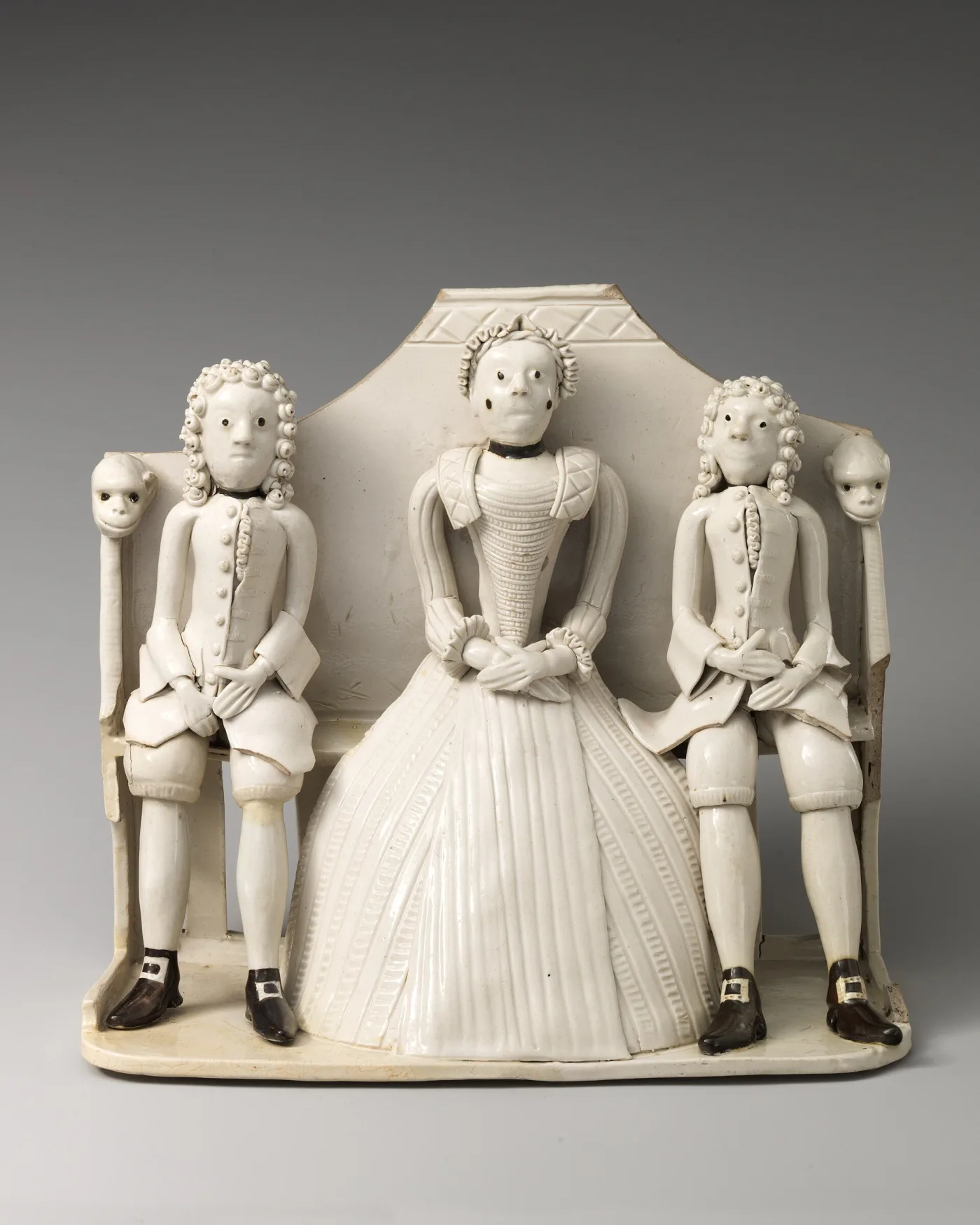
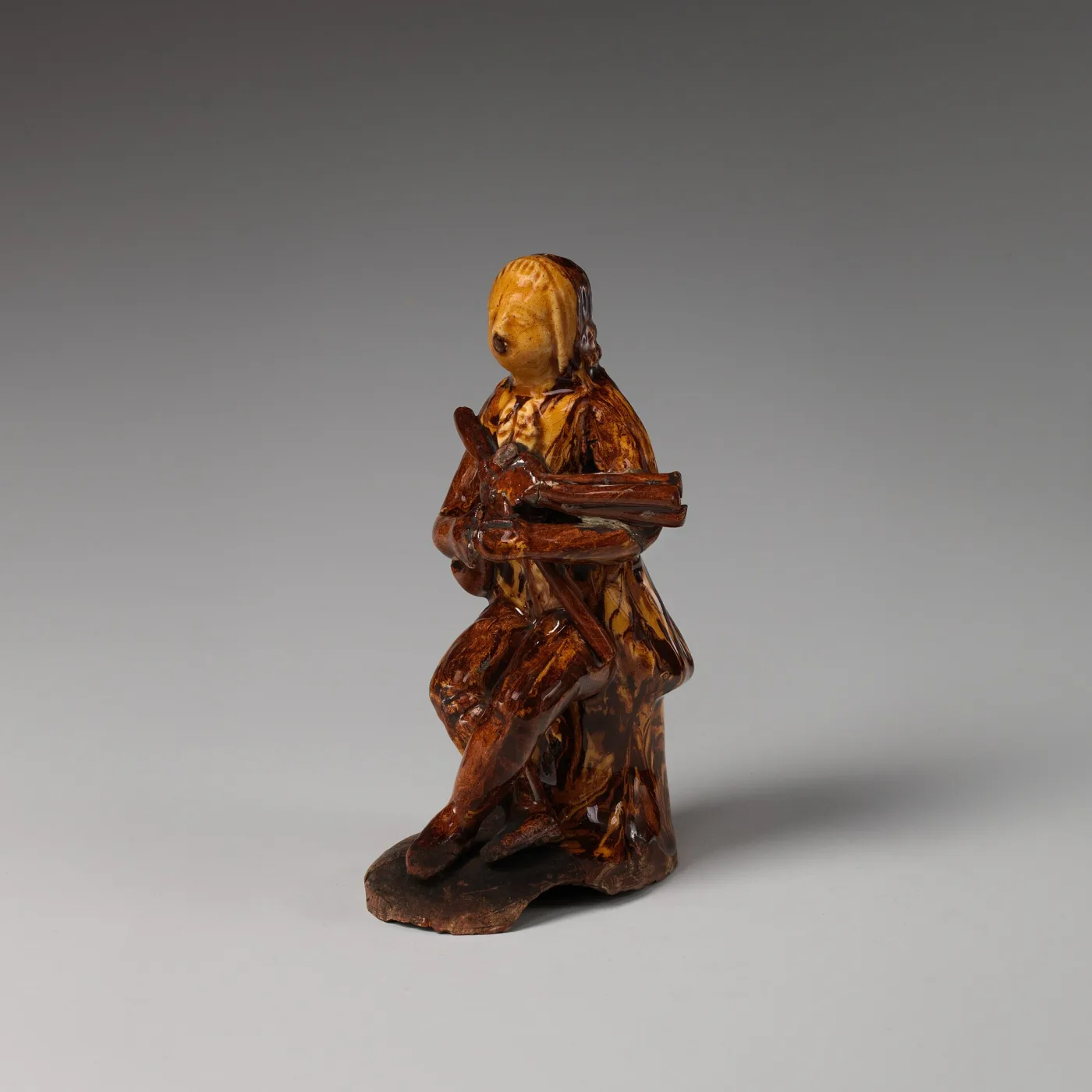
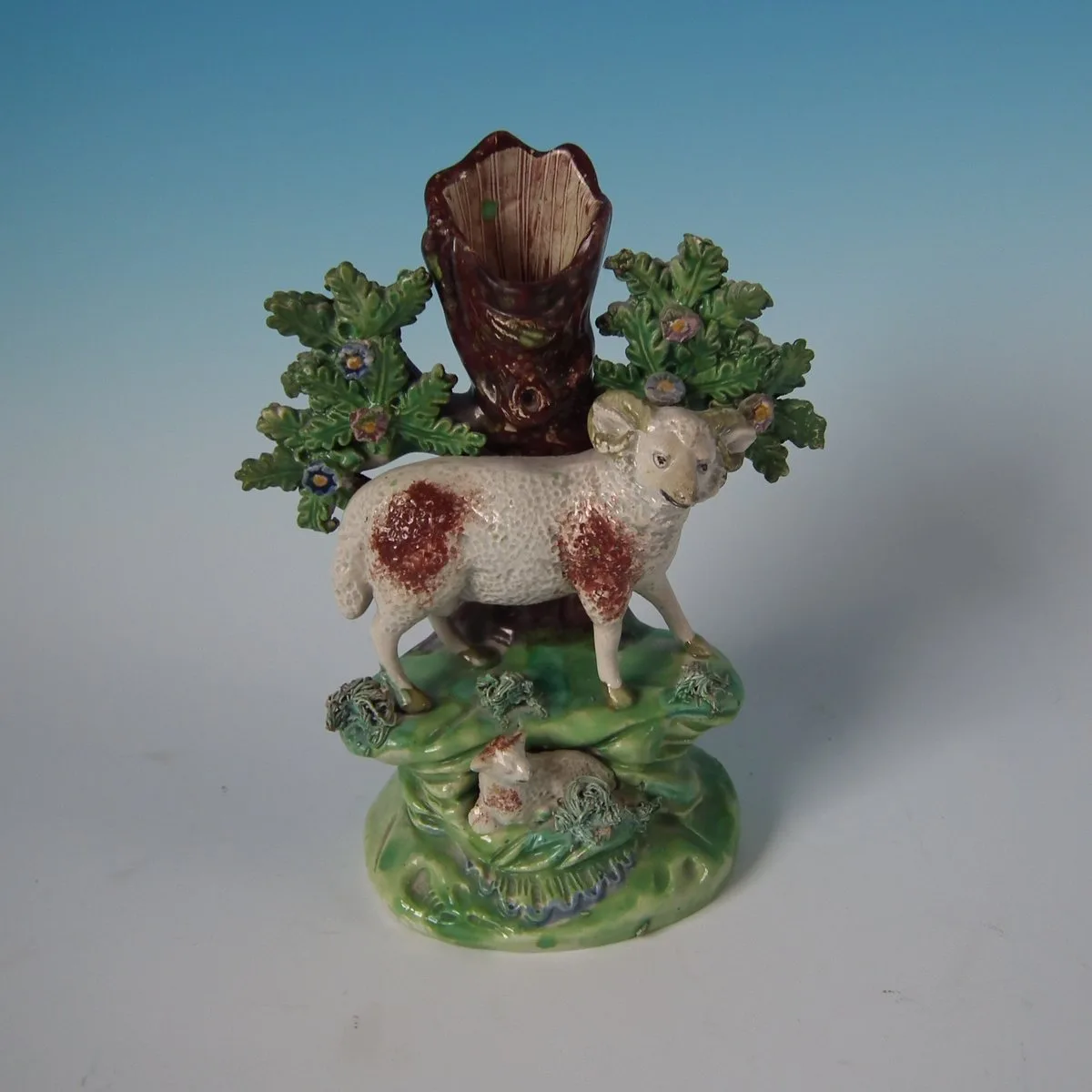
Neither of these is a flatback, and that is the point of showing them: this is what a figure modelled in the round looks like from behind, and it is the comparison that tells you what you are holding. The man's coat, the woman's shoulders and the tree are all sculpted at the back, so the piece reads as a sculpture from any angle. A true flatback — the Dick Turpin earlier in this guide is one — presents a plain vertical slab instead, usually with a small vent hole and no decoration at all. Note also that "modelled in the round" does not mean "finished to the same standard all round": the back here is painted in fast streaks of green and brown, because nobody was expected to see it. Careful modelling combined with careless back-painting is normal and honest. Careful modelling combined with careful back-painting, on a figure otherwise presented as Victorian, is worth questioning.
Common Flatback Subjects
The range of flatback subjects is remarkably broad. The most common categories include: royal and political portraits, military figures on horseback or standing, religious figures, theatrical subjects, pastoral scenes with farmers and milkmaids, couples and courting pairs, children at play, animals (especially dogs, deer, cats, and lions), castles and cottages (used as pastille burners or night-light holders), and sporting subjects. The choice of subject matter closely reflects popular culture and current events, making flatbacks a form of visual newspaper for the Victorian home.
Dating Flatbacks
While all flatbacks post-date approximately 1840, there are useful clues for more precise dating within the Victorian period. Earlier flatbacks (1840s-1850s) tend to be smaller, more carefully modeled, and painted with greater attention to detail. Mid-Victorian examples (1860s-1870s) are often larger, with bold colors but sometimes less refined painting. Late Victorian flatbacks (1880s-1900) can show declining quality, with simpler modeling, fewer colors, and less careful finishing. The subject depicted remains the single most reliable dating tool, as portrait figures can be tied to specific historical events. Collectors of Victorian decorative objects may also appreciate our guide to identifying antique majolica pottery, another colorful Victorian ceramic tradition.
Pearlware vs Earthenware Staffordshire Figures
Understanding the difference between pearlware and ordinary earthenware bodies is crucial for dating Staffordshire figures, as body composition is one of the most reliable indicators of age.
Pearlware Figures (c.1780-1830)
Pearlware is a refined earthenware body developed by Josiah Wedgwood in the 1770s. It features a pale, slightly bluish-white body with a glaze containing a small amount of cobalt oxide, which gives it a distinctive blue-tinged appearance, particularly visible in areas where the glaze pools in crevices or at the base. Pearlware Staffordshire figures date primarily from the 1780s through the 1830s and are generally finer in quality than later earthenware figures. They are often decorated with underglaze colors or a combination of underglaze and overglaze enamels. The blue tinge of pearlware glaze is most easily seen on the underside of the base, where glaze tends to collect.
Earthenware Figures (c.1840 onward)
Victorian Staffordshire figures are made from a coarser, buff-colored earthenware body that lacks the blue tinge of pearlware. The glaze is typically a clear or slightly yellowish lead glaze. The body is often visible on the unglazed base or interior, and its warm buff color contrasts with the cooler, whiter appearance of pearlware. This earthenware body was cheaper and easier to work with than pearlware, contributing to the mass production of Victorian figures.
How to Distinguish Them
The most reliable way to distinguish pearlware from later earthenware is to examine the base of the figure. Turn the piece over and look for a bluish tinge in the glaze, particularly where it pools. Pearlware figures also tend to feel lighter and more refined in the hand. The body visible through any chip or on unglazed areas will be whiter and finer than Victorian earthenware. Weight, glaze color, body texture, and overall quality of modeling all contribute to the assessment. When in doubt, comparing a suspected pearlware figure side by side with a confirmed Victorian earthenware example makes the differences immediately apparent.
Reproductions & Fakes - How to Spot Them
Staffordshire figures have been reproduced and faked for over a century, and the market is flooded with modern copies that can deceive the unwary. Learning to distinguish genuine antique figures from reproductions is perhaps the most important skill for any Staffordshire collector.
Modern English Reproductions
Several English firms have produced high-quality reproductions of Staffordshire figures, often using original Victorian molds or faithful copies of them. The most notable include William Kent (who acquired some of Sampson Smith's original molds), Staffordshire Fine Ceramics, and various small workshops. Some of these reproductions are clearly marked as modern, but marks can be removed or obscured. English reproductions generally use a whiter, harder body than genuine Victorian pieces, and their overglaze enamels often appear brighter and more uniform than antique examples.
Chinese and Other Import Copies
Since the late 20th century, large numbers of Staffordshire-style figures have been produced in China and other Asian countries for the decorator market. These copies range from poor-quality tourist souvenirs to more convincing reproductions. Chinese copies typically feature a very white, hard body quite unlike genuine Staffordshire earthenware, and their painting style, while sometimes skillful, lacks the character and irregularity of hand-painted Victorian figures. The weight of Chinese copies is often noticeably different from genuine pieces, being either too heavy or too light.
Telltale Signs of Reproductions
Several characteristics can help identify reproductions and fakes. The body color is key: genuine Victorian figures have a warm, buff-colored earthenware body, while reproductions tend to be whiter and sometimes glassy. Examine the base carefully: genuine antique figures often show fire cracks, kiln grit, and an uneven glaze line at the base, while reproductions tend to have cleaner, more uniform bases. Old enamel decoration shows natural wear patterns consistent with age and handling, while new enamels appear bright and fresh. Crazing (the network of fine cracks in the glaze) can indicate age, but can also be artificially induced. The feel of the surface, the quality of the modeling, and the overall weight and balance of the piece all contribute to the assessment. Experience in handling genuine pieces is ultimately the best teacher.
Honest Reproductions vs Deliberate Fakes
It is important to distinguish between honest reproductions (made and sold as modern decorative items) and deliberate fakes (made to deceive and sold as genuine antiques). Many reproduction Staffordshire figures are attractive and well made, and they have their own collector following. The problem arises when reproductions are artificially aged and passed off as antique. Artificial aging techniques include tea-staining the base, artificially inducing crazing, and deliberately wearing enamel decoration. A reputable dealer or auction house should always disclose if a piece is a reproduction. For comprehensive guidance on establishing the monetary value of any antique, see our guide on antique valuation and appraisal methods.
Condition Assessment & Value Factors
The value of Staffordshire figures depends on a complex interplay of age, rarity, condition, subject matter, quality, and current market demand. Understanding these factors is essential for both buyers and sellers.
Common Types of Damage
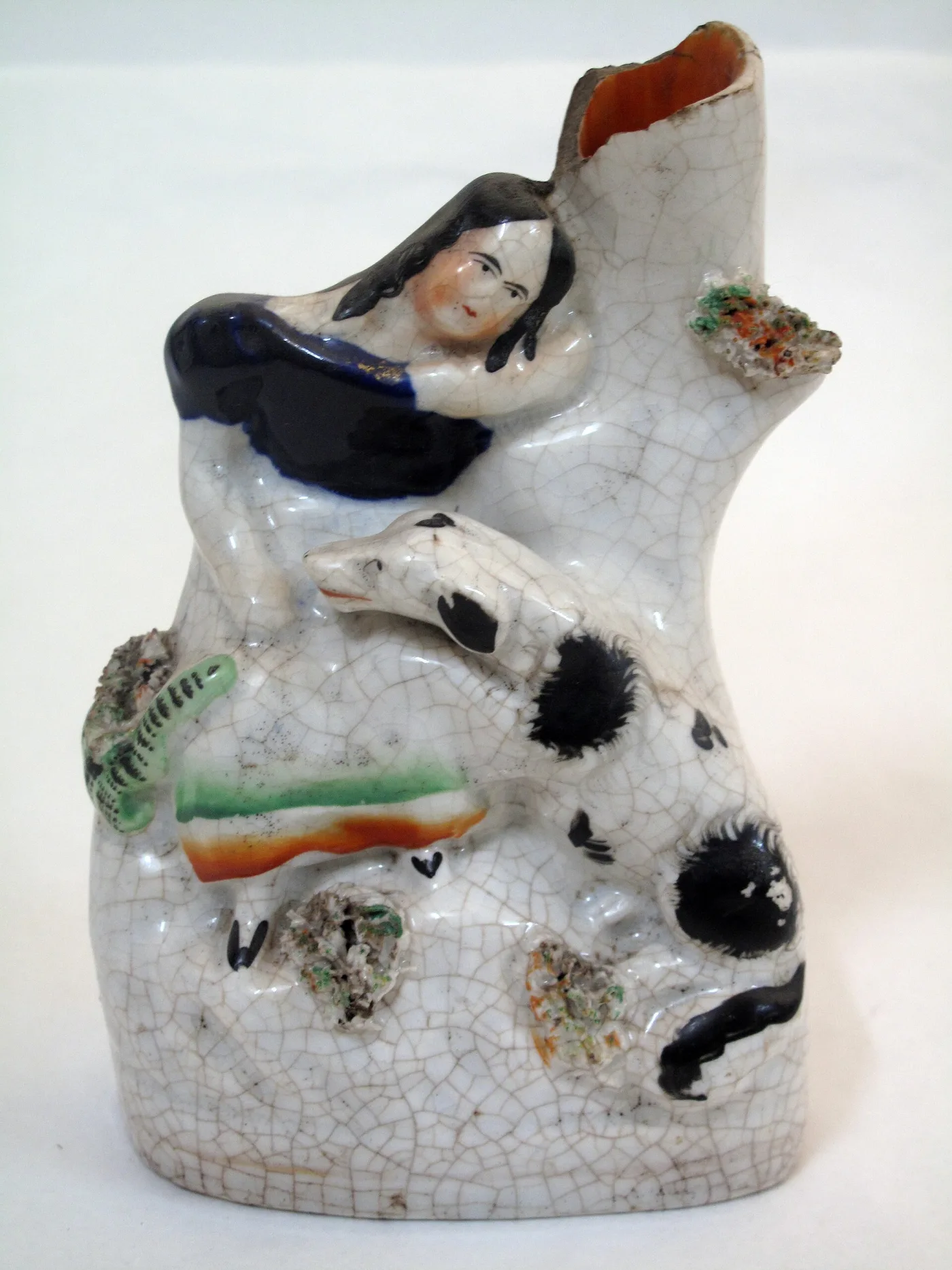
Staffordshire figures are susceptible to several types of damage. Chips and losses, particularly to extremities such as fingers, noses, and bocage leaves, are extremely common. Cracks in the body or base can range from minor hairlines to structural fractures. Enamel decoration is vulnerable to wear, flaking, and loss. Bocage elements are particularly fragile and are often partially or wholly missing on surviving examples. Smoke damage from years on a mantelpiece can discolor the glaze. Understanding these common damage patterns helps collectors assess condition accurately.
Repairs and Restoration
Many Staffordshire figures have undergone repairs or restoration during their long lives. Professional restoration can include reattaching broken pieces, filling chips, repainting worn areas, and reconstructing missing elements. While expert restoration can be difficult to detect visually, ultraviolet light will cause most repair materials to fluoresce differently from the original glaze, revealing the extent of restoration. A figure with significant professional restoration is worth substantially less than the same piece in original condition, and undisclosed restoration is one of the most common sources of disputes in the market.
Rarity and Desirability
Rarity is a major value driver. Early Georgian figures by named makers such as Ralph Wood are inherently rare and valuable. Among Victorian figures, unusual subjects, rare color variations, and figures tied to obscure historical events command premiums over common types. Staffordshire dogs, particularly unusual breeds or rare sizes, have a strong and consistent market. Portrait figures of identified individuals are generally more valuable than generic types, and the fame or notoriety of the subject affects demand.
Provenance and Market Trends
Documented provenance (ownership history) can significantly enhance value, particularly for important early figures. Pieces from well-known collections often bring premium prices at auction. Market trends fluctuate: some categories are currently strong (early figures, Staffordshire dogs, military figures), while others have softened. The international market, particularly demand from American collectors, has historically been a major driver of Staffordshire figure prices.
Building a Staffordshire Figurine Collection
Whether you are drawn to the charm of Victorian flatbacks or the refinement of Georgian-era masterpieces, building a Staffordshire collection is a rewarding pursuit that combines history, art, and the thrill of the hunt.
Starting Out
Begin by educating yourself before spending significant money. Visit museums with strong Staffordshire holdings (the Potteries Museum in Stoke-on-Trent is the best), attend auction previews to handle pieces, and invest in good reference books. Start with modest purchases of common Victorian flatbacks to develop your eye for body type, glaze, enamel quality, and modeling. A few affordable genuine pieces will teach you more than any number of books alone.
Specializing
Successful collectors often specialize in a particular category: dogs, portrait figures, military subjects, theatrical figures, or a specific maker or period. Specialization allows you to develop deep expertise, making it easier to spot bargains and avoid fakes. It also helps focus your spending and creates a more cohesive and impressive collection. Consider what interests you most and let that passion guide your collecting direction.
Where to Buy
Staffordshire figures can be found at general and specialist antique dealers, auction houses (from major international houses to small regional auctioneers), antique fairs, online auction platforms, and estate sales. Each venue has advantages and risks. Established dealers and auction houses offer greater confidence in authenticity but generally charge higher prices. Online purchases carry higher risk because photographs can disguise condition issues and reproductions. Building relationships with reputable dealers who specialize in English pottery is one of the best strategies for a serious collector.
Auction Tips
When buying at auction, always attend the preview to examine pieces in person. Use a UV light to check for repairs. Compare condition with the catalog description. Set a firm maximum bid and resist the temptation to exceed it in the heat of competition. Remember to factor in buyer's premium (typically 20-25%) when calculating your total cost. Study realized prices in past auctions to develop a sense of current market values for different categories and conditions.
Care & Display of Staffordshire Figurines
Proper care and thoughtful display will preserve your Staffordshire figures for future generations while showing them to their best advantage.
Handling
Always handle Staffordshire figures with clean, dry hands. Pick up figures by the main body, never by projecting elements such as bocage, arms, or accessories. Support the base with one hand while steadying the figure with the other. When examining a figure, do so over a padded surface to minimize damage from accidental drops. Avoid handling figures unnecessarily, as repeated handling increases the risk of chips and wear to enamel decoration.
Cleaning
Clean Staffordshire figures gently and infrequently. Dusting with a soft, dry brush is usually sufficient. If more thorough cleaning is needed, use a cotton swab barely dampened with distilled water, taking care to avoid areas of worn or flaking enamel. Never soak Staffordshire figures or use household cleaning products, as these can damage the glaze and enamel decoration. Old repairs may be soluble in water and can be damaged by even gentle washing.
Storage
When not on display, store figures individually wrapped in acid-free tissue paper in sturdy boxes. Never wrap figures in newspaper, as the ink can transfer to the glaze. Use padded dividers to prevent figures from touching each other. Store in a stable environment away from extremes of temperature and humidity. Avoid attics, basements, and garages, which are subject to temperature fluctuations that can stress ceramics.
Display
Staffordshire figures look best displayed on shelves or in glass-fronted cabinets against a plain background that allows the colors and forms to stand out. Traditional mantelpiece display, with matched pairs flanking a central ornament, remains the most historically appropriate setting. Ensure that shelves are stable and level, and consider using museum wax or putty to secure figures in earthquake-prone areas or busy households. Good lighting enhances the colors and details of the figures but avoid direct sunlight, which can fade enamel colors over time.
Resources for Staffordshire Collectors
A wealth of resources is available to help collectors deepen their knowledge and connect with fellow enthusiasts.
Essential Reference Books
Several authoritative books are considered essential for the serious Staffordshire collector. "Staffordshire Portrait Figures of the Victorian Age" by P.D. Gordon Pugh is the standard reference for portrait figures, with thousands of photographs and detailed identifications. "Victorian Staffordshire Figures 1835-1875" by A. and N. Harding provides an excellent overview of the classic Victorian period. "The Pugh Companion to Staffordshire Figures" offers a comprehensive photographic record that remains invaluable for identification. For earlier figures, "English Pottery Figures 1660-1860" by Pat Halfpenny provides scholarly coverage of the Georgian period.
Collector Societies and Communities
The Staffordshire Figure Association (SFA) is the primary collector organization, offering newsletters, meetings, and a network of knowledgeable members. Online forums and social media groups dedicated to Staffordshire pottery provide platforms for sharing knowledge, seeking identifications, and trading with fellow collectors. Joining these communities is one of the best ways to accelerate your learning and build relationships with experienced collectors and dealers.
Museums with Notable Collections
The Potteries Museum and Art Gallery in Stoke-on-Trent holds the most comprehensive collection of Staffordshire figures in the world. The Victoria and Albert Museum in London has an important collection spanning the full history of production. The Brighton Museum, the Fitzwilliam Museum in Cambridge, and several American museums, including the Winterthur Museum in Delaware, also hold significant collections. Studying original pieces in museum settings is invaluable for developing the eye needed for authentication and dating.
Online Resources
Auction house databases, particularly those of Bonhams, Christie's, and specialist regional auctioneers, provide searchable records of past sales with photographs and realized prices. Online reference sites and image databases supplement printed reference books. However, exercise caution with identifications and dating information found online, as much of it is unreliable. Always cross-reference online sources with established printed references and expert opinion.