Antique Rose Medallion Porcelain Identification Guide: Borders, Palette & Dating
Rose Medallion is the porcelain that built the China trade's reputation in the West. For two hundred years it crossed the Pacific by the crateload—dinner services, garniture vases, punch bowls, and tea wares packed in straw in the holds of clipper ships—and it still turns up today in New England estates, southern plantation houses, and the cabinets of families who have no idea their "grandmother's Chinese china" is a named, collected category with a literature of its own.
The look is unmistakable once you know it: a white ground crowded with alternating panels, some filled with court figures in pavilions and gardens, others with birds, butterflies, peonies, and fruit, all worked in the soft pinks, greens, and gilt of the famille-rose palette and divided by bands of gold. But the single word "Rose Medallion" hides a family of closely related export wares—Canton, Mandarin, Rose Canton, Rose Mandarin—that dealers and even auction houses use loosely, and the differences among them, along with the date and the quality of the painting, are exactly what separate a fifty-dollar saucer from a five-figure pair of palace vases.
This guide works through the palette, the panel structure, the gilding, the body, and the mark conventions of Rose Medallion so you can name the variant correctly, place a piece in its period from the early nineteenth century to the twentieth, separate genuine Qing-dynasty export ware from the decorative reproductions that flood the lower market, and read value from the things that actually drive it. By the end you should be able to turn over an unfamiliar plate and read its story from the figures, the border, the gold, and the base.
Table of Contents
- What "Rose Medallion" Actually Means
- Canton, the China Trade, and Where It Was Made
- The Famille-Rose Palette
- The Panel Structure: Reading the Border
- Rose Medallion vs. Rose Canton vs. Rose Mandarin
- The Central Medallion and the Figures
- Body, Glaze, and the Footrim
- Gilding and What It Tells You
- Dating Rose Medallion by Period
- Forms: Services, Vases, Punch Bowls, and Rarities
- Marks, Backstamps, and the Unmarked Rule
- Reproductions and the Twentieth-Century Revival
- Condition, Restoration, and Value
- Field Checklist Before You Buy
What "Rose Medallion" Actually Means
Rose Medallion is a Western trade name, not a Chinese one, and like "Imari" it describes a look rather than a single factory. The name combines two ideas: "rose" for the famille-rose palette built around opaque pink enamel, and "medallion" for the central reserve—usually a roundel of court figures—around which the rest of the decoration is organized. Western dealers coined the term in the nineteenth and early twentieth centuries to describe the most popular pattern of Cantonese export porcelain, and it stuck.
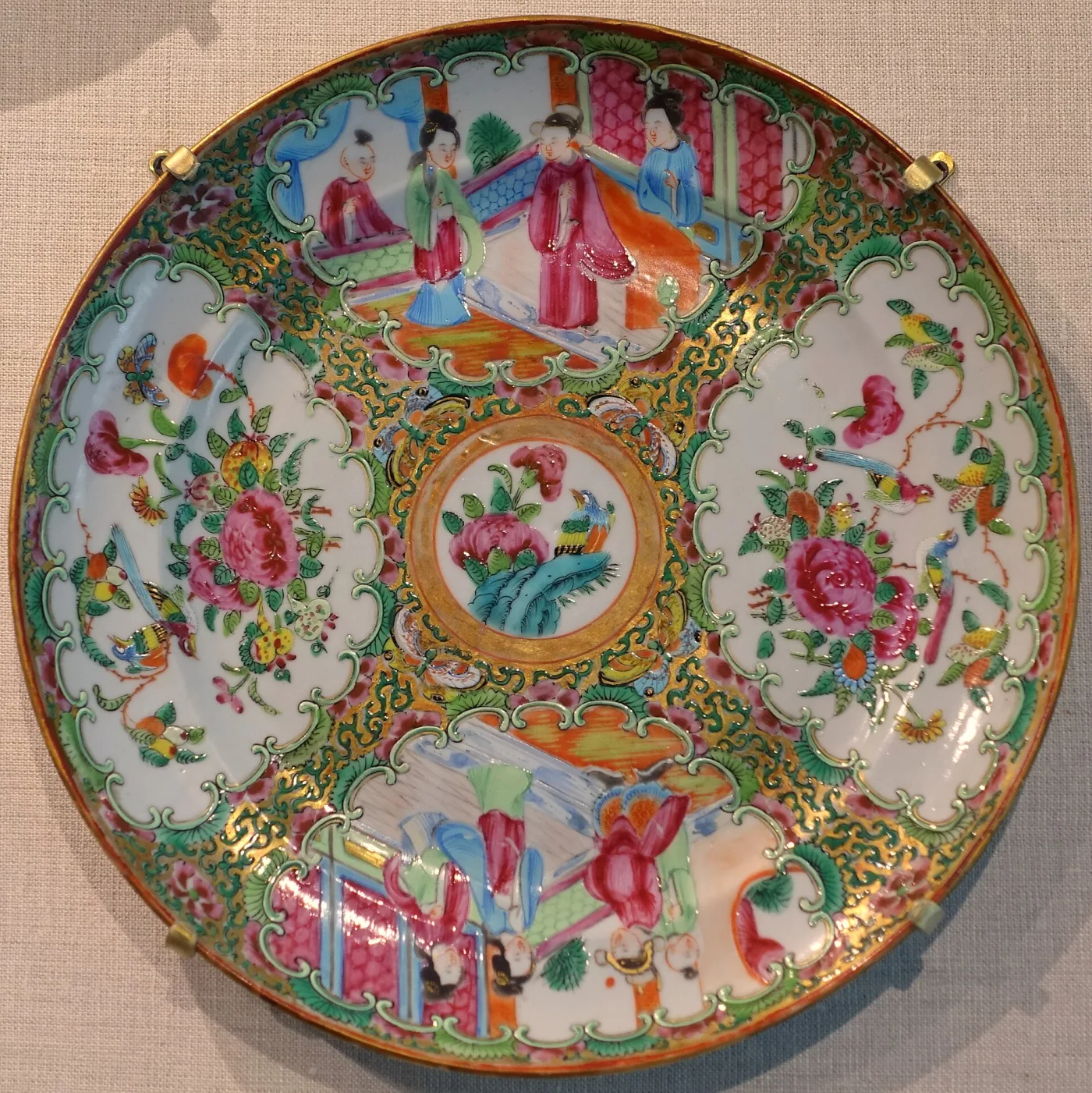
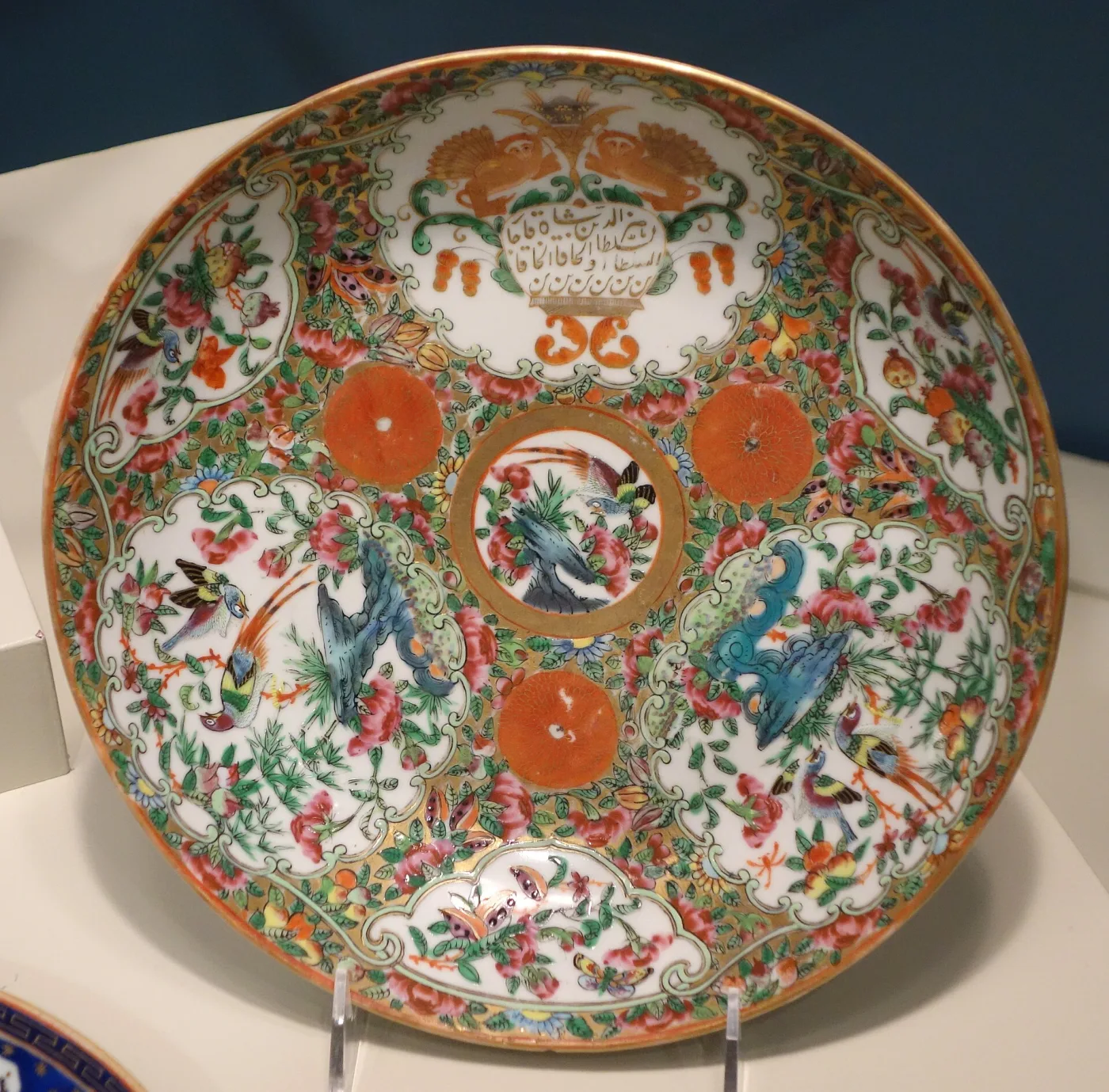
The classic Rose Medallion formula is specific and worth memorizing, because it is what distinguishes the type from its cousins. A piece of true Rose Medallion shows a white ground divided into four (sometimes six) panels or "reserves" around the rim, and these panels alternate between two subjects: groups of Chinese figures in interior or garden scenes, and panels of birds, butterflies, insects, flowers (especially the peony), and fruit. At the center sits a medallion, most often containing figures. Gold scrollwork and dense floral "filler" cover the white ground between the panels. When all of these elements are present—alternating figure and bird-and-flower panels, a central medallion, famille-rose enamels, and gilt ground—you are looking at Rose Medallion proper.
Why the Name Matters for Value
Get the name right and you price the piece right. Collectors and the market treat Rose Medallion, Rose Canton, and Rose Mandarin as distinct (if overlapping) categories with different desirability, and the more specific and correct your attribution, the more credible your valuation. As with all antique porcelain, the palette alone tells you almost nothing about value; it is the variant, the date, the quality of the figure painting, the form, and the condition that set the price.
Canton, the China Trade, and Where It Was Made
Rose Medallion belongs to the great age of Chinese export porcelain, and understanding the trade explains both the ware and its names. The porcelain bodies were thrown, fired, and glazed at the imperial kiln town of Jingdezhen in Jiangxi province, then shipped as blank or partly decorated white ware down to the southern port of Canton (Guangzhou). There, in workshops clustered in the foreign-trade district, dedicated enameling studios painted the overglaze famille-rose decoration and fired it in small muffle kilns before the pieces were packed for export.
This two-city division of labor is why the ware is called "Canton" famille rose even though the porcelain itself came from Jingdezhen: Canton is where it was decorated and where Western buyers took delivery. From the late eighteenth century through the nineteenth, ships of the British, American, Dutch, and other "East India" trades loaded enormous quantities of this porcelain alongside tea, silk, and lacquer. American vessels out of Salem, Boston, New York, and Philadelphia carried so much of it home that Rose Medallion became, in effect, the everyday "good china" of prosperous nineteenth-century American households—which is why so much of it survives in the United States today.
The Cantonese Enameling Tradition
The Canton enameling workshops produced a whole spectrum of famille-rose export wares, of which Rose Medallion was only the most popular pattern. The same studios that painted Rose Medallion also decorated armorial services to European order, monochrome-ground wares, and the figural and floral patterns that collectors now sort into Rose Canton and Rose Mandarin. The shared workshop origin is why these patterns blend into one another at the edges and why a single estate often contains examples of several at once. The broader context of this trade sits within the wider world of Asian art collecting, where Cantonese famille rose is one of the most accessible entry points.
The Famille-Rose Palette
The "rose" in Rose Medallion is the heart of the type, and learning the palette is the fastest way to recognize the family. Famille rose (French for "rose family," a term coined by nineteenth-century collectors) is an overglaze enamel palette that revolves around an opaque rose-pink, derived from a colloidal-gold or "purple of Cassius" pigment introduced to Chinese porcelain in the early eighteenth century. This pink ranges from pale blush to a deep rosy crimson and is the signature color of the whole group.
Around the pink sit the rest of the famille-rose enamels: opaque green in several shades, iron-red, yellow, aubergine and purple, turquoise, a soft black for outlines and hair, white (the palette includes an opaque white that lets colors be shaded and mixed, unlike the earlier translucent famille verte), and abundant gold. Because the enamels are opaque and can be blended, famille-rose figures and flowers have a soft, shaded, almost painterly quality quite different from the flat, jewel-like translucency of earlier Chinese enamels.
All of this decoration is overglaze: painted onto the already-glazed and fired white porcelain, then fixed in a lower-temperature second firing. Run a fingertip across a genuine piece and you can feel the enamels and gold sitting slightly proud of the smooth glazed ground. This raised, layered surface is one of your quiet authentication tools—flat, printed-looking decoration that sits level with the glaze is a warning sign of a later transfer-decorated reproduction.
Reading the Pink
The quality and handling of the pink is a useful period and quality clue. On finer nineteenth-century pieces the rose enamel is well-controlled, shaded with skill, and used to model petals and robes convincingly. On coarser late and reproduction wares the pink can be flat, harsh, evenly applied, or a slightly wrong synthetic-looking magenta. The same disciplined attention to enamel quality that governs antique ceramics generally applies here: how the color is used matters as much as which colors are present.
The Panel Structure: Reading the Border
If the palette tells you the piece belongs to the famille-rose family, the panel structure tells you whether it is specifically Rose Medallion. This is the single most important diagnostic, and it lives in the border.
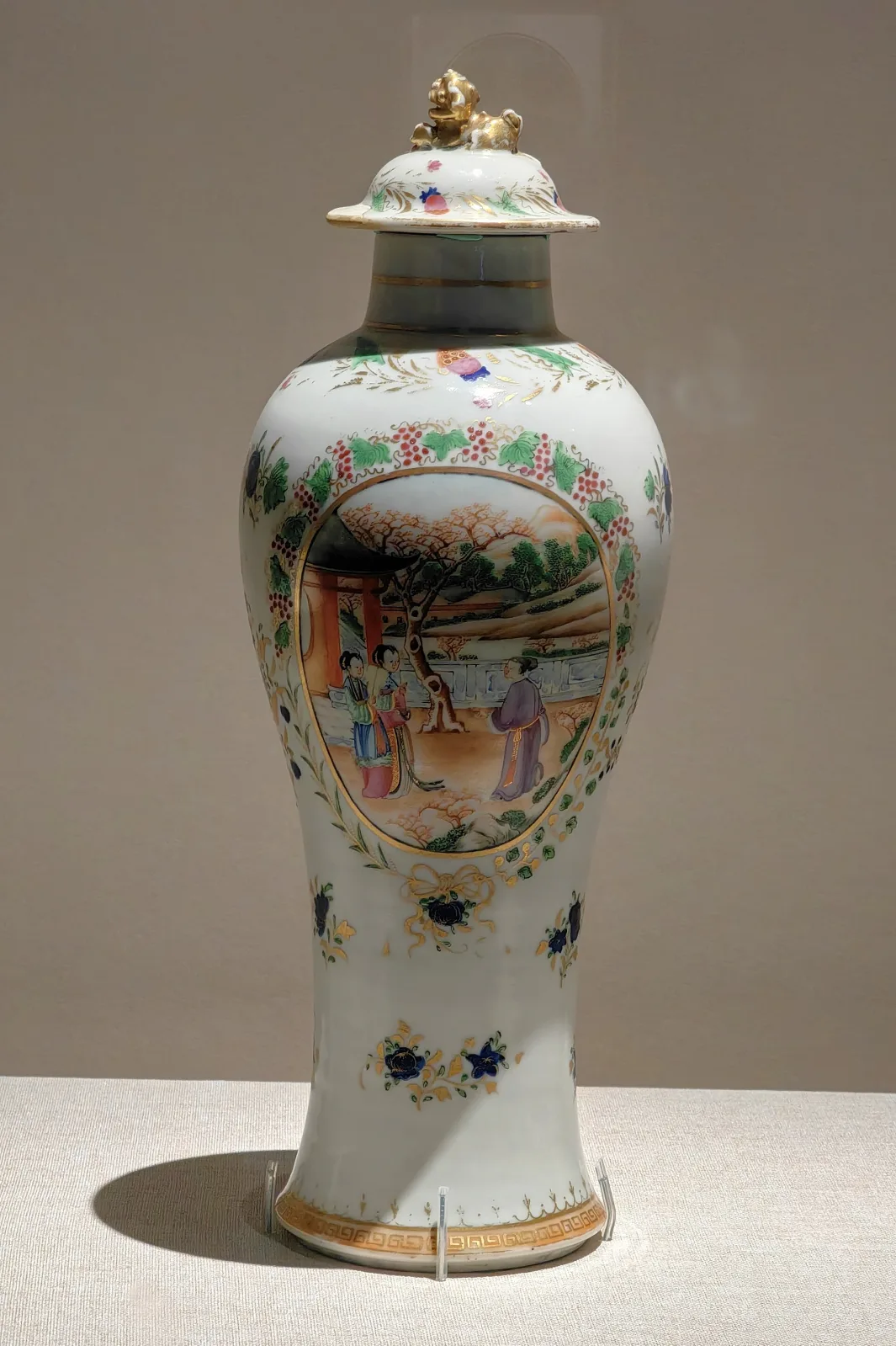
Classic Rose Medallion divides the outer band of a plate, bowl, or vase into radial panels separated by gilt borders—commonly four on a plate, sometimes six, more on a large piece. The defining rule is alternation: the panels switch back and forth between two kinds of subject. One set of panels contains groups of Chinese figures—court ladies, scholars, officials, and attendants in domestic and garden settings, often around a table or in a pavilion. The alternating set contains birds, butterflies, insects, peonies, other flowers, and fruit on a white ground. This figure / bird-and-flower alternation, panel by panel, is the textbook signature of Rose Medallion.
Between and around these reserve panels, the white ground is filled with dense, all-over decoration: gilt scrolling tendrils, small flowers, and foliage that the trade calls "filler." On the best pieces this ground is finely and richly worked; on coarser pieces it is sparse, hurried, and thin. The border on the underside of plates and around the foot is typically a band of gilt or a simpler floral repeat.
The Diagnostic in One Sentence
Here is the test in its simplest form: if the rim panels alternate between people and birds-and-flowers, with a central medallion and a gilt-filled ground, it is Rose Medallion. Change which subjects fill the panels—or remove the figures entirely—and you shift into one of the related variants covered below. Learning to look first at what the alternating panels contain is the habit that lets you name any piece in the family in seconds.
Rose Medallion vs. Rose Canton vs. Rose Mandarin
The Canton famille-rose family includes several closely related patterns that the market constantly confuses. Sorting them out is the core skill of the field, and the distinctions—though debated at the margins by specialists—follow a usable logic.
Rose Medallion is the full formula: alternating panels of figures and birds-and-flowers, plus a central medallion, on a gilt-scrolled white ground. Both subject types are present, and figures appear in the reserves.
Rose Canton uses the same palette, gilt ground, and panel layout but omits the human figures. Its reserves are filled with birds, butterflies, insects, peonies, and flowers only—no court scenes. In other words, Rose Canton is "Rose Medallion without the people." A piece with the right look but no figures anywhere is properly Rose Canton, and it generally sits a notch below figural Rose Medallion in collector demand, precisely because the figure painting is the prized element.
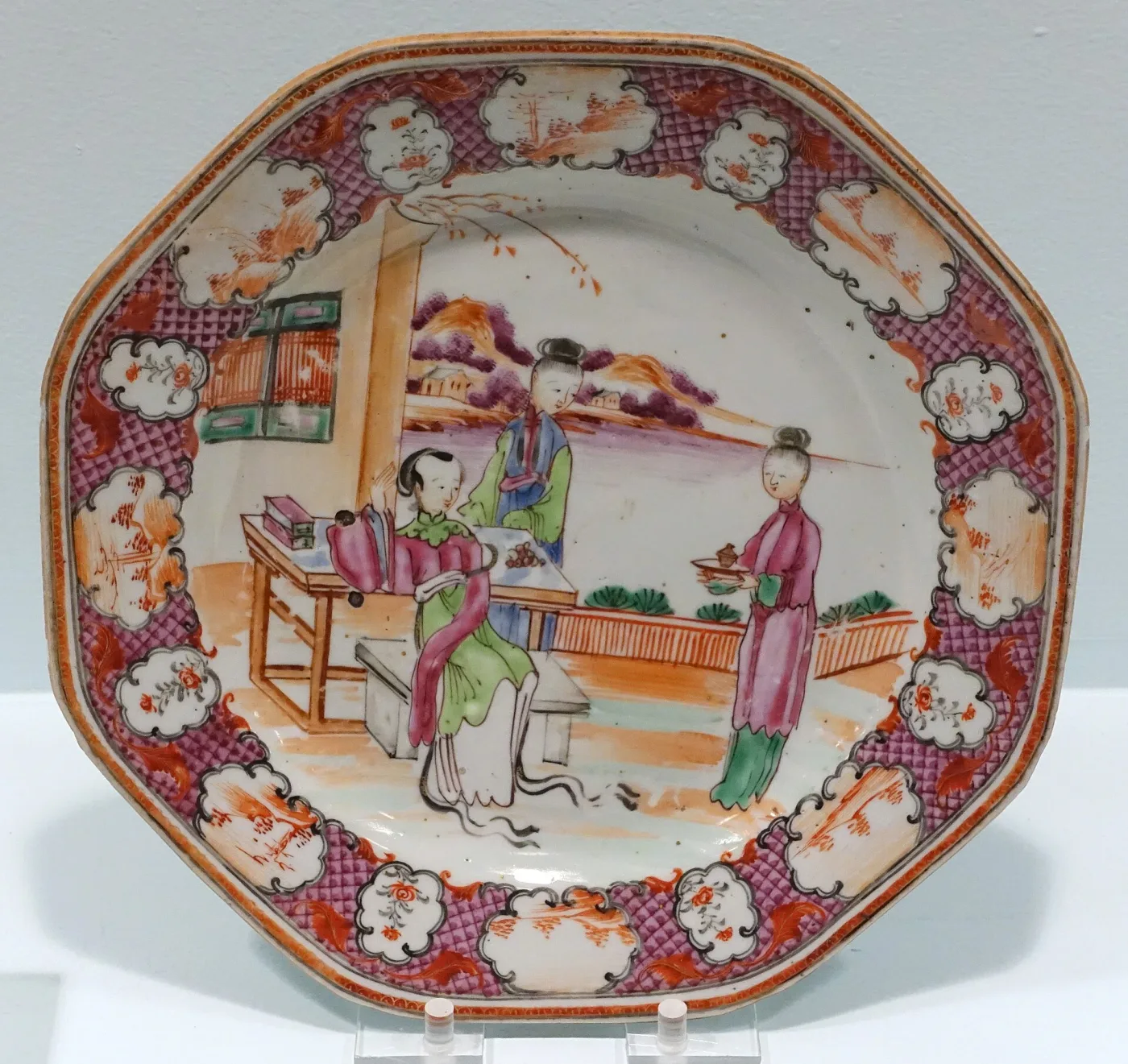
Rose Mandarin is the most figure-heavy and often the finest of the three. Here elaborate figural scenes dominate—larger, more numerous, and more finely painted groups of Mandarin officials, ladies, and attendants—frequently set off by borders of a distinctive puce or rose diaper and gilt, and sometimes with butterflies and flowers framing the scenes. Rose Mandarin pieces tend to be earlier (strong in the late eighteenth and early nineteenth centuries), more carefully painted, and more valuable than ordinary Rose Medallion. The term "Rose Mandarin" itself is a Western collector's label for the figure-rich end of the spectrum.
Mandarin palette / Mandarin ware is sometimes used interchangeably with Rose Mandarin for figural famille-rose export pieces with those characteristic puce-and-gilt borders. The boundaries blur, and some pieces sit genuinely between categories.
A Practical Way to Tell Them Apart
Work it as a quick decision tree. Are there human figures in the panels? No figures anywhere → Rose Canton. Figures alternating with bird-and-flower panels around a medallion → Rose Medallion. Figures dominant, large, finely painted, often with puce/rose diaper borders → Rose Mandarin. This single question—how prominent are the figures—does most of the sorting, and naming the variant correctly is what separates a confident attribution from a vague "Chinese export."
The Central Medallion and the Figures
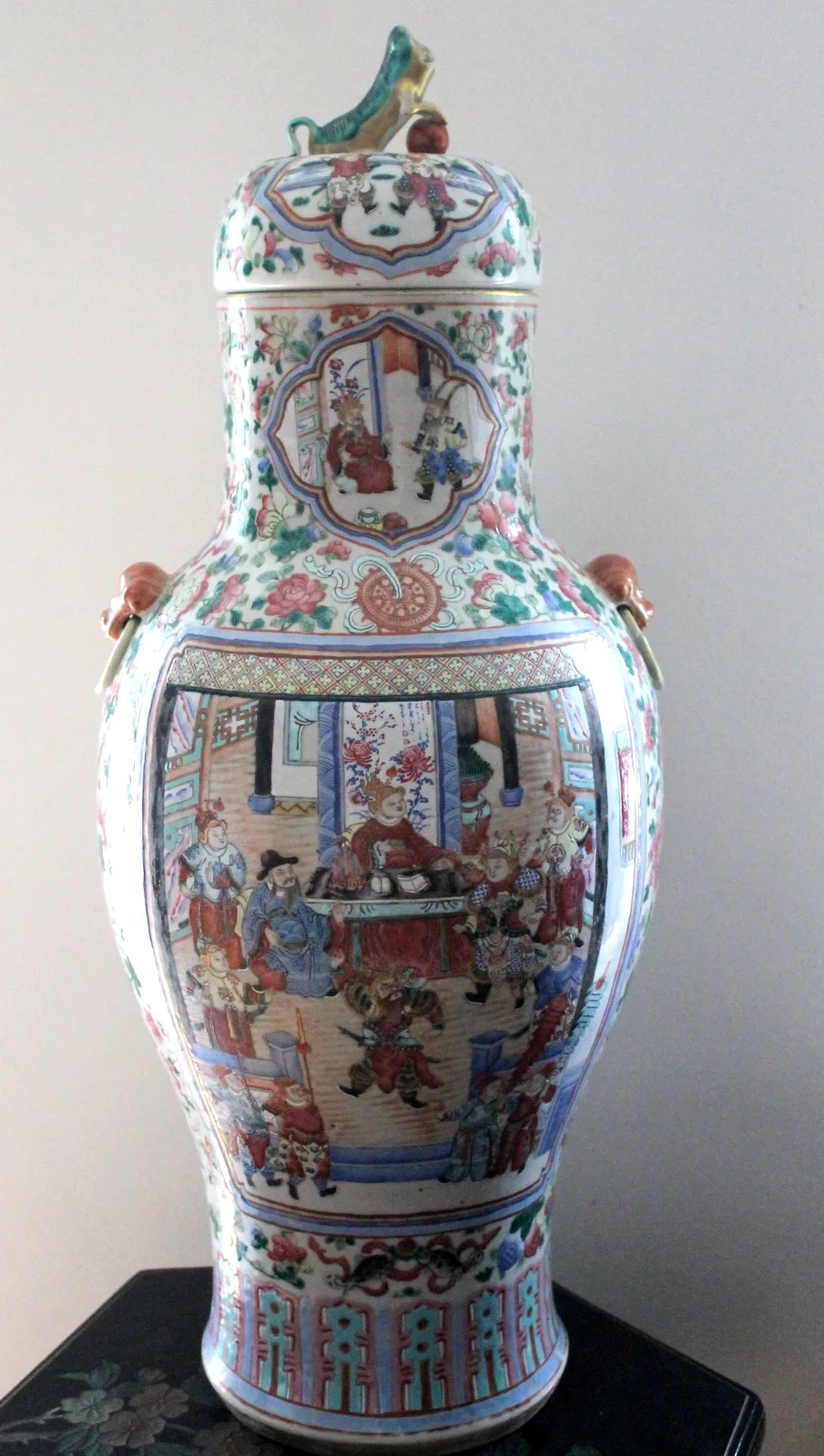
The medallion that gives the ware its name deserves close attention, because the quality of the figure painting is the strongest single driver of value within Rose Medallion. The central reserve typically contains a scene of Chinese domestic or court life: ladies and gentlemen seated around a table, a scholar with attendants, a garden gathering, or a pavilion interior. On plates and bowls this medallion is the focal point; on vases the equivalent figural panels run around the body.
Examine the figures closely. On finer and earlier pieces, the faces are individually painted with delicate features, the robes are shaded and detailed with patterns, the hands and postures are convincing, and the composition has depth and intent. On coarser and later pieces, faces become generic and repetitive (sometimes little more than a few strokes), robes are flatly filled, and the figures are crowded or carelessly placed. Because faces were among the most skilled work in the Canton studios, the care taken with them is one of the most reliable quality and date indicators you have.
The figures also help separate genuine antique work from reproductions. Hand-painted antique faces show brushstroke variation and slight asymmetry; transfer-printed or decal reproductions show identical, mechanically repeated faces and dot patterns under magnification. The same hand-versus-machine distinction that separates good Imari from late factory copies applies directly to Rose Medallion.
Counting and Quality
Collectors often note the number of distinct figures and the elaboration of the scenes; richer, more populous, more finely detailed figural work commands premiums, while sparse, repetitive figures mark the lower end. A large piece with crowded, individually characterized figures, fine robes, and well-painted faces is a quality piece regardless of exact date.

Body, Glaze, and the Footrim
Because Rose Medallion bodies were made at Jingdezhen, they share the characteristics of nineteenth-century Chinese export porcelain, and the body is one of your better dating and authentication tools. The porcelain is hard-paste, vitreous, and translucent in thin sections, with a clean, fairly white body—whiter and brighter than the grayish Japanese Arita porcelain that underlies Imari, though it warms slightly toward ivory on earlier pieces.
Turn the piece over and study the footrim, which is where age announces itself. On genuine nineteenth-century pieces the unglazed foot is finished by hand, often slightly irregular, and may show faint orange or tan "kiln" discoloration, tiny iron specks, or minor grit. The glaze frequently stops in a slightly uneven line at the foot, and the base may show honest wear—fine scratches and a softly abraded ring where the piece has stood and been moved for a century or more. The potting on early pieces can be relatively thin and refined; later mass-market wares are often heavier and more standardized.
The glaze itself is a clear feldspathic coat, usually smooth but sometimes showing minute pitting, faint bluish pooling in recesses, or slight unevenness on earlier work. A completely flawless, glassy, dead-white machine-perfect body with a sharp, spotless, perfectly turned foot is a signal of modern manufacture rather than nineteenth-century Canton production.
Weight and Potting as Date Clues
As a rough rule, finer and earlier Rose Medallion and Rose Mandarin tend to be more thinly and carefully potted, while later nineteenth- and twentieth-century export ware becomes heavier, thicker, and more uniform. Combined with the quality of painting and the footrim evidence, potting helps you place a piece on the early-to-late spectrum even when no mark is present—which, as the next-but-one section explains, is the usual situation.
Gilding and What It Tells You
Gold is fundamental to Rose Medallion—it outlines the panels, fills the ground with scrollwork, and trims the rims—and its condition and tone are among the most reliable period clues on the whole piece. Genuine nineteenth-century gilding was applied as real gold and fired, adhering well but wearing predictably on the high points and rims after generations of handling and washing.
Look for honest, uneven gold wear: gilt worn thin or away on rims, handle tops, and raised areas, but intact in the protected recesses of the scrollwork. This pattern of wear is consistent with age and is reassuring. The tone of antique fired gold is warm and slightly soft, not brassy. As with the gilt on Satsuma ware, the condition and tone of the gold is a dependable indicator: soft, warm, appropriately worn gold suggests age, while bright, unworn, brassy gold that rubs away under a fingernail suggests recent manufacture.
Reproductions and late wares often betray themselves in the gilding. Bright "liquid gold" or gold-toned lacquer applied to modern pieces reads brassy, sits too evenly, shows no logical wear, and can rub off easily. A piece claiming to be early but carrying perfect, bright, unworn gold over its entire surface deserves real suspicion—genuine old gold almost always shows some loss where hands and dishcloths have touched it for a hundred years.
Dating Rose Medallion by Period
Rose Medallion and its cousins were produced continuously for roughly two centuries, and dating relies on combining quality, palette handling, potting, gilding, and any marks rather than on a single feature. The broad periods break down usefully.
The late eighteenth and early nineteenth centuries (late Qianlong through Jiaqing and Daoguang reigns, roughly 1790–1850) represent the early, finer end. Rose Mandarin in particular flourishes here, with elaborate figural scenes, refined painting, thinner potting, and rich, well-controlled enamels. Pieces of this period are typically unmarked and show all the hallmarks of careful hand work.
The mid-to-late nineteenth century (roughly 1850–1900, Daoguang through Guangxu) is the great age of Rose Medallion proper, when the alternating-panel formula was produced in vast quantity for the American and European markets. Quality across this span ranges widely: the best is excellent, the bulk is competent commercial ware, and the tail end becomes increasingly standardized as demand and volume rose. Most surviving "antique" Rose Medallion dates to this broad window.
The turn of the twentieth century onward brings clearer origin marking and, eventually, mass reproduction. From around 1891, U.S. import law required country-of-origin marks, so "China" or "Made in China" in Roman letters places a piece after that date; the bulk of crudely painted, heavily potted, brightly gilt Rose Medallion with such printed marks is twentieth-century decorative ware, not Qing-dynasty export. The mid-twentieth-century revival is discussed in its own section below.
The Marked-Origin Anchor
The single fastest date filter is the base inscription. No Roman-letter mark, combined with fine hand painting, warm worn gold, and a hand-finished foot, points toward nineteenth-century (or earlier) production. A printed "China" mark points to roughly 1891 onward; "Made in China" leans twentieth century. This origin-marking framework parallels the way Roman-letter marks date Nippon-era porcelain, and it resolves the broad period question faster than any other single observation.
Forms: Services, Vases, Punch Bowls, and Rarities
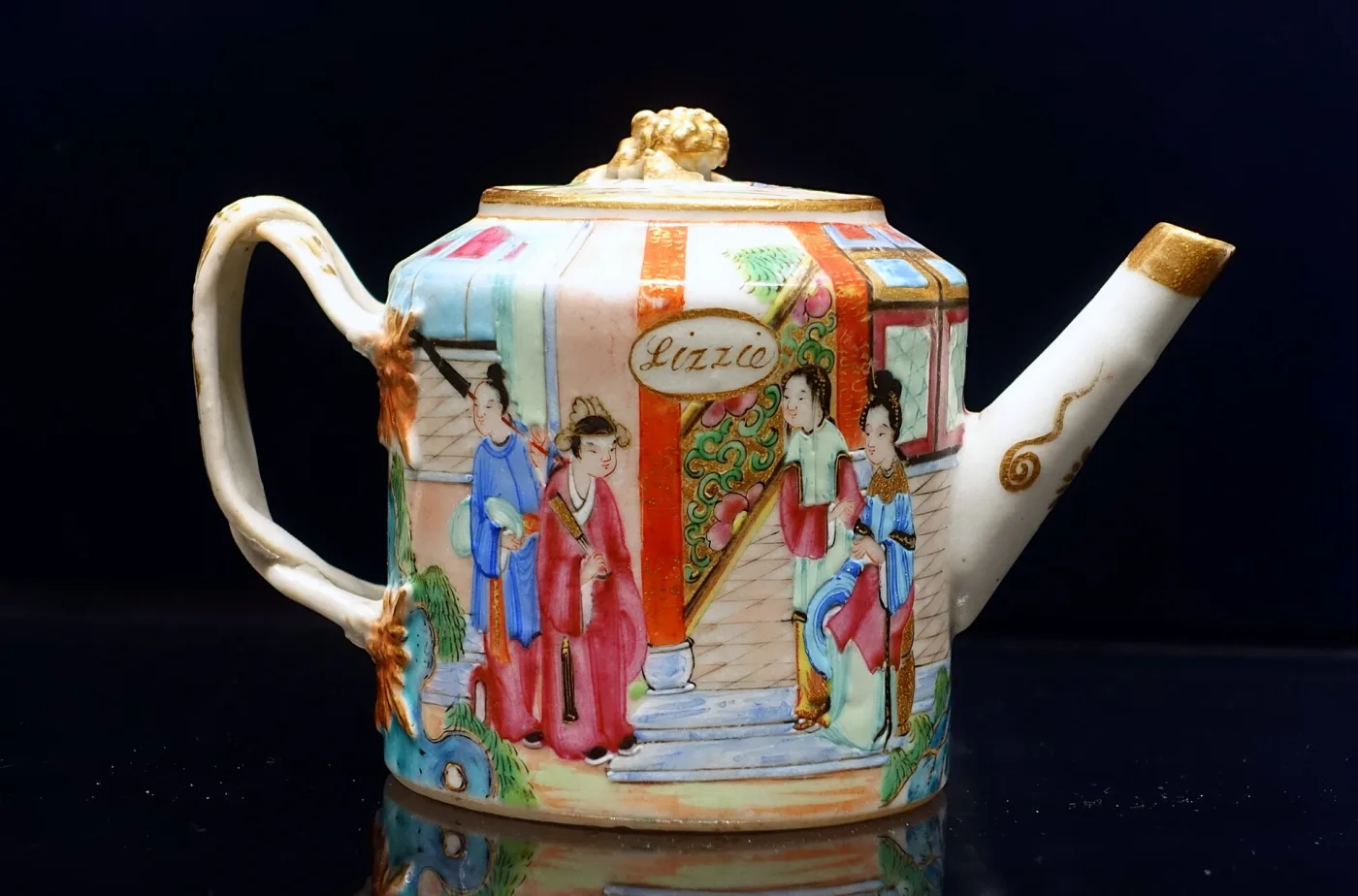
Rose Medallion was made in an enormous range of forms, and the form strongly affects both desirability and value. The most common survivors are tableware: dinner plates, soup plates, platters, covered tureens, sauce boats, cups and saucers, and the teapots and tea services that filled nineteenth-century parlors. Large dinner services in good matched condition carry real value precisely because complete survival is uncommon.
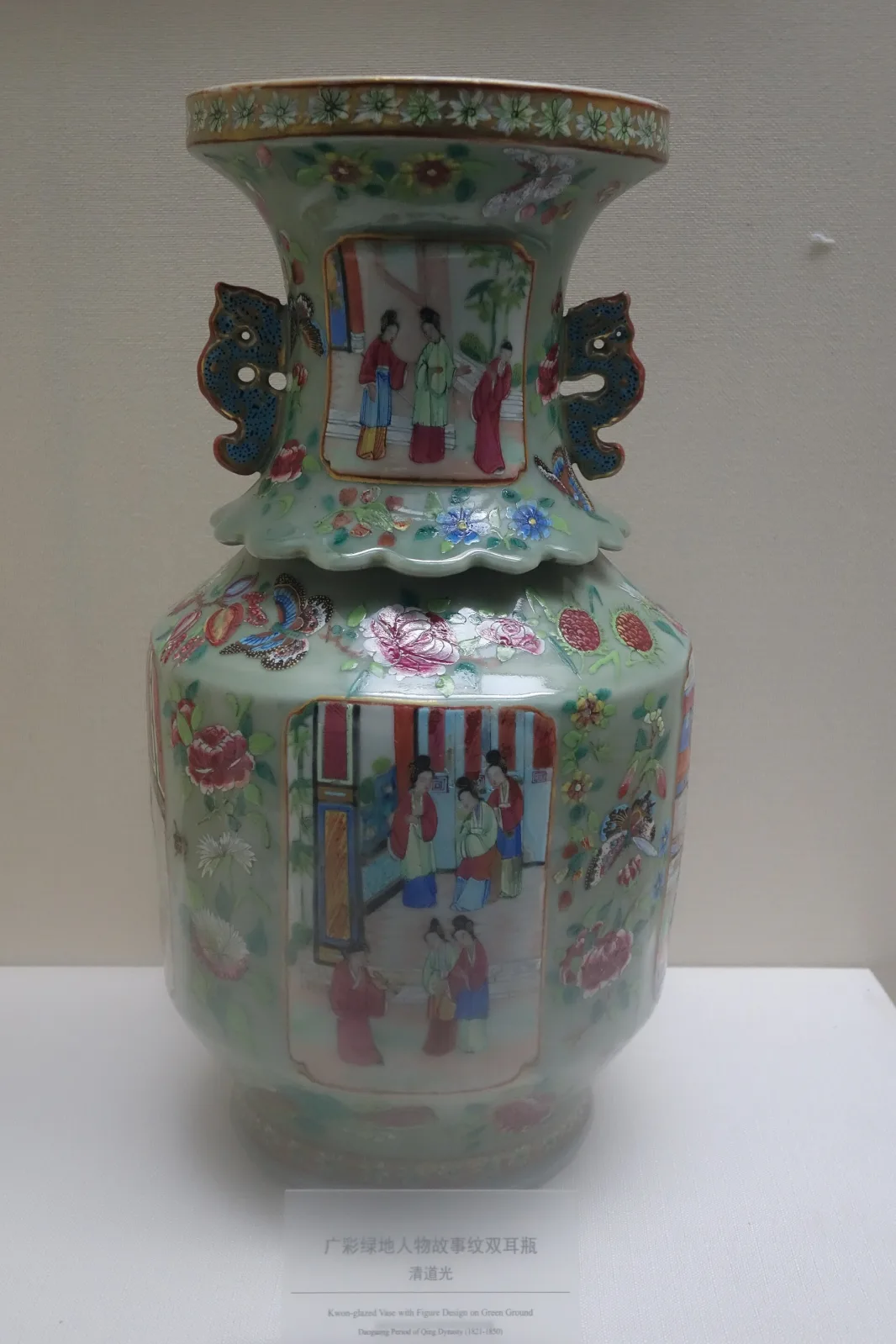
Vases and garnitures are among the most prized forms. Tall baluster vases, covered jars, and matched garniture sets made to line a mantel or cabinet were display pieces from the start, and large, finely painted pairs and garnitures can command very strong prices. As with antique vases generally, matched survival, size, and the quality of the figural panels drive the value of Rose Medallion vases sharply upward.
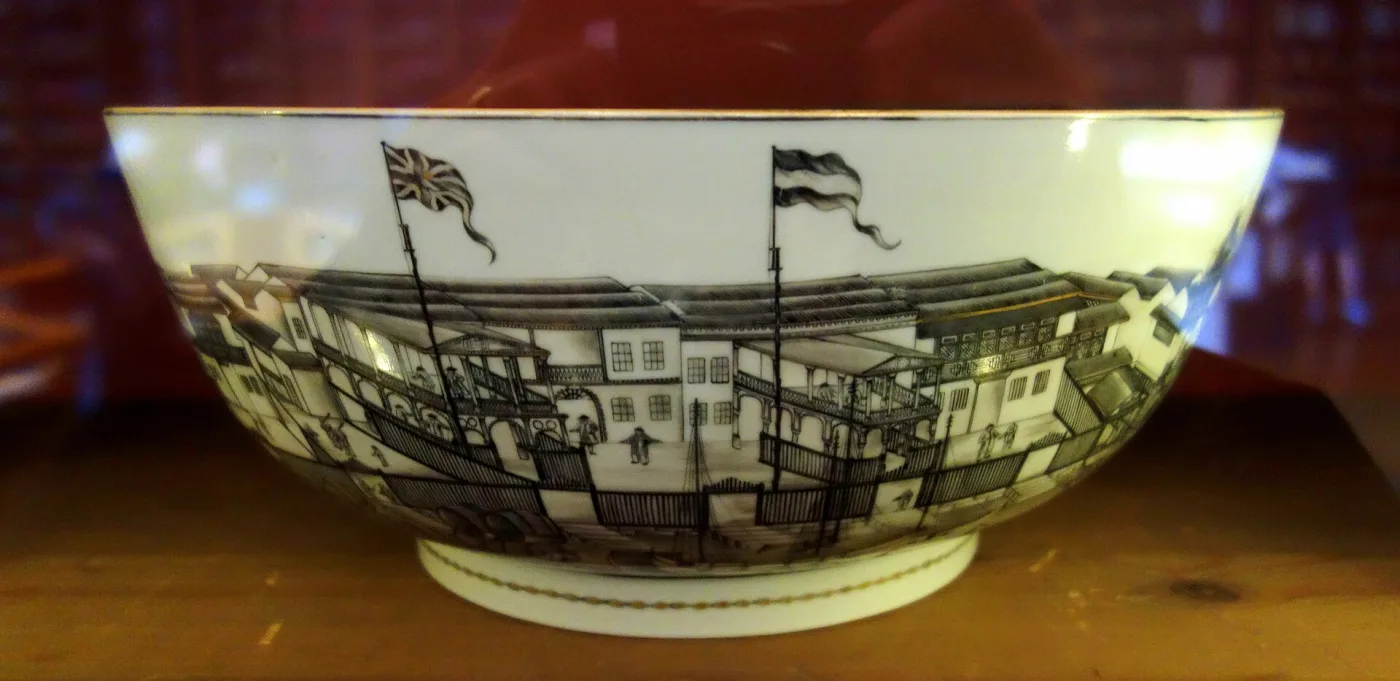
Punch bowls are a celebrated Rose Medallion form. Large Cantonese famille-rose punch bowls—often a foot or more across, with dense figural and floral decoration inside and out—were prestige objects in the China trade and remain among the most sought-after and valuable pieces today, especially early, finely painted, and undamaged examples.
Beyond these, the Canton studios produced an astonishing variety: covered ginger jars, brush pots, candlesticks, garden seats, planters and jardinières, lamp bases, shaving basins, chamber sets, and figural rarities. Unusual and large forms, well painted and undamaged, sit at the top of the market; common small tablewares sit at the bottom. Reading the form against its rarity and original purpose is a quick guide to where a piece falls.
Marks, Backstamps, and the Unmarked Rule
The most important fact about Rose Medallion marks is that genuine antique pieces are usually unmarked. Export ware made for the Western trade rarely carried a reign mark or a maker's mark, and the absence of any mark on a nineteenth-century piece is completely normal—it is not evidence against age or authenticity. Beginners who expect a backstamp on every plate misread this silence; with export Canton ware, no mark is the default.
When marks do appear, several kinds recur. Occasionally an early piece carries a hand-painted Chinese reign mark or seal mark in red or blue, but these are uncommon on export ware and, when present, were often decorative or aspirational rather than literal imperial attributions. From the late nineteenth century, Roman-letter origin marks become the key dating tool: "China" (roughly 1891 onward, after U.S. import law required country-of-origin marking) and "Made in China" (leaning twentieth century) are printed or stamped on the base of later wares. Mid-twentieth-century revival pieces may carry painted or printed "Made in China" together with importer or pattern names.
Because marks are so often absent or unhelpful, attribution leans on the physical evidence—palette, panel structure, figure quality, body, footrim, and gilding—rather than on a backstamp. This is the same situation that governs much Chinese and Japanese export porcelain, and the broader principles of reading bases, wear, and consistency appear in the authentication and provenance guide.
Reading the Base as a Whole
Read the base together rather than hunting for a single magic mark. An unmarked base with a hand-finished foot, honest wear, warm worn gilt, and fine hand painting points to nineteenth-century export. A printed "China" or "Made in China" mark places the piece after 1891 and, with heavy potting and bright gold, usually in the twentieth century. A perfectly clean, glassy base with a sharp foot and a modern printed importer's mark is decorative reproduction. The base rarely lies when read as a whole.
Reproductions and the Twentieth-Century Revival
Rose Medallion has been reproduced more or less continuously since the early twentieth century, and the market is thick with later pieces wearing the old look. Telling revival and reproduction ware from genuine nineteenth-century export porcelain is the practical heart of buying safely.
A large body of twentieth-century revival Rose Medallion was produced for export—especially mid-century and later—reusing the alternating-panel formula on heavier, more standardized bodies. This ware is typically thicker and heavier than nineteenth-century pieces, more brightly and harshly colored (a flatter, more synthetic pink), more crudely and repetitively painted (generic faces, hurried filler), and often carries a printed "Made in China" mark. It is genuine porcelain and perfectly collectable as decorative ware, but it is not Qing-dynasty export and should never be priced as if it were.
Several red flags separate reproductions from antiques. Transfer-printed or decal decoration shows, under magnification, tiny dot patterns and identical repeated faces and flowers, where hand-painted antique work shows brushstroke variation and slight irregularity. Too-bright, too-even color—harsh magenta-pink, garish green—signals modern enamels. Bright, brassy, unworn gold that rubs off points to late liquid gilding rather than fired antique gold. A too-perfect, heavy, glassy body with a sharp machine-finished foot and no honest wear is modern. And a printed "Made in China" mark is conclusive proof of twentieth-century (or later) manufacture, however convincingly the piece imitates old Canton ware.
Modern decorative reproductions continue to be made today, and from a distance many convince. As with all antique ceramics, structural examination—body, enamel quality, gold adhesion and wear, footrim finish, and the hand-versus-machine character of the painting—exposes them. The discipline that protects buyers is to handle and turn the piece, not just admire its face.
Condition, Restoration, and Value
Condition bears heavily on Rose Medallion value, and the issues are category-specific. Rim chips, hairline cracks, and star cracks (radiating from an impact point, common on plates and bowls) all reduce value, though minor footrim flakes are tolerated on early pieces. Enamel loss and flaking—particularly of the green and pink overglaze, which can lift from the glaze—is a common famille-rose problem and detracts in proportion to its extent and visibility.
Gilt wear is expected on antiques and, in moderation, actually confirms age; heavy wholesale loss of gold on main surfaces reduces value more seriously. Knife-mark scratches across plate faces and softened gilt on rims are honest evidence of use and rarely deduct much from genuine antiques—indeed they help authenticate them.
Restoration is widespread on higher-value Rose Medallion, especially vases, punch bowls, and tureens. Professional restorers fill chips, reattach broken sections, and repaint enamel and gilt convincingly. Examine suspected areas under a UV lamp: modern fills and overpaint usually fluoresce differently from original glaze and enamel, and repainted gold sits slightly above the original surface under raking light. A loupe reveals retouching along rims and cracks, and a fingernail run over the gilt can catch unfired modern gold. Always price a restored piece as restored, and follow the environmental guidance in the storage and preservation guide to avoid adding damage of your own—famille-rose enamels are vulnerable to abrasion and harsh dishwashing.
What Collectors Pay Premiums For
Premium Rose Medallion combines an early date (fine early-nineteenth-century work or Rose Mandarin), high-quality figure painting (individually rendered faces, detailed robes, populous scenes), desirable and large form (punch bowls, garniture vases, matched services), intact enamel and gold, and absence of restoration. Documented China-trade provenance adds further. Remove any one factor and the band drops; remove several—crude late painting, heavy potting, a "Made in China" mark, damage or restoration—and the piece moves firmly into decorative territory. For broader help translating these factors into numbers, see the valuation and appraisal guide.
Field Checklist Before You Buy
When you examine a piece of suspected Rose Medallion, work through this sequence before you think about price.
First, read the palette. Is this the opaque famille-rose family—soft pink, opaque greens, iron-red, yellow, aubergine, with gold—painted overglaze and sitting slightly proud of the surface? Confirm porcelain translucency by holding a thin section to the light. Second, read the panel structure, which decides the variant: do the rim panels alternate between figures and birds-and-flowers around a central medallion (Rose Medallion)? Are there no figures at all (Rose Canton)? Are large, fine figural scenes dominant, often with puce-and-gilt diaper borders (Rose Mandarin)?
Third, judge the figure painting—the strongest quality signal. Are faces individually and finely painted with shaded robes (fine, likely earlier), or generic, repetitive, and flat (coarse, likely later)? Under magnification, hand-brushed variation or transfer-printed dots and identical repeats? Fourth, examine body and footrim: turn the piece over and read the unglazed foot—hand-finished, slightly irregular, with honest wear and faint kiln tone (leans antique), or sharp, glassy, and machine-perfect (leans modern)? Weigh the potting: thin and refined (earlier) or heavy and standardized (later).
Fifth, read the gold. Is it warm, soft, and worn logically on rims and high points but intact in recesses (antique fired gold), or bright, brassy, even, and rubbing (late liquid gilding)? Sixth, read the base for marks: unmarked with honest wear (leans nineteenth-century), a printed "China" mark (1891 onward), or "Made in China" (twentieth century, especially with heavy potting and bright gold)?
Seventh, inspect condition: walk the rim for chips, turn the piece under raking light for hairlines and star cracks, scan for enamel flaking, and use UV to detect restoration and overpaint. Eighth, consider form against rarity—an early Rose Mandarin punch bowl or a matched garniture against a common late saucer—and weigh the whole picture for consistency. A "Qing export" piece with a bright "Made in China" base, flat synthetic pink, and a glassy machine foot is twentieth-century no matter how faithful the panel layout. Genuine antique Rose Medallion delivers consistency across palette, panels, figure quality, body, foot, gilt, and wear—the one thing reproductions struggle to fake all at once.
With this sequence practiced, the whole Cantonese famille-rose family becomes a category you can read with confidence at an auction preview, in a dealer's case, or on an estate walk-through. The same cross-checking discipline serves you across the related Asian wares that share collections and showcases with Rose Medallion—from Imari and Satsuma to cloisonné enamelware—and a well-chosen early punch bowl or a finely painted Rose Mandarin garniture rewards patient study, holding and building value as one of the great achievements of the China trade.