Antique Imari Porcelain Identification Guide: Marks, Palette & Dating
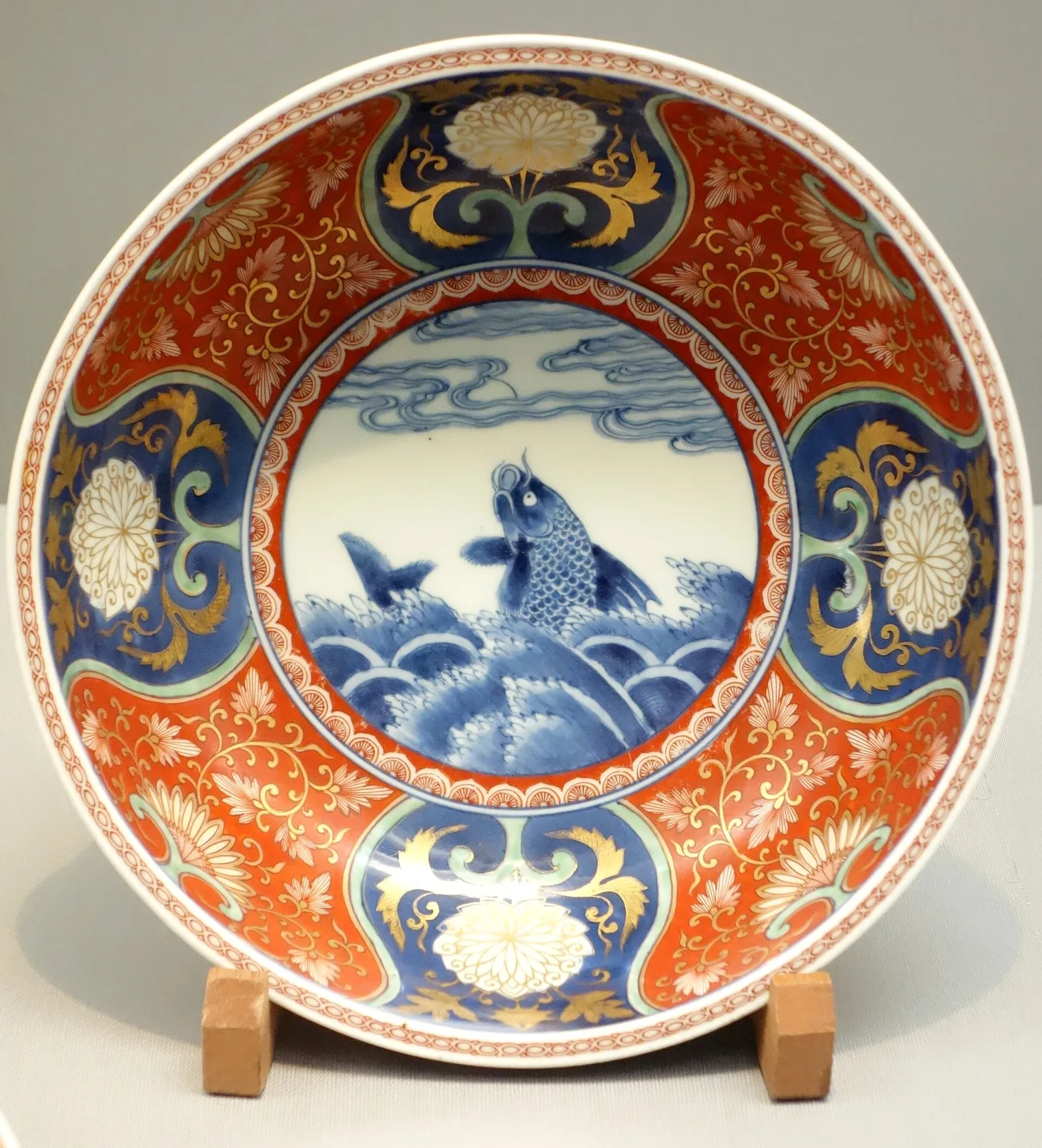
Few names in the world of Japanese porcelain are used as loosely as "Imari." The word names a port, not a kiln—a small harbor on the island of Kyushu from which the porcelain of nearby Arita was shipped to the world. Over three and a half centuries that single shipping label came to cover early seventeenth-century blue-and-white, the dense red-blue-and-gold export palette that filled European palaces, Chinese copies made to undercut the Japanese, and twentieth-century factory dinnerware sold by the carton.
Telling these apart is the whole game. A genuine Edo-period Ko-Imari ("Old Imari") charger and a late Meiji export plate may share the same iron-red brocade and the same chrysanthemum medallions, yet sit decades and sometimes a full order of magnitude apart in value. A Chinese Imari teapot can fool a careful eye until you turn it over and read the foot. And the most prized Arita wares of all—Kakiemon and Nabeshima—are technically separate traditions that the "Imari" label tends to swallow.
This guide works through Imari's materials, palette, decorative grammar, kiln history, and mark conventions so you can place a piece in its period, separate Japanese from Chinese production, and recognize the reproductions that crowd the lower end of the market. By the end you should be able to pick up an unfamiliar plate and read its story from the body, the blue, the red, the gold, and the base.
Table of Contents
- What "Imari" Actually Means
- Arita, the Port of Imari, and the Birth of Japanese Porcelain
- Body, Glaze, and the Grayish Arita Porcelain
- The Classic Imari Palette: Blue, Iron-Red, and Gold
- Kinrande and the Brocade Style
- Ko-Imari: Reading the Edo Period
- Kakiemon: The Refined Cousin
- Nabeshima: The Aristocratic Kiln
- Chinese Imari and How to Tell It Apart
- European Imari: Meissen, Derby, and the Imitators
- Reading the Base: Spur Marks, Fuku, and Pseudo-Marks
- Forms: Chargers, Vases, Garnitures, and Tableware
- Dating by Period: Edo, Meiji, Taisho, Showa
- Reproductions and Late Export Wares
- Condition, Restoration, and Value
- Field Checklist Before You Buy
What "Imari" Actually Means
Imari is a place name, but not the place where the porcelain was made. The town of Imari sits on a bay in Saga Prefecture on Kyushu, and for most of the Edo period it served as the export harbor for the kilns clustered around the inland town of Arita, roughly ten miles away. Dutch and Chinese merchants loaded crates of Arita porcelain at the Imari docks, and Western buyers naturally named the cargo after the port stamped on the manifest. The ware became "Imari" in Europe and "Imari" it has stayed.
For collectors, several senses of the word matter, and confusing them is the single most common mistake. The first is Ko-Imari, or "Old Imari": the broad body of Arita export porcelain made from the mid-seventeenth century through the end of the Edo period in 1868, including both early blue-and-white and the later red-blue-gold brocade wares. The second is Imari in the narrow palette sense: any porcelain, regardless of origin, decorated in the signature combination of underglaze cobalt blue, overglaze iron-red, and gilding. The third is later export Imari: the Meiji, Taisho, and Showa factory production that kept the look alive for the Western market well into the twentieth century.
Why the Distinction Matters for Value
A seventeenth-century Ko-Imari dish of fine quality can realize substantial sums at auction, while a 1900s export plate in the same colors is a modest decorative purchase. The palette alone tells you almost nothing about value; it is the body, the quality of painting, the kiln tradition, and the date that set the price. Learning to look past the red-and-gold dazzle is the first discipline of Imari collecting.
Arita, the Port of Imari, and the Birth of Japanese Porcelain
Japan made no true porcelain before the seventeenth century. The breakthrough came around 1610–1616, when kaolin—the white china clay essential to porcelain—was discovered at Izumiyama near Arita, traditionally credited to the Korean potter Ri Sampei (Yi Sam-pyeong), one of the artisans brought to Kyushu after Hideyoshi's Korean campaigns. The same wave of Korean expertise that seeded the Satsuma earthenware tradition also gave Japan its first porcelain stone.
Early Arita porcelain was blue-and-white, painted in underglaze cobalt in a style indebted to Chinese models. The decisive commercial turn came mid-century. When the Ming dynasty collapsed in the 1640s and the Chinese kilns at Jingdezhen fell into disorder, the Dutch East India Company (VOC), starved of its usual Chinese supply, turned to Arita. From roughly 1659 the VOC placed enormous orders, and Arita porcelain began flowing west through the port of Imari in quantity.
This export boom drove the development of the rich overglaze enamel styles—first Kakiemon, then the dense brocade Imari—that defined the ware for European eyes. The same period saw the rise of Nabeshima, the private kiln of the local feudal lord, producing the finest porcelain in Japan for domestic aristocratic use rather than export. Arita, in other words, produced several distinct traditions at once, and the export "Imari" most collectors picture is only one branch of a larger family.
The Dutch Connection
The VOC's role is central to dating and attribution. Dutch records document the volume and timing of orders, and many early export shapes were made to European specification—mustard pots, beakers, and pharmacy bottles unknown in the Japanese domestic market. When you encounter an Imari form that makes no sense for a Japanese table but perfect sense for a Dutch one, you are usually looking at seventeenth- or early eighteenth-century export production.
Body, Glaze, and the Grayish Arita Porcelain
The physical body is one of your most reliable identification tools, and it is where Japanese Imari most clearly separates itself from Chinese porcelain. True Arita porcelain is hard-paste, vitreous, and translucent—it rings when tapped and shows light through thin sections—but its body is characteristically a slightly grayish or smoky off-white rather than the brilliant pure white of Chinese export porcelain from Jingdezhen. The Izumiyama clay carried iron impurities that left this faintly gray cast.
Examine the unglazed foot rim under good light. Japanese Imari foot rims are often slightly irregular, the porcelain a warm grayish white, and the glaze frequently stops in an uneven line. You will commonly find small grit or sand adhering to the foot, picked up from the kiln setter, and the glaze on the base may show a faint bluish or greenish pooling. Chinese Imari, by contrast, tends to show a whiter, cleaner body and a more regularly finished foot.
The glaze itself is a clear feldspathic coat that often has a very slight blue-gray tint and may show minute pitting or "orange peel" texture on earlier pieces. On genuine Edo wares the glaze can pool thickly in recesses and thin at the rim. A completely flawless, glassy, dead-white glaze with a machine-perfect foot is a signal of much later or non-Japanese manufacture.
The Spur Marks Test
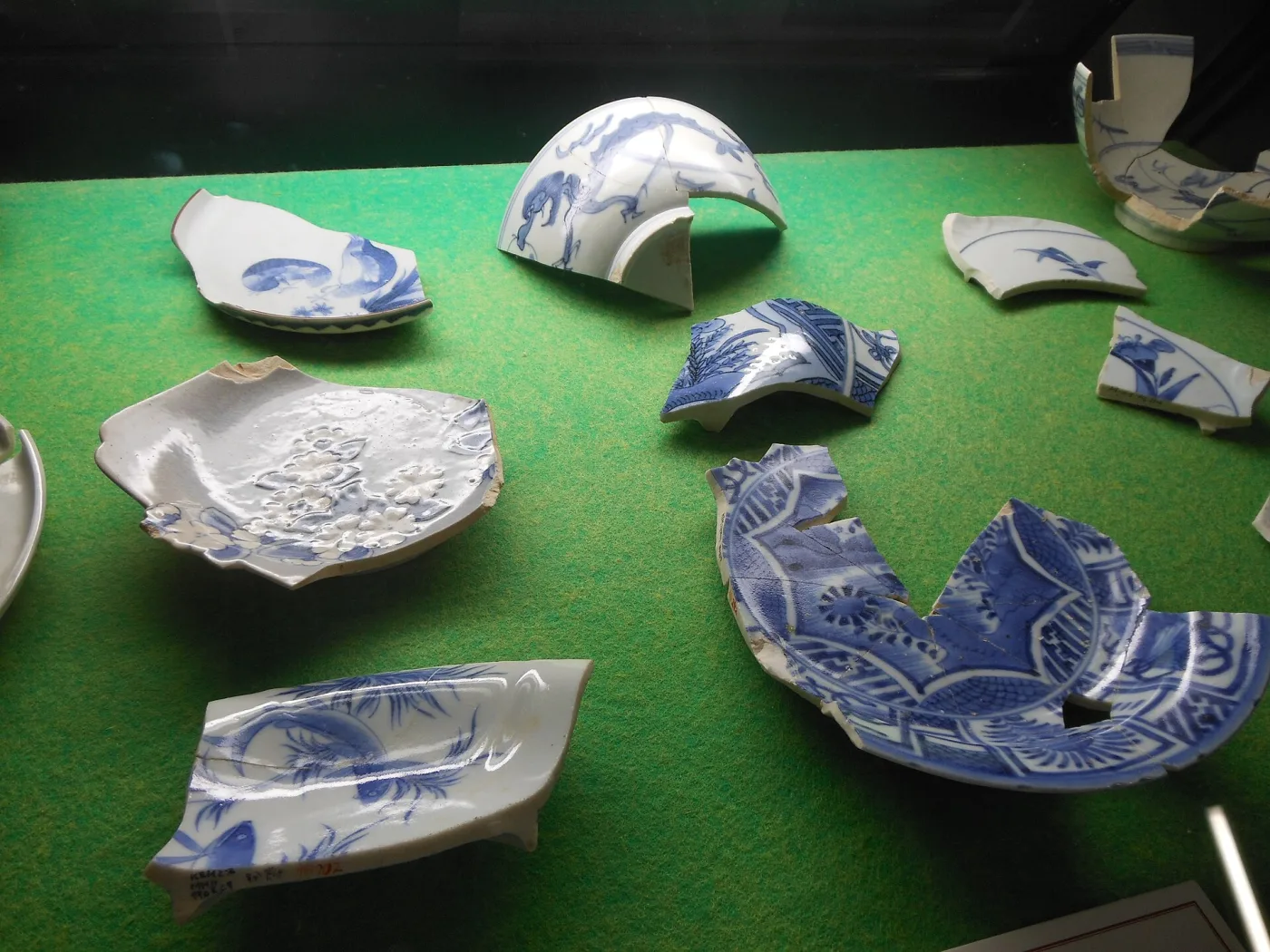
One of the most useful Japanese-versus-Chinese tells lives on the base. Many Japanese Imari pieces—especially plates and dishes—were stacked in the kiln on small clay spurs, leaving three to five small unglazed "spur marks" or stilt scars on the back or inside the foot ring. These little rough spots, often arranged in a rough circle, are characteristic of Japanese kiln practice and are far less common on Chinese export work. Their presence is a strong (though not absolute) point toward Arita manufacture.
The Classic Imari Palette: Blue, Iron-Red, and Gold
The palette that says "Imari" to most people is a specific three-color system, and learning its chemistry and order of application is one of the fastest ways to read a piece.
The foundation is underglaze cobalt blue, painted on the raw body before the clear glaze and the first firing. On genuine Japanese Imari this blue tends toward a slightly grayish, soft indigo rather than the bright sapphire or violet-blue of much Chinese cobalt. Over the fired glaze comes overglaze iron-red (a warm brick-to-tomato red derived from iron oxide) and gold, both fixed in a lower-temperature second firing. Some pieces add small touches of overglaze green, turquoise, aubergine, yellow, or black, but the blue-red-gold trinity is the core.
Because the blue is underglaze and the red and gold are overglaze, they sit at different levels on the surface. Run a fingertip lightly across a genuine piece: the blue is smooth and sealed beneath the glaze, while the red and gold sit slightly proud and, on worn pieces, may show abrasion the blue does not. This layering is hard to fake convincingly and is a quiet authentication tool.
Reading the Gold
Edo and early Meiji gilding was applied as true gold and fired, adhering well and wearing only on high points and rims after long use. Late export and reproduction Imari often uses bright liquid gold or gold-toned lacquer that rubs away under a fingernail and shows a brassier tone. As with the gilt on Satsuma ware, the condition and tone of the gold is a reliable period clue: soft, slightly worn, warm-toned gold suggests age; bright, unworn, brassy gold suggests recent manufacture.
Kinrande and the Brocade Style
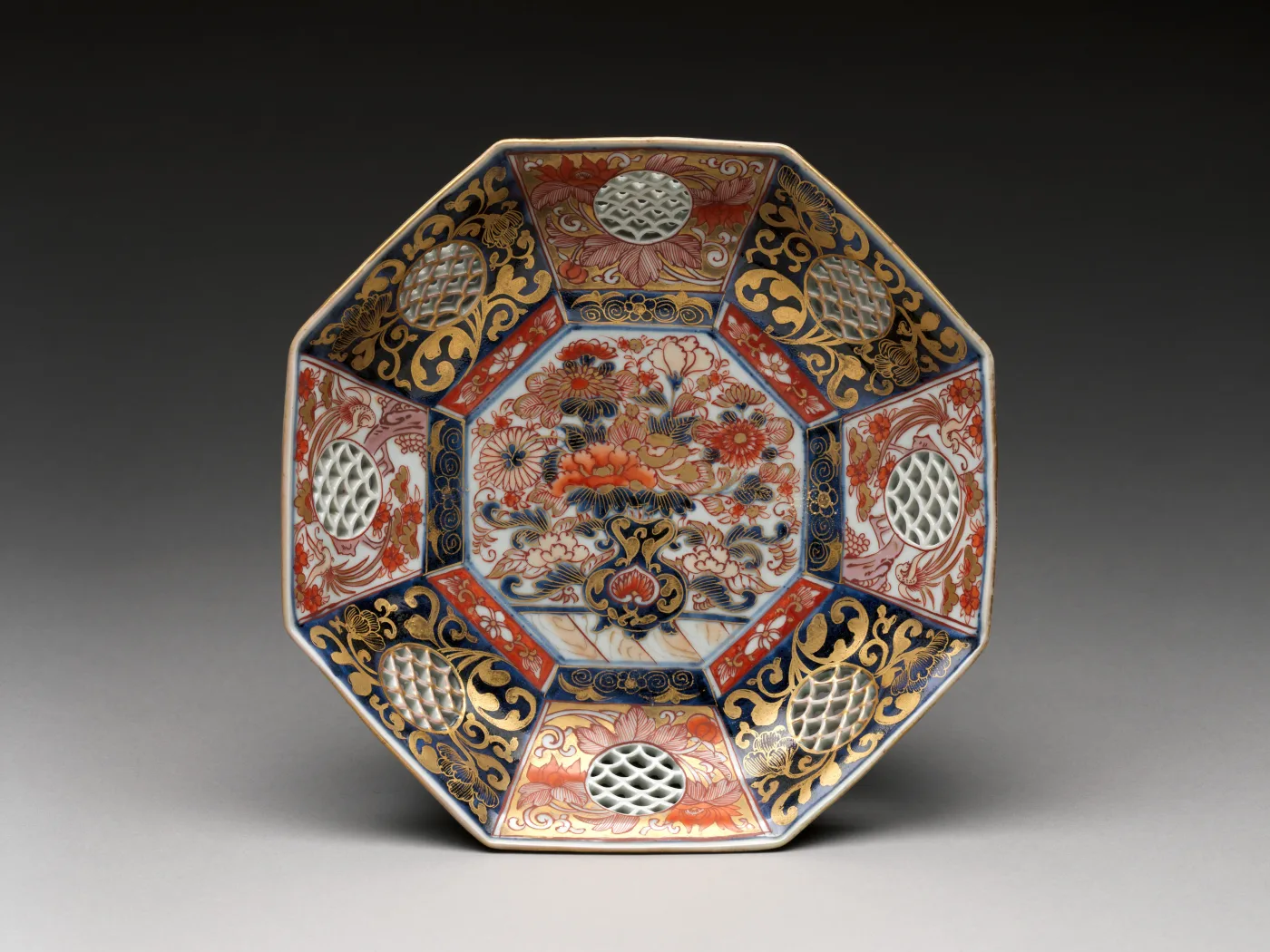
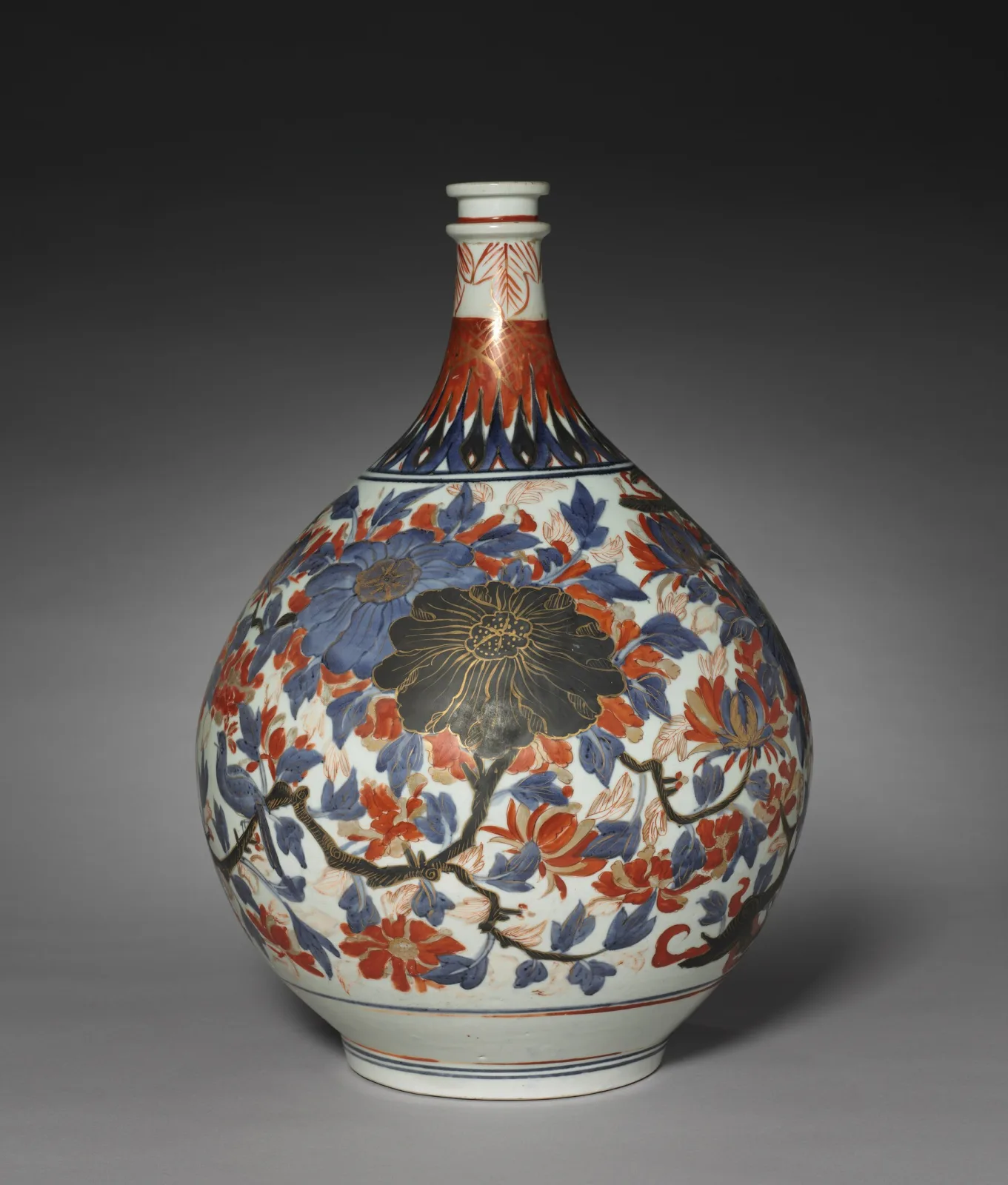
The most recognizable Imari decorative mode is kinrande—literally "gold brocade"—a dense, all-over patterning that combines underglaze blue grounds, iron-red panels, and lavish gold to imitate the look of rich woven textile. Kinrande Imari fills nearly every surface: a central medallion, radiating panels alternating florals and geometric brocade, and a patterned border, with little undecorated white left exposed.
This crowded, jewel-toned aesthetic is what filled the cabinets and chimneypieces of European aristocracy in the late seventeenth and eighteenth centuries. The visual logic is deliberately maximalist: the more densely worked the surface, the more impressive (and expensive) the piece appeared to its original buyers. Typical motifs include chrysanthemums, peonies, prunus, phoenixes, dragons, karako (Chinese boys), and stylized landscape vignettes, often arranged in radial symmetry around a central roundel.
Quality within kinrande varies enormously. The finest early pieces show controlled, finely drawn brushwork, well-registered enamels, and gold that integrates rather than smothers. Later mass-market kinrande becomes coarser: blurry blue, muddy red, heavy black outlining, and gold applied as a quick wash. Because the brocade style persisted from the Edo period straight through to twentieth-century factory ware, kinrande alone never dates a piece—only the quality of its execution and the evidence of its body and base can do that.
Ko-Imari: Reading the Edo Period
Ko-Imari ("Old Imari") is the collector's term for genuine Edo-period Arita export porcelain, roughly 1650 to 1868. Within this long span, decoration evolved in ways that allow rough dating.
The earliest export wares (c. 1650–1680) are often blue-and-white or sparsely enameled, with restrained composition, generous white ground, and high potting quality. The classic dense kinrande brocade develops through the late seventeenth and early eighteenth centuries (the Genroku era, c. 1688–1704, is a high point), when European demand peaked and the style reached its richest, most balanced form. Pieces from this period combine fine drawing with the full red-blue-gold palette and command the strongest collector interest.
Through the eighteenth and into the nineteenth century, domestic Japanese demand grew as the export trade fluctuated, and production broadened in both quality and quantity. Late Edo Ko-Imari (early nineteenth century) ranges from still-fine pieces to increasingly standardized, repetitive work. Reading Ko-Imari therefore means weighing potting quality, the softness and depth of the cobalt, the integration of the gold, and the overall compositional confidence—not just the presence of the palette.
Signs of Genuine Age
Genuine Edo Imari shows honest, consistent wear: footrim abrasion from generations of handling, gold worn from high points but intact in recesses, minor glaze scratches, and sometimes kiln grit on the foot. The cobalt has depth and slight irregularity rather than flat printed evenness. Knife-mark scratches across the face of plates (from centuries of use) and a softly worn glaze are reassuring. Pristine, scratch-free "Edo" pieces deserve scrutiny.

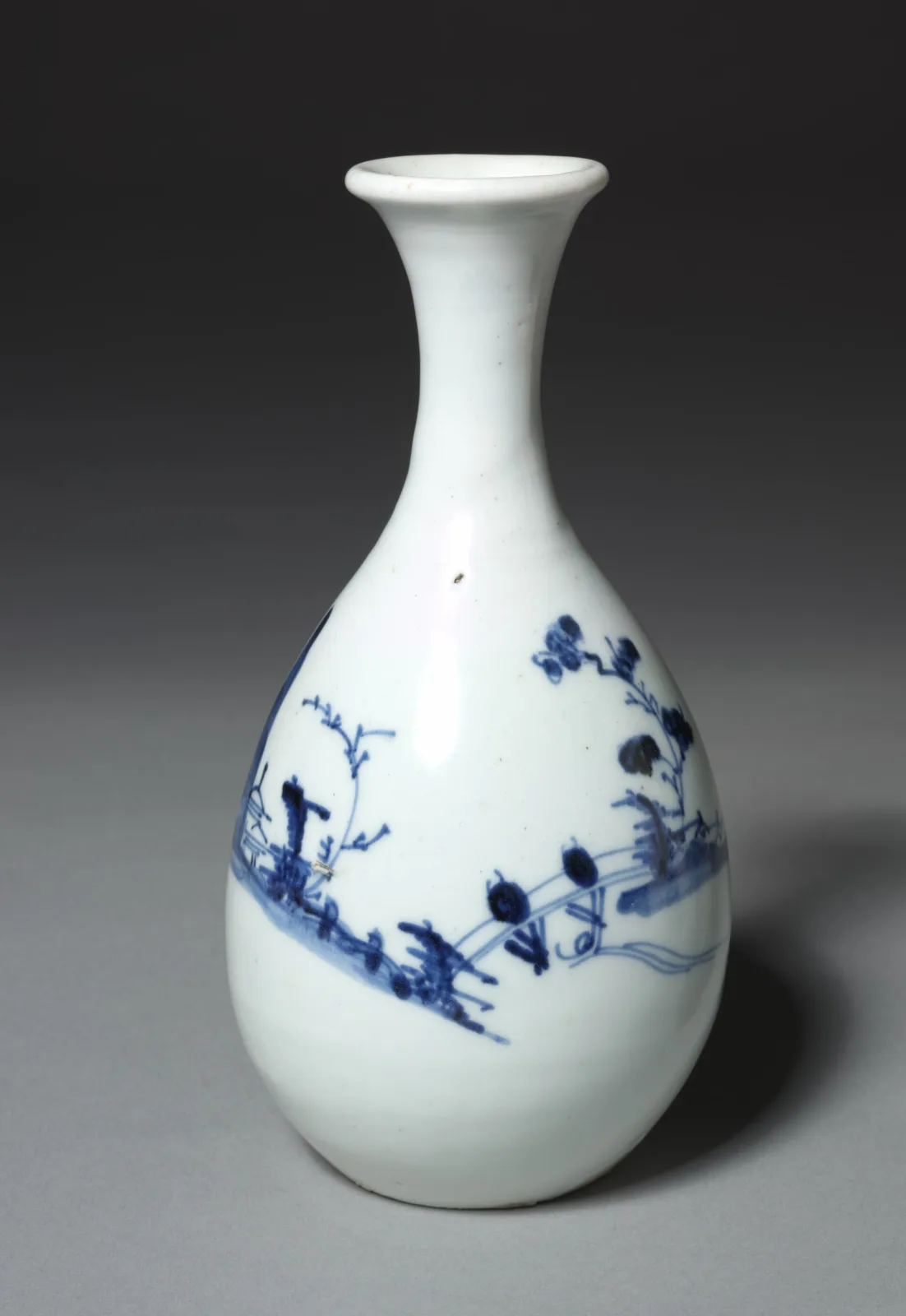
Kakiemon: The Refined Cousin
Kakiemon is technically a distinct Arita tradition, but it is so often filed under the Imari umbrella that no identification guide can ignore it. Where kinrande Imari crowds the surface, Kakiemon celebrates empty space. Developed by the Sakaida Kakiemon family workshop from the mid-seventeenth century, Kakiemon places sparse, exquisitely painted asymmetrical decoration—a single flowering branch, a quail, a tiger and bamboo—across a milky-white ground that the Japanese called nigoshide.
The defining features are the warm milky-white body (purer and whiter than ordinary Arita), a restrained overglaze palette of soft iron-red, blue, turquoise-green, yellow, and a little gold, and a composition built around negative space. Brushwork is delicate and confident; the enamels are clear and jewel-like rather than dense. Kakiemon was the most prestigious Japanese export ware in Europe, directly imitated at Meissen, Chantilly, and the early English factories.
For the collector, Kakiemon's restraint is its signature. If a piece shows refined, sparse decoration on an unusually white ground with that characteristic clean palette, you are likely looking at Kakiemon or a Kakiemon-style ware rather than standard brocade Imari—and a piece in a generally higher value tier. As with all Arita, genuine Kakiemon should show appropriate body color, footrim finish, and honest wear.
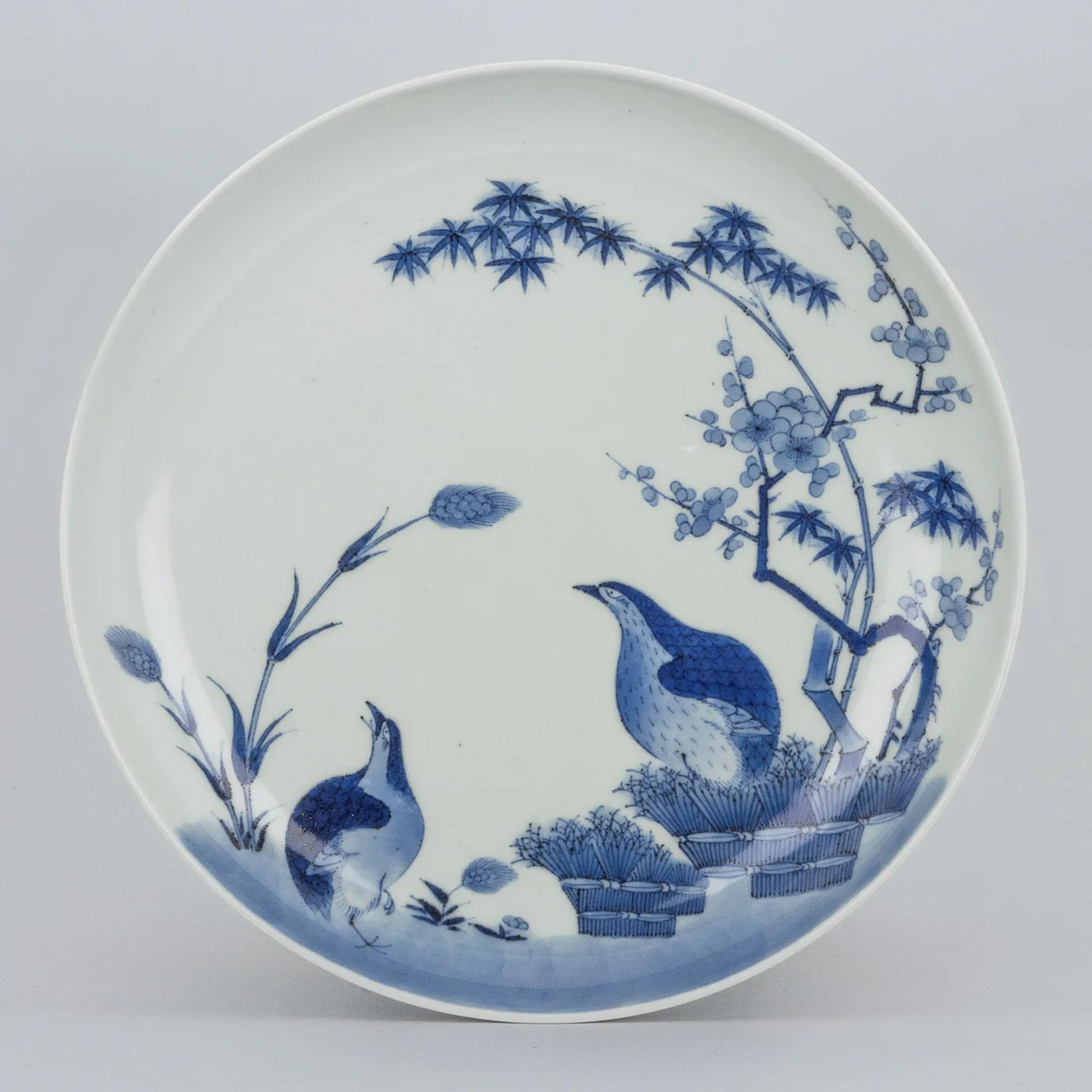
Nabeshima: The Aristocratic Kiln
Nabeshima ware represents the pinnacle of Japanese porcelain technique and was never made for export at all. The Nabeshima clan, lords of the Saga domain, operated a closely guarded official kiln (first at Iwayakawachi, later at Okawachi) to produce porcelain exclusively for the use of the daimyo and for prestige gifts to the shogunate and other lords. Production ran from the late seventeenth through the nineteenth century under strict quality control.
Nabeshima is instantly different from export Imari. Forms are standardized and precise—especially footed dishes on a distinctive tall, splayed foot (the kodai) decorated with a "comb-tooth" pattern of regular blue lines. Decoration is refined, often nature-based (flowering plants, fruit, textiles motifs), boldly placed, and impeccably executed in underglaze blue with restrained overglaze enamel (a style called iro-Nabeshima, "colored Nabeshima"). There is no crowding, no muddiness, no commercial compromise.
Genuine antique Nabeshima is rare and valuable, and the name is heavily borrowed by later and modern wares. The comb-tooth foot, the precise standardized forms, and the extraordinary control of the cobalt are the things to look for. Because authentic pieces are scarce and prices high, attribution should be cautious and ideally supported by published references or expert opinion.
Chinese Imari and How to Tell It Apart
The success of Japanese Imari in Europe did not go unnoticed at Jingdezhen. By the early eighteenth century Chinese kilns were producing their own version—"Chinese Imari"—in the same blue-red-and-gold palette, often more cheaply than the Japanese could manage, and exported it to the same European market. The same Jingdezhen-to-Canton export trade later sent vast quantities of famille-rose Rose Medallion porcelain west in the nineteenth century. Distinguishing Chinese from Japanese Imari is one of the core skills of the field.
Several tells separate them. Body color: Chinese porcelain is typically a brighter, purer white; Japanese Arita is grayer and warmer. The blue: Chinese cobalt is often a more brilliant, slightly violet sapphire; Japanese blue is softer and grayer. The foot: Chinese feet are usually cleaner, more regularly finished, and often lack the spur marks common on Japanese plates. The red: Chinese iron-red can be a thinner, more orange tone, while Japanese red is often deeper and more brick-like.
Composition differs too. Chinese Imari often shows more fluid, naturalistic, sometimes looser painting, while Japanese kinrande tends toward denser, more rigidly organized brocade panels. Neither rule is absolute—high-quality pieces from both traditions can blur the lines—so the safest reading combines body color, blue tone, footrim finish, and the spur-mark test rather than relying on any single feature. The same disciplined, multi-point approach that governs all Asian art authentication applies here.
Why It Matters Less Than You Think
Both Chinese and Japanese Imari are collectable, and an exceptional Chinese Imari piece can outvalue a routine Japanese one. The point of distinguishing them is accurate attribution and fair pricing, not a verdict of "real versus fake." A piece correctly identified as fine eighteenth-century Chinese Imari is just as legitimate an antique as its Japanese counterpart.
European Imari: Meissen, Derby, and the Imitators
The European obsession with Japanese porcelain produced a third stream: Western factories imitating the Imari palette outright. When Meissen cracked the secret of hard-paste porcelain in the early eighteenth century, among its first decorative programs were direct copies of Kakiemon and Imari designs for aristocratic patrons. English factories followed enthusiastically.
Derby made "Japan patterns" in the Imari style its commercial backbone, and the tradition carried into Royal Crown Derby, whose dense red-blue-gold "Imari" tableware patterns (such as the famous 1128) remain in production. Worcester, Spode, Minton, and others produced their own Imari-pattern wares throughout the nineteenth century. These are English bone china or porcelain, not Japanese, and they carry English factory marks.
Identifying European Imari is usually straightforward once you check the body and base. English bone china has a warm, very white, highly translucent body quite unlike grayish Arita; the potting is industrially precise; and the base typically carries a recognizable factory mark, a pattern number, and sometimes a date code. A printed English registration mark or a Royal Crown Derby cypher settles the question instantly. When in doubt, the techniques in the broader porcelain identification guide help separate hard-paste, soft-paste, and bone-china bodies.
Reading the Base: Spur Marks, Fuku, and Pseudo-Marks
Imari mark conventions confuse beginners because, unlike European factory porcelain, much genuine Edo Imari is completely unmarked or carries decorative pseudo-Chinese marks rather than honest maker's marks. The absence of a mark is normal and is not evidence against age.
When marks do appear, several types recur. Pseudo-Chinese reign marks—four- or six-character marks imitating Ming reign titles such as Chenghua, painted in underglaze blue within a double ring—are common on both Japanese and Chinese export porcelain and were decorative homage, not a claim of Chinese imperial manufacture. The character fuku ("happiness" or "good fortune"), often within a square or double ring, appears frequently on Arita wares. Hall marks, shop marks, and auspicious-phrase marks (such as references to jade or treasure) also occur.
From the late nineteenth century, Western import regulations forced clearer origin marking. "Nippon" in Roman letters dates a piece to roughly 1891–1921; "Japan" or "Made in Japan" to 1921 onward; and "Made in Occupied Japan" firmly to 1945–1952. These English-language marks are decisive late-period anchors, the same framework used to date Nippon-era porcelain and Noritake. If a piece carries any of them, it is not Edo-period Ko-Imari, full stop.
What the Base Tells You Together
Read the base as a whole. Unglazed spur marks plus a grayish body and a hand-painted pseudo-Chinese mark point toward Edo or early Meiji Arita. A printed Roman-letter "Made in Japan" with a perfectly finished foot points to twentieth-century export. An English factory cypher points to Europe. No single element is conclusive, but the base usually settles the broad category faster than any other surface, and broader principles of mark study appear in the authentication and provenance guide.
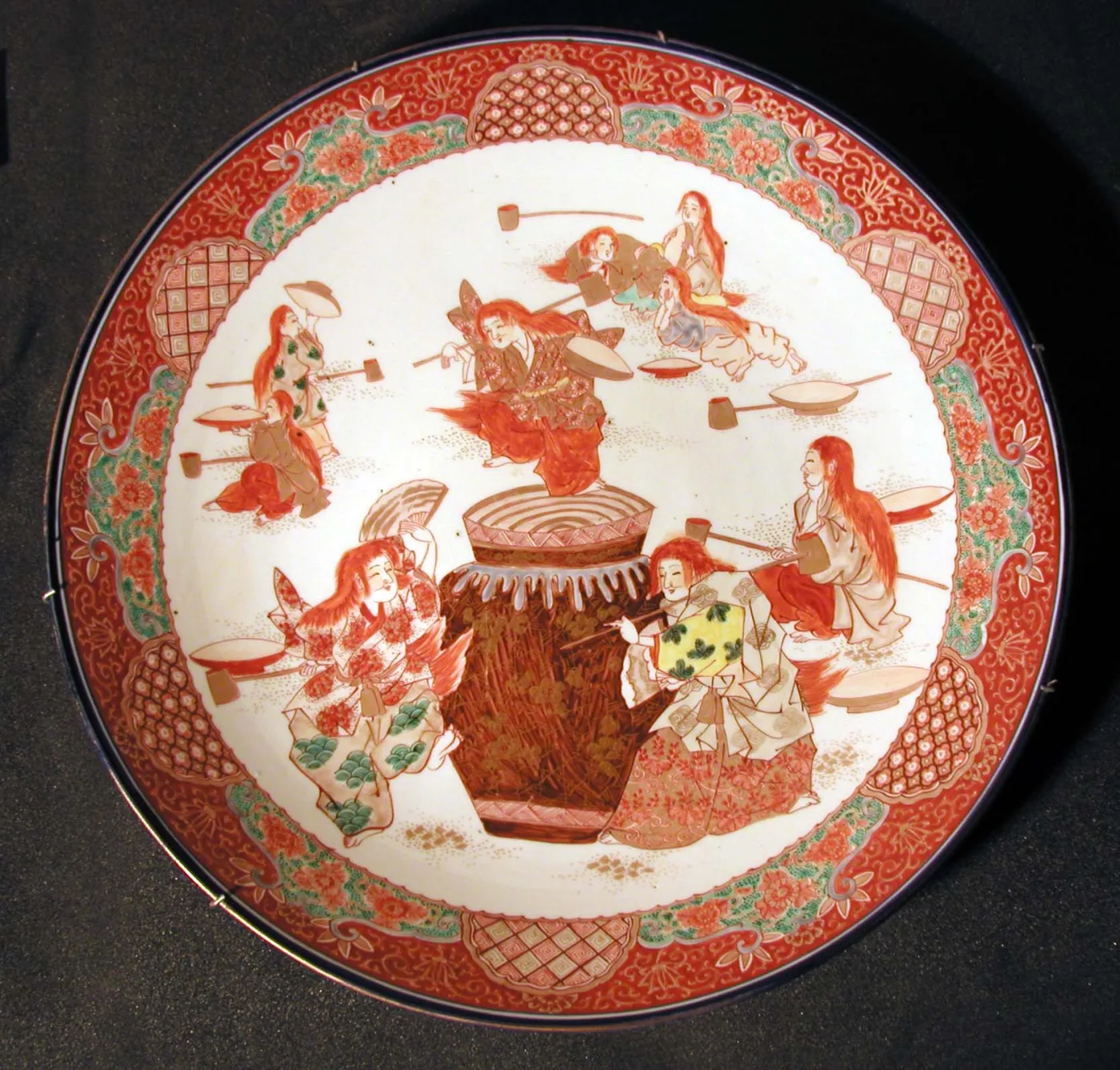
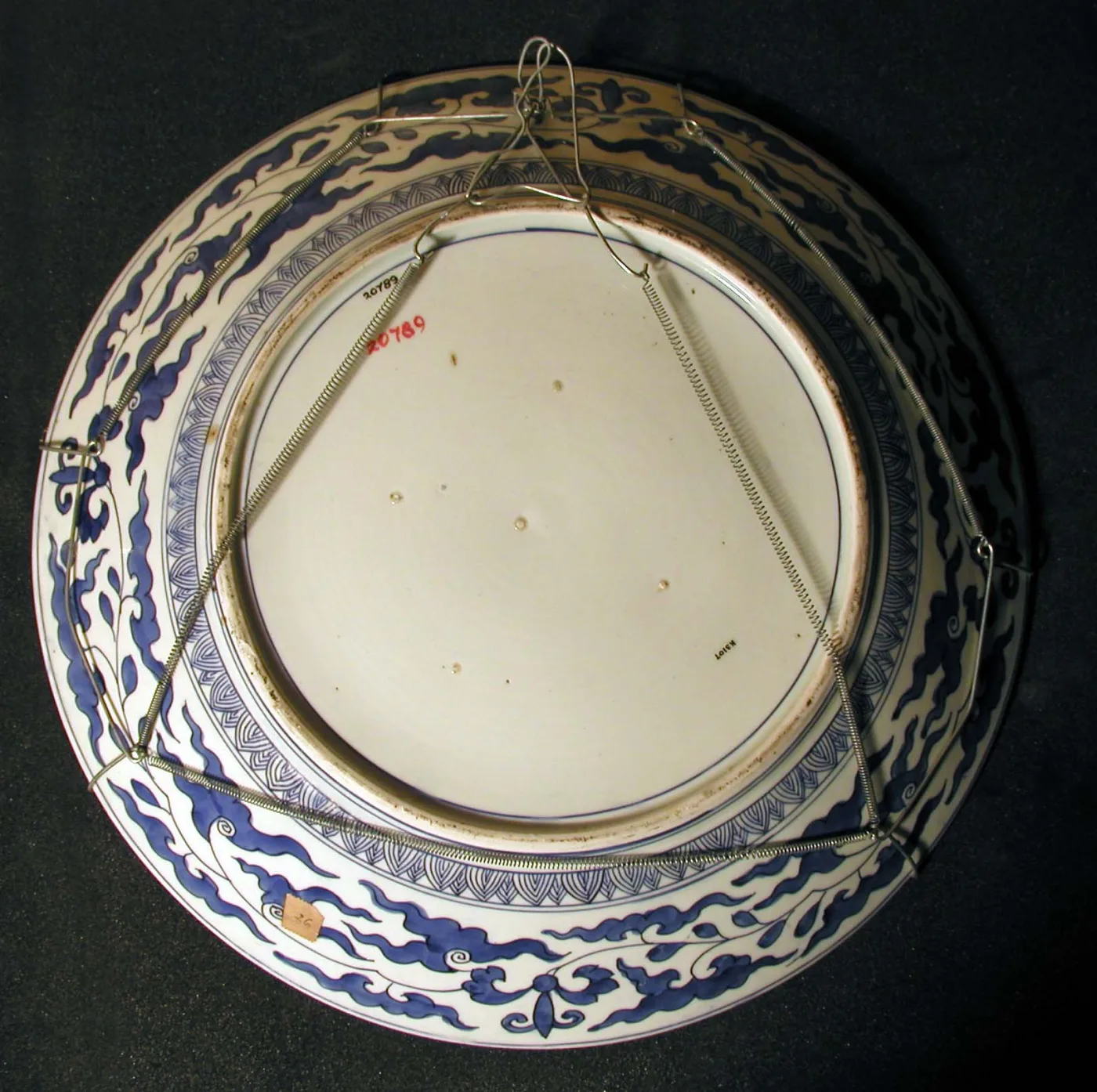
One charger, both sides, and the second picture is the one to ask a seller for. Almost everything this guide has described as decisive lives on the reverse. The footring shows how the piece was fired and whether it stood on spurs; the underside carries any mark, genuine or pseudo; the unglazed rim of the foot exposes the body itself, which is where the grayish Arita paste can actually be judged against Chinese whiteness; and the sparse blue sprays on the back are themselves a period habit that changed over time. Note also the wire fitting across this one. Hanging hardware is a later addition, fitted when a dish became a wall ornament rather than tableware, and while it is not damage it frequently conceals the footring and it means the piece has hung on a nail for decades — so check the rim for stress cracks radiating from the wire before anything else.
Forms: Chargers, Vases, Garnitures, and Tableware
Imari was made in an enormous range of forms, and the form itself often hints at period and market. Chargers and large plates—from dinner-plate size up to massive display chargers two feet across—are the iconic Imari shape, made for European walls and sideboards. The grand display charger with radial brocade is quintessential export Imari.
Vases and garnitures were enormously popular in Europe. A classic garniture is a matched set of three or five vases—typically alternating covered baluster jars and trumpet beakers—made to line a mantelpiece or cabinet. Complete period garnitures are prized; matched survival of all pieces adds considerable value over a single orphaned vase.
Tableware and tea wares include teapots, cups, bowls, ewers, and the full apparatus of Western dining and tea drinking, much of it made to European shapes. Bowls range from small tea bowls to large punch and barber's bowls. Specialized export forms—mustard pots, candlesticks, salts, and pharmacy bottles—reflect the Dutch trade and tend to indicate earlier export production. Reading the form against its plausible original market is a quiet but powerful dating aid.
Dating by Period: Edo, Meiji, Taisho, Showa
Japanese reign and historical periods give Imari a useful dating frame, especially when combined with body, palette, and base evidence.
The Edo period (to 1868) covers all genuine Ko-Imari. Within it, the late seventeenth and early eighteenth centuries (especially the Genroku era) represent the export high point, with the finest brocade work and strongest collector demand. Late Edo work is more variable. Edo pieces are typically unmarked or carry hand-painted pseudo-Chinese or fuku marks, show grayish bodies, spur marks, and honest wear.
The Meiji period (1868–1912) saw Arita modernize and ramp up export production for a booming Western market. Meiji Imari ranges from genuinely fine work to increasingly standardized commercial ware. From 1891 many pieces carry Roman-letter "Nippon" marks. Quality is broad; the best Meiji Arita is excellent, while the bulk is competent export decoration.
The Taisho (1912–1926) and Showa (1926–1989) periods produced large quantities of factory Imari-pattern porcelain and dinnerware, much of it transfer-printed or stencil-assisted, carrying "Japan," "Made in Japan," or (1945–1952) "Made in Occupied Japan" marks. This twentieth-century ware is decorative rather than investment-grade and should never be confused with Ko-Imari, however faithfully it copies the old palette.
Base Inscription as a Fast Date Anchor
As with other Japanese export ceramics, read the base before the decoration. No Roman inscription plus hand-painted marks and a grayish body points to Edo or early Meiji. "Nippon" = 1891–1921. "Japan" or "Made in Japan" = 1921 onward. "Made in Occupied Japan" = 1945–1952. Printed rather than painted marks lean late. This sequence, combined with quality and body analysis, places most Imari within a workable window.
Reproductions and Late Export Wares
Imari has been reproduced continuously for over two centuries, and the market is full of later pieces wearing the old look. Several red flags help separate them from genuine antique Arita.
Transfer-printed or stenciled decoration. Under magnification, hand-painted Imari shows brushstroke variation, slight irregularity, and the layering of underglaze blue beneath overglaze red and gold. Transfer-printed decoration shows tiny dot patterns, identical repeated motifs, and mechanical line quality. Much twentieth-century "Imari" is transfer-printed with at most hand-touched color.
Too-white, too-perfect body. A brilliant pure-white, flawless, machine-finished porcelain body with a glassy even glaze and a perfectly turned foot signals modern or non-Japanese manufacture, not grayish Edo Arita.
Bright, brassy, or rubbing gold. Liquid bright gold and gold-toned lacquer that rubs off under a fingernail and reads brassy is a late feature; fired Edo gold is warmer and wears only at high points.
Roman-letter origin marks. "Made in Japan" or "Made in Occupied Japan" on the base is conclusive proof the piece is twentieth-century, regardless of how convincingly it imitates Ko-Imari.
Modern decorative reproductions from the late twentieth century onward—including pieces made in China and elsewhere in the Imari style—often combine slightly wrong palette balance, sharp transfer decoration, and new-looking feet. From a distance they can convince; structural examination of body, blue tone, gold adhesion, and foot finish exposes them. The same scrutiny that protects buyers of antique ceramics generally applies in full force to Imari.
Condition, Restoration, and Value
Imari condition issues are category-specific and bear directly on value. Rim chips, hairline cracks, and star cracks (radiating from an impact point, common on chargers) all reduce value, though minor footrim chips are tolerated on early pieces. Glaze frets and crazing can be original or age-related; assess whether they affect display.
Gilt wear is expected on antique pieces and, in moderation, confirms age. Heavy loss of red enamel or wholesale gold rubbing on main surfaces reduces value more seriously. Knife-mark scratches across plate faces are honest evidence of use and rarely deduct much from genuine antiques.
Restoration is widespread on higher-value Imari. Professional restorers rebuild chips, reattach broken sections, and repaint enamel and gold convincingly. Examine suspected areas under a UV lamp: modern fills and overpaint usually fluoresce differently from original glaze and enamel, and repainted gold sits slightly above the original surface under raking light. A loupe reveals retouching at rims and along cracks. Always price a restored piece as restored, and follow the environmental guidance in the storage and preservation guide to avoid adding damage of your own.
What Collectors Pay Premiums For
Premium Imari combines genuine early date (fine Edo Ko-Imari, Kakiemon, or Nabeshima), high painting quality, intact enamel and gold, good size or rare form (large chargers, complete garnitures), and absence of restoration. Distinguished kiln tradition (Kakiemon, Nabeshima) and documented provenance add further. Absence of any one factor lowers the band; absence of several moves a piece firmly into decorative territory.
Field Checklist Before You Buy
When you examine an Imari piece, work through this sequence before you think about price.
First, check the body. Turn the piece over and read the unglazed foot rim—is it the warm grayish white of Arita, the brighter pure white of Chinese porcelain, or the very white translucent body of English bone china? Hold a thin section to the light to confirm porcelain translucency. Second, look for spur marks: three to five small unglazed stilt scars on the base lean Japanese.
Third, read the palette and layering. Is the blue underglaze (smooth, sealed) with red and gold sitting proud above the glaze? Is the cobalt the soft grayish Japanese tone or a brighter sapphire? Is the gold warm and appropriately worn, or bright, brassy, and rubbing? Fourth, examine the painting under magnification—hand-brushed variation, or transfer-printed dots and identical repeats?
Fifth, read the base marks. Is the piece unmarked, or does it carry a hand-painted pseudo-Chinese or fuku mark (leaning Edo/early), or a printed Roman-letter "Nippon," "Made in Japan," or "Made in Occupied Japan" (placing it 1891 onward, 1921 onward, or 1945–1952 respectively), or an English factory cypher (European)?
Sixth, inspect condition. Walk the rim for chips, turn the piece under raking light for hairlines and star cracks, and use UV to detect restoration and overpaint. Seventh, consider form against market: an export charger, a garniture vase, or a Dutch-trade shape against the claimed period.
Eighth, weigh the whole picture for consistency. A "Ko-Imari" charger with a printed "Made in Japan" base is twentieth-century no matter how convincing the brocade. A brilliant pure-white body with violet-blue cobalt and a spotless foot is more likely Chinese or modern than Edo Arita. Authentic antique Imari delivers consistency across body, blue, red, gold, foot, mark, and wear—the one thing reproductions struggle to fake all at once. The same cross-checking discipline serves you across related Japanese categories such as Satsuma ware and cloisonné enamelware, which often share collections and dealers' showcases with Imari.
With this sequence practiced, Imari becomes a category you can read with confidence at an auction preview, in a dealer's case, or on an estate walk-through. The finest early Arita rewards patient study: a well-chosen Genroku charger or a genuine Kakiemon dish holds and builds value over decades, and the brocade splendor of Old Imari remains one of the great achievements of the world's porcelain traditions.