Antique Rocking Horse Identification Guide: Makers, Dating and Value

A rocking horse is one of the few antiques that almost nobody bought for themselves. It was ordered for a child, used hard for a decade, and then pushed into an attic to wait for the next generation. That life story shapes everything about identification. The paint is usually not original, the tack has usually been replaced, the mane has usually been renewed, and the maker's mark — if there ever was one — was struck on a hidden surface that has since been sanded, painted over, or lost with the stand.
What survives, and what identification depends on, is the woodwork. How the body blocks were glued up, the shape carved into the head, the profile of the turned pillars, the number of holes in the iron brackets: these are workshop decisions, far harder to fake or lose than a label. Learn to read them and you can usually place a horse within a decade or two, and often name the firm that built it.
This guide covers rocking horses made from roughly 1800 to 1960 — how the base types divide the field, how a traditional horse is constructed, what gesso and dappling reveal about age, and the house styles of the major British and American makers — then turns to reproductions, restoration, and value.
Table of Contents
- What Counts as an Antique Rocking Horse
- From Solid Elm to the Victorian Boom
- Bow Rockers, Safety Stands and Platforms
- How a Traditional Horse Is Built
- Gesso, Paint and the Dapple Grey
- Reading the Head: Ears, Eyes and Muzzle
- Manes, Tails, Saddles and Tack
- The Stand: Pillars, Rails and Brackets
- F. H. Ayres of London
- G & J Lines and Lines Brothers
- J. Collinson & Sons of Liverpool
- Baby Carriages Ltd and Other British Makers
- American Horses, Gliders and Platform Toys
- Pressed Steel, Springs and Postwar Horses
- Where to Find Marks, Stamps and Labels
- Reproductions, Imports and Marriages
- Restoration and What It Does to Value
- Size, Condition and Value
- Care, Storage and Display
What Counts as an Antique Rocking Horse
By the strict trade definition an antique is more than a hundred years old, which today means made before about 1926. That line is useful commercially but unhelpful practically, because the workshops that made the best British horses carried on with almost unchanged methods into the 1930s and, in a few cases, the 1950s. A Collinson horse of 1935 is built the same way as one of 1905, from the same timber, by the same family firm. Most dealers therefore treat the span from about 1840 to 1940 as the collecting field and describe later pieces as vintage.
The distinction that actually drives value is not the calendar date but the method: whether the horse was carved from timber blocks by hand and finished in gesso, or pressed, moulded, or cut from sheet material. Everything in the first category is a candidate for serious money. Almost nothing in the second is, however charming it may be.
Why So Few Are Documented
Rocking horses were nursery equipment, not heirlooms, and they were rarely recorded. Firms kept few catalogues, most horses left the workshop unsigned, and the retailer's name was frequently the only text anywhere on the object. Attribution here is built almost entirely on physical evidence, which is why the workshop details in this guide matter more than they would in a category with reliable hallmarks.
Where the Category Overlaps Others
Carved and painted horses turn up in several adjacent fields. Fairground and roundabout mounts are much larger, deeply carved on one show side only, and belong to the study of carousel figures and fairground art. Home-made horses with flat sawn silhouettes and naive painted decoration are properly assessed as folk art, where the absence of a maker is part of the appeal rather than a problem. Knowing which of the three traditions you are holding determines where to look for comparable sales.

From Solid Elm to the Victorian Boom
The earliest surviving rocking horses date from the early seventeenth century. The best known, in the Victoria and Albert Museum, was carved from a single solid piece of elm and set on D-shaped rockers around 1610; tradition associates it with the young Charles I, who may have used one on medical advice. These first horses are barely horses at all by later standards — narrow, slab-sided, and closer to a chair on rockers than to a modelled animal.
Carving from a single block turned out to be a structural mistake. A solid mass of timber shrinks unevenly as it dries and splits along the grain, and almost every early horse that survives shows those splits. By the later eighteenth century makers had switched to gluing up the body from separate blocks, a lighter and far more stable method that remained standard for the next two hundred years.
The Nineteenth-Century Trade
Rocking horse making became a recognisable industry in the mid-nineteenth century, driven by middle-class prosperity, the fashion for well-equipped nurseries, and powered lathes that made turned pillars and rails cheap. The scale is easy to underestimate: by 1877 eleven separate manufacturers were trading in London alone, quite apart from the substantial firms in Liverpool and the provinces.

Decline and Revival
The trade shrank sharply after the First World War, and pressed steel and spring-mounted horses took the mass market after 1945. The last old carving firms closed between the 1960s and the 1990s. A revival began in the 1970s, when craftsmen returned to traditional methods — which matters to collectors because those excellent modern horses are now forty or fifty years old themselves and are regularly mistaken for Victorian work.
Bow Rockers, Safety Stands and Platforms
The base is the first thing to look at, because it splits the field roughly by period and immediately tells you which other details to examine.
The Bow Rocker
A bow rocker is a pair of long curved runners, usually of ash, joined by cross-boards into which the horse's legs are fixed. It is the older form and dominates until the 1880s. Bow rockers give a long, sweeping motion, and every objection to them is a practical one: they scratch floorboards, travel across a room as the child rocks, and tip forward alarmingly if the rider leans too far. They are also fragile in transport, so original bow rockers surviving with their horse are considerably scarcer than the horses themselves. A Victorian horse now standing on a trestle almost certainly began life on a bow.

The Safety Stand
The alternative, and the form most collectors encounter, is the safety stand: a fixed rectangular trestle with turned pillars at each end, from which the horse is suspended on pivoting iron straps known as swing irons. Philip J. Marqua of Cincinnati patented the arrangement in the United States as an improvement in hobby-horses, granted on 1 October 1878 as patent 208,531, and registered it in Britain about two years later. It answered every objection to the bow at once, and British makers adopted it so completely that by the 1890s it was the default.
This gives a genuinely useful dating rule. A horse whose body was purpose-built for swing irons, with belly rails already fitted to take them, cannot predate about 1880. A horse showing filled holes in the underside of its legs where rocker fixings once sat, now bolted to a stand, is an earlier horse that has been converted — extremely common, and not in itself a fault, though it should be disclosed.


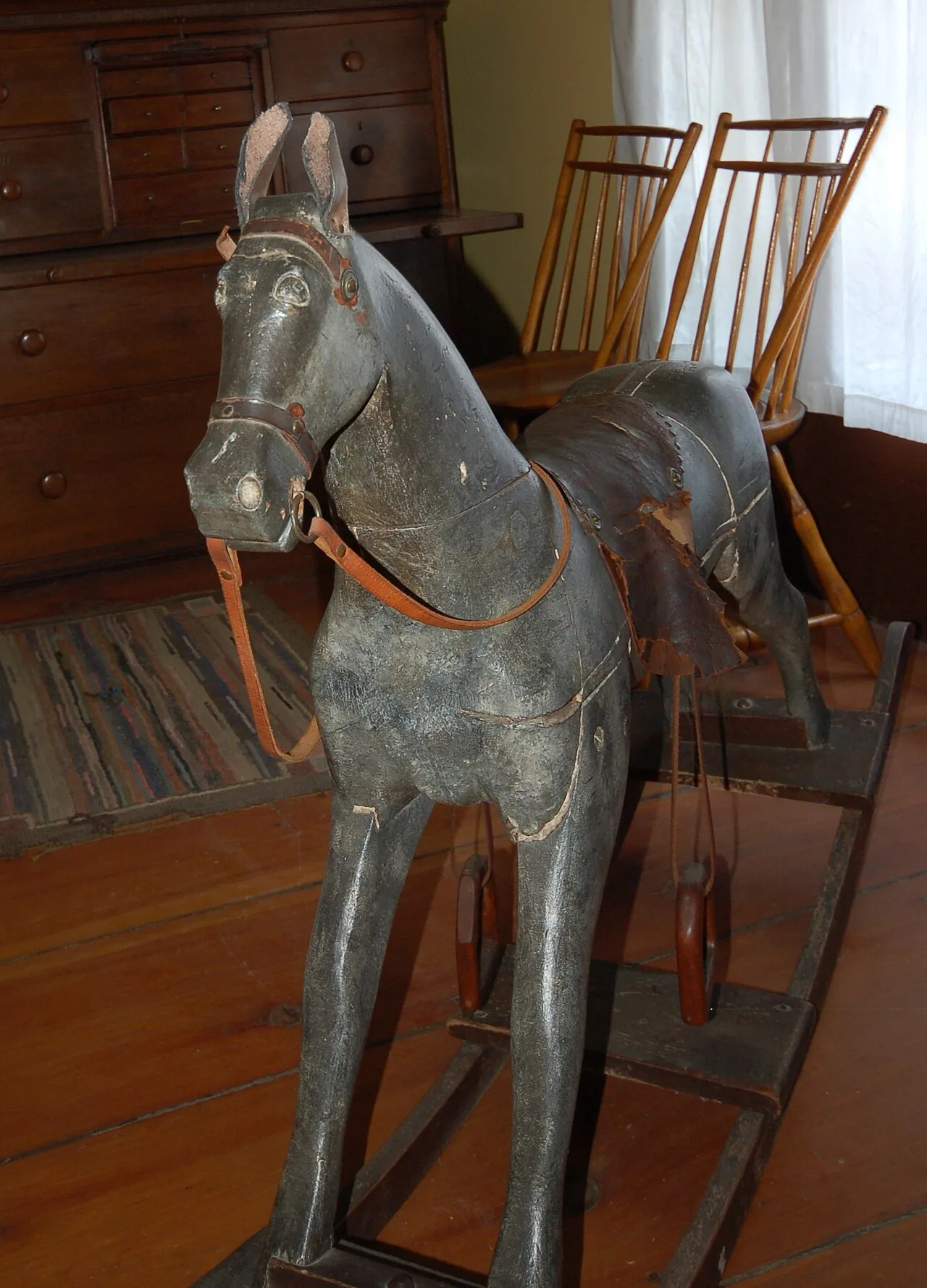
Look at the hooves in each photograph before anything else. On the bow they are bolted to a cross-board that travels with the child; on the stand they hang in mid-air from black iron straps and the base never moves. That single check sorts a horse into a broad period before you have examined the carving, the paint or the hardware. Both of these are museum pieces rather than dated examples, and the stand in the second is bright, unweathered pine — a reminder that stands are replaced far more often than horses, and that a safety stand under an early body is a conversion rather than a date.
Platform and Push-Along Horses
A third tradition sets the animal on a wheeled platform rather than a rocker, sometimes with a handle for an adult to push. These overlap heavily with the wider world of nineteenth-century antique toys and were often covered in real horsehide rather than gessoed and painted. Skin-covered horses have their own condition problems: the hide dries, cracks and lifts at the seams, and rehiding is rarely convincing. The related American shoo-fly, with flat sawn side panels enclosing a seat, is a toddler's toy valued as folk art rather than as a carved horse.
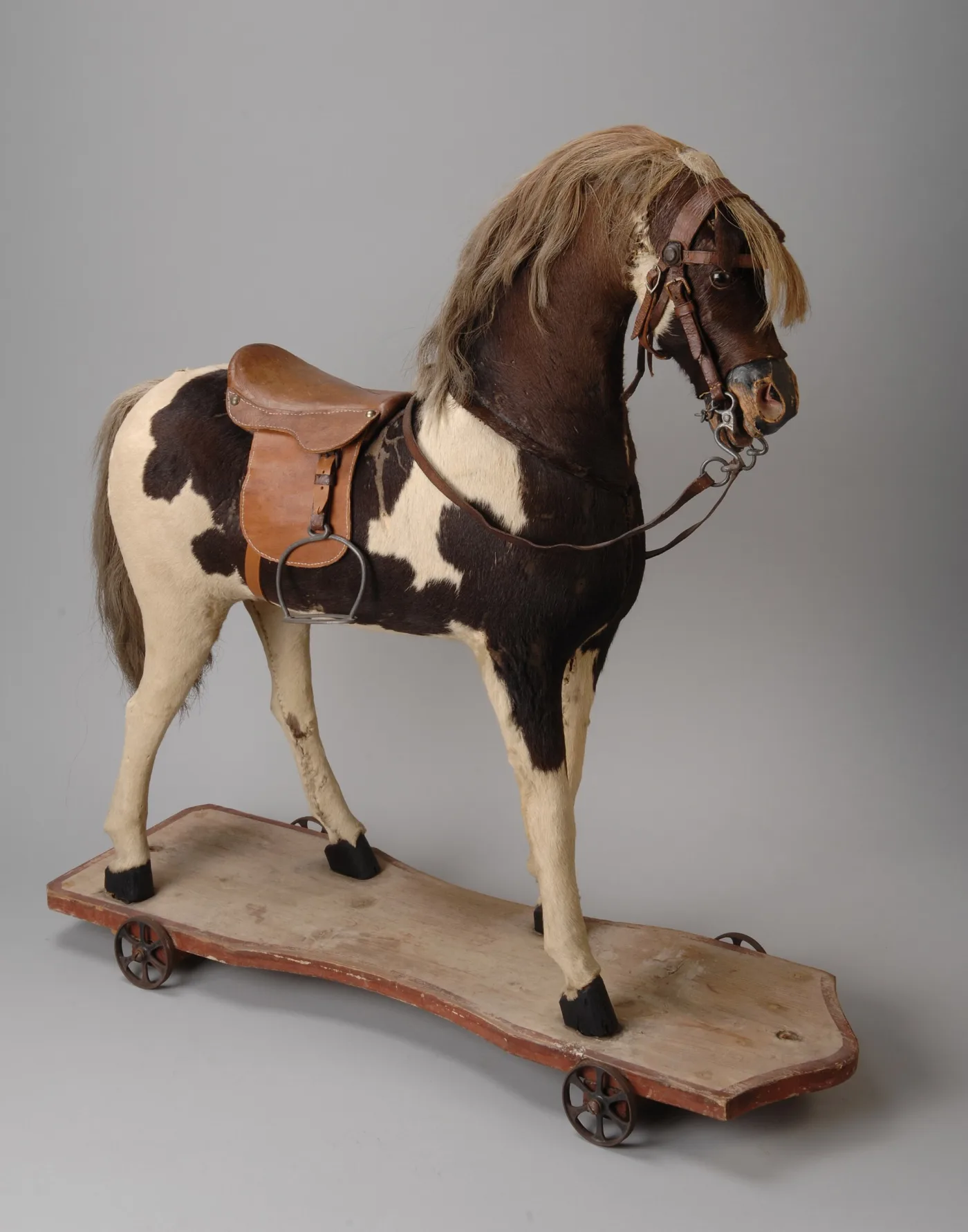

These two photographs are one object, not two: a hide-covered horse made by Moses Kohnstam of Nuremberg in 1929 and catalogued by Museum Rotterdam as a wheeled platform designed to mount into a separate rocking frame. It is a useful corrective to treating base type as a fixed property of a horse. Some were built from the start to do both, which means a platform toy turning up with no rocker may simply have lost half of itself — and a set arriving with both parts is worth materially more than the animal on its own.
How a Traditional Horse Is Built
Understanding the carcase is the single most transferable identification skill in this field, because construction is invisible from a photograph, expensive to imitate, and unaffected by repainting.
The Block-Built Body
A traditional British horse contains around eighteen separate pieces of timber. Six blocks are glued up to form the body, one larger block makes the head, two side pieces build out the neck, and each of the four legs carries a small extra block glued at the top to give enough material for the shoulder and haunch muscles. The whole assembly is then carved as one. Because the body is hollow rather than solid, the finished horse is far lighter than its size suggests.
Reading the Glue Lines
The joins between those blocks are the most reliable age evidence on the horse. Animal glue and dry timber both move, so after a century the seams open into fine straight cracks running along the body, visible through the paint as hairline ridges or splits in the gesso. Their positions are diagnostic: they follow the straight lines of the original joinery, not the random paths of impact damage. The same shrinkage behaviour that makes glue lines legible on softwood antique pine furniture applies here. A large old horse with no visible seams anywhere has almost certainly been heavily re-gessoed.
Timber Choice
Body and head are softwood, most often yellow pine, which carves cleanly and holds detail without tearing. Legs are hardwood, usually beech, because they take the whole load and the leverage of a rocking child. Rockers and stand rails favour ash for its springiness. That combination is near-universal on quality British work, and a departure from it is informative: a horse with softwood legs is either a cheap product or a repair.
Joinery at the Legs
How the legs meet the body separates the good firms from the rest. The best makers cut a mortise into the body and a matching tenon on the leg, glued and often pegged — a joint that survives generations of use. Cheaper production butted the leg against the body and drove nails or screws through. Look at the top of the leg where it enters the shoulder, in raking light, for the small filled depressions that mark nail heads under the gesso. Their presence rules out the top tier of makers entirely.
Gesso, Paint and the Dapple Grey
Gesso is the layer that makes a rocking horse look like a horse rather than like joinery, and its condition tells you a great deal about both age and restoration history.
What Gesso Is
Traditional gesso is gilder's whiting — finely ground chalk — mixed with animal glue, usually rabbit skin, and brushed on hot in several successive coats. It fills rasp marks, hides the glue lines between blocks, and dries to a dense, slightly absorbent surface that takes paint beautifully. It is also brittle. Old gesso develops a fine web of surface crazing, chips away cleanly to reveal white layers with timber beneath, and powders when rubbed. Modern acrylic gesso stays flexible, does not craze in that web-like pattern, and chips with a rubbery edge. Examining a chip on a leg or hoof under magnification is one of the quickest authenticity checks in the category.
The Dapple Grey Convention
The overwhelming majority of British horses are dapple grey, and there is a specific reason. Collinson of Liverpool showed horses in the mid-nineteenth century, and the story preserved in the trade is that Queen Victoria selected a dappled grey in 1851. Whatever the precise circumstances, the pattern became the expected finish for a British nursery horse and remained so for a century. A period British horse in bay, black or piebald is unusual and, if the paint is original, more interesting rather than less.
Dapples as a Dating Clue
How the dapples were applied is one of the more reliable house-style markers. Better nineteenth-century work shows soft, subtly graded dapples with irregular spacing, applied over a white ground with a sponge or stippling brush so each ring has a diffuse edge. Some firms favoured dark, bold dapples with heavy black shadowing; others fine, dense patches of small ones. Late and mass-market horses show dapples uniform in size, evenly spaced and hard-edged — the signature of a stencil or a mechanical repeat.

Paint Layers and Overpainting
Assume any horse you meet has been repainted at least once, and look for the evidence rather than its absence: paint bridging over old chips instead of following the surface, dapples running across a crack rather than being interrupted by it, colour on the swing irons or bracket bolts, paint filling the routed groove where the mane sits. Original surface survives most often in protected places — under the saddle, inside the ears, in the hollow behind the forelegs — so check there before concluding the finish is later.
Reading the Head: Ears, Eyes and Muzzle
If you learn only one identification skill in this field, make it the head. It carries the most carving, it varied most between workshops, and it is the part a restorer is least likely to have altered.
Carving Quality
Work through the head systematically. Are the nostrils opened and modelled, or merely painted on a flat muzzle? Is the mouth cut deeply enough to show teeth and the edge of a tongue? Are the cheekbones and jaw line defined, or is the head essentially a tapered block? The finest firms carved all of it, and their heads read as anatomy from any angle. Mid-market horses simplify progressively; the cheapest reduce the head to a rounded wedge with painted features.
Ears
Ears are carved separately on good horses and set into drilled holes with a spigot, which is why they are so often missing — they snap off at the joint. A pair of ears that match each other perfectly, sit at identical angles, and show no gesso crazing at the base is almost certainly a replacement. That is a minor and acceptable repair, but it is worth spotting because it tells you someone has worked on the horse.
Eyes
Glass eyes are the mark of quality work and are set into the gesso while it is workable, usually amber or brown with a black pupil, sometimes with painted lids and lashes worked around them to soften the expression. The same trade supplied the taxidermy business, and the eyes on a good horse are often identical to those used on mounted specimens, so the assessment techniques applied to antique taxidermy transfer directly. Painted eyes indicate either an earlier horse or a cheaper one. Domed upholstery pins pressed in as eyes are a twentieth-century economy and effectively date a horse to the later end of the field.
Head Position and Proportion
Head carriage is a house-style signal: some workshops set the head high and turned slightly to one side for an alert look, others carried it lower and straighter, and body proportion follows the same logic — stocky and short-coupled in one workshop, long and finely modelled in another. The combination of head carriage, neck depth and body length is often enough to sort unmarked horses into makers before you examine any hardware.
Manes, Tails, Saddles and Tack
Hair and leather are the shortest-lived components on a rocking horse, and the ones most often renewed. They still repay attention, because the method of attachment survives even when the material does not.
How the Mane Was Fitted
A period mane is real hair — horsehair on most British horses, sometimes cow tail hair, which is coarser and often distinctly curly — laid into a groove routed along the crest of the neck and secured with a glued fillet of wood or a strip of leather tacked over it. Look for the groove. If the mane has gone, the empty routed channel is still there, and its presence proves the horse was made to carry real hair. A mane glued flat to the surface of the neck, or a moulded ridge of hair carved as part of the timber, is later or cheaper work.

Tails
The tail sits in a drilled hole at the dock, usually plugged and glued. Long, straight horsehair suggests better work; short curly cow hair points to particular Liverpool workshops. Modern replacements are easy to spot: nylon has an even diameter and a plastic sheen, while raffia and wool yarn are the standard cheap substitutes on reproductions.
Saddles and Blankets
Original tack is uncommon and adds real money. The better firms used padded leather saddles, sometimes built over a shaped wooden block, with flaps and panels defined as on a real saddle. Blankets vary usefully between workshops: plain cotton edged with white braid and cut square with slightly rounded corners in one house style, red corduroy in another, velvet in a third. Stirrups hang from leather straps, and the leather almost always fails first.
Studs, Bridles and Reins
Decorative brass studs around the saddle edge and along the bridle are common, and their pattern is another workshop signature. Check whether the bridle is nailed permanently to the head or made to be removed and buckled, which distinguishes some firms reliably. Bright, uniform studs driven into old gesso with no verdigris and no wear indicate recently fitted replacement tack.
The Stand: Pillars, Rails and Brackets
On a safety-stand horse the trestle is frequently more informative than the animal, because stands were made to a fixed pattern in the workshop and their profiles changed slowly and traceably.
Pillars
The uprights at each end of the stand fall into recognisable families. Classic turned pillars with a distinct indented collar below the top belong to one group of makers; plain rectangular pillars, sometimes relieved with a pierced diamond cut-out, belong to another; thin, barely shaped uprights indicate late or economy production. Compare both ends — a mismatched pair means a replaced pillar and, often, a made-up stand.
Rails and Their Ends
Look at how the horizontal rails are finished at the extremities. Some workshops rounded them off simply; others cut and chamfered the ends so that a small diamond or hexagonal facet is left on the end grain. Chamfering elsewhere is equally telling: a generous chamfer along the bottom rail with only a minimal one on the top rail is a specific workshop habit rather than a general convention. The hoof rails that the horse's feet sit above may be cut away through the middle section and left wider at the ends, which is another identifiable signature.
Brackets and Swing Irons
The iron brackets that carry the swing irons are, for once, close to a hallmark. Count the bolt holes: two, three, and four-hole patterns were used by different firms and, within a firm, on different sizes of horse. Then look at how the swing iron pivots are finished — riveted over a washer, or held with a split pin, or concealed under a domed cover that the trade calls a bowler hat. These are cheap details that a workshop set once and repeated for decades, and they survive stripping and repainting. Brackets are also where stamped maker's codes appear most often, so clean them gently and look before you conclude a horse is unmarked.

F. H. Ayres of London
F. H. Ayres is the benchmark. The family business had roots in cabinet making early in the nineteenth century and began producing rocking horses in 1864 from premises in Aldersgate Street, London. By 1895 the workshops employed around six hundred people and supplied the leading stores, Harrods and Selfridges among them. Ayres also made sporting goods, and it was that side of the business that survived when the firm was absorbed by a larger sports manufacturer around 1940. The trade nickname — the Rolls-Royce of rocking horses — is deserved.
Identifying an Ayres Horse
Look first at the head: finely carved and fully modelled, with opened nostrils, a deeply cut mouth, and glass eyes set slightly downcast with painted detail worked around them, giving a characteristically gentle expression. Dappling is subtle and softly graded rather than emphatic, manes and tails are long horsehair, and saddles are well-built leather with defined flaps and panels. Blankets are typically cotton, cut square with slightly rounded corners and edged in white braid.
Ayres Stands
The stands are substantial and precisely detailed. Pine rails, beech pillars fitted with roughly one-inch spigots and wedged at the top, generous chamfers on the bottom rail against minimal chamfering on the top rail, and hoof rails cut away through the middle and left wider at the ends, with the end grain chamfered to leave a small diamond or hexagonal facet. Large Ayres horses take four-hole iron brackets. The swing iron pivots are riveted over washers rather than pinned, and Ayres did not use domed bowler-hat covers.
Ayres Marks
Marks exist but are inconsistent. A black F. H. AYRES stamp is sometimes found on the underside of the belly. White painted horizontal marks appear on stand rails on some examples. Union flag transfers reading British Manufacture were applied in some periods, and stand bases occasionally carry a stencilled retailer name, which is evidence of where the horse was sold rather than who made it. The firm's most prolific years ran from about 1875 into the early 1900s; patents were filed in 1887 for a swivelling head mechanism and in 1914 for a spring and lever arrangement, so a horse with either feature has a firm earliest date.
G & J Lines and Lines Brothers
George Lines was making wooden horses before 1876, when his brother Joseph joined him with experience in the toy trade and the two established works at 457 Caledonian Road in London. G & J Lines grew into one of Britain's largest toy manufacturers, and the family reorganised more than once, so the name on a horse depends on when it was made: G & J Lines and G & J Lines Ltd for earlier work, then Lines Brothers Ltd, Triangtois, and finally Tri-ang from 1919. The same firm came to dominate tinplate toys and antique dollhouses, which is why Lines material turns up across so many collecting fields.
Identifying a Lines Horse
Lines horses are generally lighter in the head than Ayres, with a softer and less muscular expression that the trade often describes as more feminine, and with noticeably enlarged nostrils. Face painting is subtle. Glass eyes, horsehair manes and tails, and padded leather saddles are standard on the better grades, with angular blankets. A breastplate across the chest appears on some models and is a helpful pointer. On the stands, look for turned pillars with an indented collar, rounded rail ends, and three-hole brackets.
Lines Marks and Codes
Lines marked its work more often than most, which makes attribution comparatively easy when the hardware survives. A thin metal disc stamped with a thistle is the classic trademark, sometimes fixed to the stand and sometimes as a badge on the chest. Brackets carry stamped codes: earlier ones may read G&J L Ld L for G & J Lines Ltd London, usually with a number alongside, while horses from the Sportiboy range are stamped with codes of the form L B L SP2. Later horses carry Triangtois or Tri-ang badges and transfers on the stand. Numbers and letters surviving intact on the brackets are strong provenance and are worth protecting during any cleaning.
J. Collinson & Sons of Liverpool
Collinson was the longest-lived of the British firms, trading in Liverpool from 1836 through five generations until it closed in the 1990s. It supplied the dapple grey that entered royal legend in 1851 and afterwards made dapple greys almost exclusively. Because it operated for so long and in volume, Collinson horses are the most commonly encountered good-quality British horses, and learning their traits resolves a large share of unattributed examples.
Identifying a Collinson Horse
The build is stockier than Ayres or Lines, often with a dramatically arched neck. Dappling is dark and bold, with heavy black shadowing and sometimes a marbled effect, quite unlike Ayres' soft grading. Nostrils and mouth are painted a bright, frankly garish red, and the eye detail follows suit. Manes and tails are typically short and curly. Saddles are frequently red corduroy, tack is often leatherette rather than leather, and decorative brass studs are used freely. Stands have rectangular section pillars, characteristically relieved with a pierced diamond cut-out.
The Nailed Leg
The most decisive Collinson trait is structural. Where Ayres and Lines cut mortise and tenon joints at the legs, Collinson relied on nails. Filled nail heads at the top of the legs, visible in raking light or as small circular blemishes under the paint, are close to conclusive when combined with the bold dappling and red mouth. It is not a mark of poor quality so much as a different production philosophy — Collinson built well-finished horses efficiently, and enough of them survived a century of nursery use to prove the method worked.
Baby Carriages Ltd and Other British Makers
Beyond the big three, a second tier of firms accounts for a substantial share of surviving horses, and their work is regularly misattributed upward.
Baby Carriages Ltd
Baby Carriages Ltd, also of Liverpool, worked from about 1906 to the early 1960s and produced horses closely comparable to Collinson's — unsurprising, given the shared local trade — but generally better in the shaping of the body, the crispness of the carving, and the quality of the painting. Dappling is finely patched rather than boldly blocked. Eyes are glass; manes and tails are often curly cow tail hair. Saddles are fabric, sometimes velvet. Stands show rounded rail ends and three-hole brackets. The firm marked its work with a stamp or transfer reading BCL Rambler, usually on the base of the stand, and sold horses under other brand names including Leeway. A Rambler transfer is a genuinely useful find, because it converts a Collinson-lookalike into a documented attribution.
Provincial and Postwar Workshops
A long tail of smaller workshops operated across Britain, some supplying larger firms with components rather than finished horses. Their output is generally competent, unmarked and hard to attribute, and is best described honestly as an English horse of a given period rather than forced onto a named maker. After 1945 the surviving traditional workshops simplified to compete — thinner gesso, fewer coats of paint, painted rather than glass eyes, plainer stands — so a horse with old-fashioned construction but conspicuously cheap finishing is usually a late product of an old firm rather than a different maker.
American Horses, Gliders and Platform Toys
The American tradition diverged from the British one and needs to be read on its own terms. Where Britain standardised on the gessoed dapple grey on a safety stand, American makers produced a wider variety of forms, more painted decoration, and far more platform and glider toys.

Whitney Reed
The best-known name is the Whitney Reed Corporation of Leominster, Massachusetts, which made rocking horses from roughly 1870 to 1920 and survived as a business for nearly a century before closing in the 1950s. Whitney Reed horses are hand carved, with the base carved as well, and are fitted out with cast iron hardware, leather straps, and fabric saddles. Glider bases — the American preference — are common, and a Whitney Reed glider in original paint is a desirable object in the United States market even though it would read as modest beside a large Ayres.
Massachusetts and Ohio Toy Makers
Winchendon, Massachusetts, promoted itself as Toy Town and housed several substantial manufacturers, Morton E. Converse among them, whose output included horses alongside a broad range of wooden playthings. In Ohio, the Gibbs Manufacturing Company of Canton built lithographed paper-on-wood and tin horse toys. Firms of this type competed on decoration rather than carving, so condition assessment turns on the printed and stencilled surfaces rather than on the carving beneath.
Hide-Covered and Folk-Made Horses
Skin horses, covered in real hide over a carved or built-up body, were made on both sides of the Atlantic and are more common in American survivals. They are fragile, frequently moth-damaged, and almost never improved by restoration. Alongside them sits a large body of home-made horses cut from plank and painted with whatever was to hand, occasionally dated or initialled. These are collected as folk sculpture, where originality of surface matters far more than refinement of carving.
Pressed Steel, Springs and Postwar Horses
After 1945 the rocking horse changed materially, and recognising the postwar products quickly saves a great deal of time — they are the majority of what turns up in general sales described as antique.
Mobo Pressed Steel
Mobo horses were made in England by D. Sebel & Co Ltd from 1947, built from painted pressed steel rather than carved timber. The same body pressings were reused across a family of models including Prairie King, Bronco, Range Rider and Night Rider, mounted on springs above a tubular steel frame. They are unmistakable once seen: sheet metal seams, riveted assembly, bright enamelled finishes. Mobo horses have a following of their own, and good examples with original paint and transfers are worth several hundred pounds or dollars — but they are not carved horses and should never be priced as though they were.
Spring Horses
In the United States the equivalent phenomenon was the spring horse. Wonder Products made its first horses in 1949, initially an all-wood painted body suspended on metal springs from a wooden frame, switching to a metal frame in 1959. Countless competitors followed, and by the 1960s the bodies were moulded plastic. These occupy the same market position as the mass-produced antique teddy bears of the period — hugely nostalgic, widely collected, priced modestly except for exceptional survivors in original boxes.
Plywood and Fibreboard
The cheapest postwar horses were cut from plywood or built from fibreboard, sometimes with a printed paper surface simulating dapples. Exposed laminations at a cut edge are the immediate tell. No amount of age will make one a carved horse, and sellers who describe them as Victorian are either mistaken or hoping you are.
Where to Find Marks, Stamps and Labels
Most horses appear unmarked, and a good proportion are not — the marks are simply in places nobody thinks to look. Work through the following before giving up.
The Six Places to Check
Start with the underside of the belly, where stamps were struck and where a century of paint may have obscured them; raking light across the surface will often reveal an impression even when the ink has gone. Next the iron brackets, on both faces, where stamped letter and number codes are most likely to survive. Then the base and underside of the stand rails, the usual home of paper labels, transfers and stencilled retailer names. Then the chest, where metal badges were fixed with small pins that leave two telltale holes even when the badge has been lost. Then the top faces of the stand rails, for painted or stencilled inspection marks. Finally the saddle and blanket themselves, which occasionally carry a maker's or retailer's stamp on the underside of the leather.
Reading a Retailer Mark Correctly
A stencilled shop name is not a maker's mark. Large stores commissioned horses from the trade and applied their own names, so a Harrods stencil tells you where a horse was sold, not who carved it. Retailer marks are still valuable evidence: they confirm a quality product sold through a serious outlet, and they narrow the date, since stencil styles changed over time.
Do Not Clean Marks Away
Marks on rocking horses are fragile — thin ink stamps on softwood, paper labels under varnish, painted letters on rails. Dry-brush the dust away, photograph everything before any intervention, and never take a solvent or abrasive to an area that might carry text. More attributions are destroyed by well-meant cleaning than by fraud.
Reproductions, Imports and Marriages
Three different things get sold as antique rocking horses, and only one of them is a fake. Distinguishing among them is largely a matter of knowing what each looks like.
Deliberate Reproductions
Imported horses with an artificially antiqued finish are sold in quantity through trading houses and general auctions, frequently described as nineteenth-century reproductions when most are under twenty years old. The construction gives them away. Proportions are clumsy, with a heavy head and thick legs. Detail is minimal: nostrils and mouth painted rather than carved, ears formed as part of the head instead of set in. Saddle and mane are often carved from the same block as the body, which no traditional maker ever did, and tails are raffia, yarn or nylon. The antiquing is applied evenly, including in places that never wear, whereas genuine wear concentrates on the saddle, the mane groove, the ears and the front of the hooves.
Hardware and Fasteners
Fasteners are decisive and easy to check. Phillips cross-head screws date from the 1930s and only became common after the war, so any structural Phillips screw rules out a Victorian date for that component. Staples anywhere on the tack or hair indicate modern work, as do machine-perfect dowels, modern hex bolts and bright zinc-plated brackets. On a genuine old horse the ironwork is hand-forged or early cast, pitted, and often slightly asymmetric between the two sides.
Modern Craft Horses
The second category is honest but confusing: high-quality horses made from the 1970s onward by craftsmen using traditional methods, correct timbers, real gesso, glass eyes and horsehair. These are not fakes and are often excellent, but they are not antiques and are worth a fraction of a period equivalent of comparable size. Look for crisp, unshrunk glue lines, gesso with no crazing, and — usually — a maker's plaque or serial number, since living makers sign their work.
Marriages and Made-Up Horses
The third and most common category is the marriage: an old horse on a stand it did not start with, or a genuine old stand carrying a later horse. Check that the swing irons match each other and fit the belly rails without packing pieces, that the hooves sit naturally above the hoof rails, that the pillars are a matched pair, and that wear on the stand corresponds to the horse's movement. A marriage is not fraud and is often decades old itself, but it should be reflected in the price.
Restoration and What It Does to Value
No category of antique is more routinely restored than the rocking horse, and none suffers more from restoration done at the wrong level. The reason is emotional: people restore rocking horses to give to grandchildren, and the goal of that project — a bright, sound, safe horse — is the opposite of what a collector wants.
The Value of Original Surface
Original paint and gesso, even worn, chipped, and dull, is the most valuable state a horse can be in. A completely repainted horse of the same date, size, and maker will typically fetch a fraction of what an untouched example brings. The reason is not sentiment but information: an original surface proves the object, while a repaint conceals whatever it was applied over — including replaced legs, new heads, and outright reproductions. The general principle set out in our guide to antique restoration and conservation applies with unusual force here.
What Is Acceptable
Structural repair is a different matter from cosmetic renewal and is accepted without penalty when competent and disclosed. Re-gluing an opened body seam, consolidating loose gesso, replacing a broken swing iron with a hand-forged equivalent, refitting a lost ear and renewing tack and hair are all normal maintenance on an object designed to be sat on. Buyers expect new leather and new horsehair; nobody expects hundred-and-thirty-year-old stirrup straps to survive.
What Destroys Value
Stripping to bare wood and re-gessoing eliminates the entire surface history at once, and sanding through original paint does the same thing more gradually. Modern gloss enamel over old gesso looks permanently wrong and is difficult to reverse, and replacing a carved head or leg turns the object into a composite. If you are weighing a restoration, get the horse valued in its current state first, and treat any quote for a full repaint as a decision to spend money in order to lose more.

Size, Condition and Value
Rocking horse pricing is driven by four factors in roughly this order: maker, size, originality of surface, and completeness of the original stand and tack.
How Horses Are Measured
The trade measures horses in more than one way, so establish which figure a seller is quoting. Overall stand length is the most commonly advertised dimension and runs from around forty-four inches for a small nursery horse to sixty inches or more for the largest. Body length from nose to dock, and height at the shoulder, describe the animal itself and are the better comparison when judging quality against price. Within one maker's output a large horse can be worth several times a small one: the carving is more impressive, fewer were made, and fewer survived.

Market Ranges
Broad indications from the market of recent years, rather than fixed prices: good large Collinson horses generally trade in the region of £1,500 to £3,000 depending on size and the quality of any restoration, with fifty-two to fifty-five inch examples clustering toward the lower half of that band. Documented Ayres horses of large size in original condition are the top of the market and exceptional examples have been valued well into five figures. Second-tier and unattributed English horses of average size occupy a wide band below the named makers. Postwar Mobo and spring horses are worth hundreds rather than thousands, and plywood or fibreboard horses have little collector value at any age. Approach any specific figure the way our guide to antique valuation and appraisal recommends: as a starting hypothesis to be tested against recent comparable sales, not a fact about your object.
Condition Factors That Move Price
Beyond surface originality, several defects consistently reduce value. Woodworm in the pine body is common and severity matters — old flight holes with no fresh frass are historic and acceptable, while active infestation must be treated before purchase. Splits along glue lines are expected; splits across the grain of a leg are structural. Missing ears and tails are minor; a replaced head, a made-up stand or heavy filler through the body are major. Original tack, an intact bow rocker and surviving marks each add a premium disproportionate to the material involved.
Care, Storage and Display
A rocking horse is a large object made of softwood, animal glue, chalk, leather and hair, which is to say it is sensitive to almost everything. Stable conditions do more for it than any treatment.
Environment and Pests
Aim for moderate, steady humidity. Dry heat shrinks the body blocks, opens glue lines, embrittles gesso and cracks leather; damp softens animal glue, rusts swing irons and encourages mould in the hair. Radiators, direct sunlight and unheated garages are all bad, and damp storage followed by a dry heated room is the worst sequence of all. Check annually for fresh woodworm flight holes and the pale dust that signals active infestation, and inspect the mane and tail at the roots for moth. The general principles in our guide to antique storage, care and preservation apply throughout.
Cleaning Limits
Dust with a soft brush, and if more is needed use a barely damp cloth on sound painted areas only, never on flaking gesso or near a mark. Household polish builds a film that traps dirt and complicates later conservation. Leave leather alone unless it is genuinely dry. Never wash the mane or tail in place: water travels into the glued groove and lifts the fillet.
Display and Use
If a child is going to ride the horse, have the swing irons, bolts and belly rails checked first, because the failure point on a hundred-year-old horse is the ironwork rather than the timber. Support the horse on its own stand rather than leaning it, and if it must be moved, lift horse and stand separately — the irons were designed to carry a rocking child, not the weight of the whole assembly.