Antique Mochaware Identification Guide: Patterns, Dating & Value
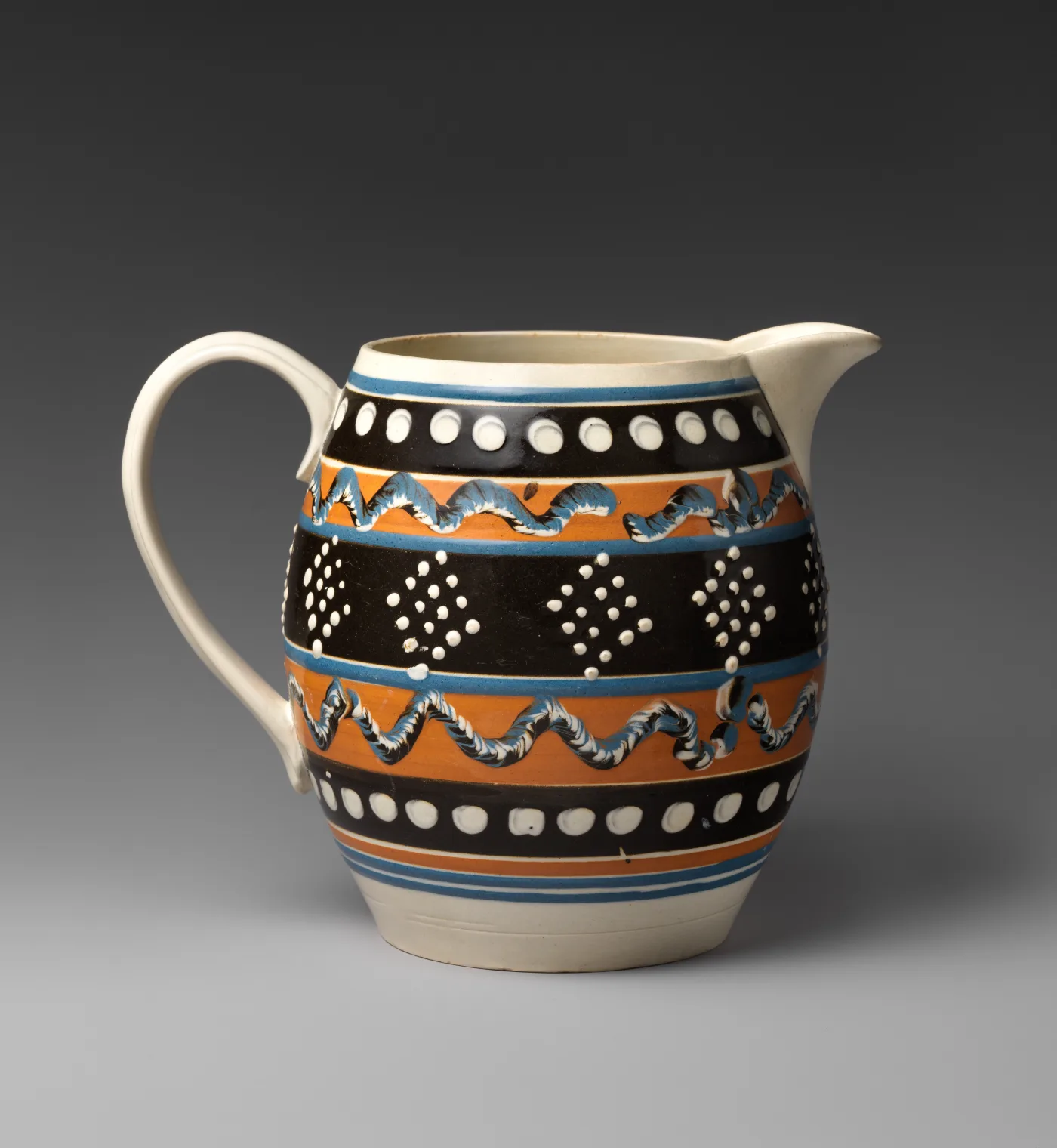
Mochaware is the most quietly spectacular of all the everyday ceramics of the eighteenth and nineteenth centuries. Made as cheap utilitarian tableware — mugs for the alehouse, jugs for the dairy, bowls for the kitchen, and pepper pots for the table — it was decorated with fluid, abstract patterns that look startlingly modern: branching brown "trees" that bloom across a band of slip in seconds, looping earthworm trails, swirling cat's eyes, and crisp horizontal stripes in slate blue, ochre, and seaweed green. Nobody at the time considered it art. Today, the best pieces sell for thousands of dollars, and a single fine mocha jug can anchor an entire collection of English and American slip-decorated earthenware.
The appeal of mochaware lies in the tension between its humble purpose and its dazzling surface. The dendritic "mocha" decoration — the branching tree pattern that gives the ware its name — was produced by a near-magical chemical reaction the moment an acidic colorant touched wet alkaline slip, so that no two pieces are ever identical and the decorator could never fully control the result. Collectors prize that spontaneity, the honest wear of generations of tavern and kitchen use, and the surprising sophistication of color and banding on objects that cost pennies when new.
This guide explains how to identify, date, and value antique mochaware. You will learn what mochaware actually is and how it relates to creamware and pearlware, how each decorative technique was made, the full vocabulary of patterns (dendritic, cat's eye, earthworm, twig, cable, marbled, and the rare "dipt fan"), the common forms and what they were used for, the few useful marks, how to read color and body to estimate a date, and — crucially — how to separate genuine antique mocha from the considerable body of reproductions and studio revivals now on the market. For the broader background, our antique ceramics and pottery identification guide places mochaware within the wider story of refined earthenware.
Table of Contents
- 1. What Is Mochaware?
- 2. Body, Glaze, and the Creamware-Pearlware Connection
- 3. How the Decoration Was Made
- 4. Dendritic "Mocha" Tree Decoration
- 5. Cat's Eye Decoration
- 6. Earthworm and Trailed-Slip Patterns
- 7. Other Slip Patterns: Cable, Twig, Marbled & Engine-Turned
- 8. Colors, Bands, and Rouletted Borders
- 9. Common Forms and Objects
- 10. History and Makers
- 11. Marks and Attribution
- 12. Dating Mochaware
- 13. Reproductions and Studio Revivals
- 14. Condition Assessment
- 15. Values and the Market
- 16. Care, Display, and Building a Collection
1. What Is Mochaware?
Mochaware (also written "mocha ware") is a category of slip-decorated refined earthenware produced mainly in Britain from about 1780 to the early twentieth century, with parallel and slightly later production in the United States, France, and elsewhere. It is distinguished not by its body — which is ordinary creamware, pearlware, or whiteware — but by its decoration: bands of colored slip applied to the unfired surface and worked into abstract patterns while wet, then covered with a clear glaze and fired.
The name comes from the dendritic, tree-like "mocha" pattern, which nineteenth-century decorators thought resembled the moss-agate stones imported through the port of Mocha (Al Mukha) in Yemen. Over time, the word "mochaware" came to cover the whole family of dipped and slip-decorated wares, even pieces that have no dendritic decoration at all. In the British pottery trade these goods were simply called "dipped ware" or "banded ware," and the people who decorated them were "dippers" and "mocha men." The current scholarly term of art, popularized by the standard reference, is "Mocha and related dipped wares."
Why It Matters to Collectors
Mochaware occupies a sweet spot in the antiques world: it is genuinely old, visually striking, historically important as a window onto everyday life, and still available across an enormous price range. A plain banded bowl can be bought for $40, while an exceptional dendritic-decorated jug or a tall presentation tankard with multiple patterns can sell for several thousand dollars. The spontaneity of the decoration — every dendritic tree is unique — gives each piece individual character that mass-produced transfer-printed wares lack.
2. Body, Glaze, and the Creamware-Pearlware Connection
Understanding the body underneath the decoration is the foundation of dating mochaware, because the ware rode on whatever refined earthenware body was current at the time. The decoration techniques stayed broadly similar for over a century; the body and glaze are what changed.
Creamware Bodies (c. 1780–1820)
The earliest mocha sits on creamware — the cream-colored, lead-glazed earthenware perfected in Staffordshire in the 1760s and 1770s. Creamware mocha has a warm, ivory-to-buff ground, and where the glaze pools it shows a faint yellowish or greenish tone. Early mocha mugs on creamware bodies are among the most desirable pieces in the field.
Pearlware Bodies (c. 1790–1830)
Pearlware — creamware with a touch of cobalt added to the glaze to counteract the cream tone and make the ware appear whiter — became the dominant body for mocha from the 1790s into the 1820s. The cobalt collects in the glaze where it pools, so genuine pearlware mocha shows a characteristic bluish tint in the recesses: around foot rims, inside handle terminals, and where banding meets the body. This bluish pooling is one of the most reliable signs of an early piece.
Whiteware and Ironstone-Type Bodies (c. 1830 onward)
From the 1830s the industry shifted to whiter, harder earthenware bodies with cleaner, more neutral glazes. Later Victorian and Edwardian mocha — the banded kitchen bowls and measures most often encountered today — sits on these whiter bodies and lacks the bluish glaze pooling of pearlware. The relationship between mocha and the broader earthenware story, including the harder white bodies, overlaps with the history told in our guide to antique ironstone china.
3. How the Decoration Was Made
Mochaware decoration is a form of industrial slipware: liquid clay (slip), colored with metallic oxides, applied to a leather-hard body and manipulated while wet. Knowing how it was done is the single most powerful authentication tool, because the techniques leave distinctive physical evidence that modern imitations often get subtly wrong.
The Lathe and the Slip
The unfired, leather-hard pot was mounted on a horizontal lathe (or a potter's wheel turned slowly). As it rotated, the decorator held brushes or slip-cups against it to lay down even horizontal bands of colored slip. This is why mocha decoration is almost always organized in continuous horizontal registers around the body — the lathe made stripes effortless and anything vertical difficult. The slips were earthenware clays colored with oxides: iron and manganese for browns and blacks, cobalt for blue, copper for green, and antimony for yellow.
Why the Bands Stand Slightly Proud
Because the colored slip is a physical layer of clay sitting on the body, you can often feel and see that the bands stand very slightly proud of the surrounding surface, or that the boundary between two slips forms a faint ridge. Run a fingertip lightly across an unworn area: on genuine slip-decorated ware you can frequently detect this subtle relief. Modern printed or painted imitations are perfectly flush.
Rouletting and Engine Turning
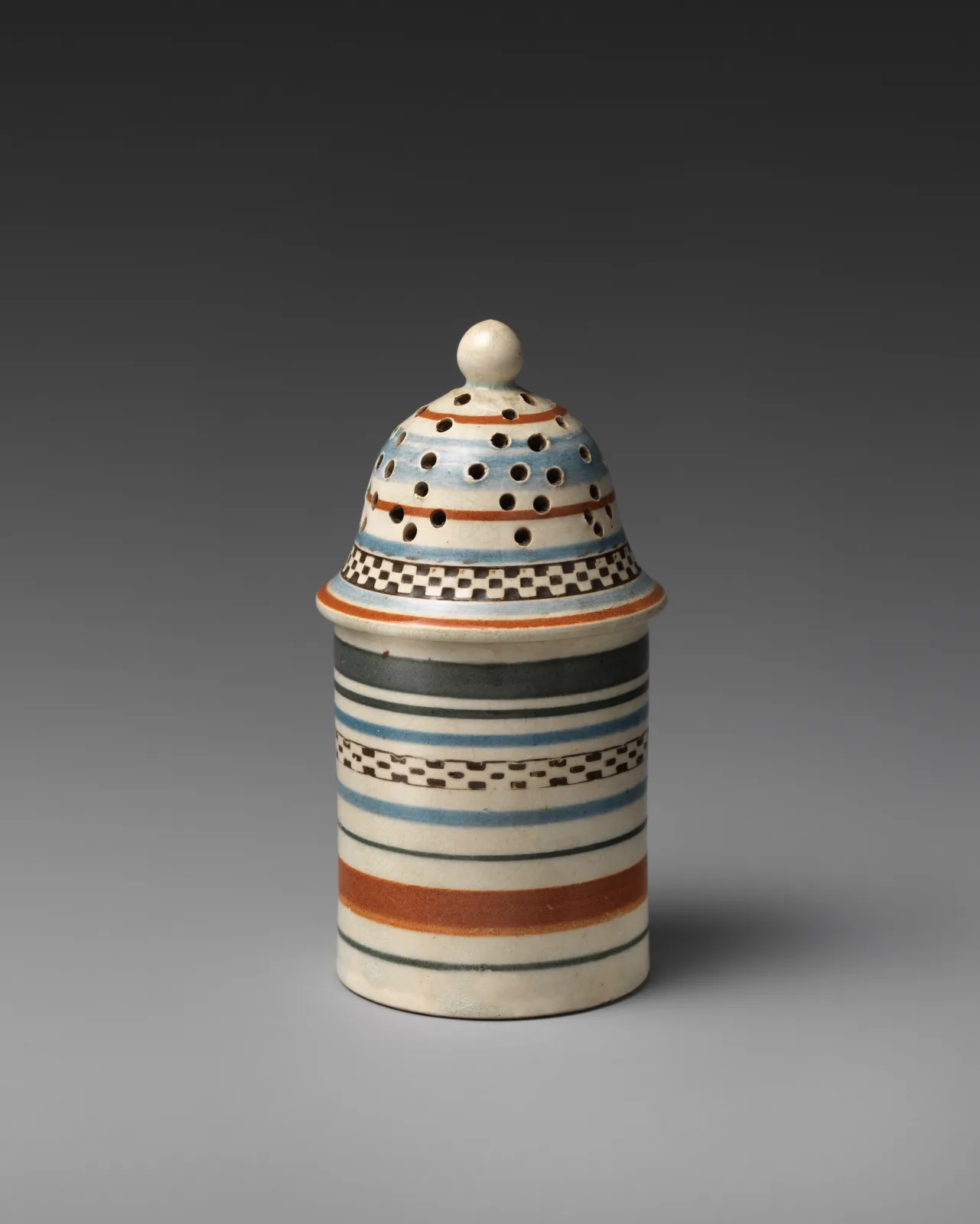
Crisp incised borders — bands of tiny repeated notches, checkers, or rope twists — were cut into the slip or body with a rouletting wheel or on an engine-turning lathe before glazing. These mechanical borders are a hallmark of period industrial slipware and are difficult to fake convincingly. The same engine-turning tradition appears on other Staffordshire wares; the broader family is discussed in our overview of Staffordshire pottery.
4. Dendritic "Mocha" Tree Decoration
The dendritic pattern is the signature of the ware and the reason it is called mocha. It is the branching, fern- or seaweed-like brown decoration that spreads across a band of wet slip in a fraction of a second.
The "Mocha Tea" Chemistry
The decorator first laid down a band of pale, alkaline slip. Then a drop or brushstroke of an acidic, dark colorant — the so-called "mocha tea," a mixture that might include tobacco juice, hops, urine, manganese, and other ingredients, each shop guarding its own recipe — was touched to the wet band. The instant the acidic colorant met the alkaline slip, surface tension and a chemical reaction drove it outward in a self-organizing, branching pattern, exactly as ink diffuses through blotting paper. The decorator controlled only the starting point, the tilt of the pot, and the consistency of the mixtures; the branching itself was spontaneous. This is why every dendritic tree is one of a kind and why fine, well-formed trees with delicate, far-reaching branches were prized even in the period.
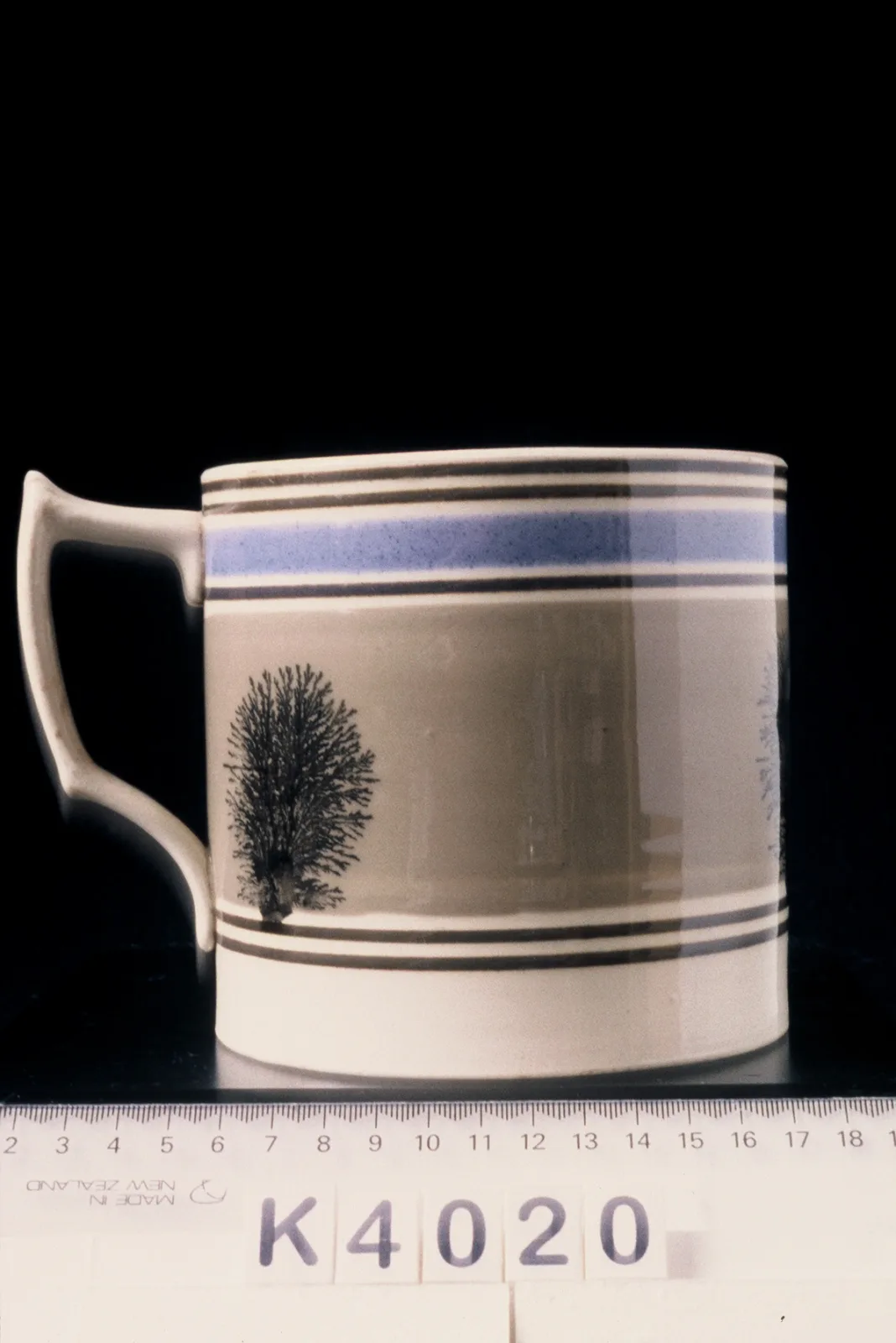
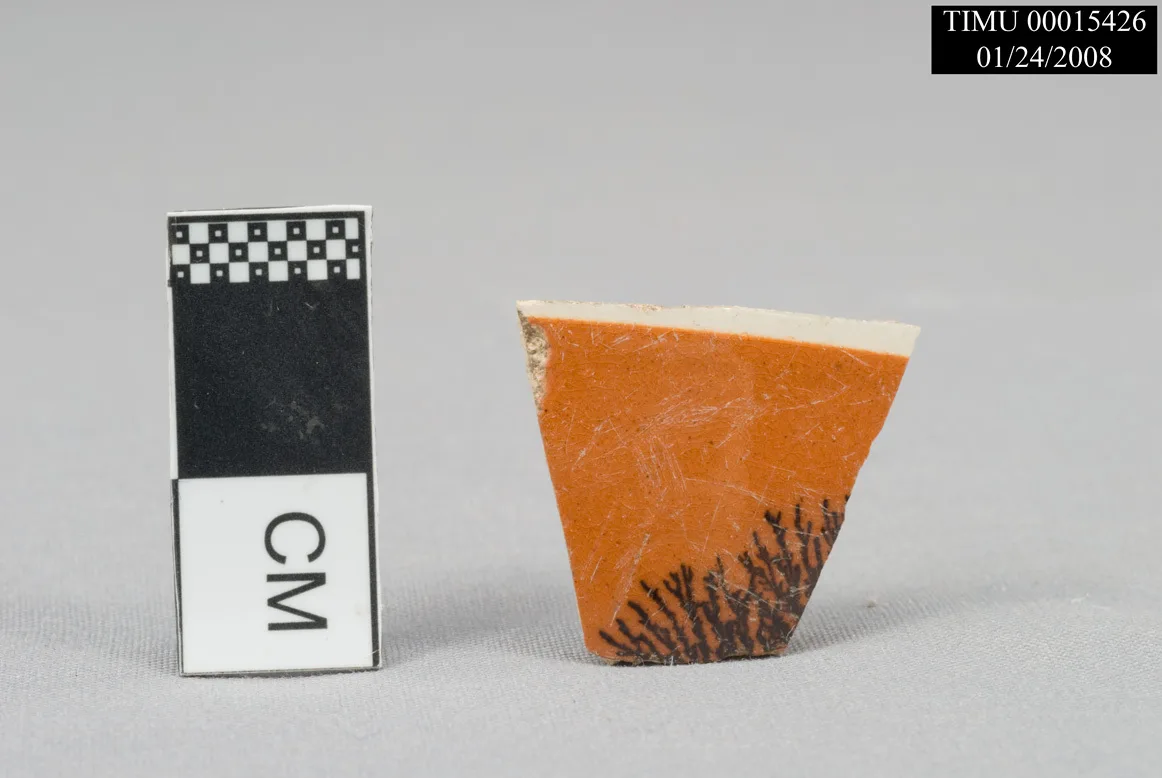
The pattern is why the ware is called mocha. It was thought to resemble moss agate, the stone traded through the port of Mocha, whose milky body carries dark moss-like inclusions — and the resemblance is the whole marketing idea behind the ware. The tree itself is not drawn. An acidic mixture, the so-called mocha tea, was touched onto a wet alkaline slip band and spread itself by capillary action into a branching form in a second or two. That is why no two are alike and why a good one has fine, tapering, irregular branches that get thinner as they divide, while a poor one blots. It also explains why the sherd is worth showing beside the mug: excavated fragments of this ware turn up constantly on both sides of the Atlantic, they are usually the cheapest way to handle the real thing, and a broken edge lets you see the slip as a thin coloured skin over a paler body — which no photograph of an intact pot can show you.
Reading the Quality of a Tree
Connoisseurs judge dendritic mocha by the delicacy and reach of the branching, the contrast against the ground, and the rhythm of repeated trees around the band. The best pieces have crisp, deeply ramified trees that branch again and again into fine filaments; coarser or later work shows blobby, stunted, or smeared trees. Trees that all lean the same way, or that grow from a continuous baseline, reflect the way the pot was tilted on the lathe as the colorant was applied.
Colors of the Ground
Dendritic decoration appears on grounds of many colors: the classic is dark brown trees on a band of orange-tan or coffee-colored slip, but trees also appear on slate blue, olive green, ochre, and pale gray grounds. The "tobacco spit" or "seaweed" terms collectors use refer to the brownish dendritic effect specifically.
5. Cat's Eye Decoration
Cat's eye decoration consists of small, concentric, eye-like spots arranged in rows or clusters, usually three-colored — a dark center, a lighter ring, and a darker outer ring — that genuinely resemble a cat's or peacock's eye.
The Three-Chambered Slip Cup
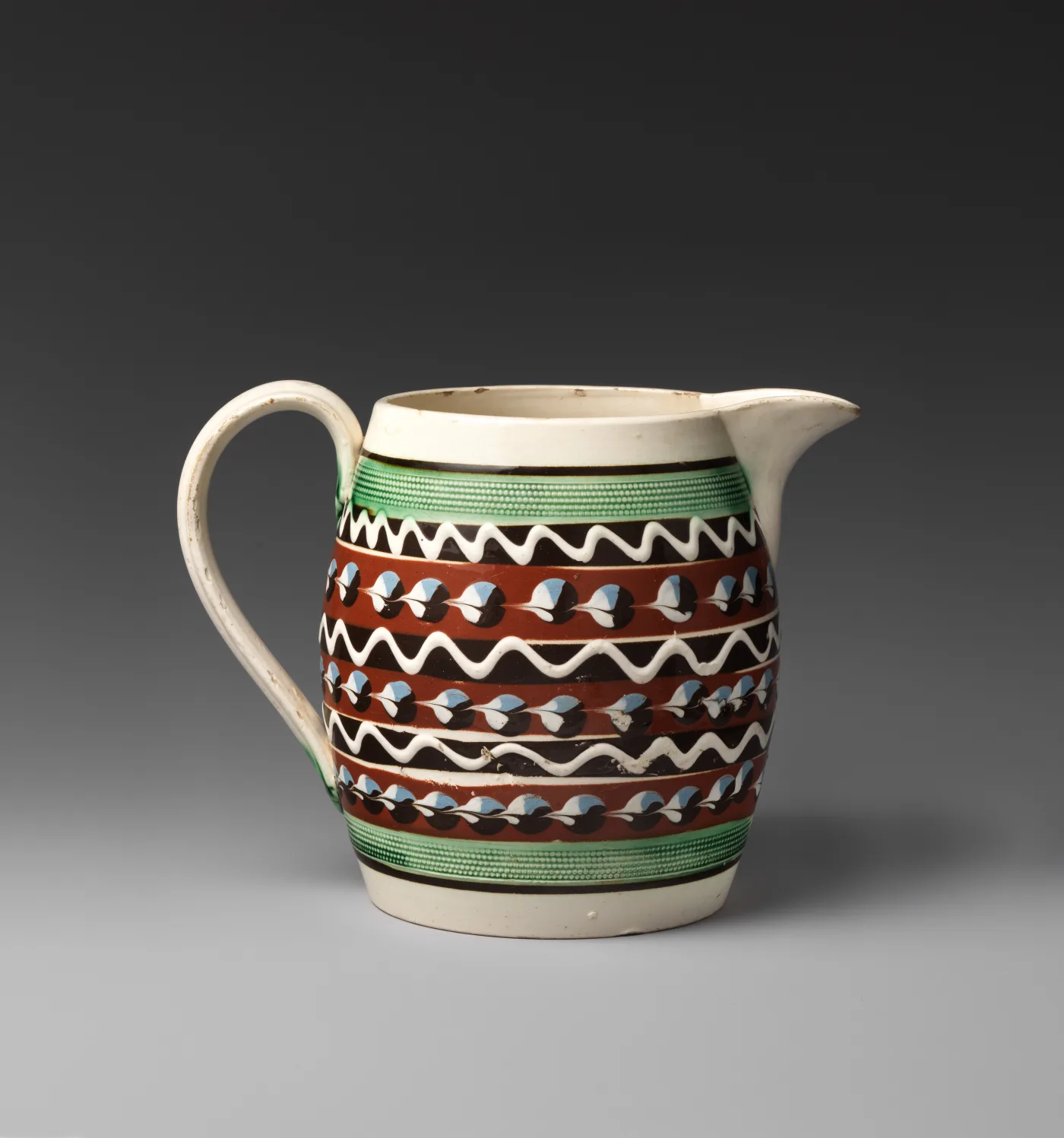
Cat's eyes were made with a special multi-chambered slip bottle or quill. The decorator charged a tube with two or three concentric colors of slip and, with a quick dab and twist against the rotating pot, deposited a small target of nested rings. Done in a rhythmic row, the eyes march evenly around a band. The cleaner and more regular the concentric rings, the more skilled the hand.
Cat's Eye as Accent
Cat's eyes frequently appear in combination with other patterns — as a row above or below a band of earthworm or dendritic decoration, or framing a central register. A piece that combines several techniques (say, dendritic trees, an earthworm band, and a row of cat's eyes, all separated by colored stripes) is more complex to produce and generally more valuable than a single-pattern piece.
6. Earthworm and Trailed-Slip Patterns
The earthworm pattern is the looping, overlapping, worm-like trail of slip that wanders around a band, often in two or three colors crossing over one another. It is one of the most recognizable and beloved of all mocha patterns.
How the Earthworm Was Trailed
Using a slip bottle with a fine nozzle (or a three-chambered bottle for multicolored worms), the decorator trailed a continuous wavy line of slip onto a contrasting wet ground as the pot turned, looping it back and forth so the trails overlap into a basket-like or interlaced effect. When several colors are trailed together from a divided bottle, the worm shows parallel stripes of color along its length — a small technical tour de force.
Common, Combed, and Trailed Variants
Related trailed effects include the "common cable" or twist, where two colors are trailed and then combed or jiggled into a rope-like twist, and broader "combed" slip where a multi-toothed tool dragged through wet bands of different colors produces feathered or wavy patterns. These combed and trailed techniques descend directly from the seventeenth- and eighteenth-century country slipware tradition, the same lineage that produced slip-decorated redware, but executed here on refined factory bodies.
7. Other Slip Patterns: Cable, Twig, Marbled & Engine-Turned
Beyond the three star patterns, mocha decorators commanded a wide repertoire, and recognizing the full vocabulary helps in identifying and valuing pieces.
Cable and Twist
The "cable" pattern is a regular, rope-like twist of two contrasting slips, produced by trailing and then combing. It often runs as a tidy border band between wider decorated registers.
Twig and Sprig
"Twig" decoration is a simple painted or trailed branching motif — less spontaneous than true dendritic mocha and more deliberately drawn — often in blue or green, sometimes with small leaves. It is a humbler relative of the dendritic tree.
Marbled and Agate Slip
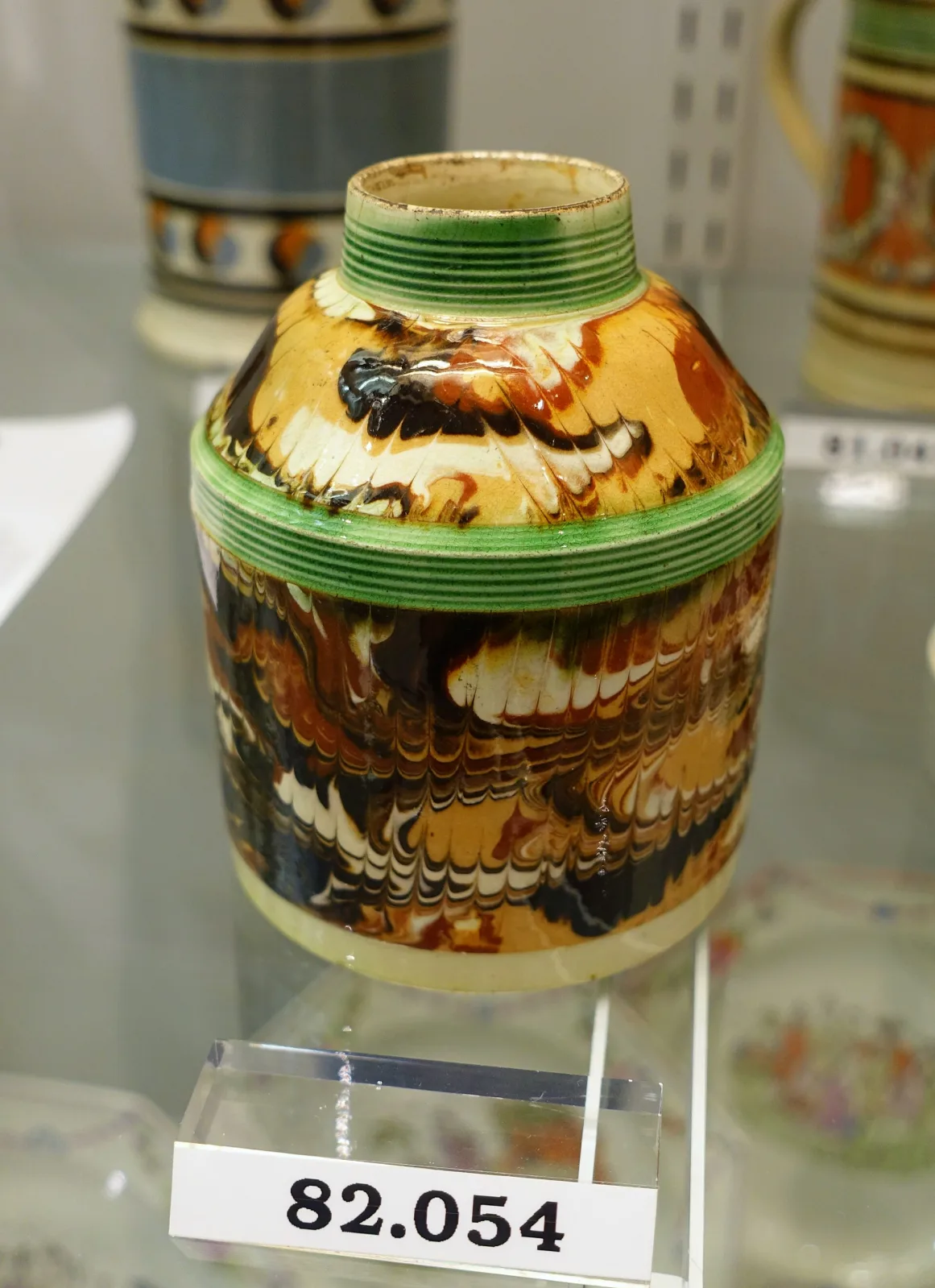
Marbled or "agate" surfaces were made by trailing several colored slips onto the band and then swirling, joggling, or blowing them together so they marble into one another, mimicking polished stone. This effect connects mocha to the wider eighteenth-century taste for agate and marbled ceramics.
Engine-Turned Grounds
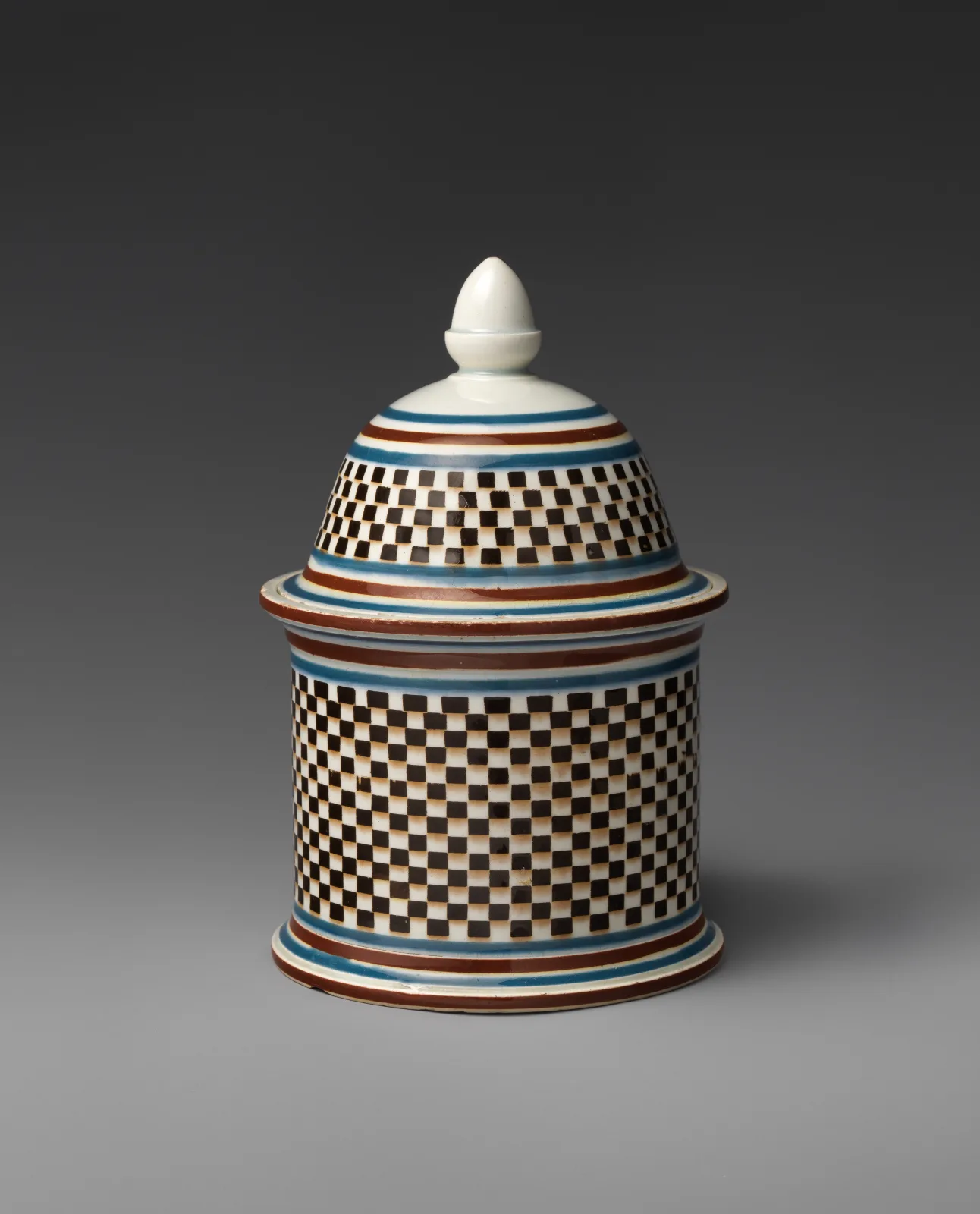
On engine-turned pieces, the leather-hard slip-coated body was cut on a lathe with an eccentric or rose-engine attachment to produce precise geometric facets, checkers, or basketwork, revealing the body color through the slip. Engine turning is crisp, perfectly regular, and mechanically repetitive — qualities almost impossible to reproduce by hand, which makes it a useful authenticity marker.

8. Colors, Bands, and Rouletted Borders
Even undecorated by dendritic or earthworm patterns, the simple banded structure of mochaware is part of its identity and a clue to date and origin.
The Color Palette
The characteristic mocha palette is earthy and muted: slate or "London" blue, mustard and ochre yellows, olive and seaweed greens, russet and coffee browns, black, and white, set against the cream or bluish-white body. These colors come from the limited range of metallic oxides that survived the glaze firing. A distinctive bright "London-shape" blue band is especially associated with early nineteenth-century pieces. Later wares tend toward simpler combinations — often just blue and white, or brown and cream bands.
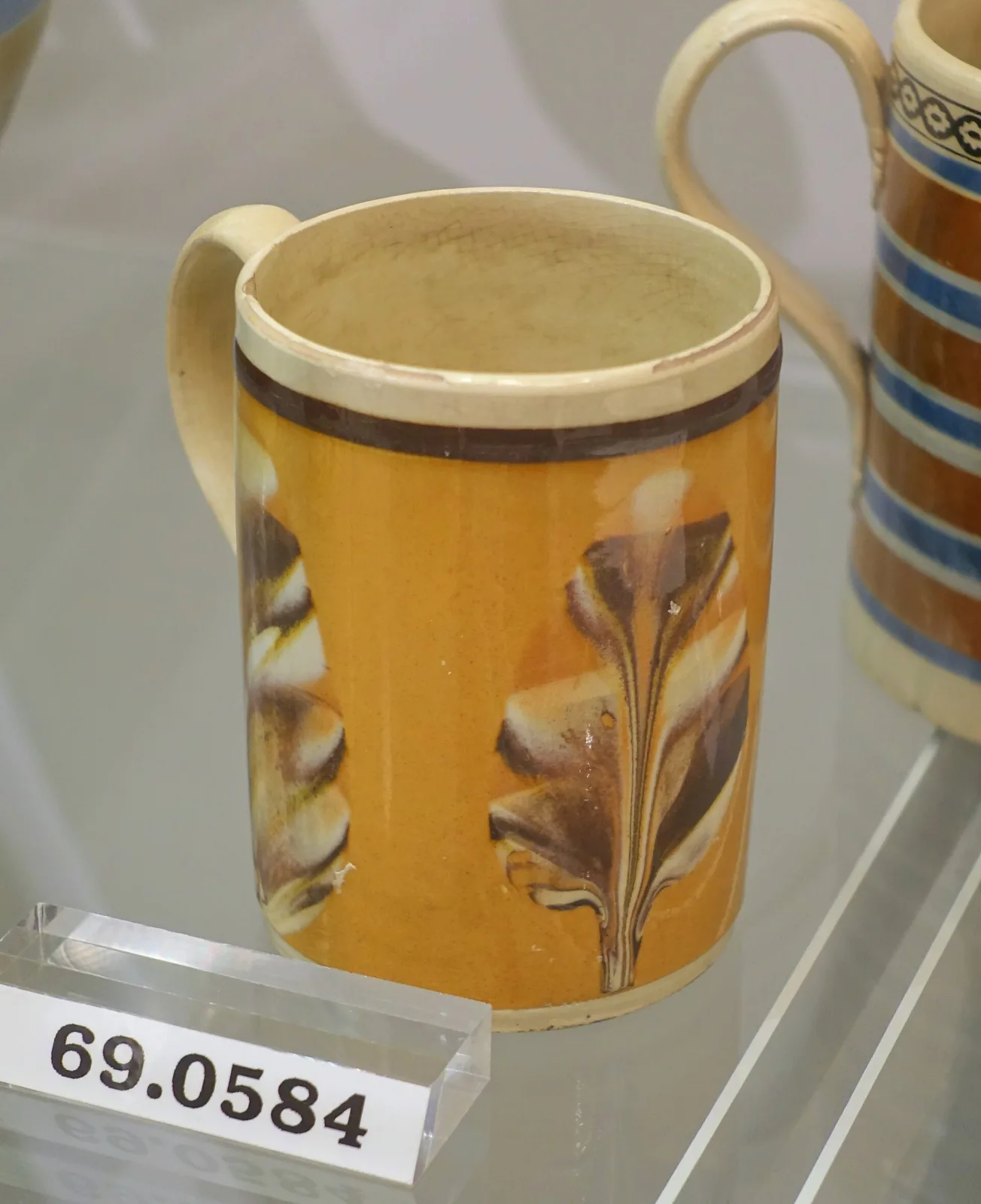
Banding Structure
Bands range from hairline stripes to broad colored registers. A typical mug might show, from rim to foot, a thin rouletted border, a narrow colored stripe, a wide central band carrying the principal decoration, another stripe, and a base band. The arrangement is always horizontal and continuous because of the lathe. Reading the band structure — how many registers, how wide, in what colors — is part of recognizing a piece's date and quality.
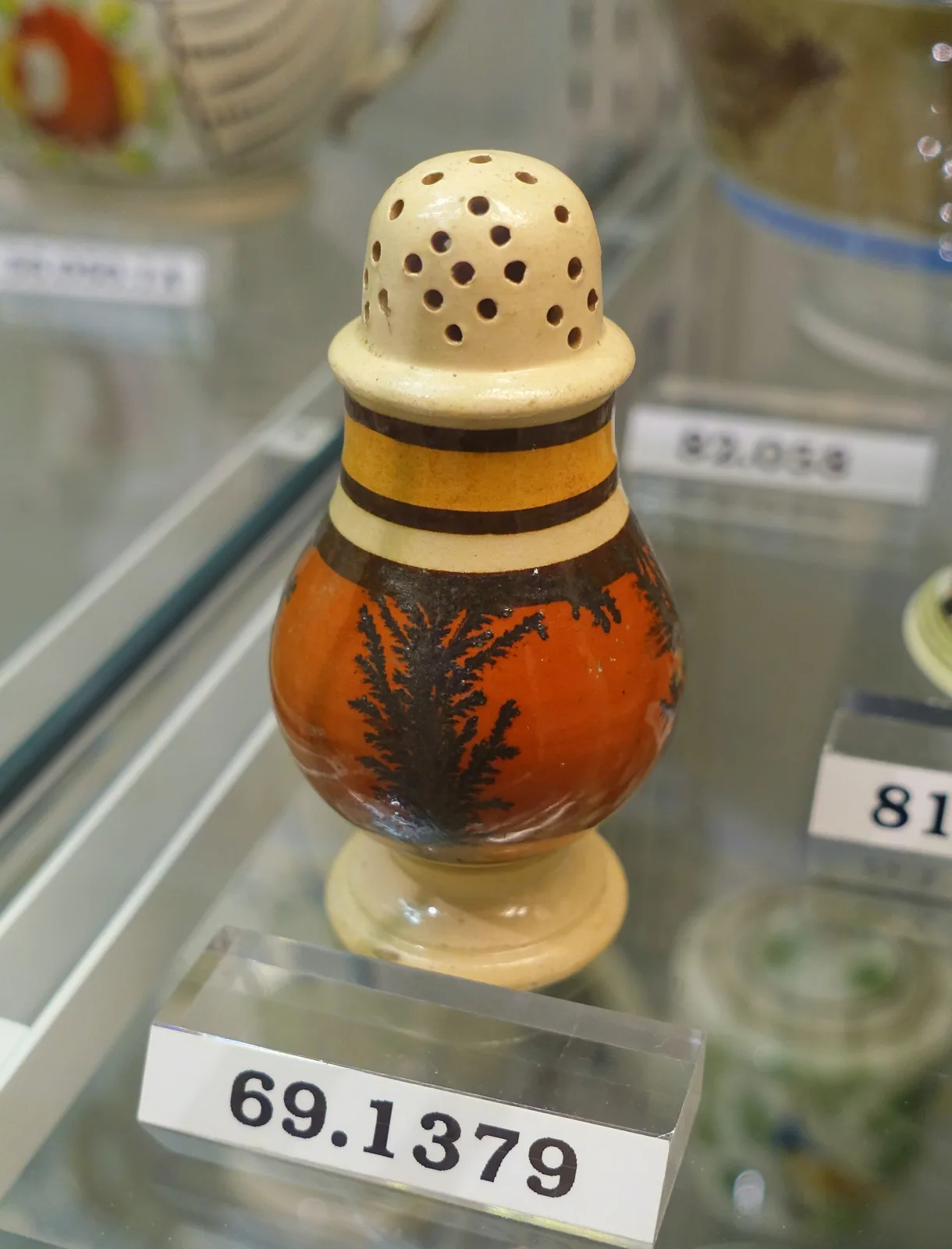
Rouletted and Slip-Inlaid Borders
The precise milled borders cut by a rouletting wheel — checkers, dots, rope twists, herringbone — frame the decorated bands. On some fine pieces, a contrasting slip was rubbed into these rouletted grooves and the surface scraped clean, leaving the pattern inlaid in another color. Crisp, regular rouletting is a sign of competent factory production and is hard for casual reproductions to match.
9. Common Forms and Objects
Mochaware was made for use, and its forms reflect the alehouse, the dairy, the kitchen, and the counting house rather than the parlor cabinet.
Mugs and Tankards
Cylindrical and slightly tapering mugs and tankards are the classic mocha form, made in graduated capacities and frequently used in taverns. Tall presentation tankards and pint and quart mugs with elaborate multi-pattern decoration are among the most collectible pieces. Some bear an applied capacity seal or an excise stamp confirming their measured volume.
Jugs and Pitchers
Baluster and barrel-form jugs, from small cream jugs to large harvest and tavern pitchers, carry some of the boldest dendritic and earthworm decoration. A large mocha jug with strong trees and crisp banding is a centerpiece object.
Bowls and Basins
Mixing bowls, slop bowls, and wash basins in graduated sizes were kitchen and dairy staples. The interiors are usually plain; the decoration runs around the exterior. The everyday banded kitchen bowl is the most commonly surviving form and the easiest entry point for new collectors, much like the utilitarian role played by yellow ware in American kitchens of the same era.
Mustard Pots, Pepper Pots, and Casters
Small covered mustard pots and the charming baluster pepper pots (casters) with domed, pierced tops are favorites with collectors because they are decorative and display well. Pepper pots in particular show the banding and cat's eye decoration on a miniature scale.
Measures, Mocha Tablewares, and Specialty Pieces
Official capacity measures, salt boxes, shakers, chamber pots, custard cups, and even a few teapots and coffeepots were made in mocha decoration. Anything beyond the common mug, jug, and bowl carries a scarcity premium. Mocha was also used on shop and tavern fittings; for the tavern context more broadly, see our guide to antique drinking vessels and steins.
10. History and Makers
Mochaware is fundamentally an anonymous industrial product, which shapes both its history and the way it is collected.
British Origins (c. 1780–1840)
Dipped and dendritic decoration appeared in the Staffordshire potteries and in Yorkshire, Scotland, and the West Country in the last decades of the eighteenth century. The technique spread quickly because it was cheap, fast, and produced attractive goods for the domestic and export markets. The first decades — on creamware and pearlware bodies — represent the artistic peak of the ware, with the finest dendritic work and the richest color.
Victorian Mass Production (c. 1840–1900)
Through the Victorian period, mocha and banded ware became a vast industrial commodity: kitchen bowls, measures, and mugs turned out by the millions on whiter bodies, the decoration increasingly simplified to plain banding with occasional dendritic or cat's eye accents. Much of the mocha encountered in shops today is later Victorian banded kitchenware.
American and Continental Production
American potteries — particularly in East Liverpool, Ohio, Trenton, New Jersey, and elsewhere — produced banded and dendritic ware on yellow ware and whiteware bodies through the later nineteenth century, so that the "mocha" decorating tradition crossed the Atlantic and merged with the American banded-ware story. French faience factories and other Continental makers produced their own dipped wares as well. Distinguishing British from American mocha often comes down to the body: British mocha sits on white or pearlware bodies, while much American dendritic decoration sits on a buff yellow-ware body.
Late Survival
Banded and dendritic ware continued into the twentieth century for utilitarian kitchen and dairy use, and a handful of British firms produced traditional mocha-decorated wares into living memory, which is one reason dating later pieces requires care.
11. Marks and Attribution
The great frustration — and part of the romance — of mochaware is that the overwhelming majority of pieces are unmarked. The decoration was applied by anonymous hands in factories that rarely marked utilitarian dipped goods.
Why Most Mocha Is Unmarked
Dipped ware was the cheapest line a pottery produced, and factories generally reserved backstamps for better tableware. As a result, most antique mocha carries no maker's mark at all, and attribution rests on body, glaze, decoration style, and form rather than a name on the base.
Marks That Do Appear
When marks exist, they help enormously. Look for impressed or printed factory names (a minority of later Victorian pieces are marked), impressed capacity figures and excise marks on mugs and measures, and — on official measures — verification stamps. The presence of a registered-design diamond or a registration number can date a piece to specific decades. The general principles of reading factory marks across English pottery are covered in our discussion of English transferware and flow blue marks, many of which apply to the marked minority of mocha.
Attribution by Style
In the absence of marks, experienced collectors attribute pieces to a period and sometimes a region by the body color and glaze tone, the palette and quality of the slips, the character of the dendritic trees, the form, and the type of rouletted border. This connoisseurship is learned by handling many documented examples.
12. Dating Mochaware
Because the decoration techniques persisted for over a century, dating relies on a cluster of clues rather than any single feature. Weigh several of the following together.
Body and Glaze
The strongest clue. A cream or buff body with a warm lead glaze suggests creamware, pointing to roughly 1780–1820. A whiter body with bluish glaze pooling in the recesses indicates pearlware, roughly 1790–1830. A clean, hard, neutral white body with no blue pooling indicates a later whiteware, generally post-1830 and often much later.
Decoration Quality and Palette
Rich, varied, delicately branched dendritic work, multiple combined patterns, and a full earthy palette point to earlier production. Simplified banding, sparse or blobby dendritic accents, and a restricted palette (often just blue and white or brown and cream) suggest later Victorian or twentieth-century manufacture.
Form and Construction
Hand-finishing marks, slightly irregular potting, applied handles with hand-tooled terminals, and thin, light bodies favor earlier dates. Heavier, very regular, machine-finished bodies favor later production. Foot rims, base finishing, and the way handles join the body all carry information.
Marks and Registration
Any registration diamond, registry number, country-of-origin mark, or printed factory name can narrow the date significantly. A "England" mark suggests post-1891 export; "Made in England" generally points to the twentieth century.
13. Reproductions and Studio Revivals
Mochaware's strong prices and distinctive look have produced two related challenges: outright reproductions intended to deceive, and high-quality studio revivals made honestly but sometimes resold as antique.
The Don Carpentier Revival and Contemporary Studio Mocha
From the late twentieth century, the American potter Don Carpentier and others meticulously revived the dipped-ware techniques, producing superb, technically authentic mocha using period methods. These contemporary pieces are legitimate works of craft and are collected in their own right, but because they are made with genuine slip techniques on appropriate bodies, they can be mistaken — or misrepresented — as antique. Many are signed or dated on the base; always check. The existence of skilled honest revivals means a convincing dendritic surface alone does not prove age.
Tells of Modern Manufacture
Look for a body and glaze that are too white, too clean, or too even, with no bluish pearlware pooling where you would expect it on a supposedly early piece. Modern glazes can be glassier and more uniform than period lead glazes. Check the base: contemporary makers often sign, date, or stamp their work, and a modern-looking foot or an artificially "aged" base (uniform staining, fake crazing, sandpapered wear) is a warning. Decoration that is printed or painted to imitate slip will be perfectly flush rather than standing slightly proud, and dendritic patterns that look identical from piece to piece cannot be genuine, since real dendritic branching is always unique.
Honest Wear vs. Fake Aging
Genuine antique mocha shows wear that makes sense: rubbing on the base and high points, interior staining and utensil marks on used bowls, glaze wear at the rim, and age crazing that runs naturally through the glaze. Fabricated aging tends to be too even, too dirty in the wrong places, or concentrated where it would impress a buyer rather than where real use would fall. The same reasoning used to authenticate other early earthenware, set out in our creamware and pearlware guide, applies directly to mocha bodies.
14. Condition Assessment
Condition strongly affects mochaware value, but because this was hard-used utilitarian ware, the market tolerates honest wear more readily than it does on fine porcelain.
Chips, Cracks, and Hairlines
Examine rims, foot rims, handle terminals, and spouts for chips and flakes. Hold the piece to the light and tap it gently to listen for the dull note that betrays a hairline crack. Star cracks in bowl bases and tight rim hairlines are common and reduce value, though a strong decorated example can still be desirable with minor flaws.
Glaze Wear and Crazing
Crazing — the fine network of glaze cracks — is normal and even expected on early lead-glazed pieces; it is not in itself a defect. Heavy staining within the crazing, glaze loss, and surface abrasion that obscures the decoration matter more. Interior staining on used bowls is expected and usually accepted.
Restoration and Repair
Mocha is restored less often than porcelain because values, while real, rarely justify elaborate repair on common forms — but rare or expensive pieces are sometimes restored. Check for filled chips, overpainted decoration, and replaced handles under raking light and ultraviolet light, which makes most modern fills and retouching fluoresce differently from the original glaze. Disclosed restoration is acceptable on important pieces but should be reflected in the price.
Completeness
For covered pieces — mustard pots, pepper pots with lids — confirm that the cover belongs to the base in body, glaze, banding, and wear. Mismatched or replaced lids reduce value significantly.
15. Values and the Market
Mochaware spans a wide price range, which is part of its appeal. The following bands are indicative; condition, rarity, decoration quality, and form move pieces well up or down.
Price Ranges
- Later Victorian and twentieth-century banded kitchen bowls and mugs: roughly $30–$150 depending on size and condition.
- Good banded and cat's eye pieces, smaller pepper pots and mustard pots: roughly $150–$500.
- Attractive nineteenth-century dendritic and earthworm mugs, jugs, and bowls: several hundred to low thousands of dollars.
- Early creamware and pearlware mocha with fine multi-pattern decoration, rare forms, tall presentation tankards, and exceptional dendritic work: several thousand dollars and up at specialist auction.
These figures are guidance only. A single outstanding piece with crisp trees, rare color, an unusual form, and strong provenance can far exceed the bracket suggested by its type.
What Drives Value
The strongest value drivers are early date (creamware or pearlware body), the quality and variety of decoration (delicate dendritic trees, multiple combined patterns, vivid color), rarity of form, large or impressive size, fine original condition, and any documented provenance or exhibition history. A mug that combines dendritic trees, an earthworm band, cat's eyes, and crisp rouletted borders on a pearlware body is worth many times a plain later banded bowl. Conversely, late date, simplified banding, damage, restoration, and common form weigh against value.
Where to Buy and Sell
Specialist ceramics dealers, country and Americana auctions, and the dedicated mocha collecting community are the best venues. Because attribution rests on connoisseurship rather than marks, buying from knowledgeable specialists who guarantee age and disclose restoration protects new collectors. General valuation principles for unmarked utilitarian antiques are covered in our antique valuation and appraisal guide.
16. Care, Display, and Building a Collection
Mochaware is robust earthenware, but the porous body beneath the glaze and the age of the pieces argue for sensible care.
Cleaning and Handling
Wash gently by hand in lukewarm water with a little mild detergent; never put antique mocha in a dishwasher, and avoid soaking crazed or hairlined pieces, since water penetrates the porous body through the crazing and can drive staining deeper or weaken cracks. Support bowls and jugs from underneath rather than lifting by handles or rims, which are the most vulnerable points. Dry thoroughly. Do not use bleach or abrasive cleaners, which can damage the glaze and lighten or remove decoration.
Display
Display away from direct strong sunlight, which over long periods can affect some colors, and avoid sharp swings in temperature and humidity. Use plate stands and rails that cradle pieces securely; museum wax can stabilize pieces on open shelves against vibration. Keep covered pieces with their lids in place to avoid separation and loss.
Building a Collection
New collectors are best served by handling as much genuine mocha as possible — at specialist dealers, auction previews, and in published collections — to build an eye for body, glaze, and decoration quality before buying expensive pieces. Start with honest, affordable banded bowls and mugs to learn the feel of real slip-decorated earthenware, then progress to dendritic and earthworm pieces as your eye sharpens. Decide early whether to collect by form (a run of mugs, a shelf of pepper pots), by pattern (the finest dendritic, earthworm, or cat's eye examples), or by color, and buy from reputable specialists who guarantee authenticity and disclose condition. For the wider world of British decorated pottery that mocha belongs to, our guides to Staffordshire pottery and antique transferware make natural companions on the collecting shelf.