Antique Heisey Glass Identification Guide: Diamond-H Mark, Patterns, and Colors
Among the American makers of fine tableware, the A. H. Heisey & Company of Newark, Ohio, holds a special place in collectors' affections — and, unusually, in their confidence. For most of its life, from 1896 to 1957, Heisey did something its rivals rarely troubled to do: it marked its glass. The small raised Diamond-H pressed into so many pieces means that Heisey is one of the few "elegant glass" makers a beginner can often confirm rather than merely guess at. That single fact makes Heisey both a wonderful entry point into collecting elegant glass and a name whose mark is widely faked, borrowed, and misunderstood.
Heisey belongs to the family the trade calls "elegant glass" — the better hand-finished tableware made from roughly the 1890s through the 1950s, a clear step above the machine-made Depression glass sold in dime stores and given away in cereal boxes. It competed directly with Fostoria, Cambridge, Duncan & Miller, Tiffin, and Imperial, and its stemware, serving pieces, and later its exquisite glass animals set a standard for clarity and finish that collectors still prize. Because Heisey marked so much of its output, identification often begins — but never ends — with finding and reading that mark.
This guide walks through the company's history, the anatomy and vocabulary of a Heisey piece, the all-important Diamond-H mark and its limits, the major pressed and blown patterns, the celebrated etchings, the full palette of colors and how they date a piece, the beloved glass animals, condition and value factors, and the Imperial-era reissues and outright reproductions that regularly trip up new buyers. Whether you have inherited a boxed set of stemware, found a small crystal horse at a sale, or are weighing a shelf of tumblers in an antique mall, the aim is the same: to help you tell exactly what you are holding, roughly when it was made, and what separates the ordinary from the exceptional.
Table of Contents
- What Heisey Is — and Where It Fits
- A Short History of the Company
- The Diamond-H Mark and Its Limits
- Anatomy and Terminology
- The Major Patterns
- Etchings and Cuttings
- Colors and How They Date a Piece
- Heisey Glass Animals
- Dating an Antique Heisey Piece
- Look-Alikes and Competing Makers
- Condition and Common Faults
- Value Factors and Price Ranges
- Imperial Reissues and Reproductions
- Care, Handling, and Storage
- Quick Identification Checklist
What Heisey Is — and Where It Fits
Heisey made pressed and blown glass tableware and decorative ware: stemware, tumblers, plates, bowls, serving pieces, candlesticks, vases, and — from the 1940s — the small solid-glass figurines that are now among its most famous products. Almost all of it was produced by hand or half by hand: pressed in moulds and then fire-polished, or blown into moulds and hand-finished. That hand-work is what places Heisey in the "elegant glass" category rather than among fully automated wares.
The distinction matters for identification because "elegant glass" is a market tier, not a single look. It sits above dime-store Depression glass and below expensive imported cut lead crystal. Heisey, along with Fostoria, Cambridge, Duncan & Miller, Tiffin, and Imperial, competed in that middle ground of well-made, affordable, but genuinely hand-worked tableware sold through jewelers and department stores rather than five-and-dimes. Recognizing that a piece belongs to the elegant tier — by its weight, its fire-polished rims, and the crispness of its detail — is the first step, even with a maker as helpfully marked as Heisey.
Why Heisey Is (Partly) Easier
Unlike Fostoria, which almost never molded its name into the glass, Heisey adopted its Diamond-H trademark around 1901 and applied it liberally for decades. When you find that mark, you have a strong starting point. But the mark is not the whole story: many genuine Heisey pieces are unmarked, some marks are worn to near-invisibility, and — crucially — the Diamond-H appears on later Imperial reissues and on outright fakes. So the mark opens the identification; the pattern, color, and quality close it.
A Short History of the Company
Augustus H. Heisey was a German-born glassman who learned the trade with several Pittsburgh houses before founding his own firm. In 1896 he opened A. H. Heisey & Company in Newark, Ohio, in the gas-rich country of central Ohio where so many American glasshouses clustered in the late nineteenth century — the same westward migration toward cheap fuel that reshaped the industry, discussed in our guide to early American pattern glass. Production began in 1896, and within a few years Heisey had grown into one of the most respected tableware makers in the country.
The Rise to Quality
Heisey built its reputation on the clarity of its metal and the crispness of its pressing. Its early lead-glass "Colonial" wares — plain, brilliant, faceted pressed glass — competed with cut glass at a fraction of the price. The company introduced the Diamond-H mark around 1901 to distinguish its output, and it advertised nationally, encouraging buyers to ask for Heisey by name. Through the 1910s and 1920s it added colored glass, elaborate etchings, and an ever-widening range of shapes.
The Golden Age and the Animals
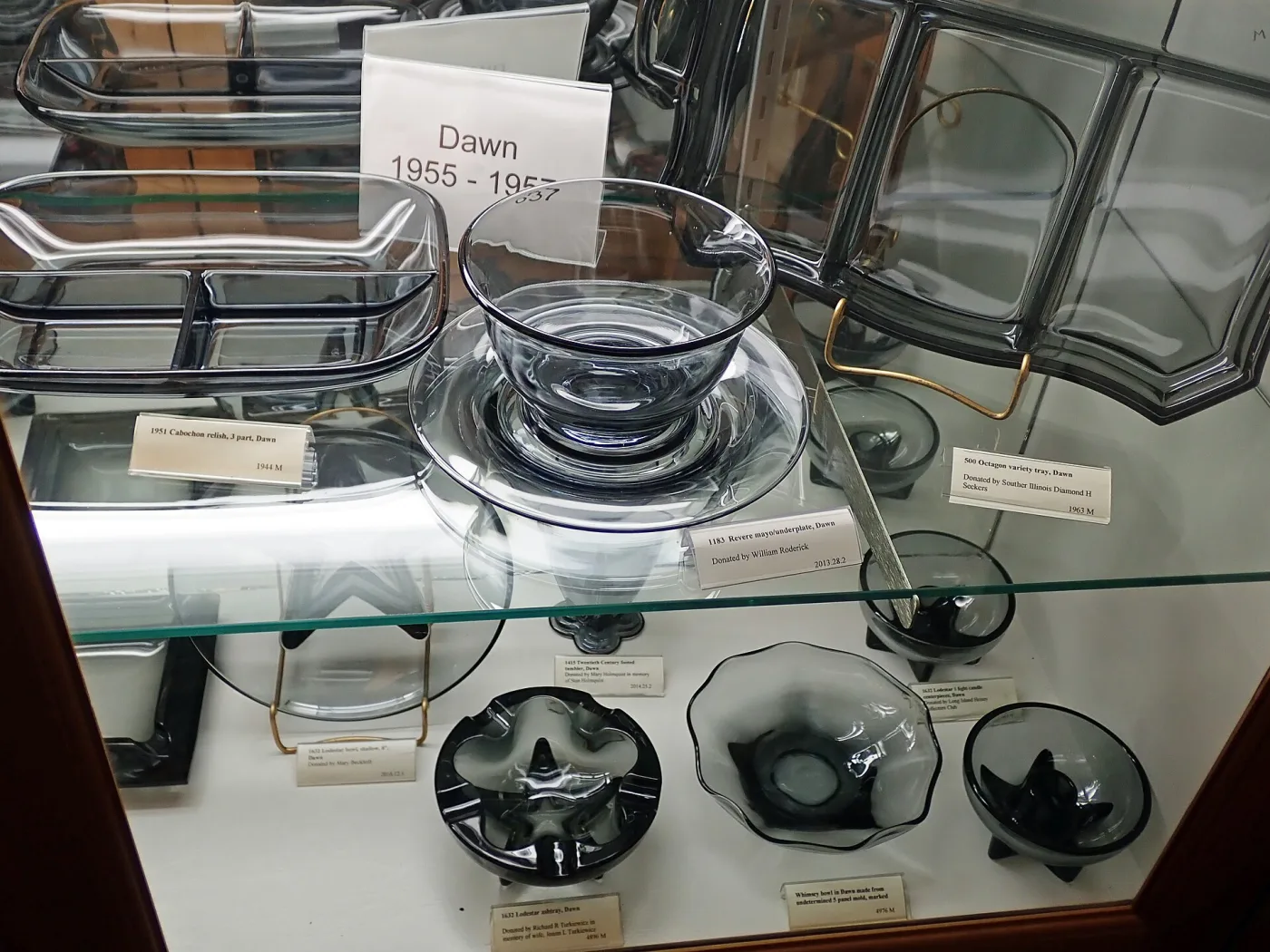
The 1920s through the 1940s were Heisey's golden age. Rich colors such as Moongleam green, Flamingo pink, and Sahara yellow defined its tableware; blown stemware carried delicate etchings such as Orchid and Rose; and in 1942 Heisey introduced the solid crystal animal figurines — horses, elephants, geese, roosters, and many more — that would become its most collected line of all. For a brief period around 1955 Heisey even produced pieces for Verlys of America, using former Verlys moulds.
The Closing and the Imperial Era
Rising costs and changing tastes closed the Newark factory in 1957. In 1958 the Imperial Glass Company of Bellaire, Ohio, bought many of Heisey's moulds and continued to press glass — including the animals — from them, sometimes using the Diamond-H and sometimes an "IG" mark. This is the single most important fact in Heisey dating: not everything bearing a Diamond-H was made in Newark by Heisey. When Imperial itself closed in 1984, the surviving moulds passed to other hands, and the story of reissues continued. The Heisey Collectors of America, which operates the National Heisey Glass Museum in Newark, has since acquired and retired many original moulds to protect the market.
The Diamond-H Mark and Its Limits
Because the Diamond-H is the first thing most people look for, it deserves careful understanding — both what it proves and what it does not.
What the Mark Looks Like
The Heisey trademark is a capital letter H set inside a diamond, moulded in relief into the glass. It is usually small — often only a few millimeters — and can be tucked almost anywhere: in the bottom of a bowl, on the underside or stem of a goblet, inside the foot, on a handle, or on the base of a figurine. On stemware it is frequently on the stem itself or the top of the foot. Because it is moulded rather than acid-etched, it is felt as a slightly raised device; run a fingertip over suspect areas as well as looking, since a worn mark reads better by touch than by eye.
What the Mark Proves
A genuine Diamond-H on an unquestionably old, well-made piece is strong evidence of Heisey manufacture — far stronger than the situation for unmarked makers like Fostoria or Cambridge. For much of the golden-age tableware, finding the mark and matching the pattern is enough to be confident.
What the Mark Does Not Prove
Three cautions are essential. First, absence of a mark does not mean "not Heisey." Many authentic pieces were never marked, the mark sometimes fell in a spot that did not take it well, and blown ware in particular was less consistently marked than pressed ware. Identifying unmarked Heisey means matching the documented pattern, exactly as with any elegant maker. Second, the mark was used by Imperial. After 1958 Imperial pressed many Heisey moulds and often left the Diamond-H in place, so a Diamond-H piece may be an Imperial-era reissue rather than Newark Heisey — a difference that matters enormously to color, date, and value. Third, the mark is faked. Because the Diamond-H adds value, counterfeit marks have been applied to non-Heisey glass, and reproductions carry copied marks. The mark, in short, starts the identification; color, pattern, and quality must finish it.
Anatomy and Terminology
A precise vocabulary makes description, dating, and condition assessment far easier, and it is the language dealers use in listings. Most of these terms apply to elegant glass generally, but they are the tools you will reach for constantly with Heisey.
Bowl, Stem, and Foot
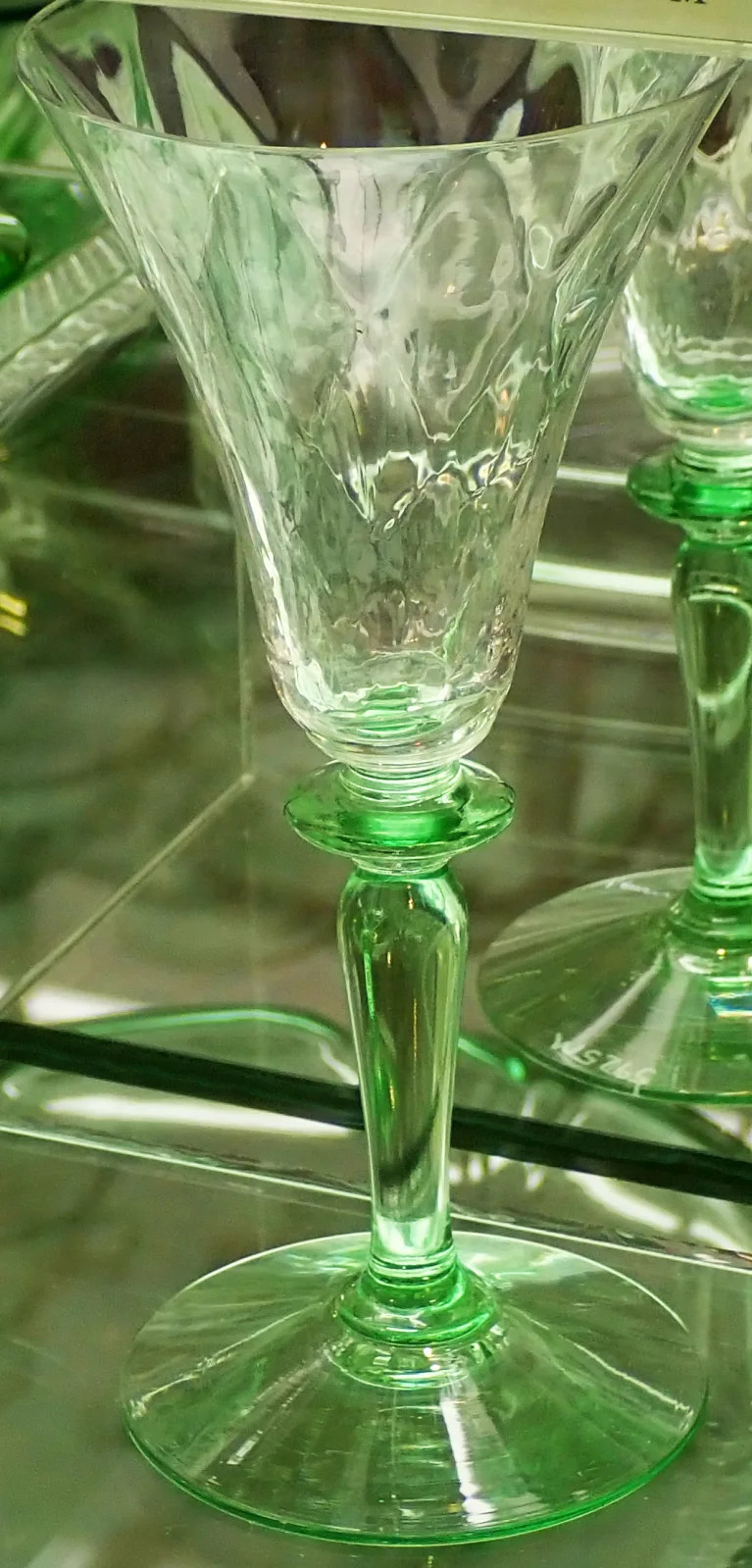
On stemware, the bowl holds the liquid, the stem connects it to the base, and the foot is the flat base itself. The proportions of the bowl, the design of the stem (plain, faceted, hollow, or figural), and the size of the foot all help identify a specific pattern and its intended use — water goblet, wine, cordial, sherbet, or iced tea. Heisey stems in particular are often distinctive, and several patterns are recognized by the stem alone.
Pattern (Line)
The pattern, or line, is the shape design of the blank itself — the moulded form before any etching or cutting. Heisey assigned each a line number and usually a name; Ridgeleigh (1469), Crystolite (1503), and Lariat (1540) are examples of moulded patterns whose decoration is the shape itself, while plain blown blanks carried different etchings.
Blank
A blank is an undecorated piece — the base form to which etching or cutting may or may not be applied. The same blank could be sold plain or decorated, which is why one shape appears in many guises and at very different prices.
Optic
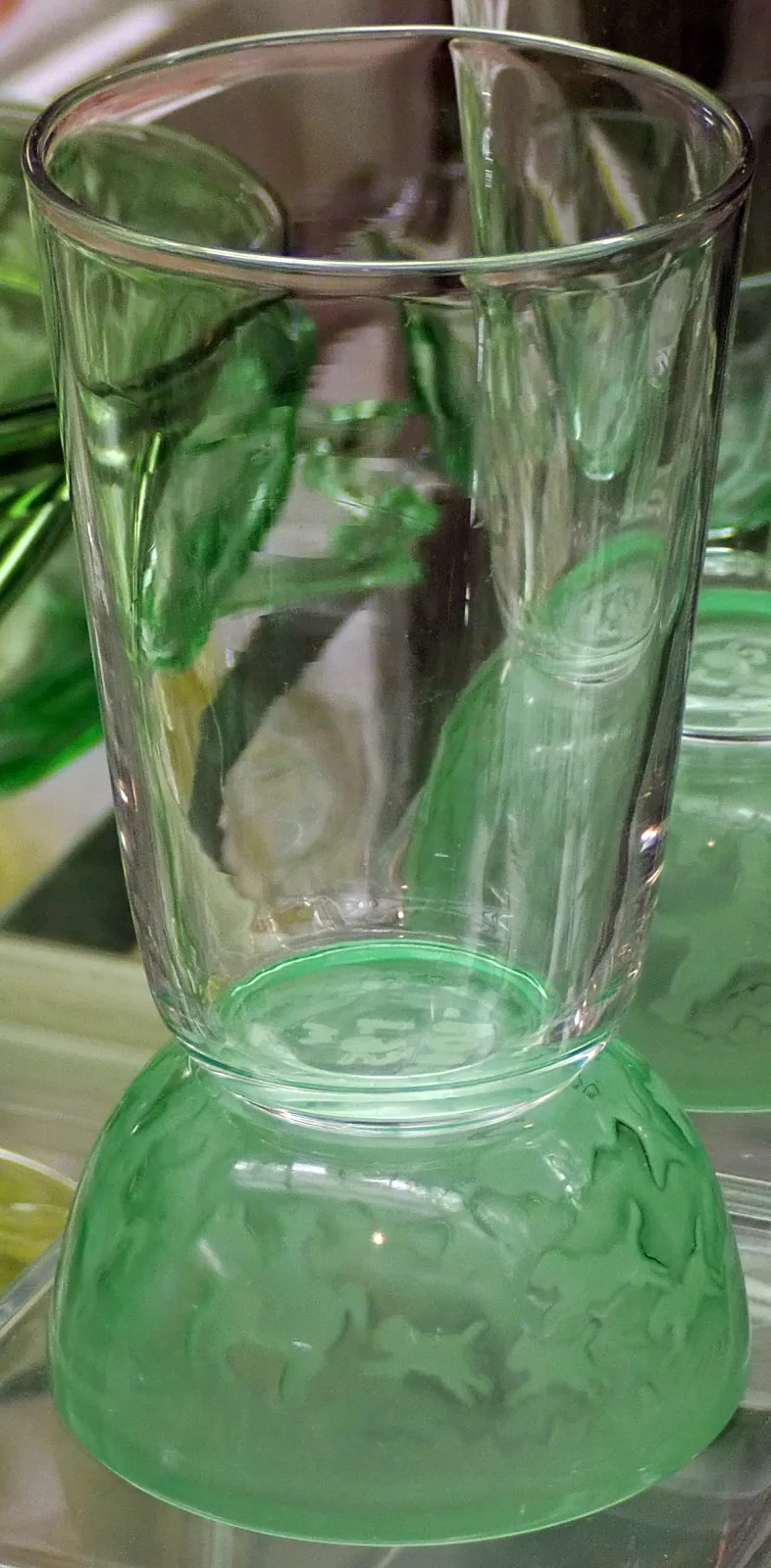
An optic is a moulded pattern of shallow ridges inside the bowl — regular vertical panels, spiral, or diamond optics that catch the light. Optics were pressed into blown ware before final shaping and are a subtle but useful pattern and dating clue.
Fire Polishing
Fire polishing is the brief reheating of a pressed piece to melt away mould lines and give the surface a smooth, glossy finish. The presence of fire-polished rather than sharp, gritty mould seams is one of the hallmarks that separate elegant glass from cheaper pressed ware — and Heisey's fire polishing was notably fine.
Sunk-Star and Colonial
Early Heisey is dominated by Colonial forms — plain paneled or flute-cut pressed shapes in brilliant lead glass — and by pressed star motifs in the bases. Recognizing the crisp, heavy, colonial look of the early wares helps separate them from later, lighter production and from the machine-pressed glass of other firms.
The Major Patterns
Heisey produced hundreds of lines, but a manageable handful account for most of what survives and most of what collectors chase. Knowing these by sight, together with the Diamond-H, will let you name a large share of the Heisey you encounter.
Colonial (early 1900s onward)
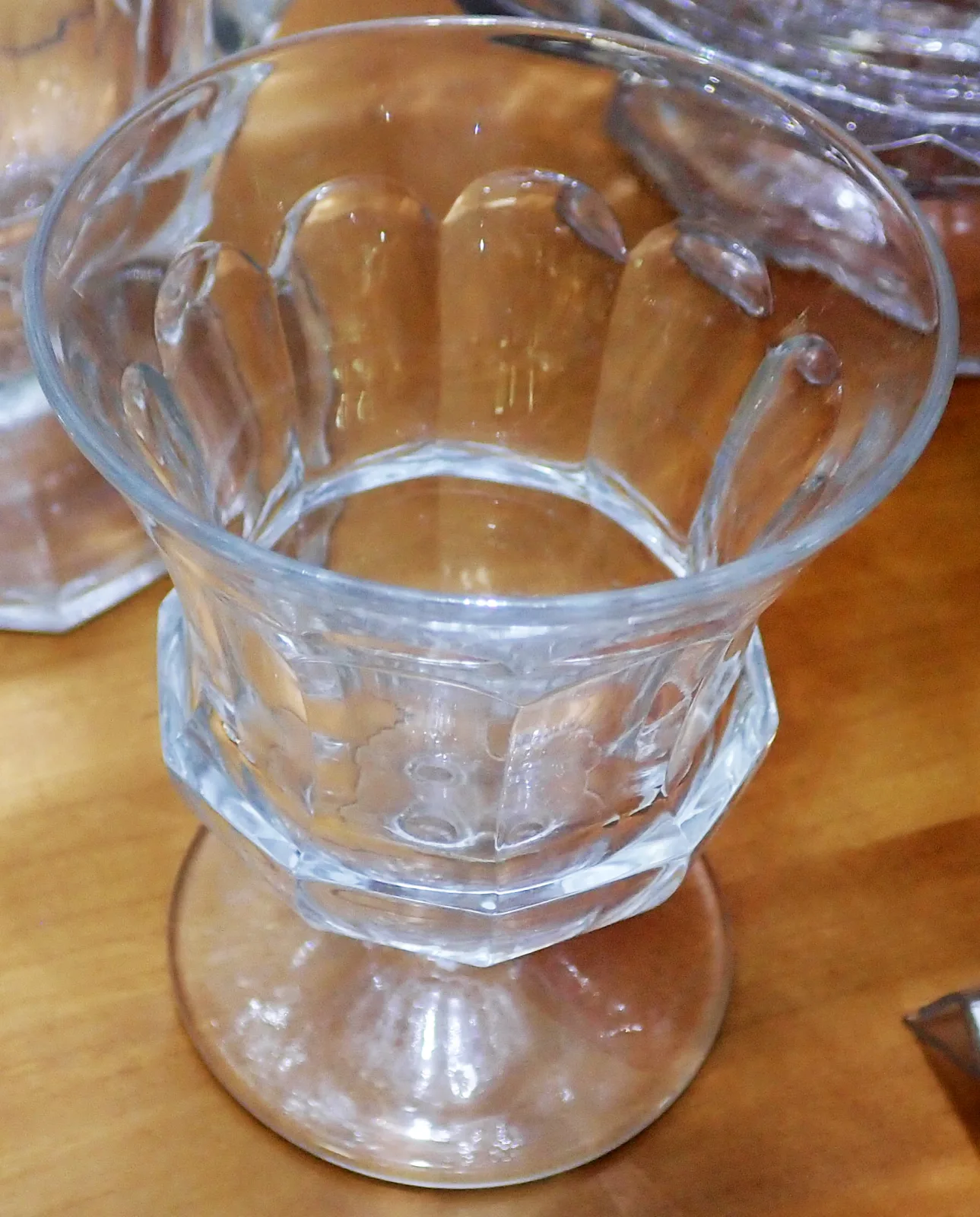
Heisey's foundation. The Colonial group comprises plain, brilliant, faceted pressed patterns — panels, flutes, and scalloped edges in clear lead glass — made to rival cut glass. Colonial wares are heavy, sparkling, and were produced in an enormous range of practical forms over many years. They are common and generally affordable, and their crisp facets and weight are a good introduction to Heisey quality.
Greek Key (No. 433)
An early and distinctive pressed pattern featuring the classical Greek key (meander) border. Greek Key is instantly recognizable and popular with collectors, made in crystal and prized for its clean geometric look.
Ridgeleigh (No. 1469)
A major Art Deco–era pressed pattern of vertical ribbing and geometric forms, introduced in the 1930s. Ridgeleigh was made in a very wide range of tableware and accessories, mostly in crystal, and its strong ribbed lines make it easy to recognize.
Crystolite (No. 1503)
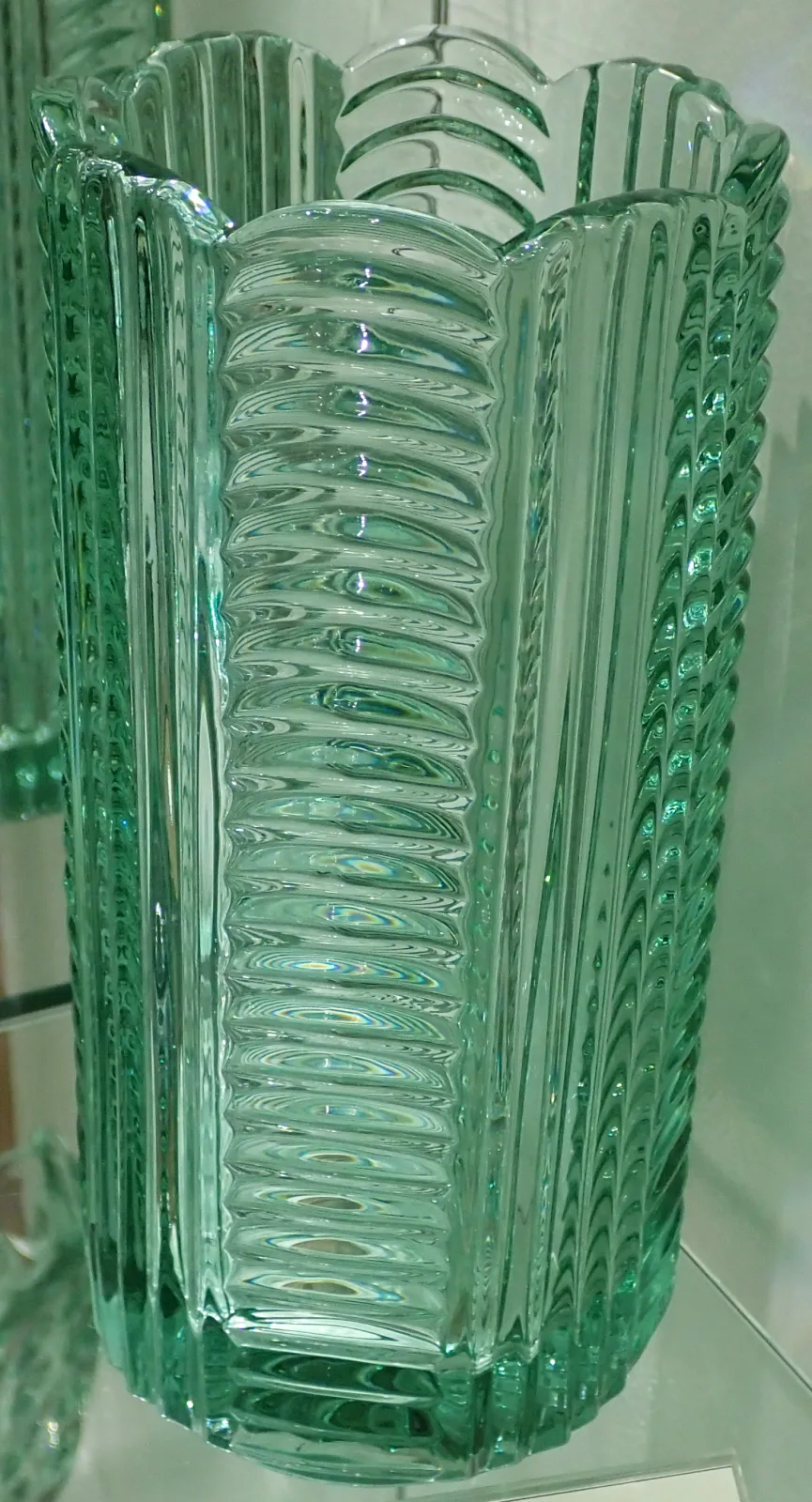
One of Heisey's best-selling later patterns, Crystolite is a swirled, rounded design of short ribs and scallops introduced around 1938. Made in a huge variety of shapes almost entirely in crystal, it is common, attractive, and a frequent "first Heisey" for new collectors.
Lariat (No. 1540)
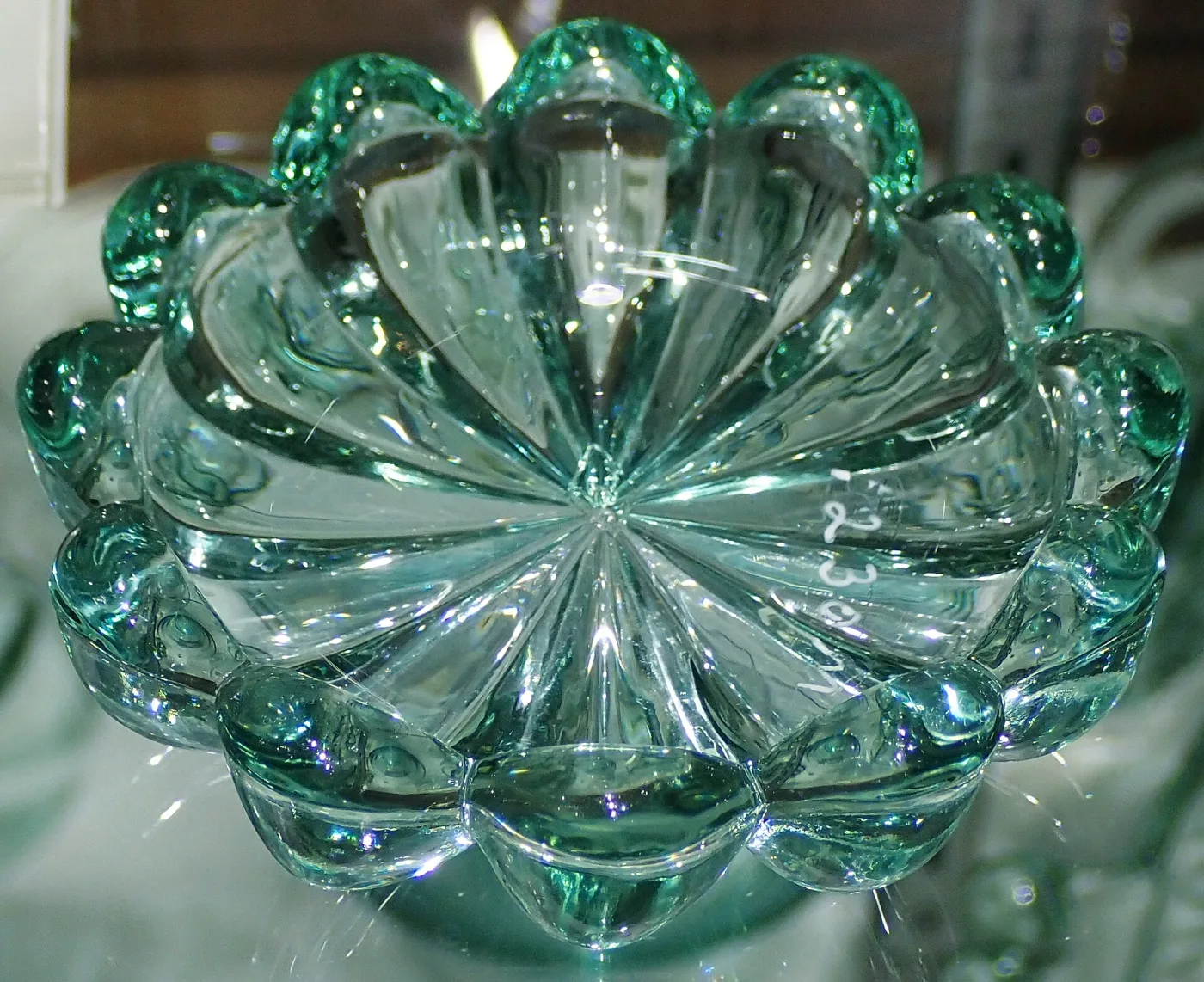
A graceful crystal pattern of looping, rope-like scallops from the 1940s, Lariat was made in extensive tableware and is well liked for its flowing, informal elegance. Like Crystolite, it is relatively common and a good value entry point.
Plantation (No. 1567)
A distinctive later pattern of pineapple-and-leaf motifs, sometimes found with the pineapples frosted. Plantation is instantly recognizable and collectible, especially in its ivy-etched and frosted variants.
Old Sandwich, Ipswich, and Saturn
Several other lines are important to collectors. Old Sandwich (No. 1404) is a heavy paneled pattern made in colors as well as crystal. Ipswich (No. 1405) is a bold paneled design, notable for candle vases and colored examples. Saturn (No. 1485) features a distinctive ringed, ball-and-ring look and appears in the rare Zircon/Limelight color. Each is recognized by its characteristic silhouette, and colored examples command strong premiums.

Etchings and Cuttings
As with Fostoria, if you can identify a Heisey etching you can usually date and value the piece, because most etchings ran only for a defined span of years and appear on documented blanks. On blown stemware the etching is often the single most diagnostic feature.
Reading a Plate Etching
A plate etching is a fine, frosted, all-over design — florals, scrolls, or classical motifs — transferred from an engraved metal plate. It feels slightly matte to a fingertip and does not catch the light in the sharp, prismatic way a wheel cut glass design does. Hold the piece to a light: an etching reads as a soft ghostly pattern within the surface, while a cutting throws bright glints from its facets. Distinguishing the two techniques is the first move, because a cut piece and an etched piece are valued and catalogued quite differently.
The Great Named Etchings
Orchid (etching No. 507, introduced 1940) is the most celebrated Heisey etching — a graceful spray of cattleya orchids on fine blown stemware and tableware, made largely in crystal and highly sought after for wedding china to this day. Rose (No. 515, 1949) is its equally popular companion. Earlier decades brought many other etchings and needle etchings across the colored blanks of the 1920s and 1930s. Each name corresponds to a specific engraved design and a known production window, which is exactly why matching the motif to a reference identifies both pattern and rough date at once.
Cuttings and Other Decoration
Beyond plate etching, Heisey used wheel cutting, gold banding, and frosting (the satin finish seen on Plantation pineapples and elsewhere). Rock-crystal cuttings — polished intaglio designs — appear on some lines. The decoration type is part of the identity of the piece; a plain blank, the same blank etched, and the same blank cut are three different products with three different values.
Colors and How They Date a Piece
Color is one of the most powerful dating tools in Heisey, because the company introduced and retired its named colors on a known timeline. Identifying the exact hue narrows the production window dramatically and, with the rare colors, transforms the value. Heisey's color names are distinctive and worth memorizing.
The Signature 1920s–1930s Colors
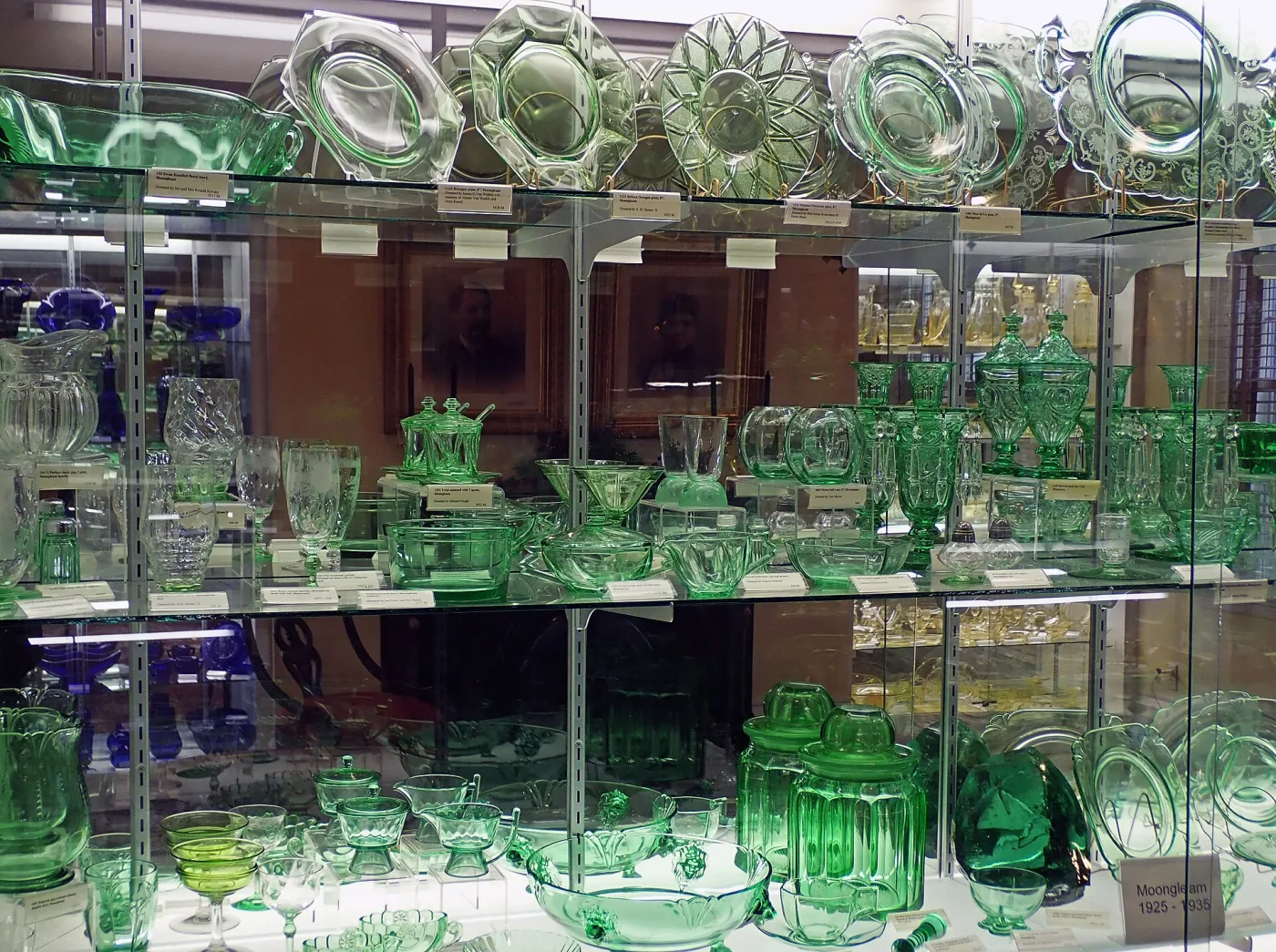
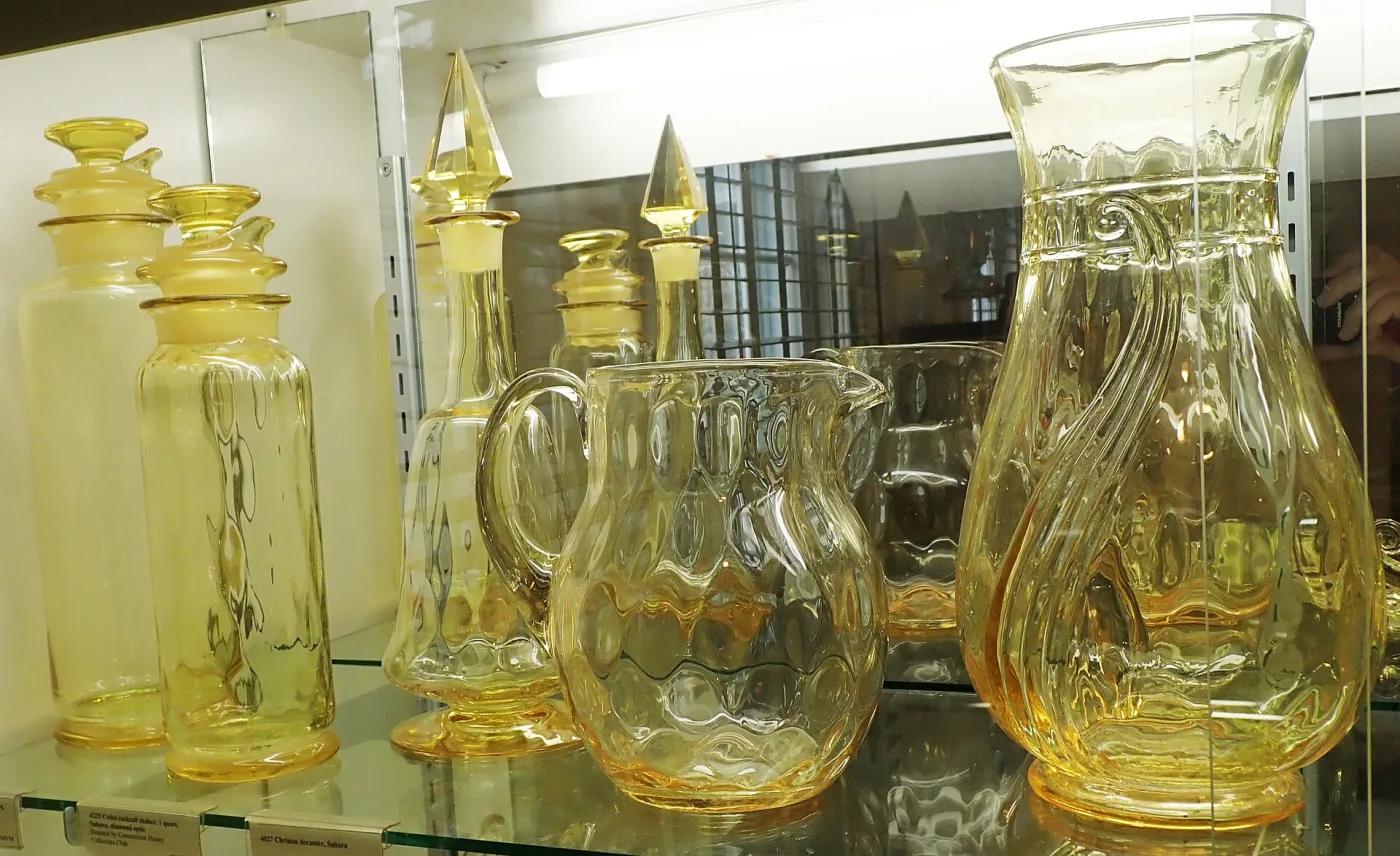
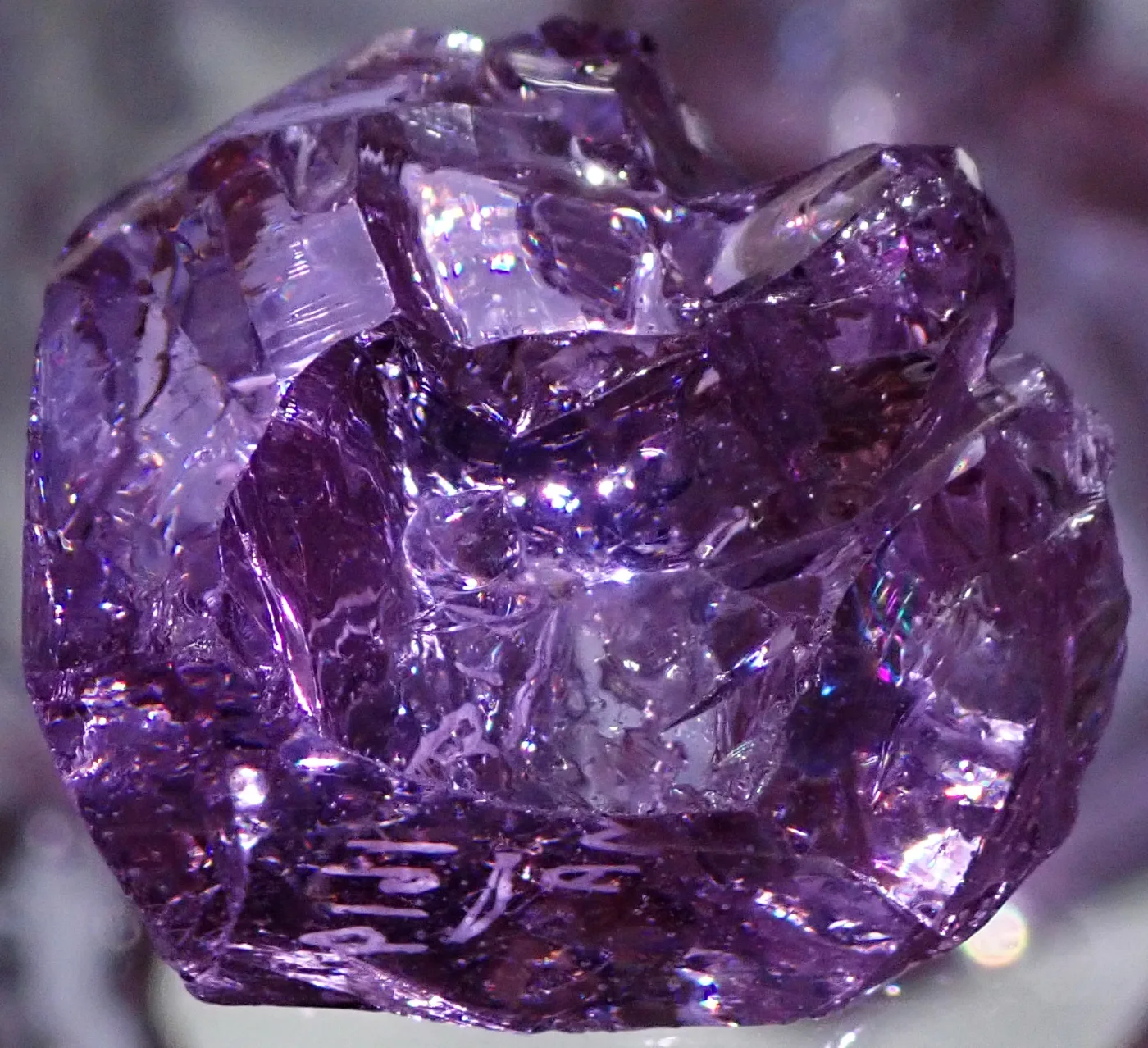
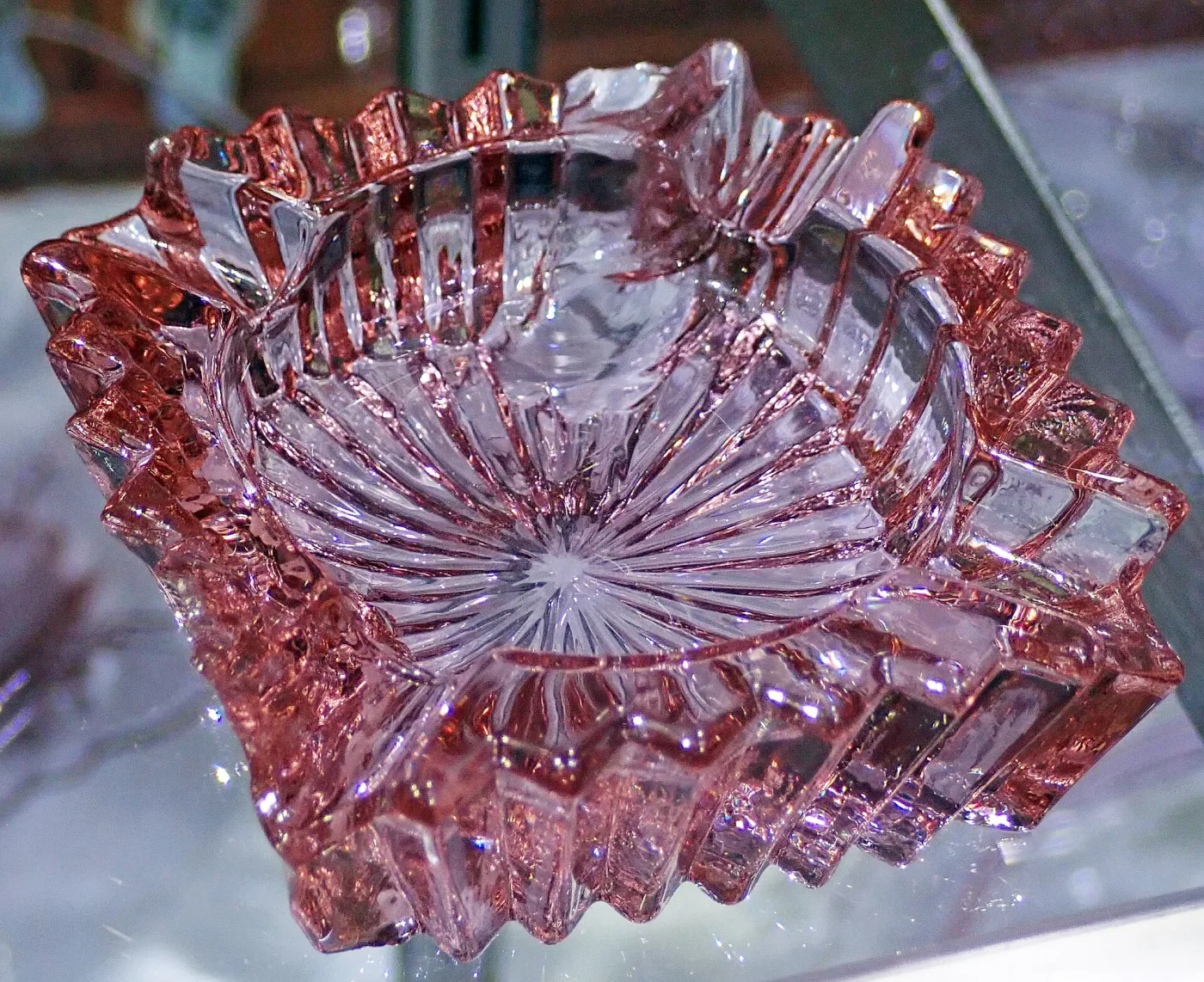
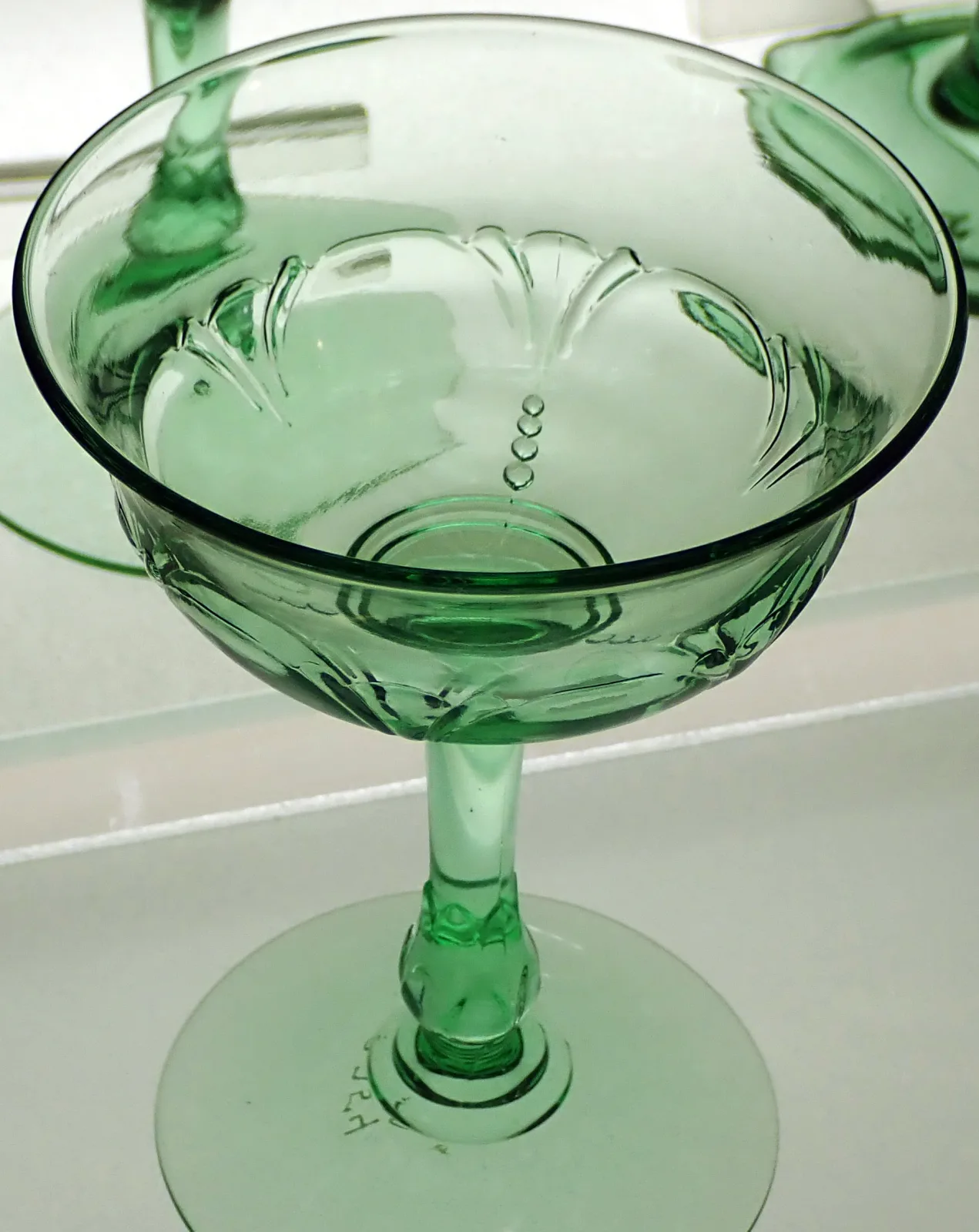
The classic Heisey colors belong to this period. Moongleam (a soft green), Flamingo (pink), and Sahara (a golden yellow) are the signature Heisey colors of the golden age and by far the most encountered. Hawthorne is a delicate orchid/lavender that also fluoresces, and Marigold is a deep amber-yellow. A paneled Old Sandwich tumbler in Moongleam or a Flamingo goblet is a quintessential late-1920s Heisey object, and the presence of these colors alone dates a piece to roughly that window.
The Rare and Prized Colors
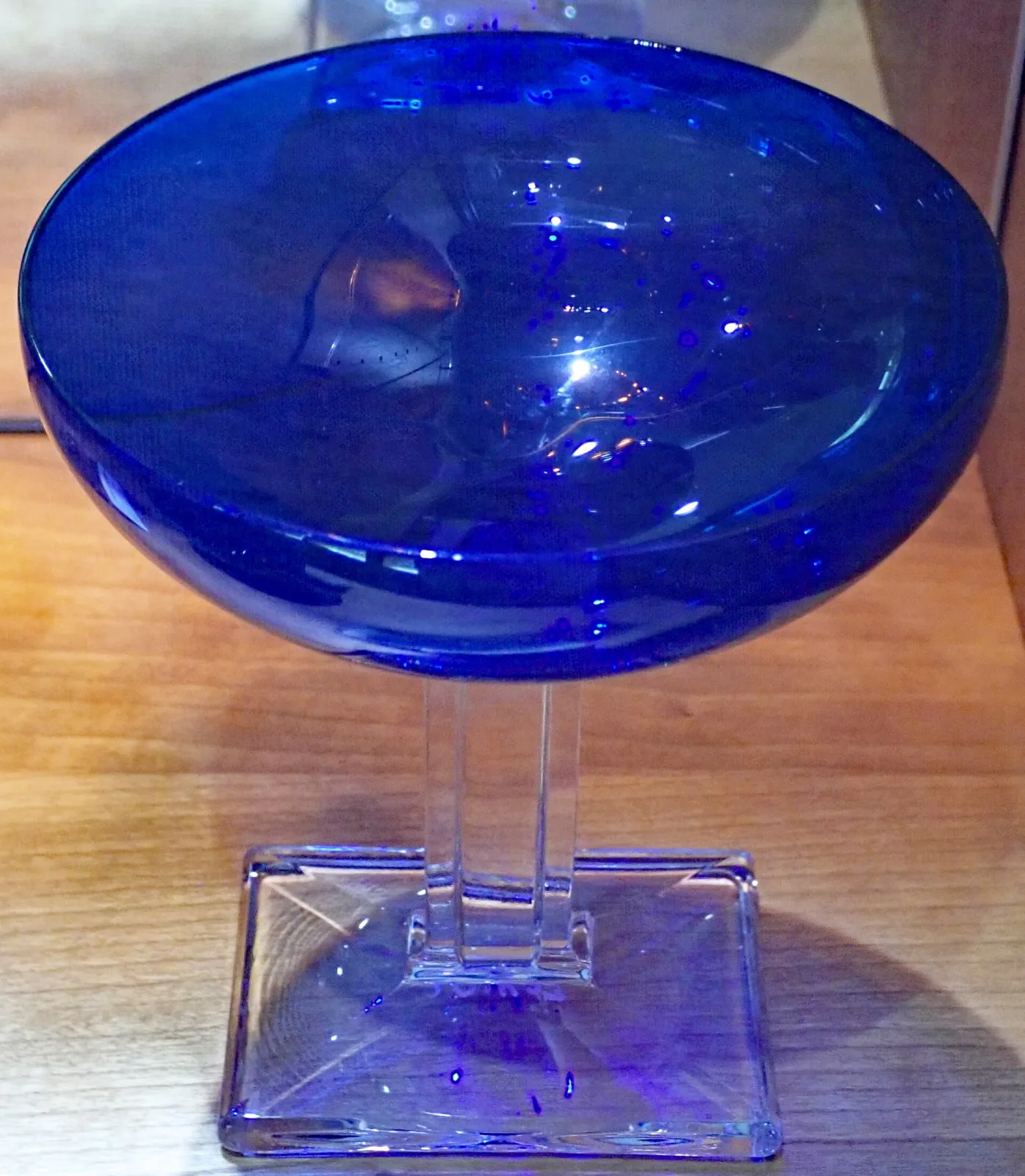
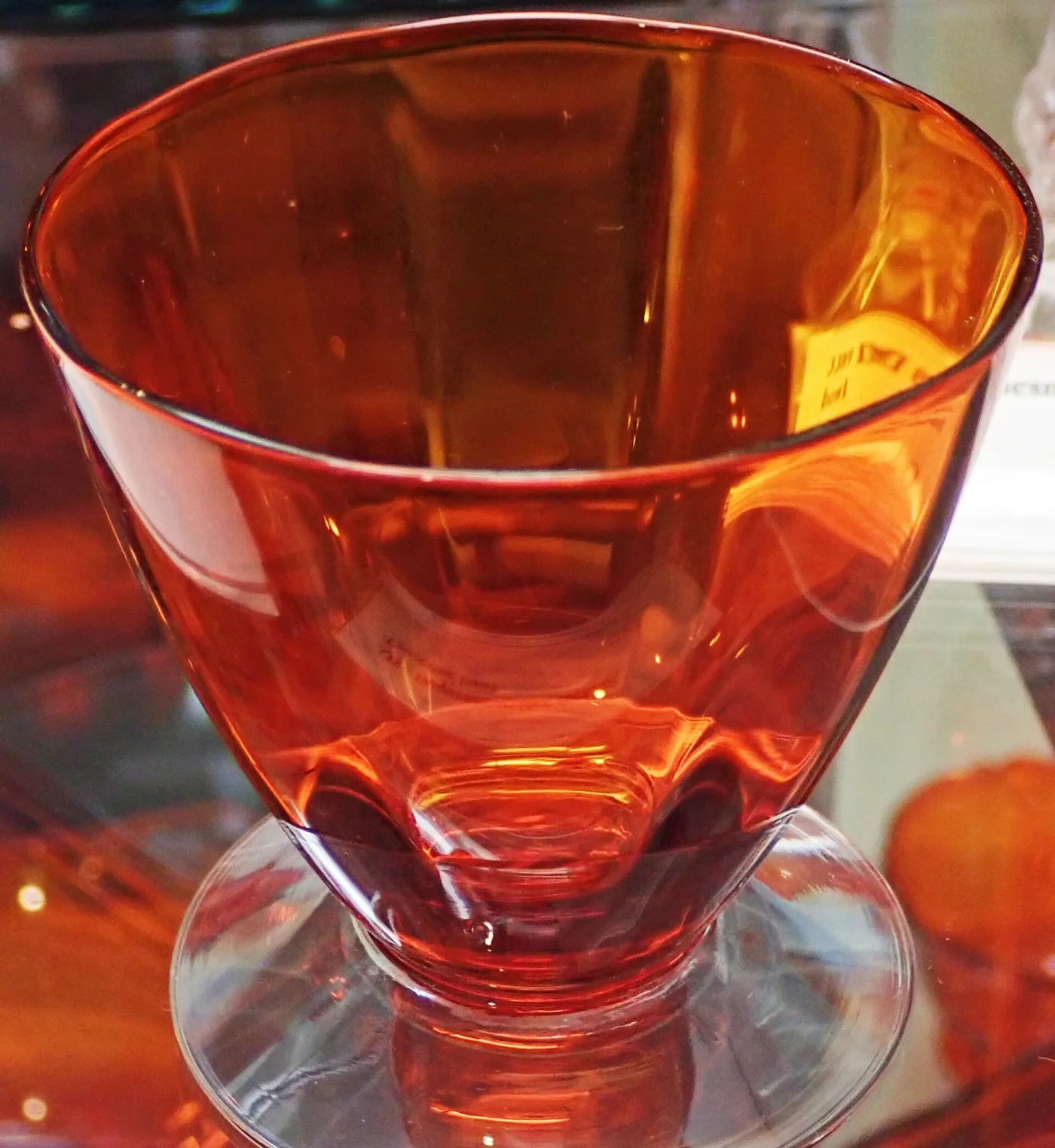
Certain Heisey colors were made only briefly and are correspondingly scarce and valuable. Alexandrite is a neodymium glass that shifts from lavender in daylight to blue under fluorescent light and is among the most coveted of all Heisey colors. Tangerine is a fiery red-orange that is notoriously variable and rare. Zircon (later renamed Limelight) is a luminous blue-green, and Cobalt (Stiegel Blue) a deep, dramatic blue. Any of these transforms an ordinary shape into a prize, so an unusual color is always a flag to investigate rather than assume.
Comparing Heisey Colors to Other Glass
Heisey's colors overlap with those of its competitors and with mass-market glass, so color alone rarely proves the maker — it must be read together with pattern, mark, and quality. A pink Heisey Flamingo piece and a pink Depression-glass piece can look superficially similar until you weigh them in the hand and study the finish. Some Heisey colors — Hawthorne, Alexandrite, and certain greens — react under ultraviolet light because of trace uranium or neodymium, a phenomenon shared with other period glass and explored in our guide to uranium glass; a UV reaction supports a period attribution but does not by itself name Heisey.
Heisey Glass Animals
No account of Heisey is complete without its figurines, which for many collectors are the whole reason to seek the maker out. Introduced in 1942 and made until the 1957 closing, the solid crystal animals are Heisey's most famous — and most reproduced — products.
The Menagerie
Heisey modeled a remarkable range of creatures: horses (the Plug Horse or "Oscar," the rearing and standing horses, the Clydesdale), an elephant in three sizes, geese in flight and at rest, a rooster, a mallard family, a colt, a giraffe, fish, a ringneck pheasant, a gazelle, a sparrow, and more. Most were made in clear crystal; a smaller number appeared in color or with frosted finishes. Each model has a documented size and pose, and collectors identify them by comparing carefully to reference photographs.
Marks and Identification
Many Heisey animals carry the Diamond-H, but placement varies and some are unmarked, so shape and modeling are decisive. The quality of the modeling — the crispness of features, the polish of the base, the exact proportions — is the surest guide. This is the single most important area for reproduction awareness, because the same moulds were later used by Imperial and others.
Why the Animals Are a Minefield
When Imperial acquired the moulds in 1958, it reissued many animals, often in colors Heisey never used and sometimes with the Diamond-H still present. Later, the moulds passed to other makers, and the Heisey Collectors of America itself has issued pieces from original moulds in deliberately new colors to fund the museum, marking them to distinguish them. The practical result is that a Heisey-shaped animal may be original Newark Heisey, an Imperial reissue, a later reissue, or a modern collector-club piece — and color, mark, and finish must all be weighed. A "Heisey" elephant in a color Heisey never made is, by definition, a later product.
Dating an Antique Heisey Piece
Dating Heisey is a matter of triangulating several clues, since no single feature carries a year. Taken together, the following usually place a piece within a decade or two — and, critically, on the right side of the 1957 closing.
Pattern Introduction and Retirement Dates
Each named pattern and etching has a documented production window. Colonial wares span the early decades; Ridgeleigh and Crystolite belong to the 1930s; Lariat and Plantation to the 1940s and 1950s; the Orchid etching begins in 1940 and Rose in 1949; the animals run from 1942 to 1957. Identifying the pattern therefore brackets the date immediately, and identifying an etching often narrows it further within that pattern's life.
Color as a Time Marker
Because colors were introduced and discontinued on a schedule, the exact hue refines the date. Moongleam, Flamingo, and Sahara point to the 1920s and 1930s; Alexandrite, Tangerine, and Zircon to short specific windows within that era; crystal with Orchid or Rose etching to the 1940s and 1950s. A pattern made across many years in crystal but only briefly in a given color can sometimes be dated quite tightly by color alone.
Newark Heisey vs. Imperial
The most important dating question for many pieces is simply: Newark or Imperial? Genuine Newark Heisey ended in 1957. If a piece is in an Imperial-only color, carries an "IG" mark, or shows the softer detail and different metal of Imperial production, it postdates Heisey even when a Diamond-H is present. Conversely, a documented Heisey color that Imperial never used, together with the mark and correct pattern, supports true Newark manufacture. Knowing which colors and finishes belong to which era is the key skill.
Construction and Finishing Clues
Mould-seam treatment, the crispness of pressed detail, the quality of fire polishing, and the brilliance of the metal all shifted over time and between makers. Early Colonial lead glass is notably heavy and brilliant; later crystal can be lighter; Imperial reissues often feel slightly different in weight and clarity. None of these is decisive alone, but together with pattern, color, and mark they form a reliable picture.
Look-Alikes and Competing Makers
Heisey shared the elegant-glass market with several skilled rivals whose products are constantly confused with it. Distinguishing them is a core identification skill and a frequent source of mis-attribution online.
The Elegant-Glass Companies
Fostoria, Cambridge, Duncan & Miller, Tiffin, and Imperial all made comparable hand-finished tableware in overlapping shapes and colors. The great advantage with Heisey is the Diamond-H: where Fostoria and Cambridge are largely unmarked and identified by pattern alone, a marked Heisey piece is far easier to confirm. Where the mark is absent, though, Heisey must be identified the same way — by matching the exact documented pattern — and a swirl, a panel, or a floral etching may belong to any of these makers until the specific design is pinned down.
The Colonial and Pressed-Pattern Overlap
Heisey's early Colonial wares resemble the plain paneled and flute-cut pressed glass made by many firms, including the wide world of early American pattern glass. Weight, brilliance, fire polishing, and — when present — the Diamond-H distinguish Heisey Colonial from cheaper look-alikes. As always, quality narrows the field and the mark or exact pattern names the maker.
Colored Glass Confusion
Colored Heisey is regularly mixed up with colored glass from other elegant makers and with pieces from the broader world of vintage barware and drinkware. Pink Flamingo and green Moongleam in particular invite confusion with Depression glass and with the pinks and greens of rival elegant firms. The mark settles many cases; where it is absent, the exact pattern and the specific shade of the named color do the work.
Condition and Common Faults
Condition governs value sharply in glass, where damage is both common and, on tableware that was actually used, expected. Inspect every piece methodically in good light.
Chips, Nicks, and Flakes
Run a fingertip around every rim, the edge of the foot, and any raised point of the pattern — these are where chips and flea-bite nicks hide. On faceted Colonial and ribbed patterns like Ridgeleigh the many raised points are especially vulnerable. Even a small rim chip substantially reduces value, and rims that have been ground down to remove a chip (leaving the rim slightly low or uneven) should be caught by comparing height and profile to a matching piece.
Cracks and Bruises
Hold the piece to the light and turn it slowly to catch hairline cracks, and give stemware a gentle tap: a clear ring suggests soundness, a dull thud can signal a crack. "Bruises" — internal cloudy fractures from impact — are common at the junction of bowl and stem. On the solid animals, check the extremities — ears, tails, legs, beaks — for chips and grinding, since these fragile points are where damage and repair concentrate.
Sickness, Cloudiness, and Wear
"Sick" glass shows a permanent cloudy or iridescent film, usually from dishwasher damage, hard water, or contents left standing; it does not wipe away and it depresses value considerably. Distinguish it from removable mineral haze. Expect honest base wear — fine scratches on the foot from use — on genuinely old, used pieces; a pattern that supposedly saw decades of table service but has a pristine, unscratched base deserves a second look.
Decoration Wear
On gold-banded and painted pieces, check the trim for rubbing and loss. Worn gilding lowers value, and heavily worn decoration cannot be restored invisibly. On plate-etched pieces the etching itself does not wear off, but harsh cleaning can dull the surrounding polish, and frosted finishes such as Plantation's pineapples can be scrubbed thin.
Value Factors and Price Ranges
Heisey values span an enormous range, and the same pattern can be modest or genuinely valuable depending on color, form, and condition. The variables below explain most of the spread.
What Drives Value
Color first, more than almost anything: the same shape in common crystal versus rare Alexandrite, Tangerine, or Cobalt can differ many times over. Then pattern and decoration — a plain blank and a rare golden-age etching are worlds apart, and a documented animal in an original color outranks a common crystal tumbler. Then the specific form, because unusual and hard-to-find shapes (large serving pieces, uncommon stems, complete sets, and scarce animal models) command premiums over the everyday goblets and plates. Condition, completeness of a set, the presence of the Diamond-H, and any original label follow. Rarity of a particular pattern-color-form combination is what creates the real prizes.
Indicative Ranges
As broad orientation rather than a price list: common crystal Crystolite, Lariat, and Colonial pieces often trade for a few dollars each, and even attractive crystal sets can be inexpensive because so much survives. Popular crystal etched patterns like Orchid and Rose occupy a comfortable middle ground per stem. Colored golden-age pieces in Moongleam, Flamingo, or Sahara command a real premium, and the rare colors — Alexandrite, Tangerine, Zircon, Cobalt — along with scarce animal models reach well into the hundreds or, for exceptional pieces, far beyond. Because condition, exact color, and Newark-versus-Imperial status swing these figures so widely, treat any single number with caution and always compare like with like.
Documenting for Insurance or Sale
Photograph each piece front and back, the foot, the Diamond-H if present, any label, and — for stemware — the full profile against a plain background, and record the pattern name, color, form, and dimensions. Note any damage honestly. The disciplined approach in our valuation and appraisal guide applies directly, and for large matched services it is worth cataloging piece counts, since a complete set is worth more than the sum of scattered pieces.
Imperial Reissues and Reproductions
Heisey is affected less by outright forgery of patterns than by legitimate reissues from its own moulds — a situation almost unique among elegant makers, and the single biggest trap for new buyers. Knowing the difference protects you from paying Newark prices for later glass.
The Imperial Era (1958–1984)
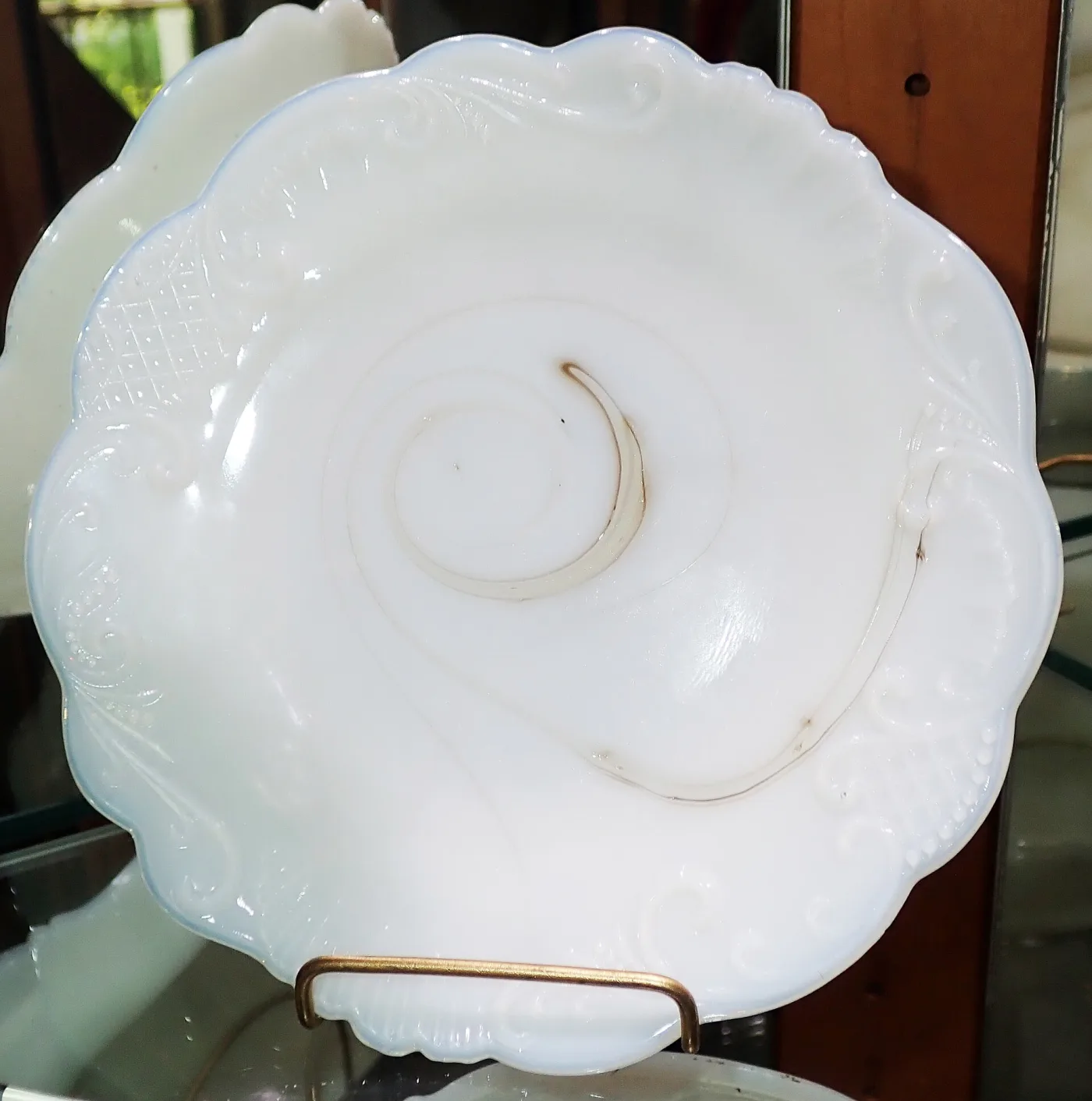
When Imperial bought Heisey's moulds in 1958 it pressed many patterns and animals from them, sometimes retaining the Diamond-H and sometimes adding an "IG" mark. This glass is genuinely made from Heisey moulds but is not Newark Heisey, and it should be dated and valued as Imperial production. Imperial frequently used colors Heisey never made — caramel slag, milk glass, verde green, and various modern hues — so a "Heisey" piece in a color outside the documented Heisey palette is a strong sign of later manufacture regardless of the mark.
Later Reissues and Collector-Club Pieces
After Imperial closed in 1984 its moulds scattered, and various makers — along with the Heisey Collectors of America — have since issued pieces from original moulds. The collectors' organization deliberately produces animals and other items in new, clearly non-original colors to fund the National Heisey Glass Museum, and marks them to prevent confusion. These are legitimate and collectible in their own right, but they are modern, not vintage, and should never be sold as period Heisey.
Fakes, Married Sets, and Optimistic Listings
Because the Diamond-H adds value, counterfeit marks have been applied to non-Heisey glass, and much online confusion is simple wishful attribution — any pink paneled tumbler called "Heisey Flamingo," any crystal animal called "Heisey." The defenses are the same as for other elegant glass: verify the specific pattern and the exact color against a documented reference rather than trusting a listing title or a lone mark, be wary of "sets" assembled from several patterns or eras, and treat a color that Heisey never used as decisive proof of a later piece. When the stakes are high, corroborate your reading with a specialist, with the Heisey Collectors of America's published research, or with the pattern-recognition of the Antique Identifier app before you buy or sell.
Care, Handling, and Storage
Heisey was made to be used, but a century of survival deserves sensible care — and careless washing is the single most common cause of the "sick," cloudy glass that ruins value.
Washing
Wash Heisey by hand in lukewarm water with mild detergent; never put it in a dishwasher, whose heat, harsh detergents, and jostling cause etching to dull, gilt to wear, and the permanent cloudiness that cannot be reversed. Support the bowl and foot of stemware separately and avoid gripping a delicate stem, which is where breaks most often start. Line the sink with a towel to cushion against knocks, and wash the solid animals one at a time so their fragile extremities are never knocked together.
Removing Haze
A removable mineral film from hard water can sometimes be reduced with a gentle soak in a mild acidic solution or a proprietary glass cleaner, but true "sickness" etched into the surface is permanent — do not scrub abrasively in the hope of removing it, as you will only scratch the glass. When in doubt, leave a valuable piece alone rather than risk it.
Storage and Display
Store stemware upright rather than resting on delicate rims, and never stack tumblers inside one another where they can wedge and crack. Keep pieces from knocking together on open shelves, cushion any that travel, and set the animals where they cannot be toppled. The broader principles in our storage, care, and preservation guide apply directly, and matched services are best kept together so a set is not gradually broken up and devalued.
Quick Identification Checklist
When you first pick up an unfamiliar piece of elegant glass, work through these questions in order. Together they will place almost any Heisey within its pattern, rough date, and value tier.
The Mark
Look and feel for the Diamond-H — on the base, foot, stem, handle, or the base of a figurine. Finding it is a strong start, but remember its limits: many genuine pieces are unmarked, and the same mark appears on Imperial reissues and fakes. The mark opens the identification; it does not close it.
Tier and Quality
Does it feel and look like elegant glass — a substantial weight, fire-polished rather than gritty rims, brilliant clarity, crisp detail? Or is it lighter, cruder machine-made ware? Establishing the tier first prevents you from chasing a maker attribution the piece does not deserve.
Pattern and Decoration
What is the moulded pattern — faceted Colonial, ribbed Ridgeleigh, swirled Crystolite, looping Lariat, pineapple Plantation, or a plain blown blank? Is there decoration, and is it a soft frosted plate etching (Orchid, Rose) or a bright faceted cutting? Naming the pattern and the decoration type is the core of the identification.
Color
What exactly is the color — crystal, or Moongleam, Flamingo, Sahara, Hawthorne, Marigold, or one of the rare Alexandrite, Tangerine, Zircon, or Cobalt hues? Does it shift color or fluoresce under different light? The precise hue narrows the date, separates Newark Heisey from Imperial reissues, and, for scarce colors, transforms the value.
Overall Judgement
Weigh the clues together. A crystal Crystolite bowl, an Orchid-etched goblet, a Flamingo Old Sandwich tumbler, and a crystal Heisey elephant are four very different objects — and reading the mark, pattern, decoration, color, and quality will nearly always tell you which one is in your hands and whether it left Newark before 1957. Match what you see to a documented reference before you assign a value, and when the piece is potentially valuable, confirm the attribution rather than trusting a lone mark or a listing title.