Antique Fostoria Glass Identification Guide: Patterns, Colors, and Dating
For almost a century, the Fostoria Glass Company set the standard for American tableware. Founded in 1887 and closing only in 1986, Fostoria outlived nearly all of its rivals and became, at its peak, the largest maker of handmade glassware in the United States. Its stemware graced the White House under several administrations, filled countless brides' hope chests, and still turns up today in cupboards, estate sales, and antique malls in enormous quantity. That very abundance is the collector's puzzle: some Fostoria trades for a dollar a piece, while a single rare etched goblet in the right color can bring a hundred times as much.
Fostoria belongs to the family the trade calls "elegant glass" — the better hand-finished tableware made from roughly the 1920s through the 1950s, a cut above the machine-made Depression glass sold in dime stores and given away in cereal boxes. Telling elegant glass from its cheaper cousins, and telling one Fostoria pattern from another, is the heart of identification. Fostoria rarely marked its wares in the mould, so attribution rests on reading the pattern, the color, the etching, and the quality of the metal itself.
This guide walks through the company's history, the anatomy and vocabulary of a Fostoria piece, its most important patterns and etchings, the full palette of colors and how they date a piece, the marks and labels that do exist, condition and value factors, and the reproductions and look-alikes that regularly fool new buyers. Whether you have inherited a boxed set of stemware or are weighing a shelf of tumblers at a sale, the aim is the same: to help you tell exactly what you are holding, roughly when it was made, and what separates the ordinary from the exceptional.
Table of Contents
- What Fostoria Is — and Where It Fits
- A Short History of the Company
- Anatomy and Terminology
- The Major Patterns
- Plate Etchings and Decoration
- Colors and How They Date a Piece
- Marks, Labels, and Signatures
- Dating an Antique Fostoria Piece
- Look-Alikes and Competing Makers
- Condition and Common Faults
- Value Factors and Price Ranges
- Reproductions and Later Reissues
- Care, Handling, and Storage
- Quick Identification Checklist
What Fostoria Is — and Where It Fits
Fostoria made pressed and blown glass tableware: stemware, tumblers, plates, bowls, serving pieces, candlesticks, vases, and the endless small accessories of a formal table. Almost all of it was produced by hand or half by hand — pressed in moulds and then fire-polished, or blown into moulds and hand-finished — which is what places it in the "elegant glass" category rather than among fully automated wares.
The distinction matters for identification because "elegant glass" is a market tier, not a single look. It sits above dime-store Depression glass and below expensive cut lead crystal. Fostoria, along with Cambridge, Heisey, Duncan & Miller, Tiffin, and Imperial, competed in that middle ground of well-made, affordable, but genuinely hand-worked tableware sold through jewelers and department stores rather than five-and-dimes. Recognizing that a piece belongs to the elegant tier — by its weight, its fire-polished rims, and the crispness of its detail — is the first step before you ever try to name the maker.
Why Identification Is Tricky
Two things make Fostoria harder to pin down than, say, a piece of marked silver. First, the company almost never molded its name into the glass, so there is no raised trademark to find. Second, Fostoria produced hundreds of patterns across nearly a century, many of them running for decades in a shifting range of colors. The same pattern shape might appear plain, optic-paneled, etched, or cut, in half a dozen colors, over a thirty-year span. Identification therefore means learning to read the object rather than looking for a signature.
A Short History of the Company
The company was founded in 1887 in Fostoria, Ohio, a town chosen for its abundant natural-gas fields — the same westward migration of glasshouses toward cheap fuel that reshaped American glassmaking in the 1880s and 1890s, discussed in our guide to early American pattern glass. When the Ohio gas began to fail, Fostoria moved in 1891 to Moundsville, West Virginia, where it would remain for the rest of its working life. Collectors still speak of "Moundsville glass" as a synonym for Fostoria.
The Rise to National Brand
Fostoria's genius was marketing as much as glassmaking. In 1924 it introduced the American pattern, a cubist, block-like design that would become the best-selling handmade glass pattern in American history and stay in production for the company's entire remaining life. Around the same time it began advertising nationally in women's magazines and, crucially, promoted the idea of matched crystal tableware — encouraging brides to select a glassware pattern the way they chose a china or silver pattern. Fostoria was the first glass company to advertise its tableware directly to consumers under a brand name.
The Golden Age and the Long Decline
The 1920s through the 1950s were Fostoria's golden age, when its etched stemware — Versailles, June, Trojan, Navarre, and dozens more — defined American formal dining. Changing tastes, imported glass, and the shift toward casual dining eroded the market through the 1960s and 1970s. In 1983 Fostoria was bought by Lancaster Colony Corporation, and the historic Moundsville factory closed in 1986. Lancaster Colony continued to sell glass under the Fostoria name for some years afterward, often sourced elsewhere — a fact that matters when you are dating a "Fostoria" piece, because not everything bearing the name was made in Moundsville.
Anatomy and Terminology
A precise vocabulary makes description, dating, and condition assessment far easier, and it is the language dealers use in listings. Most of these terms apply to elegant glass generally, but they are the tools you will reach for constantly with Fostoria.
Bowl, Stem, and Foot
On stemware, the bowl holds the liquid, the stem connects it to the base, and the foot is the flat base itself. The proportions and shape of the bowl, the design of the stem (plain, faceted, hollow, or figural), and the size of the foot all help identify a specific pattern and its intended use — water goblet, wine, cordial, sherbet, or iced tea.
Pattern (Line)
The pattern, or line, is the shape design of the blank itself — the moulded form before any etching or cutting. Fostoria assigned each a line number and usually a name. American (line 2056) and Coin (line 1372) are moulded patterns whose decoration is the shape itself; other lines, such as the 6016 stem, were plain blanks that carried different etchings.
Blank
A blank is an undecorated piece — the base form to which etching or cutting may or may not be applied. The same blank could be sold plain or decorated, which is why one shape appears in many guises.
Optic
An optic is a moulded pattern of shallow ridges inside the bowl — regular vertical panels (spiral optic, loop optic, regular optic) that catch the light. Optics were pressed into blown ware before final shaping and are a subtle but useful dating and pattern clue.
Plate Etching
Plate etching is Fostoria's signature decorating technique: an intricate all-over acid-etched design transferred from an engraved metal plate, producing a soft, frosted, lace-like pattern. It is distinct from the bolder, shinier effect of wheel cut glass. Learning to feel and see the difference between an etched and a cut surface is fundamental to Fostoria identification.
Fire Polishing
Fire polishing is the brief reheating of a pressed piece to melt away mould lines and give the surface a smooth, glossy finish. The presence of fire-polished rather than sharp, gritty mould seams is one of the hallmarks that separate elegant glass from cheaper pressed ware.
The Major Patterns
Fostoria produced hundreds of lines, but a handful account for most of what survives and most of what collectors chase. Knowing these by sight will let you name a large share of the Fostoria you encounter.
American (Line 2056)
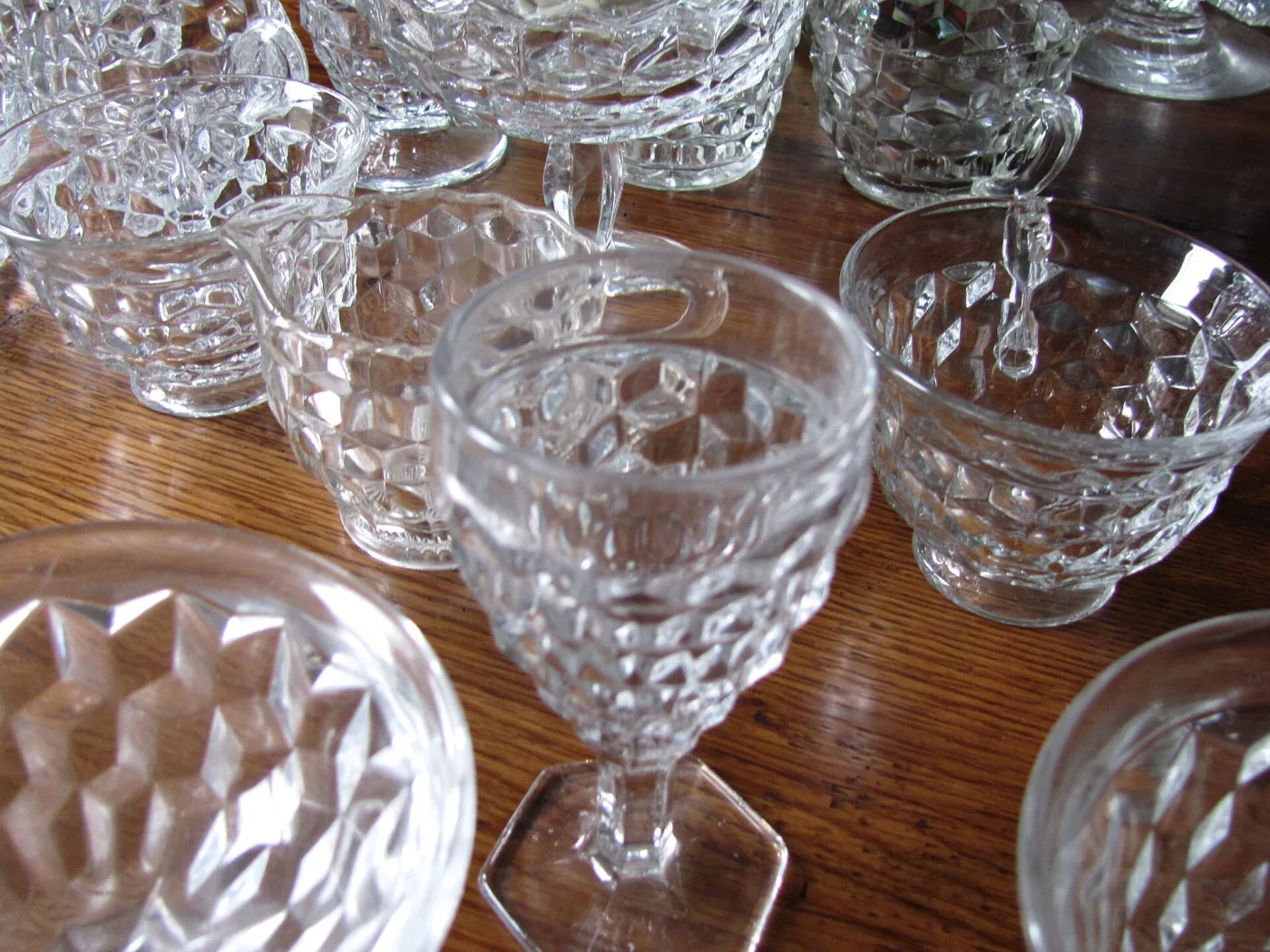
The most important pattern of all. Introduced in 1915 as a pressed pattern and expanded enormously from the 1920s, American is a clear, colorless design of small raised cubes or blocks covering the entire surface — sometimes described as "cube" or "cubist." It was made in a staggering range of forms, from tiny individual salts to massive punch bowls and pedestal cake stands, and it ran continuously until the factory closed. Its ubiquity means plain American is common and inexpensive, but rare forms — unusual serving pieces, hard-to-find sizes, and any colored American — can be genuinely valuable. Because American was so widely copied, distinguishing true Fostoria American from later imitations is a whole study in itself, addressed below.
Coin (Line 1372)
Introduced in 1958 and made into the 1980s, Coin glass is a heavy pressed pattern decorated with medallions resembling antique coins, some of them frosted. It came in crystal and in a range of colors — amber, olive green, blue, ruby, and others — and in an enormous variety of shapes: candy jars, candleholders, urns, ashtrays, cruets, and more. Coin was reissued by Lancaster Colony after 1986 and has been reproduced, so dating a Coin piece to the Fostoria era specifically requires attention to color, frosting, and marks.
Colony (Line 2412)
A swirled, ribbed pressed pattern in colorless glass, Colony was a long-running mid-century line made in a broad range of practical tableware. It is elegant but affordable, and its flowing spiral ribs make it easy to recognize. Colony is frequently confused with the older Queen Ann/Sakier lines and with similar swirl patterns by other makers.
The Etched Stemware Lines
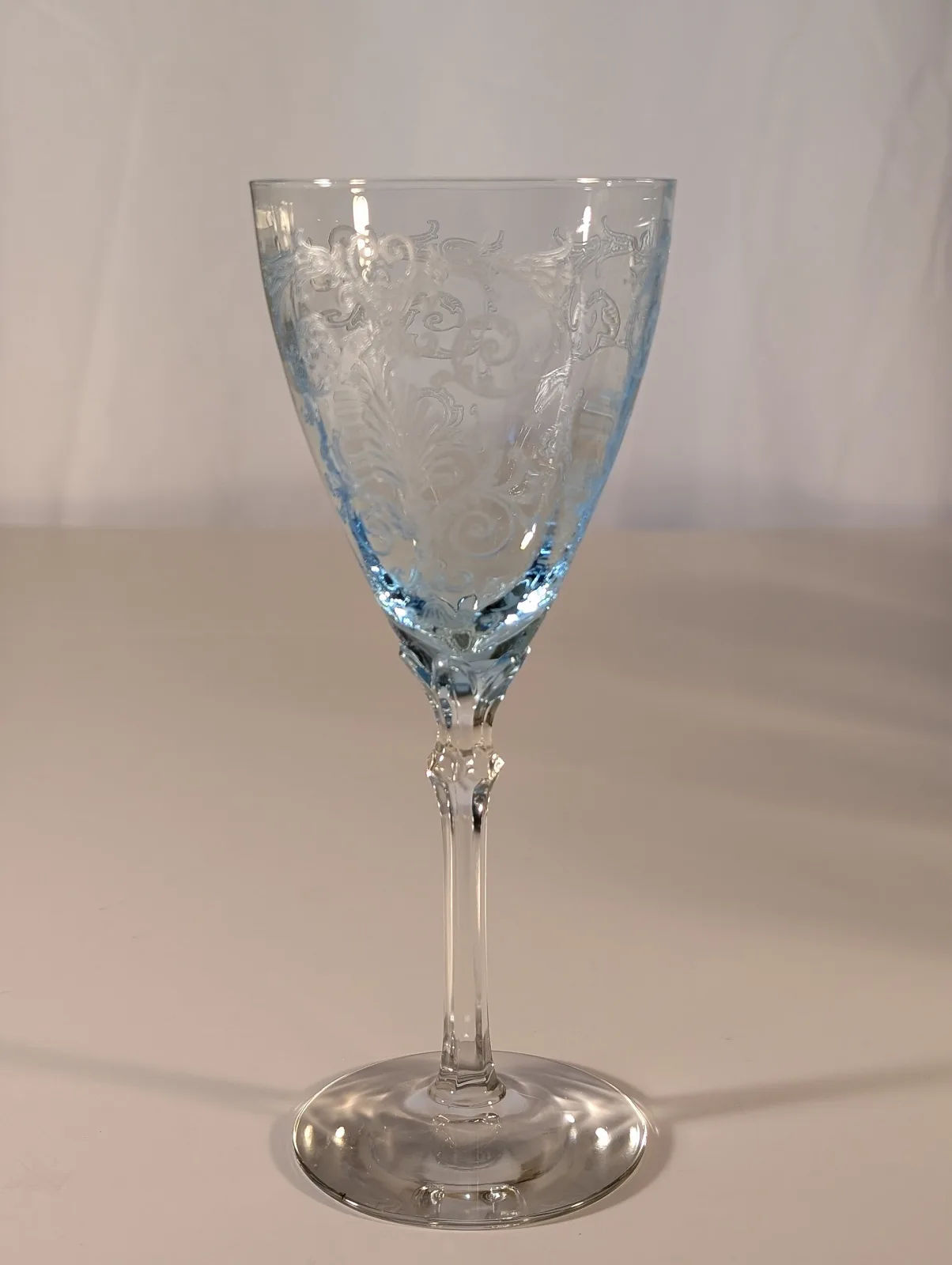
Fostoria's reputation among serious collectors rests largely on its plate-etched stemware of the 1920s through 1940s. These are blank stem shapes carrying named etchings, and the most sought-after include Versailles, June, Trojan, Kashmir, and Navarre. Because the same etching often appears on several colors of the same blank, both the etching name and the color are needed to describe a piece fully — "June in Topaz" or "Versailles in Azure" — and value can swing widely between colors of the same etching.

Plate Etchings and Decoration
If you can identify a Fostoria etching, you can usually date and value the piece, because most etchings ran only for a defined span of years. The etching is often the single most diagnostic feature of an elegant-glass stem.
Reading a Plate Etching
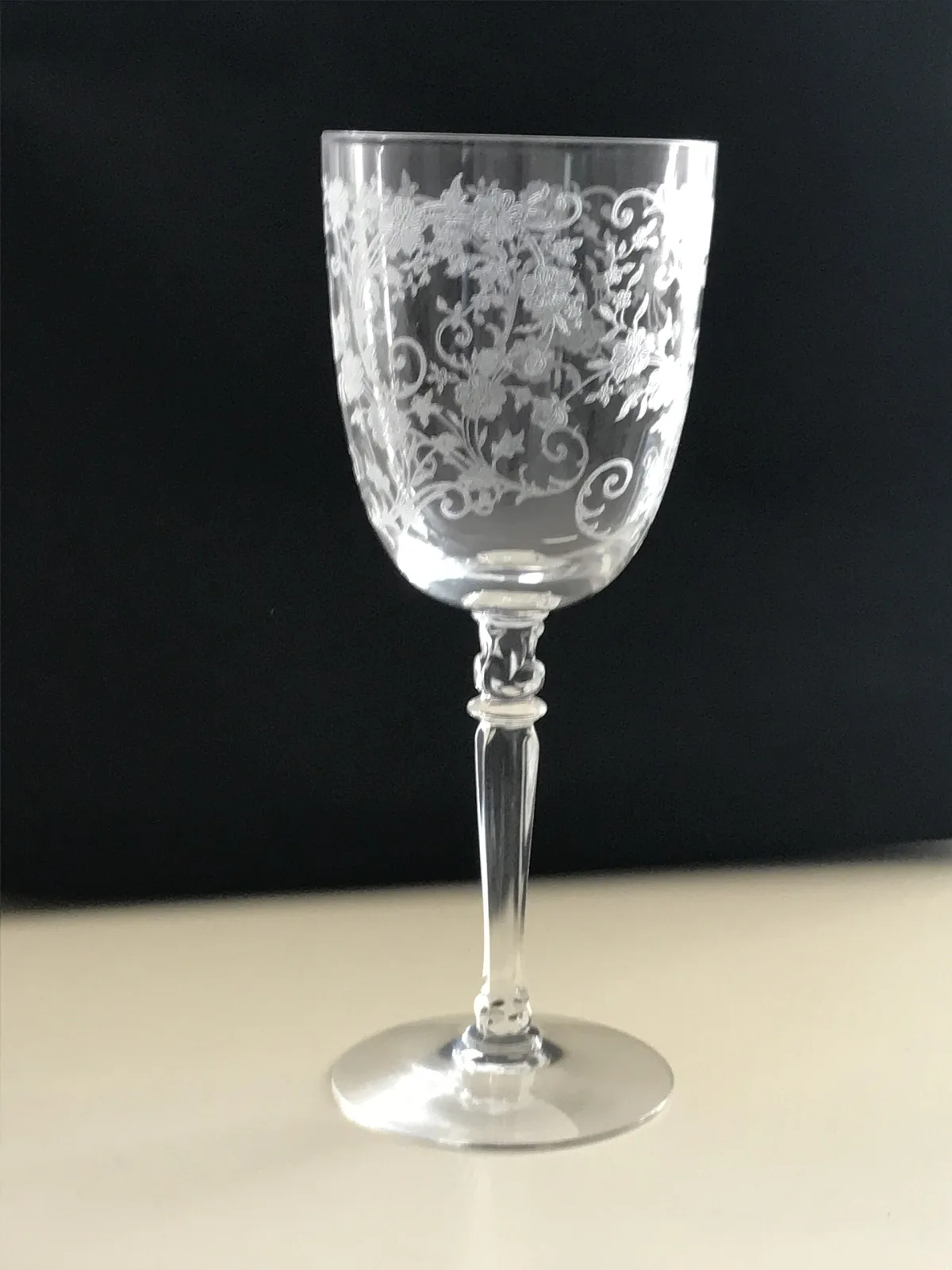
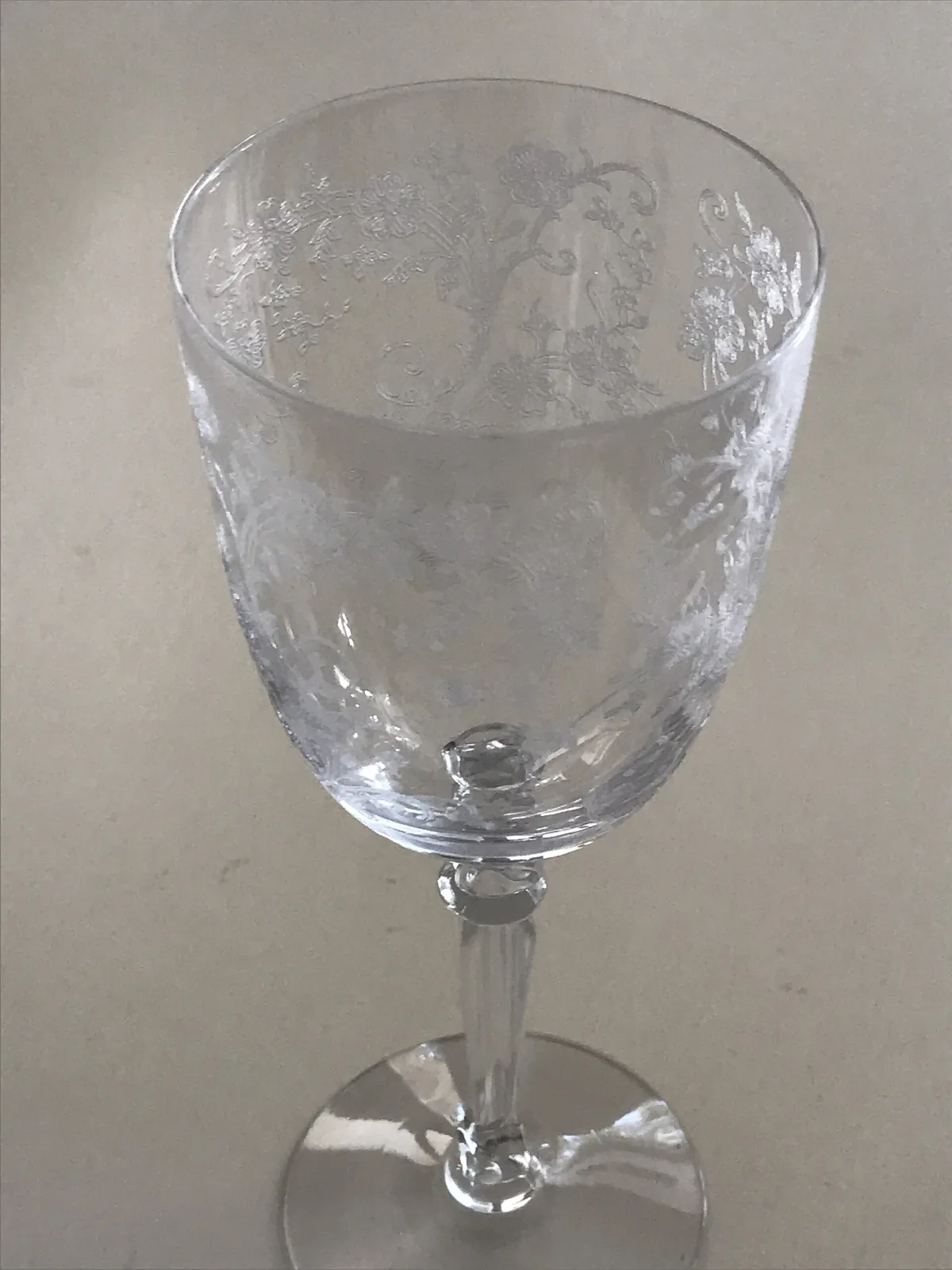
A plate etching is a fine, frosted, all-over design — florals, scrolls, urns, garlands, or classical motifs — that feels slightly matte to a fingertip and does not catch the light in the sharp, prismatic way a cut design does. Hold the piece to a light: an etching reads as a soft ghostly pattern within the glass surface, while a cutting throws bright glints from its facets. Distinguishing the two techniques is the first move, because a cut piece and an etched piece are valued and catalogued quite differently.
The Great Named Etchings
Versailles (1928–1944) and June (1928–1944) are among the most collected, delicate floral-and-scroll etchings offered on colored blanks. Trojan and Kashmir come from the same golden period. Navarre (introduced 1936) and Chintz are elegant later etchings on the 6016 and related stems, largely on crystal, and remain popular for wedding china to this day. Romance and Buttercup round out the crystal etchings of the 1940s and 1950s. Each name corresponds to a specific engraved design and a known production window, which is exactly why matching the motif to a reference identifies both pattern and rough date at once.
Cuttings, Gold, and Other Decoration
Beyond plate etching, Fostoria used wheel cutting, gold and platinum banding, and needle etching (a lighter, more mechanical line). Rock-crystal cuttings — polished intaglio designs — appear on some lines. The decoration type is part of the identity of the piece; a plain blank, the same blank plate-etched, and the same blank cut are three different products with three different values.
Colors and How They Date a Piece
Color is one of the most powerful dating tools in Fostoria, because the company introduced and retired colors on a known timeline. Identifying the exact hue narrows the production window dramatically and, with certain rare colors, transforms the value.
The 1920s–1930s Palette
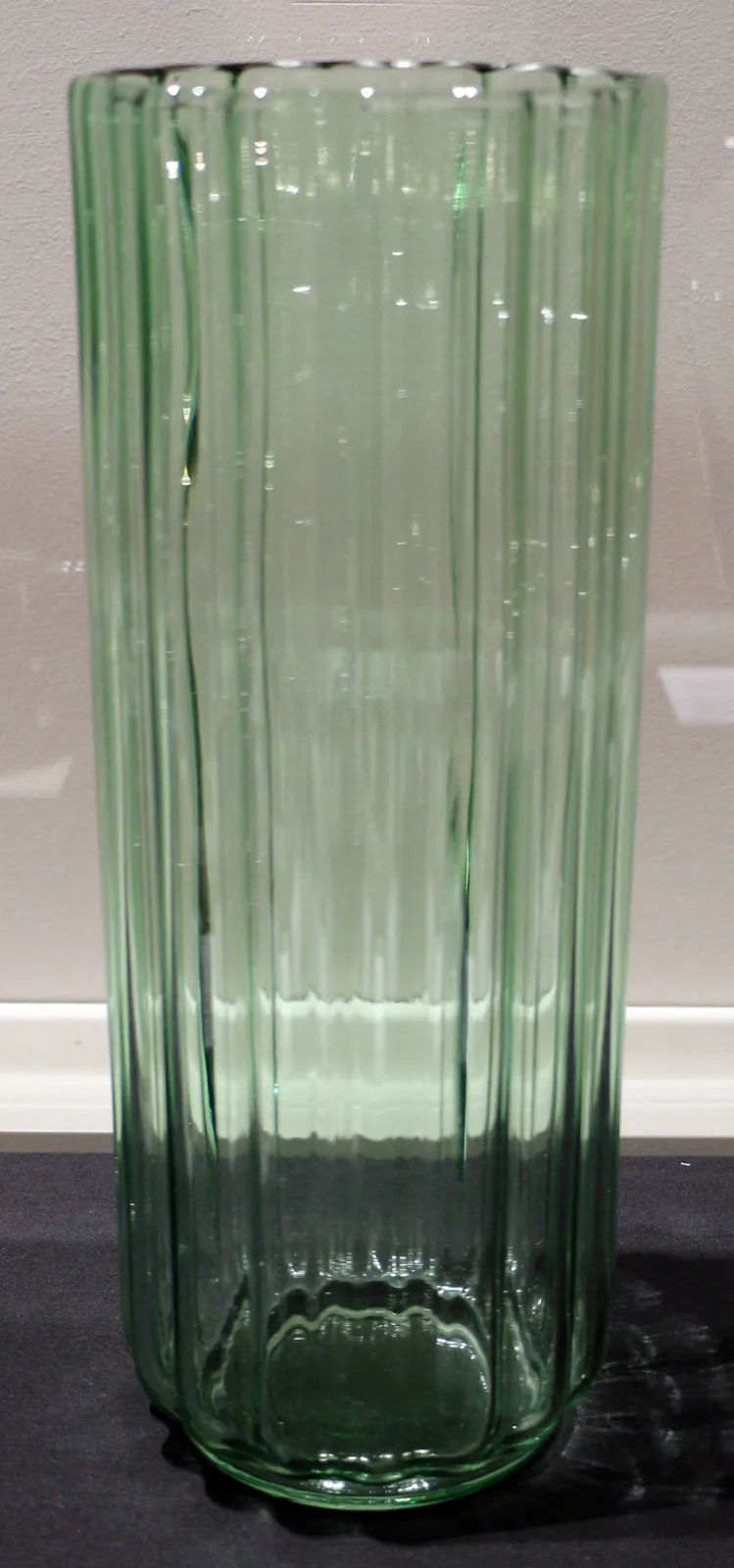
The classic elegant-glass colors belong to this period. Amber, green, rose (pink), topaz (a golden yellow, later renamed Gold Tint), and azure (a soft blue) are the signature Fostoria colors of the etched-stemware era. Ebony (black), amethyst, and the rare orchid also appear. A June or Versailles goblet in azure or rose is a quintessential 1930s Fostoria object, and the presence of these colors alone dates a piece to roughly that window.
The Later and Rarer Colors
From the late 1930s onward Fostoria introduced deeper, more dramatic colors — Empire Green, Burgundy, Regal Blue, and Ruby — often on plain modern shapes rather than etched ones. Coin glass of the 1960s onward brought amber, olive green, blue, and ruby to that heavy pressed line. Certain colors were made only briefly and are correspondingly scarce; an experienced eye treats an unusual color as a flag to investigate rather than assume.
Comparing Fostoria Colors to Other Glass
Fostoria's colors overlap with those of its competitors and with mass-market glass, so color alone rarely proves the maker — it must be read together with pattern and quality. A pink Fostoria piece and a pink Depression-glass piece can look superficially similar until you weigh them in the hand and study the finish. Some Fostoria greens fluoresce under ultraviolet light because of trace uranium, a phenomenon shared with other period glass and explored in our guide to uranium glass; a UV reaction confirms an early green but does not by itself name Fostoria.
Marks, Labels, and Signatures
Because Fostoria so rarely molded its name into the glass, the marks that do exist are worth knowing precisely — and their absence is normal, not a warning sign.
Paper Labels
For most of its history Fostoria identified its wares with paper labels rather than moulded marks. Early labels were shield- or scroll-shaped; later ones were oval or rectangular foil stickers, often reading simply "Fostoria." These labels washed off with use, so the vast majority of genuine Fostoria today carries no label at all. When a label survives it is a bonus, and an intact original label can modestly add to value — but a missing label means nothing, because most pieces never kept theirs.
Acid-Etched and Later Marks
Some later pieces, particularly from the mid-twentieth century onward, carry a small acid-etched Fostoria mark. After the Lancaster Colony acquisition, certain reissued and gift lines were marked more consistently. A moulded or acid-etched "Fostoria" therefore tends to indicate a later or reissued piece, not the etched stemware of the golden age, which is almost always unmarked. Do not assume that an unmarked piece is "not really Fostoria" — for the classic period, unmarked is the rule.
Identifying Without a Mark
The practical consequence is that Fostoria is identified the way pattern glass is identified: by matching the shape, optic, etching, and color to documented references. Reputable pattern books, the surviving Fostoria catalogs, and collector databases are the real "marks." When those line up, an unmarked piece is confidently Fostoria; when they do not, caution is warranted regardless of any sticker.
Dating an Antique Fostoria Piece
Dating Fostoria is a matter of triangulating several clues, since no single feature carries a year. Taken together, the following usually place a piece within a decade or two.
Pattern Introduction and Retirement Dates
Each named pattern and etching has a documented production window. American began in 1915; the great colored etchings mostly ran from the late 1920s into the 1940s; Coin arrived in 1958; many plain modern colors belong to the late 1930s and after. Identifying the pattern therefore brackets the date immediately, and identifying the etching often narrows it further within that pattern's life.
Color as a Time Marker
Because colors were introduced and discontinued on a schedule, the exact hue refines the date. Azure, rose, and topaz point to the classic 1920s–1930s period; Empire Green, Regal Blue, and Burgundy to the late 1930s and 1940s; Coin colors to the 1960s and later. A pattern made across many years in one color but only briefly in another can sometimes be dated quite tightly by color alone.
Construction and Finishing Clues
Mould-seam treatment, the crispness of pressed detail, the style of optic, and the type of decoration all shifted over time and support a date estimate. Earlier elegant glass tends to show more careful hand finishing; later mass-market and reissued pieces can feel heavier or less crisp. None of these is decisive alone, but together with pattern and color they form a reliable picture.
Post-1986 and Reissues
Anything demonstrably made after the 1986 factory closing — later Lancaster Colony gift lines, reissued Coin, and imported "Fostoria"-branded ware — is not Moundsville production and should be described as such. A consistent moulded or acid-etched mark, modern packaging, or a color that never existed in the vintage line all suggest a late or reissued piece rather than a golden-age one.
Look-Alikes and Competing Makers
Fostoria shared the elegant-glass market with several skilled rivals whose products are constantly confused with it. Distinguishing them is a core identification skill and a frequent source of mis-attribution online.
The Elegant-Glass Companies
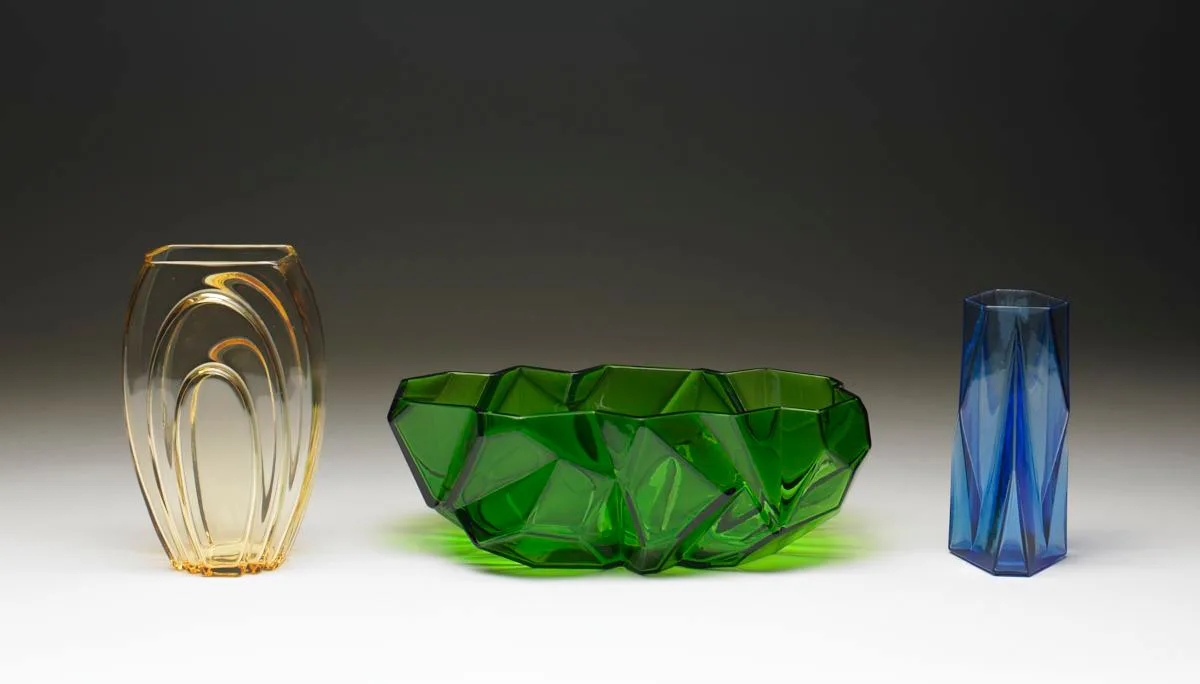
Cambridge, Heisey, Duncan & Miller, Tiffin, and Imperial all made comparable hand-finished tableware in overlapping shapes and colors. Heisey, unusually, marked much of its glass with an H-in-a-diamond and is therefore easier to confirm; the others, like Fostoria, are largely unmarked and identified by pattern. A swirl pattern, a paneled tumbler, or a floral etching may belong to any of them, and only careful comparison of the exact design settles the maker.
The American Pattern Problem
Fostoria's American is the single most imitated elegant-glass pattern. Indiana Glass produced a very similar cube pattern, and various later makers — including glass sold through Lancaster Colony and imported "whitehall"-type cube glass — mimic the look. The clues that favor true Fostoria American include the exact geometry and spacing of the cubes, the quality of the fire polishing, the specific range of authentic forms, and the absence of the tell-tale heaviness and mould flaws of the cheaper copies. Because so many forms exist and the differences are subtle, American attribution is one of the areas where a careful comparison to a documented example, or a second expert opinion, pays off before you pay a premium.
Colored Glass Confusion
Colored Fostoria is regularly mixed up with colored glass from other elegant makers and with pieces from the broader world of vintage barware and drinkware. Ruby and cranberry-toned pieces in particular invite confusion; our guide to cranberry glass explains how genuine gold-ruby coloring differs from the flashed and stained reds common on cheaper ware. As always, color narrows the field but pattern names the maker.
Condition and Common Faults
Condition governs value sharply in glass, where damage is both common and, on tableware that was actually used, expected. Inspect every piece methodically in good light.
Chips, Nicks, and Flakes
Run a fingertip around every rim, the edge of the foot, and any raised point of the pattern — these are where chips and flea-bite nicks hide. On American and other pressed patterns the many raised cubes and points are especially vulnerable. Even a small rim chip substantially reduces value, and rims that have been ground down to remove a chip (leaving the rim slightly low or uneven) should be caught by comparing height and profile to a matching piece.
Cracks and Bruises
Hold the piece to the light and turn it slowly to catch hairline cracks, and give stemware a gentle tap: a clear ring suggests soundness, a dull thud can signal a crack. "Bruises" — internal cloudy fractures from impact — are common at the junction of bowl and stem. Any crack is a serious fault on decorative glass.
Sickness, Cloudiness, and Wear
"Sick" glass shows a permanent cloudy or iridescent film, usually from dishwasher damage, hard water, or contents left standing; it does not wipe away and it depresses value considerably. Distinguish it from removable mineral haze. Expect honest base wear — fine scratches on the foot from use — on genuinely old, used pieces; a pattern that supposedly saw decades of table service but has a pristine, unscratched base deserves a second look.
Decoration Wear
On gold- or platinum-banded and painted pieces, check the trim for rubbing and loss. Worn gilding lowers value, and heavily worn decoration cannot be restored invisibly. On plate-etched pieces the etching itself does not wear off, but harsh cleaning can dull the surrounding polish.
Value Factors and Price Ranges
Fostoria values span an enormous range, and the same pattern can be nearly worthless or genuinely valuable depending on form, color, and condition. The variables below explain most of the spread.
What Drives Value
Pattern and etching first — a plain modern blank and a rare golden-age etching are worlds apart. Then color: the same etching in a common crystal versus a scarce azure or orchid can differ many times over. Then the specific form, because unusual and hard-to-find shapes (large serving pieces, uncommon stem sizes, complete sets) outrank the everyday goblets and sherbets that were made by the million. Condition, completeness of a set, and any original label or box follow. Rarity of a particular pattern-color-form combination is what creates the real prizes.
Indicative Ranges
As broad orientation rather than a price list: common plain American and everyday crystal stemware often trade for a few dollars a piece, and even attractive sets can be inexpensive because so much survives. Popular etched crystal patterns like Navarre and Chintz occupy a comfortable middle ground per stem. Colored etched stemware from the golden age — June, Versailles, and their peers in azure, rose, or topaz — commands a real premium, and scarce forms or rare colors reach well into the high tens or hundreds of dollars per piece. Because condition and exact color swing these figures so widely, treat any single number with caution and always compare like with like.
Documenting for Insurance or Sale
Photograph each piece front and back, the foot, any label, and — for stemware — the full profile against a plain background, and record the pattern name, color, form, and dimensions. Note any damage honestly. The disciplined approach in our valuation and appraisal guide applies directly, and for large matched services it is worth cataloging piece counts, since a complete set is worth more than the sum of scattered pieces.
Reproductions and Later Reissues
Fostoria is affected less by outright forgery than by honest reissues and look-alikes that get mis-described as vintage. Knowing the difference protects you from paying golden-age prices for recent glass.
Lancaster Colony Reissues
After acquiring Fostoria in 1983 and closing the plant in 1986, Lancaster Colony continued to market glass under the Fostoria name, some of it reissues of patterns like Coin and American and some of it sourced from other factories or overseas. This later glass is legitimately "Fostoria" by brand but is not Moundsville production, and it should be dated and valued accordingly. Consistent moulded or acid-etched marks and modern packaging often distinguish it.
The American and Coin Copies
Because American and Coin are the most recognizable Fostoria patterns, they attract the most imitation. Indiana Glass and others made cube patterns close to American, and Coin has been reproduced in colors and forms that never left Moundsville. Tell-tales of later or copy pieces include colors outside the documented vintage range, heavier or cruder pressing, softer detail, and marks where the genuine vintage piece would be unmarked. When a "rare colored American" seems too good and too cheap, suspect a look-alike.
Married Sets and Optimistic Listings
Much online confusion is not fraud but wishful attribution — sellers labeling any pink cube glass "Fostoria American" or any floral-etched stem "Versailles." Because the elegant makers overlap so closely, verify the specific pattern against a reference rather than trusting the listing title, and be wary of "sets" assembled from several patterns or makers sold as one. When the stakes are high, corroborate your reading with a specialist or with the pattern-recognition of the Antique Identifier app before you buy or sell.
Care, Handling, and Storage
Fostoria was made to be used, but a century of survival deserves sensible care — and careless washing is the single most common cause of the "sick," cloudy glass that ruins value.
Washing
Wash Fostoria by hand in lukewarm water with mild detergent; never put it in a dishwasher, whose heat, harsh detergents, and jostling cause etching to dull, gilt to wear, and the permanent cloudiness that cannot be reversed. Support the bowl and foot of stemware separately and avoid gripping a delicate stem, which is where breaks most often start. Line the sink with a towel to cushion against knocks.
Removing Haze
A removable mineral film from hard water can sometimes be reduced with a gentle soak in a mild acidic solution or a proprietary glass cleaner, but true "sickness" etched into the surface is permanent — do not scrub abrasively in the hope of removing it, as you will only scratch the glass. When in doubt, leave a valuable piece alone rather than risk it.
Storage and Display
Store stemware upright rather than resting on delicate rims, and never stack tumblers inside one another where they can wedge and crack. Keep pieces from knocking together on open shelves, and cushion any that travel. The broader principles in our storage, care, and preservation guide apply directly, and matched services are best kept together so a set is not gradually broken up and devalued.
Quick Identification Checklist
When you first pick up an unfamiliar piece of elegant glass, work through these questions in order. Together they will place almost any Fostoria within its pattern, rough date, and value tier.
Tier and Quality
Does it feel and look like elegant glass — a substantial weight, fire-polished rather than gritty rims, crisp detail? Or is it lighter, cruder machine-made ware? Establishing the tier first prevents you from chasing a maker attribution the piece does not deserve.
Pattern and Decoration
What is the moulded pattern — a cube (American), coin medallions (Coin), swirled ribs (Colony), or a plain blank stem? Is there decoration, and is it a soft frosted plate etching or a bright faceted cutting? Naming the pattern and the decoration type is the core of the identification.
Color
What exactly is the color — crystal, or azure, rose, topaz, Empire Green, Regal Blue, Burgundy, ruby, amber? Does it fluoresce under ultraviolet light? The precise hue narrows the date and, for scarce colors, the value.
Marks and Form
Is there a paper label or an acid-etched mark — remembering that most genuine golden-age Fostoria is unmarked? What specific form is it, and is it a common or an unusual shape? Rare forms and rare colors are where the value lives.
Overall Judgement
Weigh the clues together. A plain crystal American tumbler, a Navarre-etched crystal goblet, a June water goblet in azure, and a 1960s amber Coin candy jar are four very different objects — and reading the pattern, decoration, color, and quality will nearly always tell you which one is in your hands. Match what you see to a documented reference before you assign a value, and when the piece is potentially valuable, confirm the attribution rather than trusting a label or a listing title.