
Antique Coverlets Identification Guide: Weave, Corners & Dating
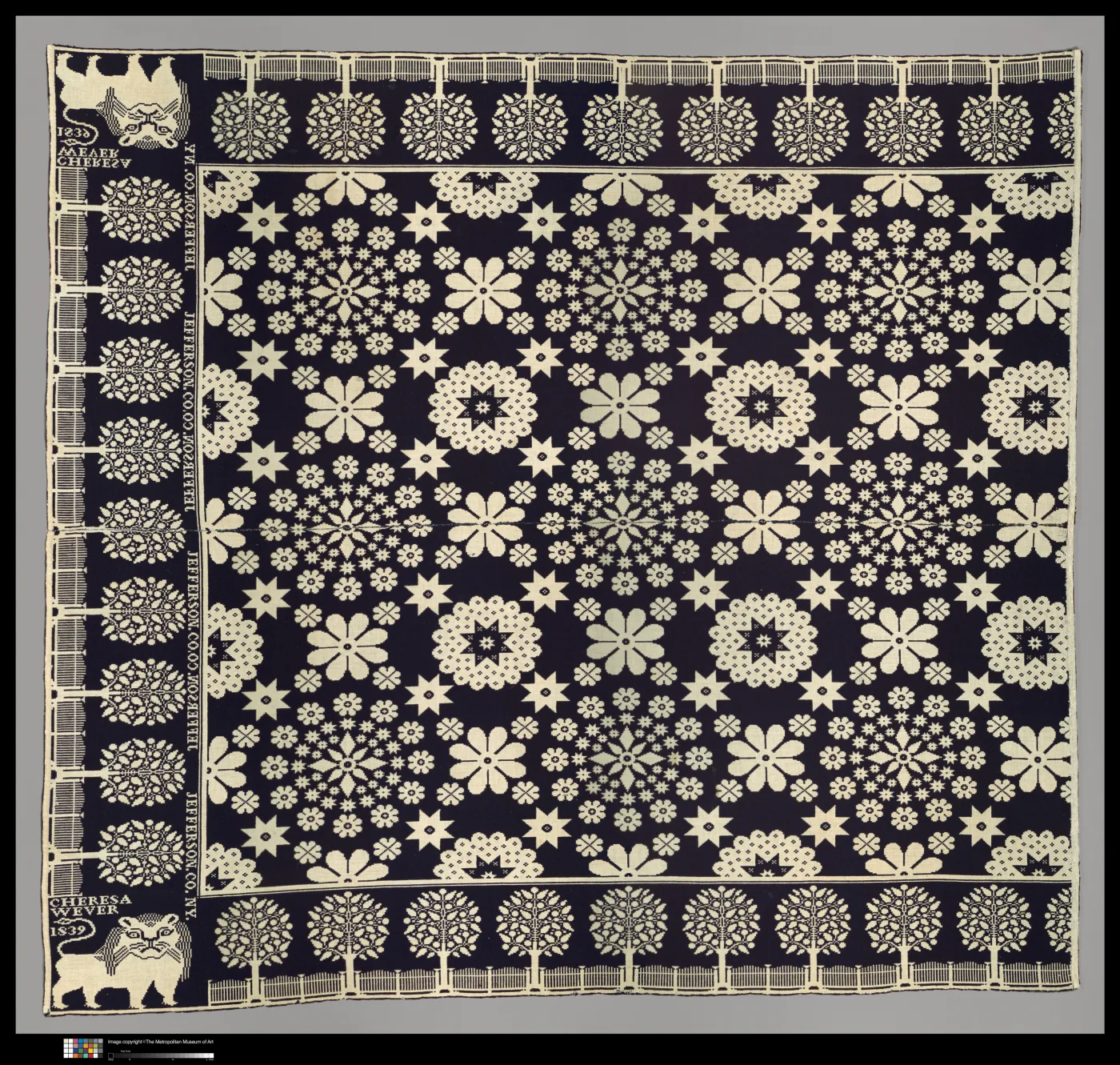
Among the great folk textiles of nineteenth-century America, the handwoven coverlet holds a special place. These bold, geometric, and floral bedcovers were woven on hand looms across the eastern United States and Canada, first as simple geometric patterns produced on home and professional looms, and later as elaborate pictorial masterpieces made possible by the Jacquard loom attachment. To the modern eye they read as graphic art in indigo and madder, white and red, but to their makers they were practical bedding, woven from home-spun and dyed wool and cotton or linen to keep a household warm.
For collectors, coverlets reward close study with an unusually rich body of evidence. Unlike most antique textiles, a great many coverlets are dated and signed directly in the weave, naming the weaver, the owner, the town, and the year in woven corner blocks. Even unsigned examples can be placed by their weave structure, fibers, dyes, dimensions, and pattern vocabulary. This makes coverlets one of the most approachable fields in textile collecting for anyone willing to learn a handful of diagnostic features.
This guide explains the major coverlet types and weave structures, how to read corner blocks and woven inscriptions, how to date a coverlet by its fibers and construction, how to recognize regional and stylistic differences, and how to separate genuine antique handwoven coverlets from later power-loom reproductions. Whether you have inherited a blue-and-white geometric coverlet from a family farmhouse or are building a focused collection of signed Jacquard pieces, these markers will help you identify, date, and value coverlets with confidence.
Table of Contents
- What Is a Coverlet?
- A Brief History of Coverlet Weaving
- Geometric Versus Figured Coverlets
- Overshot Coverlets
- Summer and Winter Weave
- Double Weave Coverlets
- Jacquard and Figured Coverlets
- Reading Corner Blocks and Inscriptions
- Fibers, Dyes, and Colors
- Seams, Width, and Construction
- Dating a Coverlet by Period
- Regional Styles and Weavers
- Spotting Reproductions and Power-Loom Copies
- Condition and Value Factors
- Care and Conservation
- Building a Collection
What Is a Coverlet?
A coverlet is a woven bedcover, distinct from a quilt in that the pattern is created entirely on the loom by the interlacing of warp and weft threads, not by piecing or stitching layers of fabric together. Where a quilt is constructed from cut shapes sewn into a top and then quilted to batting and a backing, a coverlet is a single woven cloth whose design is structural: the geometry or picture you see is the weave itself. This fundamental difference in construction is the first thing to understand, because it separates coverlets from the pieced and appliqued textiles many collectors already know.
Most American coverlets were woven in two long panels and seamed down the center, because hand looms of the period were generally too narrow to weave a full bed width in one piece. The result is a textile typically measuring roughly 70 to 90 inches square, often with a woven or knotted fringe along the bottom and sometimes the sides. The palette is usually limited and striking, dominated by deep indigo blue and natural white, with red, gold, green, and brown appearing as the dye repertoire expanded.
Because the design lives in the structure of the cloth, learning to read weave is central to coverlet identification. Collectors who enjoy the broader world of antique quilts and textile art will find coverlets a natural and rewarding extension, but the diagnostic skills are different: here you study threads and interlacings rather than patchwork and stitching.
A Brief History of Coverlet Weaving
Coverlet weaving in North America flourished from roughly the late eighteenth century through the end of the nineteenth, tracing an arc from domestic craft to professional industry and finally to obsolescence in the face of factory production.
Home and Local Weaving
In the earliest period, geometric coverlets were woven at home or by local professional weavers using the four-shaft and multi-shaft hand looms common in rural communities. Patterns were exchanged as written "drafts," the weaver's notation for threading and treadling, and handed down within families and trades. Wool was spun and dyed at home, often with indigo from the dye pot kept in many farmhouses, and woven over a cotton or linen warp. This domestic tradition produced the overshot, summer-and-winter, and double weave geometric coverlets that form the foundation of the field.
The Jacquard Revolution
The transformative development came in the 1820s with the arrival in America of the Jacquard mechanism, a loom attachment invented in France that used a chain of punched cards to control individual warp threads. This allowed weavers to produce curving, pictorial, and naturalistic designs impossible on a simple shaft loom: roses and tulips, eagles and buildings, borders of birds and trees, and the elaborate signed corner blocks that make these coverlets so collectible. Professional weavers, many of them immigrants from Britain and the German states, set up shop and wove figured coverlets to order for farm families across the Northeast and Midwest.
Decline
By the 1860s and especially after the Civil War, industrial textile production and changing tastes eroded the coverlet trade. Cheap factory-made blankets and printed bedcovers displaced the labor-intensive handwoven coverlet, and the last professional Jacquard weavers largely ceased work by the 1870s and 1880s. The Colonial Revival of the late nineteenth and early twentieth centuries later sparked renewed interest and some reproduction weaving, a fact worth remembering when dating pieces. The relatively well-documented span of the trade is a great help to collectors seeking to place a coverlet in time.
Geometric Versus Figured Coverlets
The single most useful first division in coverlet identification is between geometric coverlets, made on shaft looms, and figured or fancy coverlets, made with the Jacquard attachment. Almost every coverlet falls clearly into one of these two families, and recognizing which you are looking at immediately narrows the date, technique, and likely origin.
Geometric Coverlets
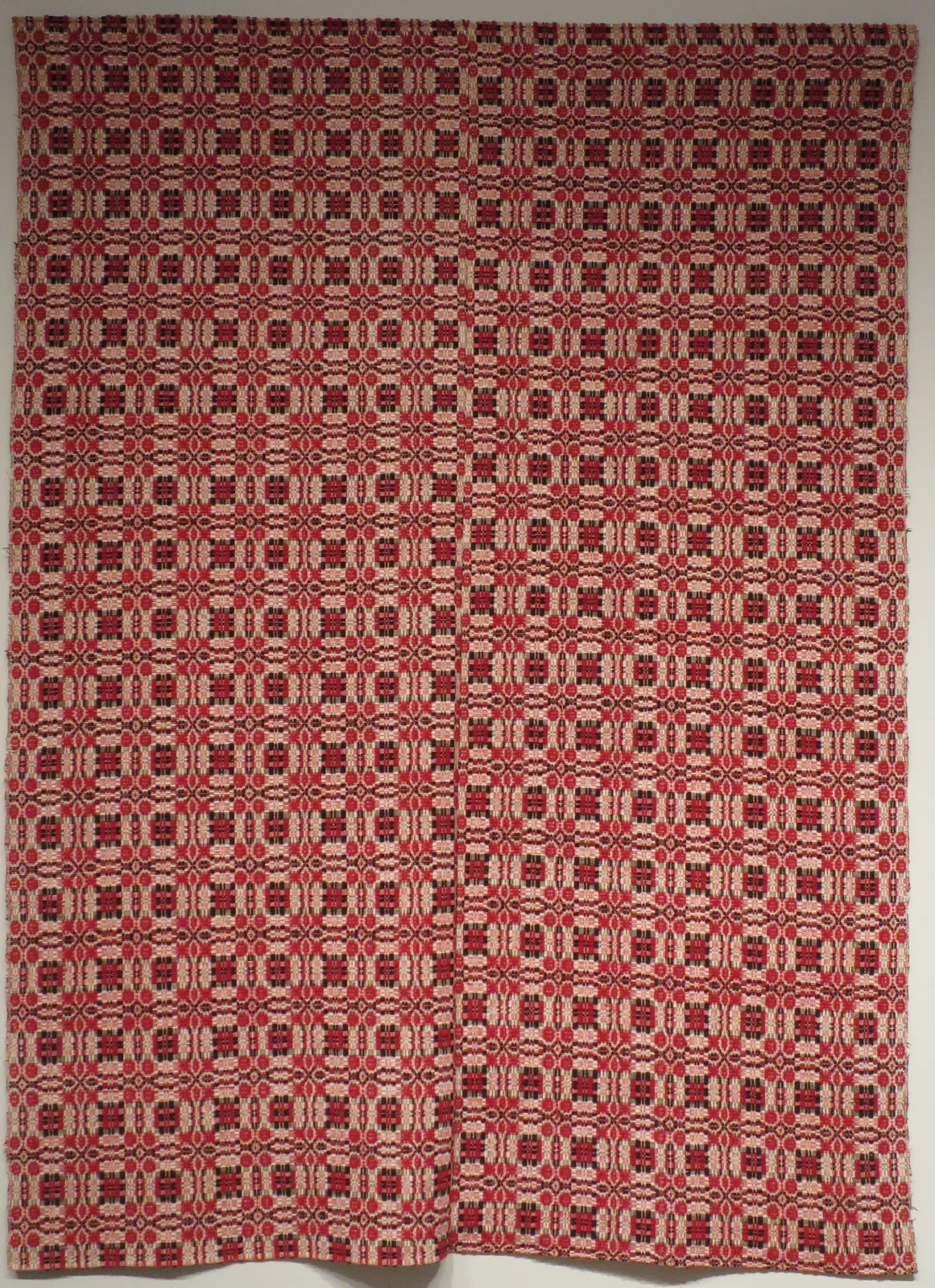
Geometric coverlets display patterns built from blocks, squares, diamonds, crosses, stars, and stepped figures, all composed of straight lines and right angles dictated by the shaft loom. Familiar pattern names include Whig Rose, Pine Bloom, Chariot Wheels, Bonaparte's March, Sunrise, and Lover's Knot, though the same draft often carried different names in different communities. These coverlets are generally the earlier and more domestic tradition and include the overshot, summer-and-winter, and double weave structures discussed below.
Figured and Fancy Coverlets
Figured coverlets, produced with the Jacquard mechanism, display curving and naturalistic motifs: flowers, foliage, medallions, eagles, peacocks, lions, buildings, trains, and elaborate scrolling borders. Because the Jacquard could control threads individually, the weaver was freed from the grid of the shaft loom. These coverlets frequently carry signed and dated corner blocks and are usually the work of professional weavers between the 1820s and 1870s.
Telling Them Apart at a Glance
If the design is entirely angular, blocky, and grid-based, you are almost certainly looking at a geometric shaft-loom coverlet. If it contains smoothly curving lines, recognizable flowers or animals, lettering, or a pictorial border, it is a Jacquard figured coverlet. This simple test resolves the great majority of identifications before you examine anything else.
Overshot Coverlets
Overshot is the most common and widespread of the geometric coverlet weaves, and for many collectors it is the entry point into the field. Understanding overshot structure makes the largest single category of coverlets legible.
How Overshot Works
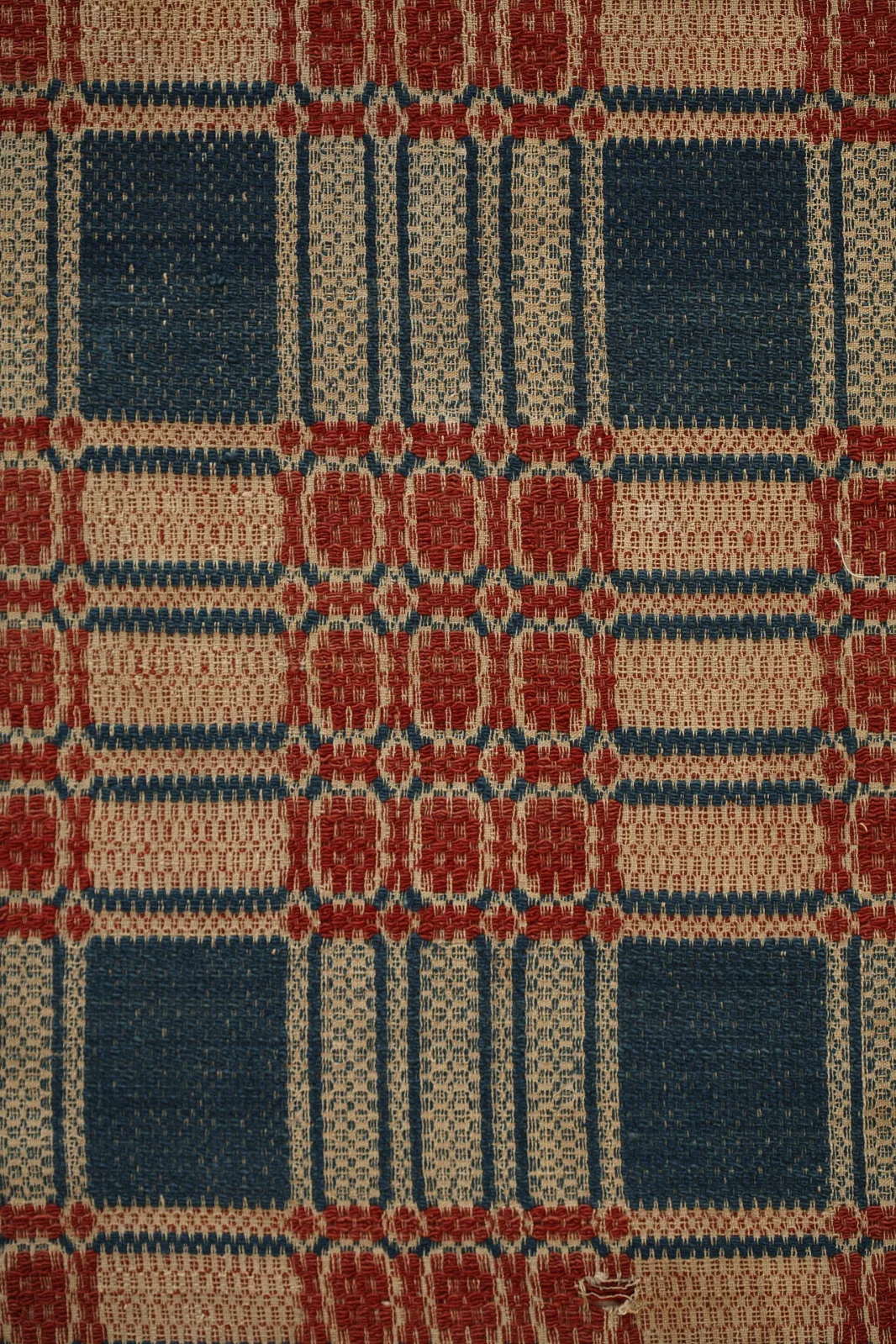
In overshot weaving, a plain-weave ground of cotton or linen is interlaced with a supplementary pattern weft, usually wool, that floats over and under groups of warp threads to build the design. These floating threads, or "overshots," create the bold blocks and figures of the pattern while the underlying plain weave holds the cloth together. The pattern weft typically skips over three or four warp threads at a time, producing the characteristic stepped, blocky motifs.
Recognizing Overshot
Turn an overshot coverlet over and you will see the same pattern in reverse colors, because the floats that show as blue on the front are absent on the back and vice versa. Run a finger across the surface and you can feel the loose wool floats, which give overshot its soft, slightly raised texture. Because long floats can snag and wear, overshot coverlets often show abrasion and loss in the pattern areas, a normal sign of age and use rather than a defect that destroys value.
Typical Overshot Coverlets
Overshot coverlets are usually the work of home or local weavers and are most often blue and white or red and white, sometimes with additional colors. They are generally earlier and more rustic than figured coverlets, though overshot weaving continued in rural areas throughout the nineteenth century and into the twentieth as a craft revival. The honest, handmade character of overshot pieces places them firmly within the tradition of American folk art, alongside samplers, hooked rugs, and other home textiles.
Summer and Winter Weave
Summer and winter is a distinctive geometric structure prized for its tidy reversibility and its association with particular regions, especially Pennsylvania. Recognizing it adds an important tool to your identification kit.
The Reversible Structure
The name summer and winter refers to the coverlet's two faces: one side is predominantly dark (the "winter" side) and the reverse is predominantly light (the "summer" side), with the pattern appearing as a positive on one face and a negative on the other. Unlike overshot, summer and winter has no long floats; the pattern weft is tied down at very short intervals, typically over no more than two or three threads, producing a tighter, more durable cloth with a fine, pebbly texture and small regular spots within the pattern blocks.
Identifying Summer and Winter
The key diagnostic is the short tie-down: examine the pattern areas closely and you will see that the colored weft is bound at frequent, regular points rather than floating freely. This gives the surface a stippled or dotted appearance within the design blocks. The cloth is firmer and wears better than overshot, and both faces are neat enough to be used as the "right" side. Summer and winter coverlets are strongly associated with the Pennsylvania German weaving tradition and are generally fine, carefully made pieces.
Why It Matters for Dating and Origin
Because summer and winter weave is regionally concentrated and technically demanding, identifying it can point toward a Pennsylvania or mid-Atlantic origin and a competent professional or semi-professional weaver. As always, structure is read alongside fiber, dye, and any inscription to build a full picture.
Double Weave Coverlets
Double weave, sometimes called double cloth, is the most substantial of the geometric coverlet structures and produces some of the most impressive and durable examples.
Two Cloths in One
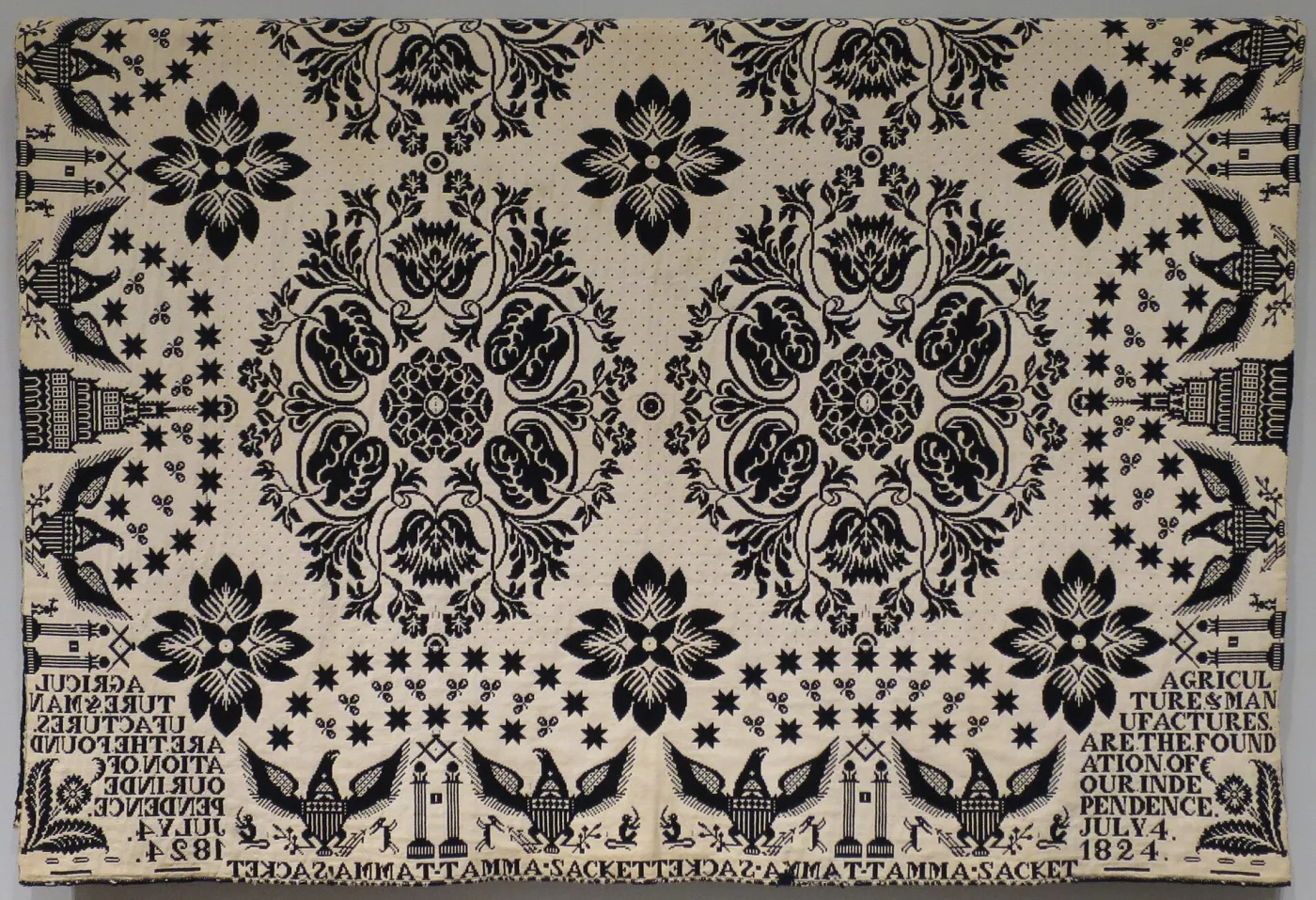
In double weave, the loom produces two separate layers of plain-weave cloth at once, one usually dark and one light, which interchange wherever the pattern requires. Where the dark layer comes to the front, you see a dark figure; where the light layer surfaces, you see a light figure; and the two cloths trade places to build the design. The result is a thick, warm, completely reversible coverlet showing the same crisp pattern in opposite colors on each face, with no floats at all.
Recognizing Double Weave
The telltale sign of double weave is that you can separate the two layers with a pin or fingernail along the edges or at points within the pattern, because they are genuinely two distinct cloths joined only where they interchange. The coverlet is noticeably heavier and thicker than overshot or summer and winter, and the pattern is sharp and solid on both sides with no loose threads. Geometric double weave coverlets often feature bold, large-scale blocky designs.
Double Weave in Figured Coverlets
Double weave was also used for many Jacquard figured coverlets, producing thick, fully reversible pictorial pieces with elaborate floral and bird designs. A double weave Jacquard coverlet in good color is among the most desirable of all coverlets, combining structural sophistication with pictorial richness.
Jacquard and Figured Coverlets
The Jacquard figured coverlet represents the artistic and commercial peak of American coverlet weaving and is the category most actively sought by collectors today.
What the Jacquard Made Possible
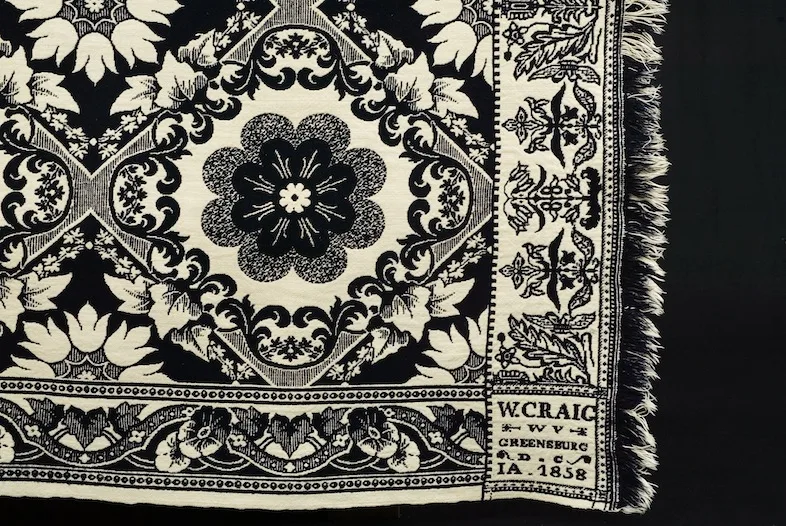
The Jacquard attachment used a chain of punched cards, each card controlling which warp threads were raised for a single pass of the weft. By stringing together hundreds of cards, a weaver could program a complex, curving, pictorial design impossible on a shaft loom. This freed coverlet design from the grid and allowed the naturalistic flowers, medallions, eagles, animals, buildings, and elaborate borders that define figured coverlets.
Typical Figured Designs
Common central fields include large floral medallions, roses and tulips, sunbursts, and lattices, while borders teem with motifs: birds (especially eagles and peacocks), trees, houses and public buildings, ships, trains, lions, and patriotic devices. Some coverlets commemorate specific events or institutions, and a few incorporate slogans or names within the border. The exuberance and specificity of these designs are a large part of their appeal.
Single Cloth Versus Double Cloth Jacquards
Jacquard coverlets were woven in several structures, including a tied or "beiderwand" single-cloth construction and full double weave. Tied single-cloth Jacquards show a pattern weft bound to a ground at intervals, while double weave Jacquards separate into two layers as described above. Recognizing the structure of a figured coverlet contributes to identifying the weaver and region, since particular shops favored particular methods.

Reading Corner Blocks and Inscriptions
One of the great pleasures and advantages of collecting figured coverlets is that so many are signed and dated in the weave itself. The corner block is the single most valuable piece of evidence a coverlet can offer, and learning to read it is essential.
What a Corner Block Contains
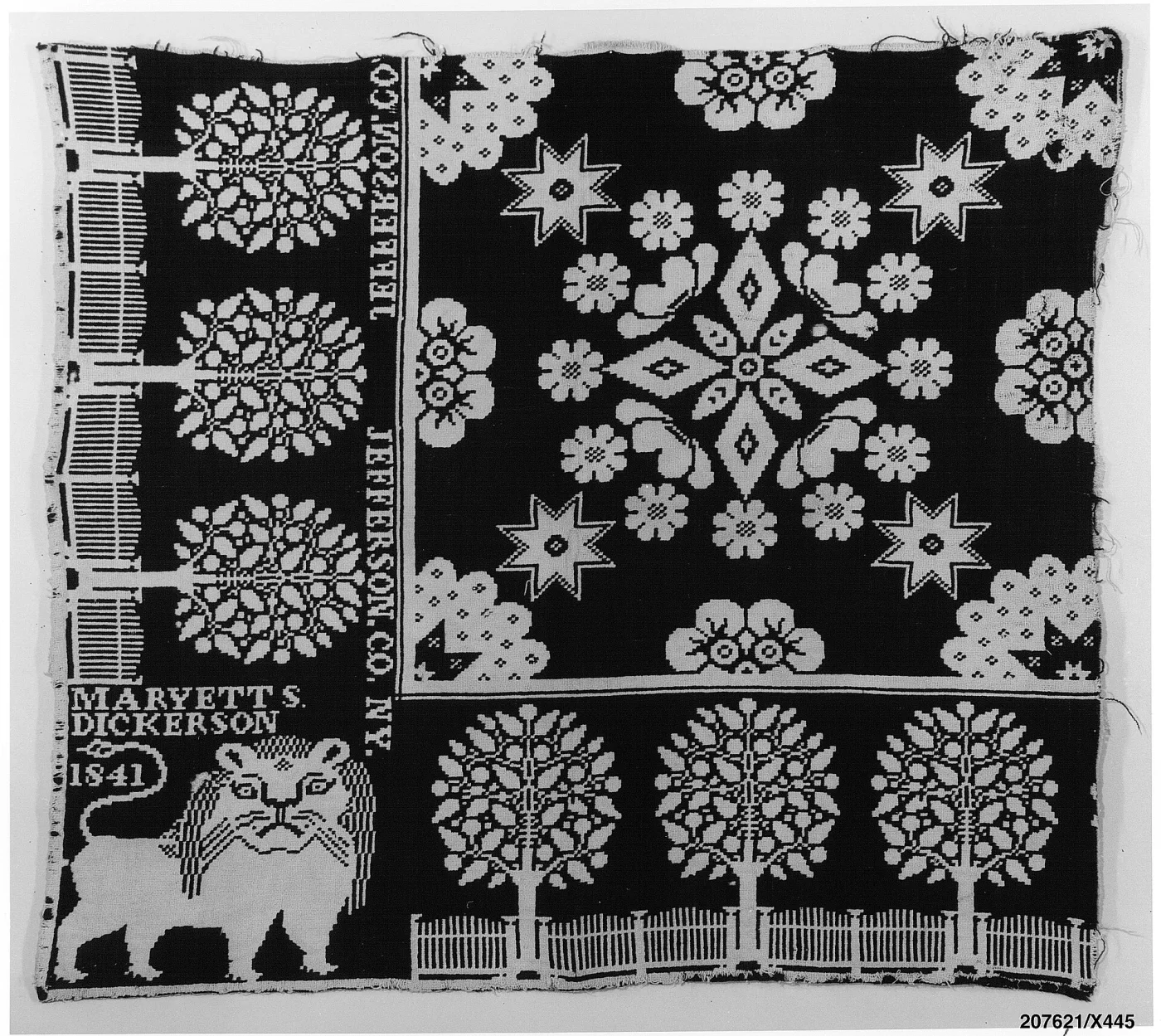
A corner block is a small woven panel set into one or more corners of a Jacquard coverlet, typically containing some combination of the weaver's name, the customer or owner's name, the town and state, and the year of weaving. Some blocks add decorative devices such as eagles, roses, stars, buildings, or patriotic motifs, and a few include the weaver's profession or a short motto. A fully inscribed coverlet might read, for example, with a personal name, a place, and a date such as 1842 woven directly into the corner.
Weaver, Owner, or Both
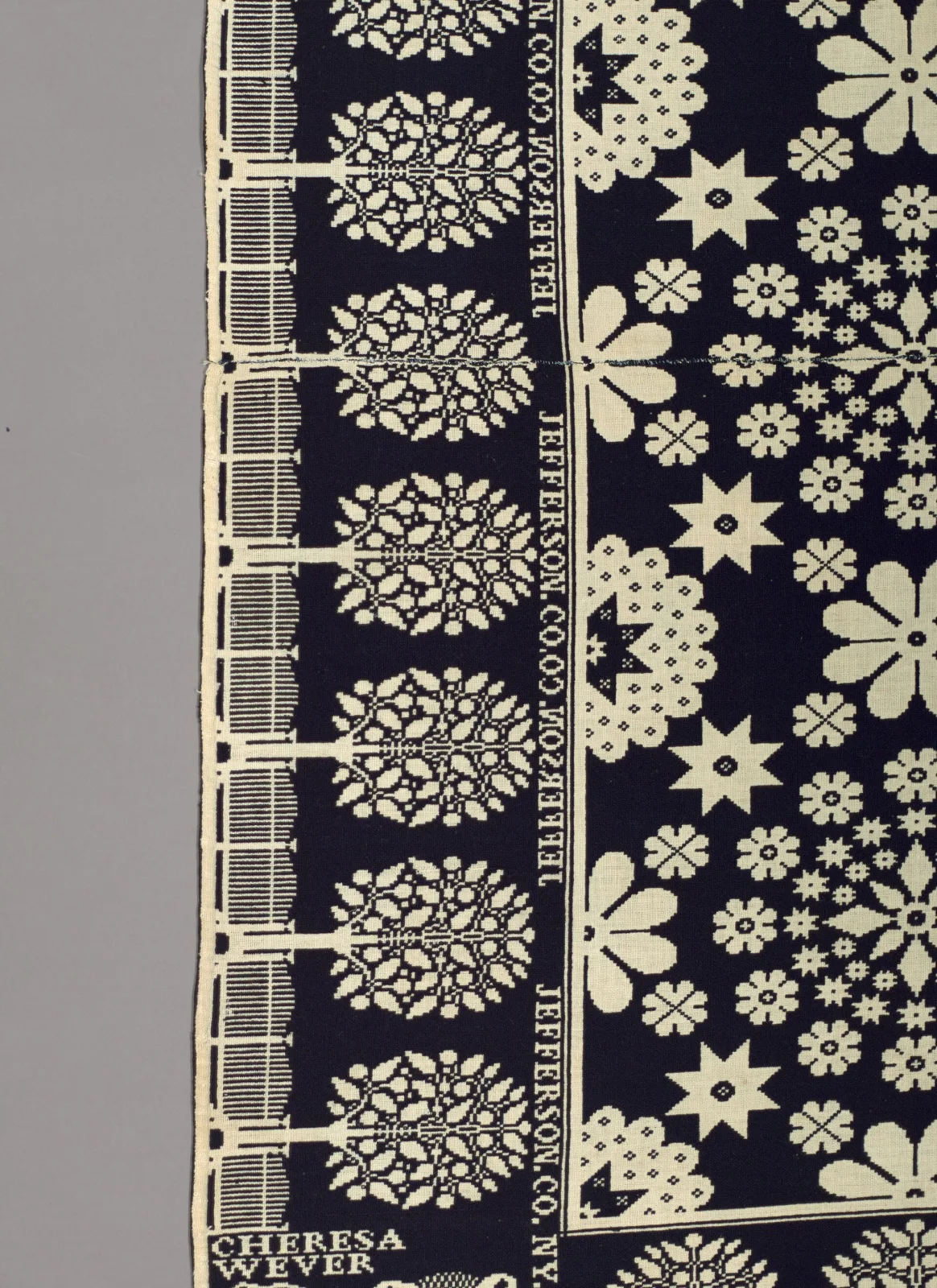
It is important to read corner blocks carefully, because the name woven into the block may be the weaver, the customer, or both. Often the professional weaver's name and town appear together with the name of the farm wife or family who ordered the piece. Decoding which is which sometimes requires reference to documented weaver records, but the presence of a place and date alone is enormously valuable for attribution and dating.
Why Inscriptions Matter So Much
A signed and dated coverlet provides a fixed point that most antique textiles lack: a named maker, a place, and a year. This transforms research, allows precise dating, and often substantially increases value, especially for documented weavers or unusual locations. Treat any woven inscription as the most important single feature of the piece, and photograph and transcribe it carefully. Recording such evidence is exactly the kind of documentation emphasized in our guide to authentication and provenance research.
Fibers, Dyes, and Colors
The fibers and dyes in a coverlet are powerful dating and authenticity tools, because the materials available to weavers changed in known ways over the nineteenth century.
The Fiber Combination
Most American coverlets combine a wool pattern weft with a cotton or linen ground. Earlier coverlets, especially before about 1820 to 1830, are more likely to use a linen (flax) ground warp and weft, while cotton became increasingly common as mechanized spinning made it cheap and plentiful. Identifying linen versus cotton in the ground is therefore a useful, if not infallible, dating clue: linen fibers are typically coarser, slightly uneven, and crisp, while cotton is softer and more uniform. The wool pattern threads carry the color.
Natural Dyes and the Indigo Tradition
The classic coverlet palette comes from natural dyes. Indigo provided the deep, fast blue that dominates so many coverlets, madder gave reds and oranges, and various plant sources produced golds, greens, and browns. Natural dyes tend to age into soft, slightly variable, harmonious tones, and indigo in particular has a characteristic depth. Familiarity with how natural dyes behave underpins the dating of many textiles, a theme explored further in our broader antique textile identification guide.
The Arrival of Synthetic Dyes
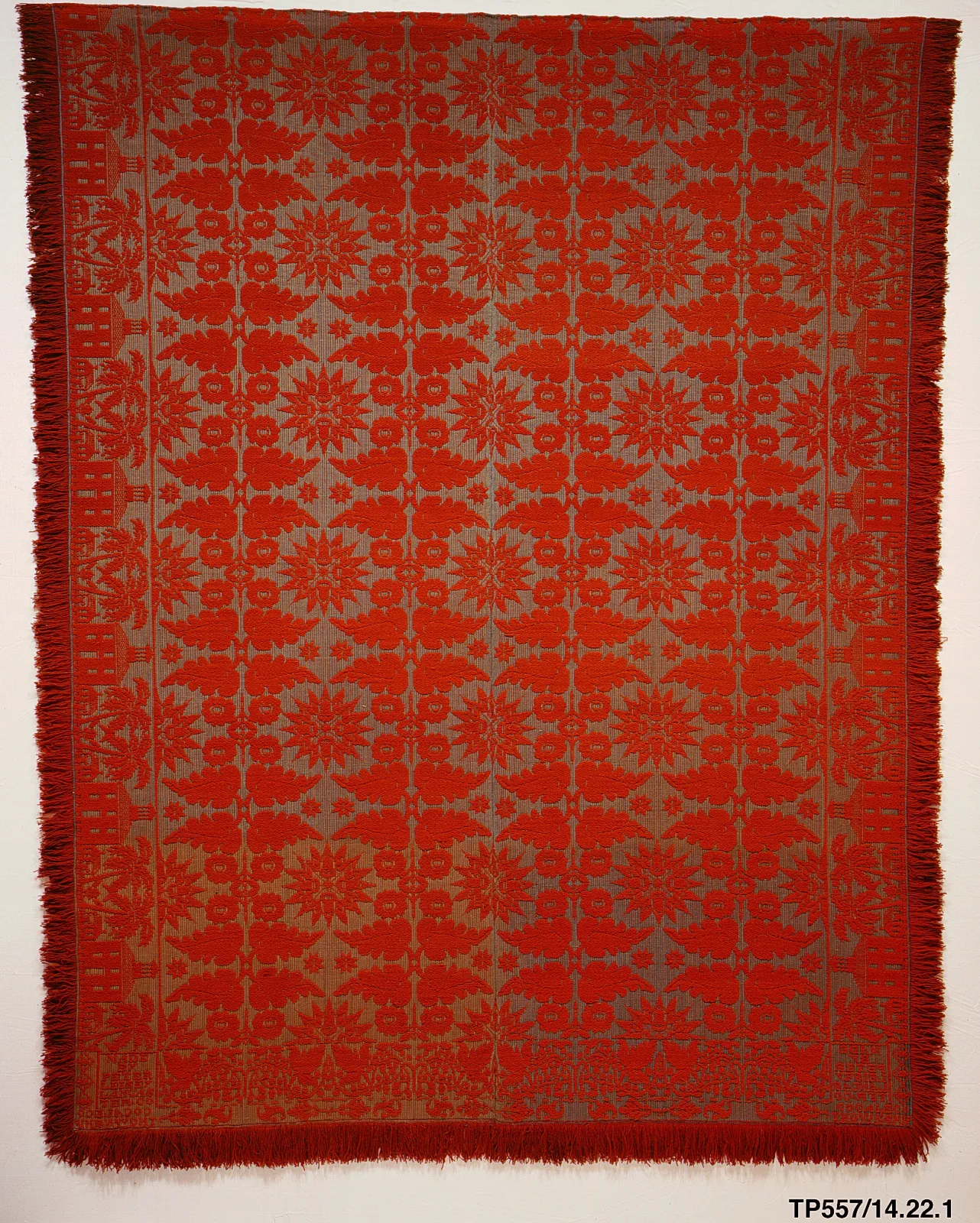
Synthetic aniline dyes were introduced from the late 1850s onward and gradually entered textile production. Harsh, very bright, or unnaturally even colors, particularly purples, magentas, and acid greens, can indicate later manufacture or a Colonial Revival reproduction. A coverlet whose colors look natural, softened, and slightly uneven is consistent with mid-nineteenth-century natural dyeing; one with garish, perfectly uniform synthetic hues warrants closer scrutiny of its age.
Seams, Width, and Construction
The physical construction of a coverlet, from its central seam to its fringe, carries clues to whether it was woven on a hand loom or a later power loom.
The Center Seam
Because most hand looms wove cloth only 36 to 45 inches wide, antique coverlets are typically made of two loom widths seamed down the middle by hand. Look for this center seam and examine whether the pattern matches across it: a careful weaver and seamstress aligned the two halves so the design flows, but minor mismatches are common and entirely authentic. A coverlet woven in a single full-width piece with no center seam is a strong indication of later power-loom manufacture, since hand looms could rarely achieve full bed width.
Selvages and Edges
The outer edges of each loom width are finished selvages produced as the cloth was woven; these neat woven edges run along the sides of the coverlet. The top edge is usually a plain woven heading, while the bottom, and sometimes the sides, often carries a fringe. Examining the selvages and headings helps confirm hand weaving and reveals how the panels were assembled.
Fringe
Many coverlets have a separately applied or self-woven fringe along the bottom edge, and occasionally the sides. Fringe was both decorative and functional, finishing the edge that hung at the foot of the bed. The presence, type, and condition of fringe affect both identification and value, and missing or replaced fringe is a common condition issue. Note whether the fringe appears original and consistent with the weave.
Dating a Coverlet by Period
Combining structure, fiber, dye, dimensions, and any inscription allows most coverlets to be dated within a few decades, and signed examples often to a single year.
Late Eighteenth to Early Nineteenth Century (to about 1820)
The earliest coverlets are geometric, woven on shaft looms, and frequently use a linen ground. Overshot, summer and winter, and double weave structures dominate, with limited palettes built on natural dyes, especially indigo. Signed and dated examples are rare in this period, so dating relies on fiber, dye, and structure. Genuine pieces from this era are scarce and valued accordingly.
The Jacquard Era (about 1820 to 1860)
The arrival of the Jacquard mechanism in the 1820s opens the great age of figured coverlets. This period produces the signed and dated corner blocks, naturalistic florals, eagles, and elaborate borders most prized by collectors. Cotton grounds become common, and the dye palette broadens. A figured coverlet with a woven date in the 1830s, 1840s, or 1850s is squarely within this classic period.
Late Production and Decline (about 1860 to 1880)
After the Civil War, handwoven coverlet production declined sharply under competition from factory textiles. Later figured coverlets sometimes show synthetic dye colors and the last professional weavers wound down their shops. Dated coverlets from the 1860s and 1870s represent the tail end of the genuine handwoven tradition.
Colonial Revival and Later Reproductions (about 1890 onward)
Renewed interest in early American crafts around the turn of the twentieth century, and again later, prompted reproduction coverlets, some handwoven and some power-loomed. These can be attractive textiles in their own right but are not antique nineteenth-century coverlets, and distinguishing them is the subject of the section below.
Regional Styles and Weavers
Coverlet weaving developed distinct regional characters, and recognizing them helps place an unsigned piece and enriches the appreciation of a signed one.
Pennsylvania and the Mid-Atlantic
Pennsylvania was a powerhouse of coverlet weaving, strongly associated with the summer and winter structure and with a large community of professional Jacquard weavers, many of German background. Pennsylvania German coverlets often feature distinctive floral and geometric vocabularies and fine workmanship. The region's textile culture connects to its broader traditions of samplers and needlework and decorated household goods.
New York, Ohio, and the Spread Westward
New York State produced many fine figured coverlets, and as settlement moved west, professional weavers established themselves in Ohio, Indiana, and beyond. Corner blocks naming towns in these states are common, and the westward diffusion of the trade can be traced through dated and located coverlets. Each region developed favored border motifs and signature designs.
New England and Canada
New England leaned strongly toward the geometric overshot tradition of home and local weaving, with figured Jacquard work somewhat less dominant than in Pennsylvania and New York. Coverlet weaving also flourished in parts of Canada, particularly among communities with strong British and continental weaving traditions, producing both geometric and figured pieces.
The Value of Documented Weavers
Specialist literature and regional studies document many individual professional weavers by name, town, and working dates. A coverlet signed by a recorded weaver gains in both interest and value, and matching an inscription to a documented maker is one of the most satisfying exercises in the field. Sound provenance and documentation enhance worth, a principle covered in our guide to antique valuation and appraisal.
Spotting Reproductions and Power-Loom Copies
Reproduction coverlets, from Colonial Revival handwoven pieces to modern power-loomed copies sold as decorative bedding, circulate widely, so careful examination is essential before paying an antique price.
Look for the Center Seam
The most reliable single test is the center seam. Genuine hand-loom coverlets are nearly always woven in two narrow widths seamed up the middle, because period hand looms could not weave full bed width. A coverlet woven in one piece with no center seam, full bed width, is almost certainly a power-loom product. This simple check resolves many cases immediately.
Examine the Weft and Floats
On the back of an overshot or figured coverlet, genuine handwoven pieces show the structural logic of supplementary wefts and floats described earlier. Modern reproductions often have a different back, sometimes with machine-bound threads, printed or applied designs, or a uniform mechanical regularity that lacks the slight variation of hand weaving. Compare front and back carefully: authenticity lives in the structure.
Assess Color and Fiber
Reproductions frequently use synthetic dyes with harsh, perfectly even colors and may use modern cotton or synthetic-blend yarns rather than the wool-on-cotton or wool-on-linen of antiques. Garish purples, magentas, and acid tones, or the slick feel of synthetic fiber, point away from a genuine nineteenth-century coverlet. Natural dye softness and the right fiber combination support authenticity.
Beware Printed and Woven Imitations
Some decorative bedcovers are printed to imitate the look of a woven coverlet pattern, with no real structural weave at all. Under close inspection these reveal a continuous printed surface rather than interlaced pattern threads. As with any printed imitation of a structural textile, if you cannot see and feel the actual woven floats and interlacings, treat the piece as decorative rather than antique.
Condition and Value Factors
Condition strongly affects coverlet value, and the wool pattern threads in particular are vulnerable to several characteristic problems.
Common Condition Problems
Float wear and pattern loss: In overshot coverlets especially, the long wool floats abrade and break with use and washing, leaving thin or missing areas in the pattern. Light, even wear is normal; large losses reduce value significantly.
Moth damage: Because the pattern weft is wool, coverlets are vulnerable to moth and insect damage, which can leave holes and grazed areas. Inspect carefully under good light for nibbled wool and active infestation.
Fading and staining: Sun fading dulls the indigo and madder, and stains from storage, damp, or use mar the surface. Strong, even original color is a major value factor.
Missing fringe and repairs: Lost or replaced fringe, old darns, patches, and reseamed centers all affect value. Sympathetic old repairs are tolerated, but extensive or clumsy restoration detracts.
Value Hierarchy
In broad terms, value rises with the rarity and quality of the design, the presence of a signed and dated corner block, the desirability of the weaver and location, strong original color, fineness of weave, and overall condition and originality. A finely woven, signed and dated double weave Jacquard coverlet by a documented maker with bright color far outranks a worn, unsigned overshot fragment, though even modest geometric coverlets retain a steady market. Documented historical association can add considerably to worth.
Care and Conservation
A coverlet's wool content and age demand careful handling to preserve both its beauty and its value.
Handling and Display
Handle coverlets with clean, dry hands and support the full weight when moving them, since old textiles can tear under their own weight. For display, a coverlet is best laid flat or hung with even support across a wide sleeve or padded rod rather than from a few points, which concentrate strain. Avoid pinning, stapling, or hanging by the fringe.
Light and Environment
Keep coverlets out of direct sunlight and strong artificial light, which fade natural dyes irreversibly, and store or display them in stable, moderate humidity away from damp. Protect against moths with good housekeeping, periodic inspection, and clean storage; wool is always at risk from insects.
Cleaning and Repair
Approach cleaning with great caution. Many antique coverlets should not be machine washed, as agitation and harsh detergent can fade dyes, felt the wool, and damage fragile structure. Gentle vacuuming through a screen removes surface dust safely, and serious cleaning or stabilization is best left to a textile conservator. Store folded coverlets with acid-free tissue in the folds and refold periodically to avoid permanent creases, following the general principles in our guide to storage, care, and preservation. Leave significant repairs to a professional experienced with handwoven textiles.
Building a Collection
Coverlets reward the focused collector with a well-documented field, abundant signed examples, and entry points at a range of budgets.
Getting Started
Begin by handling as many coverlets as possible at antiques shows, textile dealers, and auctions, turning each one over to study its structure front and back. Learn to distinguish overshot, summer and winter, double weave, and Jacquard by feel and appearance, and practice reading any corner blocks. Modest geometric overshot coverlets offer an affordable way to study weave and develop your eye before pursuing finer signed pieces.
Collecting Themes
Some collectors specialize by structure, assembling a representative group of overshot, summer and winter, and double weave examples. Others focus on signed Jacquard coverlets by a particular weaver, on a single state or region, on specific motifs such as eagles or buildings, or on dated examples spanning the decades. A themed collection tells a clearer story and deepens expertise.
Where to Buy
Specialist textile and Americana dealers offer the most reliable coverlets with informed attribution, and regional auction houses regularly sell good examples, including signed pieces. When buying online, request clear photographs of the front, back, corner blocks, center seam, fringe, and any damage, and confirm the seller understands the difference between a handwoven antique and a power-loom reproduction.
Record Keeping
Document each coverlet with photographs of the full piece, the structure front and back, any corner block inscription, the center seam, and the fringe, along with notes on structure, fibers, colors, dimensions, condition, source, and price. Transcribe and research any woven names, places, and dates. Good records support insurance, aid attribution, and add value should you ever sell, reflecting the careful practices described in our guide to building an antique collection.