Antique Burmese Glass Identification Guide: Shading, Makers & Marks
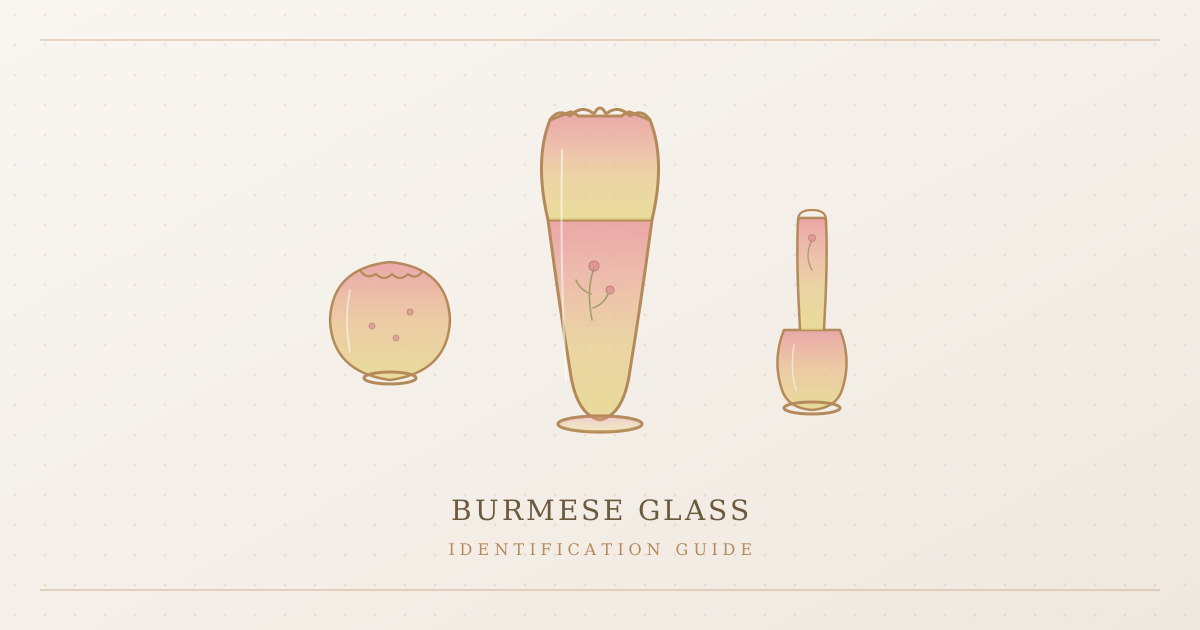
Of all the Victorian art glasses, Burmese may be the most quietly seductive. It does not shout with a fiery ruby rim the way amberina does; instead it glows, shading with almost imperceptible softness from a warm salmon-pink at the top to a delicate, opaque, greenish-yellow at the base. Held in the hand it has the density of fine porcelain and the color of a peach at sunset, and when the light is right the yellow end fluoresces an eerie green under ultraviolet, because there is uranium dissolved in the glass. It is one of the few antiques that is, in the most literal sense, radioactive—and utterly harmless to own.
That combination of subtle beauty and unusual chemistry made Burmese a sensation in the 1880s and has kept it collectable ever since. It was patented in America, licensed to England where Queen Victoria's supposed admiration gave it a royal nickname, revived repeatedly through the twentieth century, and—inevitably—reproduced and faked. A shaded yellow-to-pink piece on a dealer's shelf might be an 1880s Mount Washington fairy lamp worth a small fortune, a 1950s Gundersen vase, a 1970s Fenton bowl, or a modern import, and the differences in both origin and value are enormous.
This guide explains exactly what Burmese glass is and how its color and fluorescence are produced, walks through the original American and English makers and the crucial twentieth-century revivals, distinguishes the glossy and satin finishes, catalogs the forms and decoration, and then turns to marks, reproductions, and a disciplined field routine for telling genuine antique Burmese from the later and faked material. By the end you should be able to pick up a shaded pink-and-yellow piece, read its finish, its fluorescence, and its construction, and place it confidently in the right maker and era.
Table of Contents
- What Burmese Glass Actually Is
- The Chemistry: Uranium, Gold, and Heat
- The Origin: Mount Washington, 1885
- Queen's Burmese: Thomas Webb in England
- Glossy vs. Satin (Acid) Finish
- Forms, Fairy Lamps, and Decoration
- The Twentieth-Century Revivals
- Burmese vs. Peachblow, Amberina & Custard
- Marks, Labels, and Signatures
- The Uranium Fluorescence Test
- Reproductions and the Modern Market
- How to Tell Genuine from Fake
- Condition, Care, and Value
- Field Checklist Before You Buy
What Burmese Glass Actually Is
Burmese is an opaque, heat-reactive art glass that shades from a soft greenish or lemon yellow at one end to a rosy salmon-pink at the other, within a single continuous body of glass. The defining characteristic, as with the whole family of Victorian "struck" glasses, is that the color change is intrinsic to the metal—there is no paint, no cased layer, and no join doing the work. But two things set Burmese apart from its cousins: it is opaque (you cannot see through it), and its default orientation runs yellow at the base to pink at the top—the reverse of amberina's ruby-over-amber.
The standard look is a piece whose foot and lower body are a warm, slightly acid yellow, fading upward through a peachy transition to a delicate pink rim. On a fairy-lamp shade, a rose bowl, or a lily vase, the pink concentrates where the glass was reheated—usually the upper edge—while the cooler base stays yellow. The transition is famously gentle; where amberina can look almost banded, good Burmese melts from one color to the other so smoothly that it is hard to say exactly where yellow becomes pink. That softness is part of its signature and one of the tells of quality.
The "Radioactive Sunset" in a Nutshell
What makes Burmese genuinely unusual among art glasses is that its yellow is a uranium yellow. The base glass is a uranium-colored batch—chemically a first cousin of uranium (Vaseline) glass—to which gold has been added; the pink appears only where reheating strikes the gold to red, exactly as it does in amberina and cranberry glass. The result is a two-part color system in one body: uranium yellow that does not change, and gold-pink that is struck by heat. This is why the base of a genuine antique Burmese piece will nearly always glow bright green under a UV lamp, and it is one of the most useful authentication tools in the field, covered in detail below.
The Chemistry: Uranium, Gold, and Heat
Understanding the chemistry is the single most useful thing a collector can learn about Burmese, because it explains the color, the fluorescence, and the difference between the real thing and the imitations. Burmese begins as a uranium glass batch—an opaque or semi-opaque yellow colored by uranium oxide, usually opacified so it reads as a solid, creamy yellow rather than a transparent one. Crucially, the batch also contains a small amount of gold (as gold chloride, with a trace of a reducing agent). As formed, this metal is a uniform yellow; the gold is still dissolved and colorless, contributing nothing yet.
The pink appears through striking: controlled reheating. When the yellow-with-gold object is reintroduced to the glory hole at the right temperature, the dissolved gold precipitates into microscopic colloidal particles that scatter and absorb light to produce a rose-pink—the same colloidal-gold effect behind cranberry and gold-ruby glass. Because the glassworker reheats selected areas (usually the rim and upper body), only those areas turn pink; the rest stays uranium yellow. The soft boundary between them is the graded transition that defines Burmese.
Why the Color and Glow Behave the Way They Do
Several diagnostic consequences follow. First, the yellow end is a true uranium yellow and fluoresces vivid green under UV, whereas the pink end—where gold has masked and overlaid the uranium—glows more weakly or not at all; a genuine piece therefore lights up brightest at the yellow base and fades toward the pink. Second, the pink is a warm, gentle gold-ruby rose, not a harsh magenta or a painted salmon. Third, because the glass is opacified, the shading is a surface-and-body glow rather than a see-through gradient; you read it in reflected light, not by holding it up to a window. Any "Burmese" that is transparent, or whose yellow does not fluoresce, deserves immediate suspicion—it may be a later uranium-free imitation.
A note on later chemistry: after the mid-twentieth century, and especially in recent reproductions, some makers produced Burmese-look glass without uranium (for regulatory and cost reasons) or with different opacifiers and colorants. Fenton's later Burmese, for example, is generally uranium-free. This does not make such pieces "fake"—they are genuine products of their makers—but it means the UV test separates antique/uranium Burmese from uranium-free later glass, and you must combine it with other evidence rather than treating a green glow (or its absence) as a single verdict.
The Origin: Mount Washington, 1885
Burmese was invented and patented at the Mount Washington Glass Company of New Bedford, Massachusetts. The patent was granted in 1885 to Frederick S. Shirley, the firm's manager and one of the great art-glass entrepreneurs of the period. Mount Washington coined the name "Burmese" for the new shaded ware, and its New Bedford production is the benchmark against which all other Burmese is judged. The company made it as a luxury art glass through the later 1880s and into the 1890s, in the full Victorian repertoire of decorative and table forms.
The romantic origin of the name is part of the lore: the shaded yellow-to-pink was said to evoke the sunset colors of Burma (modern Myanmar). Whether or not that story is a marketing flourish, the "Burmese" name stuck and became the generic term for the glass. Genuine Mount Washington Burmese is hand-worked art glass—blown and tooled, frequently with crimped or ruffled rims, applied feet, and, at the top of the range, elaborate enamel and gilt decoration. Much of the finest decorated Burmese carries painted floral sprays, ferns, and even verses, applied by the factory's celebrated decorating department.
What Original Mount Washington Burmese Looks Like
Quality is the hallmark. The metal is dense and satiny, the yellow is a clean uranium lemon, and the pink is a soft, warm rose that melts into the yellow without a hard line. Both glossy and satin (acid-finished) surfaces were made (see below). Mount Washington Burmese is usually unmarked; attribution rests on the quality of the glass, the character of the decoration, the form, and provenance—which is exactly why the licensed and signed English pieces are easier to authenticate. The disciplined, evidence-first attribution that Burmese demands is the same logic laid out in our authentication and provenance research guide.
Queen's Burmese: Thomas Webb in England
Burmese was successful enough that Mount Washington licensed it to England, and the licensee was one of the greatest names in British glass: Thomas Webb & Sons of Stourbridge. Webb produced Burmese under license from the later 1880s and marketed its version as "Queen's Burmese Ware," reportedly after Queen Victoria admired and ordered pieces. For identification, Webb's Queen's Burmese is the one category of nineteenth-century Burmese that is frequently marked, which makes it the anchor of many collections.
Webb's Queen's Burmese is superb continental-quality art glass—arguably even more refined in its decoration than some American work—made in vases, bowls, fairy lamps, cruets, and the full decorative range, often with delicate painted ferns, ivy, prunus, and floral sprays, and sometimes with printed or painted marks on the base. The English pieces tend to a slightly different palette and a very high standard of enameling. Because the shaded look crossed the Atlantic under license, a fine "Burmese" fairy lamp or decorated vase may be English rather than American, and the mark (where present) is what settles it.
Why the Maker Matters for Value
As with most Victorian art glass, attribution drives price. Documented Mount Washington and marked Webb Queen's Burmese sit at the top, especially decorated and figural pieces; unmarked but clearly period Burmese is strong mid-market; and twentieth-century revival Burmese is a separate, generally lower tier. Because the American pieces are rarely signed, building the eye for quality—the softness of the shade, the depth of the yellow, the standard of any enamel, and the character of the form—is what separates a confident buyer from a hopeful one, and it is the same connoisseurship the whole field of antique glass identification rewards.
Glossy vs. Satin (Acid) Finish
One of the first things to read on any Burmese piece is its finish, because it affects both the look and, sometimes, the attribution. Burmese was made in two surface treatments. The glossy (shiny) finish is the glass as blown and fire-polished, with a bright, reflective surface that makes the pink read vividly. The satin, "plush," or acid finish is produced by treating the surface with acid (typically hydrofluoric acid vapor), which etches it to a soft matte, giving the famous velvety, powdery bloom that many collectors most associate with Burmese.
Both finishes are original and period-correct; neither is "better," though the satin finish is the more iconic and, on decorated pieces, provides a beautiful matte ground for enamel. The satin surface also softens the color transition further, enhancing the gentle glow. When you encounter a Burmese piece, note which finish it has, because reproductions sometimes get the finish subtly wrong—a satin that is too uniform and "sandblasted" rather than acid-bloomed, or a gloss that looks glassy and cold rather than warm.
Reading the Finish for Age
On genuine antique satin Burmese, the matte surface should show appropriate handling wear—the bloom slightly worn on high points and around the base, with fine scratches consistent with age, while the color still glows underneath. A satin surface that is dead-uniform, harsh, and unworn on an otherwise "old" form is a flag for a modern acid-dip or a sandblasted reproduction. Likewise, glossy Burmese should have the soft, warm reflectivity of fire-polished art glass, not the hard glare of modern pressed glass. The finish is a small clue, but combined with color, fluorescence, and construction it contributes to the overall verdict.
Forms, Fairy Lamps, and Decoration
Burmese was made across the Victorian decorative repertoire, and the form helps enormously with both period and maker. The most characteristic and collectable Burmese forms are fairy lamps (candle lamps with a Burmese shade, often on a matching Burmese or clear base, frequently marked "Clarke" for the patented candle system), rose bowls (spherical bowls with crimped-in tops), lily and trumpet vases, and small bowls, cruets, toothpick holders, and salts. Because Burmese was luxury ware, it survives disproportionately in these decorative and giftware forms rather than as everyday tableware.
Decoration ranges from the plainest shaded pieces—where the glow is the whole point—to elaborately enameled art objects. The best Mount Washington and Webb pieces carry hand-painted floral sprays, ferns, ivy, prunus, autumn leaves, and even inscribed verses and mottoes, often with gilt rims and highlights. Some pieces combine Burmese with applied glass feet, handles, and rigaree. Decorated Burmese is a fully realized art glass and commands the strongest prices; the same painted-and-gilt vocabulary appears across Victorian art glass, including the decorated perfume bottles and vanity pieces of the period.
Fairy Lamps: A Category of Their Own
Burmese fairy lamps deserve special mention because they are among the most sought-after Burmese objects and a field of collecting in their own right. A classic Burmese fairy lamp pairs a shaded pink-and-yellow dome shade with a candle cup—often a "Clarke Fairy Pyramid" or "Cricklite" cup, marked accordingly—sometimes set into a matching Burmese or crystal base or bowl. Complete, matched fairy lamps (shade plus correct base plus marked cup) are far more valuable than orphan shades, and mismatched "marriages" are common, so check that the elements belong together. The glow of a lit Burmese fairy lamp is exactly the effect the glass was designed to produce.

The Twentieth-Century Revivals
Burmese did not stay a Victorian ware; it was revived repeatedly through the twentieth century, and knowing the main revival makers is essential because their pieces are constantly mis-sold as nineteenth-century. These are not "fakes"—they are genuine products of their own eras—but the date matters enormously for value, and several of them are highly collectable in their own right.
The most important American revival came through the successors to Mount Washington. After Mount Washington was absorbed by the Pairpoint Corporation, Burmese was made again, and later the Gundersen Glass Works (and Gundersen-Pairpoint) produced a well-regarded Burmese revival in the 1930s–1950s, followed by Pairpoint itself in later decades. Gundersen Burmese is high-quality, faithful to the original concept, and collectable, though generally distinguishable by form and sometimes by a slightly different palette from the 1880s originals.
The best-known modern revival is Fenton. Fenton produced Burmese from around 1970 onward (with some earlier Burmese-style work) and made it one of its premium lines, frequently hand-painted with floral decoration and usually marked with the Fenton logo. The same reactive-striking principle behind transparent amberina glass underlies Fenton's Burmese, and much of it is uranium-free. Fenton Burmese is genuine, attractive, and often signed—but it is late-twentieth-century glass, and dating it correctly is exactly the discipline covered in our guide to Fenton art glass identification. Other studios and English makers also produced Burmese-style wares through the century.
Placing a Piece in the Right Era
The practical takeaway is that "Burmese" names a category made across roughly a century and a half, and your job is to place a given piece in its era. A marked Fenton logo puts a piece after about 1970; a Gundersen or Pairpoint form and palette suggest a mid-century revival; an unmarked, uranium-fluorescing, finely decorated satin piece with period form suggests 1880s–1890s Mount Washington; and a marked Webb base points to English Queen's Burmese. The revivals are legitimate and collectable, but only the genuine Victorian pieces carry the premium of the original 1880s art glass.
Burmese vs. Peachblow, Amberina & Custard
Burmese belongs to a family of shaded and specialty Victorian glasses that beginners constantly confuse, and the fastest way to identify Burmese is to know what it is not. The confusions are worth memorizing because getting the category wrong means getting the value wrong.
Peachblow is the closest cousin and the most common mix-up. Peachblow also shades softly and is opaque or semi-opaque, but it runs white or blue to rose/red rather than yellow to pink, and it comes in several distinct maker versions (New England, Mount Washington "Peach Blow," Wheeling, and others). The quick test: if the pale end is a uranium yellow that glows green under UV, it is Burmese; if the pale end is white, cream, or bluish, it is peachblow. Amberina is easier to separate because it is transparent and runs amber to ruby—hold it to the light and you see through it, which you never can with Burmese.
The Custard Glass and Uranium Overlap
Two more glasses cause trouble at the yellow end. Custard glass is an opaque, creamy, pale-yellow pressed glass (Northwood, Heisey, and others) that is also often uranium-based and fluorescent—but custard is a uniform, unshaded ivory-yellow, usually pressed in patterns, with no pink striking; if there is no pink shade, it is not Burmese. Straight uranium/Vaseline glass is transparent yellow-green and, again, unshaded. The rule that resolves nearly all of these: Burmese is the one that is opaque, shaded specifically yellow-to-pink, with a uranium-fluorescing yellow end. Any single missing element—transparency, the wrong pale color, no shading, or no fluorescence on a piece claimed to be antique—points away from Burmese.
Marks, Labels, and Signatures
Burmese is, for the most part, an unmarked glass, and this is the central challenge—and opportunity—of the field. The original 1880s Mount Washington Burmese was essentially never factory-signed, so the great majority of genuine American antique Burmese carries no mark at all. The absence of a signature is completely normal and is not evidence against authenticity; attribution rests on quality, decoration, form, and provenance.
The major marked exceptions are worth memorizing. Webb Queen's Burmese is frequently marked—look for printed or painted marks on the base, sometimes including "Thomas Webb & Sons," "Queen's Burmese Ware," or "Patent," and Webb's registration marks. Fairy lamp components often carry the "Clarke" or "Cricklite" trade marks on the candle cup, which help date and attribute the lamp system (though not necessarily the shade's maker). Twentieth-century revival makers marked their work: Fenton used its logo (from the 1970s), and Gundersen/Pairpoint pieces sometimes carry marks or paper labels. A mark, where present, should be read as a dating and attribution anchor and cross-checked against the character of the glass.
Paper Labels and Their Limits
Original paper or foil labels were used by various makers and, being fragile, are usually long gone; a surviving original label is a welcome bonus but, like all labels, is easily transferred or faked onto later glass. Treat a paper label as supporting evidence, never as proof, and weigh it against the physical tells—finish, shading, fluorescence, and construction. The general logic of reading, and distrusting, marks and labels across antique categories is laid out in our provenance research guide, and it applies directly to Burmese.
The Uranium Fluorescence Test
Because Burmese's yellow is a uranium yellow, the ultraviolet test is one of the most powerful tools in the field—used correctly. Shine a UV (blacklight) lamp, ideally a long-wave 365 nm light, on a Burmese piece in a darkened room. On genuine uranium Burmese, the yellow end will fluoresce a vivid, unmistakable green, brightest at the yellow base and fading as the pink (gold-struck) region takes over toward the rim. That green glow is the fingerprint of uranium in the batch and is extremely difficult to fake, because it is a property of the glass chemistry itself, not the surface.
Two cautions keep the test honest. First, a strong green glow confirms uranium, which places a piece in the antique/uranium tradition—but it does not by itself prove Mount Washington versus Webb versus Gundersen, since several uranium-era makers used uranium batches. Second, and just as important, the absence of fluorescence does not automatically mean "fake": it means the glass contains little or no uranium, which points to later, uranium-free production (notably much Fenton and modern reproduction Burmese) rather than to a nineteenth-century original. So the UV test is a superb era filter—antique uranium Burmese glows, uranium-free later Burmese does not—but it must be combined with finish, shading quality, form, and marks for a full identification.
Using UV Alongside the Eye
In practice, the UV lamp is best used to confirm what your eye already suspects. A piece with soft yellow-to-pink shading, a period satin finish, appropriate wear, and a bright green fluorescence at the yellow end is very likely genuine antique uranium Burmese. A piece with a harsh, uniform color, no wear, and no fluorescence is likely a modern uranium-free imitation. And a marked Fenton piece that does not fluoresce is simply correct—late Fenton Burmese is uranium-free—so the lamp corroborates the logo rather than contradicting it. The lamp is a tool, not a verdict; the verdict is the convergence of all the evidence. For the wider world of uranium-colored glass and how to read the glow, see our dedicated uranium glass identification guide.
Reproductions and the Modern Market
Burmese has been made and imitated more or less continuously since its heyday, and the modern market carries several distinct tiers of later glass. Knowing the main waves is the best defense against paying an 1880s price for a much later piece.
The first tier is the legitimate twentieth-century revival already discussed—Gundersen, Pairpoint, Fenton, and various studios—much of it well made, frequently marked, and collectable on its own terms. These are not "fakes"; the problem is only that they are routinely sold as Victorian. Correctly dating them (by mark, form, palette, and the UV test) is the whole game, and it is the same care that dates other twentieth-century American art glass such as Fenton and the wider studio-glass field.
The second tier is outright modern reproduction: recently made shaded yellow-to-pink glass, some of it imported, produced specifically to imitate the antique look for the decorative and antique trade. These reproductions vary in quality. The tells are familiar: often uranium-free (no green fluorescence), sometimes with a harsher or more uniform color, a satin finish that reads as sandblasted rather than acid-bloomed, molded or pressed forms with seams where an antique would be blown and tooled, and, above all, no honest wear. Reproduction rose bowls, small vases, and fairy-lamp shades in "Burmese" are the commonest and are almost always modern.
The Marriage and Repaint Traps
Two specific hazards deserve a direct warning. First, "married" fairy lamps: an antique Burmese shade set on a non-original base, or a modern shade on an old base, sold as a complete period lamp. Always check that shade, base, and candle cup belong together and share consistent age and wear. Second, later decoration and repainting: plain antique Burmese blanks are sometimes enameled or "improved" later to raise their value, and crisp, unworn enamel on a worn body is a red flag. Genuine period Burmese shows its age in the wear of the finish, the softness of the shading, the quality of any original enamel, and—on uranium pieces—the green glow, not merely in a pink-and-yellow gradient.
How to Tell Genuine from Fake
Pulling the diagnostics together, a short sequence resolves most Burmese questions. No single test is conclusive; authenticity is a convergence of several lines of evidence.
First, confirm it is Burmese at all: the glass must be opaque and shade specifically yellow-to-pink as a soft, continuous gradient. A transparent piece is amberina or uranium glass, not Burmese; a white-to-rose shade is peachblow; a uniform unshaded yellow is custard. Second, run the UV lamp: a bright green glow at the yellow end confirms uranium and places the piece in the antique/uranium tradition, while no glow points to later uranium-free production (correct for Fenton, suspicious on a piece sold as Victorian).
Read the Finish, Construction, and Wear
Third, read the finish: a genuine satin surface is an acid bloom, soft and slightly worn on the high points, not a hard uniform sandblast; a glossy surface is warm and fire-polished, not cold and glassy. Fourth, examine construction: antique Burmese is blown and tooled, with crimped or ruffled rims, applied feet or handles worked by hand, and often a polished or ground pontil, whereas seams and a flat molded base indicate pressed or later production. Fifth, look for a mark: a Webb "Queen's Burmese" base mark, a Clarke fairy-lamp cup, or a Fenton logo each anchors the maker and era—while remembering that genuine 1880s Mount Washington Burmese is normally unmarked.
Sixth, weigh the whole for consistency and honest age. Real period Burmese shows wear where wear belongs: the satin bloom softened on high points and around the base, fine handling scratches, original enamel worn from raised areas but intact in recesses, and a matched, consistent look across all parts of a fairy lamp. A flawless, seam-bottomed, non-fluorescing piece with harsh color and no wear is modern. As always, the convergence is the proof: opaque yellow-to-pink shading, uranium fluorescence (for antique pieces), an appropriate acid or fire-polished finish, blown-and-tooled construction, period form, honest wear, and a mark that fits the glass. The same multi-point discipline that protects buyers across all antique glass is what protects you here.
Condition, Care, and Value
Condition drives Burmese value as sharply as it does any art glass, and Burmese has a few particular vulnerabilities. The shaded color is in the glass and will not fade, but the satin finish is a surface treatment that can be worn, scratched, or damaged, and heavy abrasion or a modern re-acid-dip destroys value. Inspect crimped and ruffled rims for chips and grinding, check applied feet and handles for cracks at the joins, and examine any enamel decoration for flaking and later restoration. On fairy lamps, confirm the shade, base, and cup are original to each other and undamaged. Hairlines, rim repairs, and worn or "refreshed" satin surfaces are the commonest and most value-destroying faults.
On value, the hierarchy is clear. Decorated Mount Washington and Webb Queen's Burmese—especially figural pieces, elaborate fairy lamps, and finely enameled vases—sit at the top, with the best examples reaching well into four figures and rarities beyond. Undecorated but clearly period Burmese is solidly collectable mid-market glass. Gundersen and Pairpoint revival pieces form a respectable middle tier, and Fenton and later marked revival Burmese are entry-to-mid level, valued as genuine twentieth-century art glass. Modern uranium-free reproductions are decorative-only. Complete, matched, marked, and finely decorated pieces command the premiums; damage, marriages, and later "improvement" erode them. For a structured way to weigh all these factors, see our antique valuation and appraisal guide.
Care and Display
Care is conservative: hand-wash only, in lukewarm water with mild soap, supporting the body rather than lifting by a rim or applied handle, and dry gently; never put Burmese in a dishwasher, which can etch the surface, dull the satin bloom, and stress applied parts, and never scrub a satin finish, which is fragile. Avoid sudden temperature changes and harsh direct sun. As a genuinely low-level radioactive material, uranium Burmese is safe to display and handle normally—the radiation is negligible—though, as with all uranium glass, it is sensible not to eat or drink from it or store food in it. Display Burmese where soft light can bring up its glow; a lit fairy lamp or a gently backlit shelf shows exactly why the glass enchanted the Victorians.
Field Checklist Before You Buy
When a shaded pink-and-yellow piece is in front of you, work this sequence before you think about price.
First, verify the category: is the body opaque, and does it shade softly from yellow at the base to pink at the top? Rule out transparent amberina and uranium glass, white-to-rose peachblow, and uniform custard. Second, run the UV lamp: a bright green glow at the yellow end confirms uranium and the antique tradition; no glow points to later uranium-free glass (correct for Fenton, a warning on anything sold as Victorian).
Third, read the finish: a soft, slightly worn acid bloom (satin) or a warm fire-polished gloss says period art glass; a harsh, uniform sandblast or a cold glassy shine says later or reproduction. Fourth, turn it over and read the construction: a pontil with applied, tooled feet and crimped rims means hand-blown art glass; mold seams and a flat molded base mean pressed or later production. Fifth, look for and read any mark: a Webb "Queen's Burmese" base mark (English), a "Clarke" fairy-lamp cup, or a Fenton logo (post-1970)—each a maker and date anchor—while remembering that genuine 1880s Mount Washington Burmese is normally unmarked.
Sixth, on fairy lamps and multi-part pieces, confirm the elements are original to each other—matched shade, base, and cup with consistent age and wear—and watch for marriages. Seventh, assess condition honestly: rims and crimps for chips and grinding, applied parts for cracks at the joins, the body for bruises and hairlines, and any enamel for flaking and later repaint. Eighth, weigh the whole for consistency and honest wear—a softened satin bloom, fine handling scratches, original enamel worn from high points, and, on uranium pieces, that unmistakable green glow. A piece that delivers opaque yellow-to-pink shading, uranium fluorescence (for antique pieces), a period finish, blown-and-tooled construction, a sound and matched condition, and a mark (or believable absence of one) that fits the glass is the real thing.
Practiced as a routine, this sequence turns Burmese from one of the trickiest of the shaded art glasses into one of the most rewarding to collect. The color is genuinely lovely, the finest decorated and figural pieces hold and build value, and—because so much of the market is later revival or reproduction—the collector who can read the shading, the fluorescence, the finish, and the marks holds a real and lasting advantage at every auction preview, estate sale, and dealer's case.