Antique Blue Willow China Identification Guide: Patterns, Marks, and Makers
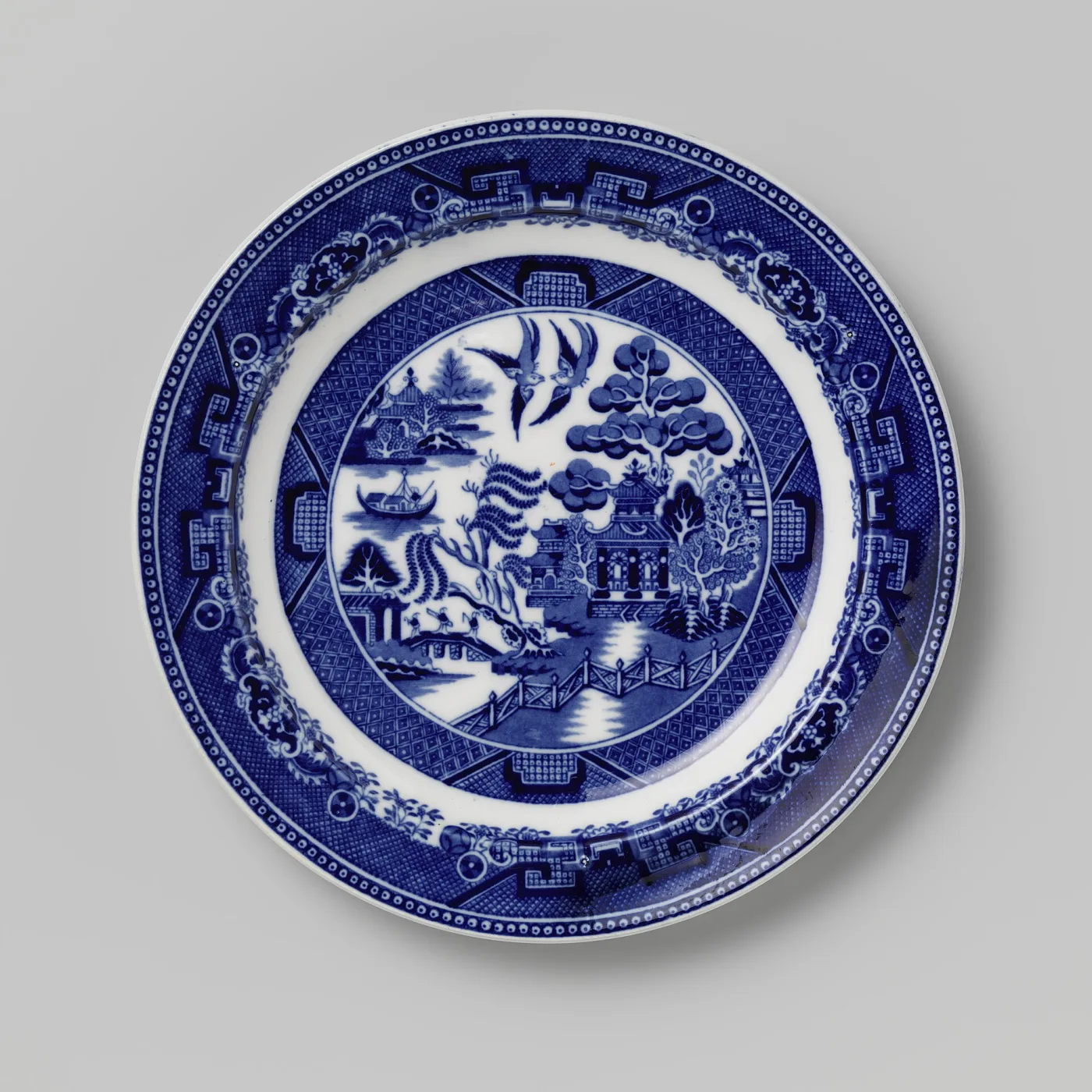
No decorative scheme in the history of ceramics has been more widely produced, more instantly recognized, or more thoroughly misunderstood than Blue Willow. The blue-and-white scene of a willow tree, a many-roofed teahouse, a zig-zag bridge with tiny figures crossing it, a boat, an island, and a pair of birds meeting in the sky has been printed onto plates, cups, platters, and pitchers by hundreds of factories on at least four continents for well over two hundred years. It has been the everyday china of farmhouse kitchens and grand hotels alike, and it remains among the most collected patterns on earth.
That very ubiquity is what makes Blue Willow so confusing to identify. Two plates that look almost identical across a room can be separated by a century in age, by an ocean in origin, and by a wide margin in value. One may be an early English piece transfer-printed from a hand-engraved copper plate around 1800; the other a machine-decorated restaurant plate from the 1950s or a brand-new reproduction sold last week. The pattern alone tells you almost nothing about which you are holding — the answer lives in the border, the quality of the printing, the body of the ware, and above all the mark on the base.
This guide explains how to read a piece of Blue Willow properly. It covers the famous (and entirely fictional) legend behind the design, the standard elements every collector should be able to name, the major border types that distinguish one maker from another, how the transfer-printing process works and how to spot it, the most important English and American makers and their marks, how country-of-origin wording dates a piece, the many color variants beyond classic blue, how to separate genuine age from modern reproduction, how to judge condition, and what actually drives value. Whether you have inherited a single cup or a service for twelve, you will finish able to tell what you have.
Table of Contents
- What Blue Willow Actually Is
- The Willow Legend (and Why It Is a Myth)
- The Standard Pattern Elements
- Borders: The Collector's Key
- How Transfer Printing Works
- The Major English Makers
- American and Other Makers
- Reading the Backstamp
- Country-of-Origin Dating
- Color and Pattern Variants
- Putting a Date on a Piece
- Reproductions and New Willow
- Condition Assessment
- What Drives Value
- Care, Cleaning, and Use
- Common Beginner Mistakes
- Frequently Asked Questions
What Blue Willow Actually Is
Before sorting makers and dates, it helps to be clear about what the term “Blue Willow” does and does not mean, because the name is used loosely for several related but distinct things.
A Pattern, Not a Maker
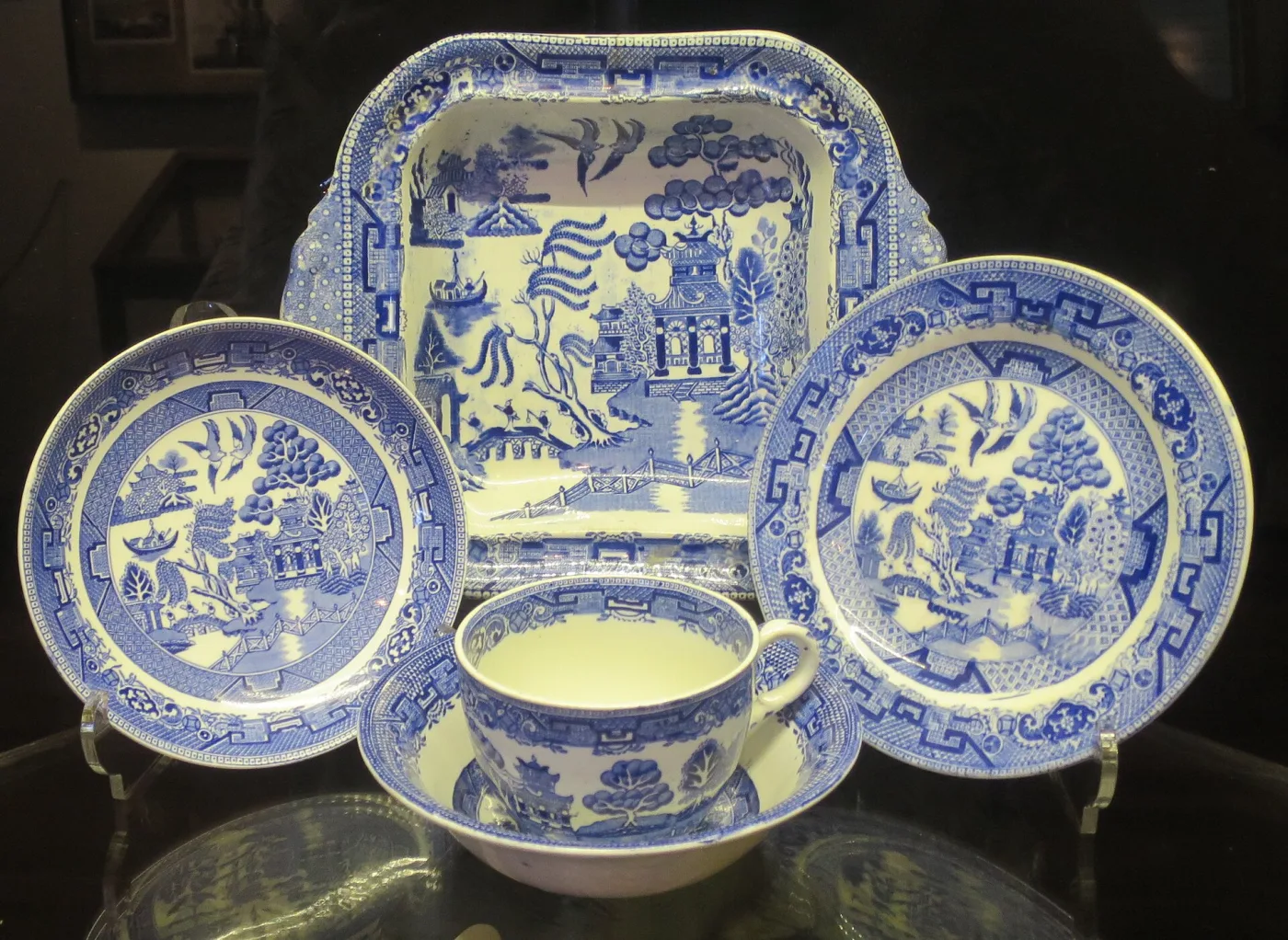
Blue Willow — also called Willow Ware or simply the Willow pattern — is a decorative design, not a brand, a factory, or a type of clay. It is a chinoiserie scene, meaning a European fantasy of a Chinese landscape, printed in underglaze blue on white earthenware or porcelain. Because it was never owned or trademarked by any one firm, it was copied freely, and hundreds of potteries in England, Europe, America, and Asia have produced it. Identifying “Blue Willow” therefore means identifying who made a particular piece and when, not simply naming the pattern.
An English Invention, Not Chinese
Despite the Chinese-looking imagery, the Willow pattern is an English creation of the late eighteenth century, developed by Staffordshire engravers drawing on imported Chinese hand-painted porcelain for inspiration. It was designed to satisfy British demand for blue-and-white “China” ware at a price ordinary households could afford, using the new technology of transfer printing rather than costly hand painting. Genuine Chinese export porcelain of the period exists and is its own field; classic Willow as collectors know it is a Western product imitating an Eastern look.
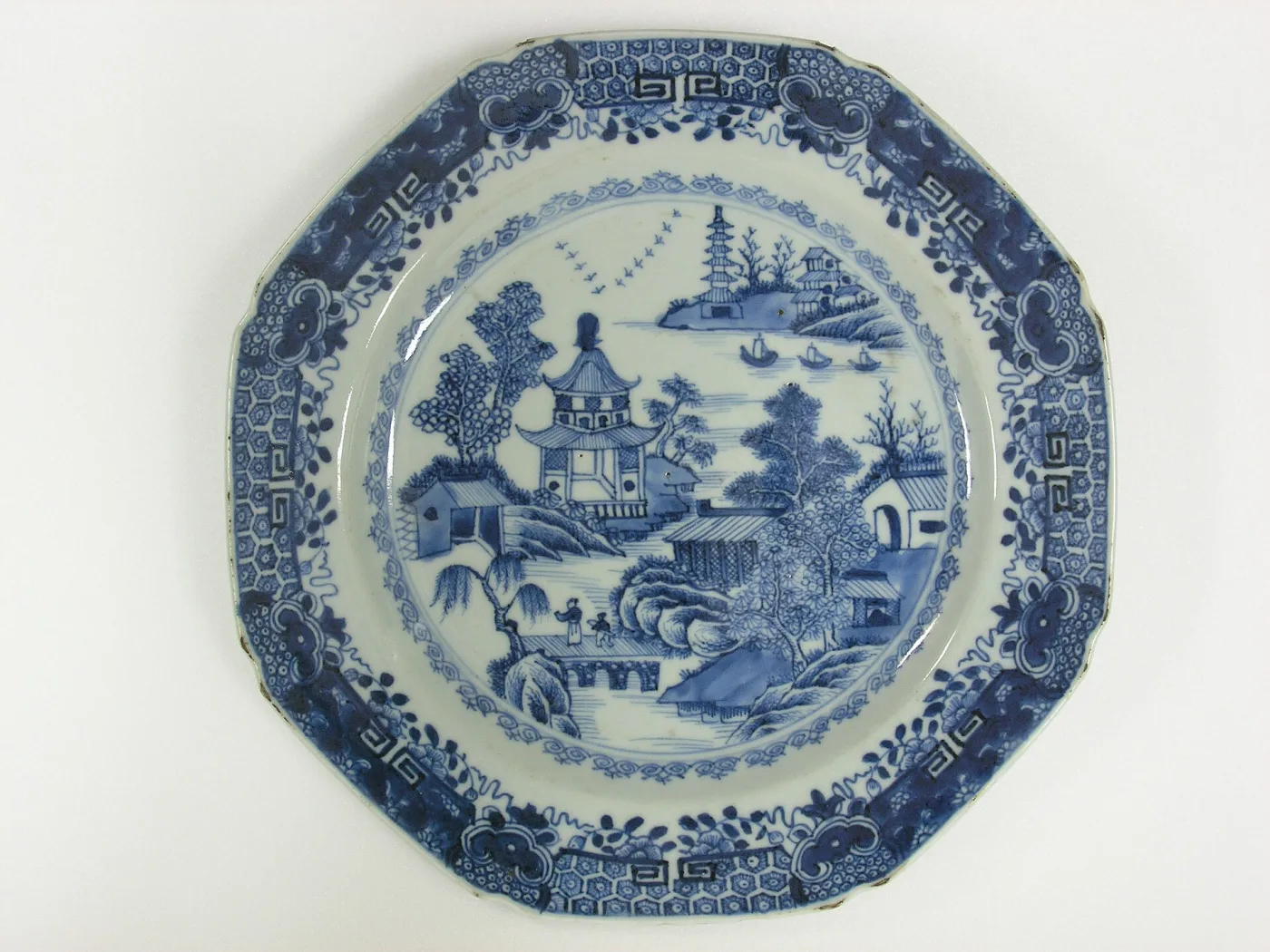
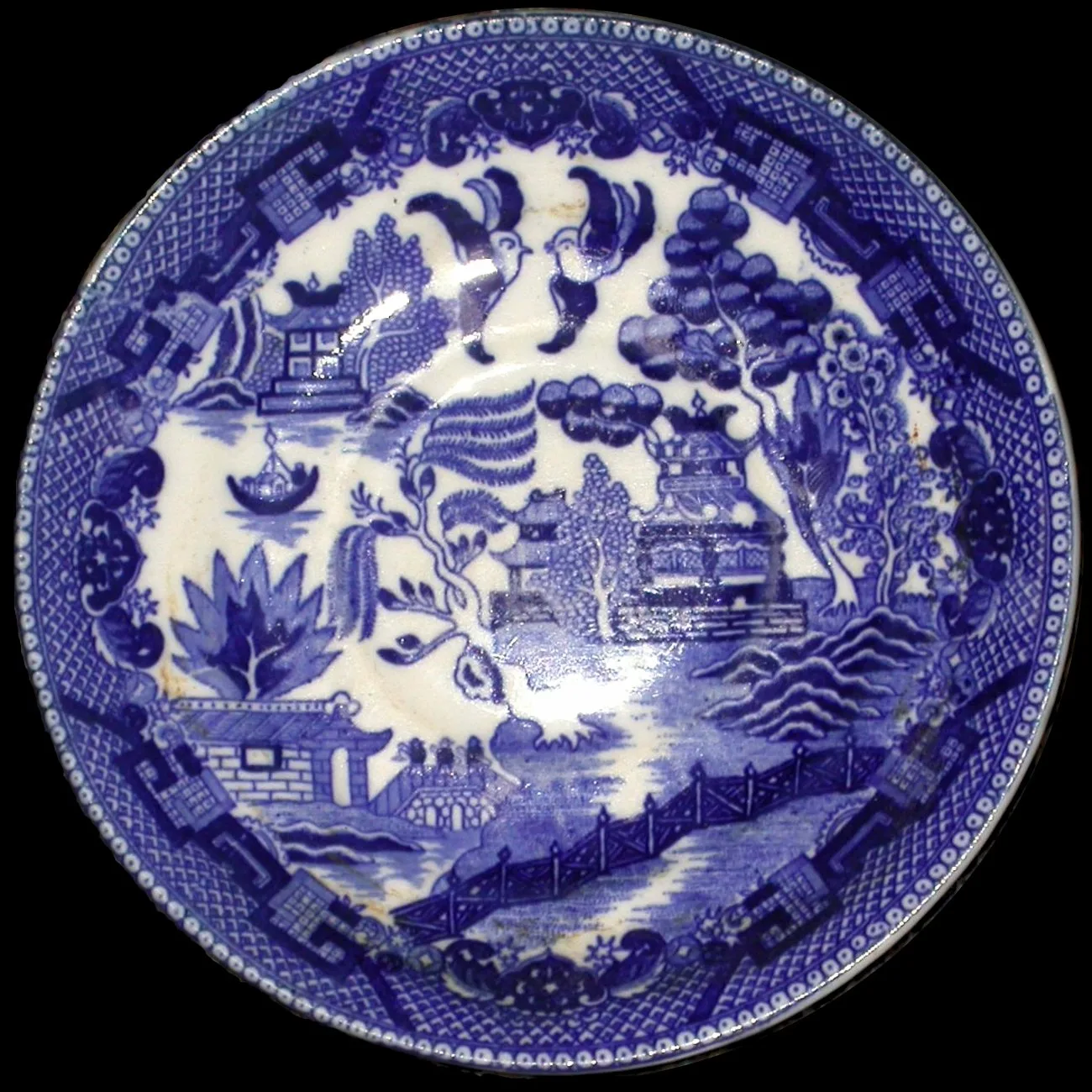
Compare the quality of the line rather than the subject. On the left, brushwork: strokes taper, pool where the brush paused, and no two roof tiles are drawn identically. On the right, engraving: the blue is built up from repeated parallel cuts and dots of even weight, and the same marks recur wherever a texture is needed. The left-hand plate is not Willow at all — it is the kind of Chinese export ware Staffordshire was imitating, though Auckland's own record calls it “the Willow Pattern made for the export market,” which shows how loosely the name travels even in museum catalogues.
Part of the Wider Transferware Family
Willow is the single most famous member of the enormous family of blue-and-white transfer-printed pottery. The same printing technology produced thousands of other patterns — pastoral scenes, Italian ruins, floral borders, and historical views — and the methods of dating and authentication overlap heavily. For the broader context of printed blue-and-white ware, our transferware identification guide covers the field as a whole, of which Willow is the best-known branch.
Why It Has Never Gone Out of Production
Willow has been made continuously since roughly the 1790s. It survived the move from hand-engraved copper plates to lithographic and modern printing, the rise and fall of dozens of factories, and shifts in taste that buried countless other patterns. As a result, a shelf of Willow can contain pieces from the Georgian era to last year, all bearing what looks like the same picture — which is precisely why careful identification matters.
The Willow Legend (and Why It Is a Myth)
Almost everyone who collects Willow encounters the romantic story said to be told by the picture, and knowing both the legend and its true origin helps you read the design — and avoid a common misconception about its age.
The Story the Picture Supposedly Tells
The familiar legend runs roughly thus: a wealthy Mandarin's daughter (Koong-se) falls in love with her father's humble secretary (Chang); forbidden to marry, the lovers flee across a bridge as the angry father pursues them; they hide on an island, are eventually discovered and killed, and the gods transform their souls into the two birds seen meeting forever at the top of the design. Every element of the scene — the bridge with three figures, the boat, the island house, the willow, the two birds — is given a role in the tale.
The Legend Came After the Pattern
The crucial point for collectors is that this “ancient Chinese legend” is not ancient and not Chinese: it was invented in England, almost certainly by Staffordshire potters or Victorian writers, as marketing and storytelling after the pattern already existed. The design did not illustrate a pre-existing myth; the myth was written to explain a design that had been assembled from various Chinese motifs for commercial reasons. Treat the legend as charming folklore, not as evidence of Eastern origin or great age.
Why This Matters for Identification
Sellers sometimes lean on the legend to imply that a piece is mysteriously old or authentically Chinese. It is neither claim that the story supports. A piece's true age and origin are settled by its mark, its body, and the quality of its printing — never by how faithfully it tells the love story. Knowing the legend is fun and helps you name the elements; it has no bearing on dating.
The Standard Pattern Elements
Learning the named components of the design is the foundation of identification, because the presence, arrangement, and number of these elements distinguish “standard” Willow from its many variants.
The Core Cast
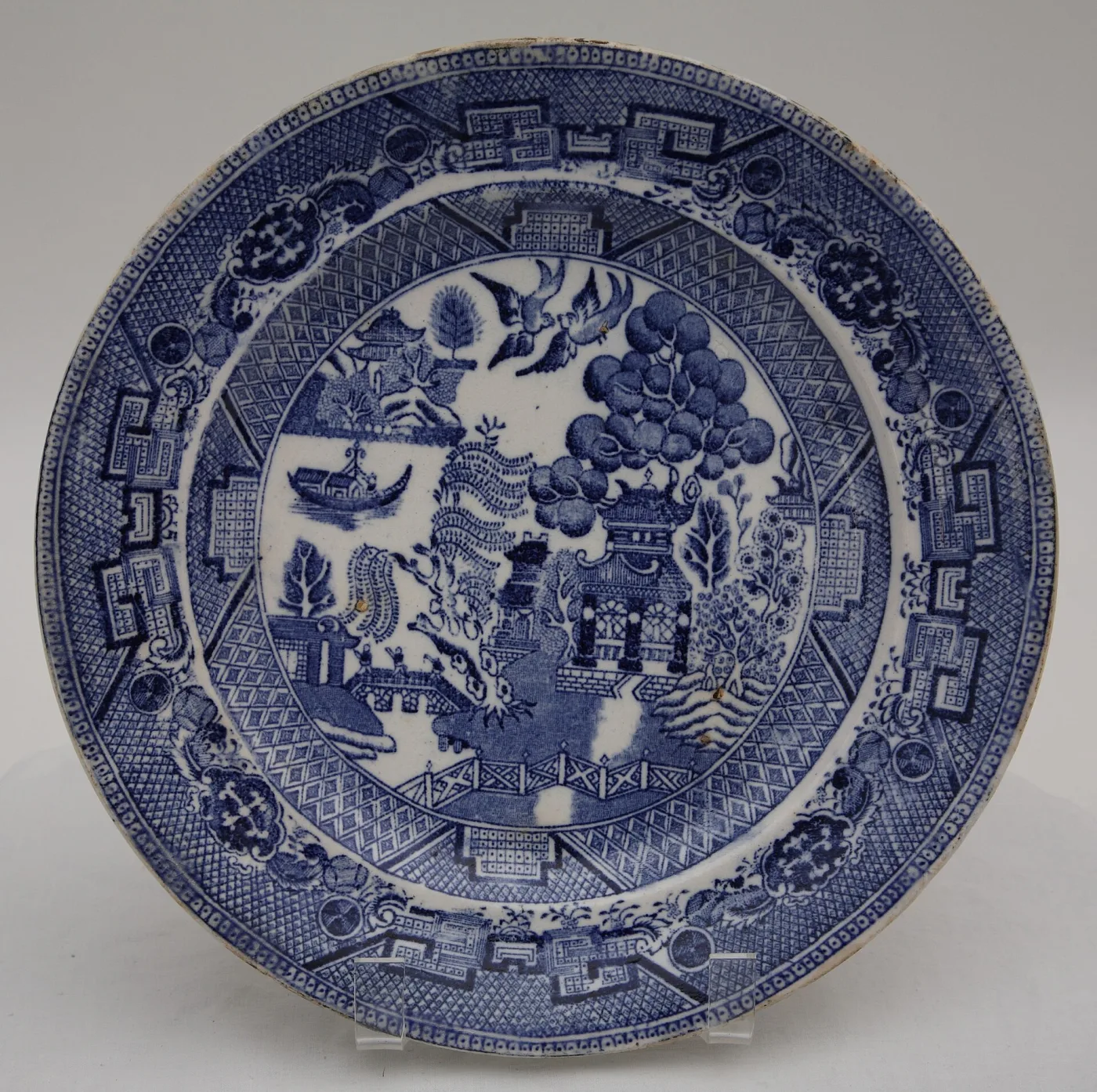
The fully developed “standard” Willow pattern contains a recognized set of elements: a large willow tree near the center; a substantial teahouse or pavilion with several roofs beneath it; an orange or apple tree beside the house; a zig-zag bridge carrying three figures (the fleeing lovers and the pursuing father); a boat with a figure on the water; a small island with a cottage; an elaborate fence or railing across the foreground; and, in the sky, the two birds facing each other. A surrounding decorative border frames the whole.
Counting and Arrangement
Collectors distinguish versions partly by counting elements — how many figures cross the bridge (the classic standard shows three), how many roofs the teahouse has, whether the apple tree bears a particular number of fruit, and the exact placement of the boat and island. Early and faithful versions tend to include the full cast in the “correct” arrangement; simplified or later versions may drop figures, shrink the scene, or rearrange it.
Standard Versus Variant Layouts
The most common layout is called the “Standard” Willow, but several recognized alternatives exist, such as the “Two Temples” (or “Broseley”) and “Traditional” arrangements, which differ in the position of the buildings, the form of the bridge, and the framing. Recognizing which layout you have is a first step toward identifying a maker, since some firms favored particular versions.
Mirror Images and Reversals
Because the pattern was engraved by many hands, you will encounter mirror-image versions in which the willow and teahouse swap sides. This is normal and reflects different engravers' copper plates rather than a fault. Note the orientation as one more identifying detail rather than assuming a reversed scene is “wrong.”
Borders: The Collector's Key
If there is one secret to telling Willow makers apart, it is the border — the decorative band around the rim is often far more diagnostic than the central scene, which many factories copied closely from one another.
Why Borders Distinguish Makers
The central Willow scene was so widely copied that it varies surprisingly little between factories; the border, by contrast, was where engravers exercised individual style. Particular border designs became closely associated with particular makers and periods, so identifying the border type frequently narrows the field of possible origins more sharply than studying the bridge or birds.
The Main Border Families
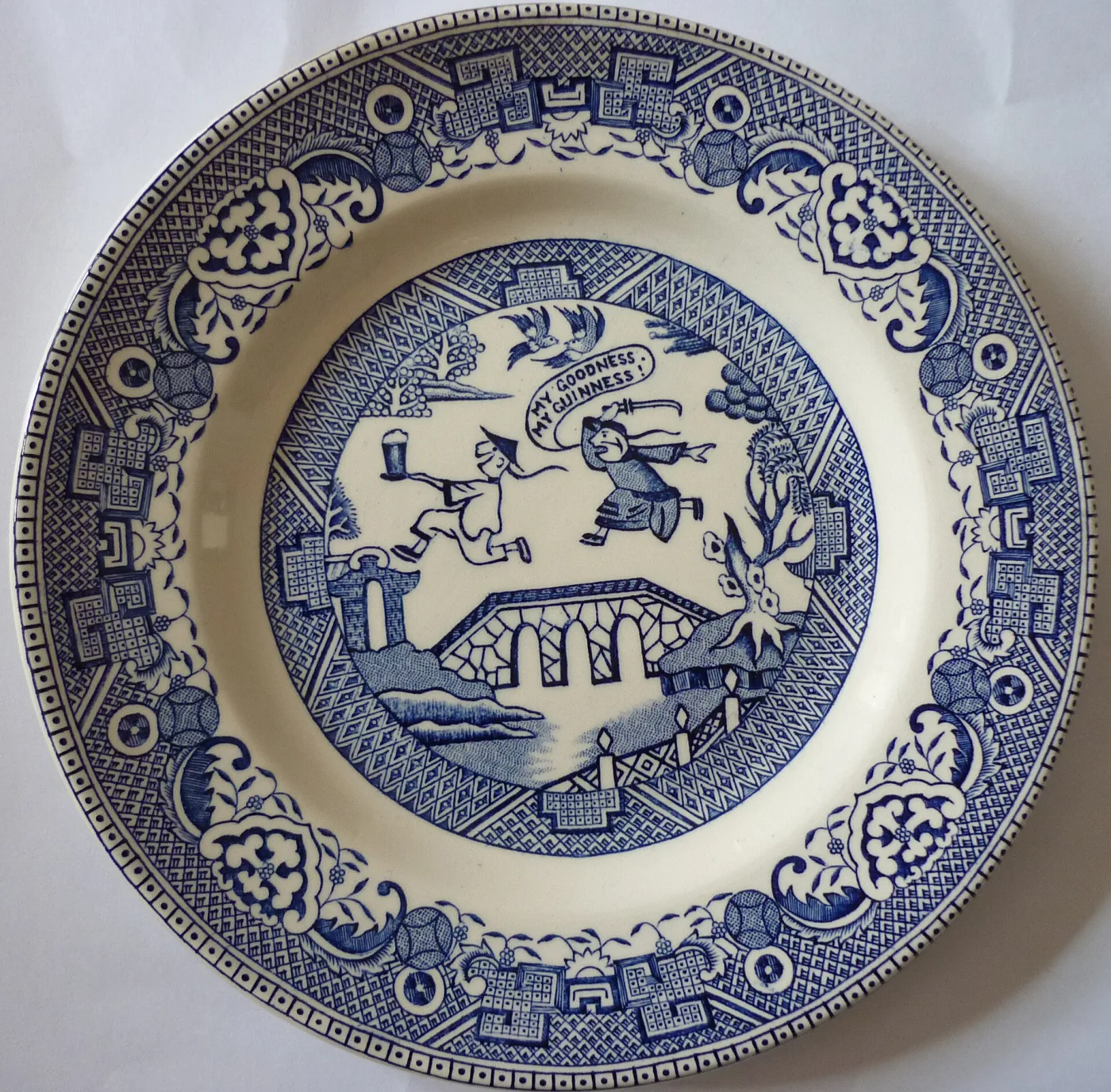
Several broad border types recur. The geometric or fretwork border uses repeating angular, lattice-like motifs and is among the oldest and most classic. The butterfly border incorporates stylized insects and scrolls. The apple or fruit-and-flower border features rounded fruit and blossoms. There are also scrollwork, trellis, and floral-band borders. Each family appears in many sub-variations, and learning to sort them by eye is a core collector skill.
Matching Border to Maker
Standard reference works on Willow catalog which border types and inner-band designs correspond to which factories and eras. While the central scene says “this is Willow,” the border often says “this is likely an early English maker” or “this is a later, simpler production.” When a backstamp is worn or absent, the border becomes the most important surviving clue to origin.
Inner Bands and Spacers
Beyond the rim border, look for inner decorative bands, line borders, and the small “spacer” motifs between the main scene and the rim. The fineness and design of these elements track the quality and date of a piece: crisp, detailed inner bands suggest careful early engraving, while coarse or absent ones often indicate later, cheaper production.
How Transfer Printing Works
Understanding the printing process is essential because the way the blue design was applied — and the tiny flaws that betray it — is one of the surest guides to a piece's age and quality.
From Engraved Copper to Pottery
Classic Willow is a transfer print: a design hand-engraved onto a copper plate is inked with cobalt color, printed onto thin tissue paper, and the inked paper is laid onto the unglazed (biscuit) pottery, transferring the design. The piece is then glazed and fired, sealing the blue beneath the glaze (hence “underglaze blue”). This Staffordshire innovation made detailed blue-and-white ware affordable for the first time, and the same technology underlies the whole transferware field.
The Tell-Tale Signs of Early Transfer Printing
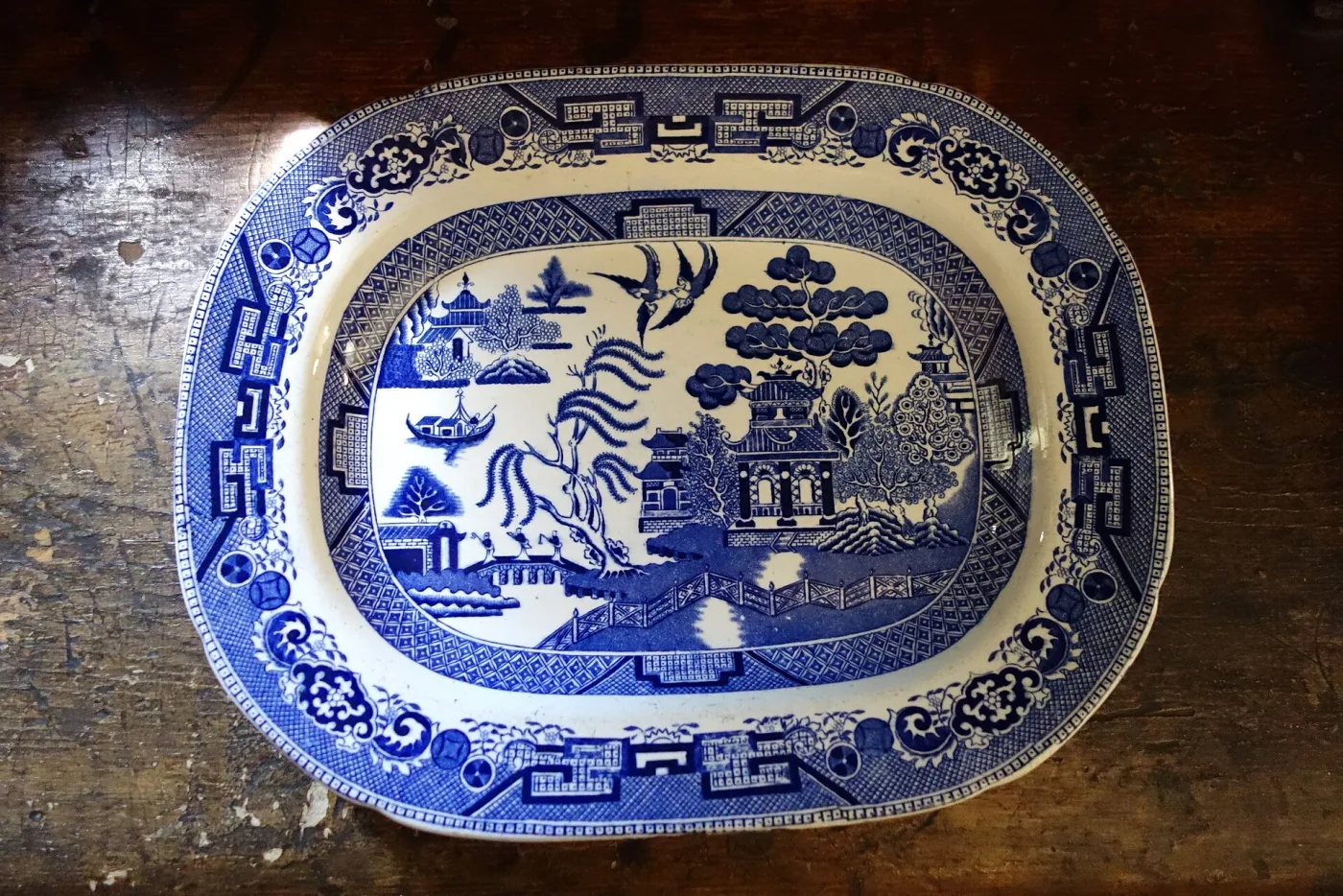
Genuine early transfer prints show characteristic features: faint seam lines or slight misalignments where sections of the paper met, tiny gaps or “flaws” where the tissue wrinkled, a slightly stippled or engraved texture visible under magnification (fine dots and lines from the engraving, not a smooth photographic tint), and small variations from piece to piece. The blue often has depth and slight unevenness rather than flat, mechanical uniformity. These honest imperfections are signs of hand-engraved, hand-applied work.
Underglaze Versus On-Glaze
On true underglaze Willow, the blue lies beneath the glaze: run a fingertip over the surface and the decoration is smooth and protected, and the color cannot be scratched off. Later or cheaper pieces sometimes use on-glaze or decal decoration sitting on top of the glaze, which can wear, scratch, or feel slightly raised. Checking whether the blue is under or on the glaze is a quick, useful test of quality and often of age.
Modern Lithographic and Decal Printing
Twentieth-century and contemporary Willow is frequently decorated by lithographic transfer or decals rather than hand-engraved copper plates. The result tends to be flat, perfectly even, and photographically smooth, lacking the fine engraved texture and small flaws of early work. Under a loupe, a modern litho or decal often shows a regular dot screen or uniform tint, whereas an early engraving shows irregular hand-cut lines and stipple. This single distinction separates a great deal of early ware from later production.
The Major English Makers
England was the birthplace and long the heartland of Willow, and recognizing the principal English firms — and the look of their ware — is central to dating and valuing a piece.
Spode and the Early Pioneers
Josiah Spode is traditionally credited with perfecting and popularizing the Willow pattern in Staffordshire around the 1790s, and Spode Willow is among the most historically important. Other early Staffordshire engravers — including Thomas Minton, often associated with the pattern's early development — helped establish the design. Early Spode and contemporaries produced finely engraved, deeply colored ware that sits at the prestigious end of the field. The fine earthenware bodies of this era connect to the wider story told in our ceramics and pottery identification guide.
The Great Victorian and Later Firms
Through the nineteenth and twentieth centuries, a roll-call of major English potteries produced Willow in quantity: Booths (noted for a fine, often unusually crisp Willow), Allerton, Wedgwood, Minton, Royal Worcester, Doulton, and many Staffordshire firms. Each tended to have characteristic body, glaze tone, border choice, and backstamp, so attributing a piece to a specific maker depends on reading those features together rather than the scene alone.
Booths and the “Real Old Willow”
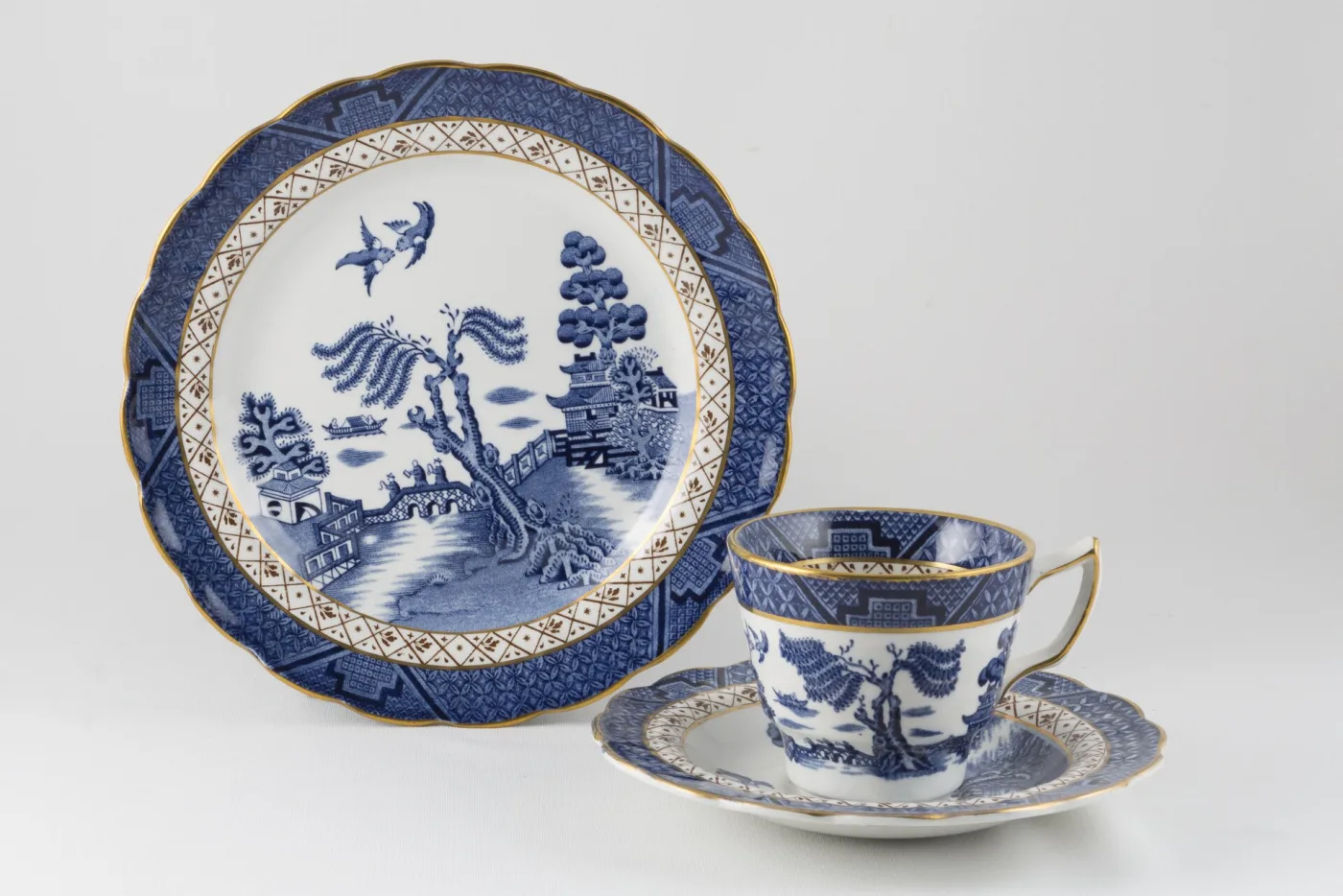
Booths is particularly worth knowing because its “Real Old Willow” line is widely collected and often confused with much older ware. Booths produced a high-quality, richly printed (sometimes gilded) Willow that looks antique but dates largely from the late nineteenth and twentieth centuries. The phrase “Real Old Willow” in a mark is a brand line, not a guarantee of great age — a useful caution for buyers.
Johnson Brothers and Twentieth-Century Tableware
Firms such as Johnson Brothers produced enormous quantities of Willow dinnerware for the twentieth-century household and export market. This later English tableware is attractive and collectible but generally more recent and more common than Georgian or early Victorian ware, and its clearly printed modern backstamps usually make it straightforward to date. Recognizing it prevents the common error of paying early-Spode prices for mid-century Johnson Brothers.
American and Other Makers
Willow long ago escaped England, and a great deal of the ware encountered today — especially in North America — was made by American, Japanese, and other producers whose marks and characteristics are worth knowing.
American Potteries
By the late nineteenth and early twentieth centuries, American firms were producing Willow for home and commercial use. Buffalo Pottery (Buffalo China) is especially well regarded for its early-1900s Willow, and Homer Laughlin, along with numerous other American potteries, produced Willow dinnerware and restaurant ware. American Willow often carries clear, dated, or distinctively American backstamps, and the heavy vitrified bodies of commercial and restaurant ware are recognizable in their own right.
Japanese Willow
Japan became a vast producer of inexpensive Willow for export, particularly in the twentieth century. Japanese Willow is typically marked “Made in Japan” or, for the immediate post-war years, “Made in Occupied Japan,” the latter being a precise and valuable dating clue (roughly 1945–1952). Japanese pieces range from thin porcelain tea ware to sturdy dinnerware, and the wording of the mark is usually the fastest route to dating them.
Continental European Makers
Potteries across Europe — in France, Germany, the Netherlands, and elsewhere — also produced Willow and Willow-like blue-and-white ware. Their marks, body types, and border styles differ from the English norm, and some Continental blue-and-white shades drift toward the deep, flooded look discussed in our flow blue china identification guide. Country-of-origin wording again does much of the work in separating these from English and Asian pieces.
The Sheer Breadth of Production
The practical lesson is that “Blue Willow” on the shelf could have come from almost anywhere. Far from narrowing the field, the pattern itself is the least distinctive feature; origin must be established from the mark, the body, the border, and the printing quality, considered together.

Reading the Backstamp
The mark on the base is the single most powerful identification tool for Willow, and learning what to look for — and what its absence means — is the heart of dating and attribution.
Where to Look and What to Expect
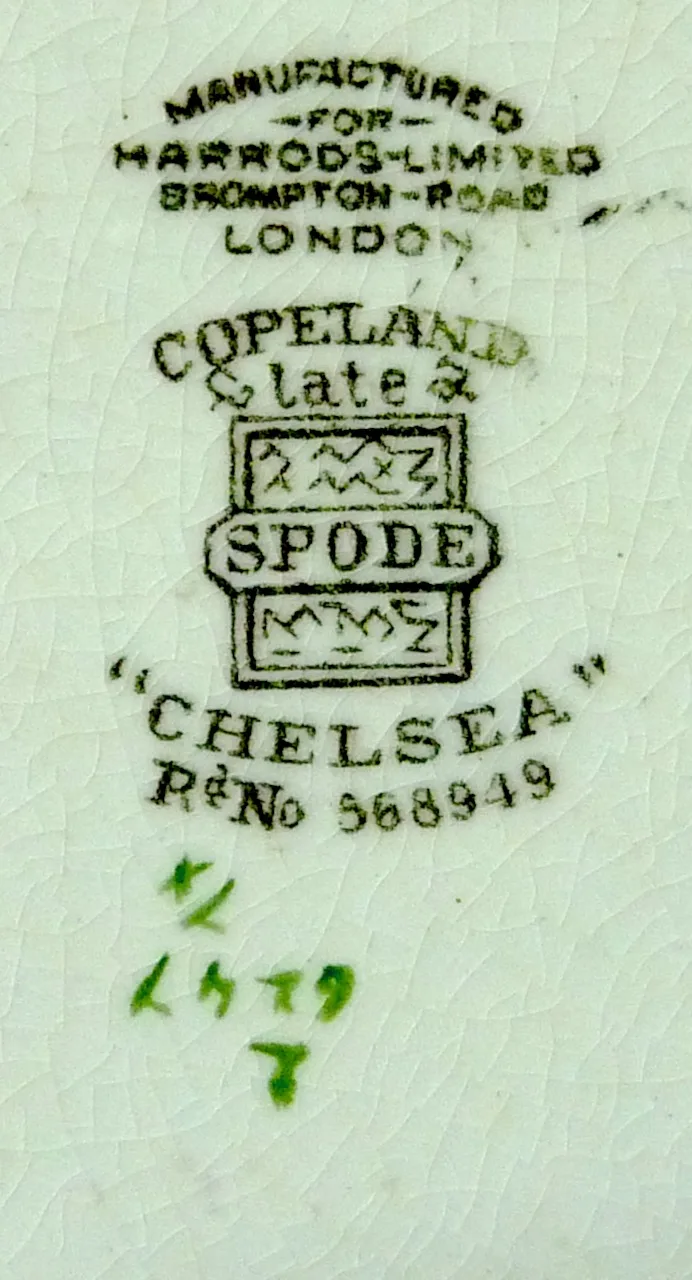
Turn the piece over and examine the base under good light. Marks may be printed (the most common), impressed (stamped into the clay), or painted. A Willow mark may include a maker's name or initials, a pattern name (often simply “Willow” or a brand such as “Old Willow”), a factory device or crest, a country of origin, and sometimes registration numbers or codes. The systematic reading of base marks is the same discipline applied throughout ceramics, as set out in our porcelain identification guide.
Printed Maker's Marks
From the Victorian era onward, most factories applied a printed backstamp identifying the firm, often with the pattern name and decorative devices. These marks evolved over time, so the exact wording and design place a piece within a maker's history. Matching a printed mark to documented examples in a marks reference is the surest single step in identification.
Impressed and Early Marks
Earlier ware may carry an impressed maker's name or a small impressed device rather than (or in addition to) a printed mark, and some very early pieces are unmarked or carry only a workman's or pattern symbol. Impressed marks are pressed into the soft clay before firing and have a characteristic indented look. Their presence, style, and wording all help date a piece to the earlier period.
Registration Marks and Numbers
British pieces may carry a diamond-shaped registration mark (used in the mid-to-late nineteenth century) or a “Rd. No.” registration number (from 1884 onward), both of which can be decoded to a registration date that sets an earliest-possible date for the design. These are precise dating tools when present and well worth checking for.
When the Mark Is Absent or Worn
Many genuine pieces are unmarked, partially marked, or have marks worn by age and washing. Absence of a mark does not condemn a piece, but it shifts the burden onto the border, body, and printing quality. A confident, crisp, modern-looking printed mark, by contrast, generally indicates later production — honest age tends to show honest wear.
Country-of-Origin Dating
Few clues are as quick and reliable as the country-of-origin wording in a mark, because import laws fixed when particular phrases came into use, giving you firm date brackets at a glance.
No Country Named: Often Earlier
The earliest Willow generally carries no country of origin at all, because such labeling was not required. A piece with a maker's mark but no country name may predate the era when origin marking became standard — though this must be weighed with other evidence, since unmarked country is not proof of great age on its own.
“England” Versus “Made in England”
A widely used rule of thumb holds that the single word “England” in a mark points to roughly the 1890s onward (after country-of-origin marking was required for goods entering the United States), while the fuller phrase “Made in England” generally indicates the twentieth century, becoming common from around the 1920s. The shift from “England” to “Made in England” is one of the handiest rough dating signals in all British ceramics.
“Made in Japan” and “Occupied Japan”
For Japanese Willow, “Made in Japan” indicates twentieth-century export ware, while “Made in Occupied Japan” pinpoints the brief post-war occupation period (roughly 1945–1952), a precise and collectible date bracket. “Nippon” marks indicate an earlier window (before about 1921), giving Japanese pieces some of the tightest origin-based dating available.
Other Origin Wording
Marks naming other countries — or using “Foreign” or specific national wording — similarly reflect the import-labeling rules of their era and help bracket a date. Combined with the maker's mark and the style of the ware, origin wording usually narrows a piece to a few decades quickly and reliably.
Color and Pattern Variants
Although “Blue Willow” is the iconic form, the Willow pattern appears in a range of colors and treatments, and recognizing these variants is part of identifying and valuing a piece.
Classic Cobalt Blue
The standard and overwhelmingly most common color is a deep cobalt blue on a white ground. The exact shade varies from a bright, clear blue in fine early work to a softer or greyer blue in later or cheaper ware, and the depth and quality of the blue is itself a clue to the engraving and the period.
Flow Blue Willow
Some Willow was made in the “flow blue” style, in which the cobalt was deliberately made to blur and bleed into the glaze during firing, producing a soft, flooded, hazy look. Flow blue Willow is a distinct and collectible sub-type; its smudged outlines are a deliberate effect, not a printing fault, and it overlaps with the wider flow-blue field.
Other Colors: Pink, Mulberry, Brown, Green
Willow was also printed in colors other than blue — pink (sometimes called “Pink Willow”), mulberry (a purplish brown), brown, green, and black among them. These colored Willows used the same scene with different transfer inks. Some colors are scarcer than blue and can be more sought after by collectors precisely because they are less common, though blue remains the classic and most recognized.
Polychrome and Gilded Willow
A minority of Willow is polychrome — hand-colored or printed in several colors — or embellished with gilding, as in some higher-end Booths and other quality lines. These richer treatments were more expensive to produce and can command premiums, but they also require care in dating, since gilded “old-look” Willow is often later than it appears.
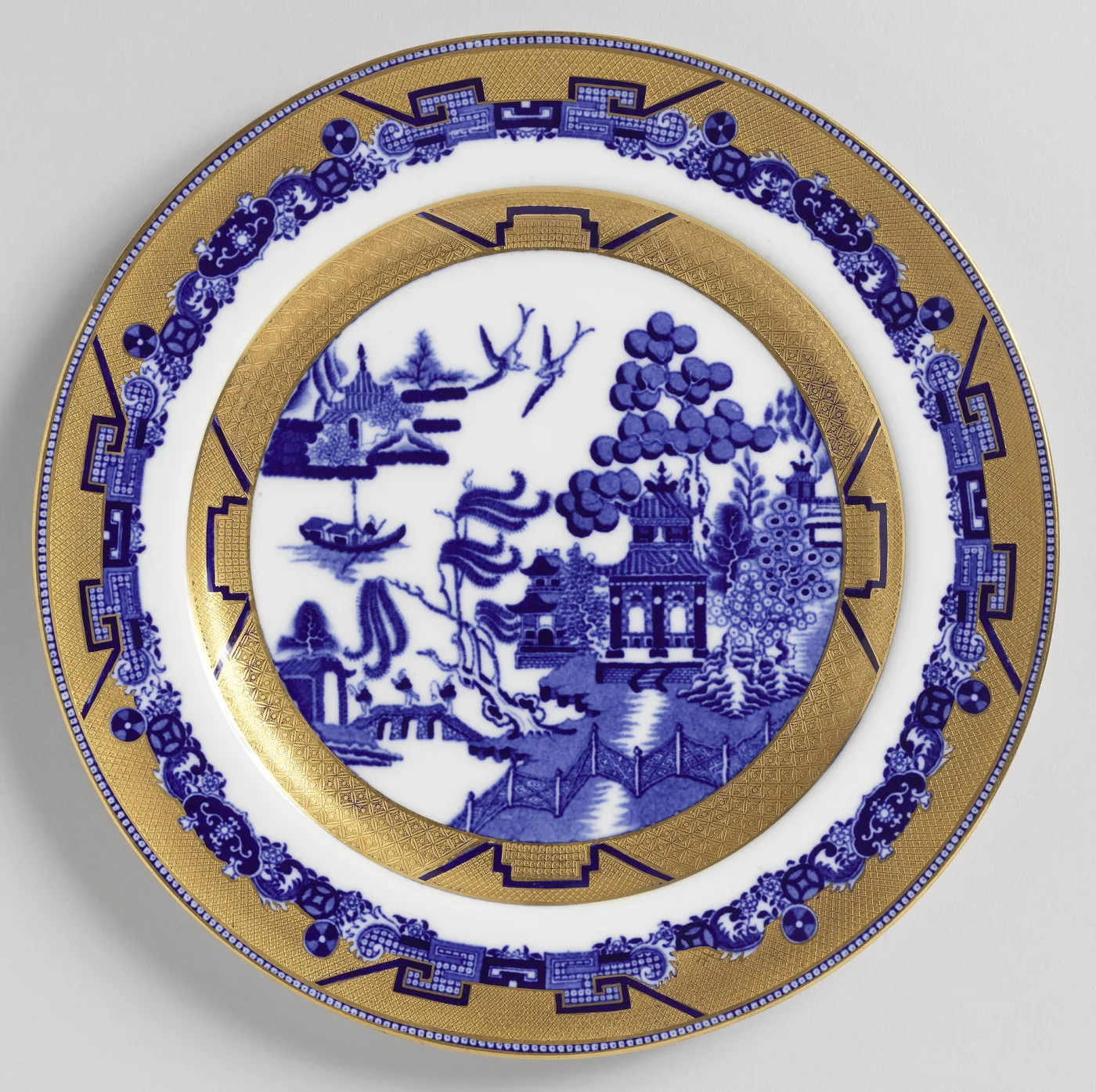
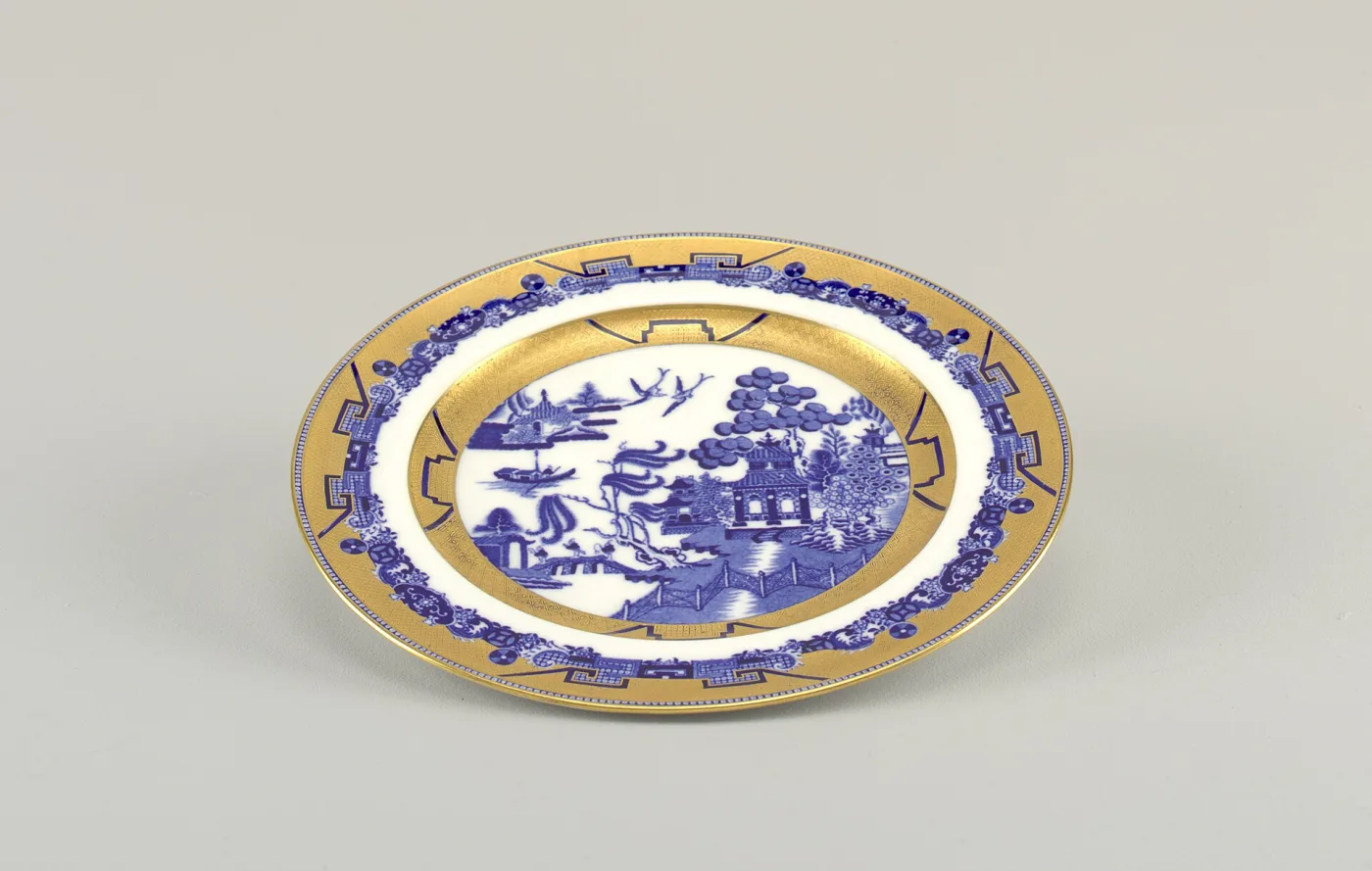
These are two photographs of one object, a nineteenth-century Mintons plate, and the pair is worth studying because gilded Willow has to be judged in two passes. Flat on, look at how much work the gold is doing: the printed scene is confined to a central medallion, the rim is a broad gold ground, and the fretwork panels around it are drawn in blue over the gold rather than being a printed Willow border at all. That is the giveaway that you are looking at a decorated blank rather than standard Willow — the print has become the smaller half of the design. Then tip the piece under a lamp, as in the second view. Gilding is applied on top of the fired glaze, so unlike the underglaze blue beside it, it wears: rims go pale, high points on moulded edges go silvery-brown, and washing-up thins it first where fingers land. A plate whose blue is crisp but whose gold has gone patchy has simply been used, but heavy gold that looks perfect on a piece sold as Georgian is a reason to check the mark again.
Putting a Date on a Piece
Dating Willow well means combining several independent clues rather than relying on any single one, because the pattern's two-century span and global production defeat any one-line shortcut.
Start with the Mark and Origin
Begin with the backstamp: identify the maker if named, decode any registration mark or number, and read the country-of-origin wording for its date bracket. This usually establishes the broad period — Georgian, Victorian, early twentieth century, or modern — faster than anything else, and frames everything that follows.
Read the Printing Quality
Next, judge the print itself: fine, slightly irregular, engraved-looking lines with small flaws and stipple point toward early hand-engraved copper-plate work, while flat, perfectly even, photographic-looking decoration points toward later lithographic or decal production. The quality and character of the blue is a strong, if qualitative, dating signal that complements the mark.
Consider the Body and Glaze
Examine the ware itself. Early pieces are typically earthenware (often pearlware, with a faintly blue-tinged glaze pooling blue in the crevices) or fine bone china; the glaze, weight, foot-ring finish, and any crazing all carry period clues. Heavy, bright-white, very smooth vitrified bodies often indicate later commercial or modern production. The general principles for reading bodies and glazes apply here just as in our ironstone china identification guide.
Cross-Check the Border and Layout
Finally, match the border family and pattern layout against documented maker associations. A particular border on a particular body with a particular mark and origin wording usually converges on a fairly tight date and attribution. When the clues disagree — an “old” scene with a modern mark, say — trust the hard evidence of the mark and printing over the romance of the picture.
Reproductions and New Willow
Because Willow has been made continuously and is so beloved, the market is full of recent, reproduction, and reissued ware, and telling new from old is one of the buyer's most important skills.
Willow Has Never Stopped Being Made
Unlike many antique patterns, Willow is not merely reproduced — it is still in ordinary production. New Willow dinnerware is sold today, and decades of twentieth-century ware fills cupboards everywhere. The challenge is therefore less about deliberate forgery and more about distinguishing genuinely old pieces from the vast quantity of recent and current production that looks superficially identical.
The Decoration Test
The most reliable tell is the printing. New and recent Willow is almost always decorated by modern lithographic transfer or decal: flat, perfectly even, photographically smooth, often with a visible regular dot screen under magnification, and lacking the fine engraved lines, stipple, seams, and small flaws of early hand-engraved work. An early copper-plate print has character and minor irregularity; a modern print is mechanically perfect. This difference, seen under a loupe, separates most old from most new.
Body, Weight, and Glaze Clues
Modern reproductions often have a very white, very smooth, heavy vitrified body and a hard, bright, craze-free glaze, in contrast to the softer earthenware, faint glaze tint, lighter or differently balanced weight, and natural crazing of genuinely old ware. Suspiciously perfect, brilliant-white china carrying an “antique” scene deserves scrutiny.
Marks on Reproductions
Reproduction and current Willow usually carries clearly modern marks — crisp printed backstamps, contemporary brand names, “Made in China” or other modern origin wording, dishwasher- and microwave-safe notices, or no period maker at all. A modern care notice or a current country-of-origin phrase is conclusive evidence of recent manufacture, whatever the picture suggests. Treat any clean, modern mark as exactly what it is.
Honest Reproductions Versus Deception
Much new Willow is sold honestly as new and is perfectly enjoyable as tableware. The danger is when recent or mid-century ware is described — innocently or otherwise — as “antique” or “Spode” to justify a high price. The defense is always the same: read the mark, test the printing, and examine the body before believing any claim of great age. The broader skills of provenance and attribution in our authentication and provenance research guide apply directly.
Condition Assessment
Condition strongly affects both the value and the usability of Willow, and printed earthenware has its own characteristic problems to check for methodically under good light.
Chips, Nicks, and Rim Damage
Run a fingertip and your eye around every rim, foot, spout, handle, and the edges of lids, where chips and nibbles concentrate. Rim chips and flakes, nicks to spouts and handle ends, and damage to foot rings all reduce value. Plates and platters chip at the edges; hollow ware chips at spouts and rims.
Cracks and Hairlines
Hold the piece to the light and look for hairline cracks, especially across plate centers, through the walls of bowls and jugs, and from rims; tap gently and listen for a dull, dead note that betrays a crack. Hairlines are common on old earthenware and are a serious condition issue, particularly if they have darkened with age and use.
Crazing and Staining
Fine crazing — the network of tiny glaze cracks — is extremely common on old earthenware Willow and is generally a sign of age rather than a fault. It becomes a value problem when the crazing has trapped brown or grey staining from tea, food, or damp. Heavy, discolored crazing and ingrained stains lower value and are hard to remove safely.
Wear to the Print and Glaze
Examine the decoration for wear: utensil scratches across plate centers, fading or thinning of the blue, and rubbed glaze on well-used surfaces. On true underglaze ware the blue is protected and wears slowly, but heavy use dulls the glaze and can scratch it. Significant surface wear, especially in the center of much-used plates, reduces value.
Repairs, Restoration, and Marriages
Inspect for old riveted (stapled) repairs on early pieces, filled and over-painted chips and cracks, and replaced or married lids on tureens and teapots. Restored areas may feel different, show a difference in sheen, or fluoresce under ultraviolet light. Married lids that do not quite fit or match the body are common on serving pieces and affect value.
What Drives Value
Willow values span an enormous range, and the famous pattern alone is rarely the main driver — several factors combine to separate a few-dollar plate from a prized early piece.
Age, Maker, and Rarity
Early, finely engraved ware by an important maker — Georgian and early Victorian Spode and its contemporaries above all — sits at the top, while later mass-produced twentieth-century and modern Willow is modest. Attributable, well-documented early pieces from prestigious firms command the strongest prices; anonymous later tableware is common and inexpensive.
Form and Rarity of Shape
Unusual and larger forms multiply value. Large meat platters, tureens, sauce boats, drainers, footed dishes, and unusual or novelty shapes are far more sought after than the ubiquitous cups, saucers, and dinner plates. A rare form in an early body and a desirable border can be worth many times a common plate of the same pattern.
Color and Treatment
Scarcer colorways (some pink, mulberry, green, or polychrome Willows) and richer treatments (fine flow blue, quality gilding) can carry premiums over standard blue, all else being equal. Conversely, a worn, late, plain blue plate is at the entry level no matter how charming the scene.
Condition and Completeness
Condition swings value substantially: clean, bright, undamaged, uncrazed-and-unstained, unrestored pieces command strong prices, while chips, cracks, heavy staining, print wear, and restoration subtract heavily. Complete sets and serving pieces with their original lids carry premiums, and a matched service is worth more than the sum of scattered pieces.
Setting Realistic Expectations
Because Willow is so common, sober, market-based valuation matters: the name guarantees recognition, not rarity. For realistic figures across categories, our valuation and appraisal guide explains how to weigh age, maker, form, and condition together — and how to avoid both overpaying for ordinary ware and overlooking a genuinely early treasure.
Care, Cleaning, and Use
Old printed earthenware rewards gentle, conservative handling, and a few simple habits prevent most of the damage that destroys value.
Hand-Wash Antique Pieces
Never put old or valuable Willow in a dishwasher. Detergent and heat dull the glaze, worsen crazing and staining, and can damage any gilding or on-glaze color. Wash gently by hand in lukewarm water with a little mild detergent, padding the sink, and dry promptly with a soft cloth. (Modern, dishwasher-safe new Willow is the exception, but treat anything old as fragile.)
Dealing with Crazing and Stains
Avoid prolonged soaking of crazed pieces, since water and any cleaning agent penetrate the crazing and cause or worsen staining. Do not use bleach or harsh chemicals routinely, as they can lurk in the crazing and damage the piece over time. For stubborn stains on a valued piece, seek conservative, reversible conservation methods rather than aggressive cleaning.
Display and Handling
Display plates on padded stands or secured hangers away from edges, and keep pieces out of harsh direct sunlight, which can, over long periods, affect some colors and any over-glaze decoration. Lift teapots and jugs by the body, never by the handle or spout alone, and never lift a lidded piece by its lid.
Storage
For storage, separate stacked plates with felt or acid-free tissue to prevent scratching, support handles and spouts, and avoid stacking heavy pieces on fragile ones. The general principles in our storage, care, and preservation guide apply directly to printed earthenware and china.
Common Beginner Mistakes
A handful of errors trap new Willow collectors repeatedly, and avoiding them will save both money and disappointment.
Assuming the Pattern Means It Is Old or Chinese
The single biggest misconception is that the Willow scene — and its romantic legend — signals great age or Chinese origin. Neither is true: Willow is an English pattern made continuously for over two centuries by makers worldwide, and a piece's age and origin come from its mark, body, and printing, not from the picture or the story.
Trusting the Scene Over the Mark
Because every Willow piece looks broadly alike, beginners judge by the familiar scene and ignore the base. The mark, the country-of-origin wording, any registration number, and the quality of the printing are what actually identify and date a piece. Always turn it over and read the evidence before forming a view.
Mistaking Modern or Mid-Century Ware for Antique
Vast quantities of twentieth-century and current Willow look superficially like early ware. A flat, perfectly even, photographic print; a brilliant-white, heavy, craze-free body; or a modern mark with a care notice all indicate recent production. Paying antique prices for mid-century Johnson Brothers or new reproduction Willow is a classic and costly error.
Overpaying for Common Forms
Cups, saucers, and dinner plates are the most-produced Willow forms and are usually inexpensive, however appealing. Value concentrates in early ware, prestigious makers, unusual and large forms, scarce colors, and fine condition — not in the ordinary plate, no matter how famous the pattern.
Ignoring Condition Faults
Hairline cracks, heavy stained crazing, print wear, and restoration are easy to miss and significantly reduce value. Inspect every rim, foot, and surface under good light (and ultraviolet for restoration), check lids for fit and match, and treat undisclosed damage as a serious value issue. For confident identification, photograph the base, the mark, the border, and the printing clearly before buying, selling, or valuing.
Frequently Asked Questions
Is Blue Willow china Chinese?
No. Despite the Chinese-style imagery, the Willow pattern is an English creation of the late eighteenth century, developed by Staffordshire potters who drew on imported Chinese porcelain for inspiration. It was made affordable by transfer printing and produced by hundreds of factories in England, Europe, America, and Japan. Genuine Chinese export porcelain is a separate field; classic Willow as collectors know it is a Western product imitating an Eastern look.
How old is my Blue Willow china?
Age is determined by the mark, the printing, and the body together, not by the pattern. Read the backstamp for a maker and any registration number, and the country-of-origin wording for a date bracket (no country named often means earlier; “England” points to roughly the 1890s onward; “Made in England” usually means the twentieth century). Fine, slightly irregular engraved printing on softer earthenware suggests early ware; flat, perfectly even printing on heavy bright-white china suggests later or modern production.
What is the legend behind the Willow pattern?
The familiar story tells of a Mandarin's daughter and a humble secretary who fall in love, flee across a bridge from her angry father, hide on an island, are killed, and are turned by the gods into the two birds at the top of the design. It is a charming tale, but it was invented in England after the pattern existed, as storytelling and marketing — it is not an ancient Chinese legend and says nothing about a piece's age or origin.
How can I tell who made my Blue Willow?
Start with the backstamp: a maker's name, initials, crest, or brand identifies the firm, and matching it to a marks reference confirms it. When the mark is worn or absent, the border design becomes the key clue, since particular borders are associated with particular makers, while the central scene varies little. The body, glaze, country-of-origin wording, and printing quality together narrow the attribution.
Why is the border so important on Blue Willow?
Because the central Willow scene was copied so closely by so many factories that it varies little between them, whereas the rim border is where engravers showed individual style. Particular border families — geometric, butterfly, apple/fruit, scroll, and others — became associated with specific makers and periods, so identifying the border type often narrows the origin more sharply than the scene. When a mark is missing, the border is your best surviving evidence.
Is Blue Willow valuable?
It ranges enormously. Early, finely engraved ware by an important maker such as Spode, and rare or large forms (platters, tureens, sauce boats) in good condition, command strong prices. But the vast majority of Willow is later, mass-produced, common tableware — cups, saucers, and dinner plates — worth only modest sums. The pattern guarantees recognition, not value; age, maker, form, color, and condition decide the price.
What is “flow blue” Willow?
Flow blue Willow is the pattern printed in the flow-blue style, where the cobalt was deliberately made to blur and bleed into the glaze during firing, giving soft, hazy, flooded outlines. The smudged look is an intentional effect, not a printing fault, and flow blue Willow is a distinct collectible sub-type that overlaps with the wider flow-blue field of nineteenth- and early-twentieth-century ware.
Does “Made in Japan” or “Occupied Japan” Willow have value?
Japanese Willow is generally twentieth-century export ware and is usually modest in value, but the wording dates it precisely: “Made in Japan” indicates the twentieth century, while “Made in Occupied Japan” pinpoints roughly 1945–1952 and is collected for that brief, datable window. “Nippon” marks indicate an earlier period (before about 1921). Condition, form, and the appeal of the specific piece still determine the price within these brackets.
How do I tell antique Willow from a modern reproduction?
Examine the printing under a loupe: early hand-engraved copper-plate Willow shows fine, slightly irregular lines, stipple, faint seams, and small flaws, while modern lithographic or decal Willow is flat, perfectly even, and photographically smooth, often with a regular dot screen. Then check the body and mark: a brilliant-white, heavy, craze-free body, a crisp modern backstamp, a care notice, or current country-of-origin wording all indicate recent manufacture, whatever the scene suggests.
Can I use my Blue Willow china for meals?
Modern, dishwasher-safe Willow is made for everyday use. Antique pieces are best used gently or kept for display: hand-wash only, avoid prolonged soaking of crazed ware, and be cautious with old pieces around food if there is any gilding, on-glaze color, or uncertainty about the glaze. When in doubt, treat old Willow as a decorative collectible and reserve daily dining for modern ware.