
Griswold Cast Iron: Dating a Skillet by Its Logo
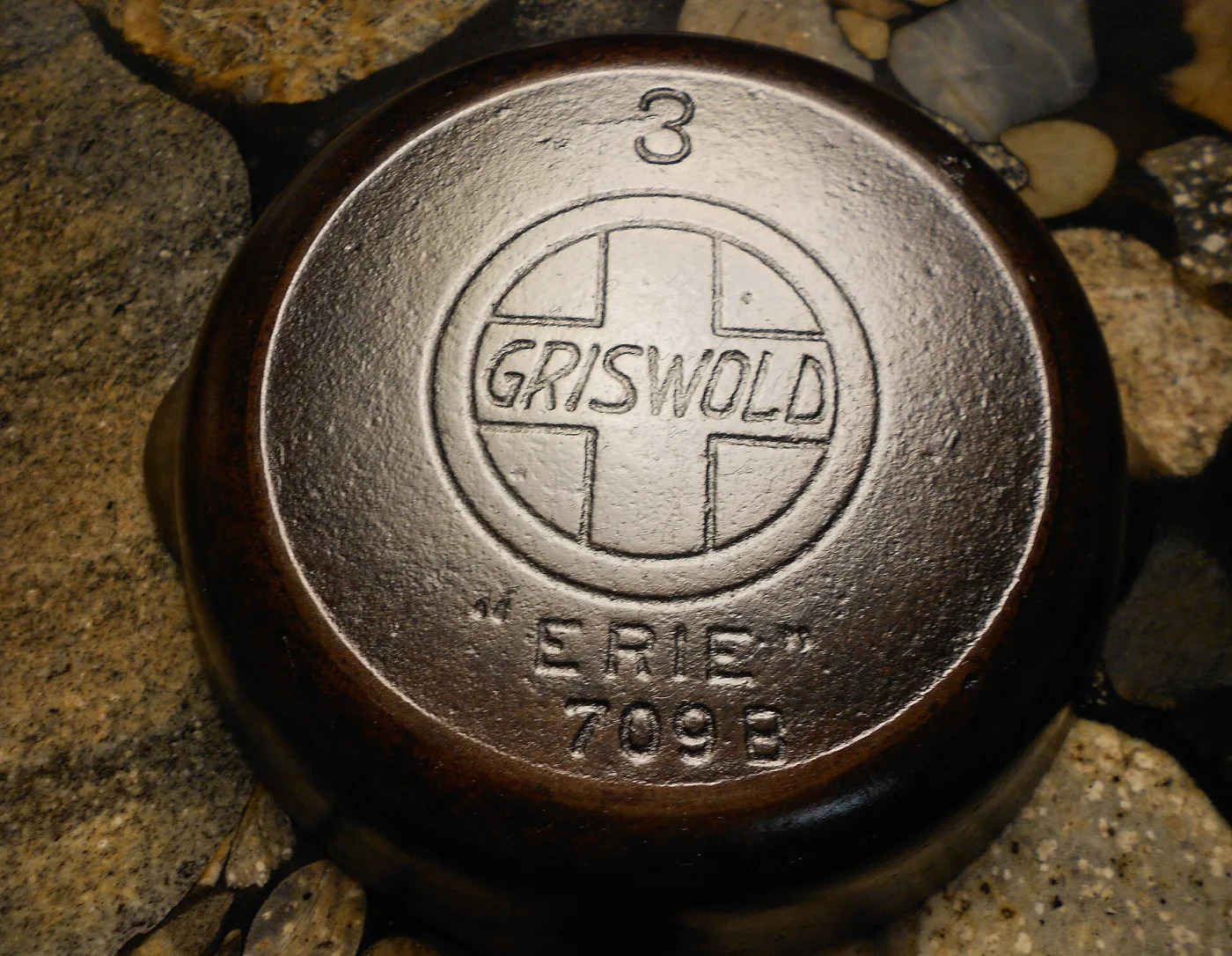
Griswold made cast iron cookware in Erie, Pennsylvania, for more than ninety years, and it marked almost every piece it cast. That mark changed several times, and because each version was used for a known span of years, the logo on the bottom of a Griswold skillet is the quickest and most reliable way to date it.
This guide reads those marks in order, from the plain word ERIE of the 1880s to the Wagner-era pans made after the Erie foundry closed, with the date range for each and the details that separate one from the next.
Table of Contents
The Marks in Order
Every Griswold date starts with one question: what does the mark on the base say, and how is it lettered? The table below puts the main marks in sequence. The date ranges are approximate, and published sources place the boundaries a few years apart, so read them as eras rather than exact years, and note where two eras overlap.
| Mark on the base | Approximate dates | How to recognise it |
|---|---|---|
| ERIE, no Griswold name | c. 1880–1907 | The word ERIE, often in quotation marks, with no cross logo and no company name |
| Slant logo | c. 1906 to the 1920s | GRISWOLD in italic letters leaning right, inside a cross in a double circle; ERIE below it, or ERIE, PA., U.S.A. |
| Large block logo | c. 1920–1940 | GRISWOLD in bold, upright block letters in a large logo, usually with ERIE, PA., U.S.A. |
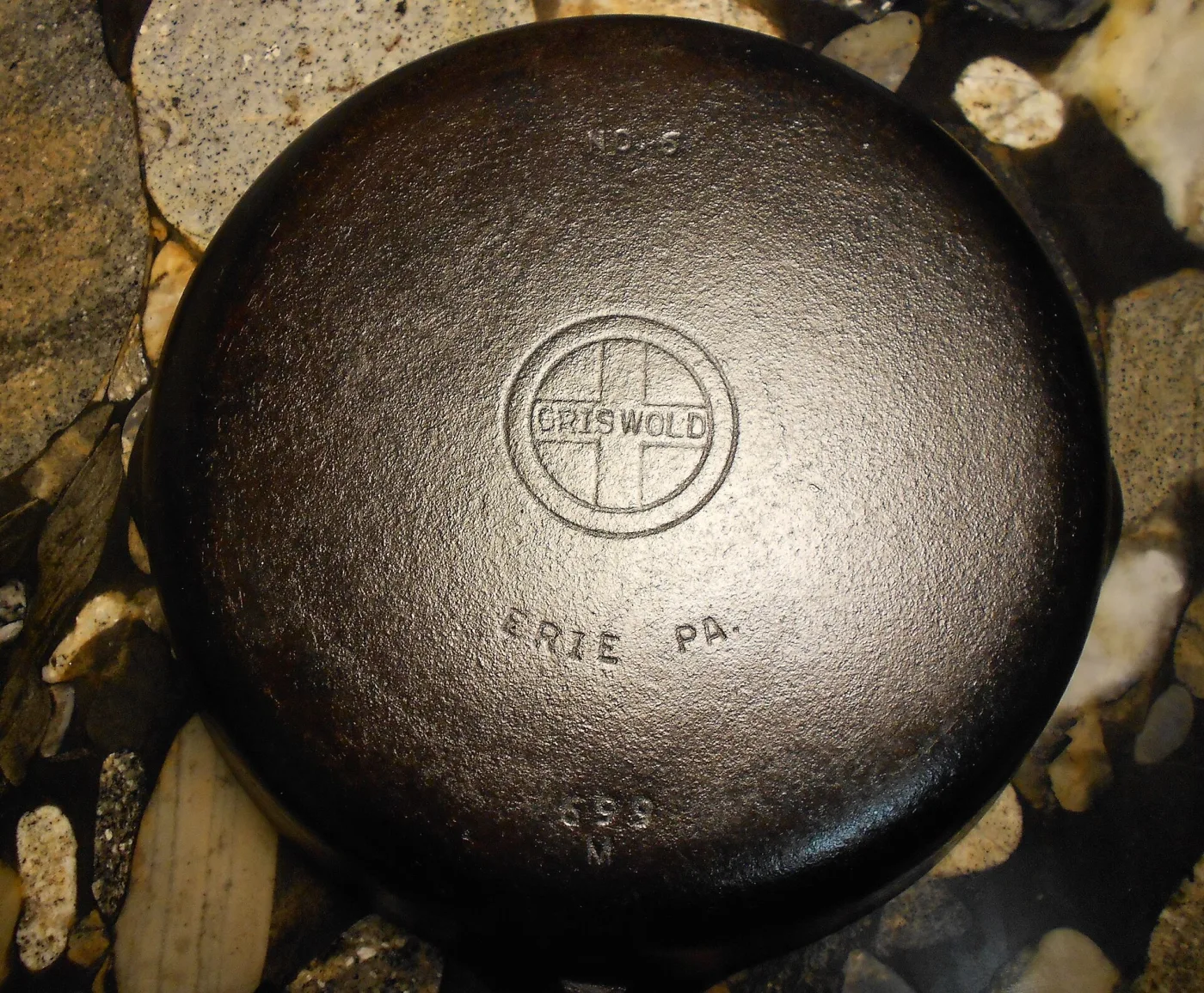
| Small logo | c. 1939–1957 | The same block logo reduced in size, with lighter lettering and ERIE, PA. shortened |
| Griswold with no ERIE, PA.; later Griswold with Wagner | 1957 to the late 1960s | Made after the Erie plant closed and the brand passed to Wagner |
Published sources disagree about the slant logo in particular: one gives the 1910s to the early 1920s, another 1906 to 1929. They agree on the order, and the order is what dates a pan. A slant logo is always older than a large block logo, and a large block logo older than the small one.
Before the Logo: ERIE
The company was founded in Erie in 1865 and took the name Griswold Manufacturing Company in 1887. For its first decades it did not put its own name on its skillets at all. It marked them with the name of the town, ERIE, and collectors date these ERIE skillets from about 1880 to about 1907.
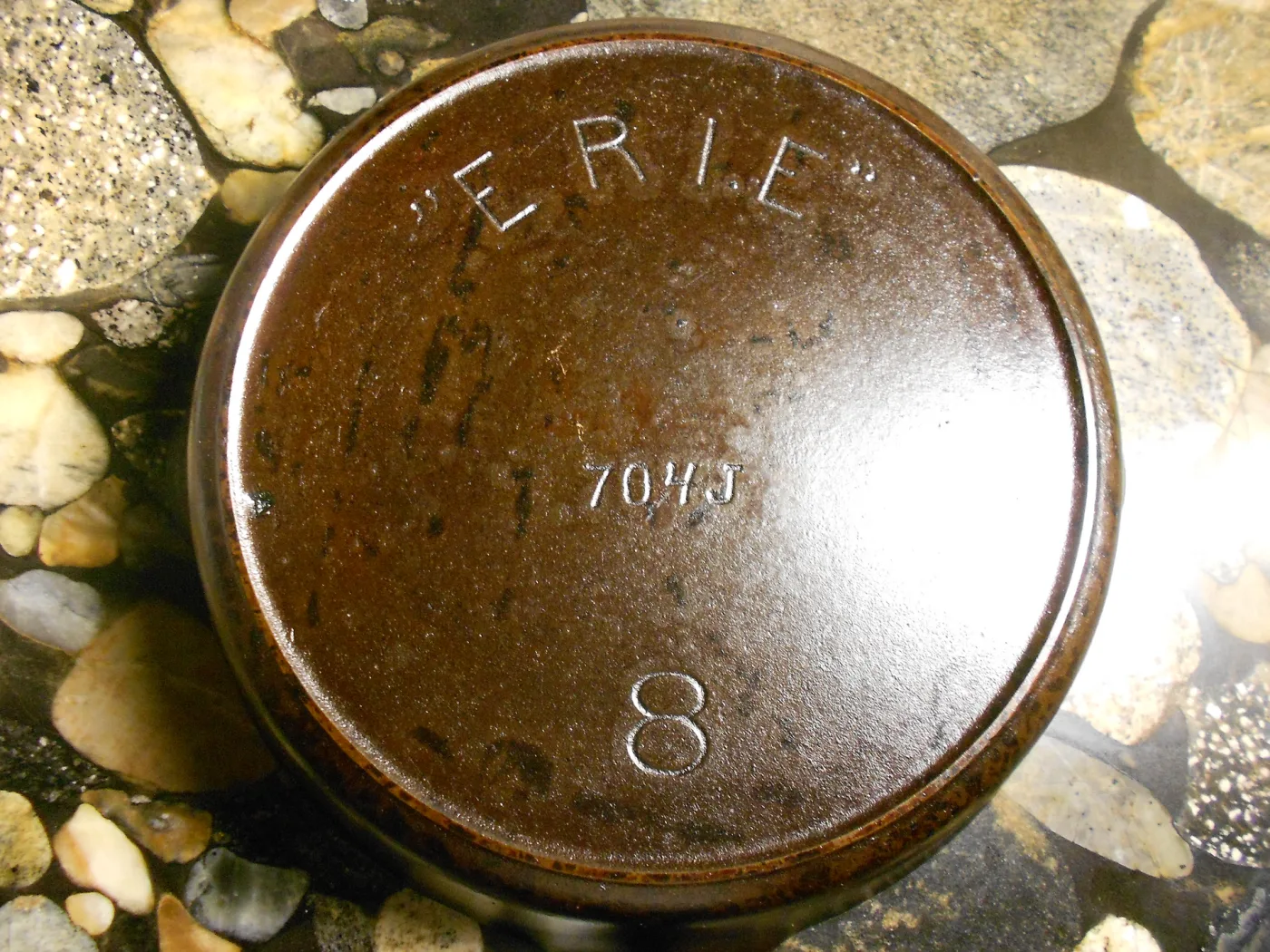
Two numbers appear on most of these pans and on everything that followed. The large single number is the size, and the smaller number with a letter, like the 704J above, is the pattern number. Around 1906 the company began adding its own name to the old mark, first as Griswold's Erie, and then moved to the cross logo that collectors know best. Earlier and rarer Griswold marks exist, but ERIE is the earliest one you are likely to find at a sale.
The Slant Logo
The slant logo was the first Griswold trademark used across nearly all of the company's production. Look for three things: the word GRISWOLD in italic letters that lean to the right, a cross behind it, and a double circle around the whole mark.
What sits under the logo splits the slant era in two. Some pieces read simply ERIE, as above, and others spell out ERIE, PA., U.S.A. Collectors call these Slant Erie and Slant EPU. Many slant-era skillets also have a heat ring, a raised ring around the outer edge of the base. If you are sorting a mixed lot of cast iron, the broader cast iron collectibles guide covers the other makers you will meet alongside Griswold.

The Large Block Logo
Around 1920 the lettering straightens up. The large block logo spells GRISWOLD in bold, upright block letters and is usually accompanied by ERIE, PA., U.S.A. It ran until about 1940.
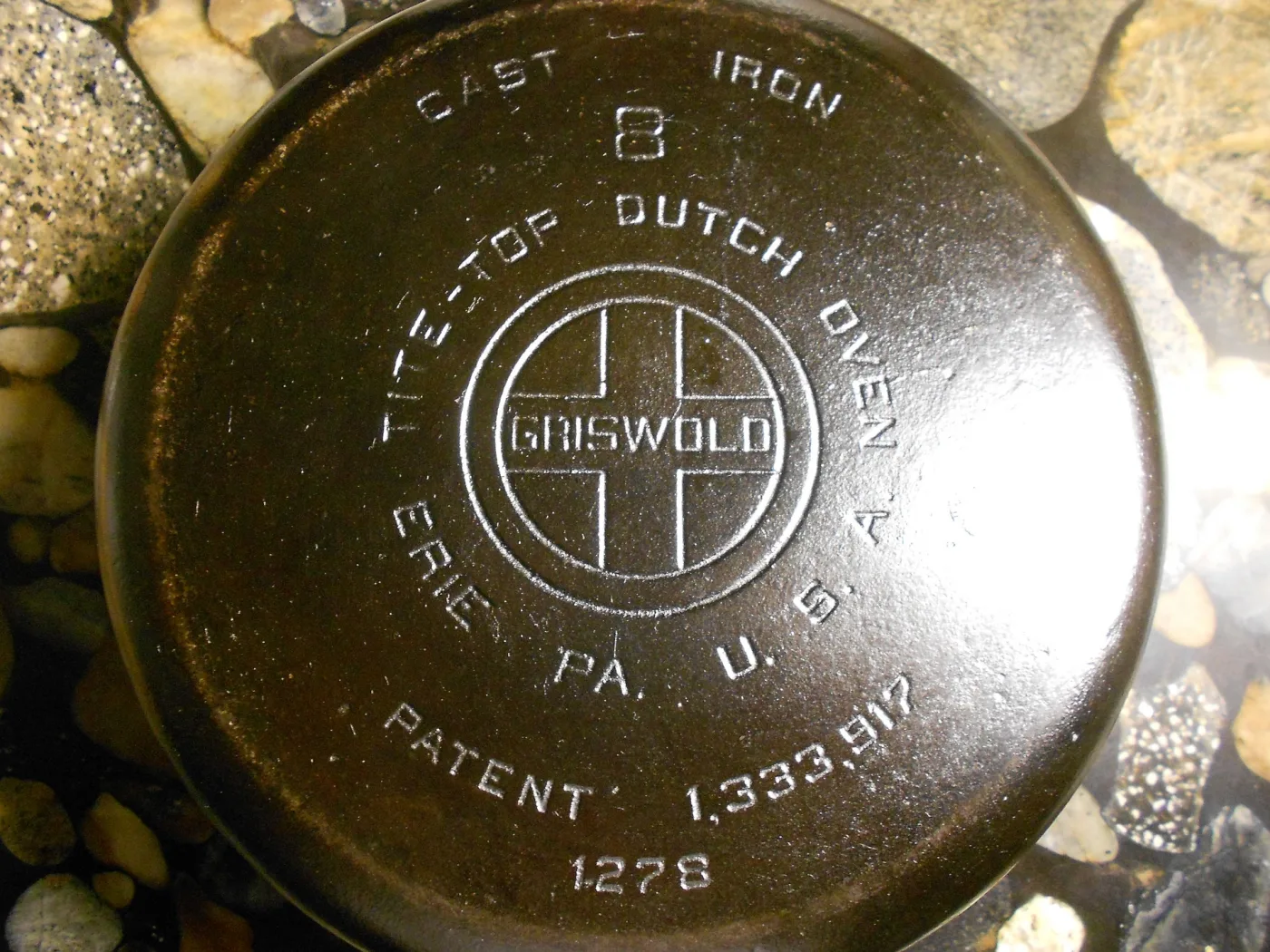
Pieces other than plain skillets often spell out what they are around the logo, as this Dutch oven does. That lettering helps identify the form but does not change the date: read the logo itself.
The Small Logo
About 1939 the logo was reduced in size, the lettering became lighter, and ERIE, PA., U.S.A. was shortened to ERIE, PA. This small logo was used until 1957. It is the easiest late mark to recognise: the logo looks undersized in the middle of the base.
Skillets are not the only thing that carried these marks. Griswold also cast trivets, kettles and other kitchen iron with the same logos, so the sequence here works on those too; our guides to antique trivets and antique kitchenware cover what else turns up with a Griswold mark.
After 1957: Wagner-Era Griswold
The Griswold family sold the company in 1946. In March 1957 McGraw-Edison acquired it, the brand was sold to the Wagner Manufacturing Company of Sidney, Ohio, and the Erie plant closed in December 1957.
Griswold-branded pieces continued to be made after that, and they are easy to spot once you know the rule: the Griswold logo without ERIE, PA. under it dates from 1957 into the mid-1960s. In the early to mid 1960s some pieces carry both Griswold and Wagner marks, and the Griswold name was phased out around 1970. These later pans are genuine Griswold-branded cast iron, but they were not made in Erie.
Three More Things to Check
The logo dates a pan. Three other features help confirm that the date makes sense.
The cooking surface. Older American cast iron, Griswold included, was sand cast and then machined smooth inside as a finishing step. Most foundries dropped that step in the mid-twentieth century, and many modern pans are left with the rough texture of the mould. A glassy smooth interior fits an older pan, although it cannot date one on its own.
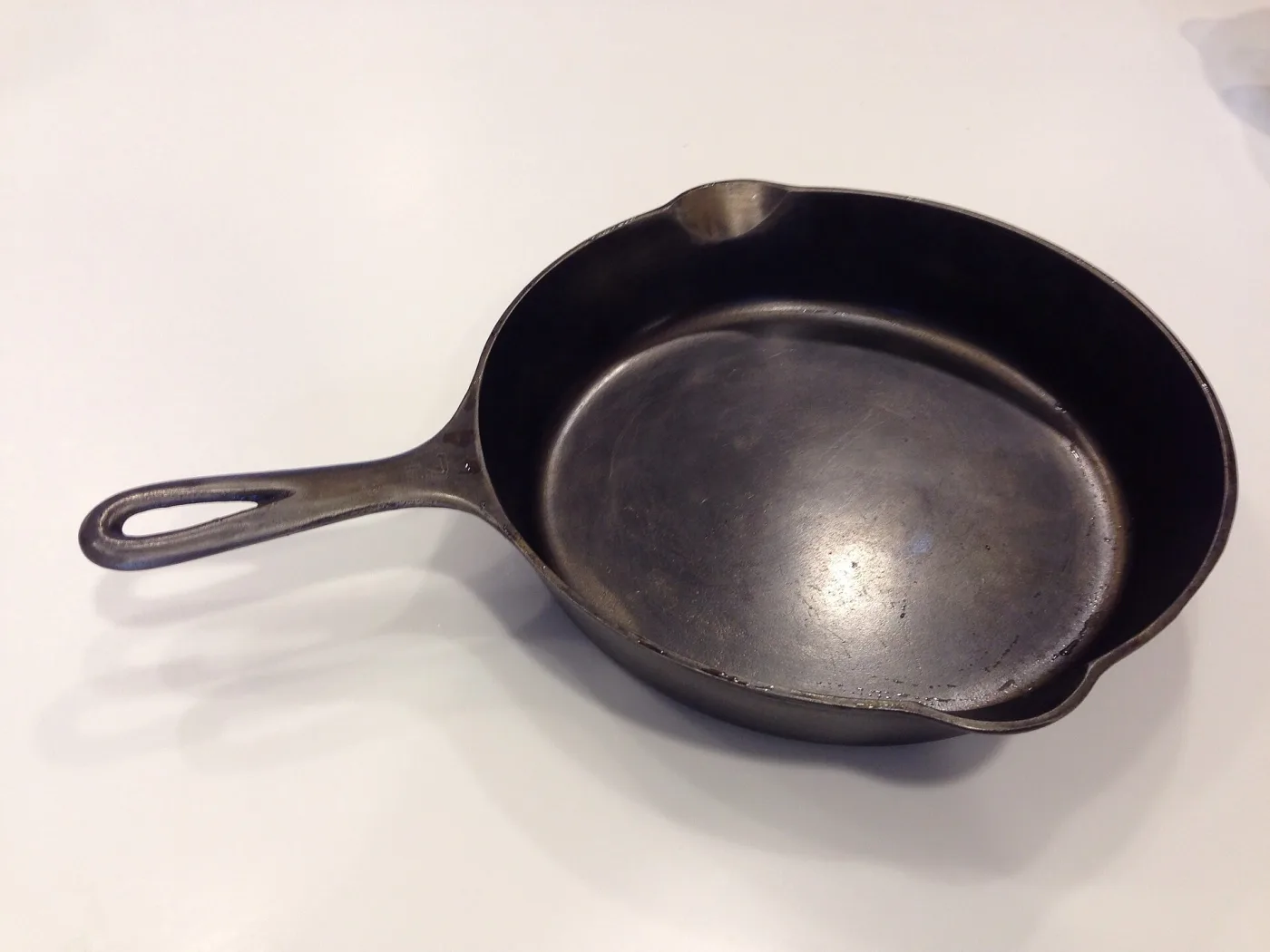
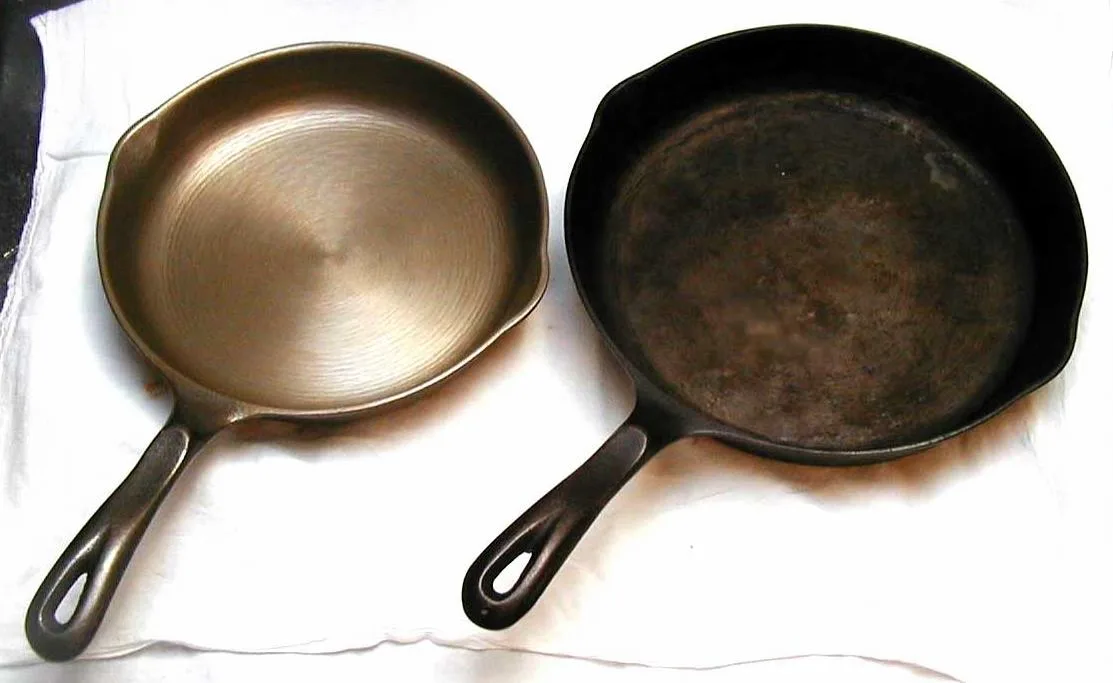
The size and pattern numbers. Most Griswold pieces carry both, as every photograph in this guide shows: the size as a single large number, the pattern number as a smaller number, often with a letter. Compare the logo and lettering on your pan carefully against the photographs above.
The casting. Older Griswold and Wagner pans are known for finer castings than most modern cast iron. For other old household iron and its makers, the guides to sad irons and copper cookware are good next reads.
Frequently Asked Questions
How do I tell how old my Griswold skillet is?
Turn it over and read the mark. ERIE on its own, with no Griswold name, puts it before about 1907. A slanted Griswold inside the cross logo means roughly 1906 to the late 1920s, bold upright block letters about 1920 to 1940, and a noticeably smaller logo about 1939 to 1957. A Griswold logo with no ERIE, PA. under it was made after the Erie plant closed in 1957.
What does ERIE mean on a cast iron skillet?
It is the town where Griswold made it, Erie, Pennsylvania. Griswold marked its skillets simply ERIE, with no company name, from about 1880 until about 1907, so a skillet marked only ERIE is one of its earliest common forms.
What is the difference between the Griswold slant logo and the block logo?
The slant logo spells GRISWOLD in italic letters that lean to the right, inside a cross in a double circle. The block logo that followed from about 1920 uses bold, upright letters. The slant logo is the older of the two.
Is a Griswold skillet without ERIE PA real?
Yes, but it is late. Griswold's Erie plant closed in December 1957 after the brand was sold to Wagner, and Griswold-branded pieces made afterwards dropped ERIE, PA. from the mark. Dual Griswold and Wagner marks appear in the 1960s, and the Griswold name was phased out around 1970.
Why is the inside of an old skillet so smooth?
Older American cast iron was sand cast like modern pans and then machined smooth on the cooking surface as a finishing step. Most foundries dropped that step in the mid-twentieth century, so a glassy smooth interior is a sign of an older pan, though not a date on its own.
The Short Version
Turn the pan over. ERIE with no Griswold name means before about 1907. A slanted Griswold in the cross logo means the slant era, roughly 1906 to the 1920s. Bold upright block letters mean about 1920 to 1940, and a noticeably small logo with ERIE, PA. means about 1939 to 1957. A Griswold logo with no ERIE, PA. at all was made after the Erie plant closed in 1957.
Then check that the rest agrees: a smooth interior, crisp numbers and a casting that is not unusually heavy. When the logo and the pan tell the same story, you have your date.