
Shaker Furniture Identification Guide: Communities, Marks & Dating
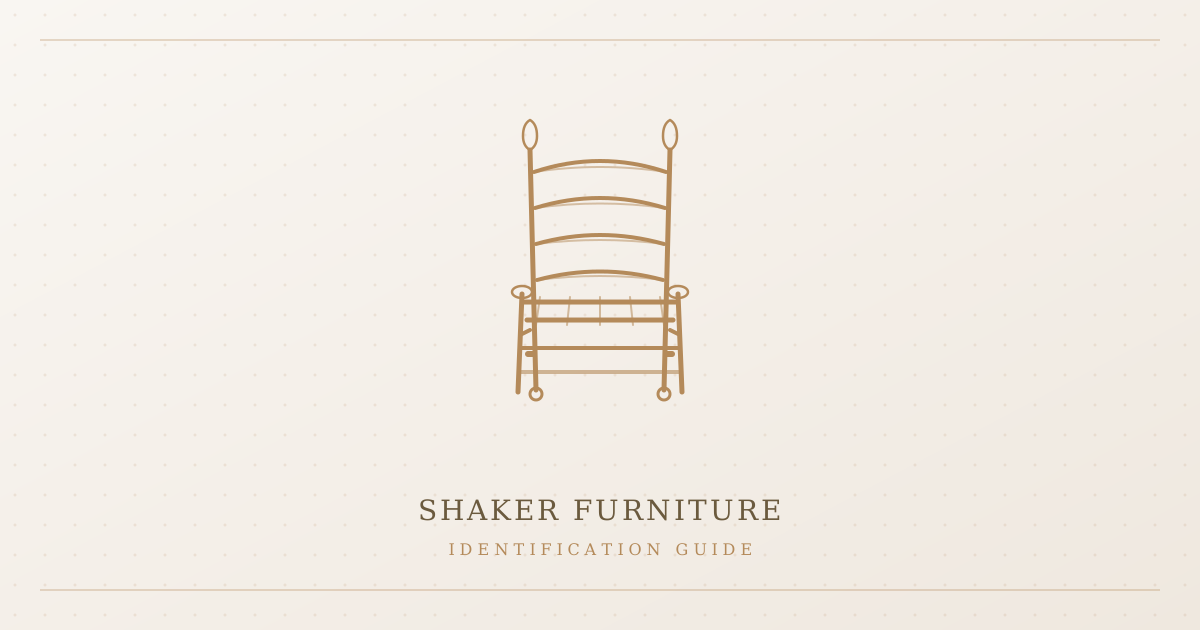
No American furniture is more instantly recognizable — or more widely imitated — than the work of the Shakers. Their tapered ladder-back chairs, oval boxes with swallowtail joints, and severe built-in cupboards distilled a religious philosophy into wood: simplicity, honesty, and utility raised to the level of art. That clarity is exactly why "Shaker" became one of the most borrowed style words in the furniture trade, applied to everything from genuine community-made pieces to twentieth-century factory reproductions and modern flat-pack cabinetry.
The Shakers, formally the United Society of Believers in Christ's Second Appearing, built self-sufficient communal villages across New England, New York, Ohio, and Kentucky from the late 1700s onward. They made furniture first for their own dwellings and workshops, and later — most famously chairs — for sale to "the world." Understanding which category a piece falls into, and which community and decade it came from, is the core skill this guide builds.
Below you will find a practical framework for reading form, wood, joinery, finish, and marks so you can separate genuine Shaker work from Shaker-style furniture, place authentic pieces by community and era, and judge condition and value honestly. As with any famous name, treat each clue as one strand of evidence — a tape seat or a peg rail proves nothing on its own.
Table of Contents
- Who Were the Shakers?
- What "Shaker Style" Really Means
- The Core Design Principles
- Signature Forms to Recognize
- Woods and Finishes
- Joinery and Construction Clues
- The Communities and Their Traits
- Production Chairs, Numbers & Trademarks
- Marks, Labels, and Attribution
- Genuine Shaker vs. Revival & Reproduction
- Condition, Restoration, and Value
- Field Checklist Before You Buy
Who Were the Shakers?
The Shakers arrived in America in 1774 under the leadership of Mother Ann Lee, an English immigrant whose followers organized into celibate, communal societies dedicated to hard work, equality of the sexes, and separation from worldly excess. By the mid-nineteenth century roughly eighteen major communities stretched from Maine to Kentucky, home to several thousand members at the movement's peak. Each village was largely self-supporting, running farms, mills, and craft shops that produced everything the community needed.
Furniture-making grew directly out of this self-sufficiency. Cabinetmakers — always working anonymously, as personal fame contradicted Shaker humility — built beds, chairs, tables, cases of drawers, and vast built-in cupboards for the communal dwelling houses. The same shops later turned outward, selling chairs, oval boxes, and other goods to non-Shakers as a source of income once membership began to decline after the Civil War.
Why Their Furniture Looks the Way It Does
Shaker design was not an aesthetic movement chasing fashion; it was theology expressed in objects. "Beauty rests on utility," the saying went, and ornament for its own sake was considered pride made visible. The result was furniture stripped to essential function: clean lines, honest joinery on display, and proportions refined over generations of repetition. That discipline is precisely what later designers admired and what modern reproductions try — and often fail — to capture.
What "Shaker Style" Really Means
When collectors say a piece is "Shaker," they may mean one of three very different things, and confusing them is the most common — and most expensive — mistake buyers make. First, genuine community-made furniture built by Shakers in a Shaker village for their own use or for sale. Second, period furniture made outside the community in a similar plain vernacular. Third, later "Shaker-style" reproductions and interpretations, from Colonial Revival copies to today's mass-market cabinetry.
Only the first category is truly "Shaker" in the sense that drives the collector market and museum interest. The plainness that defines the style is also what makes it easy to imitate — a simple tapered leg and a ladder back are not hard to reproduce, which is why documentation and construction evidence matter far more here than a general "look."
Style Name vs. Community Attribution
Just as with a famous maker, separate two questions. First: Is this genuine Shaker community work at all? Second: Which community and which decade produced it? A realistic, defensible description might be "Shaker, Mount Lebanon, New York, circa 1840" or, just as honestly, "Shaker-style ladder-back chair, American, twentieth century." Both are legitimate; only one commands Shaker prices, and that claim needs real evidence behind it.
The Core Design Principles
Certain principles recur so consistently across genuine Shaker furniture that they function as a mental checklist. None is proof in isolation, but their combination — and above all their coherence — tells you a great deal.
Radical simplicity: No carving, no inlay, no applied ornament, no veneer for show. Decoration, when present at all, is limited to a turned finial, a subtle taper, or a color of paint.
Honest, visible joinery: Dovetails, mortise-and-tenon joints, and wooden pegs are exposed rather than hidden, treated as part of the design. The Shakers saw no reason to disguise sound construction.
Function first: Every element earns its place. Graduated drawers, built-in cupboards, peg rails running around rooms, and multipurpose forms all answer a practical communal need.
Refined proportion: Light, compact, and beautifully balanced. Shaker furniture often looks deceptively plain until you notice how carefully each dimension relates to the others.
Lightness and mobility: Chairs were built to be light enough to hang on wall pegs for cleaning, which drove the whole vocabulary of slender turned posts and woven seats.
Coherence Over Checklist
The trap is treating these traits as a shopping list. A reproduction can bolt a ladder back, a tape seat, and a coat of red paint onto a clumsy frame. Genuine Shaker quality shows in how the elements relate: consistent scale, disciplined proportion, and joinery that flows from the structure rather than sitting awkwardly on top of it. A useful test is to ask whether the piece would still read as balanced with any single feature removed. On the best community work, it would; on weak imitations, the "Shaker" cues are doing the work the proportions cannot.
Signature Forms to Recognize
Shaker output spans seating, case pieces, tables, and small woodenware, and each form carries its own diagnostic priorities.
Ladder-back (slat-back) chairs: The signature form. Slender turned posts, two to four gently arched horizontal slats (graduated in size), woven seats, and turned finials on the rear posts. Side chairs, armchairs, and rocking chairs all follow this template. These joined, turned chairs are worlds apart in construction from the plank-seated Windsor chairs made elsewhere in the same period.
Tape (list) seats: Woven seats of colored cotton or wool "listing" tape in checkerboard or herringbone patterns are almost uniquely Shaker and a strong identifying feature. Rush, splint, and cane were also used, but the woven tape seat is the classic tell.
Case pieces and built-ins: Cases of graduated drawers (largest at the bottom, smallest at top), tall cupboards over drawers, and enormous built-in storage walls in the dwelling houses. The built-in cupboard-and-drawer unit is one of the movement's defining contributions.
Tables and stands: Trestle dining tables long enough to seat a communal "family," small round or square candle stands on tripod bases, and sewing or work tables with drawers. Legs are typically turned or tapered with no carving.
Oval boxes and carriers: Bentwood oval boxes and handled carriers joined with distinctive "swallowtail" (finger) laps secured by copper tacks. These small objects overlap the world of treenware and woodenware and are among the most collected — and most reproduced — Shaker items.
Beds and utilitarian furniture: Simple low beds on wooden rollers, sconces, hanging shelves, and drying racks round out the domestic vocabulary. Even the humblest piece shows the same restraint as the finest.
The Tilting Chair
One clever Shaker innovation deserves special mention: the tilting chair. To keep members from damaging floors by leaning back, the Shakers devised a ball-and-socket "tilter" — a wooden ball set into the bottom of each rear leg on a leather thong, allowing the chair to rock back while the foot stayed flat on the floor. Original tilters are a strong authenticity marker, though they were often lost, replaced, or removed over the decades.

Woods and Finishes
The Shakers worked with locally available American timbers, and the wood used is an important dating and attribution clue. Maple is the classic choice, especially for turned chair parts, and became so characteristic that it functions almost as a signature. Pine (often for case interiors, backboards, and drawer bottoms), cherry, birch, butternut, and walnut all appear, with hickory reserved for parts that had to bend. Southern communities such as Pleasant Hill and South Union used regional woods including walnut and cherry more freely.
Primary and secondary woods should make sense together for the community and period. Genuine work typically pairs a hardwood show surface with regional softwood secondaries in drawers and backs. Timbers inconsistent with nineteenth-century American practice — plywood, tropical hardwoods, or uniform modern lumber — are an immediate caution flag.
Paint, Stain, and Patina
Contrary to the modern image of raw blond wood, much Shaker furniture was originally painted or stained in muted, community-regulated colors: red, yellow ochre, blue, green, and various washes. These finishes were thin and functional, meant to protect and unify rather than decorate. Original paint dramatically increases value, so learn to distinguish authentic aged surfaces — thin, worn where hands and cloth naturally acted, oxidized in a coherent pattern — from later overpaint applied to fake age or to "improve" a plain piece. Stripped surfaces, by contrast, usually reduce value on important pieces because they erase original evidence. The same careful reading of surface and wear that guides antique furniture identification generally applies with particular force here.
Joinery and Construction Clues
Construction evidence almost always outweighs decorative style, and with furniture this plain it is often the deciding factor. Start with drawers. Genuine period Shaker drawers show hand-cut dovetails — slightly irregular in spacing and angle, with visible scribe lines and saw kerfs. Drawers frequently use half-blind dovetails at the front (visible only when the drawer is pulled) and through-dovetails at the back. Uniform, perfectly even machine-cut dovetails point to later manufacture.
Examine how the piece is held together. Early work uses hand-cut mortise-and-tenon joints locked with wooden pegs (treenails), glued corner blocks, and animal-hide glue that crystallizes and darkens with age. Wooden knobs and pulls are the Shaker norm — turned from the same or a contrasting wood — rather than metal hardware, which the community generally avoided on furniture. Turned chair parts should show the marks and subtle variation of hand-lathe work, not the dead uniformity of modern duplication.
Wear Logic and Tool Marks
Authentic wear tells a coherent story. Drawer bottoms rub against runners, chair stretchers show foot wear, finish thins where hands and textiles acted, and the bottoms of feet abrade unevenly. Hand-plane tracks, drawknife facets, and lathe chatter can support age, but they can also be faked, so what matters is consistency — genuine oxidation and handling should align with the tool marks rather than sit freshly on top of altered surfaces. Circular-saw marks on secondary surfaces indicate post-1840s production at the earliest, a useful bracket when combined with other clues.
The Communities and Their Traits
Because Shaker furniture was made anonymously across many villages over more than a century, attribution rests heavily on regional and stylistic variation. Specialists identify community origin from the shaping of chair posts, stretchers, slats, and finials, together with the woods used. A working knowledge of the major communities sharpens any assessment.
Mount Lebanon (New Lebanon), New York: The central and most influential community, and the great center of chair production. Mount Lebanon chairs — with their characteristic finials, hand grips, and shaped slats — became the "Shaker chair" the wider world knew, and the community's export business set the standard for the style nationally.
Hancock, Massachusetts: Founded in 1790 and famous for its round stone barn, Hancock specialized in fine case furniture — blanket chests, tall chests of drawers, and built-ins — noted for durable, thoughtful construction.
Enfield (New Hampshire and Connecticut), Canterbury, and Sabbathday Lake: The northern New England communities produced distinctive case pieces and tall clocks; Canterbury and Sabbathday Lake in Maine are especially important, the latter being the last active Shaker community.
Union Village, Pleasant Hill, and South Union: The western communities in Ohio and Kentucky developed their own regional character, using local woods and showing subtle differences in proportion and hardware that separate their work from eastern pieces.
Reading Regional Variation
The practical lesson is that "Shaker" is not a single monolithic style but a family of closely related community traditions. Finial profiles (acorn, egg-and-collar, or elongated shapes), the taper and turning of posts, slat arch and thickness, and the choice of wood all carry regional information. Reference collections at museums and the surviving villages are the gold standard for calibrating your eye; auction catalogs from specialist Americana sales are the next best teacher.
Production Chairs, Numbers & Trademarks
By the 1860s the Mount Lebanon community had built a thriving business selling chairs to the outside world, and these "production chairs" are the Shaker furniture most collectors actually encounter. They were made in graded sizes and, crucially for identification, marked with a size number from 0 to 7 — usually stamped or incised on a back slat or the top of a rear post. Number 0 and 1 chairs were the smallest (made for children) and are especially desirable today; number 7 was the largest.
To combat the flood of commercial imitators cashing in on the Shaker name, the community introduced a formal trademark. From 1873 the Mount Lebanon chair operation applied a gold-transfer decal (decalcomania) trademark, produced by Palm, Fechteler & Company, described in the Shakers' own 1875 catalog as "a gold transfer... designed to be ornamental." The presence of an original gold trademark decal, combined with a size number, is strong evidence of genuine Mount Lebanon production-era work.
Reading a Production Chair
On a genuine production chair, expect turned maple posts, a woven tape or cane seat, mushroom-shaped hand grips on armchairs, and the ball-and-socket tilters described earlier on some examples. Rockers were a staple of the line. Because these chairs were made in quantity for sale, they show more standardization than earlier "in-community" furniture — but they are still Shaker, and the size number and trademark let you date and place them with unusual confidence. Beware, however, that the trademark decal has itself been faked, so weigh it alongside construction and wear rather than treating it as automatic proof.
Marks, Labels, and Attribution
Outside the production-chair line, genuine Shaker furniture is famously unmarked. Because personal recognition ran contrary to Shaker belief, cabinetmakers almost never signed their work, and most authentic pieces bear no maker's stamp at all. Attribution therefore depends on provenance and construction rather than a signature — the opposite of how you would approach a marked maker.
Where marks do exist, they tend to be functional rather than promotional: pencil or chalk inscriptions noting a room, a "family," or an inventory number; occasional owner initials; or, on later and sale pieces, applied paper labels and the production trademark. Twentieth-century marks — company stamps, retailer labels, or model numbers — are definitive evidence of reproduction rather than community work, however convincing the styling.
Documentation Over Certificates
For a category where the best pieces reach the mid-six figures at auction, provenance is everything. Prioritize a documented history tracing a piece to a specific community or long-held collection, old exhibition and catalog references, and assessments from recognized Shaker specialists. Modern "certificates of authenticity" from unknown issuers carry little weight. As with any high-value object, disciplined provenance research protects you far more reliably than a printed guarantee, and it is the single strongest lever you have on a piece that carries no maker's mark.
Genuine Shaker vs. Revival & Reproduction
The plainness that defines Shaker furniture makes it the most reproduced of all American styles, so separating genuine community work from later interpretation is the central buying challenge. Reproductions fall into several tiers, each with its own tells.
Commercial "Shaker-style" furniture (late 1800s onward): Rival chair makers imitated the Mount Lebanon line almost immediately — the very reason the trademark was created. These lack authentic size numbers and trademarks, and typically show cruder turning and proportion.
Colonial Revival and Arts-and-Crafts interpretations (early 1900s): The Shaker aesthetic influenced the plain, honest vocabulary of the Mission and Arts-and-Crafts movement; if you are placing a squarish, oak, obviously factory-made "Shaker-ish" piece, compare it against Stickley and Mission oak production, which it often actually is.
Modern reproductions and kit furniture (mid-1900s to today): From museum-shop reproductions to flat-pack "Shaker" cabinetry, these are made with machine-cut joinery, plywood, modern screws and glue, and uniform lumber. Some are honest, high-quality tributes; none is antique Shaker.
The Reproduction Red-Flag List
Watch for machine-cut dovetails of dead-uniform spacing, plywood or particleboard panels, modern Phillips-head or uniform machine screws, staples in drawer bottoms, tropical or non-regional woods, thick modern polyurethane finishes, and paint applied over new-looking wood to fake age. On chairs, look skeptically at perfectly identical "sets," suspiciously crisp trademark decals with no corresponding wear, and turnings too uniform to be hand-lathe work. Any one of these does not settle the question alone, but a cluster of them strongly signals a reproduction. And as always, be alert to "married" pieces — a genuine top on a later base, or a period case fitted with replaced drawers — where wear, oxidation, and wood should agree throughout.
Condition, Restoration, and Value
Value in Shaker furniture is driven by authenticity, community attribution, form desirability, originality, and condition — roughly in that order. A documented early piece from a known community occupies a completely different market from an anonymous production chair, which in turn sits well above later Shaker-style reproduction. The finest documented pieces have reached the mid-six figures at auction, while common production chairs trade in the low hundreds to low thousands depending on form, size number, and completeness.
Originality matters enormously. Original paint or stain, original tape seats or tilters, and original hardware all add value; replaced seats, refinished surfaces, stripped paint, and married parts subtract it. Honest wear and old, reversible repairs are expected in furniture well over a century old and are generally acceptable. Aggressive refinishing, however, usually reduces value at the high end of the market, because it erases exactly the surface evidence that supports authenticity.
Conservation vs. Renovation
For anything approaching genuine community quality, favor conservation — stabilizing original material and preserving evidence — over renovation that chases visual freshness. Reweaving a tape seat in a historically correct pattern can be appropriate; stripping original red paint to reach bare wood is almost always a mistake. Sympathetic restoration and conservation protects long-term value, while over-restoration can destroy the age evidence that both authenticates the piece and underpins its price. When a piece may be significant, get a professional condition report before any intervention.
Field Checklist Before You Buy
Use this sequence in person to work efficiently. First, read overall form and proportion from a few feet away and decide whether the piece even belongs to the Shaker vocabulary. Second, decide the likely category — genuine community work, period vernacular, or later reproduction — before falling in love with any single detail. Third, inspect construction under and inside the object: dovetails, pegs, secondary woods, glue, knobs, and saw marks.
Fourth, examine the finish: is there original paint or stain, and does its wear form a coherent story? Fifth, on chairs, check for a size number and trademark decal, original tape or cane, and any surviving tilters, weighing them against overall wear. Sixth, audit for marriages and replacements by comparing oxidation, wood, and wear between components. Only then weigh any label, inscription, or provenance claim — and buy the object in front of you, not the story attached to it.
Final Buying Mindset
The best Shaker purchases come from disciplined observation and honest expectations. Decide whether you want documented early community furniture, an attractive and affordable production chair, or a well-made reproduction for daily use, then pay accordingly. Track comparable sales at specialist Americana auctions, keep your own photographic notes, and for significant acquisitions commission professional appraisal and condition reporting before you commit. In a category built on simplicity, the discipline is all in the looking.