
Antique Newcomb College Pottery Identification Guide: Marks, Glazes & Dating
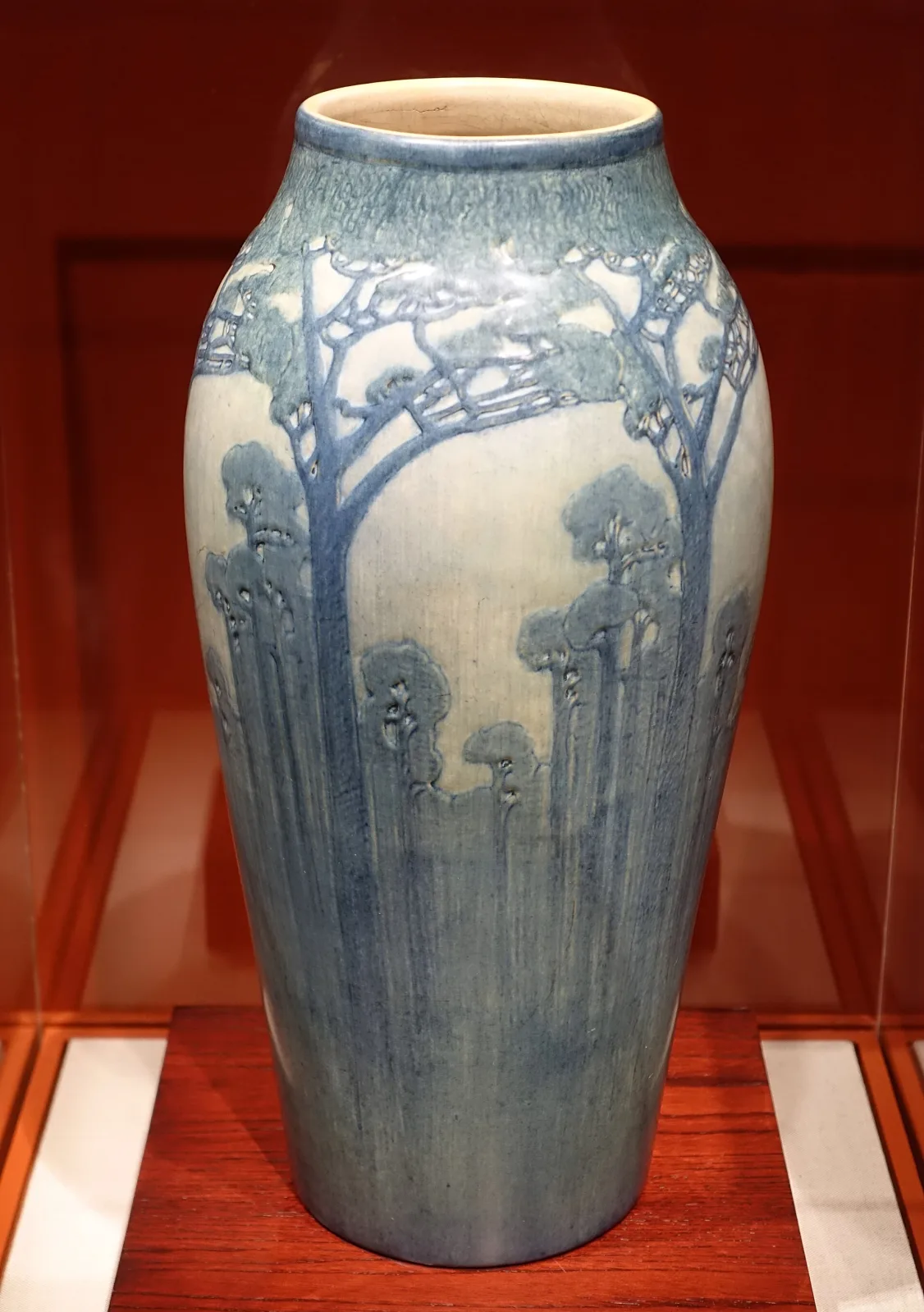
Newcomb College pottery is the most poetic of all American art pottery, and the most documented. For forty-five years, between 1895 and 1940, it was made not in a commercial factory but inside a women's college in New Orleans—thrown by a handful of professional potters and decorated, piece by piece, by art students and graduates whose initials are cut into nearly every base. The result is a body of work that is both an Arts and Crafts enterprise and a signed historical record: a vase made at Newcomb can usually be dated to within a few years, attributed to a named woman, and matched to a registration number in a surviving ledger.
The look is as distinctive as the documentation. Most collectors picture the late style first—a soft, blue-and-green matte vase carved with a moss-draped live oak and a full moon, the so-called "moon and moss" landscape that Sadie Irvine made famous—but Newcomb's range runs from glossy, high-glaze early wares in the 1890s and 1900s to the velvety matte landscapes of the teens, twenties, and thirties. Across all of it the subject matter is the American South: pine, magnolia, jonquil, iris, cypress, Spanish moss, and the live oaks of the Gulf Coast, drawn from nature by women trained to look at it closely.
This guide works through the marks system, the glazes, the decorators, the forms, and the periods of Newcomb pottery so you can read a base correctly, place a piece in its decade, attribute it to its maker, separate genuine college production from look-alike art pottery and outright fakes, and understand the things that actually drive value in one of the most collected names in the field. By the end you should be able to turn a vase over and reconstruct most of its biography from the cluster of marks on its foot.
Table of Contents
- What Newcomb Pottery Is
- The College, the Potters, and the Decorators
- The Marks System: Reading the Base
- The NC Cipher and Impressed Marks
- High Glaze vs. Matte: The Two Great Periods
- The Palette and Southern Subject Matter
- The Decorators and Their Monograms
- Dating Newcomb by Mark and Style
- Forms: Vases, Bowls, Plaques, and Crafts
- Body, Carving, and Surface
- Newcomb vs. Other Art Pottery
- Fakes, Marriages, and Misattributions
- Condition, Restoration, and Value
- Field Checklist Before You Buy
What Newcomb Pottery Is
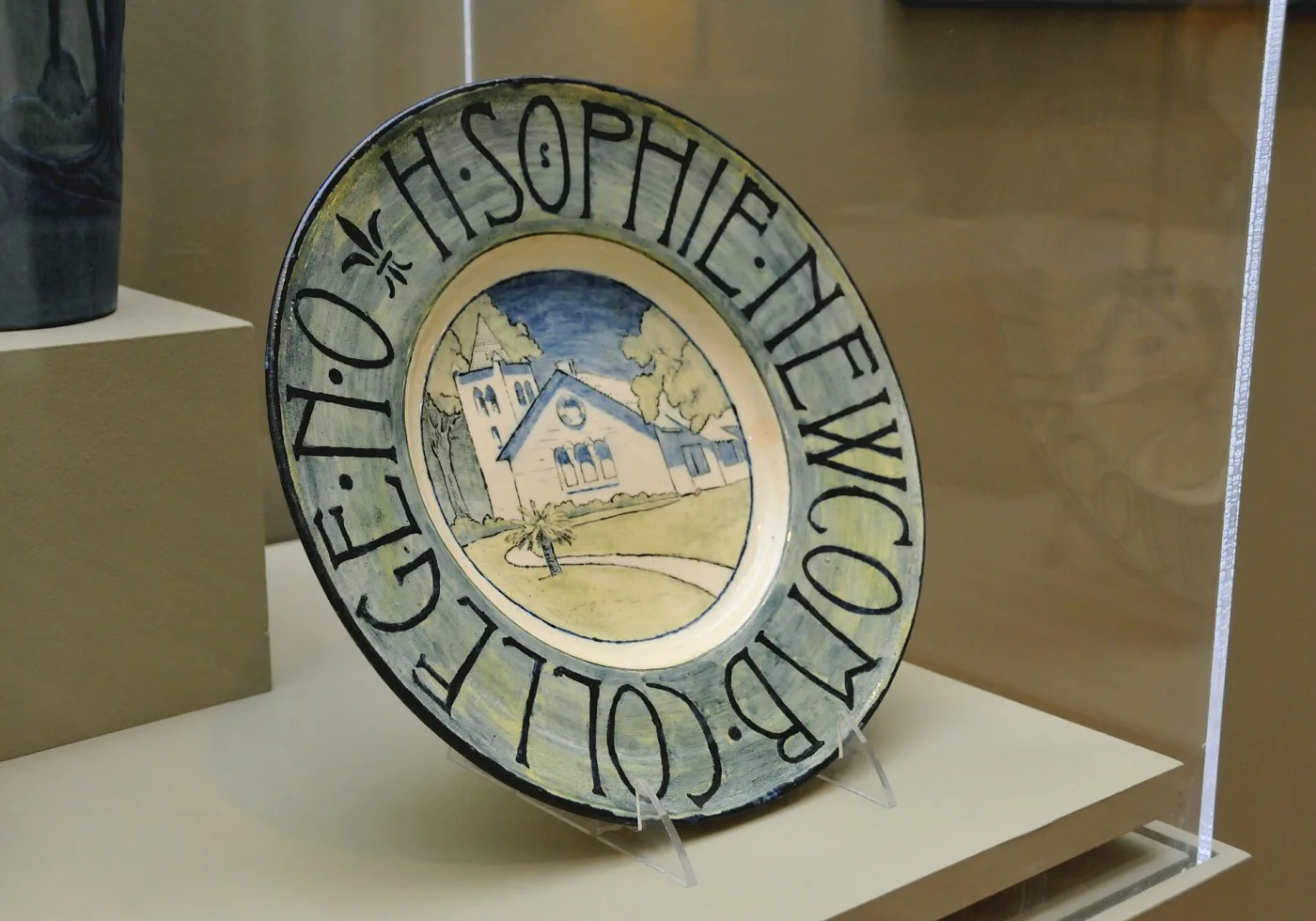
Newcomb pottery is the art pottery produced by the H. Sophie Newcomb Memorial College, the women's coordinate college of Tulane University in New Orleans, as part of its art curriculum. It began in 1895 as a teaching and income-generating enterprise rooted squarely in the Arts and Crafts movement, and it ran in recognizable form until about 1940. Unlike the big Ohio art potteries, Newcomb was never a high-volume commercial factory; it was an educational workshop where the decorating was done by women.
The defining structure of the enterprise is worth fixing in your mind, because it explains the marks. Professional potters—men, since throwing was treated as a trade—turned the bodies on the wheel. The decoration was carried out separately by Newcomb's women art students and graduates, who carved and painted the designs under faculty direction. This division means a typical Newcomb piece carries the marks of two different people—the potter who threw it and the woman who decorated it—plus the college's own cipher and a registration number. Few other potteries record so much on the base.
Why the Documentation Matters
Newcomb is unusually well-researched. The college kept records, the registration numbers tie to surviving documentation, and decades of scholarship have reconstructed who decorated what and when. For a collector this is a gift: it means attribution and dating are not guesswork but a matter of reading a known system. As with the best-documented American antique ceramics, the value of a Newcomb piece is bound up in exactly who made it, when, and how—information the base usually hands you directly if you know how to read it.
The College, the Potters, and the Decorators
The pottery grew out of the art program led by Ellsworth Woodward, the long-serving director who shaped Newcomb's aesthetic, and his brother William Woodward. Their guiding idea was thoroughly Arts and Crafts: that the decoration should be original, hand-done, drawn from local nature, and the work of the individual student rather than a repeated commercial pattern. That philosophy is why no two Newcomb pieces are exactly alike and why the designs lean so heavily on Gulf-Coast flora.
On the throwing side, one name dominates the early and middle decades: Joseph Fortuné Meyer, the French-born master potter who threw the great majority of Newcomb bodies from the 1890s into the 1920s. Meyer's hand is behind an enormous share of surviving pieces, and his potter's mark is one of the most common on Newcomb bases. Later potters include Jonathan Hunt and, in the matte period, Kenneth Smith, who also worked on glaze chemistry.
The decorators were the students and graduates, and the most prolific became Newcomb's stars: Sadie Irvine, whose moss-and-moon live-oak landscape became the pottery's signature; Henrietta Bailey; Anna Frances (A. F.) Simpson; Marie de Hoa LeBlanc; Harriet Joor; Mary Sheerer, who helped found and guide the decorating program; and a long roster of others whose monograms collectors learn to recognize. The chemist Paul Cox, arriving around 1910, developed the soft matte glazes that define the later, most familiar Newcomb style.
An Arts and Crafts Enterprise
Newcomb belongs firmly to the same turn-of-the-century Arts and Crafts world that produced Stickley mission oak furniture and the great Ohio art potteries. Its values—handwork, honesty of material, nature-based ornament, and the individual maker's mark—are the movement's values, expressed by a community of Southern women at a moment when few professional avenues were open to them. Understanding that context is part of understanding why the work is collected as seriously as it is.
The Marks System: Reading the Base
The single most useful skill with Newcomb is reading the cluster of marks on the base, because a fully marked piece tells you almost everything. A classic Newcomb base can carry five distinct elements, and learning to find and separate them is the heart of identification.
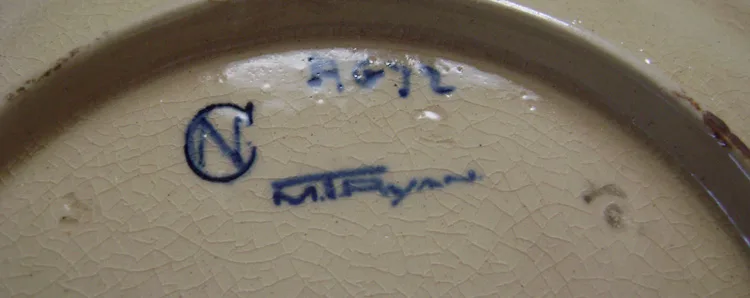
First, the "NC" cipher—the conjoined letters N and C, the college's own logo, usually impressed and often painted as well. This is the anchor mark that says "Newcomb." Second, the decorator's mark or monogram: the initials or device of the woman who carved and painted the piece, painted or incised, which gives you the attribution. Third, the potter's mark: the cipher of the man who threw the body (most often Joseph Meyer's mark), typically impressed. Fourth, a registration or piece number—a code, often a letter followed by digits, that ties to the college's records and is a strong dating tool. Fifth, a clay-body or glaze indicator in some periods, such as a "Q" used on certain bodies, and occasionally a date code.
Not every piece carries all five, and the exact form of each evolved over forty-five years, but the principle holds: read the base as a set of separate marks, not a single signature. Identify the NC cipher first to confirm the maker, then locate the decorator's monogram for attribution, then the potter's mark, then the registration number for dating. A piece that shows this layered, consistent system—several different hands recorded together—is behaving the way genuine Newcomb behaves.
The Habit That Protects You
Train yourself to expect multiple marks and to check that they are consistent with one another and with the style of the piece. A base bearing only a crude painted "Newcomb" and nothing else, with no impressed cipher, no potter's mark, and no registration number, is not behaving like real Newcomb and deserves suspicion. The richness and internal consistency of the marks is itself an authentication tool, in the same way that careful reading of bases underpins the broader authentication and provenance process.
The NC Cipher and Impressed Marks
The NC cipher deserves its own attention because it is the keystone of every genuine attribution. The mark is the letters N and C interlocked into a single device, adopted early and used throughout the pottery's life. On most pieces it is impressed into the clay before firing—pressed in with a die, leaving a crisp, slightly sunken mark—and on many it is also rendered in painted underglaze color. The presence of a clean impressed cipher, made before the piece was glazed and fired so that the glaze pools faintly in its recesses, is exactly what you want to see.
Around the cipher cluster the other impressed marks. Joseph Meyer's potter's mark and the registration numbers were typically impressed as well, and on genuine pieces these impressions share the same character: they were made in the soft clay and then glazed over, so the glaze sits in and around them naturally. This integration of mark and glaze is hard to fake convincingly. A mark that sits on top of the fired glaze—painted, stamped, or engraved after firing—rather than being impressed into the body beneath it, is a serious warning sign.
What an Impressed Mark Should Look Like
Under a loupe and in raking light, a genuine impressed Newcomb mark looks like part of the object: the clay is displaced cleanly, the edges are slightly softened by the glaze that flowed over them, and there is no sign of the abrasion or surface disturbance that comes from cutting or grinding a mark into an already-finished piece. Painted decorator monograms, by contrast, sit under the glaze and were applied before firing, so they too are sealed beneath the glassy or matte surface rather than riding on top of it. Marks that break this rule—added after firing—are the clearest red flag in the whole field.
High Glaze vs. Matte: The Two Great Periods
Newcomb's surfaces fall into two broad families, and knowing which one you are looking at immediately narrows the date. These are the high-glaze (glossy) early period and the matte later period, and the transition between them, around 1910, is the single most important dating watershed in Newcomb collecting.
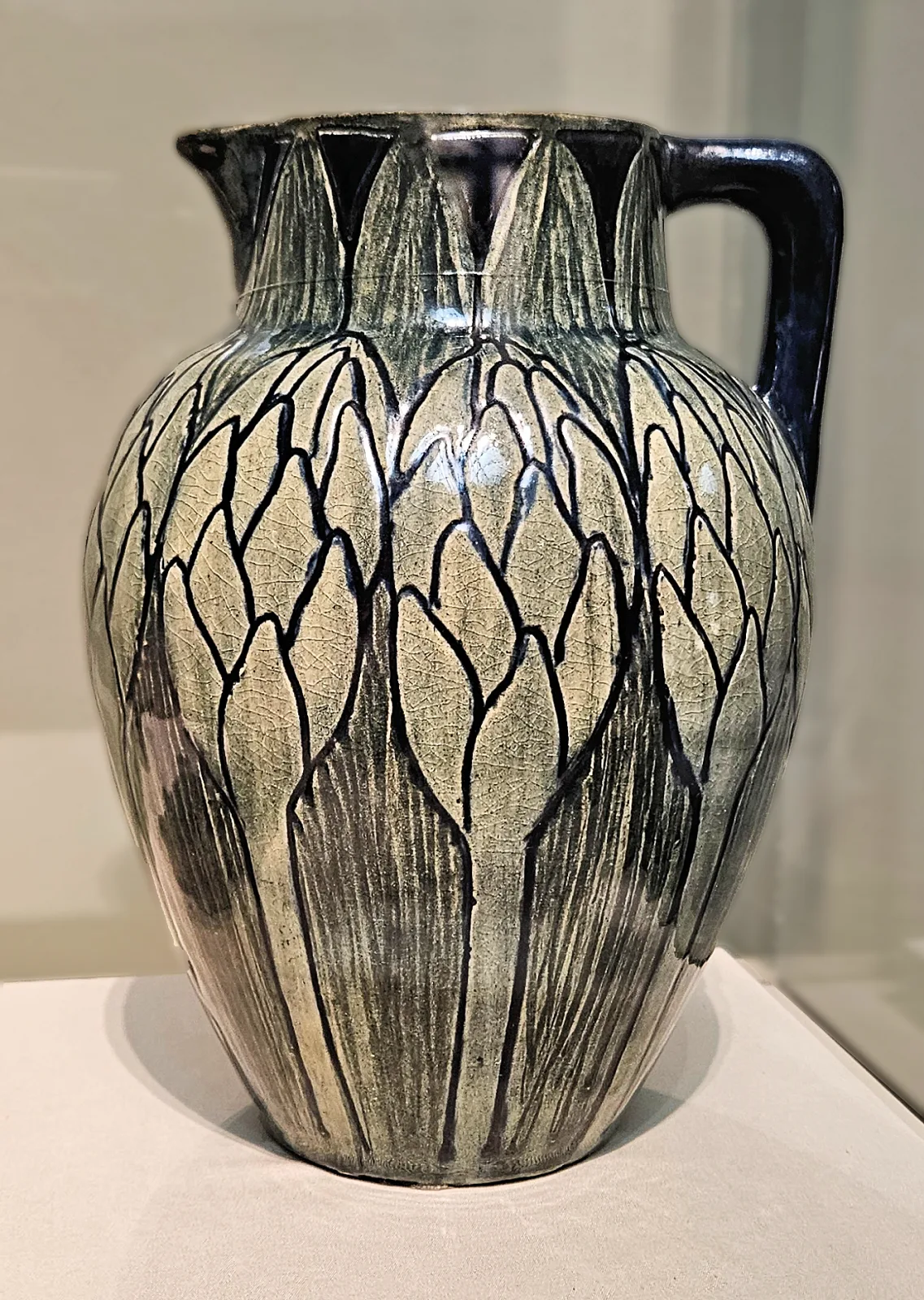
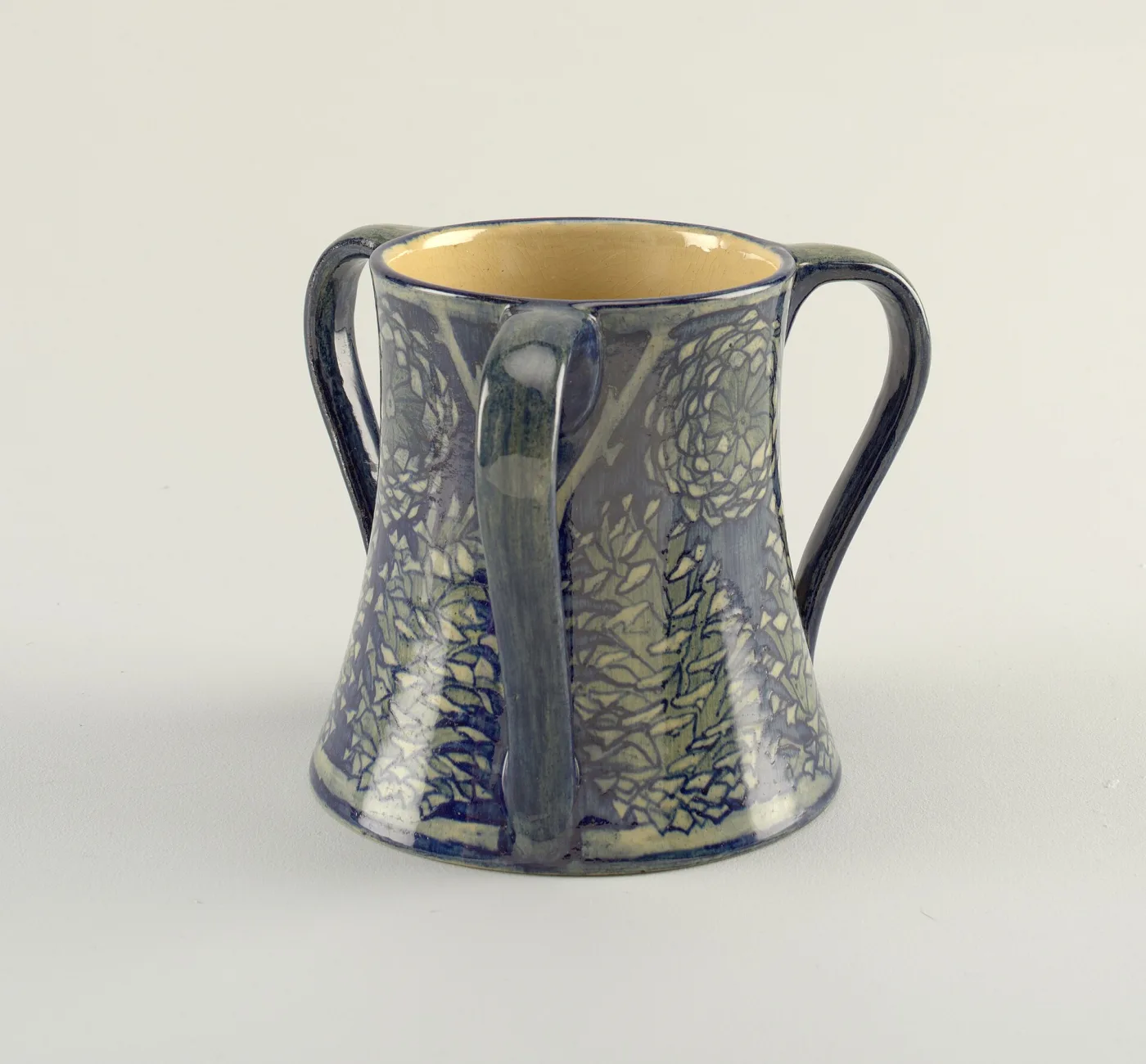
The early high-glaze wares (roughly 1895 to about 1910) have a glossy, often semi-transparent glaze over crisply painted and incised decoration. The designs of this period tend to be more linear and graphic—stylized flowers, plants, and occasionally figures, frequently outlined and filled in clear blues, greens, yellows, and other colors under a shiny surface. These early pieces are scarcer than the later matte wares, are prized by specialists, and include some of the most important Newcomb made.
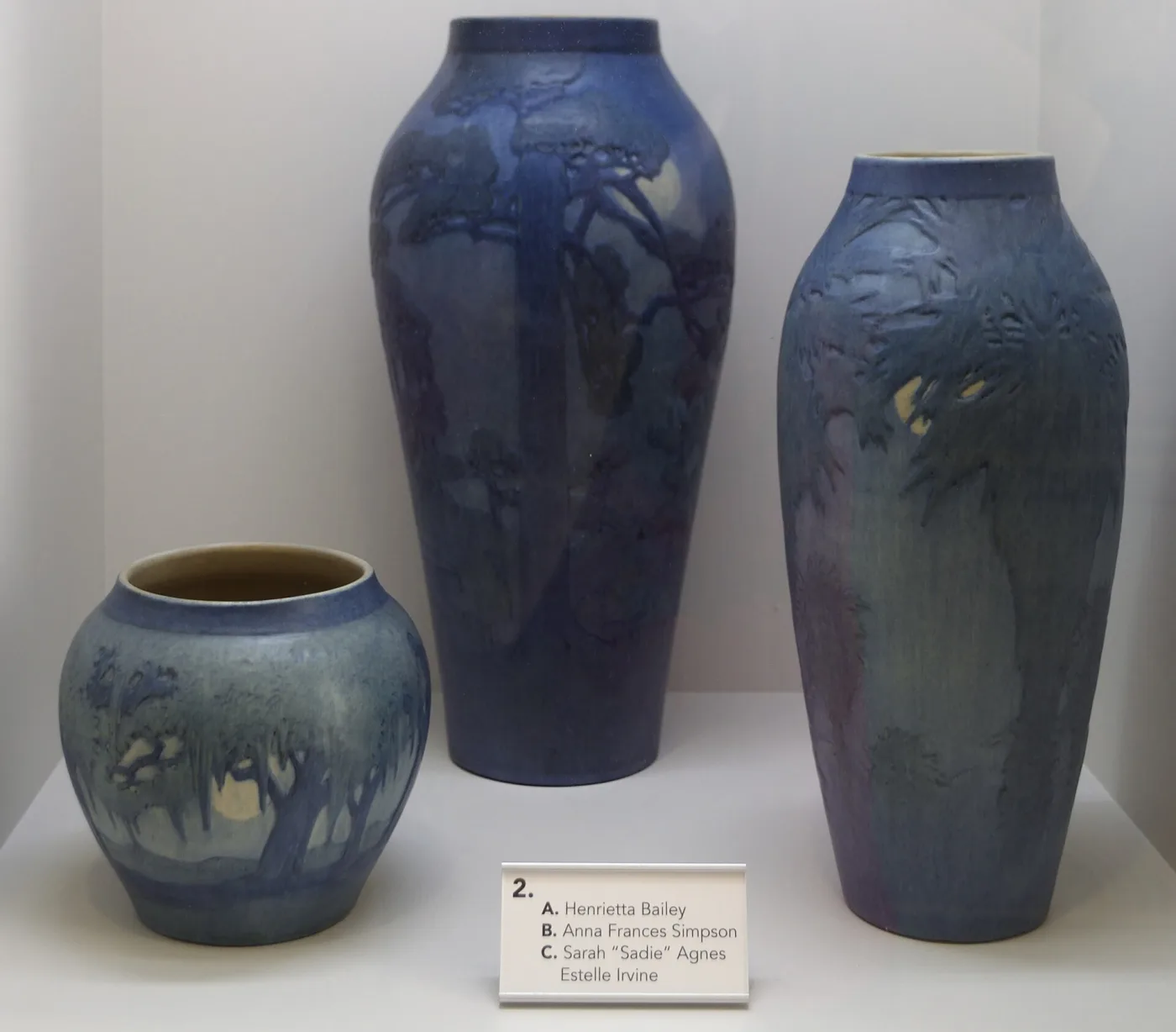
Around 1910, with the chemist Paul Cox, Newcomb developed the soft, satiny matte glazes that most people now think of as quintessentially Newcomb. The matte period (roughly 1910 to 1940) is the era of the dreamy blue-and-green landscapes: carved or modeled designs—live oaks, Spanish moss, the moon, cypress, magnolias—under a velvety, light-absorbing surface with characteristic soft blurring and pooling of color. The famous "moon and moss" oak landscapes belong here. This matte ware is the most familiar and most plentiful Newcomb, though fine examples are by no means common.
The Surface as a Date Anchor
As a first filter, glossy almost always means early (pre-1910) and matte almost always means later (post-1910). The two surfaces feel completely different in the hand: the high glaze is hard, shiny, and slightly reflective, while the matte is soft, dry to the touch, and absorbs light. Because the matte glaze was a deliberate technical achievement of the second period, a soft-matte moss-and-moon landscape is, by surface alone, a twentieth-century piece—useful to remember when a seller dates a matte vase to the 1890s.
The Palette and Southern Subject Matter
If the glaze tells you the period, the palette and subject matter tell you the maker. Newcomb is, above all, a regional pottery: its decoration is drawn from the plants, trees, and landscape of the American South, and that local subject matter is one of its strongest identifying traits.
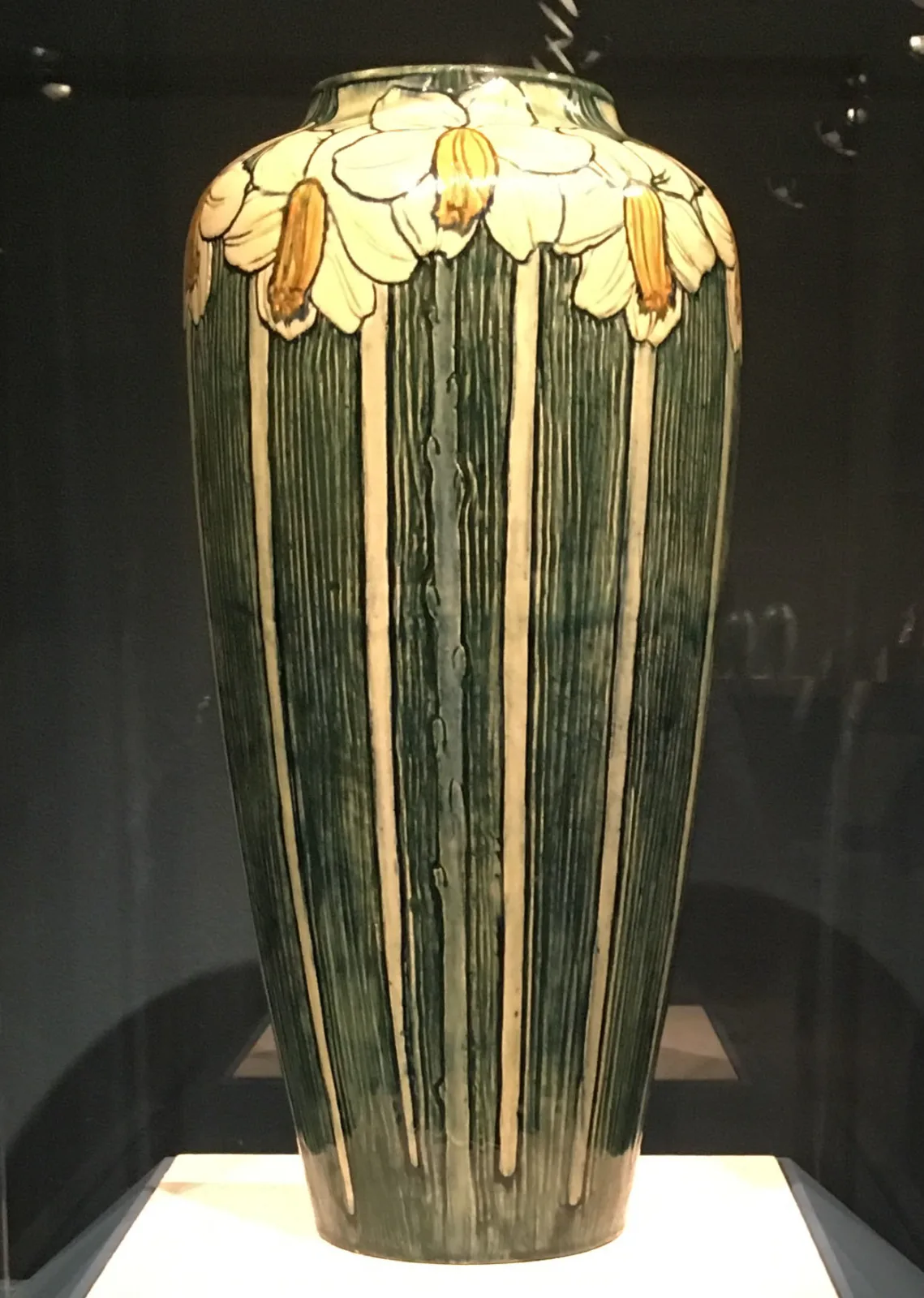
The palette is dominated by blues and greens—the soft, hazy blue-green of the matte landscapes is almost a Newcomb trademark—supported by yellows, ivories, pinks, and the occasional rose or gold accent. The colors are quiet, naturalistic, and atmospheric rather than bright or jewel-like, especially in the matte period where the glaze deliberately softens and blends them. This restrained, nature-toned palette sets Newcomb apart from the brighter or more metallic glazes of some other art potteries.
The motifs read like a catalogue of Gulf-Coast flora: live oaks draped in Spanish moss (often with a full moon glimpsed through the limbs—the signature landscape), pine trees and pinecones, magnolias, jonquils and narcissus, irises, cypress, tobacco and cotton, fruit, and various flowers and grasses. Early high-glaze pieces sometimes include more stylized or geometric Arts and Crafts treatments and occasionally figures or scenes; the matte period leans heavily toward the landscape and floral repertoire.
Reading the Botany
Because the designs were drawn from observed nature by trained art students, the botany is usually accurate and the compositions individual—genuine Newcomb flowers and trees look studied and specific, not generic. The same disciplined, nature-based approach to ornament that distinguishes fine Art Nouveau design runs through Newcomb's best work, where a magnolia or an oak is rendered with real attention rather than as a stock decorative motif. Crude, stiff, or clumsily drawn "Newcomb" flora is a reason to look harder at the rest of the piece.

The Decorators and Their Monograms
Because each piece was decorated by an identifiable woman whose monogram appears on the base, attribution to the decorator is central to Newcomb collecting—and it directly affects value. Learning the major decorators and their devices is what turns a generic "Newcomb vase" into "a Sadie Irvine moss-and-moon vase," with everything that distinction means for desirability.
Sadie Irvine (active from the 1900s into the 1920s and beyond) is the most famous Newcomb decorator, credited with originating the moss-draped-oak-and-moon landscape that became the pottery's icon. Her work is the most sought-after by many collectors precisely because of that association, and her monogram is one to learn first.
Anna Frances Simpson (A. F. Simpson) was extraordinarily prolific in the matte period and a master of the landscape and floral wares; her pieces are among the most frequently encountered fine examples. Henrietta Bailey is another major and highly regarded hand. Marie de Hoa LeBlanc and her sisters, Harriet Joor, Leona Nicholson, Mary Sheerer, and many others fill out the roster, each with a recognizable monogram and characteristic subjects.
Why the Monogram Matters
The decorator's monogram, read together with the registration number, is what lets specialists attribute and date a piece with confidence, and it is one of the main drivers of price: a well-known decorator working in her best manner commands a premium over an unattributed or lesser hand. Reference works and decorator-mark guides exist specifically to match these monograms to names. As with signed work generally, documented attribution is a major component of value, and it pays to confirm the monogram against a reliable reference rather than trust a seller's say-so—an approach the broader valuation and appraisal guide applies across signed antiques.
Dating Newcomb by Mark and Style
Dating Newcomb is more precise than dating almost any other art pottery, because the marks system and the well-documented stylistic periods reinforce each other. You can usually place a piece within a decade, and often within a few years, by combining several lines of evidence.
Start with the glaze: high glaze points to roughly 1895–1910; matte points to roughly 1910–1940. Then read the style: crisp, linear, graphic decoration with clear outlines belongs to the early period, while soft, carved, atmospheric landscapes belong to the matte period. Next, the registration number: Newcomb's piece-numbering system, recorded in the college's documentation, allows specialists to assign dates from the code, and reference tables exist for decoding these marks. Finally, the decorator and potter: knowing a decorator's active years and a potter's tenure (Meyer into the 1920s, later potters afterward) brackets the date further.
These strands rarely contradict one another on a genuine piece, and that internal consistency is itself a check. A soft matte moss-and-moon landscape decorated by Sadie Irvine, thrown by Joseph Meyer, with a registration number consistent with the 1910s or 1920s, all agreeing, is a coherent and reassuring object. A piece whose glaze, style, decorator, and number disagree—an "early" date on a matte landscape, a decorator's monogram outside her known years—signals either a misattribution or a fake.
The Power of Cross-Checking
The lesson is to date by convergence, not by any single mark. When the surface, the drawing style, the decorator's known career, the potter, and the registration number all point to the same period, you have a firmly datable object—an unusually strong position in the often-vague world of art pottery dating, where many makers offer nothing like this much evidence.
Forms: Vases, Bowls, Plaques, and Crafts
Newcomb is best known for its decorated vases, but the enterprise produced a wider range of forms, and the form affects both desirability and value. Knowing the repertoire helps you judge where a piece sits.
Vases in many shapes and sizes are the heart of the output and the form most collectors pursue, especially the carved matte landscapes. Tall, well-proportioned vases with fine, fully developed landscape decoration by a known hand are the classic high-value Newcomb. Beyond vases, the pottery made bowls, low bowls and vessels, mugs and tankards (more common early), candlesticks, inkwells, lamp bases, plaques and tiles, and a range of useful and decorative wares.
The college also produced related crafts beyond ceramics as part of its art program—metalwork, jewelry, embroidery, and bookbinding among them—though it is the pottery that dominates the collector market. Among the ceramics, flat plaques and tiles carrying scenic decoration are particularly prized when fine, sitting alongside the broader world of decorative art tiles from the Arts and Crafts era. Size, the completeness and quality of the decoration, and the form's rarity all factor into where a given piece falls.
Form and Desirability
As a rough guide, large vases with rich, all-over carved landscape decoration by a star decorator sit at the top; small, simply decorated, or partially decorated pieces sit lower; and unusual forms—fine plaques, well-modeled rarities—can command strong premiums when quality matches scarcity. As with antique vases across the board, size, condition, and the quality and extent of the decoration drive value sharply, and a large finely carved Newcomb landscape vase is a different proposition entirely from a small plain bowl.
Body, Carving, and Surface
The physical fabric of Newcomb pottery supports identification once you know what to expect. The body is an earthenware or stoneware-type ceramic—not porcelain—thrown on the wheel by the professional potters, with a clay color that varies by period and body type but is generally a buff to light tone beneath the glaze.
The decoration on matte pieces is characteristically carved and modeled: the designs were often incised and worked into the surface in low relief before glazing, so a genuine matte landscape has real, tactile dimension—you can feel the carved outlines of the oak trunk, the moss, and the moon. The matte glaze then settles into and over this carved relief, pooling slightly in the recesses and softening the edges, which produces the gentle, atmospheric blur that is so hard to imitate. Early high-glaze pieces rely more on painted and incised line under the glossy surface than on deep carving.
Turn a piece over and the base supports the story: the foot is finished by hand, the impressed marks sit in the clay with glaze flowing into them, and there is honest wear consistent with age on pieces that have been handled and displayed for the better part of a century. The integration of carving, glaze, and mark—decoration worked into the body, glaze melting over both, marks impressed beneath—is the signature of authentic construction, and it is exactly what reproductions struggle to reproduce all at once.
Surface Tells
On genuine matte ware the surface is dry, soft, and velvety, the carved relief is purposeful and assured, and the glaze sits naturally in the recesses. A piece whose "carving" is shallow and timid, whose matte surface looks sprayed-on, chalky, or uniform rather than pooled, or whose decoration sits flat with no worked relief, is not behaving like the real thing. The hand of a trained decorator working into the clay leaves evidence that a casual copy cannot fake.
Newcomb vs. Other Art Pottery
Newcomb sits within the rich world of American art pottery, and distinguishing it from its contemporaries sharpens identification. Several other makers produced matte and nature-themed wares in the same decades, and a quick comparison clarifies what is specifically Newcomb.
Rookwood, the great Cincinnati pottery, also made fine matte and scenic wares and shares the era and the Arts and Crafts ambition, but Rookwood is a large commercial factory with its own elaborate flame mark and date system, a far larger output, and a different palette and subject range. Van Briggle, in Colorado, is the closest in spirit—soft matte glazes and modeled Art Nouveau forms—but its decoration is typically molded relief integral to the form rather than Newcomb's carved-and-painted Southern landscapes, and its marks (the conjoined "AA" cipher) are different. Roseville and Weller are higher-volume Ohio commercial potteries whose decoration is largely mold-cast and repeated, quite unlike Newcomb's individually hand-decorated pieces.
The decisive differences are the marks and the method. Newcomb's NC cipher, its separate decorator and potter marks, its registration numbers, and above all its individually hand-carved, nature-specific Southern decoration set it apart from both the molded commercial wares and the other studio potteries. Even Moorcroft in England, another hand-decorated art pottery of the period with its own tube-lined floral style and signature, is immediately distinguishable by technique and mark. When several different hands are recorded on one base and the decoration is carved rather than molded, you are most likely looking at Newcomb.
Fakes, Marriages, and Misattributions
Because Newcomb is valuable and famous, it attracts fakes, "improved" pieces, and honest misattributions. Knowing the common problems is the practical core of buying safely, and most of them reduce to a single principle: the marks must be original to the piece and consistent with everything else about it.
The most dangerous problem is the added or faked mark. Because the NC cipher, decorator monogram, potter's mark, and registration number drive value, fakers add them to genuine-but-unmarked art pottery, to lesser wares, or to outright modern pieces. The defense is the rule established above: genuine Newcomb marks are impressed into the clay and painted under the glaze, sealed beneath the fired surface. A mark that sits on top of the glaze, that has been engraved or ground into a finished piece, or that disturbs the surface around it, is added and the piece is suspect. Always examine the marks under magnification and raking light to confirm they were made before firing.
A second problem is the misattribution—other matte art pottery, or unsigned studio work, sold as Newcomb because it has the right blue-green look. Here the absence of the full marks system gives the game away: real Newcomb carries the cipher, the separate hands, and usually a number; a "Newcomb-style" piece with none of that apparatus is something else. A third is the internal inconsistency discussed earlier—a decorator's monogram outside her active years, a date code that disagrees with the glaze or style, a potter's mark that does not fit the period.
The Decisive Test
The decisive test for Newcomb is the integrity and consistency of the base. Genuine pieces show a coherent cluster of original, pre-firing marks—cipher, decorator, potter, number—whose attributions and dates agree with the glaze, the carving, and the style. Anything that fails this test—marks added after firing, a lonely or crude single mark, or marks that contradict the object—should be treated as a fake or misattribution until proven otherwise. The same disciplined, structural approach that protects buyers across antique ceramics and pottery exposes the great majority of Newcomb problems.
Condition, Restoration, and Value
Condition bears heavily on Newcomb value, as it does on all art pottery, and the issues are specific to the medium. Chips to rims and feet, hairline cracks, and glaze flakes or losses all reduce value in proportion to their size and visibility. The matte glaze can be vulnerable to chipping and surface wear, and damage to the decorated face matters more than a minor flaw on an undecorated base.
Crazing—the fine network of glaze cracks—occurs on some pieces and is generally tolerated as normal to the ware, though heavy or stained crazing detracts. Glaze pops, grinding chips, and small firing flaws from the original making are usually accepted as part of a handmade object and matter less than later damage. Honest, light surface wear consistent with age is normal and not a fault.
Restoration is common on higher-value Newcomb and must always be checked, because it materially affects price. Professional restorers fill chips, repair cracks, and inpaint glaze and decoration convincingly. Examine suspected areas under a UV (blacklight) lamp: modern fills and overpaint usually fluoresce differently from the original glaze, revealing repairs that are invisible in ordinary light. A loupe catches retouching along rims and cracks, and the restored area often feels or looks subtly different in texture. Always price a restored piece as restored, and store and display Newcomb following the environmental guidance in the storage and preservation guide, since the matte surfaces are susceptible to abrasion and staining.
What Drives Newcomb Value
Premium Newcomb combines several factors: a known and desirable decorator (Sadie Irvine, A. F. Simpson, Henrietta Bailey and the other major hands) working in her best manner; a fine, fully developed design, especially the carved matte landscapes with rich detail; desirable form and good size; strong, well-integrated glaze and carving; and excellent, undamaged, unrestored condition. Early high-glaze pieces and rare forms add scarcity value. Remove any one factor and the price softens; a small, plainly decorated, or restored piece by a lesser or unidentified hand sits far below a large, finely carved, signed landscape in pristine condition. For help translating these factors into figures, the valuation and appraisal guide walks through the reasoning.
Field Checklist Before You Buy
When you examine a piece of suspected Newcomb pottery, work through this sequence before you think about price.
First, turn it over and read the base. Find the NC cipher—the conjoined N and C—and confirm it is impressed into the clay and sealed under the glaze, not added on top of a fired surface. Then locate the other marks: the decorator's monogram (your attribution), the potter's mark (Joseph Meyer's into the 1920s, later potters afterward), and a registration number for dating. Expect several marks, not one, and check that they are original and consistent.
Second, read the surface to fix the period: glossy high glaze points to roughly 1895–1910, soft matte to roughly 1910–1940. Third, read the decoration: is it crisp and linear (early) or carved, atmospheric, and landscape-driven (matte)? Confirm the subject is genuine Southern flora—live oaks and moss, pine, magnolia, jonquil, iris—drawn with the studied accuracy of a trained hand, not generic or clumsy ornament.
Fourth, feel the carving and glaze on matte pieces: real relief worked into the body, glaze pooling naturally in the recesses, a soft velvety surface—not a flat, sprayed-on, or chalky imitation. Fifth, cross-check for consistency: do the glaze, the drawing style, the decorator's known active years, the potter, and the registration number all point to the same period? Convergence confirms; contradiction warns.
Sixth, inspect condition: walk the rim and foot for chips, turn the piece under raking light for hairlines and glaze losses, assess crazing, and use a UV lamp to detect restoration and overpaint. Seventh, weigh form, size, decorator, and quality of design together against the asking price. A large, finely carved matte landscape by Sadie Irvine or A. F. Simpson, thrown by Meyer, fully and consistently marked, in excellent condition, is a serious object; a small, crudely decorated piece with a single suspect mark and no supporting apparatus is something else entirely.
With this sequence practiced, Newcomb becomes one of the most readable names in American art pottery—a body of work where the base usually tells you the maker, the decorator, and the decade, and where the carved Southern landscapes reward patient study. The same cross-checking discipline serves you across the related studio and art potteries that share collections and showcases with Newcomb—from Rookwood and Van Briggle to the broader world of art ceramics—and a finely carved, well-attributed Newcomb vase holds its place as one of the great achievements of the American Arts and Crafts movement.