
Antique Napkin Rings Identification Guide: Figural Silver Plate, Sterling, and Serviette Rings
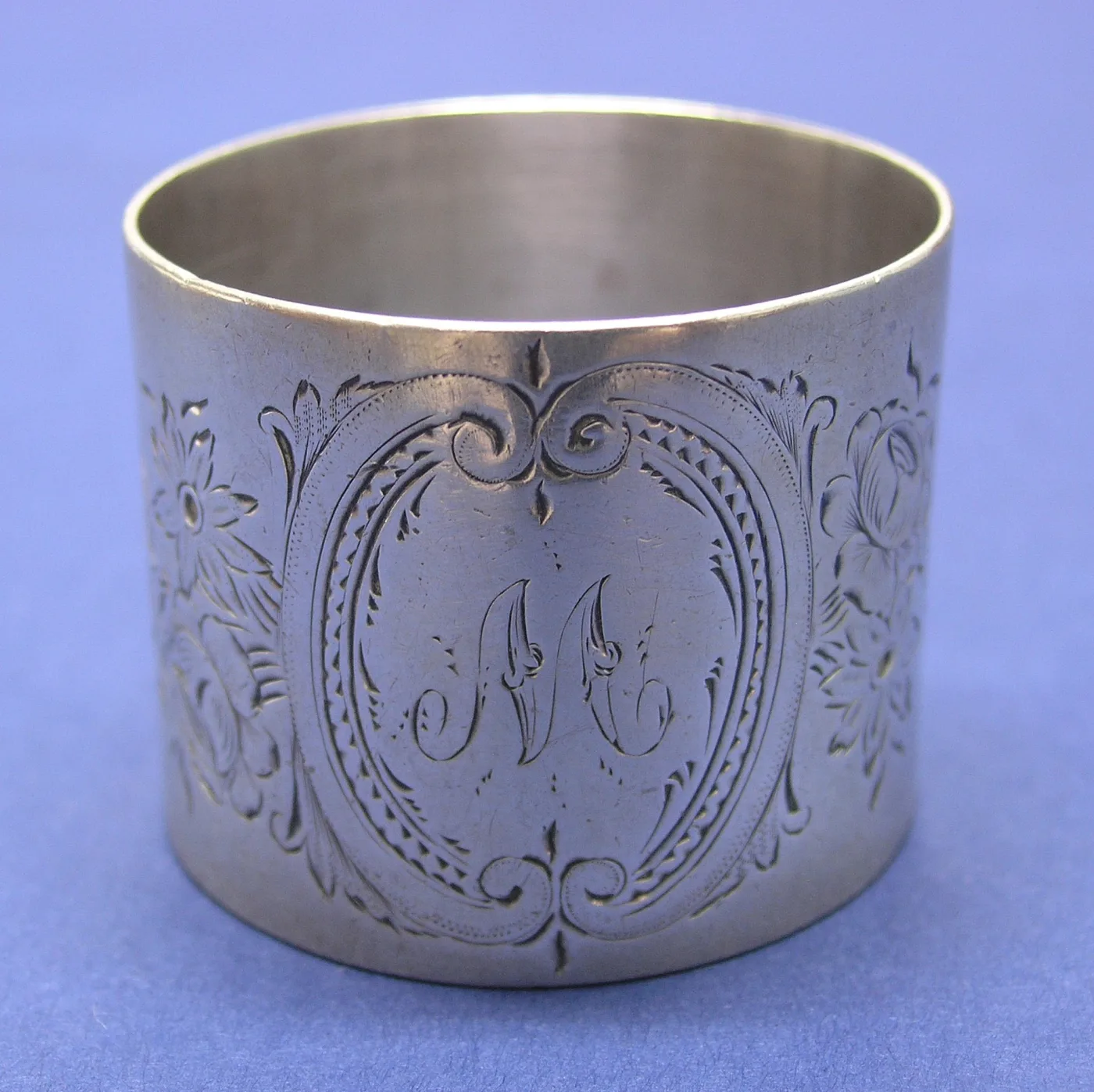
The napkin ring is one of the most quietly collected objects in the entire field of antique tableware — a small band of silver, plate, ivory, bone, wood, or early plastic whose only job was to identify and hold a diner's rolled cloth napkin between meals. It seems trivial, and yet a single figural American silver-plate napkin ring from the 1880s — a cherub seated beside the ring, a bird perched on its rim, a kitten batting at it — can change hands for several hundred dollars, and the very best examples cross into four figures. Few other objects pack so much collecting interest, design variety, and price spread into so small a package.
Napkin rings (called serviette rings in British usage) belong to the etiquette of the household table from roughly the 1850s to the 1930s. In an era before paper napkins and frequent laundering, each family member kept a personal cloth napkin, rolled and slipped into an individually marked ring, reused across several meals until wash day. The ring identified whose napkin was whose — hence the monograms, the engraved names, the christening presentations, and the differently patterned rings sold in sets so each place at the table could be told apart.
This guide covers the whole field: the difference between American figural silver-plate rings and English engraved sterling serviette rings, the major makers (Meriden, Rogers, Reed & Barton, Tufts, Wilcox, and the English silversmiths), how to read hallmarks and plate marks, the ivory, bone, celluloid, treen, and Tunbridge ware rings, how to date a ring by its style and marks, the all-important question of reproductions and recast figurals, how to assess condition and completeness, and how value is built from material, maker, subject, and condition. Whether you have inherited a drawer of mismatched rings or are building a serious figural collection, this guide will help you tell what you have.
Table of Contents
- A Brief History of the Napkin Ring
- The Two Great Families: Figural and Band
- Materials: Silver, Plate, Ivory, Bone, and Plastics
- American Figural Silver-Plate Rings
- Major Makers and Their Marks
- English and Sterling Serviette Rings
- Reading Hallmarks and Plate Marks
- Dating a Napkin Ring
- Ivory, Bone, Horn, and Treen Rings
- Celluloid, Bakelite, and Early Plastics
- Novelty, Christening, and Souvenir Rings
- Sets, Numbering, and Cased Groups
- Reproductions, Recasts, and Fakes
- Condition Assessment
- What Drives Value
- Care, Cleaning, and Storage
- Common Beginner Mistakes
- Frequently Asked Questions
A Brief History of the Napkin Ring
The napkin ring is a surprisingly modern invention. Unlike the cruet stand or the salt cellar, which descend from medieval and Renaissance forms, the napkin ring did not exist as a distinct object before the early nineteenth century. It emerged in bourgeois France around the 1800s — the French rond de serviette — as a practical response to a specific domestic economy: in households that laundered table linen weekly rather than daily, each diner needed a way to keep and recognize a partly used napkin between meals.
The ring spread across the Channel and the Atlantic through the middle decades of the nineteenth century, and it reached its zenith in the 1870s and 1880s. Two technological and social forces drove the boom. The first was electroplating, patented by Elkington in 1840, which made silver-look objects affordable to the rising middle class. The second was the elaboration of the formal table that accompanied Victorian prosperity — a properly set table now called for individual napkins, individual rings, and a whole vocabulary of specialized small silver — much of it matching the patterns of the household's silver flatware.
The American Figural Golden Age
In the United States, the napkin ring took a particular and exuberant turn. From about 1870 to 1900 the Connecticut and Massachusetts silver-plate firms produced thousands of figural napkin rings — the ring mounted on a decorative base bearing a cast figure of a bird, animal, child, cherub, or fanciful scene. These figural rings, sold as inexpensive but charming gifts, are today the most collected category of napkin ring in the world and the focus of dedicated specialist literature and collectors' clubs.
The Decline
The napkin ring declined with the household economy that produced it. As laundry became cheaper and more frequent, as paper napkins arrived, and as formal dining simplified after the First World War, the personal napkin ring lost its function. Production of figural rings had largely ceased by 1910; plainer engraved rings and christening gifts continued into the 1930s and beyond, but as sentimental gifts rather than working objects. By mid-century the napkin ring survived mainly as a wedding or christening present and a flea-market curiosity — which is exactly how the great collecting interest of the late twentieth century began.
The Two Great Families: Figural and Band
Almost every antique napkin ring falls into one of two broad families, and recognizing which you are holding is the first step in identification.
The Band (or Plain) Ring
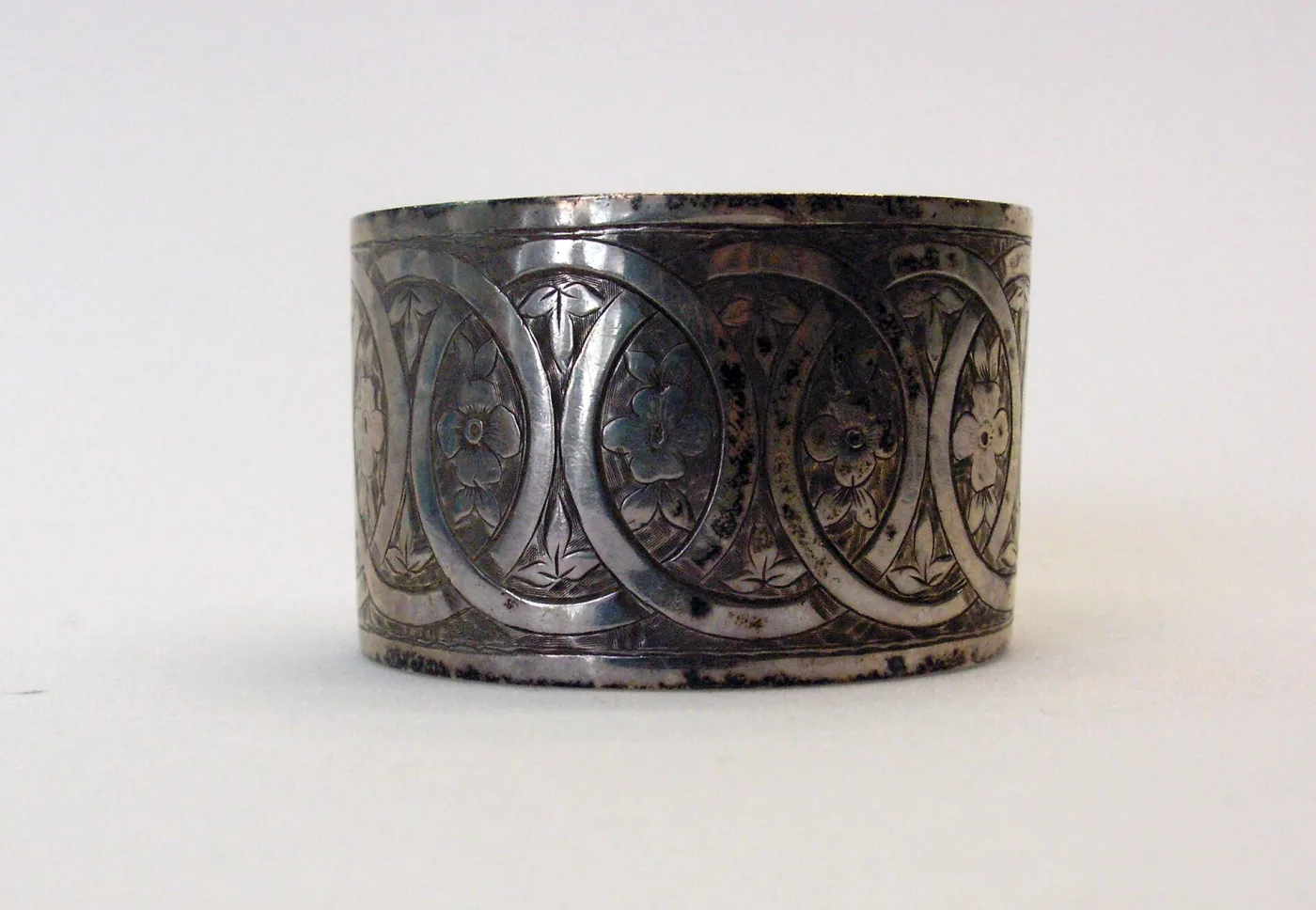
The band ring is the simple form: a cylinder or short tube, plain or engraved, with no attached figure. It can be sterling silver, silver plate, gold, ivory, bone, horn, wood, or plastic. The decoration — if any — is engraving, chasing, piercing, or applied bands on the surface of the ring itself. Band rings are the dominant English form and were made everywhere; the great majority of rings you will encounter are bands. Their interest lies in the quality of the metal, the maker, the engraving, and any monogram, name, or date.
The Figural Ring
The figural ring mounts the band on a base that carries a cast decorative figure. The ring may be held by, perched on by, pulled by, or set beside the figure. Subjects run the full range of Victorian sentimentality and whimsy: cherubs and children, birds (especially fanciful long-tailed ones), cats, dogs, squirrels, rabbits, foxes, frogs, butterflies and dragonflies, flowers and leaves, and narrative scenes (a child in a wheelbarrow, Kate Greenaway figures, a Punch-and-Judy theme). Figurals are almost exclusively American silver plate of the 1870–1900 period, and they are where the money is.
Why the Distinction Matters
The two families have completely different markets. A plain engraved sterling band, however nicely made, is worth its silver plus a modest collector premium — typically tens of dollars. A scarce figural in good condition with crisp casting and an original ring is worth hundreds, and the rarest subjects bring four figures. The same words — "antique silver napkin ring" — cover objects three orders of magnitude apart in value, which is precisely why careful identification matters.
Materials: Silver, Plate, Ivory, Bone, and Plastics
Material is the second great identifier, controlling both period and value. Determining the material correctly is the single most important factual step.
Sterling and Coin Silver
Solid silver rings — sterling (.925) in England and post-1868 America, coin silver (~.900) in earlier American work, .800 or .835 on the Continent — are the most valuable metal category. English sterling carries a full hallmark set; American sterling is marked "STERLING" or "925"; coin silver may be marked "COIN," "PURE COIN," or simply with a maker's name. A solid silver ring has heft, rings with a clear note when tapped, and shows no copper or yellow base metal at worn edges. For the full hallmark and standard-mark picture, see our antique silver identification guide.
Silver Plate (EPNS and Quadruple Plate)
The great majority of napkin rings — and essentially all American figurals — are silver plate: a thin layer of silver electrodeposited over a base metal (usually nickel silver or white metal). British plate is marked EPNS (electroplated nickel silver); American plate is often marked "QUADRUPLE PLATE," "TRIPLE PLATE," or simply with a maker's name and a model number. Plate wears through to a yellow or gray base at the high points, and this honest wear is a sign of age, not a fault.
Ivory and Bone
Ivory and bone rings were popular from the mid-nineteenth century. Ivory shows the characteristic fine cross-hatched Schreger lines (in elephant ivory) and a warm, slightly translucent surface; bone shows tiny dark dots and channels (the remains of blood vessels) and is more opaque. Distinguishing the two — and recognizing legal and ethical issues around ivory sale — is covered in depth in our antique ivory carvings identification guide.
Horn, Treen, and Tunbridge Ware
Pressed horn, turned hardwood (treen), and inlaid Tunbridge ware rings form a small but charming wooden category, made largely in England and on the Continent. Treen rings in boxwood, lignum vitae, olivewood, and fruitwood were often souvenir items; Tunbridge ware rings carry the characteristic micro-mosaic of end-grain wood tessellations.
Early Plastics
From the 1870s celluloid imitated ivory cheaply; from the 1920s Bakelite and Catalin produced brightly colored novelty rings. These early plastics are now collected in their own right, and distinguishing genuine period celluloid and Bakelite from later plastics is a discipline of its own — see our guide to Bakelite, Catalin, and early plastics.
Gold, Brass, Pewter, and Mixed Metal
Gold napkin rings are rare and almost always presentation or christening pieces. Brass and Aesthetic-Movement mixed-metal rings (copper, brass, and silver combined in the Japanese-influenced taste of the 1880s) form a niche category. Pewter and britannia-metal rings are at the cheap end; for the pewter family generally, see our pewter identification guide.
American Figural Silver-Plate Rings
The figural napkin ring is America's great contribution to the form and deserves its own detailed treatment, because it is both the most collected and the most reproduced category.
Construction
A figural ring is built from several cast and stamped parts soldered together: a base (often a small footed platform or naturalistic ground), one or more cast figures, and the napkin ring itself (usually a stamped and seamed cylinder). The whole assembly was electroplated after construction. Better examples have crisp, deeply detailed casting; tired later castings and modern recasts are softer, with mushy detail and filled-in undercuts.
Subjects
The subject is the single biggest driver of figural value. Common subjects — a single bird, a simple cherub, basic leaves and flowers — are affordable. Scarce and desirable subjects command large premiums: detailed narrative scenes, dogs and cats in action, Kate Greenaway children, recognizable storybook characters, dragonflies and butterflies, and combination pieces (a ring plus a bud vase, a salt, a bell, or a place-card holder). Animals interacting with the ring — a cat reaching into it, a bird perched on its rim, a squirrel pulling it — are especially prized.
Combination and Mechanical Pieces
The most elaborate figurals combine the napkin ring with another table function: a small bud vase rising behind the ring, an attached open salt, a place-card clip, a tiny bell, or a hinged or rotating element. These combination pieces are scarcer and bring strong prices. A figural that incorporates a salt dish connects to the world of Victorian table silver covered in our salt cellars identification guide.
The Specialist Literature
Figural napkin rings are catalogued in dedicated reference books — most importantly the standard collector guides that assign each known figural a catalogue number, identify its maker and model number, and estimate rarity. Serious figural collecting is impossible without these references, because the maker's model numbers stamped on the base map directly to catalogued, illustrated examples.
Major Makers and Their Marks
The American silver-plate industry of the late nineteenth century was concentrated in Connecticut and Massachusetts, and a manageable list of firms produced most figural and band napkin rings.
Meriden Britannia Company
Meriden Britannia (Meriden, Connecticut, founded 1852) was the giant of American silver plate and the most prolific maker of figural napkin rings. Meriden pieces are marked "Meriden B. Company" or with the firm's trademark and a model number. In 1898 Meriden became a founding member of the International Silver Company, and later rings carry International marks.
Rogers (the many Rogers firms)
The Rogers name — Rogers Brothers, Rogers Smith & Co., Wm. Rogers, Rogers & Bro., and several others — appears on a great many plated rings. The Rogers Brothers introduced commercial electroplating in America in 1847, and the name became almost a generic byword for silver plate. The specific Rogers firm and its mark help date and place a ring.
Reed & Barton
Reed & Barton (Taunton, Massachusetts) made both figural and high-quality band rings, marked with the firm name and a model number. Reed & Barton figurals are well cast and sought after.
Tufts, Wilcox, Pairpoint, and Others
James W. Tufts (Boston) produced many figurals marked "Tufts" with a model number. The Wilcox Silver Plate Company (Meriden) made figural and combination pieces. Pairpoint (New Bedford), Derby, Middletown, Simpson Hall Miller, and Aurora Silver Plate round out the major American makers. Each firm used a distinct mark and its own model-number series, so a clear photograph of the base mark is the key to attribution.
English and Continental Makers
English serviette rings carry the marks of the silver trade — Birmingham and Sheffield makers dominate the sterling band market. Mappin & Webb, Walker & Hall, and countless smaller Birmingham silversmiths produced engraved sterling rings; the maker's mark plus the assay-office hallmark identifies them precisely. Continental rings carry national silver marks rather than maker-led plate marks.
English and Sterling Serviette Rings
The English (and broader sterling) tradition is the band ring raised to a fine craft. Where the American figural is a charming novelty, the English serviette ring is a piece of formal table silver, and it is identified and dated by the same hallmark system that governs all British silver.
Forms and Decoration
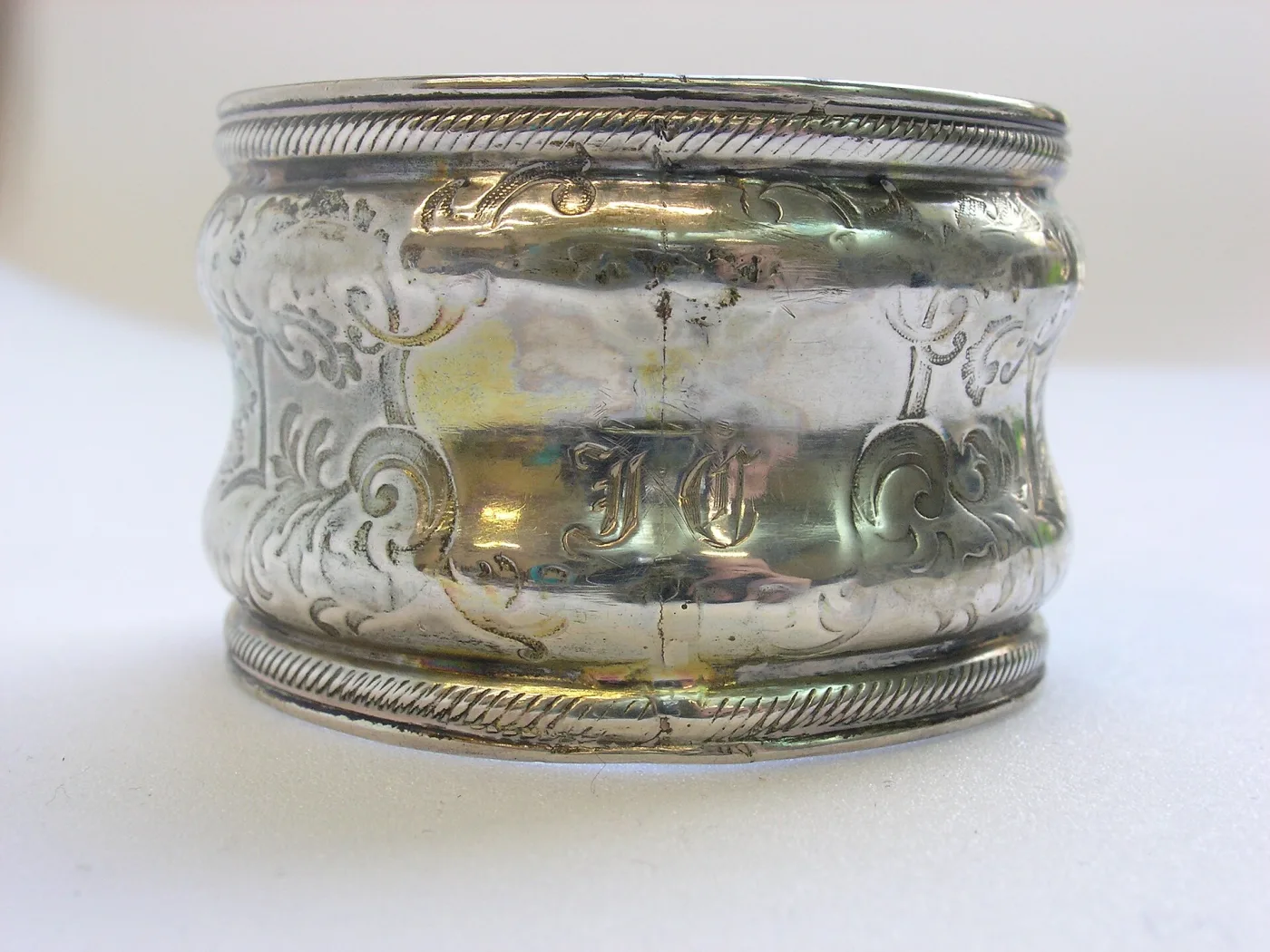
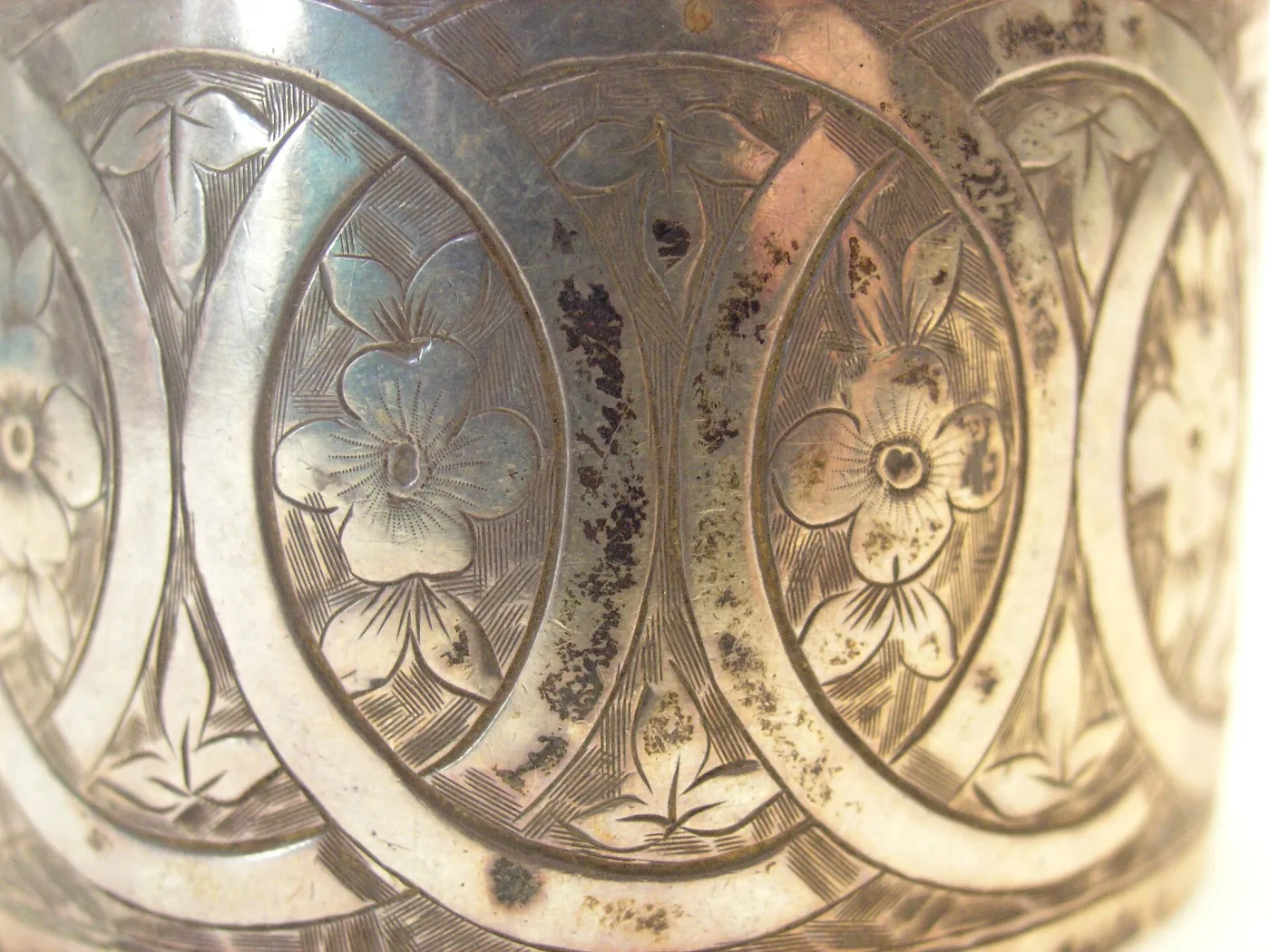
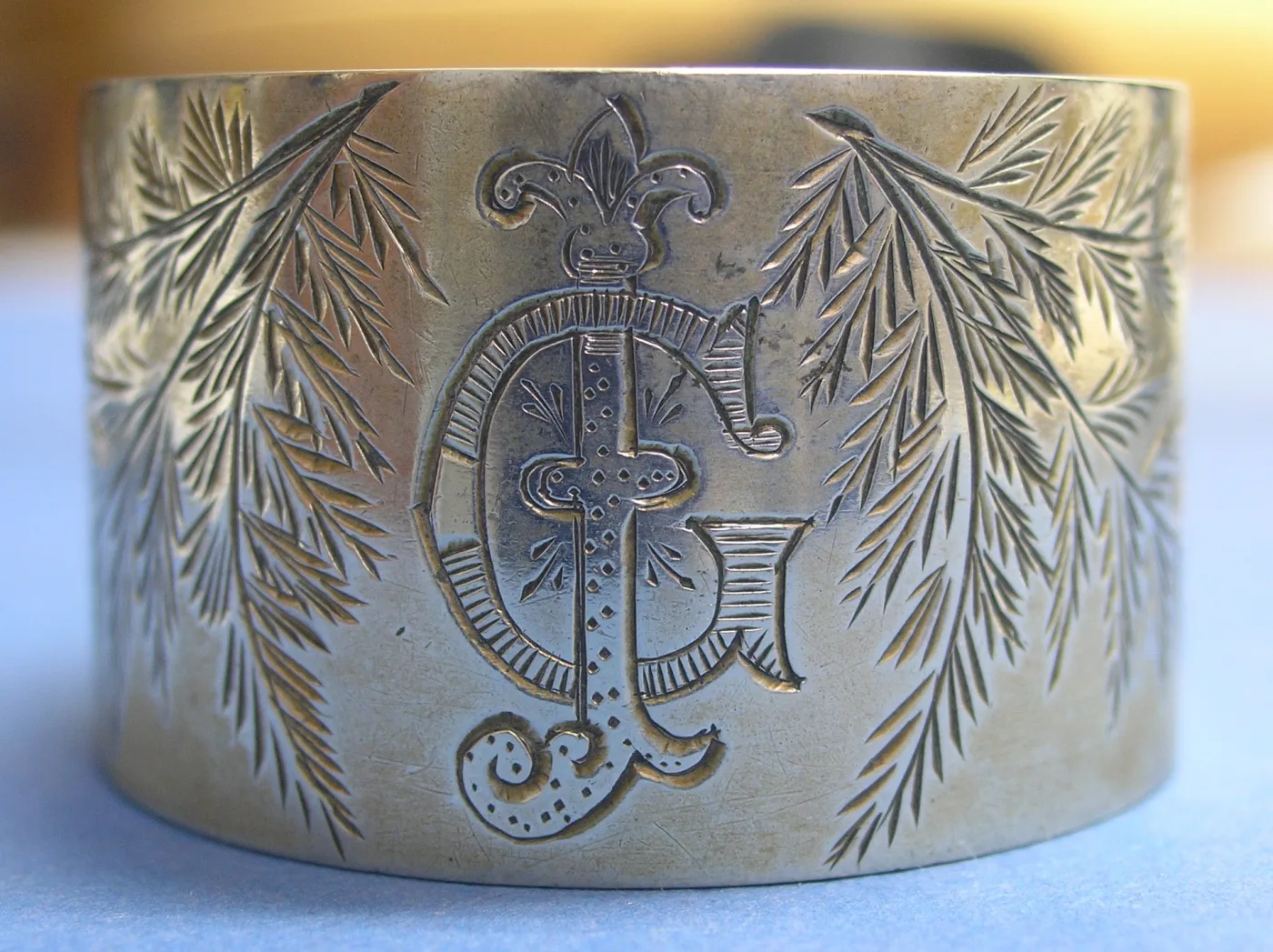
Sterling band rings range from the entirely plain (a polished cylinder relying on a good monogram) to the richly decorated: bright-cut engraving, repoussé floral chasing, pierced fretwork, applied wirework borders, and reeded or beaded rims. Edwardian rings often show Art Nouveau whiplash motifs; 1920s and 1930s rings show Art Deco geometry. The decoration helps date the ring stylistically even before the hallmark is read.
The Monogram
Most sterling rings carry a monogram, name, or initials in a central cartouche — the whole point of a personal napkin ring. A crisp, period-appropriate monogram adds character and, for named or dated presentation pieces, genuine interest. A monogram is not a defect; an erased or buffed-out monogram (leaving a thin, dished, polished patch) is a flaw, because it means metal has been removed and the surface compromised.
Cased Sets
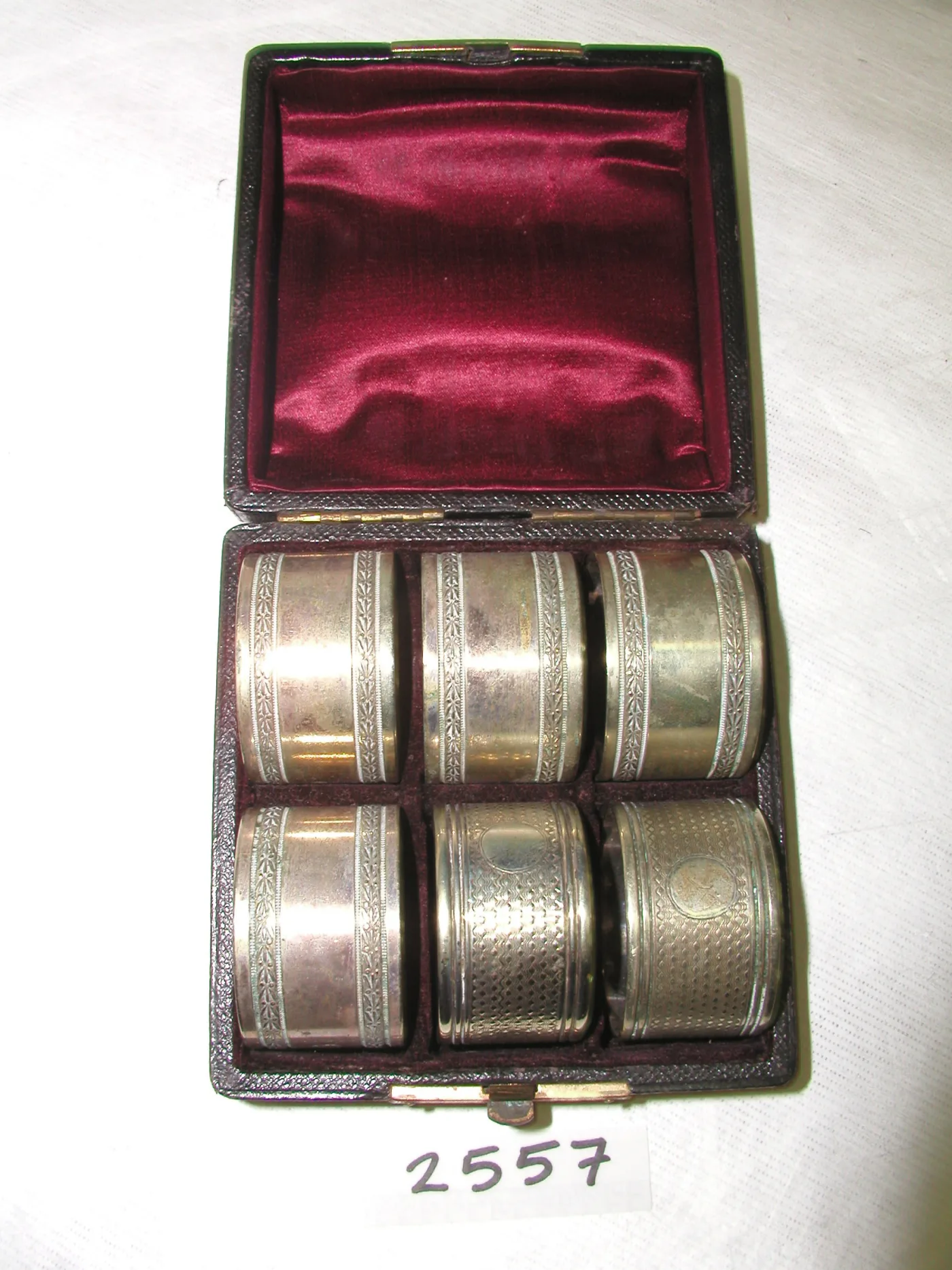
Fine sterling rings were often sold in fitted presentation cases, singly (a christening gift) or in sets of two, four, six, or eight (each ring numbered or differently engraved so family members could tell them apart). An original fitted case with its silk-and-velvet lining intact materially increases value and confirms the rings belong together.
Napkin Rings in the Table Service
Sterling napkin rings were frequently part of, or matched to, a larger silver service — coordinating with the engraving of the cutlery, the cruet, and the serving pieces. A ring that matches a known pattern of flatware or a salver or serving tray in the same service gains provenance and interest. The dining context links napkin rings to the whole Victorian table, including the cruet sets and condiment frames that shared its center.
Reading Hallmarks and Plate Marks
The marks on the ring are the most reliable evidence for material, maker, place, and date. Read them carefully, ideally under a loupe.
English Sterling Hallmarks
An English sterling serviette ring should carry the standard mark (lion passant for sterling .925), the town mark (anchor for Birmingham, crown for Sheffield, leopard's head for London), the date letter (a single letter whose font and shield shape pin the exact assay year), and the maker's mark (initials in a shaped punch). From 1890 the duty mark was discontinued, so a ring lacking a sovereign's-head duty mark is consistent with a date after 1890. Birmingham was the great center of small-silver production, so most sterling rings carry the Birmingham anchor.
American Silver Marks
American sterling is marked "STERLING" or "925", frequently with a maker's name or trademark and a pattern number, but without the British system of date letters — so American silver is dated by maker's marks and style rather than an assay date. Coin silver is marked "COIN" or "PURE COIN" or left to the maker's name alone.
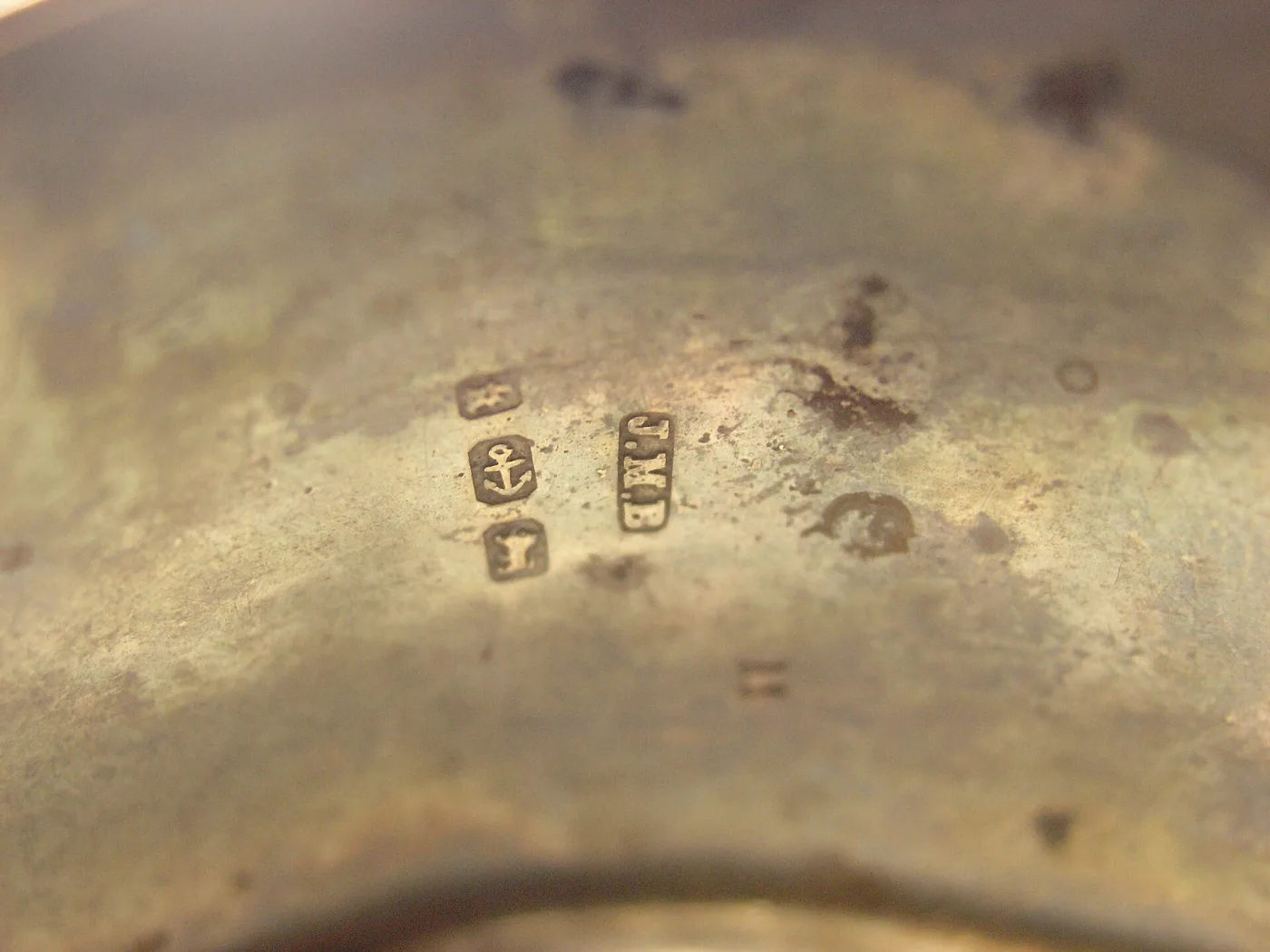
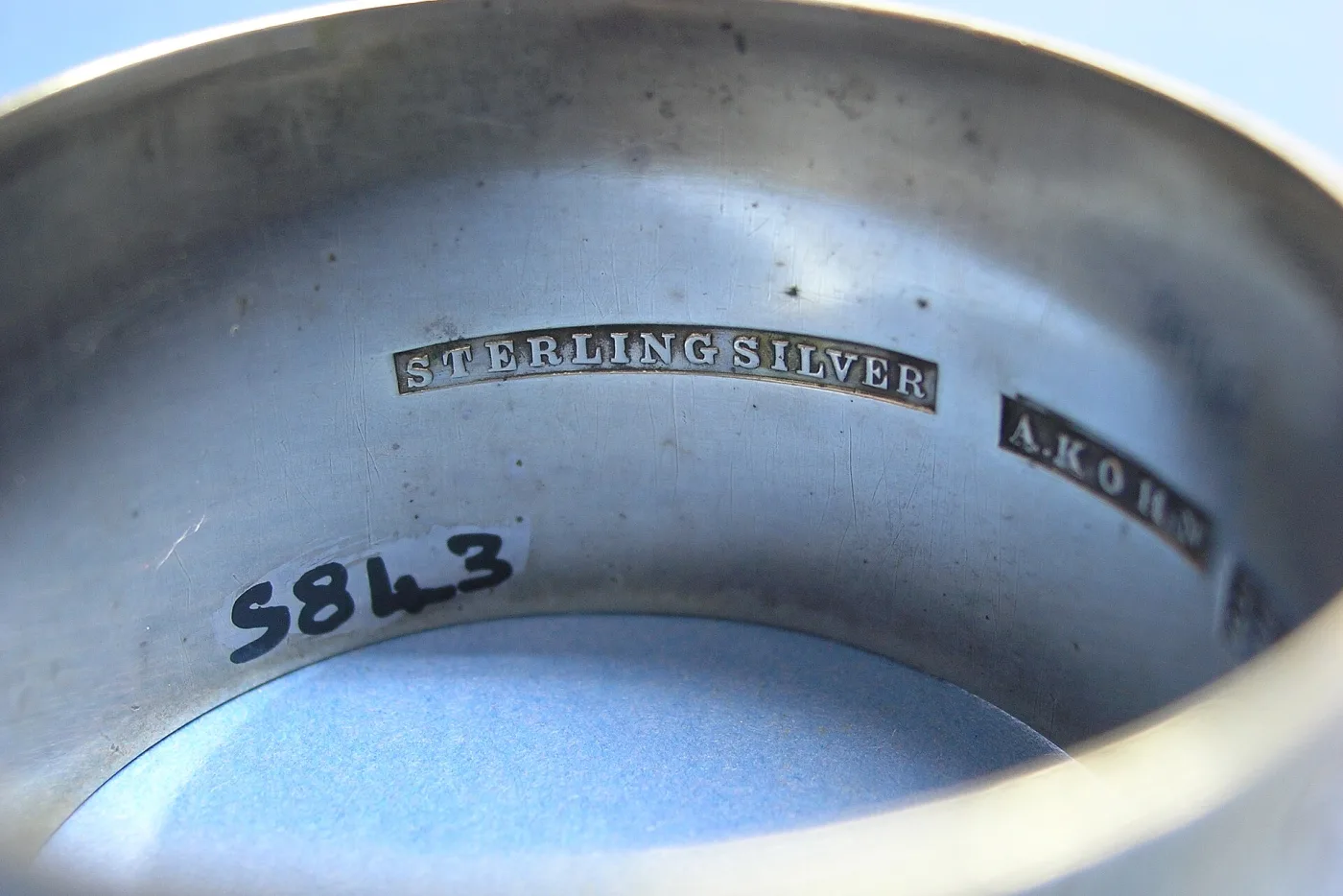
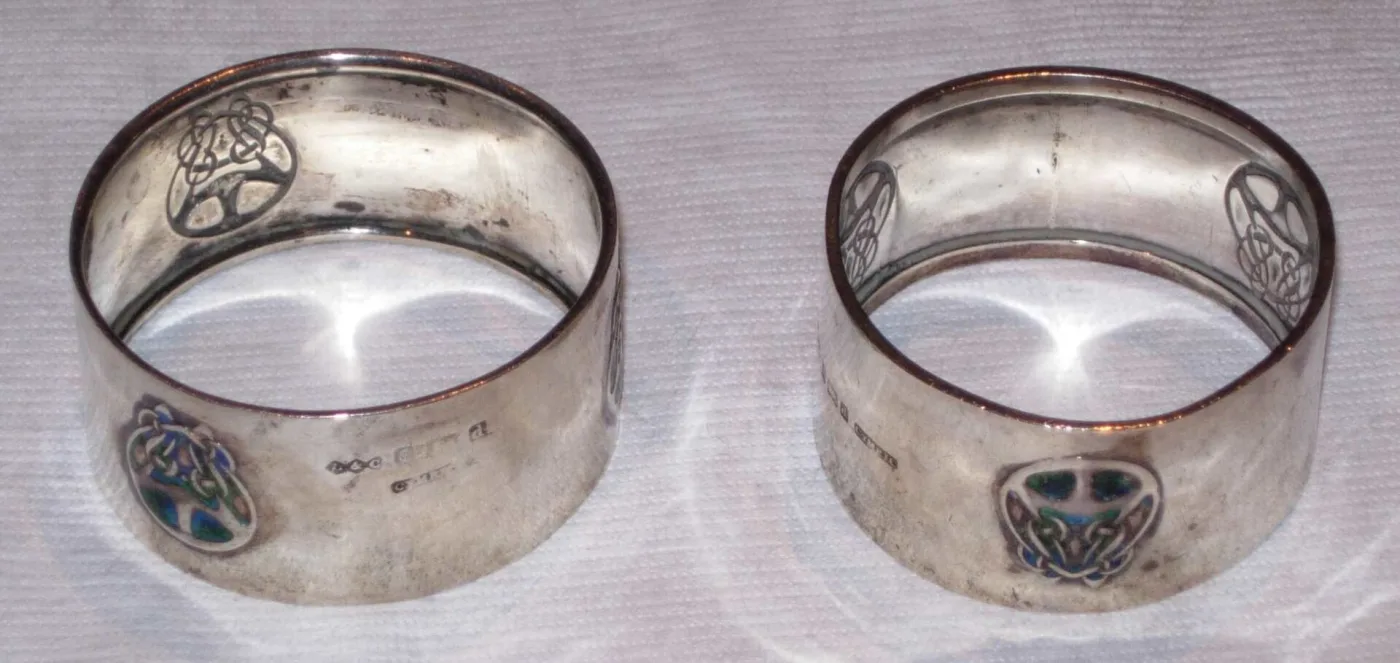
These are two systems for marking the same metal, and the difference decides how precisely you can date a ring. The left-hand ring carries a full British assay hallmark: an anchor for the Birmingham office, a lion passant for the .925 standard, a shielded date letter, and the maker's initials in a shaped punch — four marks that between them fix the town, the metal, the exact assay year and the workshop. The right-hand ring is struck only with the words STERLING SILVER and the maker's name, A. Kohn of Auckland, which is how American and colonial sterling is normally marked. It tells you the metal and the workshop but nothing about the year, so dating falls back on style and on the firm's working dates. One detail to read past: the small black number inked below the struck marks on the right is the museum's own inventory number, added long after the ring was made, not part of the original marking.
American Silver-Plate Marks
Plate is marked with the maker's name or trademark plus a descriptive plate term: "QUADRUPLE PLATE" (the marketing term for a heavy deposit), "TRIPLE PLATE," "EP" (electroplate), or a model number alone. A model number on a figural base is gold: it maps directly to catalogued examples and identifies the exact design. The presence of "Quadruple Plate" immediately tells you the piece is plated, not solid.
British Plate Marks
British plate is marked EPNS (electroplated nickel silver) or EPBM (electroplated britannia metal), with the maker's mark and sometimes a registered design number ("Rd. No.") that can be looked up to find the design's registration year — a useful dating tool for British plated rings made after 1884.
Continental Silver Marks
French rings carry the Minerva head and a maker's lozenge; German rings after 1888 carry the crescent-and-crown with a fineness number (800, 835, 900); Scandinavian, Dutch, and other national systems each have their own marks that need regional reference works to decode.
Dating a Napkin Ring
Combine the marks with the style and construction to reach a confident date.
The Hallmark Date Letter (British Sterling)
For British sterling, the date letter is definitive: decode the cycle and the assay office and you have the exact year. Reference tables (Bradbury, Jackson) and online databases give the cycles for each office. This is the most precise dating tool available for any napkin ring.
The Maker's Mark and Model Number (American)
For American pieces, the maker's mark dates the firm's active period, and the model number (cross-referenced against catalogues and trade catalogues) can pin a figural to a specific introduction date. The shift from individual-firm marks to International Silver marks (after 1898) and to Reed & Barton's later marks gives broad date brackets.
Stylistic Period
Style gives a window even without marks. High-Victorian figurals with elaborate naturalistic bases are 1870–1895. Bright-cut neoclassical band rings echo the 1790s–1820s (and were revived later). Aesthetic-Movement Japanese-taste rings are 1875–1890. Art Nouveau whiplash and Art Deco geometry place a ring firmly in 1900–1915 and 1920–1935 respectively.
Construction Cues
Electroplating means the ring is 1840 or later, full stop — a plated ring cannot be Georgian even if its style mimics one. Seamed stamped cylinders are typical of mass-produced Victorian rings; heavy seamless construction suggests better quality or solid silver. Crisp casting on a figural points to a period original; soft, blurry casting suggests a worn die or a modern recast.
Ivory, Bone, Horn, and Treen Rings
The organic-material rings are a distinct collecting world with their own identification challenges.
Ivory
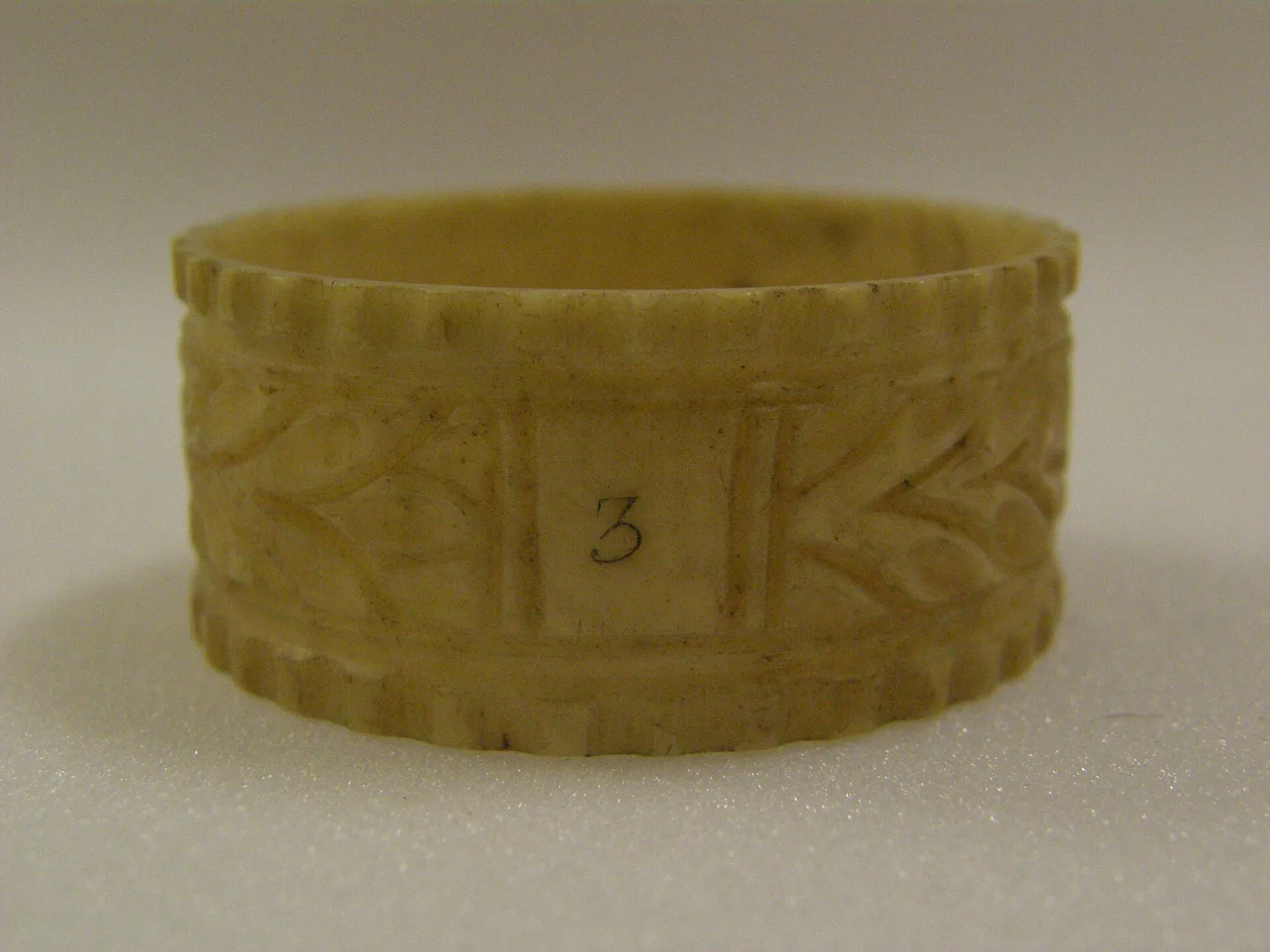
Genuine elephant ivory shows Schreger lines — fine cross-hatching visible on cut surfaces, forming a characteristic diamond pattern — and a warm, faintly translucent body that may develop a fine network of age cracks. Ivory rings were often turned with reeded or pierced decoration and sometimes inlaid. Important note: the sale of ivory is heavily restricted by law in many jurisdictions, and the ethics are fraught; identification is one thing, sale is another. Our ivory carvings guide covers both the identification and the legal landscape.
Bone
Bone is the common substitute for ivory: cheaper, more opaque, and showing tiny dark dots and short dark channels (Haversian canals — the traces of blood vessels) that ivory lacks. Bone rings were widely made as inexpensive and souvenir items, often carved or scrimshawed with simple decoration.
Horn
Pressed and turned horn produces translucent amber-to-dark rings, sometimes pressed with relief decoration. Horn is lighter than ivory or bone, warm to the touch, and shows a fibrous grain when examined closely.
Treen and Tunbridge Ware
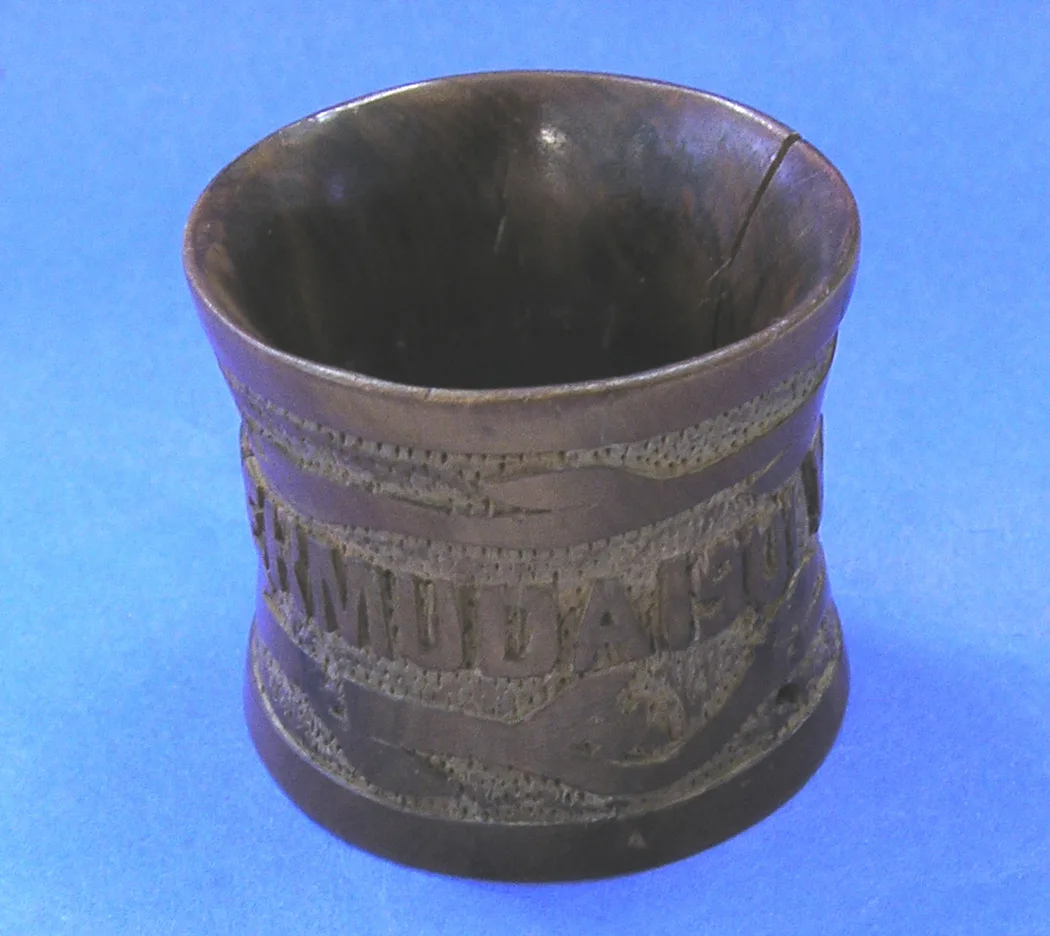
Turned wooden (treen) rings in boxwood, olivewood, lignum vitae, and fruitwoods were popular souvenirs and gift items, sometimes carved with mottoes or place names. Tunbridge ware rings carry the distinctive micro-mosaic of tiny end-grain wood tesserae forming geometric or pictorial patterns — a Kentish English specialty of the nineteenth century. Mauchline ware rings, by contrast, carry printed transfer scenes under varnish on sycamore.
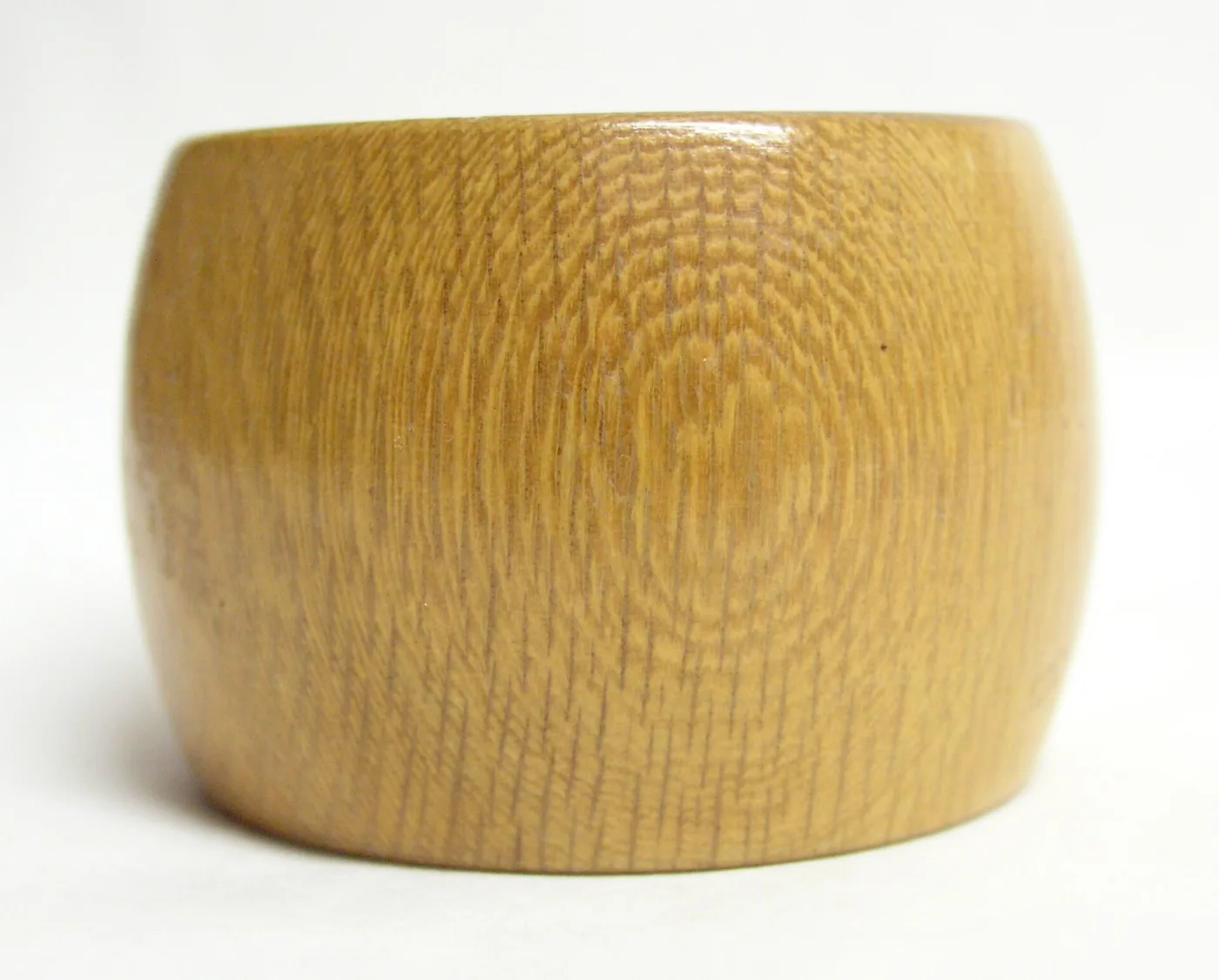
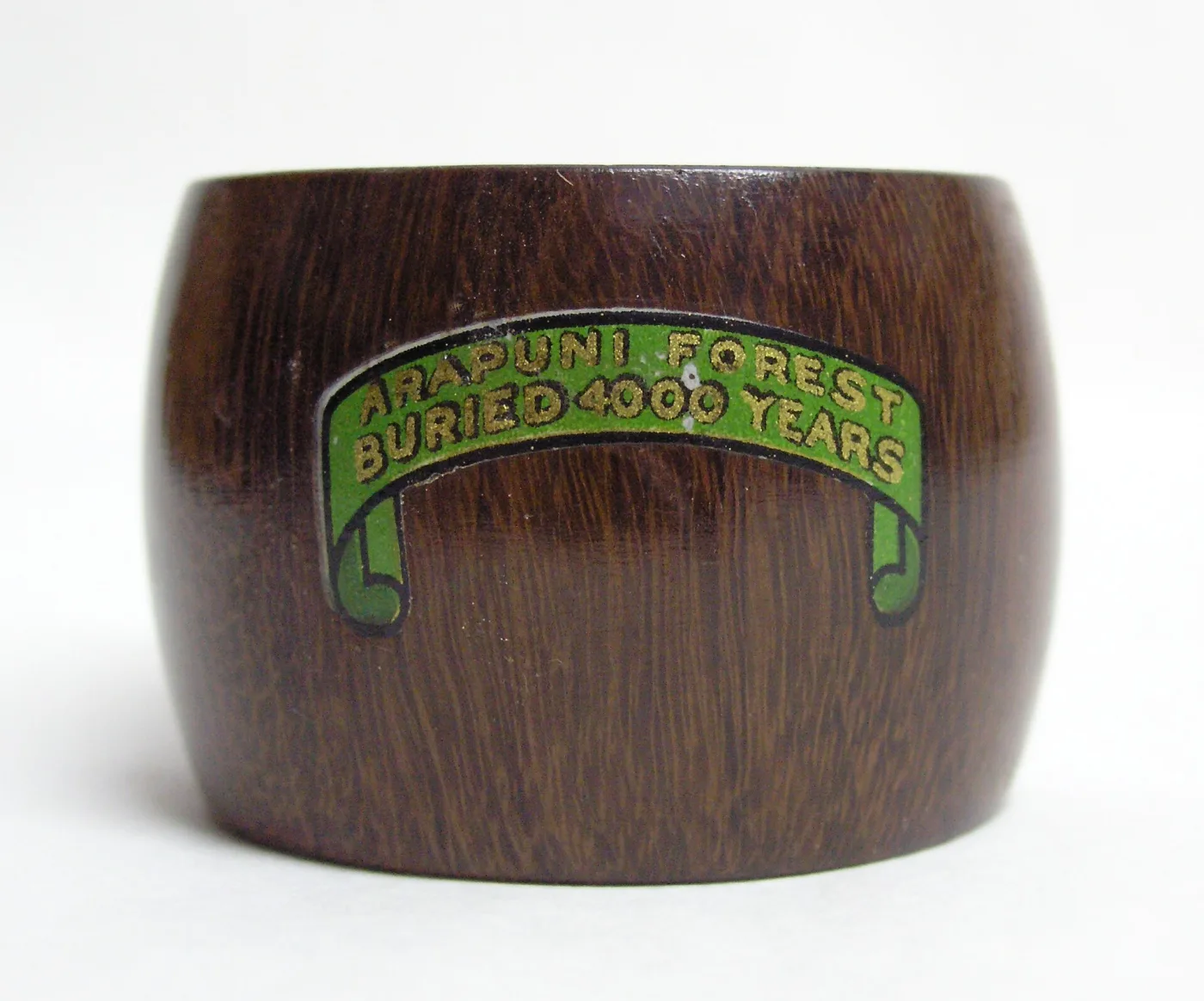
These two came into the museum as a single pair in 1929, and between them they show the whole treen category. The pale one is what most turned wooden rings are: a barrel of plain hardwood whose only ornament is the figure of the grain, cheap when new, near-impossible to date, and worth very little now. The dark one is the same object with a printed label under varnish, and the label changes everything — it names Arapuni, in New Zealand, where dam works in the 1920s cut into a long-buried forest, which is both a place and a date bracket that agrees with the museum's 1929 accession. Neither ring is Tunbridge ware, which is the other thing to look for here: that would show a mosaic of hundreds of tiny end-grain squares rather than plain turning. A label, a place name or a motto is usually the difference between an anonymous wooden ring and a collectable one.

Celluloid, Bakelite, and Early Plastics
Plastic napkin rings span sixty years of material history, from the first ivory imitations to bright Depression-era novelties, and they are increasingly collected.
Celluloid (1870s–1930s)
Celluloid — the first commercial plastic — was used from the 1870s to imitate ivory and tortoiseshell at a fraction of the cost. "French ivory," "Ivorine," and "Pyralin" are trade names for celluloid made to look like ivory, complete with molded imitation grain lines (which, unlike real Schreger lines, are perfectly regular and repeating). Celluloid is lightweight, warms quickly in the hand, and gives a faint camphor smell when rubbed or warmed. It is also flammable and can degrade — crazing, yellowing, and crumbling are common in old celluloid.
Bakelite and Catalin (1920s–1940s)
Bakelite (the dark, filled phenolic) and Catalin (the cast, brightly colored phenolic) produced novelty napkin rings in butterscotch, red, green, and amber, often in figural shapes — animals, fruit, and cartoon forms aimed at children's tables. Genuine Bakelite is heavy for its size, gives a clunky tone when two pieces are tapped, and tests positive with the warm-water sniff test (a faint phenol/formaldehyde smell) or a Simichrome polish test (yellow residue on the cloth). Our Bakelite and early plastics guide sets out these tests in full.
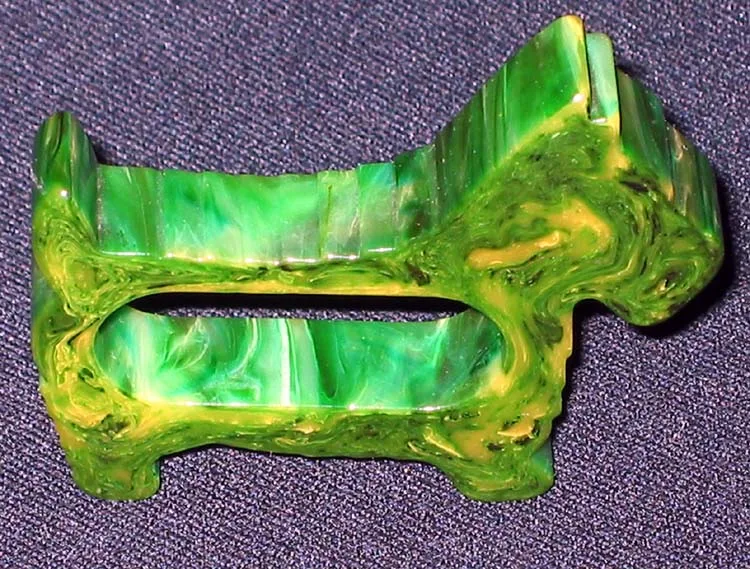
Later Plastics
From the 1950s, injection-molded polystyrene, acrylic, and melamine rings flooded the market as cheap, brightly colored, dishwasher-safe tableware. These are not antiques and have little collector value, but they are frequently misidentified and mispriced as Bakelite. The tests above distinguish them: later plastics are light, give a sharp click rather than a clunk, and fail the warm-sniff and Simichrome tests.
Novelty, Christening, and Souvenir Rings
Several special categories sit alongside the main families and carry their own interest.
Christening and Presentation Rings
Sterling rings engraved with a child's name and a birth or christening date were a standard godparent's gift well into the twentieth century. A clearly engraved, dated christening ring is a small piece of social history and can be researched genealogically — the name and date sometimes lead to a documented family, which adds provenance and interest.
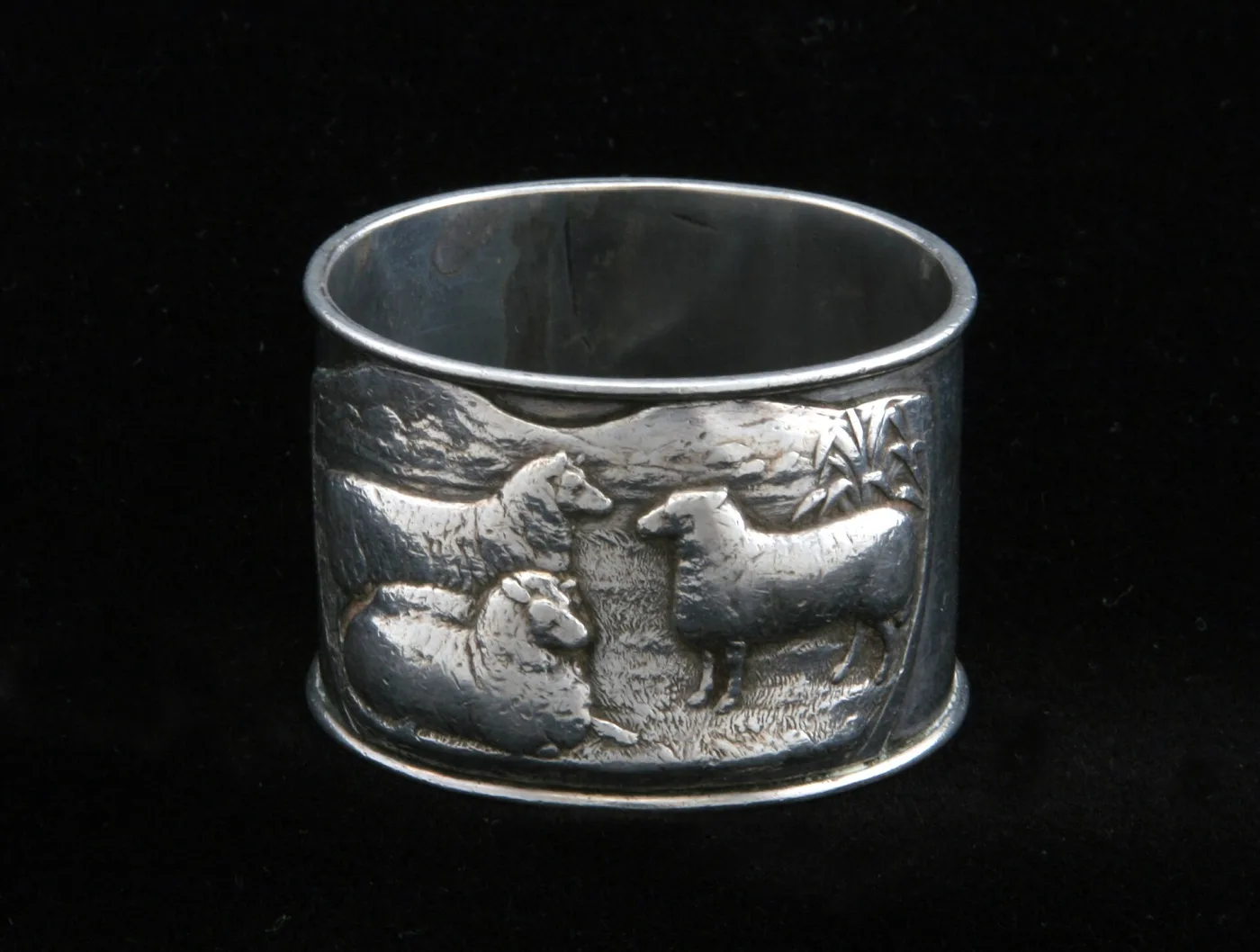
Souvenir and Commemorative Rings
Napkin rings were sold as travel souvenirs (engraved or enamelled with a place name, a landmark, or a coat of arms) and as commemoratives (royal jubilees, world's fairs, exhibitions). Enamelled souvenir rings overlap with the world of souvenir spoons, which were made by the same firms for the same tourist market and often share decorative motifs.
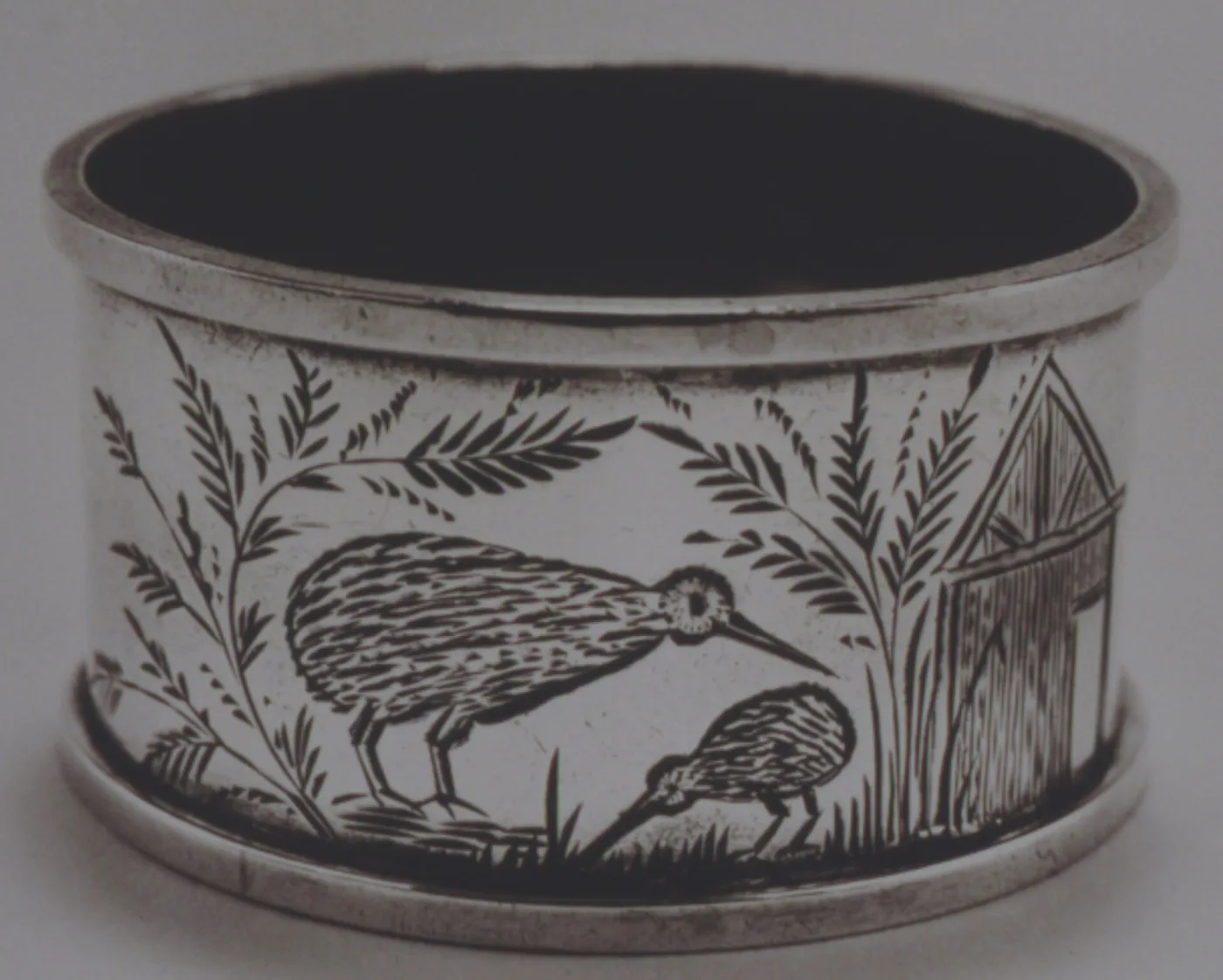
Novelty Figurals
Beyond the standard Victorian figurals, novelty rings of all later periods exist: Art Deco chrome animals, mid-century enamelled flowers, carved coconut and exotic-wood tourist pieces, and brass animal rings. These trade on charm rather than precious-metal value.
Aesthetic and Arts-and-Crafts Rings
The Aesthetic Movement produced mixed-metal rings in the Japanese taste (silver applied with copper and brass birds, fans, and blossoms) in the 1880s; the Arts and Crafts movement produced hand-hammered rings with stylized natural ornament and occasional cabochon stones. Both are scarce and prized by collectors of those design movements.
Sets, Numbering, and Cased Groups
Because each diner needed a recognizable ring, napkin rings were frequently made and sold in sets — and understanding sets is important to both identification and value.
How Sets Were Distinguished
Within a set, individual rings were told apart in one of several ways: by number (each ring engraved 1 through 6 or 8), by name or initial (each ring carrying a different family member's monogram), by a different engraved motif on each ring, or by a different colored enamel or stone. A set in which the rings share a pattern but differ in one identifying detail is original and desirable.
The Value of Completeness
A complete original set in its fitted case is worth substantially more than the sum of the same rings sold singly — and far more than a "set" assembled later from unrelated rings of similar style. Look for consistent wear, consistent hallmarks (same maker, same date letter), consistent engraving style, and a case whose fitted recesses exactly match the number and size of the rings.
Marriages and Made-Up Sets
As with cruets, dealers sometimes assemble "sets" from rings that never belonged together. Mismatched hallmarks (different date letters or makers), inconsistent engraving, varying wear, and a case whose recesses don't quite fit the rings are the giveaways. A made-up set is not dishonest if disclosed and priced as individual rings; it becomes a problem when sold as an original cased set.
Reproductions, Recasts, and Fakes
Figural napkin rings, being valuable and made by casting, are among the more reproduced small antiques, and recognizing later copies is an essential skill.
Modern Recasts
The most common deception is the modern recast: a mold taken from a period figural and used to cast new copies, which are then plated to look old. Recasts betray themselves through soft, blurred detail (each casting generation loses sharpness), filled-in undercuts and crevices, a slightly smaller size than the original (metal shrinks as it cools), pitting or porosity in the metal surface, and seam lines or sprue marks in the wrong places. Period castings are crisp; recasts are mushy.
Marriages of Figure and Ring
A period figure base can be married to a replacement ring, or a period ring fitted to a replacement base. Look for solder joints that don't match the surrounding patina, plating that differs between the figure and the ring, and a ring whose style or wear is inconsistent with the base. The base usually carries the maker's mark and model number, so a base-and-ring whose ring looks newer than its marked base warrants suspicion.
Replated Pieces
A worn figural can be re-plated to look fresh. Re-plating destroys the soft patina and honest wear that authenticate the piece, fills fine detail with a thick new silver layer, and leaves the surface too bright and uniform for its claimed age. Collectors generally prefer honest original surface — even worn — to a re-plated piece.
Outright Reproductions and Fantasy Pieces
Some figural "antiques" were never period objects at all: fantasy designs cast in recent decades, sometimes marked with spurious or vague marks, sometimes unmarked. The absence of a credible maker's mark and model number on a supposedly Victorian American figural is a warning sign, since the genuine firms marked their work. Cross-checking the model number against catalogued examples is the surest defence.
Married, Erased, and Re-engraved Monograms
On band rings, watch for monograms that have been buffed out (leaving a thin, dished patch) and re-engraved with a different or "more desirable" monogram or date. Re-engraving to fake a presentation or a famous association does happen on higher-value pieces; an engraving that looks crisper or newer than the surrounding surface, or sits in a dished, over-polished panel, should be questioned.
Condition Assessment
Condition is graded across several axes, weighted differently for figurals and band rings.
Plate Wear (Plated Rings)
Examine the high points — the top of the ring, the figure's head and back, the base edges — where plate wears first. Light wear showing a little base metal is acceptable and authentic. Heavy wear-through over large areas reduces value but does not destroy it; collectors accept honest wear on genuine pieces more readily than they accept a re-plated surface.
Casting Sharpness (Figurals)
For a figural, the crispness of the casting is central to both authenticity and value. Sharp, deep, well-defined detail signals a period original; soft, filled, blurry detail signals wear or a recast. Compare the piece against catalogued illustrations of the same model where possible.
Damage and Repair
Look for dents, splits in the ring seam, broken or missing cast elements (a bird's tail, a child's arm), re-soldered joints, and bent bases. Missing cast elements are serious and hard to remedy; a clean old re-solder of a structural joint is acceptable. On organic rings, look for cracks (ivory and bone shrink and split), chips, and stabilized or filled losses.
Monogram and Engraving Condition
A crisp original monogram is fine and often desirable. An erased monogram (dished, over-polished panel) is a defect. A re-engraved or altered monogram is both a defect and a warning sign of possible deception.
Completeness
For combination figurals, all elements (vase, salt, bell, place-card clip) should be present. For sets, all rings and the original case should be present and consistent. Missing parts and missing cases reduce value materially.
What Drives Value
Several factors combine to set the price of a napkin ring, and their interaction explains the enormous spread in the market.
Family and Material
Figural silver plate generally outvalues plain band plate; among band rings, sterling and coin silver outvalue plate, which outvalues base metal and ordinary plastic. But a scarce figural in good condition beats a plain sterling band by a wide margin — the figural premium is driven by collecting demand, not metal content.
Subject and Rarity (Figurals)
For figurals, subject is everything. Common single birds and simple cherubs are affordable; scarce narrative scenes, action animals, Kate Greenaway figures, recognizable characters, and combination pieces command the highest prices. The collector references that catalogue and rate the rarity of each known figural are the practical guide to which subjects are scarce.
Maker
Among figurals, the established firms (Meriden, Reed & Barton, Tufts, Wilcox) carry confidence and a modest premium over anonymous pieces. Among sterling bands, a known and respected silversmith, or a match to a documented service, adds value.
Condition and Originality
Crisp original casting, honest unre-plated surface, intact monogram, complete combination elements, and (for sets) an original case all add value. Recasts, re-plating, erased or altered monograms, and missing elements all subtract.
Provenance and Association
A dated christening ring traceable to a documented family, a souvenir ring tied to a specific exhibition, or a ring belonging to a named service all carry provenance value beyond the object itself. For the broader principles of building provenance and a coherent collection, see our buying and selling strategies guide.
Care, Cleaning, and Storage
Napkin rings need care matched to their material — silver, plate, and organic materials each have different needs.
Cleaning Silver and Plate
Clean sterling and plate with a soft cotton cloth and a non-abrasive silver polish used sparingly. Avoid silver dips and aggressive polishing on plate — they strip the thin silver layer and accelerate wear-through. On figurals, never machine-buff: it rounds the crisp casting detail that gives the piece its value. For deeper conservation principles — when to clean, when to leave alone — see our restoration and conservation guide.
Caring for Ivory and Bone
Keep ivory and bone away from heat, direct sun, and humidity swings, which cause cracking and warping. Clean only with a barely damp cloth; never soak. Stable temperature and humidity are the main preservation goals.
Caring for Celluloid and Bakelite
Celluloid is flammable and chemically unstable: keep it cool, ventilated, and away from other celluloid (degrading celluloid off-gasses and can accelerate the decay of neighbours). Bakelite is more stable but should not be soaked for long periods or exposed to harsh solvents, which can dull the surface.
Storage
Store silver and plate in anti-tarnish cloth or bags, away from rubber and cardboard (which off-gas sulfur). Wrap organic and plastic rings in acid-free tissue. Keep figurals where their projecting cast elements (tails, arms, vases) cannot be knocked and broken. For the general principles of safe long-term storage, our vanity and dresser sets guide covers parallel care of mixed metal-and-organic small antiques.
Common Beginner Mistakes
A handful of errors catch new napkin-ring collectors repeatedly.
Mistaking Plate for Sterling
EPNS and "Quadruple Plate" rings can look like solid silver to a casual eye. The marks (EPNS, "Quadruple Plate," a model number, or a maker's name without a sterling/925 mark) and the worn-through yellow or gray base at the edges are the giveaways. A figural is essentially always plate, never solid silver.
Paying Antique Prices for a Recast
The most expensive mistake. Without checking casting sharpness, size, surface porosity, and the maker's mark and model number, a modern recast can pass for a period figural. Always examine the detail and verify the mark before paying a period price.
Mistaking Later Plastic for Bakelite
Bright plastic rings from the 1950s onward are routinely sold as "Bakelite." The warm-water sniff test, the Simichrome test, and the weight and tone of the piece distinguish genuine period Bakelite from later injection-molded plastics.
Over-cleaning and Re-plating
Aggressive polishing strips plate and rounds figural detail; re-plating destroys the patina and detail that authenticate a piece. Clean gently and infrequently, and resist the urge to re-plate worn pieces — honest wear is worth more than a fake-fresh surface.
Assuming a "Set" Is Original
A boxed group of similar rings is not necessarily an original set. Check that hallmarks, engraving, and wear match across all rings and that the case recesses fit them exactly. Made-up sets are common.
Ignoring the Base Mark on a Figural
The maker's mark and model number on a figural's base are the key to its identity, date, and rarity — and to spotting recasts and marriages. Always photograph the base clearly. For buying remotely, insist on clear photos of the base mark, the casting detail, and any monogram, exactly as you would for any silver purchase.
Frequently Asked Questions
What is the difference between a napkin ring and a serviette ring?
None — they are the same object. "Napkin ring" is the standard American term; "serviette ring" is the common British term. Both describe a band used to hold and identify a personal cloth napkin between meals.
How can I tell if my napkin ring is silver or silver plate?
Look for the marks. Sterling carries "STERLING," "925," or a full British hallmark (lion passant, town mark, date letter, maker's mark). Plate carries "EPNS," "Quadruple Plate," "Triple Plate," or a maker's name and model number without a sterling mark. Plate also wears through to a yellow or gray base metal at the high points, while solid silver wears uniformly.
Why are American figural napkin rings so much more valuable than plain ones?
Because they are collected as miniature sculptures, not as silver. The cast figures — birds, animals, children, narrative scenes — appeal to a dedicated collecting community, and scarce subjects in good condition are genuinely rare. A plain sterling band is worth its silver plus a small premium; a scarce figural can be worth hundreds or, exceptionally, thousands.
How do I know if a figural napkin ring is a reproduction?
Check the casting: period originals are crisp and sharply detailed, while recasts are soft, blurry, slightly undersized, and often pitted. Check the marks: genuine American figurals carry a maker's name and a model number that maps to catalogued examples; unmarked or vaguely marked "Victorian" figurals are suspect. Re-plated and married pieces show inconsistent surface and solder.
Is a monogram on a napkin ring a problem?
No — a monogram is original and expected; the whole purpose of a personal ring was to be marked. A crisp period monogram adds character, and a dated christening engraving can add provenance. What hurts value is an erased monogram (a dished, over-polished blank patch) or a re-engraved one, both of which mean the surface has been altered.
Can I tell ivory from celluloid and bone?
Yes, with care. Real elephant ivory shows fine cross-hatched Schreger lines and a warm translucence; bone shows tiny dark dots and channels and is more opaque; celluloid shows perfectly regular molded "grain" lines, is lightweight, and gives a camphor smell when warmed. A loupe and (for plastics) the warm-sniff test usually settle it. Remember that ivory sale is legally restricted in many places.
How old is my napkin ring likely to be?
Most antique napkin rings date from about 1850 to 1935. American figurals are concentrated in 1870–1900. A British sterling ring can be dated to the exact year from its hallmark date letter. Plated construction means the piece is 1840 or later. Bakelite novelty rings are 1920s–1940s; celluloid imitation-ivory rings span the 1870s–1930s.
Are napkin rings sold in sets worth more?
A genuine original set in its fitted case is worth more than the same rings sold singly, because complete cased sets are scarcer and more desirable. But verify it is a true set — matching hallmarks, engraving, and wear, with a case that fits the rings exactly — rather than a later marriage of similar rings.
Should I re-plate a worn silver-plate napkin ring?
Generally no. Re-plating destroys the original surface, fills fine casting detail, and removes the honest wear that authenticates the piece. Collectors usually prefer a genuine worn original to a re-plated one. Clean gently and accept honest wear as part of the object's age.
Where can I find out which firm made my figural ring?
The maker's mark and model number stamped on the base are the key. Match them against the standard collector references for figural napkin rings, which catalogue known examples by maker and model number with rarity ratings. A clear photograph of the base mark is the single most useful piece of evidence for attribution and dating.