Antique Jade Identification Guide: Nephrite, Jadeite and Dating
Jade is the hardest category in Chinese art to date and the easiest to fall in love with, and those two facts are related. The stone does not age. It cannot be radiocarbon dated because it contains no carbon, and it cannot be thermoluminescence tested because it was never fired. A jade carved last year and a jade carved three thousand years ago are made of chemically identical material, and no laboratory in the world can tell you which is which from the stone alone.
Everything therefore rests on the surface: on the marks the tools left, on the way the polish sits, on whether the form belongs to a period that actually made that form, and on what burial or centuries of handling have done to the outermost fraction of a millimetre. This is connoisseurship in the strict sense, and it is learnable — the evidence is physical, repeatable, and visible under a ten-power loupe. It is simply not the kind of evidence a certificate can supply.
This guide works in the order a specialist works a piece. First establish the material, because a great many objects sold as jade are not jade at all. Then separate nephrite from jadeite, which alone eliminates most of the wrong answers about age and origin. Then read the treatments, the tool marks and the surface alteration. Only after all of that does the form, the subject and the maker's name come into it — because a convincing shape is the one thing a forger can copy perfectly.
Table of Contents
- What Actually Counts as Jade
- Eight Thousand Years in Outline
- Telling Nephrite from Jadeite
- Colour, and What It Does Not Tell You
- Tests You Can Run Without a Laboratory
- A, B and C: The Treatment Grades
- Tool Marks: The Strongest Evidence
- Burial Alteration and Faked Age
- Archaic Forms and Their Names
- Archaism: Old Shapes, Later Hands
- The Qianlong Golden Age
- Mughal and Hindustan Jades
- Jade Outside China
- Bangles, Beads and Pendants
- Reign Marks, Poems and Signatures
- Stands, Boxes and Fittings
- Simulants and Outright Fakes
- Damage, Repair and Repolishing
- What Actually Drives Value
- Handling, Cleaning and Storage
What Actually Counts as Jade
In gemmology, jade means two minerals and nothing else. Nephrite is a calcium magnesium iron silicate from the amphibole group, in the tremolite–actinolite series. Jadeite is a sodium aluminium silicate from the pyroxene group. They look similar, they were both worked by the same cultures, and they were assumed to be one substance until the French chemist Alexis Damour analysed Burmese material in 1863 and demonstrated that they were not.
The Chinese word yu, usually translated as jade, is considerably broader. It has covered serpentine, marble, quartzite, agate, turquoise and any handsome hardstone worth carving, and it still does in ordinary speech. This is not a translation error but a genuine difference in category, and it matters commercially: an object correctly described in a Chinese catalogue as yu may be serpentine, and an honest seller repeating that description is not lying to you. Establish the mineral yourself rather than relying on the word.
The Long List of Things Sold as Jade
Serpentine, particularly the translucent variety bowenite, is the most common substitute and accounts for a very large share of inexpensive carvings. It is much softer, at roughly 2.5 to 5.5 on the Mohs scale, so it takes detail crisply and scratches easily. Quartzite, often dyed a startling green and sold as "Malay jade" or "Malaysian jade", has an obvious granular sparkle in strong light. Aventurine quartz circulates as "Indian jade" and betrays itself by the glittering mica platelets suspended in it. Chrysoprase is marketed as "Australian jade" and is far more evenly coloured than real jadeite ever is.
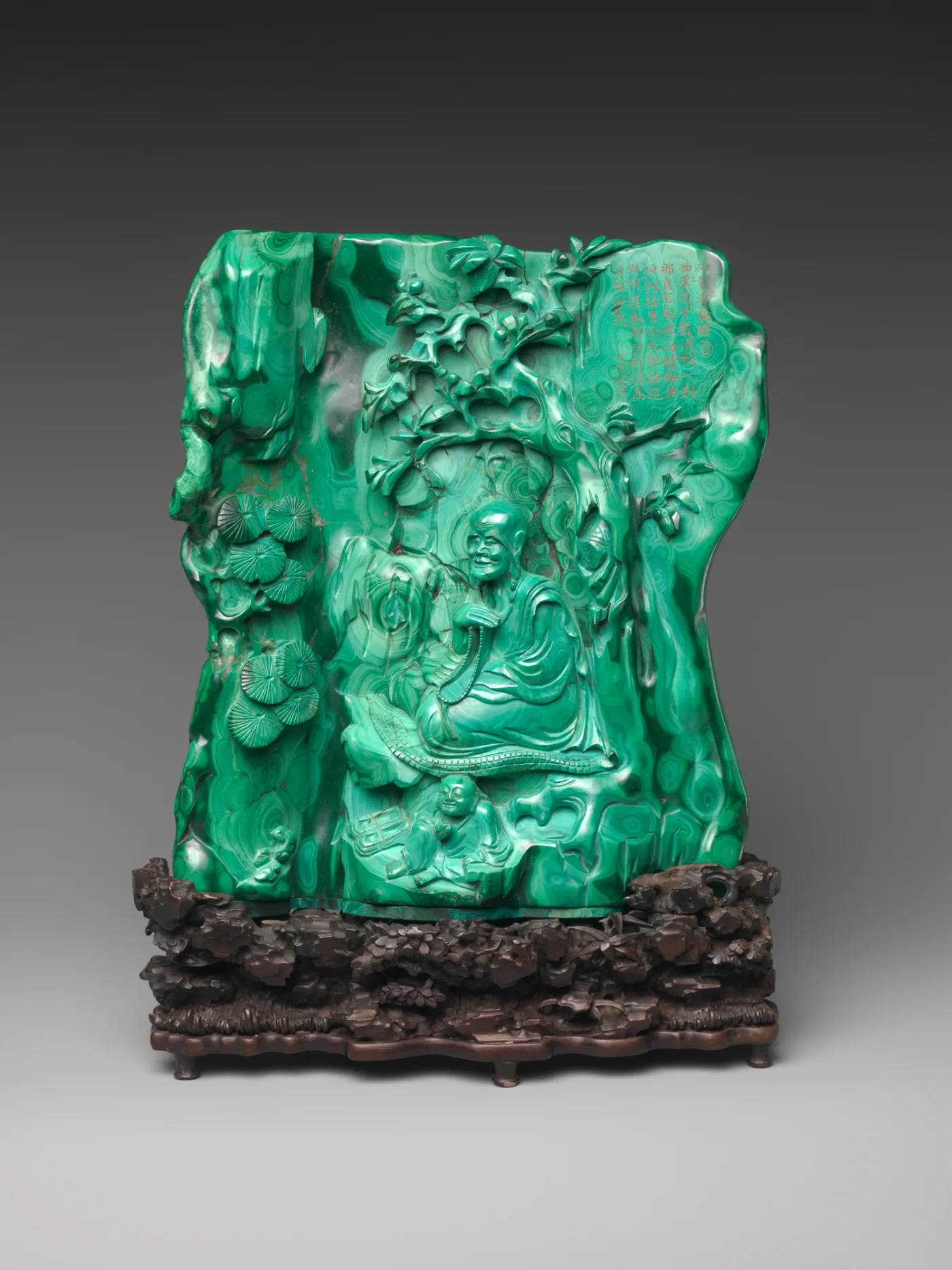
Two more deserve attention because they are genuinely hard to spot. Hydrogrossular garnet, the "Transvaal jade" of South Africa, has a density close to jadeite and a similar granular texture, though it usually carries small black inclusions. Dolomitic marble, dyed and waxed, is very convincing to the eye and only gives itself away on a hardness or density test. Beyond the natural stones sit glass, plastic, and pressed jade powder bound in resin, all of which are covered later in this guide.
Eight Thousand Years in Outline
You cannot date a jade without knowing which shapes existed when, so a compressed chronology is a working tool rather than background reading. What follows is the skeleton every attribution hangs on.
Neolithic: Ritual Before Ornament
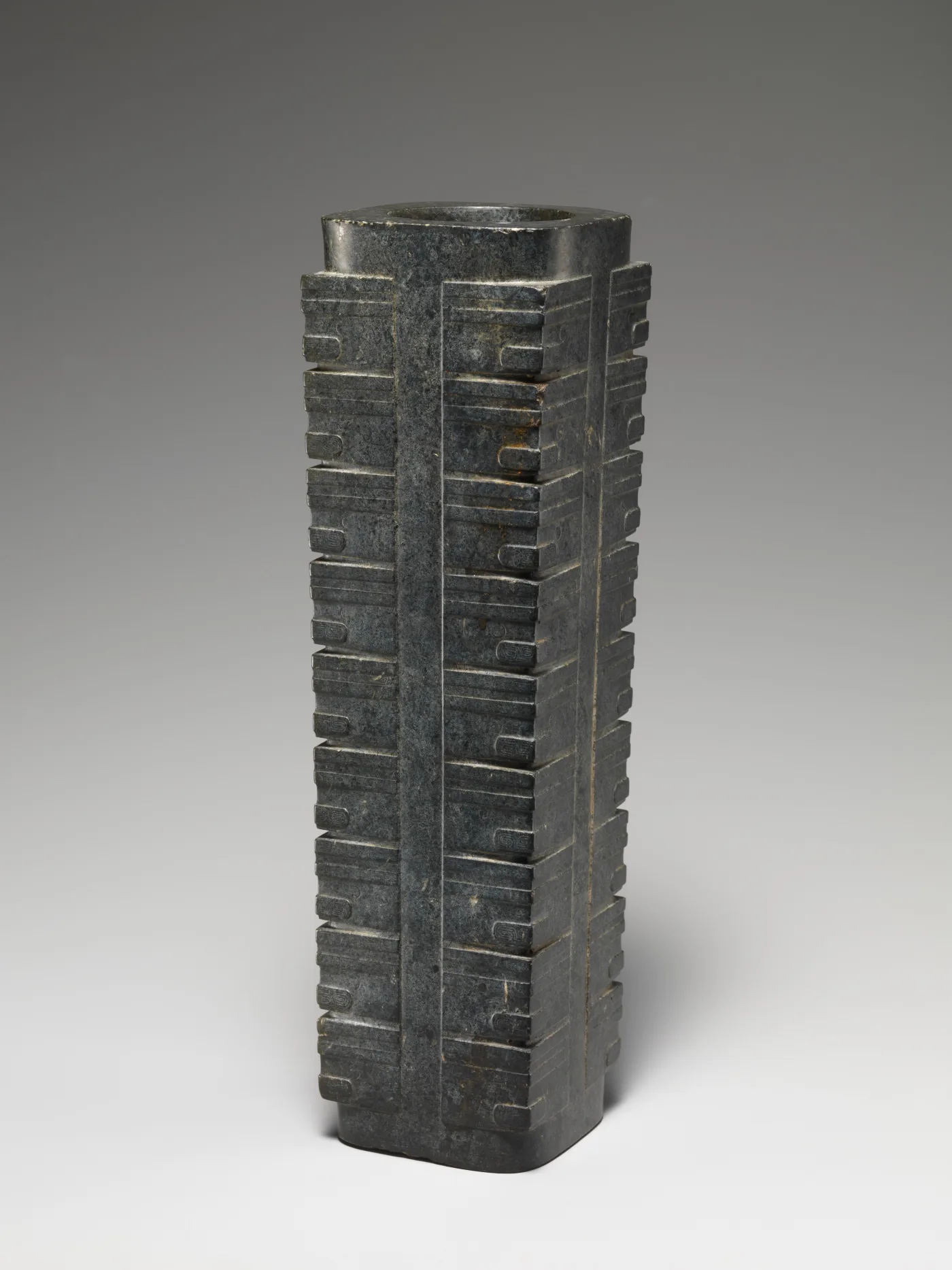
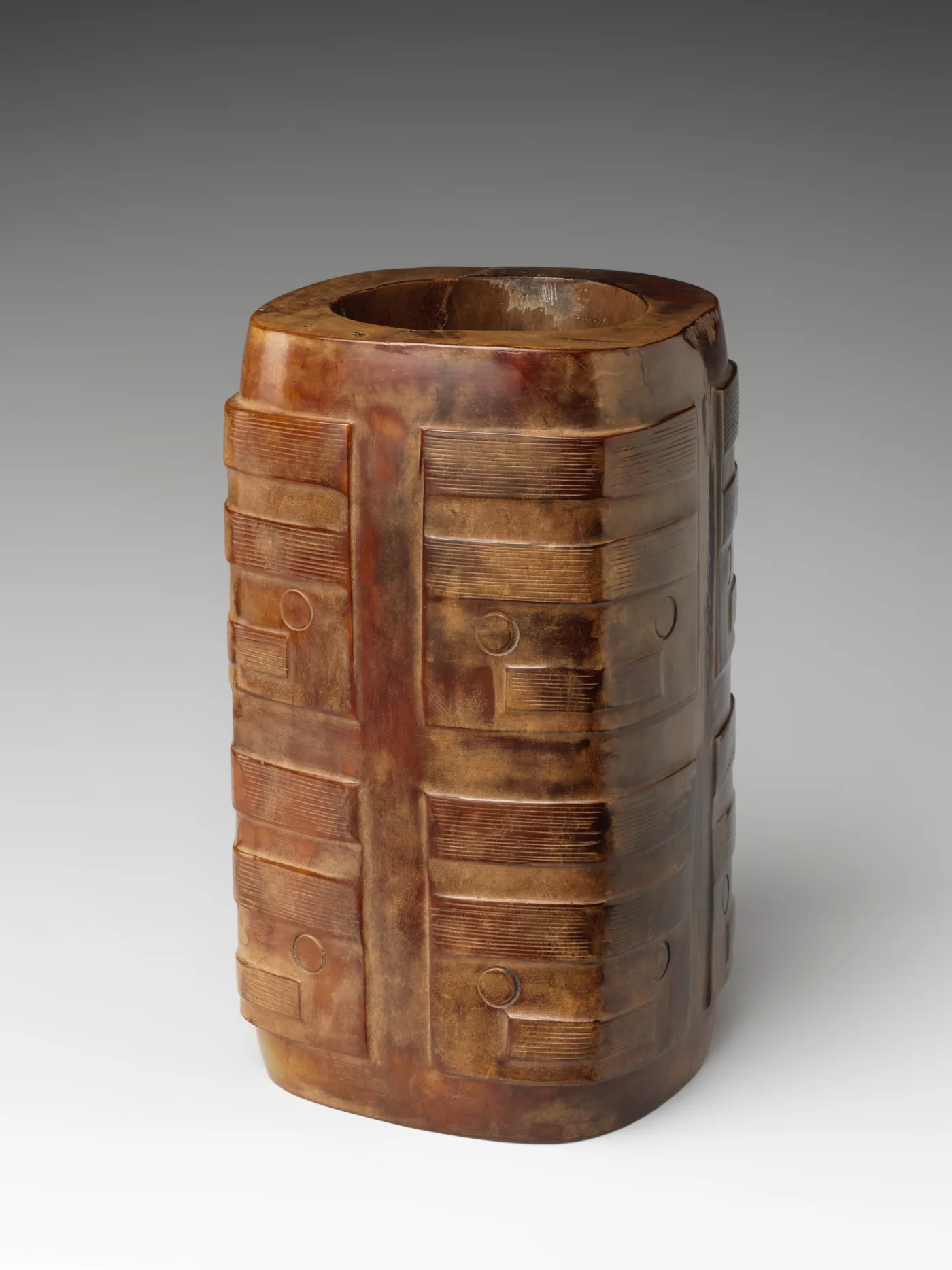
The earliest worked jades in China are Neolithic and already sophisticated. The Hongshan culture of the northeast, from roughly 4700 to 2900 BC, produced coiled pig-dragons, C-shaped dragons and hooked cloud plaques in a yellowish or pale green nephrite, with surfaces that are smoothly modelled and almost without incised detail. The Liangzhu culture of the Yangtze delta, from about 3300 to 2300 BC, produced the two forms that define archaic jade in the popular imagination: the bi, a flat disc with a central hole, and the cong, a tube square on the outside and circular inside, carved at the corners with tiered mask motifs of extraordinary fineness. Most Liangzhu jade has weathered to an opaque creamy white known in the trade as chicken-bone white.
Bronze Age to Han: The Ritual System
Shang jades, best known from the tomb of Fu Hao at Anyang, are small, flat and graphic: blades, birds, fish, tigers and human figures cut with strong double-line grooves. Zhou jades formalise the ritual repertoire and introduce the huang, an arc-shaped pendant hung in assemblages that chimed as the wearer moved. By the Warring States and Han periods, carvers were producing openwork dragon plaques of real virtuosity, sets of jade sword fittings, and an entire industry of burial jade: orifice plugs, cicada-shaped tongue amulets, pig-shaped hand grips, and for the highest rank the celebrated suits of jade plaques sewn with gold wire.
Tang and Song: Naturalism, Then Nostalgia
Tang jade turns outward and naturalistic, absorbing Central Asian and Persian motifs and producing belt plaques, cups and lively animal carvings. The Song period then does something that shapes everything after it: it looks backwards. Scholars catalogued ancient bronzes and jades in illustrated antiquarian books, and carvers began making deliberate imitations of archaic forms for a collecting market. Archaism as a genre starts here, and it never stops.
Ming and Qing: Volume, Then Empire
Ming jade is generally stockier and less finely finished than Qing work, with a distinctive slightly sugary polish, and it is where the first great named carver appears: Lu Zigang of Suzhou, whose signed rectangular plaques were so admired that his signature became the single most forged mark in the field. The Qing dynasty then transformed the supply. In 1759 the Qianlong emperor's campaigns in the Tarim Basin brought the nephrite sources of Khotan and Yarkand under direct control, and jade began arriving at court in tons rather than pounds. Almost everything a general collector encounters is Qing or later, and the Qing section below covers it in detail.
Telling Nephrite from Jadeite
This is the first real fork in the road, and it settles more questions than any other single observation. Nephrite is the historical Chinese jade, worked continuously for eight millennia. Jadeite arrived in quantity from Burma only in the late eighteenth century and became fashionable in the nineteenth. A jadeite carving cannot be Ming, cannot be Han, and cannot be Neolithic Chinese, whatever the seller's story. Establishing the mineral therefore eliminates entire centuries in one step.
Structure, Seen Under a Loupe
The two minerals are built differently and the difference is visible at ten power on a polished surface held under a single bright light. Nephrite is a felted mass of microscopic interlocking fibres, so its polished surface is smooth and continuous and its internal appearance is soft, cloudy and directionless. Jadeite is granular, made of interlocking blocky crystals of unequal hardness, and polishing leaves the harder grains standing very slightly proud. The result is a faint dimpling across the surface, best seen in a reflected highlight, which the trade calls orange peel. Orange peel effect is close to conclusive for jadeite.
Lustre and Feel
Nephrite has a greasy or oily lustre, as though a film of wax lay over it, and this waxy quality is exactly what Chinese connoisseurship prizes in fine Hetian material. Jadeite is vitreous and glassy, and at its best has a wet, almost liquid brilliance. Once you have handled a dozen of each, the distinction is immediate and the loupe becomes a confirmation rather than a first resort.
Numbers That Settle It
Where the eye is uncertain, the physical constants are not. Nephrite has a specific gravity of about 2.90 to 3.03 and a spot refractive index near 1.61. Jadeite runs 3.30 to 3.38 and reads about 1.66. That density gap is large enough to feel in the hand once you are calibrated, and it is easily measured at home by hydrostatic weighing. Hardness is close and unhelpful, at 6 to 6.5 for nephrite against 6.5 to 7 for jadeite.
One popular belief is worth correcting. Jadeite is harder, but nephrite is markedly tougher, because its interlocking fibrous structure resists fracture far better than jadeite's granular one. Nephrite is in fact among the toughest natural materials known, which is precisely why Neolithic cultures made axes and weapons from it. Hardness resists scratching; toughness resists breaking. The two are not the same property, and confusing them leads people to handle nephrite carelessly and jadeite too reverently.
Colour, and What It Does Not Tell You
Colour is the first thing anyone notices and one of the weakest dating tools available. Both minerals occur in a wide range of colours, and the same range was quarried in the Neolithic and last week. What colour does tell you, read carefully, is something about the source and a great deal about whether the stone has been treated.
The Nephrite Range
Nephrite runs from white through celadon and grey-green to deep spinach green and near black, with yellows and browns in between. The most prized is the translucent white known as mutton-fat jade, historically from the Hetian region of Khotan. Dark spinach green shot through with small black chromite specks is characteristic of Siberian material from around Lake Baikal, and its distribution in Chinese carving reflects Russian trade rather than antiquity.
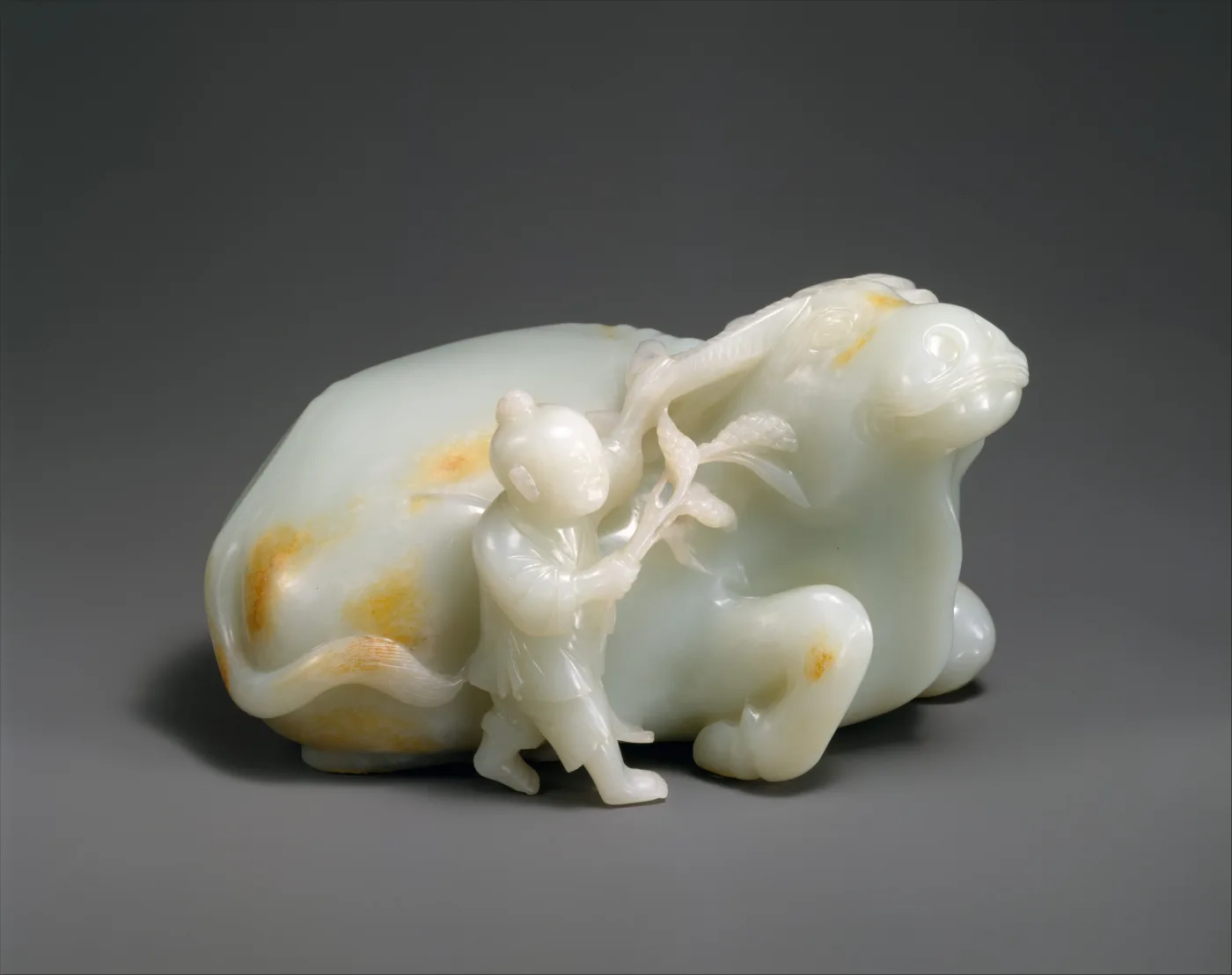
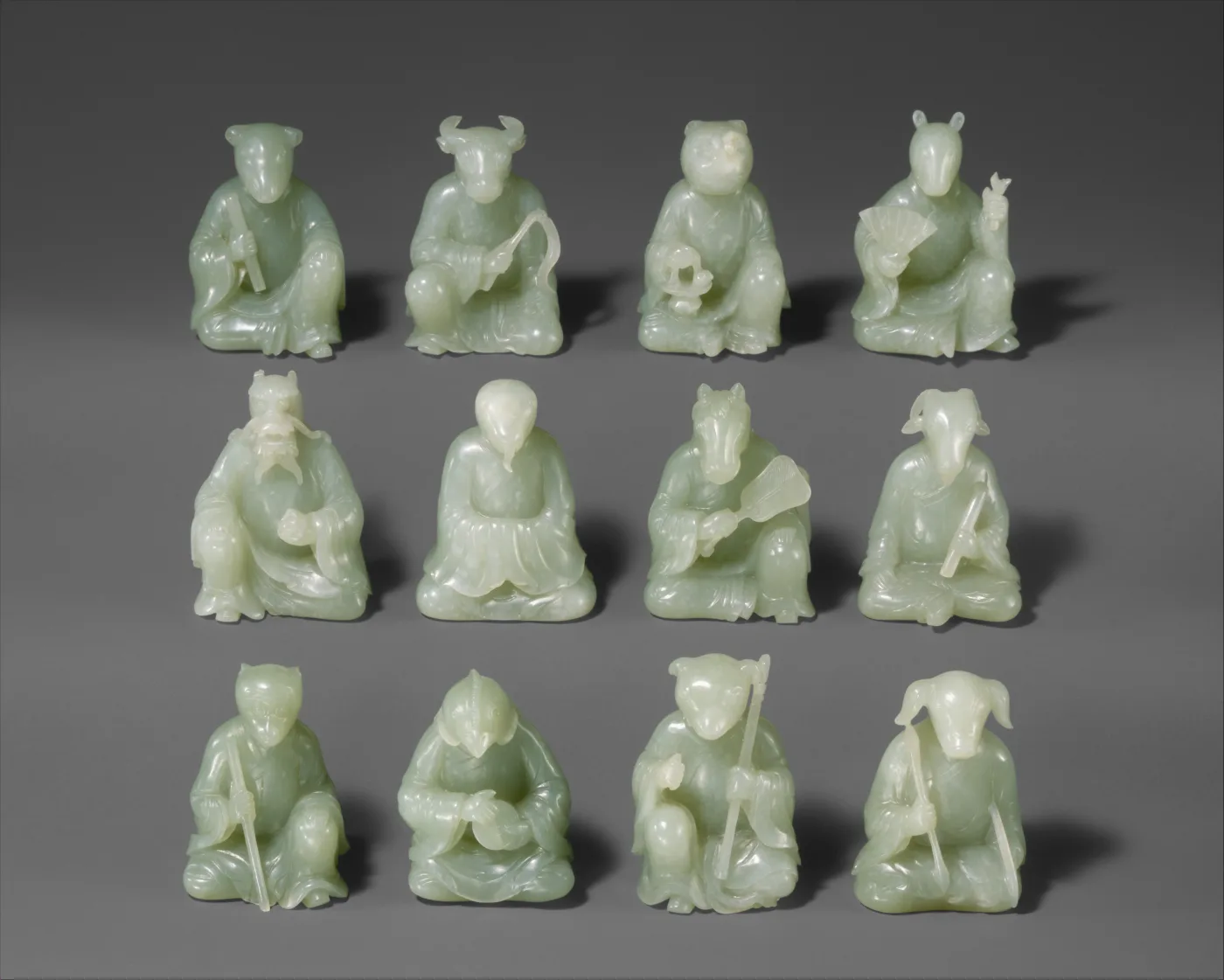
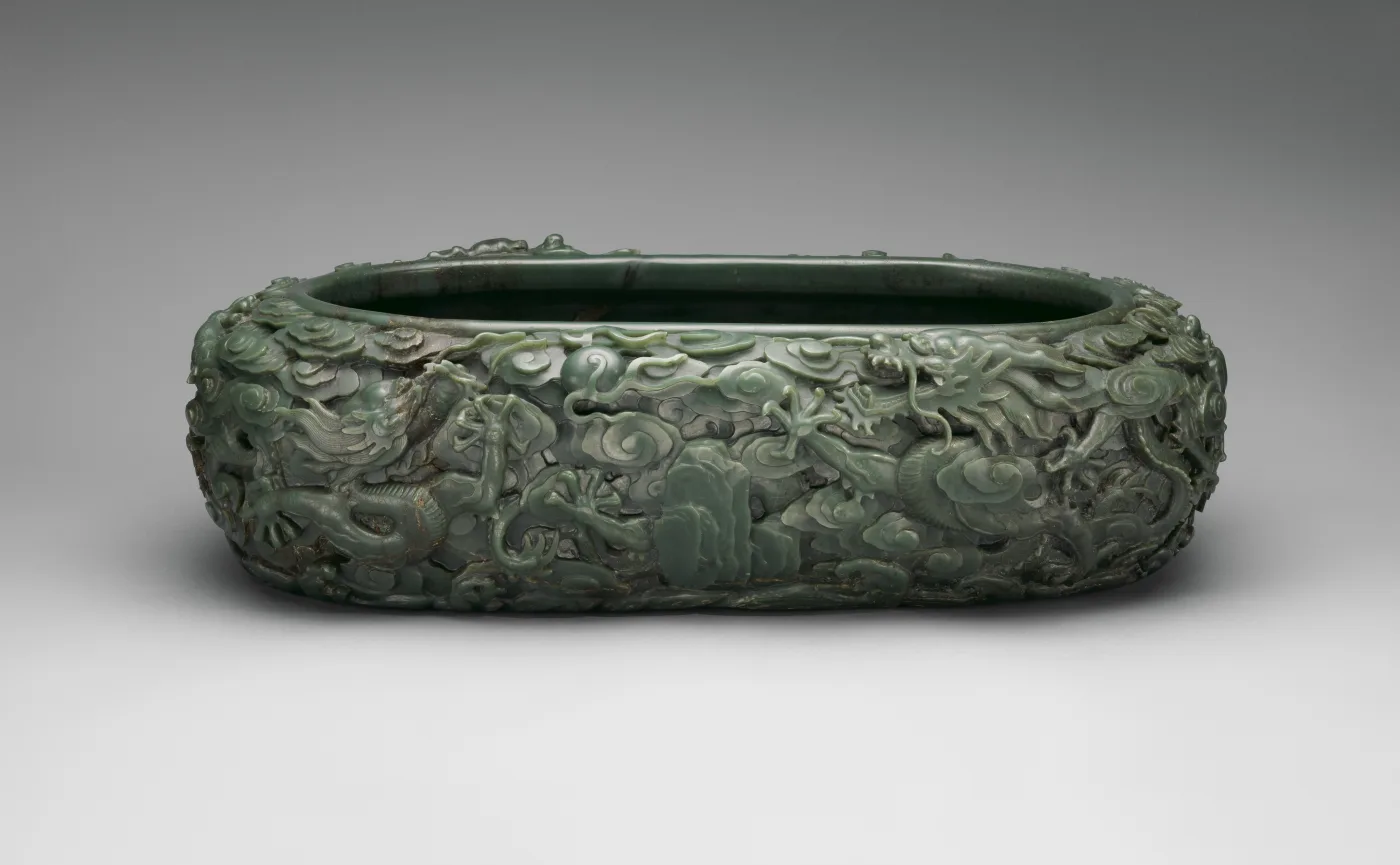
Warm russet and caramel tones on the outer surface, often called skin, come from iron staining of the original boulder as it lay in a riverbed. Good carvers deliberately incorporated skin into a design, turning a russet patch into a bat, a lingzhi fungus or a persimmon. That kind of intentional use of the skin is a genuine quality indicator; it takes planning and it wastes material, and forgers rarely bother.
The Jadeite Range
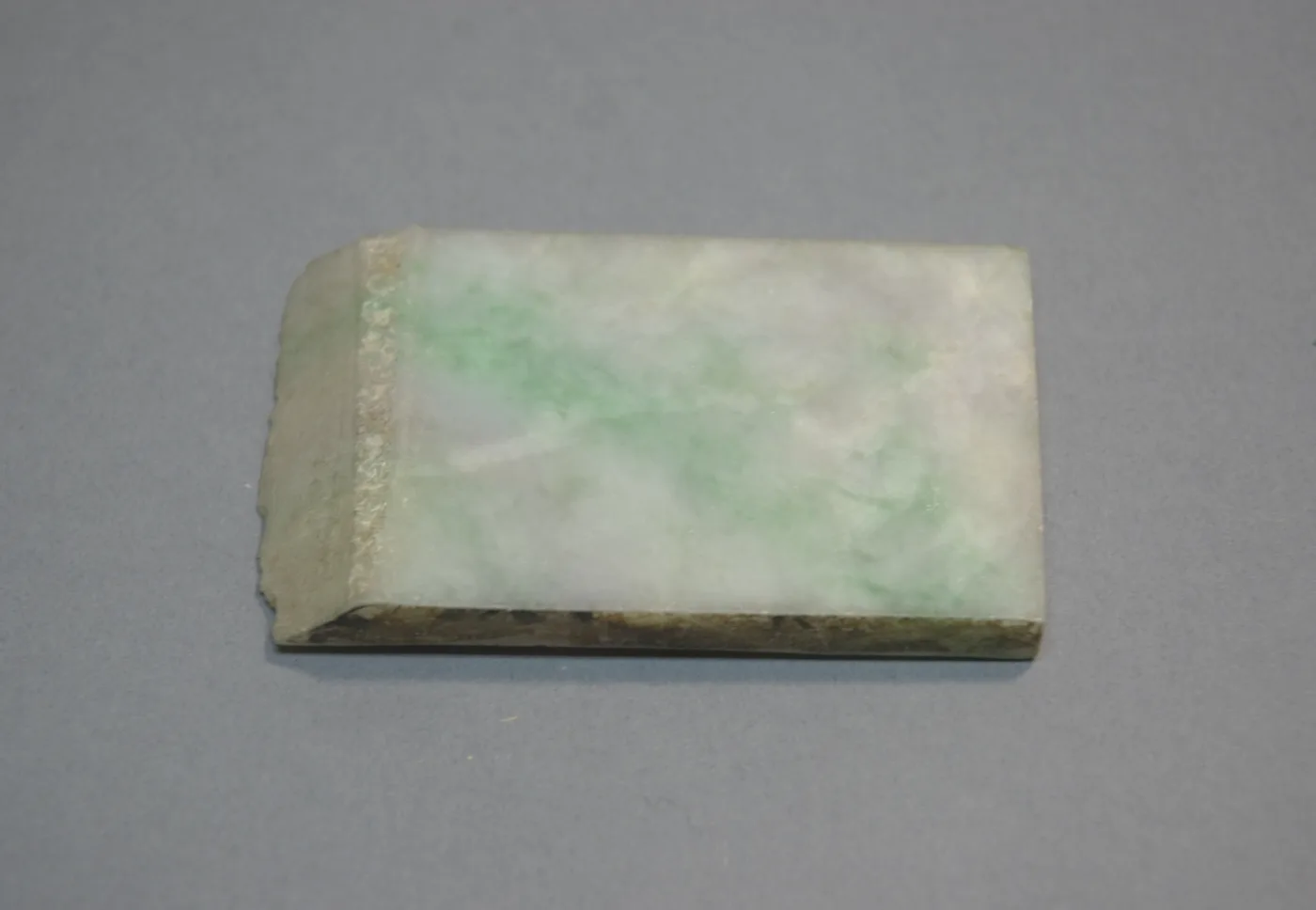
Jadeite spans white, apple green, deep emerald, lavender, yellow, orange-red and black, frequently several at once in a single piece. The most valuable is imperial green: an intense, evenly saturated emerald green coloured by chromium, semi-transparent, without grey or blue in the tone. Lavender is caused by different trace elements and is very commonly imitated by dye, so any strongly coloured lavender piece deserves the treatment tests described below.
Mottled combinations have their own names in the trade. Moss-in-snow describes bright green threads through white ground. Where a carver has used a red-brown zone for a fish and a green zone for the water in the same block, the piece is worth more than either colour alone would suggest, because matching the colour zones to the subject is difficult and cannot be faked after the fact.
Why Colour Cannot Date a Piece
There is a persistent belief that jade darkens, mellows or absorbs colour from being worn, and that a deeply coloured stone must therefore be old. It does not, and the belief is actively exploited. Jade is chemically stable and essentially inert; what changes over centuries is the polish, the accumulation of grime in recesses, and in buried pieces the altered surface layer. None of that is colour change in the body of the stone. Treat any argument for age that rests on colour alone as no argument at all.
Tests You Can Run Without a Laboratory
A handful of simple procedures will separate jade from most simulants and nephrite from jadeite. None requires more than a loupe, a torch and a kitchen scale, and none of the recommended ones damage the object.
Specific Gravity by Hydrostatic Weighing
This is the single most informative home test and works on any solid piece without a mount. Weigh the object in air. Then suspend it on a fine thread so that it hangs fully submerged in a beaker of water on the same scale, touching nothing, and weigh again. Divide the dry weight by the difference between the two readings and you have the specific gravity.
The results separate the field cleanly. Jadeite lands near 3.33, nephrite near 2.95, serpentine near 2.55, quartzite near 2.65 and hydrogrossular garnet near 3.4. A digital scale reading to a tenth of a gram is enough for anything above about twenty grams. Do not attempt this on a piece with glued repairs, a porous burial-altered surface, or a fabric or metal mount.
Magnification
A ten-power loupe under a single point source answers more questions than any other tool. Look for the orange-peel dimpling that indicates jadeite. Look for dye concentrated in fissures and along grain boundaries rather than distributed evenly through the stone. Look for the fine network of etched channels left by acid bleaching. Look at how the tool marks cross each other, which is the subject of its own section below. Twenty power is useful; anything more usually adds confusion rather than information.
Tests Worth Knowing and Their Limits
Jade feels cold to the touch and stays cold for several seconds because it conducts heat away from the skin efficiently. Plastic warms almost instantly, which makes this a decent screen for resin. Glass, however, also feels cold, so a pass proves little on its own.
Struck gently while suspended, a sound jade gives a clear sustained note that lower-density simulants cannot match. It is a real effect, and Chinese collectors have used it for centuries, but it depends heavily on the shape and thickness of the piece and on whether it is cracked. Use it comparatively, never on its own.
A hardness test with a steel point will scratch serpentine, soapstone and marble but not either jade. It also leaves a permanent scratch on someone's antique, so treat it as a last resort on an unmounted piece, in a hidden spot on the underside, and never on anything you do not own.
Where the Laboratory Becomes Necessary
Two questions cannot be settled at home. Whether jadeite has been polymer-impregnated is determined by infrared spectroscopy, which detects the resin directly, and no visual test is a substitute when real money is involved. Whether a nephrite carving is Neolithic or a good modern copy is a connoisseurship judgement no instrument can make. Any laboratory certificate for jade tells you about the material and its treatment; it does not date the carving, and a report that appears to promise otherwise deserves close reading. The general principles in our guide to authentication and provenance research apply here with unusual force.
A, B and C: The Treatment Grades
The jadeite trade uses a three-letter shorthand that every buyer should know, developed in Hong Kong in the 1980s and 1990s when chemical enhancement became widespread. The letters describe treatment, not quality, and a poor piece of A jade can be worth far less than a fine piece of B.
What the Letters Mean
A jade is natural, untreated stone. A surface coating of colourless wax applied during final polishing is traditional and does not disqualify a piece. B jade has been bleached in strong acid to remove brown iron staining, which leaves the stone porous and structurally weakened, then impregnated under pressure with polymer resin to restore transparency and hold it together. C jade has been artificially dyed. B+C has had both, and is extremely common in cheap green and lavender jewellery.
Spotting Treatment
Bleached and impregnated jadeite shows a distinctive surface under magnification: a fine irregular network of etched channels where acid has eaten out the grain boundaries, sometimes described as crazing or a dried-mud pattern. The lustre is subtly duller and flatter than natural stone, the ring is dead rather than clear, and under long-wave ultraviolet many resins fluoresce a chalky blue-white that natural jadeite does not. Held to a strong light, an impregnated piece often looks slightly hazy or plasticky in a way that is hard to name but easy to recognise once seen.
Dye betrays itself by where it sits. Natural colour in jadeite follows the mineralogy, appearing in patches, veins and streaks with diffuse boundaries. Dye pools in fractures and runs along grain boundaries, so under a loupe you see colour concentrated in a web of fine lines rather than in the body of the material. Some older chromium-based green dyes show a broad absorption band in the red through a handheld spectroscope where natural chromium colouration gives a distinct triplet of fine lines, but modern dyes are formulated to defeat this and a clean spectroscope reading no longer proves much.
Why This Matters for Antiques
Bleaching and impregnation are modern industrial processes that did not exist before the late twentieth century. A piece that tests as B jade is therefore a modern object, or at best an antique that has been aggressively reprocessed, and either way it is not what an antique buyer thinks they are purchasing. Dyeing is older and cruder but the same logic broadly applies. Treatment detection is not only a value question; it is a dating tool.
Tool Marks: The Strongest Evidence
Here is the heart of the matter. Jade is not cut, it is worn away. Neither mineral can be carved with a metal blade, because both are harder than steel. Every jade in existence was shaped by abrading it with a harder loose abrasive, carried on a softer tool, with water as a lubricant. The tool is a vehicle; the sand does the work. Because the abrasives and the machines changed over time in traceable ways, the marks they leave are the closest thing this field has to a date stamp.
How Jade Was Traditionally Worked
The traditional abrasives were quartz sand, crushed garnet and natural corundum, mixed to a slurry. They were applied with bamboo, wood, leather and eventually iron laps and discs, driven by a bow or a treadle-powered wheel. Holes were made with a solid or tubular drill spun by a bow; a tubular drill leaves a cylindrical core, which is why cores turn up on excavation sites. Long cuts were made by drawing a cord or wire back and forth through the slurry. All of this is slow, and the slowness is legible in the finished object.
Reading a Traditional Groove
A groove cut by a rotating stone or metal disc charged with slurry has a rounded U-shaped section, and it tapers to nothing at each end because the circular wheel enters and leaves the stone at a shallow angle. It varies slightly in width along its length. Where the carver repositioned the piece, one groove overshoots or slightly misaligns with the next, and those small overruns are extremely difficult to fake convincingly. Under magnification the walls show fine striations that are not perfectly parallel, because the loose abrasive grains rolled as they cut.
Bow-drilled holes taper, sometimes noticeably, and their walls show concentric rings rather than a spiral. Ancient perforations were frequently drilled from both faces to meet in the middle, producing an hourglass profile with a small ridge or step where the two bores failed to align perfectly. A hole of constant diameter with a clean spiral track is a modern hole.
What Modern Tools Leave
Since the late nineteenth century, carvers have used silicon carbide, and since the mid twentieth century diamond-charged burrs in high-speed rotary handpieces. Diamond burrs cut fast and leave a completely different signature: grooves of constant width and depth with flat or sharply V-shaped bottoms, regular parallel striations all running at the same angle, and no taper at the ends. They also reach into deep undercuts and tight recesses that a bow-driven wheel simply cannot access, so an ambitious openwork carving with crisp undercutting throughout is nearly always modern.
Polish is the companion evidence. Old surfaces were finished by hand with progressively finer abrasives on leather and gourd, which leaves a soft, slightly undulating surface with a deep glow and edges that are subtly rounded. Modern polishing on a high-speed wheel with cerium oxide or diamond paste produces a flat, uniformly glassy surface with crisp, almost mechanical edges. Run a fingertip over a genuinely old jade and the surface has a gentle topography; a modern one is dead flat.
Two Cautions
Traditional tools were still in use in Chinese workshops well into the twentieth century, so bow-drill marks establish a technique and not a precise date. And any piece that has been repolished has had the evidence removed, which is one reason repolishing destroys so much value. When tool marks and form disagree, believe the tool marks; when the tool marks have been polished away, you are left without your best witness and should price the object accordingly.
Burial Alteration and Faked Age
Jades that have spent centuries in the ground change at the surface, and the trade calls the result qin se, or infiltration colour. Understanding what genuine alteration looks like is the second great authentication tool after tool marks, mostly because the fakes are so numerous and so consistently wrong in the same ways.
What Genuine Alteration Looks Like
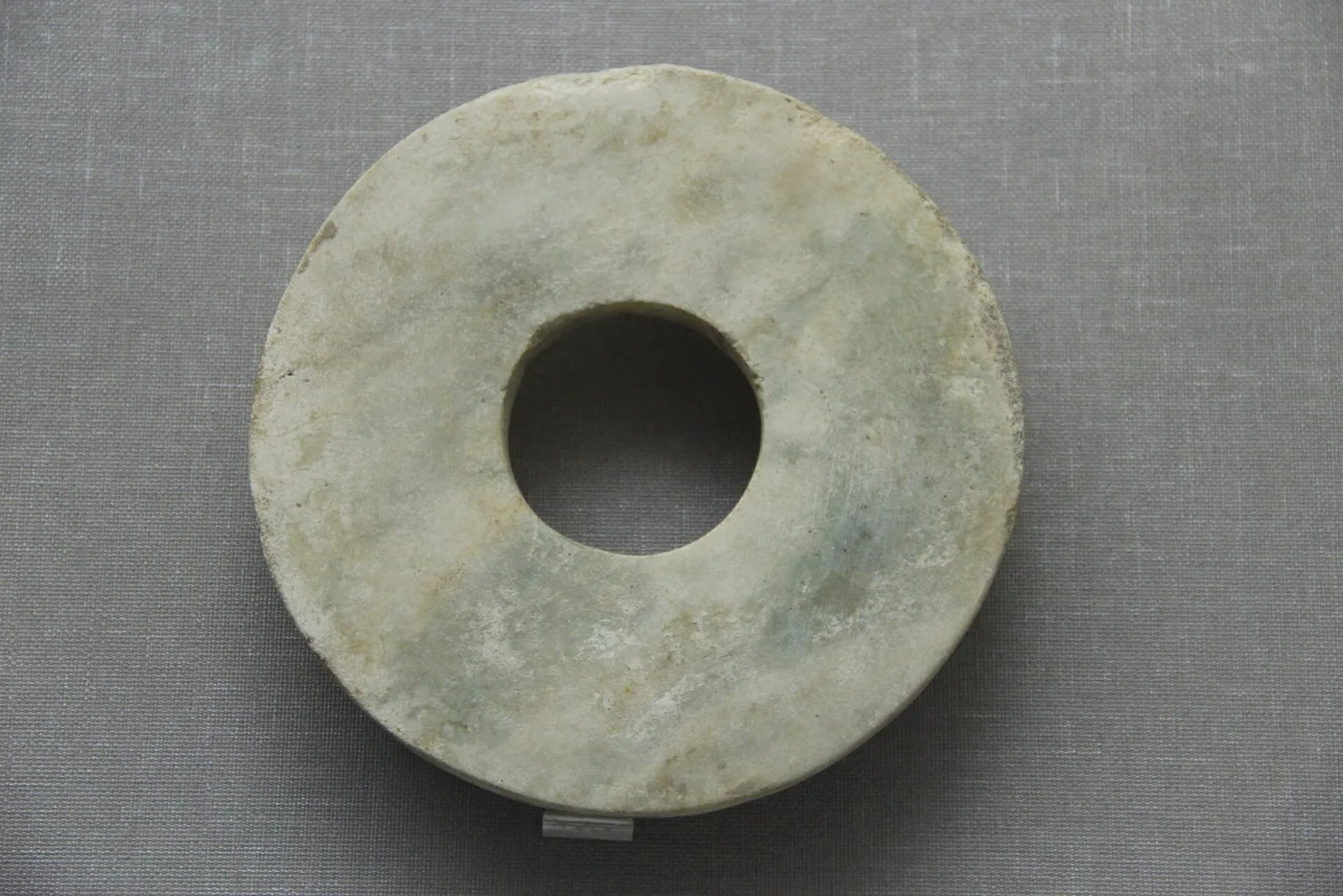
The most dramatic form is calcification: the stone loses its translucency and becomes opaque, chalky and slightly porous, in the creamy tone called chicken-bone white. It occurs unevenly, often on one side or along one edge where conditions in the grave were harshest. Iron and manganese compounds from soil and corroding bronzes produce russet, brown and black staining, and manganese sometimes deposits in fine branching dendrites that look like tiny ferns.
The critical point is that all of this is three-dimensional. Real alteration follows the internal structure of the stone: it exploits fissures, penetrates further into softer zones, and is visibly graded in depth where the piece happens to be chipped. It also sits underneath the tool marks where the tool marks came first, and above them only where later damage exposed fresh material. Examine any broken or chipped edge with a loupe, because that cross-section shows you immediately whether the colour has depth or is a film.
How Age Is Faked
The methods are old and industrial in scale. Stone is baked to induce crazing and opacity, soaked in acid to etch a false porosity, stained with iron salts, potassium permanganate, strong tea or tobacco water, buried in fertiliser or with organic material to accelerate discolouration, or sandblasted to simulate wear. Fake dendrites are painted on. The stories that accompany these pieces are traditional too, and the persistent tale of blood jade reddened inside a corpse has no basis: the red is iron oxide, and it comes from the soil.
Faked alteration fails on depth and distribution. It stops abruptly at the surface with no gradation. It is suspiciously even, covering the whole object at uniform intensity, where real burial conditions are never uniform. It settles into tool marks and recesses in a way that shows it was applied after carving, rather than being interrupted by them. It frequently comes off on a cotton swab with a little acetone or even water. And it often smells faintly of chemicals, especially when a piece has been warmed in the hand for a few minutes.
Handling Wear
Jades carried and rubbed for generations develop a distinct, subtle softening on the high points and projecting edges, while recesses stay sharper. The polish becomes richer where the fingers went. Uniform wear over an entire surface, including places no thumb could reach, means tumbling or sandblasting rather than a century in someone's pocket. This is the same logic used to read genuine handling wear on antique snuff bottles and on netsuke, where the pattern of use is one of the most reliable authenticity indicators available.

Archaic Forms and Their Names
Knowing the vocabulary of forms serves two purposes. It lets you describe a piece accurately enough to search for comparables, and it lets you spot the anachronisms that give away invented objects. Forgers reproduce known types well and invent new ones badly.
The Ritual Repertoire
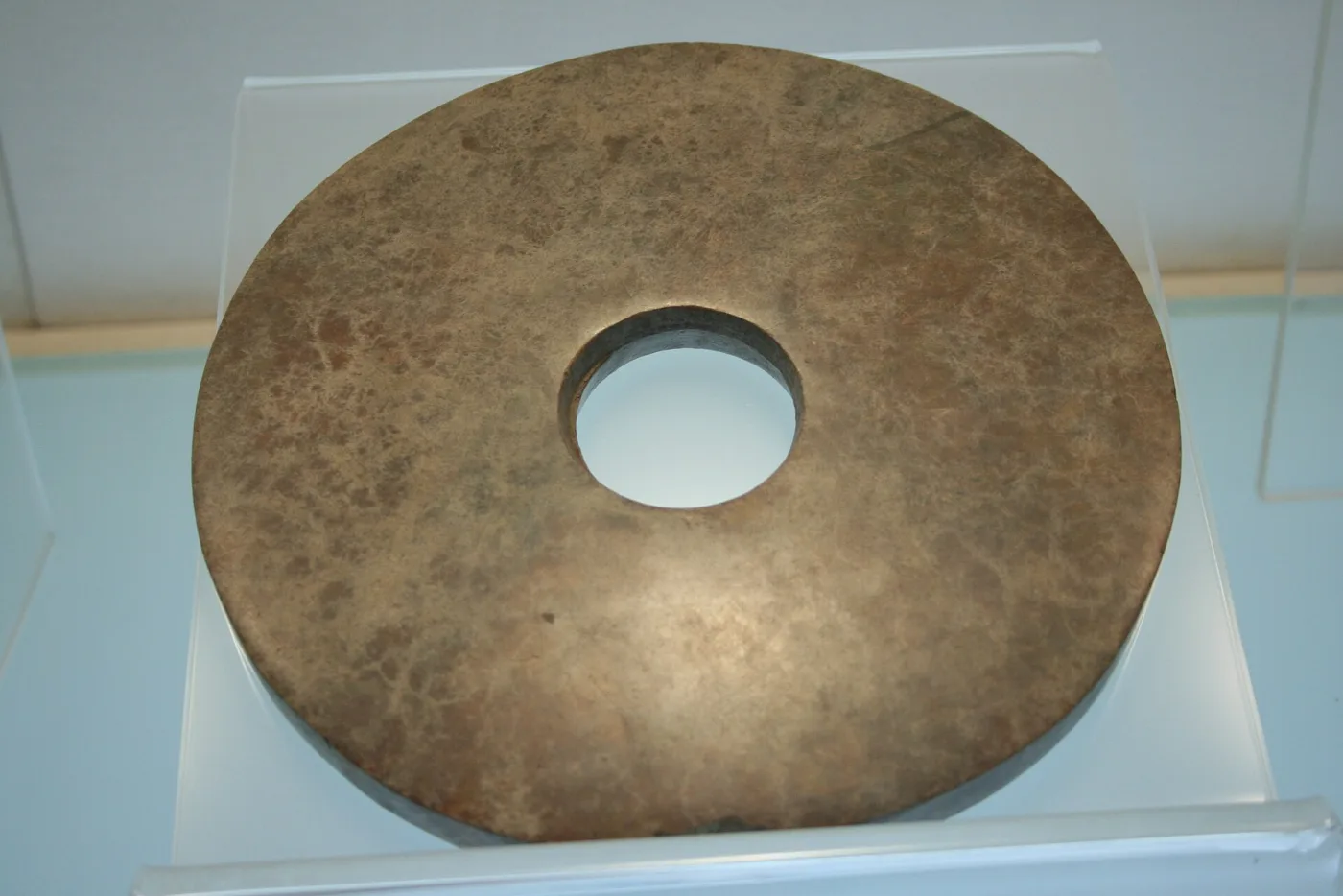
The bi is a flat disc with a central hole, the commonest archaic form and one made continuously from the Neolithic to the present. Early examples are plain; later ones carry raised grain or spiral bosses. The cong is a squared tube with a cylindrical bore, tiered on the outside, associated overwhelmingly with Liangzhu. The huang is an arc, roughly a segment of a disc, drilled for suspension in pendant sets. The gui and zhang are flat blade forms derived from tools and weapons, used as rank insignia and never sharpened for real use.
Burial Jades
Han burial practice generated a distinctive group. The cicada, a stylised, sparely cut insect, was placed on the tongue as a symbol of transformation and rebirth; genuine ones are cut with a small number of decisive angled grooves in the manner known as Han eight cuts. Small stoppers closed the body's orifices. Carved pigs, cylindrical and highly abstracted, were held in the hands of the deceased. Because these were made specifically to be buried, they are the forms most often found with genuine burial alteration, and correspondingly the forms most often faked with the artificial kind.
Sword Fittings and Ornaments
Jade sword fittings form a set of four types, mounting on the pommel, the guard, the scabbard as a slide, and the scabbard tip as a chape. They are common from the Warring States through the Han and are a well-studied group, which makes their proportions relatively easy to check against published examples. Belt hooks, with a curved shaft and a small button on the underside, run across many periods and vary enormously in quality.
Anachronism as a Tell
Watch the decoration rather than the shape. A Neolithic form carrying a motif invented a thousand years later is an obvious fault, but the subtler version is more common: a Han-shaped object with the crisp, even, deeply undercut relief of a Qing workshop, or a Shang blade with Qing-style scrolling. Fake archaic jade is usually carved by someone trained in a much later style, and the style leaks through. Compare against dated excavated material in museum collections rather than against other objects on the market, which may all descend from the same forger.
Archaism: Old Shapes, Later Hands
A large proportion of the archaic-looking jade in circulation is neither ancient nor fraudulent. From the Song dynasty onward, Chinese carvers made deliberate imitations of ancient forms for collectors who admired antiquity, and by the Qing this had become a major and entirely respectable branch of production. Such pieces are called archaistic, and they are collected on their own terms.
Recognising Archaistic Work
Archaistic jades tend to be technically better than their models and stylistically confused. The relief is more even, the surfaces are more highly finished, and the symmetry is more exact than Bronze Age workshops achieved. Motifs from several different periods are mixed in a single object, because the carver worked from illustrated antiquarian books rather than from excavated originals. Proportions are often subtly modernised — thinner walls, a more elegant silhouette, a more comfortable weight. Artificial staining is frequently present, applied openly as part of the aesthetic rather than as a deception.
Why the Distinction Pays
A good Qianlong archaistic vessel is a valuable object in its own right and will be catalogued as such by any competent auction house. The mistake that costs money is not owning an archaistic piece; it is paying a Han price for one. When a seller's dating is centuries earlier than the workmanship supports, the honest reading is usually archaism rather than forgery, and it is worth saying so plainly, because the piece may still be well worth buying at the right number.
The Qianlong Golden Age
Most antique jade on the open market is Qing, and most fine Qing jade descends from a single supply shock. The Qianlong emperor's campaigns in the Tarim Basin, concluded in 1759, gave the court direct control of the Khotan and Yarkand nephrite sources, and tribute began arriving in quantities the imperial workshops had never had before. The emperor was a serious and demanding collector, and the confluence of unlimited material with imperial attention produced the technical high point of the entire tradition.
What Imperial Quality Looks Like
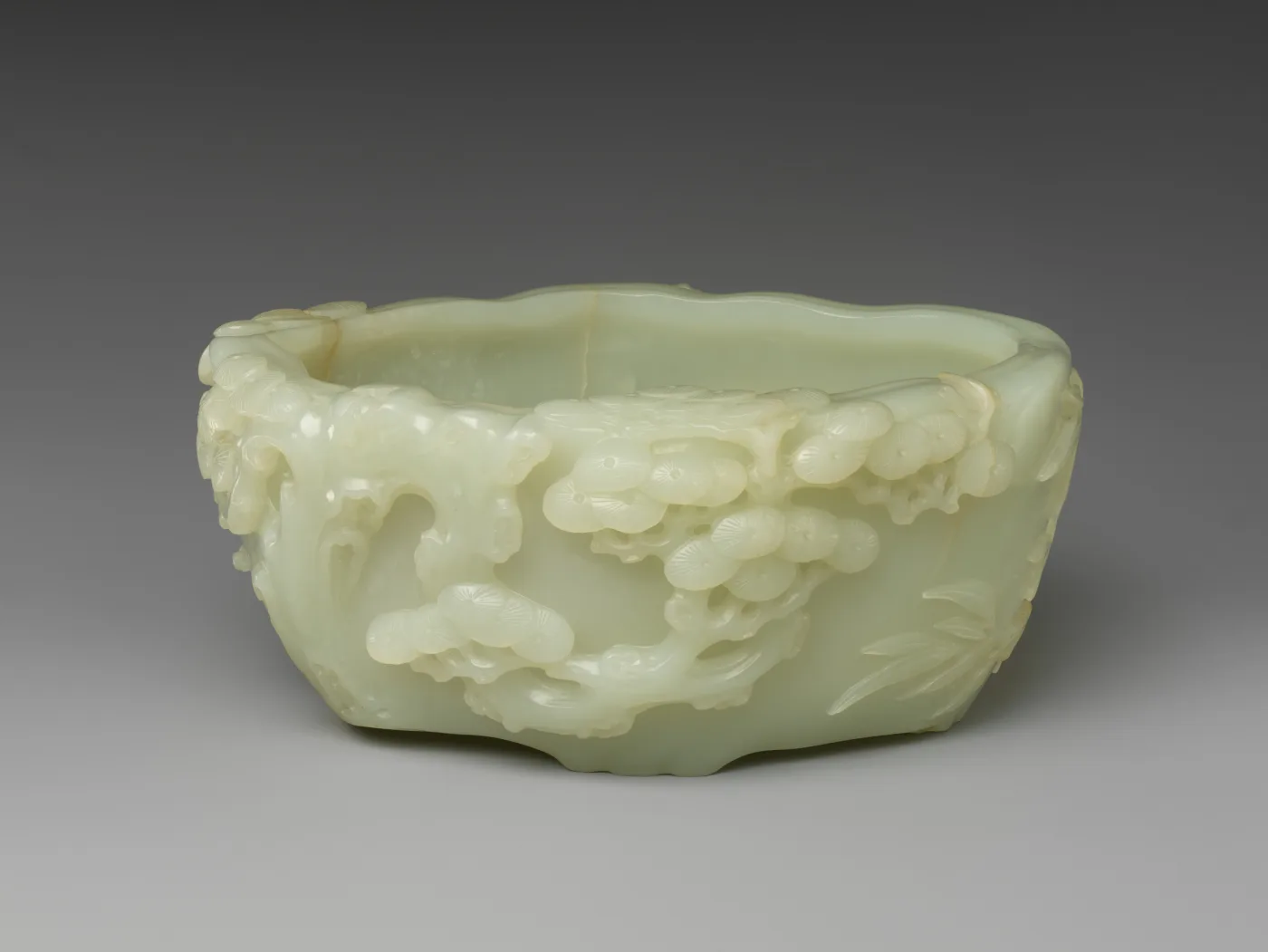
The material comes first: even, flawless, translucent white or pale celadon nephrite, worked in a thickness that shows off the translucency. The carving is crisp and confident, with clean undercutting, well-judged negative space, and no hesitation marks. The polish is deep and soft rather than glassy. Large vessels are hollowed to an even wall thickness throughout, which is far more difficult than it sounds and is a genuine mark of a first-rate workshop. Where russet skin appears, it is used deliberately in the composition.
Where the Work Was Done
The palace workshops inside the Forbidden City coordinated production, but much of the actual carving was done in Suzhou, long the centre of the finest lapidary work in China, and in Yangzhou, which specialised in the largest pieces. The most famous single object of the period, an enormous jade mountain depicting Yu the Great taming the floodwaters, was carved in Yangzhou in the 1780s from a boulder weighing several tons that took years to transport. Beijing workshops handled a great deal of court production directly.
Typical Qing Forms
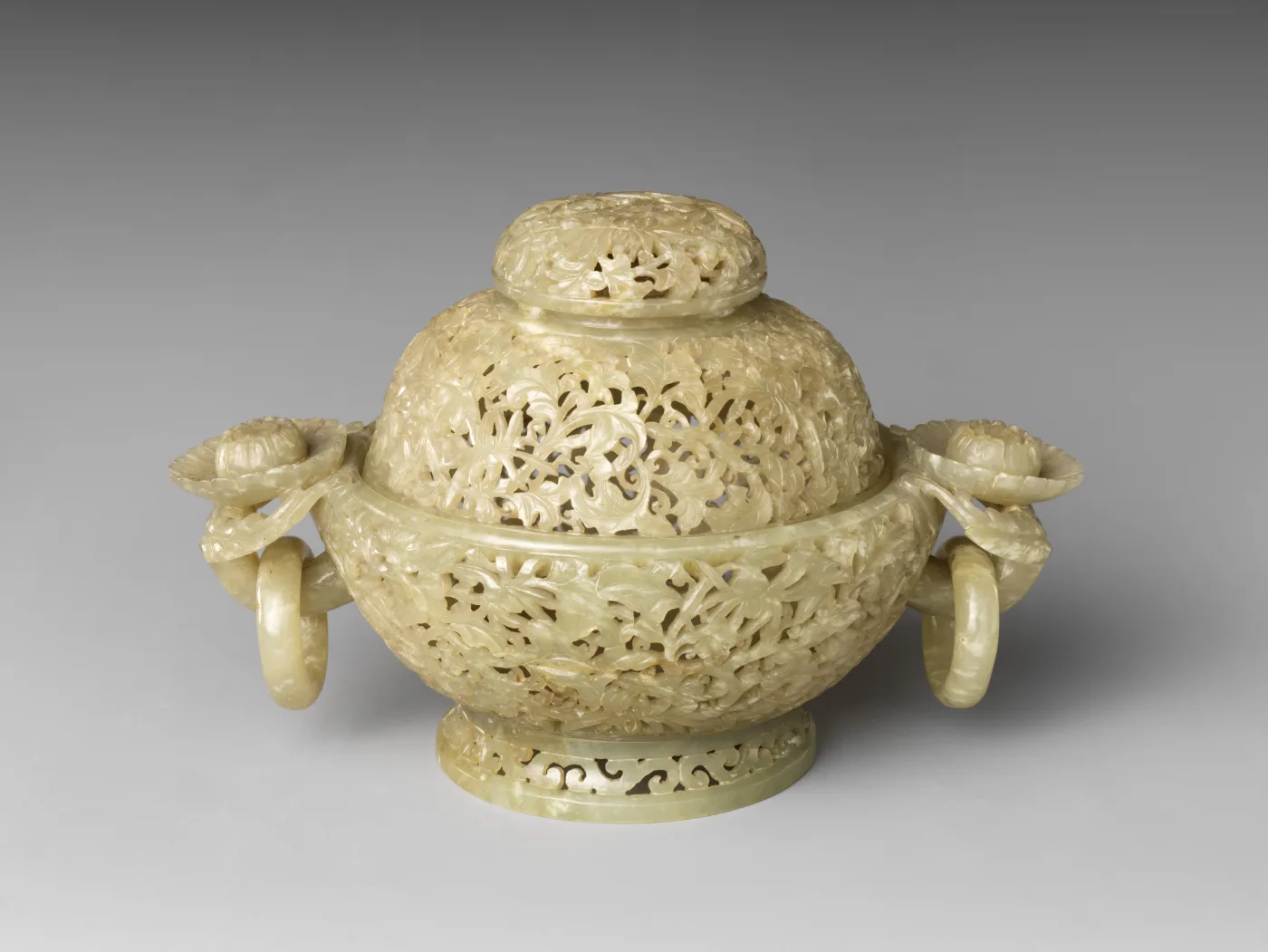
The repertoire is wide: brush washers, brush pots, water droppers and table screens for the scholar's desk; covered vases and censers with animal-mask handles and loose rings carved from the solid; ruyi sceptres; belt buckles and pendants; snuff bottles; boulders carved as miniature landscapes; and archaistic vessels imitating ancient bronzes. A loose ring carved in one piece with the vessel it hangs from is a standard Qing display of skill and, when the ring shows the right kind of asymmetric hand-abraded tool marks, a useful authenticity indicator.
The Arrival of Jadeite
Burmese jadeite reached China in significant volume only from the late eighteenth century, moving along the trade routes into Yunnan from the mines of Kachin State. It was initially treated as an exotic curiosity, and its rise to supremacy came in the nineteenth century, strongly associated with the taste of the Empress Dowager Cixi. This is the single most useful date in jade: a Chinese jadeite carving is late Qing or later, full stop. It sits alongside the other late Qing luxury crafts — cloisonné enamelware, carved cinnabar lacquer and export porcelain — and often shares their subjects and their export markets.
Mughal and Hindustan Jades
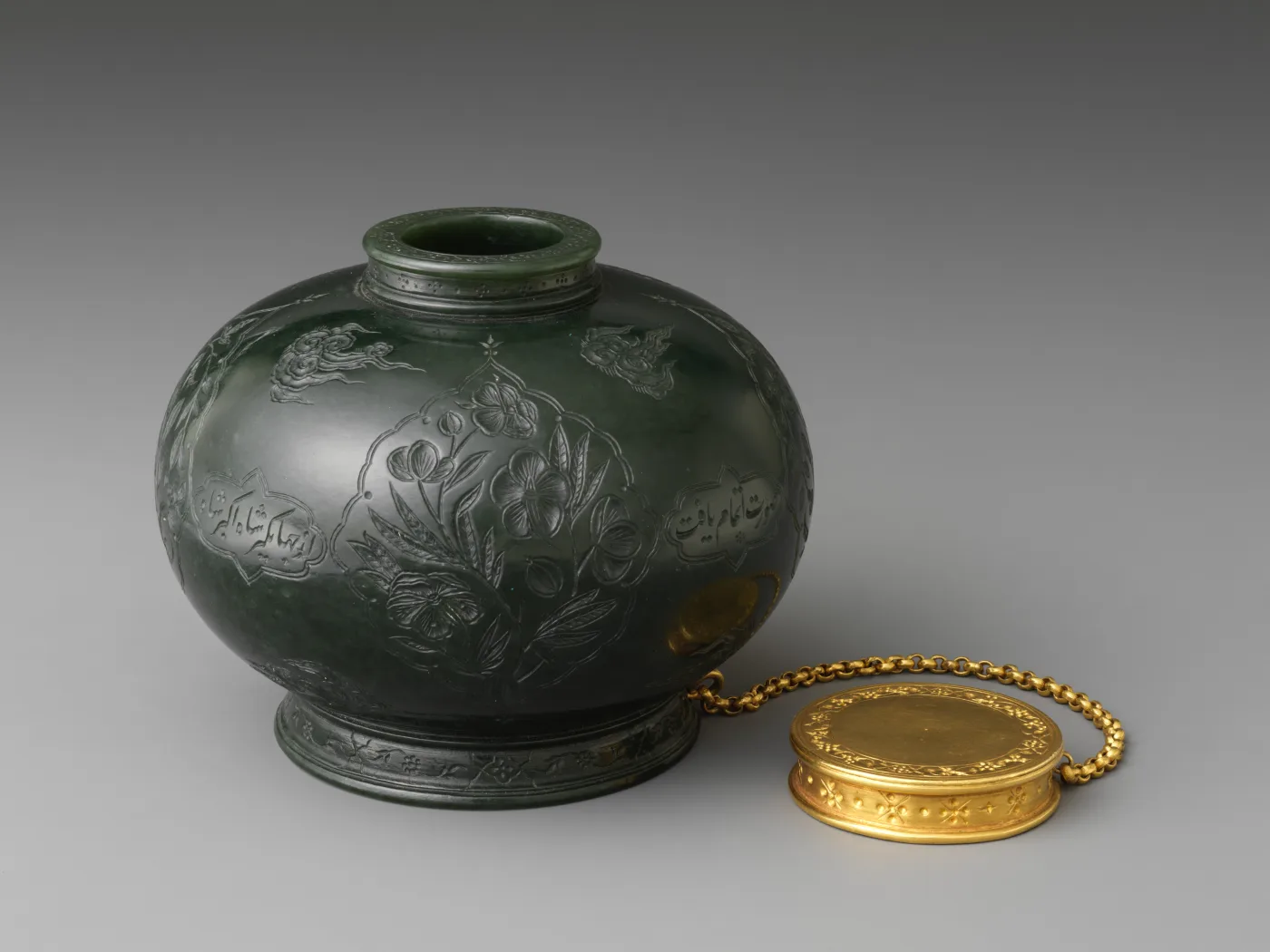
A distinct and highly collectable tradition developed in Mughal India in the seventeenth and eighteenth centuries, working the same nephrite from Central Asian sources but toward completely different ends. Qianlong admired these pieces enormously, called them Hindustan jades, collected them, wrote poems about them and had Chinese versions made.
Recognising the Style
Mughal jade is defined by thinness. Bowls, cups and dish walls are worked down until they are translucent and almost fragile, a technical feat of a wholly different order from Chinese hollowing. The ornament is naturalistic and floral: acanthus leaves, poppies, chrysanthemums and lotus petals in low relief, often radiating from the foot. Handles take the form of animal heads, particularly ibex and rams, or curl into leaf scrolls. Many pieces are inlaid with gold wire and set with rubies, emeralds and glass in the kundan technique.
Mughal Versus Chinese Copies
Chinese archaistic copies of Mughal work exist in quantity, some of them imperial. They are usually slightly thicker in the wall, and the floral ornament is more regular and more symmetrical than Indian carvers made it — Mughal foliage grows, Chinese copies repeat. The stone is often a different colour, since Chinese workshops used whatever the tribute supply provided. Genuine Mughal inlay is set into carefully undercut recesses that grip the gold; later imitations frequently glue the metal on.
Jade Outside China
China dominates the field but does not own it, and a working knowledge of the other traditions prevents expensive misattributions in both directions.
Mesoamerica
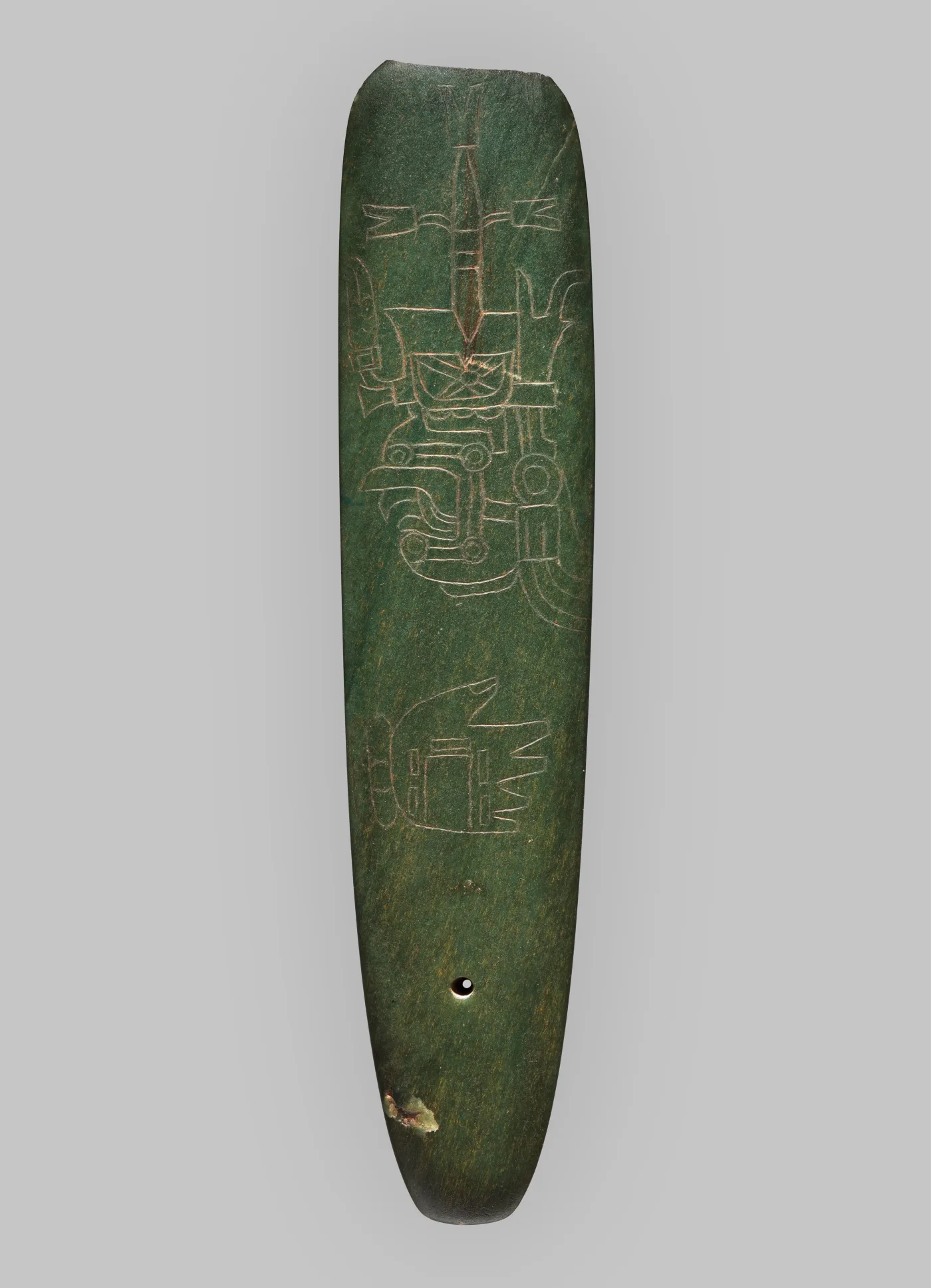
The Olmec and Maya worked jadeite from the Motagua Valley in Guatemala, and their material is the reason jadeite entered European languages at all — Spanish colonists brought it back as piedra de ijada, the stone of the flank, believed to cure kidney complaints, from which both jade and nephrite take their names. Mesoamerican jadeite tends toward blue-green, apple green and mottled grey-green, quite unlike the Burmese range. The forms are unmistakable: axe-shaped celts with incised faces, masks, ear flares, and pectorals. This material is heavily faked and heavily restricted by cultural property law, and provenance documentation matters more here than in almost any other collecting field.
New Zealand
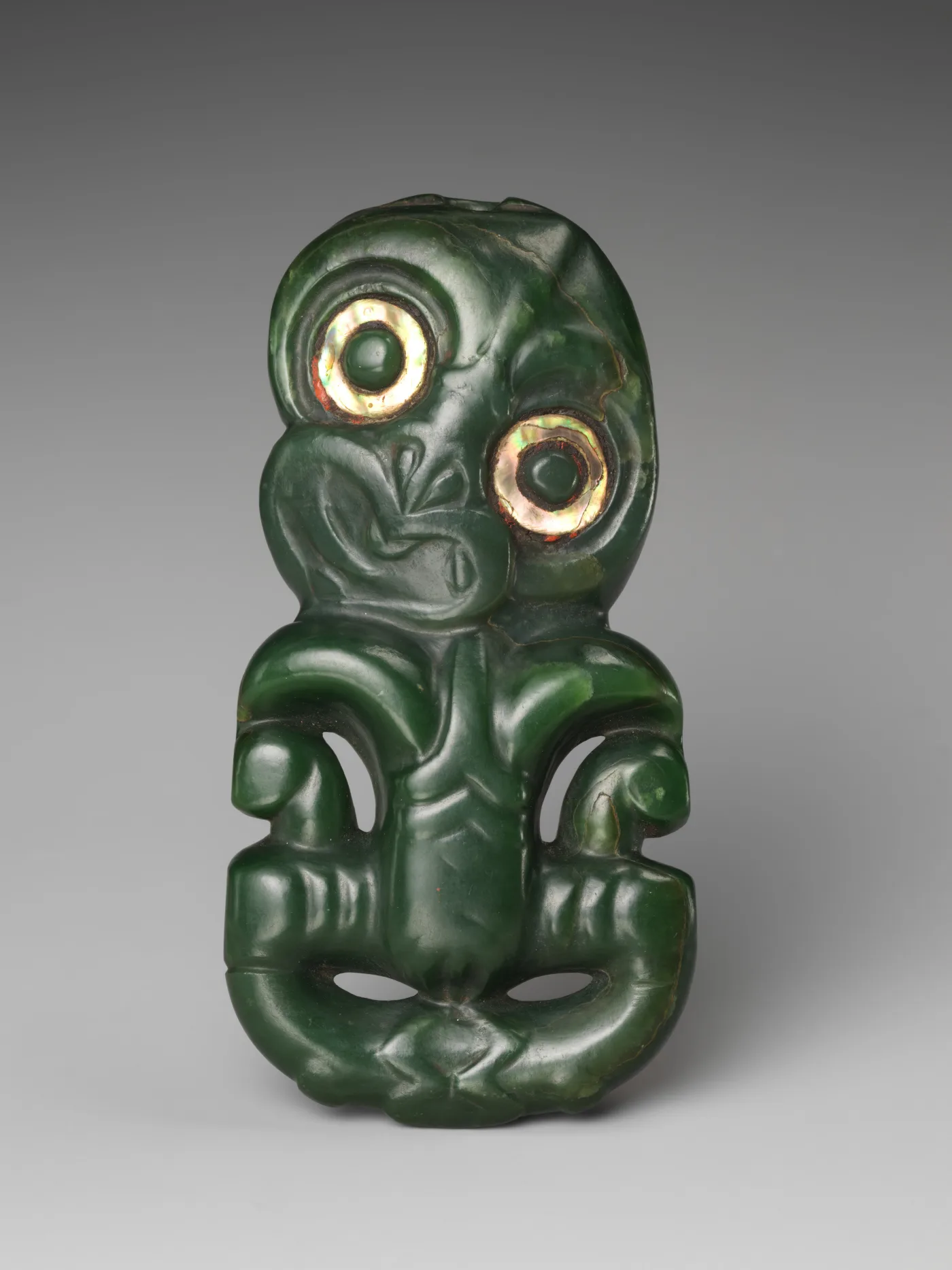
Māori carvers worked New Zealand nephrite, known as pounamu or greenstone, into hei-tiki pendants, mere hand clubs and adze blades. The stone is typically a translucent olive to deep green, sometimes with a distinctive golden cast. Genuine early hei-tiki show the same evidence you look for in Chinese jade — hourglass drilled suspension holes, hand-abraded surfaces, and wear that concentrates where the cord passed. Pounamu carries deep cultural significance and its trade is subject to specific New Zealand regulation.
Other Sources
Siberian nephrite from around Lake Baikal supplied the dark spinach green with black specks that appears in Russian and Chinese work from the nineteenth century onward. British Columbian nephrite entered the market in commercial quantities only from the 1970s and is common in modern carvings sold as antique; its bright, even green with a slightly translucent quality is worth learning. Wyoming, Taiwan and Korea are all significant sources. None of these is a fake — the material is genuine nephrite — but a Canadian stone in a supposedly eighteenth-century carving is a hard fact to argue with.
Bangles, Beads and Pendants
Jade jewellery has its own market, its own price logic and its own set of traps, and much of it moves independently of the antique carving trade. It is also where most treated stone ends up.
Bangles
A traditional Chinese bangle is cut as a complete ring from a single slab, with the centre bored out and, in efficient workshops, the core used for a smaller bangle or a set of pendants. The process wastes an enormous amount of material, which is why a fine large bangle in even colour costs so much more than the same weight of carved fragments. Check the interior surface, which is where dye and impregnation are most visible, and check for repairs: a metal collar or band almost always hides a break, and a glued join fluoresces under ultraviolet and kills the ring when the bangle is suspended and tapped.
Beads and Pendants
Bead strands should be examined at the drill holes, where dye concentrates and where drilling technique is visible. Old hand-drilled beads show slightly irregular, sometimes off-centre holes, often tapering or drilled from both ends; modern beads have perfectly cylindrical laser-straight bores. Common pendant subjects each carry a meaning worth knowing, because the subject affects desirability: the plain circular ping'an kou or peace buckle, Guanyin and Buddha figures, gourds, cabbages punning on wealth, bats for good fortune, and ruyi heads.
Jade in Western Settings
From the late nineteenth century, Western jewellers mounted Chinese jade plaques and cabochons in gold and platinum, and the Art Deco period produced a large body of jade, onyx and diamond work from the major houses. These are hybrid objects: the stone may be considerably older than the mount, and the two need appraising separately. The mount can usually be dated precisely from its hallmarks, which is a good deal more than the jade will ever tell you, and the general approach set out in our guide to antique jewelry identification applies directly.
Reign Marks, Poems and Signatures
Jade carries marks far less often than porcelain, and the marks it does carry are weaker evidence than beginners expect. Treat every inscription as a claim to be checked against the object rather than as information about it.
Reign Marks
Four-character or six-character reign marks appear on some Qing jades, incised and often filled with gold. Apocryphal marks — later pieces bearing an earlier emperor's mark — are extremely common and were not always intended to deceive; a Qianlong mark on a Republican-period carving was frequently a statement of style. An incised mark can also be added to an old undecorated piece at any time, and the addition is detectable only by comparing the tool marks and the wear inside the characters against the rest of the surface. Fresh, sharp characters on a softly worn object are a bad sign.
Imperial Poems
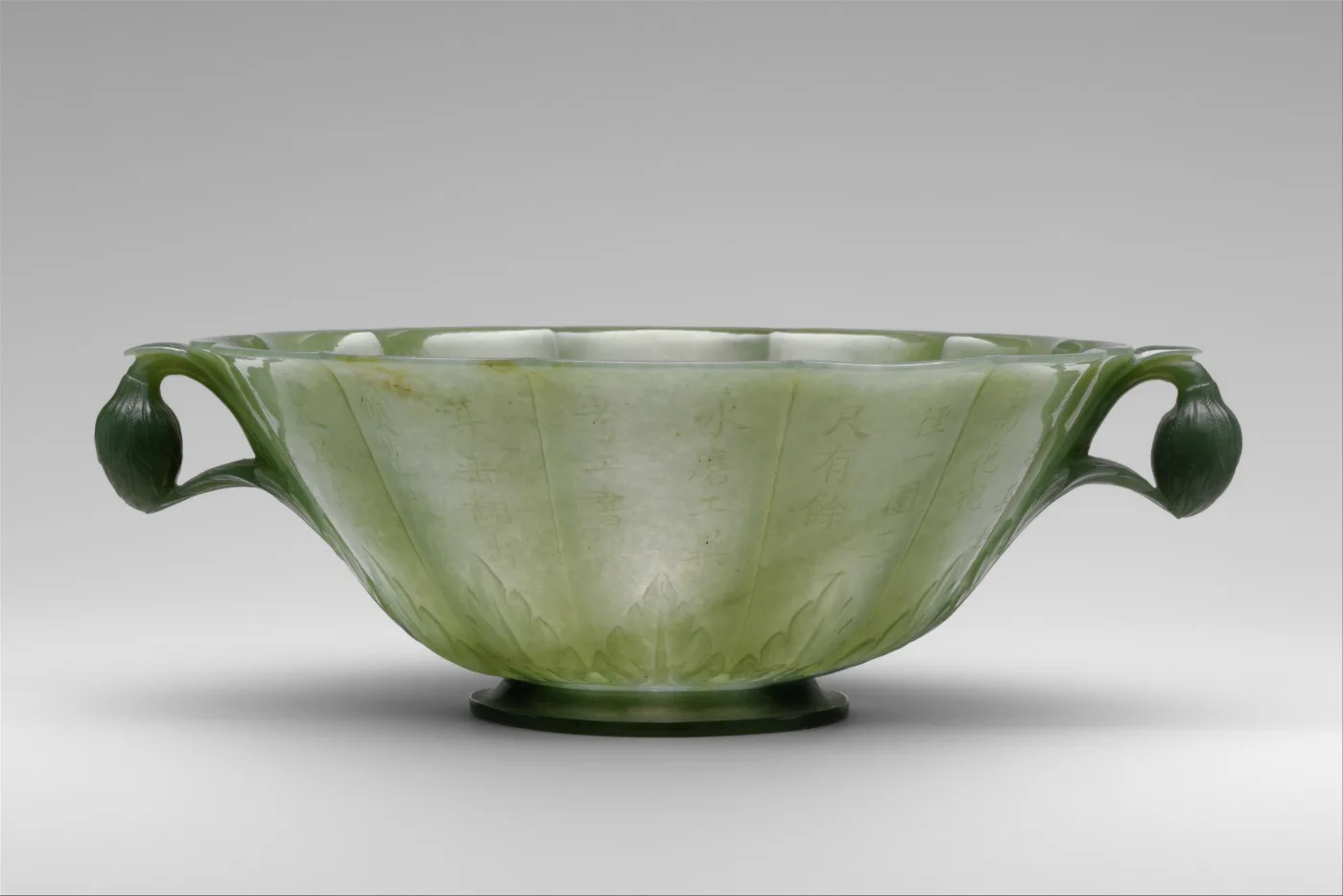
Qianlong had his own poems inscribed on jades he particularly admired, including much older pieces he had acquired, and these inscriptions are a documented and researchable category. When genuine they are enormously valuable, which guarantees that they are forged constantly. The characters should show the same abraded, slightly irregular groove profile as any other traditional cutting, with wear consistent with the surrounding surface. The text itself can often be traced in published collections of the emperor's verse, and an inscription that matches no known poem is a serious warning.
Carver Signatures
Lu Zigang, the late Ming Suzhou master, signed his plaques, and his name has been applied to countless pieces made in the four centuries since. The overwhelming majority of jades signed Zigang have no connection to him. Later carvers signed with increasing frequency in the Republican period and after, and modern master carvers sign routinely; those signatures are meaningful and often supported by documentation. The rule is straightforward: on early jade, treat a signature as decoration until proven otherwise; on twentieth-century work, take it seriously.
Stands, Boxes and Fittings
The accessories a jade arrives with are frequently more datable than the jade itself, because wood, textile and paper all age in ways that stone does not.
Good Qing carvings were supplied with fitted hardwood stands, often in zitan or hongmu, carved to match the profile of the base. A stand that fits perfectly, shows consistent wear, and is stylistically coherent with the piece supports the attribution significantly. A stand that is loose, generic or clearly made for something else tells you the object has moved through the trade separately from its original fittings, which is common and not damning but does remove a line of evidence.
Higher-status pieces came in fitted boxes, sometimes silk-covered with brocade lining and bone or ivory toggles, occasionally lacquered and inscribed. Imperial objects may have box labels or catalogue numbers. Any old collection label, exhibition sticker or inventory number should be photographed before it is disturbed, because it may be the only physical link the object has to a documented history, and that history is worth more than the stand it sits on. The same principle governs Asian art generally, where original packaging routinely carries the best available evidence of provenance.
Simulants and Outright Fakes
Fakes in this field fall into three groups, and they call for different responses.
Wrong Material
Serpentine, dyed quartzite, glass, plastic and resin-bonded jade powder account for most of what is sold as jade at the low end. All are caught by the density test. Glass has additional tells: gas bubbles visible under magnification, mould seams, conchoidal chips with a curved glassy fracture, and a warmth that develops faster in the hand than stone. Resin composites feel noticeably light, sound dead, and often show a suspiciously even distribution of "inclusions" that are in fact suspended particles.
Right Material, Wrong Age
This is the difficult group and the one worth real attention. Genuine nephrite or jadeite, carved recently, artificially aged, and offered as antique. Modern Chinese workshops produce these in quantity and at every price level, and the best of them are made by skilled carvers who know exactly which faults to avoid. The defence is the tool marks and the surface, in that order: diamond burr signatures cannot be removed without repolishing, and repolishing destroys the softly undulating old surface that a good fake needs. Look also for undercutting a bow-driven wheel could not have reached, and for staining that sits in the tool marks rather than beneath them.
Right Material, Right Age, Wrong Carving
The most sophisticated category. An old, plain, low-value jade — a disc, a blank, a damaged fragment — is recarved with a more desirable design, or an old piece is given a new inscription. The stone is genuinely old and the surface may carry genuine ancient alteration, but the decoration is modern. The giveaway is inconsistency: the newly worked areas have brighter, fresher surfaces than the untouched ones, the alteration is interrupted by the new cuts rather than following them, and the wear patterns do not correspond to the design. Compare the interior of every groove against the surrounding surface; on an honest object they have aged together.
Damage, Repair and Repolishing
Condition affects jade prices heavily, and the field has strong conventions about what counts as damage.
Fissures Versus Cracks
Natural fissures, called stone lines in the trade, are part of the material and were present when the piece was carved. They usually run with the internal structure, do not break the surface plane, and often have no colour difference across them. Cracks are damage: they cross the design without regard to it, they can be felt with a fingernail, and they frequently show dirt or staining along their length. The distinction matters enormously for jadeite jewellery, where a stone line is tolerated and a crack can halve the value.
Chips, Losses and Repairs
Check every projecting element under raking light — dragon horns, loose rings, openwork tendrils, the rims of vessels. Small chips are often disguised by regrinding the surrounding area, which leaves the local contour subtly wrong and the polish slightly different in tone. Old repairs may use metal collars, wire binding or pins. Modern adhesives fluoresce under ultraviolet, so a UV torch swept over the whole object in a dark room finds glue lines in seconds and costs almost nothing.
Repolishing
Repolishing is the quiet value destroyer. A cloudy or scratched jade returned to a modern wheel comes back bright, glassy and, to the trained eye, dead: the soft old surface has gone, the edges are too crisp, the tool marks are flattened, and the object has lost its best evidence of age along with a large part of its price. Signs include an unnaturally uniform gloss, rounded-off detail in the design, and a mismatch between deeply recessed areas the wheel could not reach and the exposed surfaces it could. Never have an antique jade polished.
What Actually Drives Value
Jade supports two largely separate markets that use different criteria, and confusing them produces wild misjudgements in both directions.
The Gem Market
Fine jadeite is valued as a gemstone, and the criteria are colour, transparency and texture. Colour means hue, saturation and evenness, with intense chromium green at the top. Transparency runs from opaque through the semi-translucent to the highly prized glassy grades. Texture means fineness of grain, judged by how smooth the surface looks under the loupe. Untreated A jade of top colour and translucency reaches prices that startle people who think of jade as a decorative stone, and the carving quality is almost secondary — the material is the asset.
The Antique Market
Antique nephrite carvings are valued as works of art. Period, quality of carving, size, subject, condition and above all provenance drive the price, and material quality matters chiefly because good workshops used good stone. An eighteenth-century imperial white nephrite brush washer with a documented Western collection history behind it belongs to a different market from a technically similar modern carving, and the difference is the history.
Provenance
Because the stone cannot be dated scientifically, documented history carries more weight in jade than in almost any other field. An object recorded in a collection before 1950, illustrated in an old catalogue, or carrying a dated auction label has an authenticity argument that no amount of connoisseurship can fully replace. This is exactly why old labels, boxes and paperwork should never be discarded, and why the framework in our guide to antique valuation and appraisal puts documentation ahead of appearance.
Legal Considerations
Jade is not covered by CITES, unlike antique ivory carvings, so the wildlife trade rules that complicate ivory ownership do not apply. Other restrictions do. China restricts the export of cultural relics above certain ages, Mesoamerican archaeological material is protected by national patrimony laws and international agreements, and Burmese jadeite has been subject to import restrictions in the United States at various points. Buy from sellers who can document lawful export, and keep the paperwork with the object.
Handling, Cleaning and Storage
Jade is tough but not indestructible, and most damage happens through confidence rather than accident.
Handling
Carry a carving with both hands supporting the body, never by a projecting element, a handle or a loose ring — those are the parts that break, and on a fine piece they are the parts that carry the value. Work over a padded surface. Jade dropped onto stone or tile will chip regardless of its toughness, and jadeite, being less tough than nephrite, is the more vulnerable of the two despite being harder.
Cleaning
Lukewarm water, a drop of neutral soap and a soft brush is the whole method, followed by a thorough rinse and a soft cloth. Do not use an ultrasonic cleaner: it can propagate existing fissures, it strips traditional wax finishes, and on impregnated stone it can damage the resin outright. Avoid steam cleaners, solvents, acids and commercial jewellery dips. Leave burial-altered surfaces alone entirely — chicken-bone white is porous and will absorb whatever you apply, permanently. If a piece is dirty in the recesses, a dry soft brush removes far more than people expect.
Storage
Store pieces separately in soft pouches or lined compartments, because jade scratches jade and jadeite scratches nephrite readily. Keep them away from sudden temperature change, which is what actually cracks stone, and out of prolonged direct sunlight, since some dyed and treated material fades. A stable, moderate environment is all that is required; the general recommendations in our guide to antique storage, care and preservation serve jade well. Keep original stands, boxes and labels with the object rather than filing them elsewhere, since a separated stand tends never to find its way back.
A Closing Word on Buying
The strongest position a jade buyer can take is to value the object in front of them rather than the story attached to it. Judge the material, read the tool marks, examine the surface, then decide what the piece is worth as what it demonstrably is. If it is a fine Qing carving being sold as Han, buy it as Qing and be pleased. If the tool marks are modern, the age claim fails no matter how good the stone or how convincing the patina. The stone will not tell you its age, but the person who worked it left a record on every surface, and that record is legible if you look.