
Antique Hoosier Cabinet Identification Guide: Makers, Hardware, and Dating
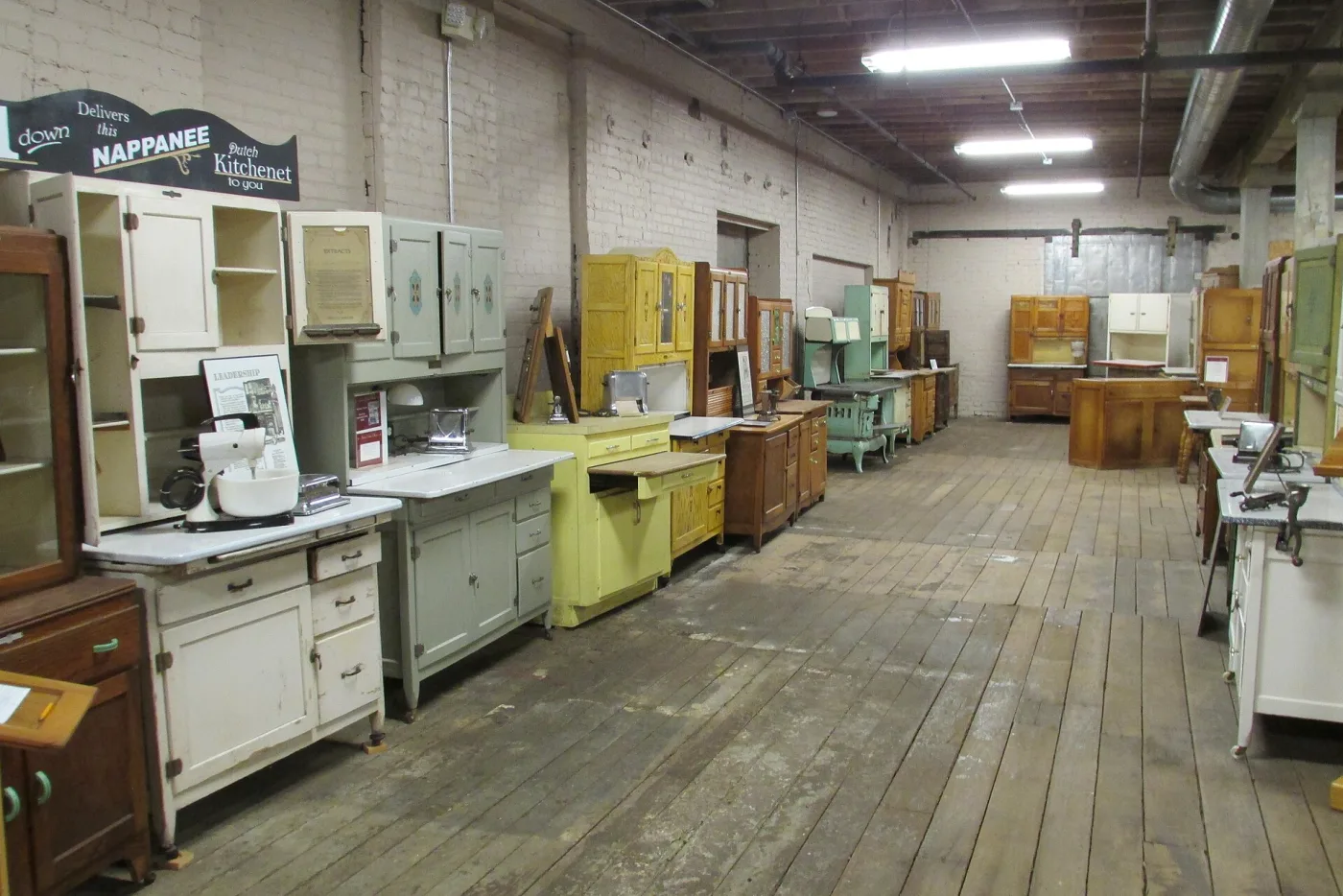
For roughly the first four decades of the twentieth century, the free-standing kitchen cabinet known generically as the Hoosier was the organizing heart of the American kitchen. Before built-in cabinetry lined the walls of every home, a family's flour, sugar, spices, mixing bowls, and baking tools lived inside a single tall oak or enameled cabinet with a pull-out work surface — a self-contained "kitchen efficiency center" that promised to save the housewife miles of steps a day. Tens of millions were sold, and enough survive that they turn up constantly at estate sales, farm auctions, and antique malls, which is exactly why so many people want to know what they actually have.
The word "Hoosier" is a genericized trademark, much as "Frigidaire" once meant any refrigerator. It comes from the Hoosier Manufacturing Company of New Castle, Indiana, the largest and best-known maker — but dozens of firms, most of them clustered in Indiana, built the same type of cabinet. Sellers, Napanee, McDougall, Wilson, Boone, and Kompass & Stoll were all major competitors, and correctly a cabinet is only a "Hoosier" if it was made by the Hoosier company itself. Learning to read the hardware, the accessories, the labels, and the construction is what lets you tell a genuine Hoosier from a Sellers or a Napanee — and all of them from a modern reproduction.
This guide covers what a Hoosier cabinet is and the parts that define it, the history of the type and its rise and fall, the anatomy and vocabulary you need, the major manufacturers and how to distinguish them, the all-important accessories and hardware, the two great finishes (golden oak and white enamel) and how they date a piece, how to read labels and decals, condition and the perennial problem of "married" tops and bases, value factors, reproductions and reproduction parts, and sensible care. Whether you have inherited Grandmother's baking cabinet or are weighing one at a sale, the goal is the same: to help you name the maker, place the date, and judge what separates an ordinary example from a desirable one.
Table of Contents
- What a Hoosier Cabinet Is
- A Short History of the Kitchen Cabinet
- Anatomy and Terminology
- The Major Makers
- Hardware, Accessories, and Fittings
- The Flour Bin and Sifter
- Finishes: Golden Oak vs. White Enamel
- Work Surfaces and the Enamel Top
- Labels, Decals, and Maker Marks
- Dating a Hoosier Cabinet
- Married Pieces and Mismatched Tops
- Condition and Common Faults
- Value Factors and Price Ranges
- Reproductions and Replacement Parts
- Quick Identification Checklist
What a Hoosier Cabinet Is
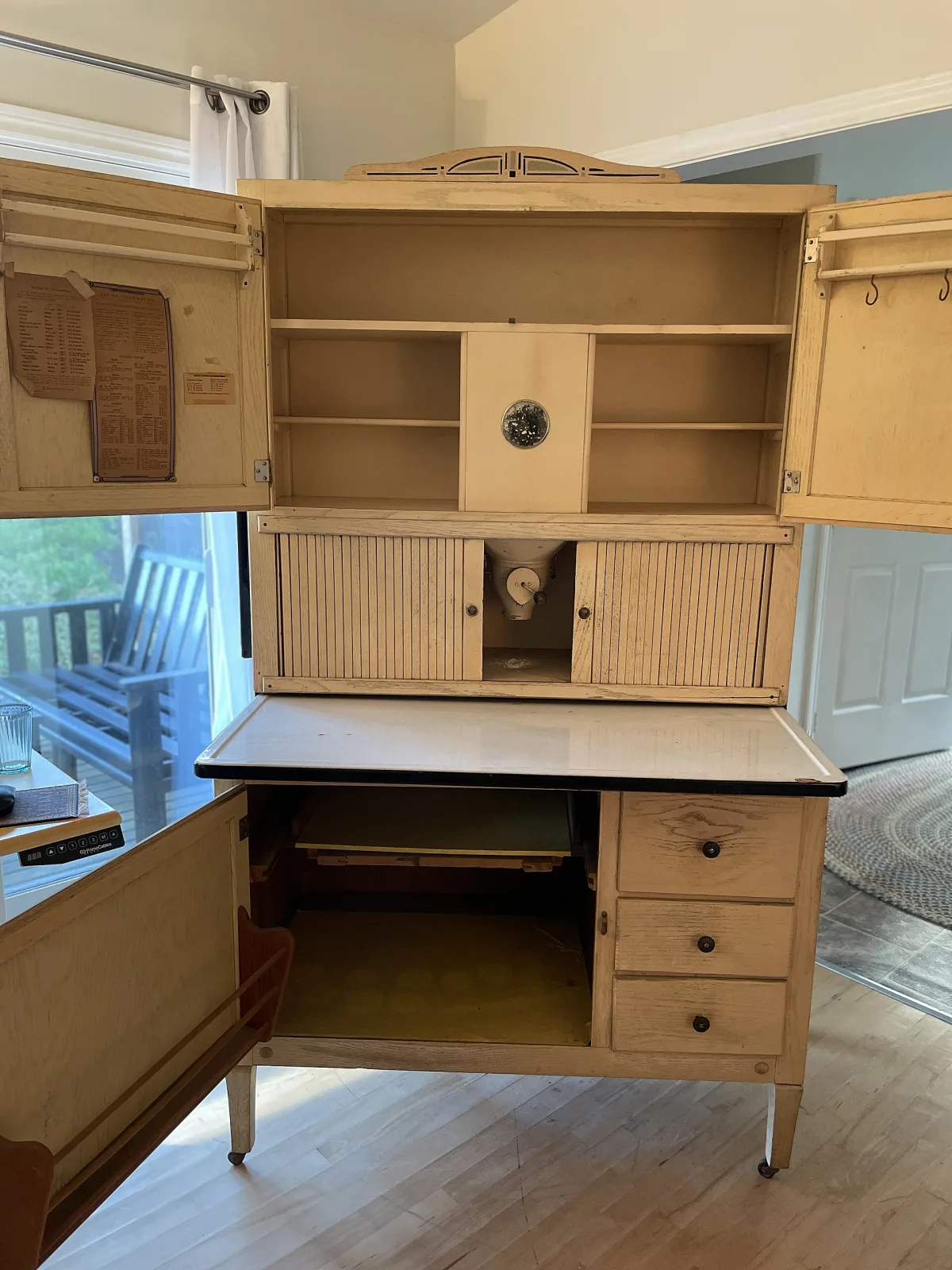
A Hoosier cabinet is a free-standing, factory-made kitchen work cabinet, typically built in two stackable sections. The base holds drawers and a large cupboard and carries a pull-out or slide-out work surface at about counter height. The top (or hutch) sits on the base and holds cupboards for storage, very often including a built-in flour bin with a sifter and a rack of matching glass jars for sugar, coffee, and spices. Between the two, a roll-down tambour door frequently closes off the upper cupboards and the back of the work surface. The whole assembly stands on its own legs or feet, entirely independent of the walls.
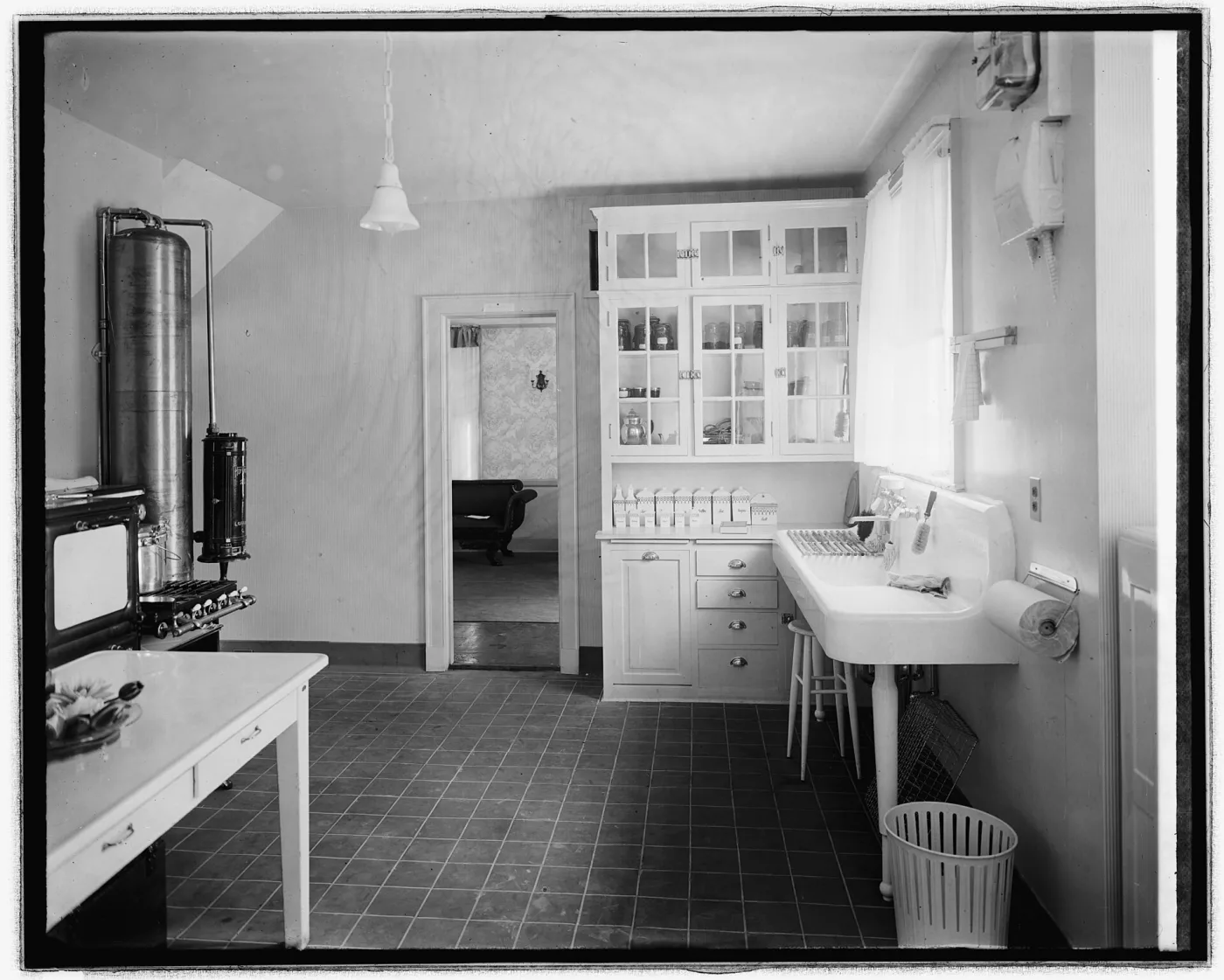
That independence is the defining idea. The Hoosier belongs to the era before continuous built-in kitchen cabinetry. Its entire selling proposition was to gather the ingredients and tools of baking and food preparation into one compact station so the cook did not have to cross the kitchen a hundred times a day. Manufacturers explicitly marketed the cabinets as labor- and step-saving devices, complete with pseudo-scientific claims about the miles a housewife would be spared each year. Understanding this purpose explains every feature you will find: the flour bin, the sifter, the graduated measurements printed on doors, the meal-planner charts, the want-list slips, and the sea of specialized jars and racks.
Hoosier, Cabinet, or Cupboard?
In everyday use "Hoosier cabinet," "Hoosier cupboard," "baking cabinet," and "kitchen cabinet" are used interchangeably for the whole class of object, and that is fine for casual conversation. For accurate identification, though, keep two distinctions in mind. First, "Hoosier" strictly names the product of the Hoosier Manufacturing Company; a cabinet by another firm is a Sellers, a Napanee, a McDougall, and so on. Second, the type is quite different from earlier free-standing kitchen storage such as the pie safe, the jelly cupboard, or the country pine cupboard — those are typically handmade or vernacular pieces, while the Hoosier is a mass-produced, patented, accessory-laden product of the early factory age.
A Short History of the Kitchen Cabinet
The free-standing kitchen cabinet grew out of the earlier baker's table and the possum-belly work table of the late nineteenth century, gaining enclosed storage above and below a central work top. The type crystallized around 1900, and the Hoosier Manufacturing Company, founded in Albany, Indiana, and soon established in New Castle, gave it both its most successful form and its lasting nickname.
The Indiana Cluster
For reasons of timber supply, rail access, and simple competitive clustering, the industry concentrated heavily in Indiana. New Castle (Hoosier), Elwood (G. I. Sellers & Sons), Nappanee (the Napanee/Coppes lines and Mutschler), Greencastle, and other Indiana towns became the center of production, which is why the whole category took on the state's own nickname. Ohio, Michigan, and other states hosted makers too — McDougall was in Indianapolis and later Frankfort, Indiana; Wilson and others operated elsewhere — but the Indiana identity stuck so firmly that "Hoosier" became the generic word nationwide.
The Golden Age, 1900–1930
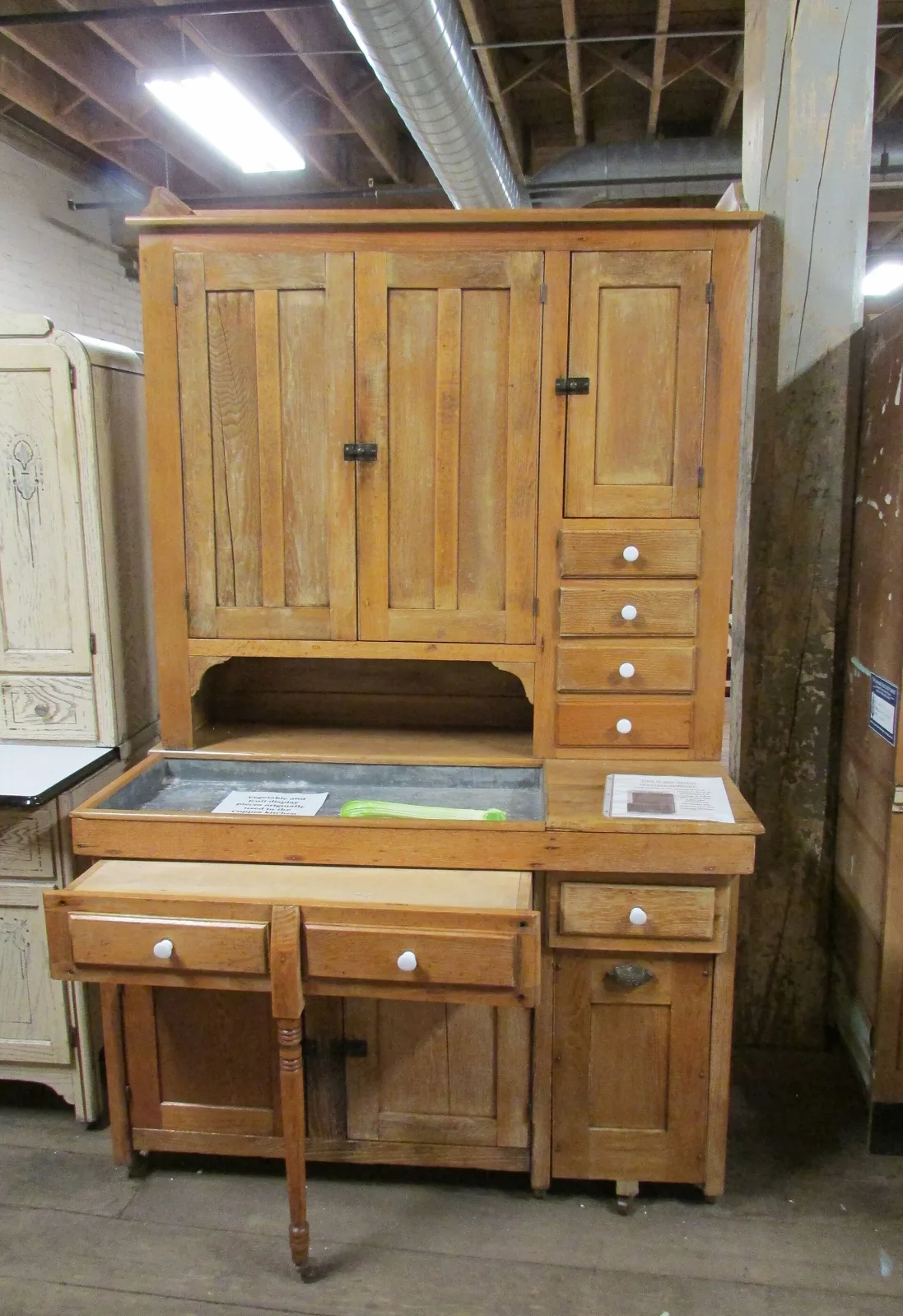
The cabinets sold in enormous numbers through the 1910s and 1920s, promoted with installment plans, national advertising, and clubs. Early examples were golden oak; from the late 1910s onward, painted and porcelain-enameled finishes in white and pastel colors grew steadily more popular as tastes shifted toward the bright, sanitary, "modern" kitchen. The accessories multiplied: sifter-flour bins, sugar jars, spice sets, bread and cake drawers, cutlery trays, meal planners, and pull-out tin or aluminum work surfaces. This is the classic period from which most surviving cabinets date.
The Decline and the End
The Hoosier's decline was caused by the very modernity it had once represented. As houses were built or remodeled with built-in continuous cabinetry and integral countertops from the 1930s onward, the free-standing work cabinet lost its reason to exist. The Depression hurt sales, and by the late 1930s and 1940s the type was obsolescent; most makers had stopped or converted production by the 1940s. The cabinets that survived became, first, unfashionable hand-me-downs and, later, sought-after antiques prized for exactly the nostalgic, self-contained charm that once made them practical.
Anatomy and Terminology
A precise vocabulary makes description, dating, and condition assessment far easier, and it is the language dealers and restorers use. Most Hoosier-type cabinets share the same core parts even when makers arranged them differently.
Base and Top
The two principal sections are the base (the lower cabinet with drawers, cupboard, and work surface) and the top (the upper hutch with cupboards, flour bin, and jars). They were built to separate for shipping and moving and simply stack together in use. Because they separate so readily, mismatched or "married" base-and-top combinations are a constant identification issue, discussed in its own section below.
The Work Surface
The work surface is the pull-out or slide-out counter at the front of the base, at about baking height. Early tops were often wood; the classic period favored a sheet of enameled steel (frequently called porceliron or simply the enamel top) or sometimes zinc or aluminum, which slid outward to enlarge the counter and pushed back to save space. This surface, and its condition, is central to both usefulness and value.
The Tambour
A tambour is a flexible roll-down door made of narrow wooden slats glued to a canvas backing, running in curved grooves — the same mechanism as a roll-top desk. Many Hoosier tops used a tambour to close the upper cupboards and the recess above the work surface. A smoothly running original tambour is prized; a warped, split, or missing one is a common fault and a frequent repair.
The Flour Bin and Sifter
The flour bin is a large tin or metal hopper, usually mounted behind a tall left-hand door of the top, holding many pounds of flour. Most bins incorporate a sifter at the bottom, operated by a crank or shaker so flour could be measured and sifted directly onto the work surface. This single feature is the most iconic Hoosier fitting and a major identification and dating clue in its own right.
Jars, Racks, and Fittings
The tops typically carried a rack of matching glass jars — a large sugar jar, a coffee jar, a tea jar, and a set of small spice jars — often with lids or shakers marked with the maker's name. The spice jars in particular echo the older tradition of dedicated spice boxes and cabinets that the Hoosier absorbed into a single fitted unit. Additional fittings included bread and cake drawers (sometimes with sliding metal lids), cutlery trays, a meal planner or menu chart, a want-list pad, and pull-out cutting boards. The presence and originality of these accessories strongly affects both attribution and value.
The Major Makers
Identifying the maker is the core of Hoosier identification, and it is done chiefly through hardware design, accessory style, labels, and the characteristic look of each firm's cabinets. A handful of companies account for the great majority of surviving examples.
Hoosier Manufacturing Company (New Castle, Indiana)
The namesake and largest producer. Hoosier cabinets are the benchmark against which the others are compared, and the company's marketing — the "Hoosier Beauty," the "Hoosier Highboy," and its clubs and installment plans — made the name generic. Genuine Hoosier pieces frequently carry the name on hardware, jar lids, sifter mechanisms, and metal tags, and the firm's accessories (its particular sugar jar, its meal planner, its distinctive nickel hardware) are well documented. Because "Hoosier" is so often used loosely, confirming that a cabinet is actually a Hoosier — rather than a generic cabinet — means finding the Hoosier name on the fittings or matching its documented hardware.
G. I. Sellers & Sons (Elwood, Indiana)
Hoosier's greatest rival and, by some measures, a comparable giant. Sellers cabinets are especially noted for the "Klearfront" design and for high-quality fittings; Sellers hardware, jar sets, and the automatic lowering flour bin are collectible in their own right. A Sellers is identified by its name on hardware and accessories and by its characteristic door and drawer configurations. Collectors often rate Sellers on a par with Hoosier for quality.
Napanee / Coppes Napanee and Mutschler (Nappanee, Indiana)
The town of Nappanee produced several important lines. The Coppes brothers' "Napanee Dutch Kitchenet" and related cabinets are well regarded, and Mutschler Brothers was another significant Nappanee maker. Napanee cabinets carry their own hardware and jar branding. (Note the spelling: the town is "Nappanee," while the brand was often styled "Napanee.")
McDougall, Wilson, Boone, and Others
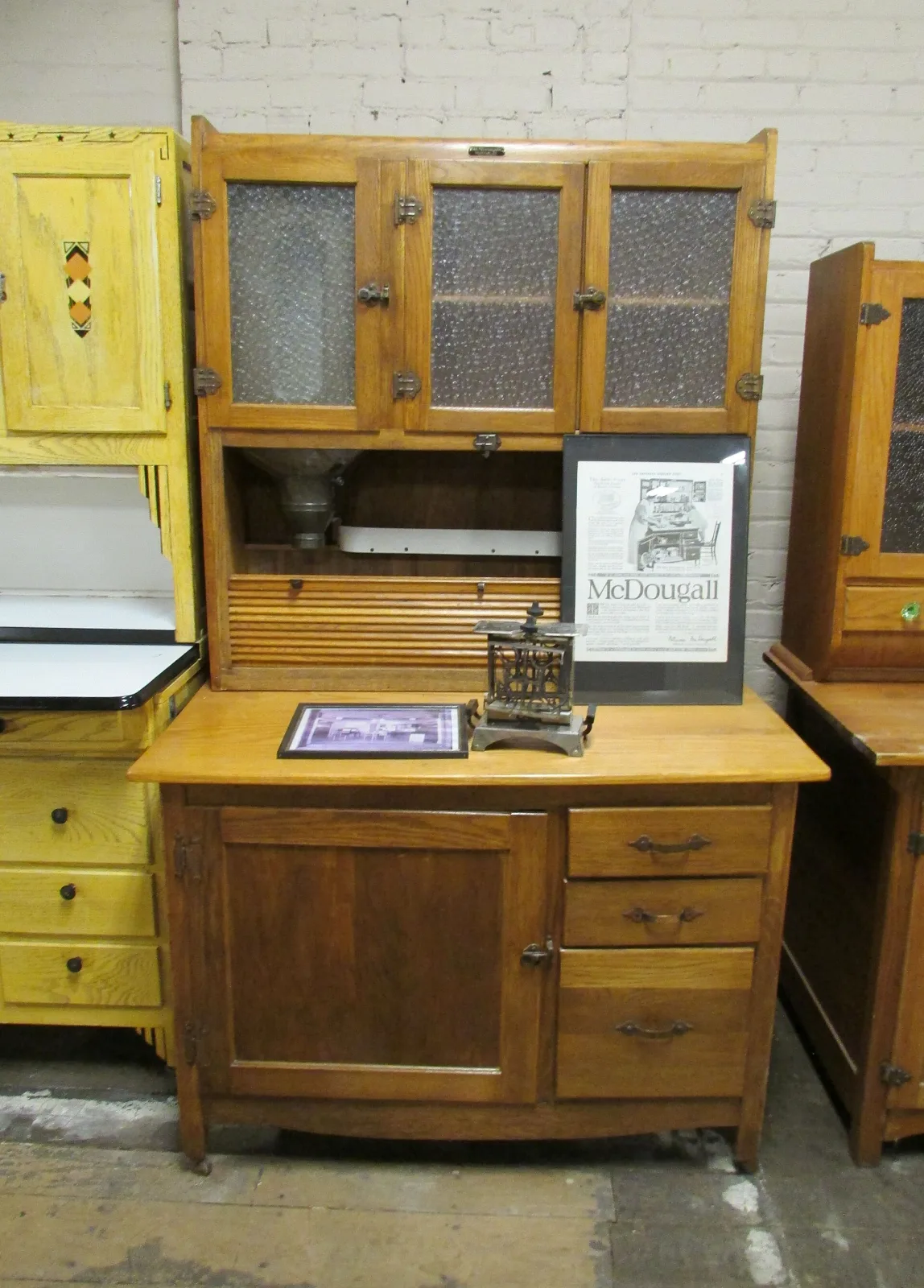
Several more firms are commonly encountered. McDougall (Indianapolis, later Frankfort, Indiana) was an early and prominent maker. The Wilson kitchen cabinet, Boone (Lebanon, Indiana), Kompass & Stoll (Niles, Michigan), Showers Brothers (Bloomington, Indiana), and the Ariel cabinet all produced cabinets of the same general type. Each is identified the same way — by the maker's name on hardware, jars, and labels, and by the specific look of its fittings. When no name is present, attribution rests on matching documented hardware patterns and accessory styles.

Hardware, Accessories, and Fittings
Hardware and accessories are the single most powerful tool for identifying and dating a Hoosier cabinet, because each firm used its own designs and frequently stamped them with its name. Where wood and overall form can look generic across makers, the metalwork usually tells the truth.
Latches, Hinges, and Pulls
Look closely at the door latches, the hinges, the drawer pulls, and any nickel-plated or japanned fittings. Manufacturers commonly cast or stamped their names into latches and hardware, and the styles evolved over time — early bin latches, sliding-door catches, and cutlery-drawer fittings all changed across the production years. Nickel-plated hardware suggests one period, later chrome or painted hardware another. A latch stamped "Hoosier" or "Sellers" is often the quickest positive identification you will find, so examine every piece of metal before concluding a cabinet is unmarked.
The Jar Sets
The rack of glass jars is both a defining feature and a strong maker clue. A full original set typically includes a large sugar canister, coffee and tea jars, and a row of small spice jars, often with metal or glass lids bearing the maker's name and sometimes the contents. Jar shapes, lid styles, and any embossed or printed branding are documented for the major firms. Because loose jars are widely sold and reproduced, an original, complete, correctly branded set materially raises a cabinet's value and confidence of attribution.
Meal Planners, Want Lists, and Charts
Many cabinets carried a printed meal planner (a rotating menu chart), a want-list pad for shopping, and tables of weights, measures, and cooking times mounted inside a door or on the tambour recess. These paper and metal fittings are frequently branded and dated in style, and a surviving example is both charming and diagnostic. Their presence, condition, and correctness all feed into identification.
Cutting Boards, Bins, and Drawers
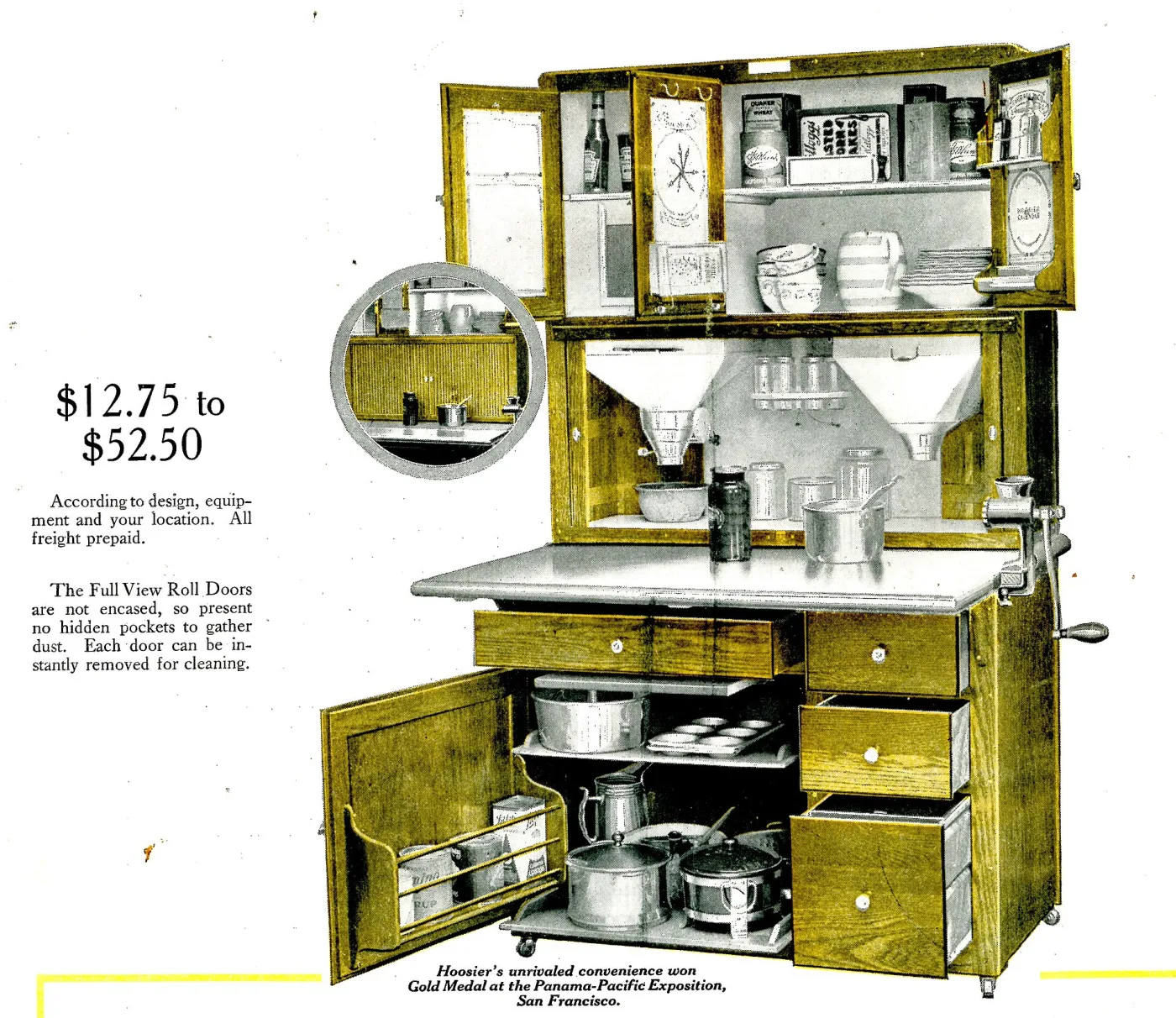
Pull-out cutting boards, metal-lined bread and cake drawers, tilt-out bins for sugar or meal, and lined cutlery drawers — often still holding period kitchenware and utensils — round out the fittings. The number and arrangement of these — how many drawers, whether a bread drawer has a sliding lid, whether there is a second bin beside the flour bin — help match a cabinet to a maker's documented models and to a period within that maker's output.
The Flour Bin and Sifter
No feature says "Hoosier cabinet" more immediately than the built-in flour bin and sifter, and few features are as useful for identification. It deserves a close look on any cabinet you are assessing.
How It Works
The typical flour bin is a large tin hopper mounted behind a tall door in the top section, filled from above and holding many pounds of flour. At its base sits a sifter — a rotating or shaking mesh mechanism, often crank-operated — through which measured flour could be sifted directly down onto the work surface. Some makers used a self-lowering or tilt-out bin; Sellers, for instance, was noted for an automatic bin that swung down for filling. The exact mechanism and its maker's markings are documented for the major firms.
What the Bin Tells You
Because bin and sifter designs differed by maker and changed over time, the bin is a strong attribution and dating clue. Names and patent information are frequently stamped on the sifter mechanism or the bin itself. The style of the crank, the shape of the hopper, and the way the bin mounts to the door all help match a cabinet to a maker and period. A bin that is clearly a mismatched later replacement, conversely, is a warning that the top may be married or heavily restored.
Condition of the Bin
Original tin flour bins are often rusted, dented, or missing their sifter parts, since flour, moisture, and decades of use are hard on thin metal. A complete, working, correctly branded bin adds real value and confidence; a missing bin, a crudely replaced one, or a bin converted to a plain shelf detracts. Because reproduction bins and sifters are sold, verify that a suspiciously pristine bin actually matches the cabinet's age and maker rather than assuming originality.
Finishes: Golden Oak vs. White Enamel
Finish is one of the most useful dating tools for Hoosier cabinets, because the fashion shifted on a fairly predictable timeline from natural oak toward painted and enameled surfaces. Identifying the finish narrows the date and shapes the value.
Golden Oak (Earlier)
The earliest and, to many collectors, most desirable cabinets are golden oak — solid oak or oak-veneered cases with a warm, clear or amber varnish finish showing the grain. Golden oak dominated the first two decades of production, roughly the 1900s and 1910s, before white kitchens became the vogue. An oak Hoosier with good original finish, original hardware, and a full accessory set is a classic and generally commands a premium over a painted example of similar quality. The oak look connects these cabinets to the broader golden-oak furniture of the period, including much turn-of-the-century case furniture.
White and Colored Enamel (Later)
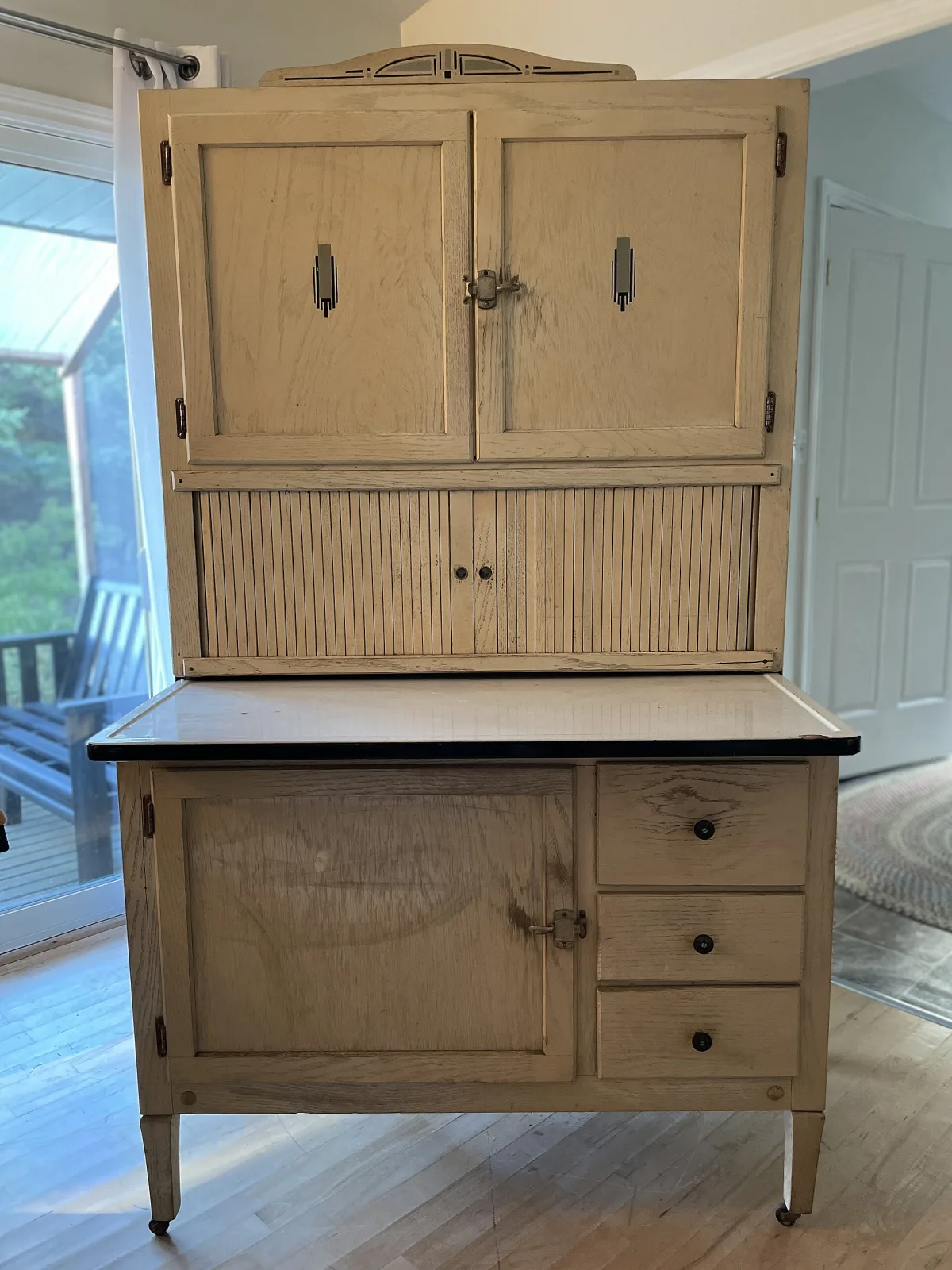
From the late 1910s and through the 1920s and 1930s, the bright, sanitary "modern" kitchen came into fashion, and painted finishes — white above all, but also pale gray, green, cream, and other pastels — became standard. These enameled cabinets, often with contrasting trim and colored knobs, evoke the classic 1920s–30s kitchen. Original painted finishes in good condition are collectible, but painted cabinets were also the ones most often repainted over the decades, so distinguishing an original factory finish from later house paint is an important skill.
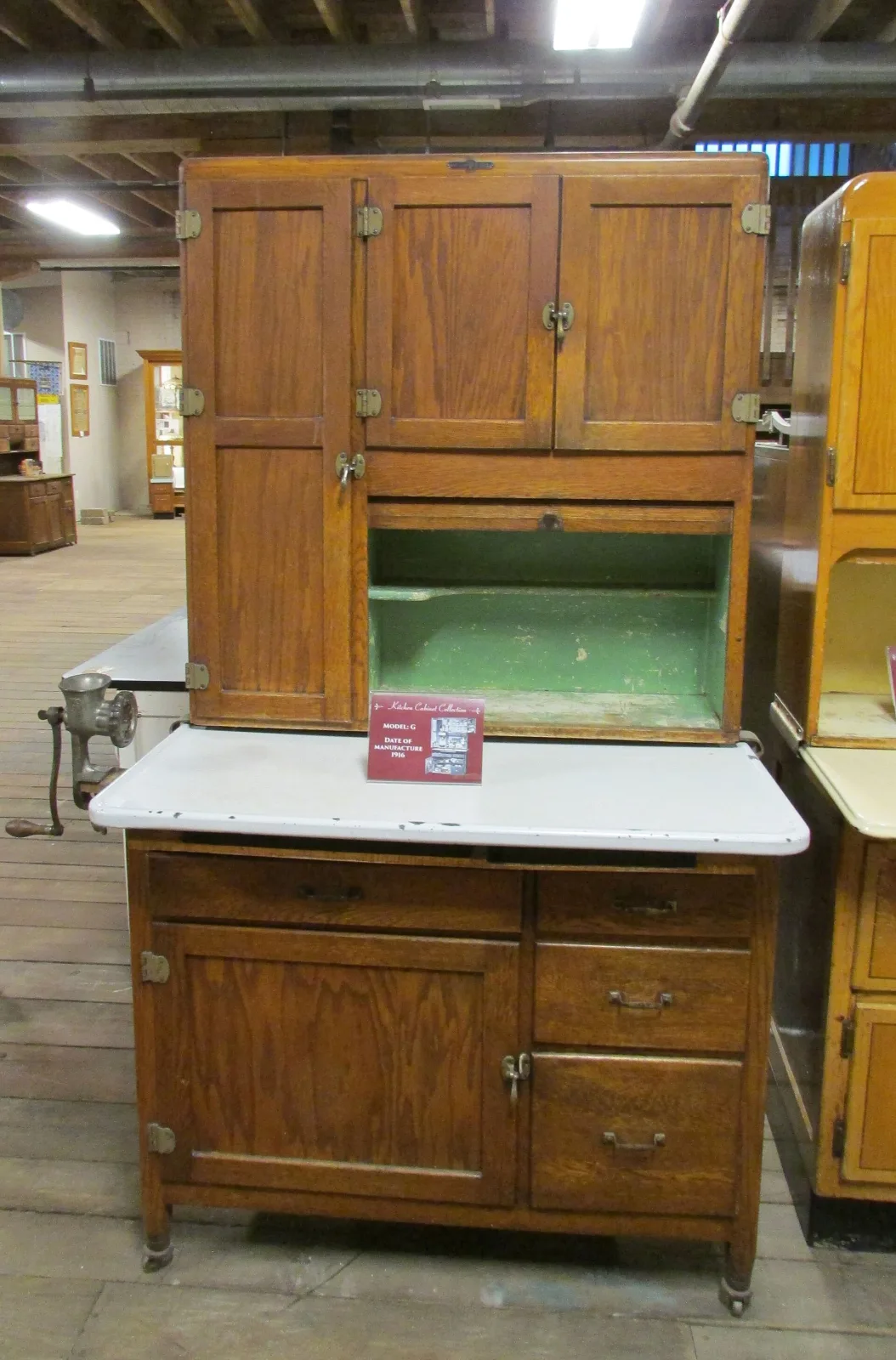
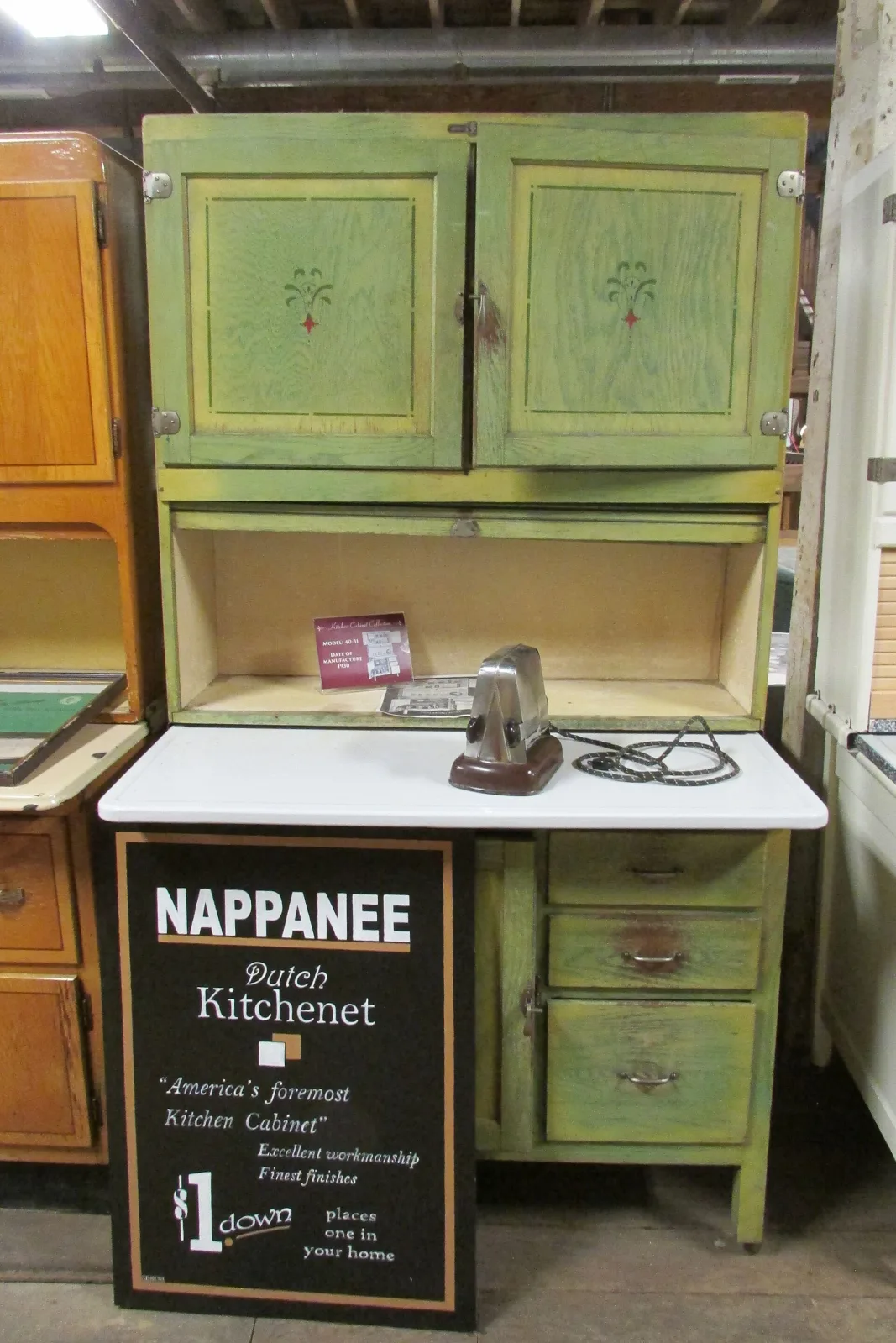
Fourteen years apart, and the finish is only the most obvious difference. Look at the hardware: the 1916 cabinet has cast brass butt hinges and a cast latch, screwed on individually; the 1930 one has thin pressed-steel hinges and stamped pulls, because by then the fittings were being stamped rather than cast. Look at the decoration: hand-applied stencilling with a coloured accent is a late feature and never appears on golden oak. And look through the paint on the right-hand cabinet — the oak grain is still visible under it, which is how a factory enamel behaves. A later house repaint sits thick enough to fill the grain and to clog the hinge screws, and that is the test worth learning, because "original painted finish" and "repainted" differ severalfold in value on cabinets that otherwise look identical.
Reading the Finish for Date and Originality
Broadly, natural oak points earlier and white or pastel enamel points later, though the periods overlap. Just as important is whether the finish is original. A crackled, mellow, correctly colored factory finish is very different from a thick, brushy, modern repaint that hides the grain and clogs the hardware. Stripped-and-refinished oak and freshly repainted enamel both reduce originality (and often value) compared with honest, unmolested surfaces. When judging finish, weigh both the era it implies and how much of it is factory-original.
Work Surfaces and the Enamel Top
The pull-out work surface is both the practical center of the cabinet and a key element in dating and valuing it, so examine it carefully.
Materials and Evolution
Early cabinets often had wooden work surfaces; the classic period is defined by the sheet-metal enamel top — a porcelain-enameled steel surface, frequently white with a colored edge, that slides out to enlarge the counter. Zinc and aluminum surfaces also appear. The enamel top's smooth, wipeable surface was part of the "sanitary kitchen" appeal, and its style and color help place a cabinet in period. A wood top generally suggests an earlier or plainer cabinet; a porcelain-enamel top is typical of the 1920s–30s classic examples.
Condition of the Top
Enamel tops chip, crack, rust at the edges, and wear thin from decades of use. A clean, intact enamel surface with minimal chipping is a strong positive; heavy rust, large chips, or a replaced top detracts. Because tops were made to slide and separate, a top can be a later replacement of the wrong size or color — a subtle sign of a married or heavily restored cabinet. Check that the top fits its runners correctly and matches the cabinet's age and maker.
The Sanitary Kitchen Connection
The push toward wipe-clean surfaces that produced the enamel top also filled kitchens with speckled enamelware and graniteware, glass storage jars, and other easily cleaned goods. A Hoosier's porcelain-enamel work surface is part of that same early-twentieth-century hygiene movement, and recognizing the style of the enamel — its color, its edge trim, its wear — helps both date the cabinet and confirm that the top belongs to it.
Labels, Decals, and Maker Marks
When present, a maker's mark settles attribution instantly, so a thorough search for labels and marks should be part of examining any cabinet. Marks take several forms, and they hide in predictable places.
Where to Look
Search the backs and undersides of drawers, the inside of cupboard doors, the back of the case, the flour-bin sifter mechanism, the jar lids, and every piece of hardware. Makers applied paper labels, stamped or embossed metal tags, cast names into latches, and printed their names on jars, meal planners, and want-list pads. A single stamped latch or a branded jar lid is often the clearest evidence you will find. Because paper labels perish, the metal marks — on hardware and sifters — are frequently the survivors.
Decals and Painted Marks
Some cabinets carried decorative or maker decals, and painted or stenciled marks appear on certain models. As with any decal-marked furniture, condition matters: an original decal is a strong clue, but decals were also reproduced, so a suspiciously crisp decal on an otherwise worn cabinet deserves scrutiny. The same disciplined approach used for reading marks on other case furniture, such as the shopmarks discussed in our Stickley and mission oak guide, applies here: corroborate a mark against construction, hardware, and wear rather than trusting it alone.
When There Is No Mark
Many cabinets survive with no legible mark at all — labels lost, jars replaced, hardware swapped. In that case attribution rests on matching documented hardware patterns, accessory styles, and construction details to a known maker, exactly as with unmarked pieces in any furniture category. An unmarked but clearly period cabinet is still a genuine Hoosier-type cabinet; it simply cannot be pinned to a specific firm without corroborating features.
Dating a Hoosier Cabinet
Dating a Hoosier is a matter of triangulating several clues, since no single feature carries a year. Taken together, the following usually place a cabinet within a decade or so.
Finish and Style
Golden oak points to the earlier period (roughly 1900s–1910s), while white and pastel enamel finishes point to the 1920s and 1930s. The overall styling — heavier, more ornate early cabinets versus lighter, plainer, more "streamlined" later ones — supports the same reading. Because the fashion shift is well documented, finish and form together bracket the date quickly.
Hardware and Accessories
Hardware styles, jar and lid designs, sifter mechanisms, and the type of work surface all evolved across the production years and are documented for the major makers. Nickel-plated hardware, particular latch designs, and specific jar shapes can each narrow the window. Identifying the maker first, then matching the fittings to that maker's documented timeline, is the most reliable dating path.
Construction Clues
Construction details — the joinery, the type of drawer bottoms and runners, the use of solid oak versus veneer, the back boards, and the fasteners — reflect early-twentieth-century factory methods and shifted over time. Machine-cut joinery and mass-production hardware are expected; hand-cut dovetails and vernacular construction would instead suggest an earlier or non-factory piece that is not truly a Hoosier at all. Reading construction alongside finish and hardware guards against both over- and under-dating.
Married Pieces and Mismatched Tops
Because Hoosier cabinets were built as separable top-and-base pairs, the "married" cabinet — a top from one cabinet mated to a base from another — is one of the most common and important issues in the field. Recognizing it protects you from paying an intact-cabinet price for a mismatched assembly.
How Marriages Happen
Over a century of moving, storage, and dealer trade, tops and bases became separated and were later recombined — sometimes innocently, sometimes to make a saleable "complete" cabinet from two damaged ones. A married cabinet may pair different makers, different finishes, or different periods, and the two halves may not quite fit or align.
Signs of a Marriage
Check that the top and base match in maker's marks, hardware style, finish color and wear, wood and grain, and dimensions. Warning signs include a top that overhangs or underfits the base, mismatched or freshly refinished halves, hardware of two different styles, a flour bin or jars that do not match the base's period, and wear patterns that do not correspond between the sections. Where one half is marked and the other is not, or the two carry different makers' names, the cabinet is married. A genuinely matched, all-original top-and-base is worth considerably more than a married assembly of similar appearance.
Why It Matters
An original, matched cabinet is both more valuable and more historically honest than a marriage. This does not make married cabinets worthless — a well-matched marriage can still be a useful and attractive piece — but it should be described and priced as such. When assessing value, always determine first whether the top and base truly belong together, because that single fact can swing the figure substantially.
Condition and Common Faults
Condition governs value sharply, and Hoosier cabinets, having been heavily used working furniture, frequently show wear and repair. Inspect every element methodically.
The Metal Fittings
Flour bins and sifters rust and lose parts; enamel tops chip and rust at the edges; jar lids and shakers corrode or go missing; hardware gets bent, replaced, or over-cleaned. Because these metal parts are both the most diagnostic and the most vulnerable, their completeness and condition weigh heavily. A complete, original, working set of fittings is a major positive; missing or crudely replaced fittings are a common and value-reducing fault.
The Tambour
The roll-down tambour is a frequent trouble spot: slats warp, the canvas backing splits, and the door jams, sticks, or is removed entirely. A smooth-running original tambour is prized; a repaired, replaced, or missing one detracts. Test the tambour's action if the cabinet has one, and note any repair.
Wood, Finish, and Structure
On oak cabinets, check for veneer loss, water damage, stripped or refinished surfaces, and warping. On painted cabinets, distinguish original factory enamel from later house-paint repaints, and check for chipping and over-painting of hardware. Structurally, inspect the drawers and runners, the legs and feet, the back boards, and the fit of the two sections. As with any working antique, honest wear consistent with age is expected and acceptable; crude repairs, replaced structural parts, and heavy refinishing reduce originality and value.
Completeness
Completeness is a recurring theme: the original flour bin and sifter, the full matching jar set, the meal planner and want-list fittings, the correct enamel top, and the original hardware all contribute. A cabinet that retains most of these, in honest condition, is far more desirable than one stripped of its fittings, however sound the case.
Value Factors and Price Ranges
Hoosier values span a wide range, and the same basic cabinet can be modest or genuinely desirable depending on maker, finish, completeness, and condition. The variables below explain most of the spread.
What Drives Value
Maker and quality come first: a documented Hoosier or Sellers, especially a top-line model, generally outranks an unmarked or lesser-known cabinet. Finish matters — original golden oak in good condition is often the most sought-after, and original (not repainted) enamel is desirable too. Completeness is decisive: the original flour bin and sifter, the full correctly branded jar set, the meal planner and want-list fittings, the intact enamel top, and the original hardware together can transform value. Condition and originality — honest surfaces versus stripping or repainting, sound structure versus crude repair — then modulate the figure, and whether the cabinet is all-original or married can swing it substantially.
Indicative Ranges
As broad orientation rather than a price list: a rough, incomplete, or married cabinet with missing fittings and a tired finish sits at the low end and can be quite inexpensive. A sound, attractive cabinet in original oak or original enamel, with most of its fittings, occupies a comfortable middle. A fully complete, correctly fitted, well-preserved cabinet from a top maker — original finish, original bin and sifter, full branded jar set, intact enamel top, all original hardware — reaches the upper end and can command a real premium. Because condition, completeness, and marriage status swing these figures so widely, treat any single number with caution and always compare like with like.
Documenting for Insurance or Sale
Photograph the cabinet as a whole and each key element separately: the flour bin and sifter, the jar set and lids, every maker's mark and stamped latch, the meal planner and want-list fittings, the enamel top, and any damage. Record the maker (if determined), the finish, the fittings present, and the dimensions, and note honestly whether the top and base match. The disciplined method in our valuation and appraisal guide applies directly, and thorough documentation both supports value and helps a future buyer or appraiser confirm your attribution.
Reproductions and Replacement Parts
Hoosier cabinets are affected less by whole-cabinet forgery than by reproduction parts and by married and heavily restored pieces, though outright reproduction cabinets do exist. Knowing what is reproduced protects you from paying original prices for new components.
Reproduction Hardware, Jars, and Fittings
Because so many original cabinets lost their fittings, a lively market exists in reproduction jars, sifters, flour bins, hardware, latches, and meal planners — sold legitimately to restore cabinets, but capable of misleading a buyer when a "complete original" cabinet is quietly fitted with new parts. Reproduction jars and lids in particular are common. Examine fittings for the wear, patina, and manufacturing detail consistent with age; a suspiciously pristine, uniform set of "original" jars or a too-clean sifter on an otherwise worn cabinet is a flag to investigate.
Whole-Cabinet Reproductions
Modern furniture makers have produced Hoosier-style cabinets, both as honest new kitchen furniture and, occasionally, as pieces that can be passed off as old. New wood, modern plywood or particleboard, contemporary fasteners and finishes, and hardware lacking genuine age all betray a reproduction. As always, construction and materials, read together, distinguish a period factory cabinet from a modern one.
Restoration, Marriage, and Honest Description
The most common "trap" is not a fake at all but an over-restored or married cabinet presented as original. Stripped and refinished oak, freshly repainted enamel, a replaced enamel top, a married top-and-base, and a set of reproduction fittings can combine to make a shiny, "complete" cabinet that is far less original than it looks. None of this makes such a cabinet worthless, but it should be described and priced honestly. When the stakes are high, corroborate maker, date, and originality against documented references, examine every fitting for genuine age, and use the pattern-recognition of the Antique Identifier app to help confirm what you are looking at before you buy or sell.
Quick Identification Checklist
When you first approach an unfamiliar kitchen cabinet, work through these questions in order. Together they will place almost any Hoosier-type cabinet by maker, rough date, and value tier.
Is It a Hoosier-Type Cabinet at All?
Confirm the defining form: a free-standing, factory-made kitchen work cabinet in stackable top-and-base sections, with a pull-out work surface and, typically, a built-in flour bin, jar rack, and tambour. That form separates it from handmade pie safes, jelly cupboards, and country pine cupboards, and from later built-in cabinetry.
Who Made It?
Search every piece of metal and every hidden surface for a name — stamped latches, branded jar lids, sifter mechanisms, paper labels, metal tags, meal planners. A "Hoosier," "Sellers," "Napanee," "McDougall," or other name settles attribution. Where no name survives, match the hardware and accessory styles to a documented maker.
What Finish and Fittings?
Note the finish — golden oak (earlier) or white/pastel enamel (later) — and whether it is original or refinished. Inventory the fittings: is the flour bin and sifter present and working? Is the jar set complete and correctly branded? Is the enamel top intact? Are the hardware and meal-planner fittings original? Finish and completeness together drive both date and value.
Is It Original or Married?
Check that the top and base match in maker, finish, wear, wood, and dimensions. Look for mismatched halves, two hardware styles, a top that overhangs or underfits, or fittings from the wrong period. Determining whether the cabinet is all-original or married is one of the most consequential judgments you will make.
Overall Judgement
Weigh the clues together. An original golden-oak Hoosier with a working sifter, a full branded jar set, an intact enamel top, and all original hardware is a very different object from a repainted, married cabinet missing its fittings — even if they look superficially alike across a crowded sale floor. Match what you see to documented references before assigning a value, determine maker and originality first, and when a cabinet is potentially valuable, confirm the attribution rather than trusting a lone name or a shiny "complete" set.