Antique Epergne Identification Guide: Trumpets, Makers, and Dating
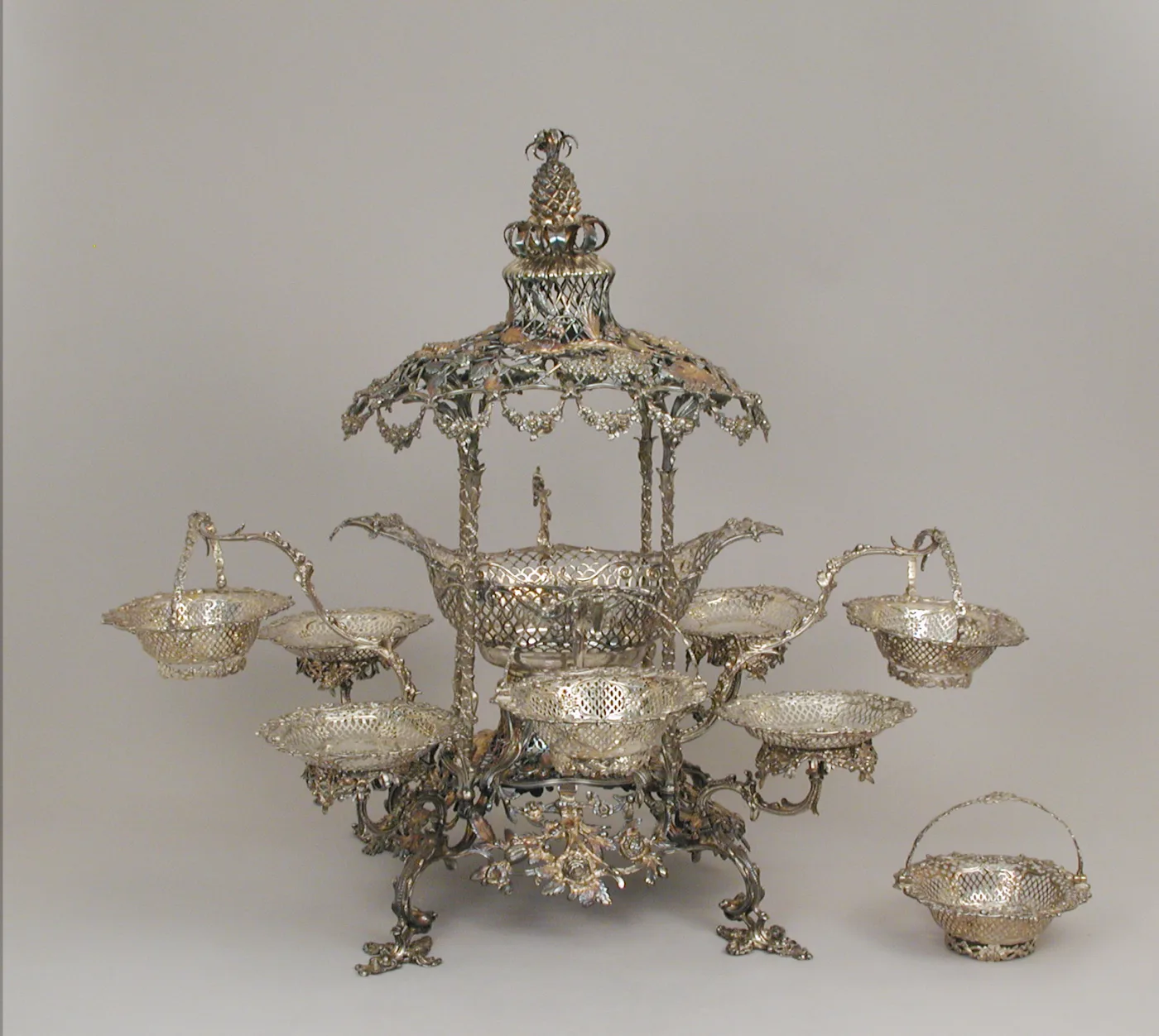
An epergne is the grand branching centerpiece that crowned the formal dining table from the middle of the eighteenth century through the end of the Victorian era. The word comes from the French épargne (a saving or economy), and the object it names is a single ornamental stand that gathers several functions in one place: a tall central vessel flanked by radiating arms that hold smaller dishes, baskets, or trumpet vases for fruit, sweetmeats, nuts, pickles, and flowers. At its Georgian height the epergne was a silver showpiece of the aristocratic table; by the Victorian decades it had become a glass-and-metal fantasy of trumpets and hanging baskets that anchored the middle-class dining room.
Identifying an antique epergne means untangling several questions that overlap. Is it silver, Old Sheffield plate, electroplate, or an all-glass form set in a metal frame? How many arms or trumpets does it carry, and are they all original to the frame? What glass color and technique do the vases show — clear flint, cranberry, vaseline, opalescent, or Continental art glass? Which maker do the marks, the frame casting, or the glasswork point to? And is the piece a Georgian original, a high-Victorian production of the 1870s and 1880s, an Edwardian survival, or a twentieth-century reproduction assembled from mismatched parts?
This guide walks through the history and terminology of the epergne, the major construction types (silver, plate, and glass-in-frame), the anatomy of trumpets and baskets, the leading English and Continental makers, the glass colors and patterns that define Victorian epergnes, how to read hallmarks and registry marks for dating, the reproductions and “married” assemblies that trap beginners, condition and repair issues unique to these fragile branching forms, and the factors that set value in today’s market.
Table of Contents
- What Is an Epergne?
- A Brief History of the Epergne
- Anatomy and Terminology
- The Major Construction Types
- Silver and Sheffield Plate Epergnes
- Glass-in-Frame Epergnes
- Glass Colors and Techniques
- English Makers
- Continental and American Makers
- Forms and Configurations
- Reading Hallmarks and Marks
- Dating an Epergne
- Married Pieces and Reproductions
- Condition Assessment
- What Drives Value
- Care, Cleaning, and Display
- Common Beginner Mistakes
- Frequently Asked Questions
What Is an Epergne?
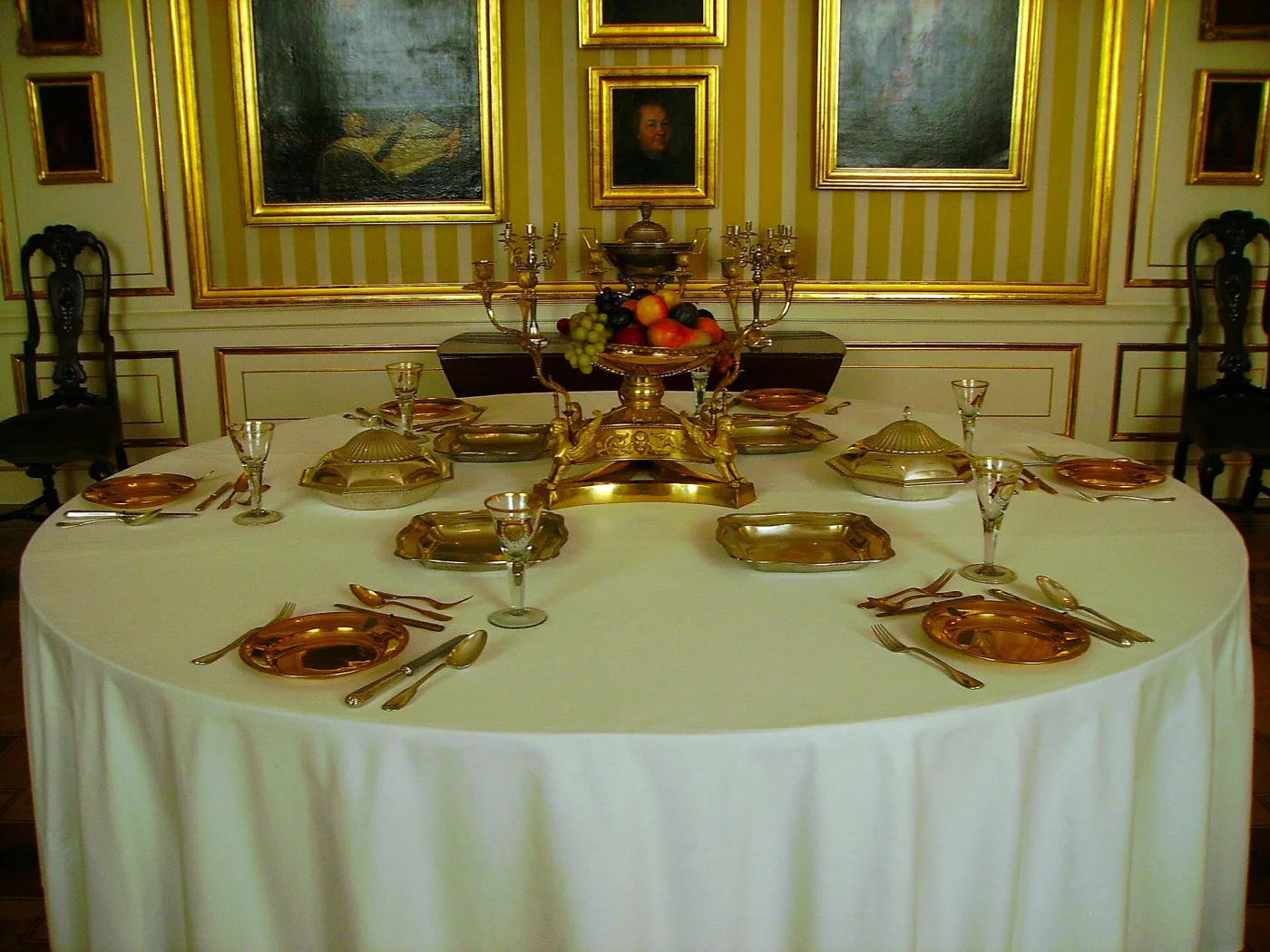
An epergne is a centerpiece built around a central axis with additional dishes or vases held out on arms, brackets, or a tiered frame. That structural definition is what separates it from its relatives. A single footed bowl on a stem is a comport or tazza; a flat mirrored slab is a plateau; a stack of graduated plates on a central rod is a dessert stand or a cake stand. An epergne is specifically the branching, multi-vessel form — the one that fills the center of the table with height and radiating detail rather than a single dish.
The purpose was both practical and theatrical. Practically, the epergne let a host present fruit, sweetmeats, nuts, and condiments together without cluttering the table with separate dishes, and its height kept the center of a long table interesting without blocking sightlines the way a tall vase would. Theatrically, it was a status object — a way to show wealth in silver or in fashionable colored glass, and a natural focal point for the flowers, fruit, and candlelight of a formal dinner.
Because the form spanned roughly a hundred and fifty years and moved from aristocratic silver to middle-class glass, “epergne” covers an enormous range: a heavy Georgian sterling stand with cast branches and cut-glass dishes, a delicate Victorian frame of gilt metal holding four cranberry trumpets, an all-glass Continental centerpiece with a single towering flute, or an Edwardian silver-plate frame with a mirror base and pierced baskets. Identifying one starts with recognizing which of those worlds it belongs to.
A Brief History of the Epergne
The epergne emerged in England in the 1720s and 1730s as an expensive item of aristocratic silver, drawing on French and Huguenot design traditions. Early Georgian epergnes were substantial silver stands with a central basket or bowl and detachable branches ending in small dishes and casters, sometimes incorporating candle sockets. Makers such as Paul de Lamerie and the leading London Huguenot silversmiths produced grand rococo examples in the 1730s and 1740s, with asymmetrical scrollwork, shells, and naturalistic cast detail.
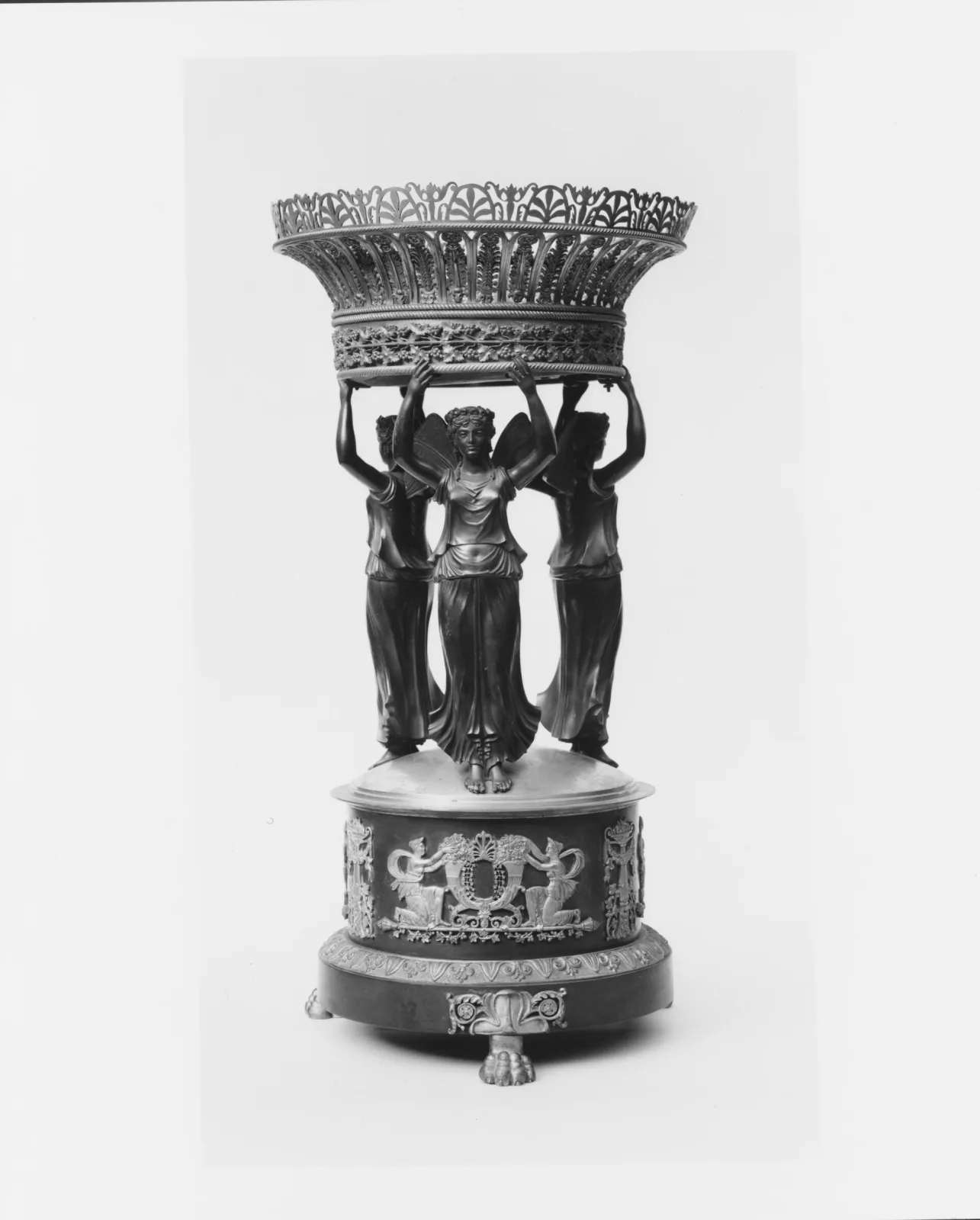
Through the mid-eighteenth century the epergne remained a luxury silver object. The rococo taste of the 1750s and 1760s favored exuberant pierced branches, hanging baskets, and figural supports; the neoclassical shift of the 1770s and 1780s (associated with designers in the Adam manner) brought more restrained urn forms, beaded borders, and boat-shaped bodies. Cut-glass dishes and liners became common, adding sparkle and reducing the weight of silver required.
The invention of Old Sheffield plate (fused silver on copper) in the 1740s, and later of electroplating (patented by Elkington in 1840), progressively lowered the cost of a metal epergne and widened its market. By the early Victorian period a plated epergne was within reach of the prosperous middle class.
The great Victorian flowering of the epergne came after about 1860, when the form fused with the booming English and Bohemian art-glass industry. The characteristic high-Victorian epergne is a metal frame — often gilt brass or silver plate — holding tall, slender glass trumpet vases and, frequently, hanging baskets or “bride’s baskets” suspended on chains or curved arms. These epergnes appeared in every fashionable Victorian glass color, and their production peaked from the 1870s through the 1890s. The Great Exhibition of 1851 and the international exhibitions that followed showcased ever more elaborate examples and cemented the epergne as a centerpiece of aspirational Victorian dining.
After 1900 the elaborate branching epergne fell out of fashion along with the formal multi-course Victorian dinner. Edwardian production continued in simpler silver-plate and cut-glass forms, but the towering colored-glass trumpet epergne became a period piece. Twentieth-century reproductions — particularly of the Victorian glass-and-frame type — have been made steadily since the mid-century, and a great deal of what circulates today is either reproduction or an assembled marriage of old parts.
Anatomy and Terminology
Learning the parts of an epergne makes description, dating, and condition assessment far easier. The vocabulary is consistent across silver and glass examples.
Frame or Stand
The metal (or occasionally glass) structure that supports everything else. In silver examples the frame is the cast or formed body; in glass epergnes it is typically a metal armature of a central column and radiating arms, often gilt brass, silver plate, or (in later pieces) white metal.
Central Trumpet or Vessel
The tall central element — a trumpet vase, a flute, a basket, or a bowl. In classic Victorian glass epergnes this is a slender trumpet that rises well above the side elements and sets the overall height (commonly fourteen to twenty-four inches).
Side Trumpets, Arms, and Baskets
The radiating elements. These may be additional trumpet vases (typically three or four surrounding the center), small footed dishes, pierced baskets, or hanging baskets suspended from curved arms. Symmetry and matching are important: original side elements match one another in size, color, and decoration.
Base and Feet
The foot of the stand. Silver epergnes often have three or four cast scroll or paw feet; glass-frame epergnes may have a domed or spreading metal base, sometimes fitted with a circular mirror plateau to reflect the glass and candlelight.
Fittings: Collars, Nozzles, and Screws
The hardware that holds glass elements in the frame. Trumpets seat into metal collars or rings; some frames use threaded rods, wing nuts, or spring clips. The nature of the fittings is a key dating and authenticity clue: hand-cut threads and hand-finished collars point to period work, while modern uniform hardware suggests reproduction or repair.
Liners and Dishes
Removable glass or metal liners that sit inside silver dishes. Original cut-glass liners in a Georgian silver epergne substantially increase both authenticity and value; replacements are common.
The Major Construction Types
Before attributing a maker, decide which of the broad construction families an epergne belongs to. This single decision reframes everything that follows — the marks to look for, the likely date range, and the value tier.
Solid Silver (Sterling)
An epergne made entirely of sterling silver, hallmarked at the assay office. These are the most valuable category, especially Georgian examples by named makers. Weight, hallmarks, and the quality of the casting and piercing drive value.
Old Sheffield Plate
Silver fused to a copper core, made from roughly 1760 to 1840. Old Sheffield plate epergnes show a warm silver surface that wears to reveal copper (“bleeding”) at high points and edges, and typically carry no hallmarks (or only a maker’s device), since plated wares were not assayed as sterling. The construction of the copper edges (rolled-over, seamed, or lapped) is diagnostic.
Electroplate (EPNS / EPBM)
Silver electroplated onto a base of nickel alloy (EPNS, electroplated nickel silver) or Britannia metal (EPBM), from 1840 onward. The great majority of Victorian and Edwardian metal-frame epergnes are electroplate. They carry maker’s marks and plating designations (EPNS, A1, etc.) but no sterling hallmarks.
Glass-in-Frame
The characteristic Victorian type: glass trumpets and baskets held in a metal frame (usually plated or gilt brass). Here the value lives largely in the glass — its color, technique, maker, and completeness — with the frame as a secondary consideration.
All-Glass
Less common: an epergne formed entirely of glass, with a glass central column and glass arms fused or fitted together, no metal frame. These are typically Continental (Bohemian, Venetian) art-glass showpieces and are judged as glass sculpture.
Silver and Sheffield Plate Epergnes
The metal epergne is the older and (in sterling) the more valuable tradition. Assessing one is essentially a silver-identification exercise layered onto the epergne form.
Georgian Sterling
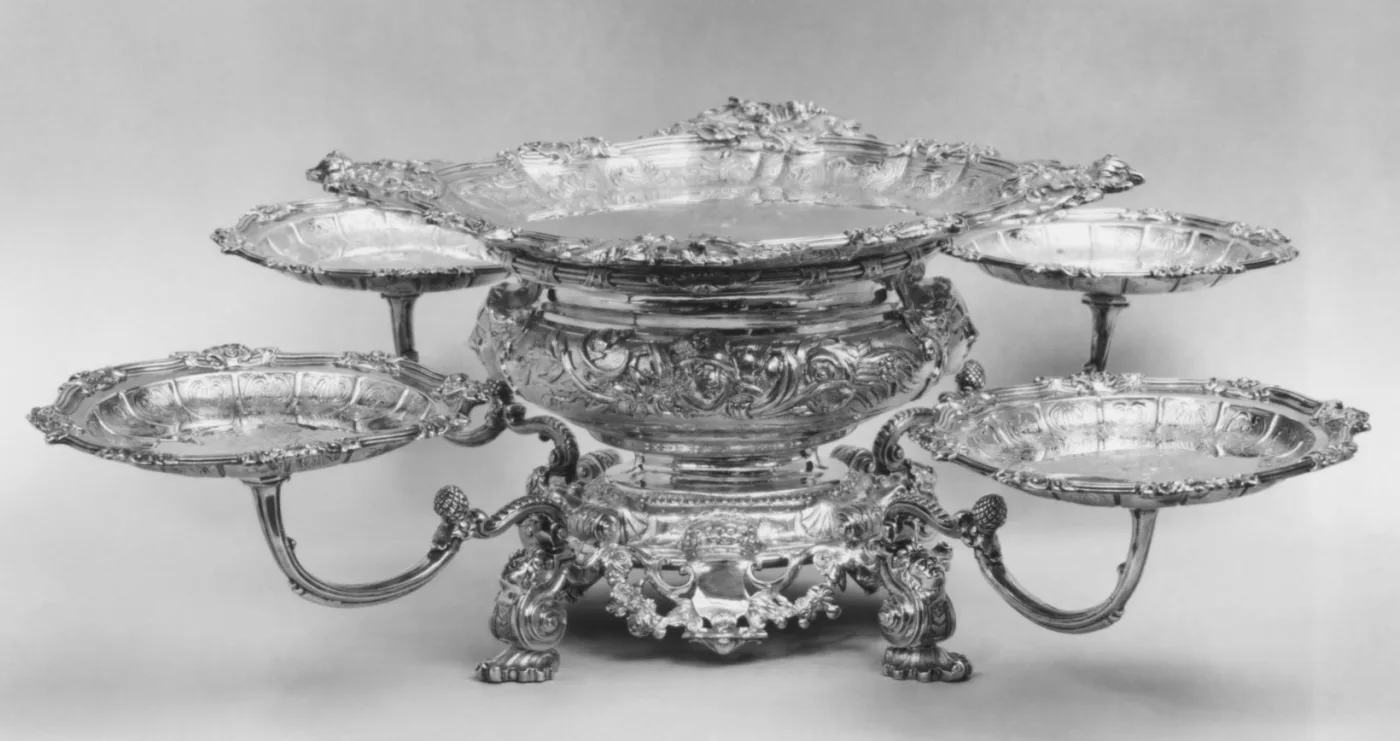
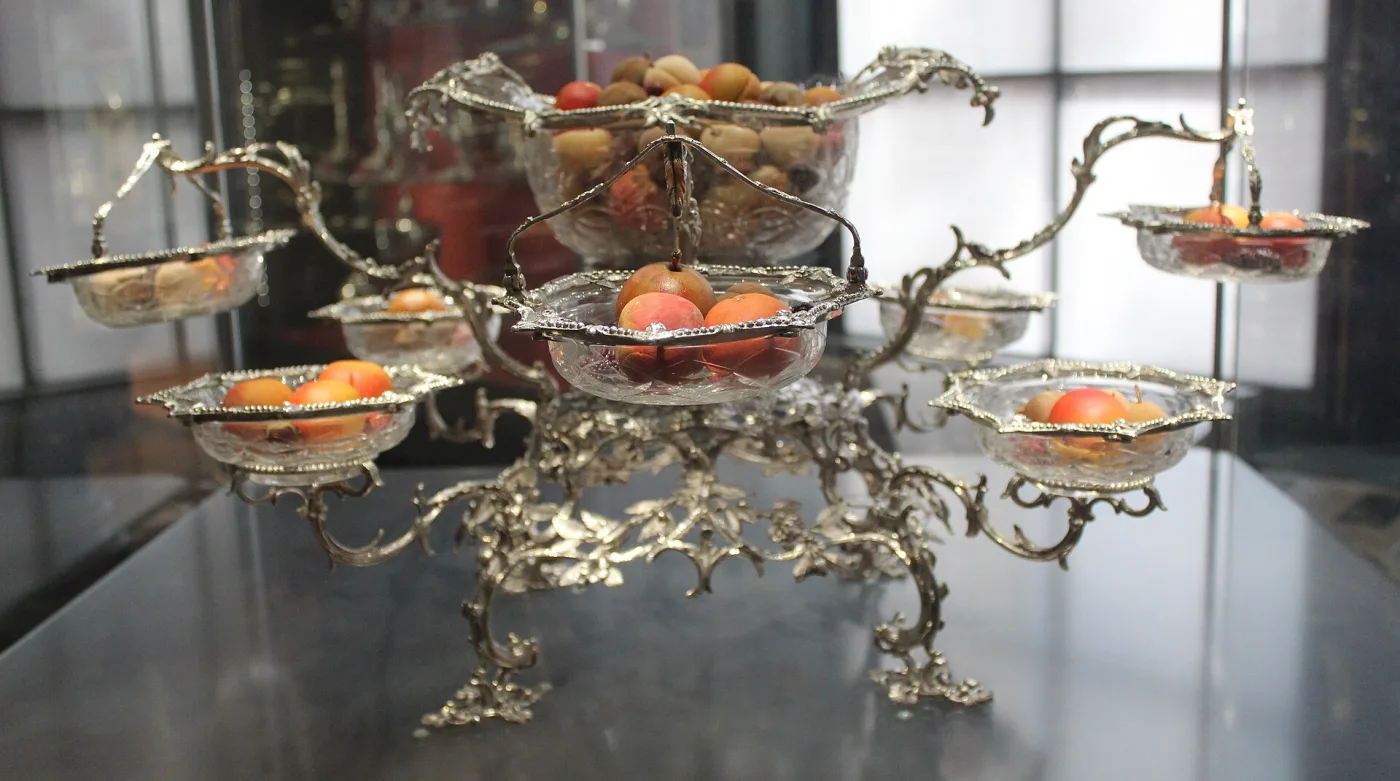
Georgian silver epergnes (roughly 1730–1820) are the aristocrats of the field. Look for full London hallmarks — lion passant (sterling standard), the date letter, the assay office town mark, and the maker’s mark — on the frame and, ideally, repeated on the detachable branches and dishes. Matching marks across all components confirm the piece is a complete original set rather than an assembly. Rococo examples of the 1740s–1760s show asymmetrical cast scrollwork; neoclassical examples of the 1770s–1790s show urns, beading, and boat-shaped bodies. Reading these marks is the heart of the exercise; our antique silver identification guide covers the full hallmark system in detail.
Old Sheffield Plate
Old Sheffield plate epergnes (c. 1760–1840) offered the Georgian look at a fraction of the silver cost. Because they were not sterling, they were generally unmarked or bore only a small maker’s device. Identify them by the fused-plate construction: a silver skin over copper that wears to a warm copper “bleed” at edges and high points, rolled or lapped copper edges (later disguised with applied silver wire), and seams where the plated sheet was worked. Old Sheffield plate is a distinct collecting category from electroplate; for the full distinction see our Sheffield plate identification guide.
Victorian and Edwardian Electroplate
From 1840 onward, electroplating dominated the affordable metal epergne. Victorian electroplate epergnes are often elaborate — pierced baskets, cast figural supports (cherubs, vines, birds), and mirror-plateau bases — and carry maker’s marks such as those of Elkington, Mappin & Webb, Hukin & Heath, or Walker & Hall, along with plating designations. These are honest period objects, but they sit well below sterling in value. Do not mistake “EPNS” for a hallmark: it explicitly means the piece is plated, not solid silver. Our silver flatware guide explains the same plate-versus-sterling mark logic that applies to epergne frames.
Glass-in-Frame Epergnes
The glass-in-frame epergne is what most people picture when they hear the word: a metal armature holding tall glass trumpets and hanging baskets in a fashionable color. This is the high-Victorian form, and it is where most collector interest and most reproduction activity concentrate.
The Metal Frame
Frames are typically gilt brass, silver plate, or white metal. A central column rises from a domed or spreading base; radiating arms (usually three or four) curve outward and upward to hold side trumpets, and additional curved arms may suspend hanging baskets. Better frames are well-cast with crisp detail, cleanly gilded, and fitted with hand-finished collars; cheaper and later frames are thin, roughly cast, and use uniform modern hardware. Many frames incorporate a circular mirror plateau in the base to reflect the glass.
The Trumpets
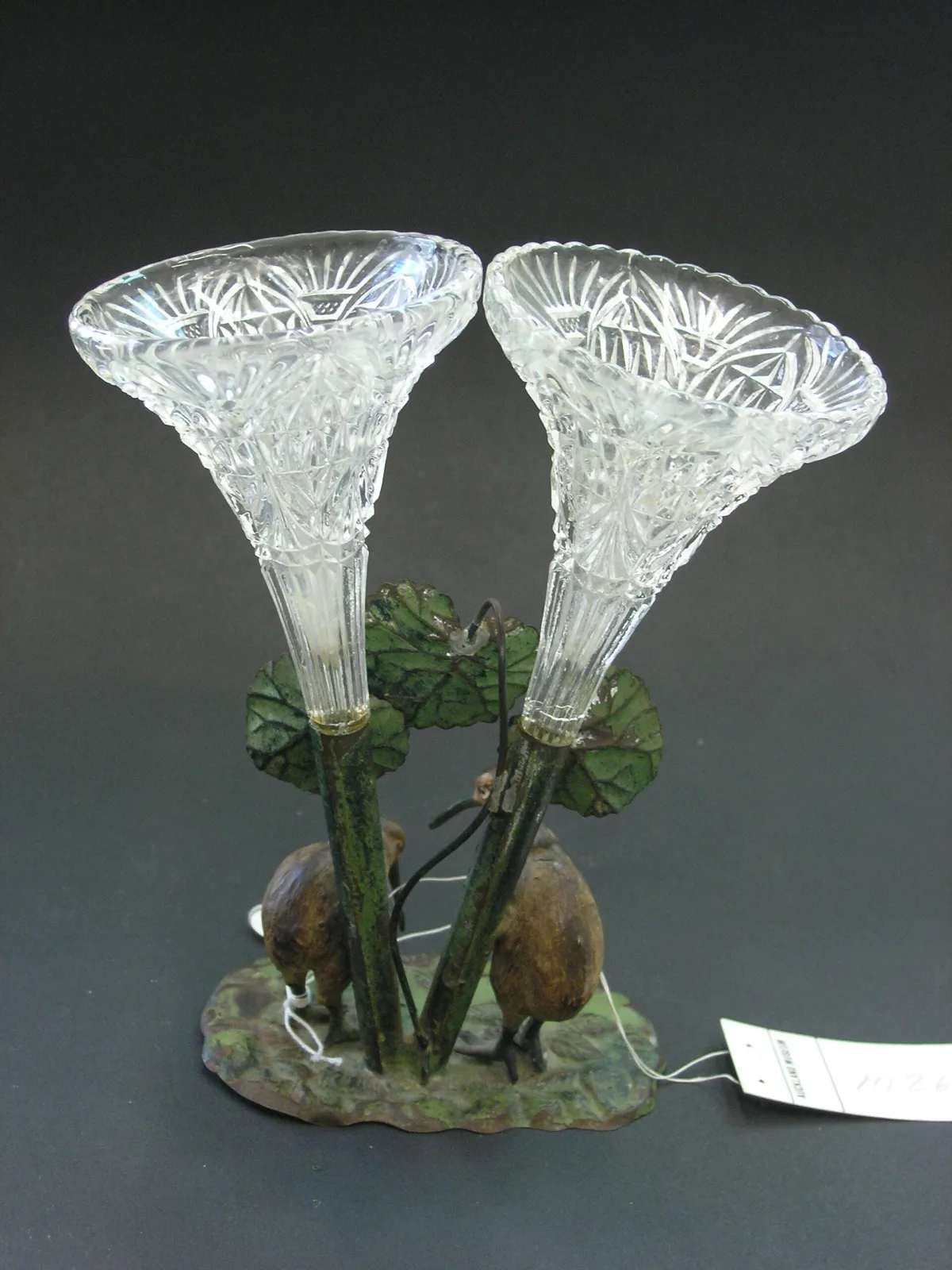
The glass trumpet vase is the signature element. A classic four-trumpet epergne has one tall central trumpet and three shorter side trumpets, all matching in color, technique, and rim treatment. Trumpets flare from a narrow base (which seats in the frame collar) to a wide, often ruffled or crimped mouth. The rim treatment — plain, crimped, pie-crust, or applied with a contrasting thread or rigaree — is a strong maker and dating clue.
Hanging Baskets and Bride’s Baskets
Many Victorian epergnes suspend small glass baskets from S-shaped arms, or incorporate a “bride’s basket” — a shallow decorative glass bowl — at the base. Hanging baskets are frequently lost or replaced, so their presence, matching, and original suspension hardware matter for authenticity.
Applied Decoration
The finest Victorian trumpets carry applied glass decoration: spiraling clear or contrasting-color threads (threading), crimped rigaree bands, applied glass leaves and flowers, or vaseline-glass edging on a cranberry body. Applied work executed while the glass was hot — with tool marks and slight asymmetry — indicates quality period production.
Glass Colors and Techniques
The color and technique of the glass trumpets are central to identifying and valuing a Victorian glass epergne. The same color vocabulary runs through the wider world of Victorian art glass.
Clear Flint (Colorless)
The most common and generally least valuable, unless the glass is fine cut or the maker is notable. Clear trumpets with cut or engraved decoration on a good frame can still be desirable.
Cranberry (Gold-Ruby)
The most sought-after color for Victorian glass epergnes. Cranberry trumpets — often with applied clear or vaseline edging and threading — make the classic showpiece epergne. The color is produced by colloidal gold and glows rose-pink in transmitted light; our cranberry glass identification guide covers the chemistry, makers, and how to tell true gold-ruby from surface-stained imitation.
Vaseline and Uranium
Yellow-green uranium glass (vaseline) trumpets glow bright green under ultraviolet light — a quick, near-conclusive authenticity check for the period. Vaseline was frequently used as a contrasting edge or thread on cranberry epergnes, and also for whole trumpet sets. See our uranium glass identification guide for the UV test and dating detail.
Opalescent
Opalescent epergnes — where the glass shades from color to milky white at the rims and raised elements — were a Victorian specialty, particularly in vaseline opalescent (uranium plus opalescent edging) and cranberry opalescent. English makers such as John Walsh Walsh and the Continental houses produced striking opalescent trumpet sets.
Continental Art Glass
Bohemian and Venetian makers produced epergnes in their characteristic techniques — cased and cut glass, iridescent surfaces, latticino and millefiori canework. A Murano epergne with ribbon-cane trumpets belongs to Venetian glass collecting; for that tradition see our Murano glass identification guide.
Spatter, Cased, and Novelty Glass
Late-Victorian trumpets appear in spatter (spangled) glass, cased two-color glass, and novelty finishes. These are collectible but require the same completeness and matching checks as any glass epergne.
English Makers
England produced the majority of the epergnes on the market, both the metal frames and much of the glass. Attribution is often to the frame maker, the glasshouse, or both.
Elkington & Co. (Birmingham)
The pioneer of electroplating (patent 1840) and a leading maker of Victorian silver-plate epergnes, often elaborate and figural. Elkington marks include the firm’s name and a date-letter system of its own; well-marked Elkington frames are readily attributable and dated.
Mappin & Webb; Hukin & Heath; Walker & Hall
The major Sheffield and Birmingham electroplate houses of the later nineteenth century. Their epergne frames — from restrained Edwardian cut-glass-and-plate examples to elaborate Victorian pierced-basket forms — are common and carry clear maker’s marks and plating designations. Christopher Dresser’s designs for Hukin & Heath in the 1870s and 1880s are particularly collectible.
Stourbridge Glasshouses
The Stourbridge district supplied much of the fine trumpet glass. Stevens & Williams (later Royal Brierley) and Thomas Webb & Sons produced high-quality cranberry, opalescent, and applied-decoration trumpets. John Walsh Walsh of Birmingham is especially associated with opalescent and threaded epergne glass. Much fine trumpet glass is unmarked, so attribution rests on technique, color, and rim treatment rather than a signature.
Sowerby, Davidson, and Greener (Gateshead / Sunderland)
The northeast pressed-glass houses produced pressed and opalescent epergne trumpets in pattern molds, some carrying registered design numbers or trademarks (Sowerby’s peacock head) that aid dating. Pressed trumpets are more affordable than mouth-blown Stourbridge work.

Continental and American Makers
Bohemian Glasshouses
Bohemian makers produced epergnes in cased, cut, and enameled glass, often in deep ruby and richly gilded. These sit alongside the broader tradition of Bohemian glass and are judged on the quality of the casing, cutting, and enameling as much as on the epergne form itself.
Venetian (Murano)
Venetian epergnes showcase the Murano repertoire — latticino and filigree canework, aventurine, applied glass flowers, and pastel or gold-fleck colors. A Murano epergne is a piece of Venetian glass art with the epergne structure; attribution follows Venetian glass conventions.
French
French makers produced both silver and glass epergnes; Baccarat and Saint-Louis supplied fine cut-crystal dishes and trumpets, and French silver epergnes carry the distinctive French assay marks (the Minerva head for sterling standard) rather than English hallmarks.
American
American production of the true branching epergne was comparatively limited, but American art-glass houses supplied trumpet glass and bride’s baskets, and American silver-plate firms (Reed & Barton, Meriden, Pairpoint) made plated centerpiece frames. American plated marks and pattern numbers identify these; the glass often overlaps with the American cranberry and opalescent traditions.
Forms and Configurations
Epergnes come in a range of configurations, and recognizing the standard patterns helps you spot missing or added elements.
Single-Trumpet (Lily) Epergne
A single tall trumpet rising from a base, sometimes with a bride’s basket at the foot. The simplest and most common surviving Victorian glass form. Also called a “lily” epergne when the trumpet is slender and flaring.
Three- and Four-Trumpet Epergnes
The classic configuration: a tall central trumpet with two, three, or four matching shorter side trumpets radiating from the frame. Four-trumpet examples (one tall, three short) are the archetype; all trumpets should match in color and rim treatment.
Trumpet-and-Basket Combinations
Frames that combine upright trumpets with hanging baskets on curved arms — the most elaborate and decorative Victorian type, and the one most likely to have lost or replaced baskets.
Silver Branch Epergnes with Dishes
The Georgian and silver-plate type: a central bowl or basket with detachable arms ending in small cut-glass or silver dishes, sometimes with candle branches. Completeness of dishes and liners is the key issue.
Canoe and Boat Epergnes
An elongated boat- or canoe-shaped frame holding a row of trumpets or dishes along its length — a distinctive later-Victorian and Edwardian form used on long tables.
Fruit-Stand and Comport Hybrids
Some centerpieces blur the line between epergne and comport, with a central raised dish and small side dishes. Whether such a piece is called an epergne depends on the presence of true radiating arms.
Reading Hallmarks and Marks
Marks are the single most reliable evidence for the metal parts of an epergne. What you find — and where — tells you the material, the maker, and often the exact year.
Sterling Hallmarks
English sterling epergnes carry a full hallmark set: the lion passant (sterling standard), the town assay mark (leopard’s head for London, anchor for Birmingham, crown historically for Sheffield), a date letter that fixes the year, and the maker’s mark. Crucially, look for the marks repeated on every detachable part — frame, branches, and dishes. Matching marks confirm an original set; mismatched or absent marks on some parts signal marriage or replacement.
Old Sheffield Plate Marks
Old Sheffield plate was generally not hallmarked as sterling. Some makers struck a small maker’s device, and from 1784 a few used regulated marks, but many pieces are unmarked. Identification relies on the fused-plate construction rather than on a hallmark.
Electroplate Designations
Electroplate carries maker’s marks plus letters such as EPNS (electroplated nickel silver), EPBM (electroplated Britannia metal), or quality codes like A1. These are not hallmarks and do not indicate solid silver — they explicitly denote a plated object.
Registered Design Marks (Glass and Metal)
British registered design marks help date both glass and metal parts. The diamond-shaped registry mark was used from 1842 to 1883 and encodes the exact registration date; the “Rd No.” (registered number) system from 1884 onward gives a number that maps to a year. A registry mark on a frame or a molded number on a pressed trumpet is a precise dating tool.
Continental Marks
French sterling shows the Minerva head; German silver shows the crescent-and-crown with a fineness number (from 1888) and often “800” or “835”. These systems differ entirely from English hallmarks and point to a Continental origin.
Dating an Epergne
No single feature dates an epergne; dating relies on convergent evidence from marks, construction, glass technique, and style.
Marks and Registry Numbers
Where present, hallmarks (sterling) and registry marks (glass and metal) are the most precise dating tools, often fixing the year exactly. This is the first thing to check.
Construction Method
Old Sheffield plate places a metal frame before about 1840; electroplate places it after 1840. Hand-cut threads, hand-finished collars, and slightly irregular castings indicate nineteenth-century work; uniform modern hardware and machine-perfect frames suggest twentieth-century reproduction.
Glass Technique
Mouth-blown trumpets show pontil marks (rough or polished) on the base and slight asymmetry; pressed trumpets show mold seams and uniform walls. Applied threading and rigaree executed while hot, with tool marks, indicate quality Victorian work. A uranium (vaseline) trumpet that glows under UV is consistent with period production and rules out most modern non-uranium reproductions.
Style and Proportion
Rococo asymmetry points to the mid-eighteenth century; neoclassical urns and beading to the 1770s–1790s; tall colored-glass trumpet-and-basket fantasies to the 1860s–1890s; restrained cut-glass-and-plate forms to the Edwardian period. The overall vocabulary of the piece narrows the date band.
Wear Consistency
Genuine age shows consistent, logical wear — plate worn through at handling points, glass bases with fine multi-directional scratches, gilding rubbed where fingers naturally touch. Wear that is absent, uniform, or inconsistent between parts is a warning of reproduction or marriage.
Married Pieces and Reproductions
The epergne is one of the most frequently “married” and reproduced of all antique forms, precisely because it is assembled from separable parts. Understanding this is the single most valuable skill in the field.
Married Assemblies
A “married” epergne combines a period frame with replacement trumpets (or vice versa) that were not originally together. The tell-tale signs: trumpets that do not quite match one another in color, size, or rim treatment; glass that sits loosely or is packed with putty or modern washers to fit; a frame and glass with inconsistent wear; and a color match that is close but not exact. A married piece may contain genuine old parts and still be worth far less than an all-original example.
Replaced Trumpets and Baskets
Because trumpets and hanging baskets are fragile and exposed, they are the most commonly lost and replaced elements. Replacements are often modern glass, slightly wrong in color or proportion. Count the elements, check that they match precisely, and confirm the fittings are consistent. A four-trumpet epergne missing one trumpet, or wearing one modern replacement, is not a complete original.
Modern Reproductions
Reproduction Victorian-style glass epergnes have been made continuously since the mid-twentieth century, including cranberry and vaseline examples in modern frames. Signs include thin roughly-cast frames, bright unworn gilding, uniform modern hardware (identical machine screws and washers), glass with ground flat bases and no pontil, and trumpets that are all suspiciously identical and unworn. Some reproductions are sold honestly as such; others are passed as period.
Reproduction and Reissued Glass
Twentieth-century glasshouses reissued Victorian trumpet forms and colors. Fenton and other American makers produced cranberry and opalescent glass in the Victorian manner that can end up in reproduction epergne frames. Fenton’s marks and lighter, slightly orange-tinted cranberry help distinguish these; our Fenton glass identification guide details the marks and color differences.
Reframed Glass
Genuine old trumpets are sometimes fitted into new frames (or new trumpets into old frames) to create a saleable “epergne” from mismatched stock. Examine whether the collars fit the glass naturally or have been adapted, and whether wear on the frame corresponds to wear on the glass.
Condition Assessment
Epergnes are structurally fragile and combine two vulnerable materials — thin glass and worked metal. Condition assessment must cover both, plus the critical question of completeness.
Completeness
The first and most important check: are all elements present and original? Count trumpets, baskets, dishes, and liners; confirm they match; verify the fittings. A complete original epergne is worth far more than one missing or with replaced parts.
Glass Damage
Examine every trumpet rim, base, and applied element under raking light and with a fingernail for chips, cracks, and flakes. Ruffled and crimped rims are especially prone to small flakes. Internal cracks in colored glass can be hard to see; a small flashlight held inside reveals stress lines. Check applied threads and rigaree for losses.
Frame and Plating
Inspect the metal frame for plating wear (copper or base metal showing through), dents, splits at solder joints, bent arms, and losses to cast detail. On silver, check for splits, repairs, and thinning. On Old Sheffield plate, some copper “bleed” is normal and honest; on electroplate, worn plating is common and re-plating (which can obscure marks) is generally undesirable.
Fittings and Stability
Confirm that trumpets seat securely in their collars and that the frame is stable and not distorted. Loose glass packed with putty, modern washers, or tape indicates ill-fitting (often replacement) elements.
Mirror Plateau
If the base has a mirror plateau, check the silvering for loss, foxing, and replacement. Original Victorian mirror plate shows age-appropriate spotting; a bright modern mirror is a replacement.
Repairs
Look for soldered repairs to the frame, re-glued or re-fitted glass, and re-plating. Sympathetic structural repair to a frame is acceptable to many collectors; replaced or restored glass is a value issue. For broader guidance on assessing and living with repairs, see our restoration and conservation guide.
What Drives Value
Several factors converge to set the market value of an antique epergne.
Material
Solid sterling silver, especially Georgian by a named maker, sits at the top. Old Sheffield plate is mid-tier and collectible in its own right. Electroplate frames are modest in value; here the glass usually carries the piece. All-glass and glass-in-frame value tracks the glass.
Completeness and Originality
An all-original, complete epergne — every trumpet, basket, dish, and liner matching and present — commands a large premium over a married or incomplete example. This is often the single biggest value factor for glass epergnes.
Glass Color and Technique
Cranberry, vaseline opalescent, and fine Continental art glass command the highest prices among glass trumpets; clear pressed glass is the entry level. Applied decoration (threading, rigaree, vaseline edging, applied flowers) adds significant premium.
Maker and Attribution
Documented attribution to a named silversmith (Georgian sterling) or a notable glasshouse or frame maker (Elkington, Hukin & Heath with a Dresser design, Stevens & Williams glass) raises value. Much fine glass is unmarked, so a confident attribution based on technique is itself valuable.
Size and Presence
Large, tall, elaborate epergnes with multiple trumpets and baskets command more than small single-trumpet examples, all else equal — presence sells.
Condition
Chips, cracks, replaced glass, worn plating, and structural repairs all reduce value. A flawless complete example of a modest form can outperform a damaged or married example of a grander one.
Provenance
Documented history — a named collection, an exhibition record, original retailer’s marks — adds value, particularly for important sterling pieces. For how to research and document ownership history, see our authentication and provenance research guide.
Care, Cleaning, and Display
Epergnes demand careful handling because they combine fragile glass with worked metal and are top-heavy by design.
Always disassemble an epergne before moving or cleaning it. Lift trumpets and baskets out of their collars gently and straight up; never carry the assembled piece by a trumpet or an arm. Store and transport the glass elements separately, wrapped and padded, and never stacked.
Clean glass trumpets by hand in warm water with mild detergent, never in a dishwasher (heat shock and detergent damage the surface and can loosen applied elements). Rinse and dry immediately to prevent water spots and interior “sickness.” For cloudiness inside trumpets, a soak with denture-cleanser solution can help; deep sickness is permanent.
Clean silver and plate sparingly with an appropriate silver polish, working around (not over) any hallmarks, and avoid abrasive cleaners on plated surfaces — over-polishing electroplate wears the plating through to the base metal. Do not attempt to re-plate a marked frame; it obscures the marks and reduces value. For a full routine covering silver, glass, and mixed-material objects, see our storage and preservation guide.
Display an epergne on a stable, level surface away from edges and traffic, and out of direct sunlight (which can slowly fade lighter glass colors over decades). If the base has a mirror plateau, keep moisture off the silvering to prevent further foxing.
Common Beginner Mistakes
Mistaking Electroplate for Silver
“EPNS” on a frame means electroplated nickel silver — a plated object, not sterling. Many buyers overpay for a Victorian plate epergne believing it to be solid silver. Look for a full hallmark set (lion passant, town mark, date letter) to confirm sterling; plating designations rule it out.
Overlooking a Marriage
The most costly mistake is buying a married epergne as an original. Always compare the trumpets to one another for exact color, size, and rim match, check that the glass seats naturally without packing, and confirm the wear on frame and glass is consistent. A close-but-not-exact color match is the classic red flag.
Ignoring Missing Elements
An epergne missing one trumpet, a hanging basket, or its cut-glass liners is incomplete, and the price should reflect it. Count and match every element before valuing the piece.
Buying Reproduction Glass as Victorian
Modern reproduction trumpets have ground flat bases (no pontil), bright unworn surfaces, and machine-perfect uniformity. Check the base for a pontil mark and examine wear before accepting a trumpet as period.
Trusting Online Color Photos
Cranberry and other colored glass photograph inconsistently. Ask sellers for backlit images (held to a window) and full base shots of every trumpet so color depth, sickness, and pontil marks are visible. For online buying strategy generally, see our buying and selling strategies guide.
Re-plating a Marked Frame
Re-plating a worn electroplate frame may look tidier but obscures maker’s marks and removes honest age; most collectors prefer an original worn surface to a re-plated one.
Carrying the Piece Assembled
Lifting an assembled epergne by a trumpet or arm is the fastest way to break one. Always disassemble first.
Frequently Asked Questions
What exactly is an epergne?
An epergne is a table centerpiece built around a central vessel with additional dishes, baskets, or trumpet vases held out on radiating arms or a tiered frame. It differs from a single comport, tazza, or cake stand precisely in having that branching, multi-vessel structure. Epergnes were made in silver, Old Sheffield plate, electroplate, and glass-in-frame forms from the 1730s through the Edwardian era.
How do you pronounce “epergne”?
Most commonly “ay-PAIRN” or “ee-PURN.” The word derives from the French épargne (a saving), the idea being that one stand economized on the many separate dishes a formal table would otherwise require.
Are antique epergnes valuable?
It varies enormously. A modest Victorian electroplate frame with clear pressed trumpets might sell for under a hundred dollars, while a complete cranberry-and-vaseline glass epergne in good condition can reach several hundred to well over a thousand. Georgian sterling epergnes by named makers run into the thousands and, for important rococo examples, far higher. Completeness, material, glass color, and maker drive the range.
How can I tell if my epergne is silver or plate?
Look for hallmarks. English sterling carries a full set: lion passant (standard), a town assay mark, a date letter, and a maker’s mark, ideally repeated on every detachable part. Electroplate instead carries maker’s marks plus designations like EPNS, EPBM, or A1, which explicitly mean the piece is plated. Old Sheffield plate is usually unmarked and is identified by its fused silver-on-copper construction.
What is a “married” epergne?
A married epergne is one assembled from parts that were not originally together — typically a period frame fitted with replacement trumpets, or old trumpets set into a newer frame. Signs include trumpets that do not exactly match, glass packed with putty or washers to fit, and inconsistent wear between frame and glass. Married pieces are worth substantially less than all-original examples.
How do I know if a trumpet is a replacement?
Compare all trumpets for exact color, size, and rim treatment; original sets match precisely. Check the base for a pontil mark (mouth-blown period glass) versus a ground flat base (often modern). Confirm the trumpet seats naturally in its collar without packing, and that its wear matches the other elements. A single odd trumpet in an otherwise matched set is usually a replacement.
Do vaseline (uranium) epergnes really glow?
Yes. Uranium glass fluoresces bright green under ultraviolet (blacklight), and this is a fast, near-conclusive test that a yellow-green trumpet is genuine period uranium glass rather than a modern non-uranium imitation. Many cranberry epergnes also carry vaseline edging or threading that will glow while the cranberry body does not.
Can a damaged epergne trumpet be replaced?
Yes, but honestly disclosing it matters. A period-appropriate replacement trumpet sourced to match the set is better than a mismatched modern one, but any replacement makes the piece less than fully original and should reduce the price accordingly. Do not represent a replacement trumpet as original.
Where should I buy an antique epergne?
Reputable dealers in Victorian glass and silver, established antique shows and centers, and major auction houses for higher-end sterling and important glass examples. Online marketplaces work for experienced buyers who can read photos, but insist on backlit images and full base shots of every glass element, and confirm completeness and matching before committing.
Is my epergne Georgian or Victorian?
Marks are the surest guide: a sterling hallmark with an eighteenth-century date letter, or Old Sheffield plate construction, points to Georgian; electroplate and tall colored-glass trumpet-and-basket forms point to Victorian (post-1840, peaking 1870s–1890s). Style corroborates: rococo asymmetry and neoclassical urns are Georgian, while fantastical colored-glass trumpet epergnes are high-Victorian.